The history of the country house is sadly often a cycle of rise and fall with the main variable being the speed of each respectively. The old phrase was ‘one generation made the wealth, the second enjoyed it, and the third lost it’. Over recent decades the trend has changed slightly in that, with longer life expectancies prolonging the older generations, the houses have had fewer chances for the rejuvenation which inheritance often brought. As an alternative, Ruth Watson uses Country House Rescue as a catalyst for the type of entrepreneurial change which is the only way for these houses to survive – if only the owners would listen!
The first episode in Series 3, to be broadcast at on Channel 4 at 21:00 on 6 March 2011, takes us to Wyresdale Park in Lancashire to meet a father and son who don’t agree on the best way to maximise the obvious potential of the beautiful estate.
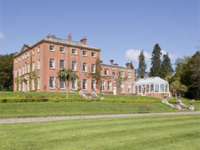
Wyresdale Hall was built between 1856-65 for Bolton cotton-magnate-turned-banker, Peter Ormrod, who bought 6,000-acres from the Duke of Hamilton to create his estate. The house, which cost £50,000 (about £4m at today’s value) at the time, was designed by noted local architect Edward Graham Paley (b.1823 – d.1895) who had an extensive practice, partnering first with his mentor Edmund Sharpe, then, following Sharpe’s retirement, Hubert Austin, before being joined by his son, Henry Paley. The work of Paley & Austin in particular was well-regarded with Pevsner saying they “did more outstanding work than any other in the county” and was “outstanding in the national as well as the regional context”.
Paley worked on relatively few country houses, being much better known for his ecclesiastical output, with included the design of Lancaster Cathedral. Paley was brought up in deeply religious home and, working with Edmund Sharpe, who was heavily influenced by Pugin, it was unsurprising that Paley adopted the strict ecclesiastical style with the ‘correct’ use of Gothic elements. Perhaps looking a little too much like a convent rather than a home, the house is, nonetheless, still a good example of the type of regional interpretations of Pugin’s architectural theories which gained ground in the 19th-century.
The grade-II listed house and estate passed through the Ormrod family before the land was bought by the Whewell family in the 1920s who then bought the house in 1967. Now the family are facing the usual struggles of a listed house, an extensive list of improvements, and the need to make the changes which sometimes sit uncomfortably with the more traditional older generation.
———————————
Country House Rescue – Series 3
My usual powers have slightly failed me and I haven’t a verified list of all the houses in Series 3 but here are the ones I have identified so far:
One rather unscientific barometer of the health of the country house market is the thickness of Country Life magazine as it comes through the letterbox each week. After the thinning of the issue in the run-up to Christmas it’s always pleasing to feel the first weighty edition of the new year. Yet, though this week’s issue (2 March) boasts ’70 pages of property for sale’ it’s remarkable that the estate agents have so few significant country houses to offer and of those that are there, it seems, along with last week’s issue, the largest houses are relaunches.
Pyrford Court, Surrey (Image: Savills)
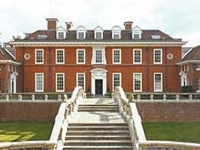
One of the most interesting is grade-II listed Pyrford Court, Surrey. Originally built in 1910 for the 2nd Lord Iveagh, of the Guinness brewing family, it was one of a group of houses built around that time on the profits of beer (along with Polesden Lacey, Elveden Hall, and Bailliffscourt). The land was sold to Lord Iveagh by his father-in-law, Lord Onslow, whose family had owned the area since the 17th-century. The house was designed by Clyde Young who had also worked at Elveden, another seat of the Guinness family, though the sensitively designed wings were added in 1927-29 by J.A. Hale of Woking to designs by Lord Iveagh. The stylish neo-Georgian house is an elegant red-brick composition which originally sat in a 1,000-acre estate – though sadly now reduced to just 21-acres. Lord Iveagh died in 1967 and the house sat empty until sold in 1977 – apart from a brief burst of fame as a location in the 1976 film ‘The Omen’. The house then became an old people’s home with all the attendant damage until the current owners started their seven-figure restoration.
Pyrford Court was originally launched on the market in January 2010 for an ambitious £20m, a staggering rise in valuation from the £3.25m paid in 2000 and from the £8m asking price when it was offered for sale in 2002 (reduced, a year later, to £6.5m). Yet this proved too much for the market to take; even for a ‘super-prime’ house within 25 miles of central London, and despite the high-quality restoration of the impressive interiors. It subsequently languished and has now been promoted with a double-page advert – though the price is ‘on application’ meaning we won’t yet know quite how far the price has dropped. However, looking at the other houses Savills have for sale in the area this is by far the most interesting and attractive house.
Brockhampton Park, Herefordshire (Image: Jackson-Stops & Staffs)
Another impressive house is the classically elegant, red-brick Brockhampton Park, Herefordshire. Although the architect hasn’t been confirmed, the fact that it is virtually identical to Hatton Grange in Shropshire by Thomas Farnolls Pritchard, means it can probably be attributed to him. The house was built in the late 1750s for Bartholomew Richard Barneby, probably using the £3,000 brought to him through his marriage in 1756 to one Betty Freeman. The Barneby family had owned the estate since the 15th-century and were to own it until 1946 when John Talbot Lutley (who was a descendent of the Barneby family) left the house and 1,200-acre estate to the National Trust. Col. Lutley was a no-nonsense man who, on hearing of the NT country houses scheme, wrote them a short letter in 1938 saying that as he was a bachelor whose heirs were rather distant, would they be interested?
James Lees-Milne was duly dispatched – and almost rejected it on sight as it wasn’t pure Georgian due to some relatively small Victorian alterations. However, after a tour of the estate and on seeing the beautiful Lower Brockhampton Manor, he felt that the latter two would be fine additions for the Trust – even if the big house would be a drain. It was duly left to the NT in 1946 following the Colonel’s death. Neither the house nor the contents were of sufficient quality to justify retaining or opening to the public so they sought to let it. Unfortunately no private tenant wished to take it on, usually citing its remoteness, however in 1985 an insurance company let the house as offices and undertook a comprehensive restoration programme. After they moved out in 1996 it was again restored as a private home and is now available with just 8-acres but surrounded by the rest of the NT-owned estate. Interestingly the house is listed under the ‘Sales’ section of the Jackson-Stops & Staff website but I suspect this is due to it being leasehold – again ‘price on application’ so the price of the privilege is unknown, but the house has been advertised since last summer so it may be cheaper than before.
Ebberly House, Devon (Image: Savills)
Perhaps the most surprising house to still be available is the grand Ebberly House, Devon. Rather than the expected provincial house, this is a house which displays remarkable architectural sophistication. Described by Pevsner as ‘unusual and attractive’, whose distinctive rounded ends ‘hint at the variety of room shapes inside; a provisional echo of the interest of contemporary architects such as Nash and Soane’. Designed by Thomas Lee of Barnstaple, a pupil of Sir John Soane, the grade-II* house compensates for it’s remoteness with a fantastic house set in a fine 250-acre estate. Offers in excess of £4m on the back of a postcard to Savills in Exeter.
Perhaps there are some clever marketing plans being hatched at the estate agents which means that rather than pushing their best properties in the first big property edition of Country Life of 2011 they’re saving them for…when? Bonuses have just been announced and those looking to buy are probably active so perhaps there is just a general scarcity of significant country houses coming to the market. Does this indicate 2011 will be rather thin for the agents as uncertainty limits buyers to the super-rich looking for somewhere in London or will the market pick up and a slew of new houses soon be released to whet our appetites?


 The Country Seat