The garden front of Chartwell, Kent (Image: National Trust)
Some country houses are less of note than the people who were associated with them. For some, the architect will be the draw, but with a strange ‘Midas’-like power, any house associated with figures of great renown will always be remembered. When asked to name the greatest UK Prime Minister, Sir Winston Churchill often justifiably tops the polls, and his retreat, Chartwell in Kent, became his refuge, but also a burden which was only relieved late in his life. As is often the case with older houses, they require adaptation for modern life, and Chartwell was no different. In an almost inverse to Churchill’s fame, the architect who worked on the house was the low-profile Philip Tilden, about whom we’ll find out more in a separate article.
Chartwell passed to the National Trust in 1965 and, this weekend it will be the focus of their ‘Uncovered‘ campaign which is exploring the British landscape. As the event in the series most connected with a house, below is a guest article from Emily Christmas, Learning and Events Officer at Chartwell for the National Trust, exploring Churchill’s love of the countryside and why the house became so special to him.
——————————————————————–
“I have no hesitation in saying that this site is for its size the most beautiful and charming I have ever seen.”
These were the words used by Sir Winston Churchill to describe the property he purchased in 1922, which would become his family home for the following decades.
Looking South-East from the balcony at Chartwell towards the Studio and cottages, the view for which Churchill bought the House (Image: National Trust)
In his eyes, he was acquiring the land and the view far more than the house itself. And what visitors today might not realise is that what he saw back then was not the same Chartwell that can be seen today.
The house and gardens are very much the product of two minds: Sir Winston Churchill and his architect Philip Tilden. Even before the sale was completed, Tilden was at work preparing the house for reconstruction. Over the course of the following several years, work was undertaken to change the existing house into one that would take best advantage of the stunning views with which Sir Winston fell in love.
The history of the property isn’t well known, though the oldest part of the building is thought to have been a Tudor hunting lodge; and like most ancient sites in this part of Kent, there’s the oft-uttered myth that King Henry VIII stayed at Chartwell while on the way to visit his sweetheart Anne Boleyn at Hever. One of the rooms in the house was even named after him.
View of the front of the house at Chartwell, Kent, before acquisition by Sir Winston Churchill in 1922 (Image: National Trust)
Over the course of the following centuries it changed hands several times, became at one point a house for abandoned children, and in the 19th century the house, gardens, and outlying cottages began to take on something of the appearance that can be seen today.
Enamoured as he was with the views from Chartwell, Sir Winston Churchill immediately set to work rebuilding the house to best take advantage of Kentish weald.
The Colquhoun family, who had been in possession of the property for the previous century or so, had extended the house a fair bit, as can be seen in the photographs. However, to ensure the largest number of rooms had access to the stunning views, Churchill reduced the overall size of the house, creating in their place the rooms on the south-east terrace, which can be accessed through what is now Lady Churchill’s sitting room.
Chartwell, the garden front from the south (Image: National Trust)
Visitors to the house today often remark upon the views when they walk out onto the pink terrace. Looking out across the North Downs, it’s not difficult to understand how Sir Winston felt when he first saw the place, despite the changes it has gone through over the past century.
——————————————————————–
Having withstood war, bombs, and even a hurricane, the property still boasts some of the most beautiful views to be found in Kent. You can experience the views in person and visit during the National Trust ‘Chartwell Uncovered’ weekend of 21st-22nd September. Displays will include copies of some of the most iconic Churchill paintings of the landscape within the very views they depict, so it’s a rare opportunity to get insight into Churchill’s reflections on the land, his house, and his life.
To coincide with the article, it seemed a good opportunity to look at the life and work of Philip Tilden; an architect with a complex life, who worked on a remarkable series of houses. Watch this space…
Roehampton House, SW London – Thomas Archer, 1712 (Image: St James)
Thomas Archer is described as the most European, and certainly one of the most accomplished, of the English Baroque architects. His later relative obscurity was mainly due to the misfortune that his contemporaries were some of the greatest British architects of any era. However, looking at the examples we do have of his work, we can clearly see his virtuoso skill and creative talent written into the fabric of the buildings. The recent restoration of Roehampton House, London, and its conversion into apartments, is a rare chance to live in an example of his work.
Umberslade Hall, Warwickshire (Image: Fine & Country estate agents) – a house not designed by Thomas Archer.
In many ways, Thomas Archer (b.1668 – d.1743) was the quintessential ‘gentleman architect’. The youngest son of Thomas Archer M.P. of Umberslade Hall, Warwickshire, he studied at Trinity College, Oxford, but clearly had broader horizons as, after graduating in 1689, he immediately undertook a four-year Grand Tour, heading to Italy via Germany and Austria. Almost nothing is known of his time in Italy, yet he must have studied the architecture and been influenced so heavily that this became his chosen profession. However, as a man of independent means, for Archer, this was less about earning a living and more about the translation of a recognisably ‘European’ form of Baroque to his native country. His architectural career was to be one of successive highlights; broadly, each commission was for a notable patron and the work produced of exceptional quality.
North front, Chatsworth House, Derbyshire (Image: bronndave via flickr)
Archer’s gentry origins and Whig affiliations secured him a place at Court where he came to know one of the most powerful aristocrats, William Cavendish, the 4th Earl (1st Duke from 1694) of Devonshire. Retiring to his estates during the reign of James II, in 1686 the Earl embarked on a programme to rebuild Chatsworth. In doing so, he elevated the status and grandeur of the private country house to a level not seen since the Elizabethan Prodigy houses – but with the key difference that this was explicitly for non-Royal appreciation. The Duke found in Thomas Archer an enthusiastic collaborator, but one with the advantage of direct experience of the style of grand Italian architecture he so admired. Chatsworth grew in phases, with the majestic south front begun in 1686, the east front in 1693 (both designed by William Talman), the west front in 1696 (possibly designed by the Duke), with Archer finally being given his opportunity, the north front, in 1705. As the final phase, Archer had to unite the mismatched lengths of the east and west fronts, which he brilliantly achieved though the use of a visual distraction; a bowed central projection. The use of curves was to become a stylistic hallmark of Archer, one used repeatedly and almost uniquely in the work of the English Baroque architects.
No sooner had Archer secured his first commission than he simultaneously acquired his second; Heythrop House, Oxfordshire, for Charles Talbot, 1st Duke of Shrewsbury. Unusually for a Talbot, the 1st (and only) Duke of Shrewsbury had converted from his Roman Catholic upbringing to Church of England, and had found favour at Court under Charles II, but he was required to live abroad between 1700-1706 and spent time in Italy. Whilst there, his diary in 1704 records that he was given a draft plan for a house by Paolo Falconieri, Chamberlain to Grand Duke Cosimo III of Tuscany, and occasional amateur architect. Marcus Whiffen believes that it was this draft which was given to Archer and on which he based his design for Heythrop. One piece of evidence for the Italian origins of the designs were the very large rooms (e.g. the hall being 32ft x 27ft, a drawing room of 47ft x 25ft) which take little account of the colder English climate.
Heythrop Park, Oxfordshire – Thomas Archer, 1706 (Image: Heythrop Park Hotel)
Heythrop is a confident work which clearly draws its inspiration from the Italian Baroque, with an energetically decorated façade, showing stylistic connections to Bernini’s rejected design for the Louvre. The grand Oxfordshire palazzo was probably completed by the early 1720s – though sadly the Duke did not live to see this, having died in 1718. The interiors were designed by James Gibbs but were tragically lost in the huge fire which completely gutted the house in 1831. It remained a shell until 1870 when it was bought by Thomas Brassey as a wedding present for his third son and commissioned Alfred Waterhouse to rebuild the interior. Sold in 1926, it became a Jesuit college until 1969, when it then became the Natwest Bank training college (the latter two uses leading to the construction of extensive ancillary buildings), and then in 1999, it was sold again to become the hotel it remains today.
Top: Pavilion at Wrest Park – plan from Colen Campbell (Vitruvius Britannicus) Bottom: S. Giovanni dei Fiorentini, Rome – plan by Michelanglo, from J. von Sandrart (Insignum Romae Templorum Prospectus)
Although Thomas Archer was not responsible for the design of the main house at Wrest Park (the later house we see today was designed by the then owner, Thomas de Grey, 2nd Earl de Grey), he did create one of the finest garden pavilions in the country. In 1711, Archer was commissioned by Henry Grey, 1st Duke of Kent, to build an elaborate pavilion to terminate the axial view, looking down the Long Canal, from the main house. Again, Archer demonstrated his familiarity with Rome, using a version of Michelanglo’s unexecuted plan for the church of San Giovanni dei Fiorentini. This is still one of the most exciting buildings in the country; a distillation of Michelanglo, filtered through the English Baroque.
Continuing what must have been a busy period by Archer’s standards, in 1712 he also designed Roehampton House, south-west London, for Thomas Cary. To call the original design ‘dramatic’ is something of an understatement as the plate in Vitruvius Britannicus shows it with a grand, full-width broken pediment – though whether this was actually built or was, but later removed, is unclear. The plan of the house itself was double-pile with flanking wings, though these were not built originally. The house then passed through a number of aristocratic owners before being bought in 1910 by Canadian banker Arthur Morton Grenfell. It was Grenfell who commissioned Lutyens to extend the house – though the efforts were not to benefit him as he was declared bankrupt in 1914, before the interiors could be fully completed.
Archer’s next commission, also in 1712, was for Hurstbourne Priors [Park], Hampshire, though, intriguingly, the plan does not match the house that was built – two surviving pictures by John Griffier show a much plainer design. Proving just what Archer intended and any differences to what was built would be almost impossible as the house was rebuilt by James Wyatt in c. 1780-85, then again by Beeston & Burmester after a fire in 1894 and finally demolished in 1965. Intriguingly, Tim Mowl suggested that the ‘Bee House’ aka Andover Lodge, was also by Archer and represents an experiment with architectural forms.
Having achieved such success in his life, in 1715, Archer turned to designing his own home. The result was Hale Park, Hampshire, though the house which survives today is much altered following work by Henry Holland Junior in 1770, and further changes in the early and late 19th-century, which covered the brick in (a now unfortunately peachy) render, added a portico and raised the level of the forecourt. Also of note was Archer’s redesign of Hale Church, creating a slice of a Roman church in Hampshire.
After 1715, Archer seems to have curtailed his architectural work as he was given the lucrative post of ‘Controller of Customs’ at Newcastle and largely retired. He is known to have designed Harcourt House for Robert Benson, Baron Bingley, which stood on the south side of Cavendish Square, London, until it was demolished in 1906.
Chettle House, Dorset (Image: Chettle House)
One of Archer’s last commissions, Chettle House in Dorset, could be argued to be his finest. Built c.1730, for George Chafin, who was a neighbour of Archer’s after he bought the nearby Hale Park, the house is a striking summary of the various elements which Archer had used so well in other buildings, but which here achieve a perfect balance. The curved corners of the exterior (though raised later), along with the projection on the entrance front combine to make the house truly sculptural.
However, there are a number of other intriguing attributions, which Archer may have worked on during his career, with varying degrees of certainty.
Welford Park, Berkshire – Thomas married into the Archer family (no relation) and was asked to re-model the house; adding an extra storey and grand Ionic pilasters.
Chicheley Hall, Buckinghamshire – c.1703 – suggested by Arthur Oswald in Country Life but not given in Colvin. Various elements such as the materials and certain details used on other Archer houses strongly indicate his involvement. Interiors now terribly ‘bland-ified’ as a conference venue.
Aynhoe Park, Northamptonshire – between 1707-11 – on stylistic grounds and the evidence of a payment to him from Hoare’s Bank of £39 15s. 6d. by Thomas Cartwright. This work included the addition of a library, conservatory, stables, and a coach-house – though the first two were later altered by Soane in 1800-1.
Bramham Park, Yorkshire – c.1710 – no evidence but stylistically possible. Designed for Robert Benson, who we know commissioned Harcourt House in London.
Serle’s House, Hampshire – built in 1730, this house has clear stylistic similarities with Archer’s earlier work. Now the Royal Hampshire Regiment museum.
Addiscombe House, Surrey – Marcus Whiffen argues that it is undoubtedly Archer, and it could well be, but unfortunately further inspection is frustrated by its demolition in the early 1860s. Images are shown on pages 42 & 44 of a PDF of a local book [note: 10mb download].
The challenge with looking at Archer’s work is that there is relatively little of it. Without the financial pressures to work, he was able to be very selective in what he chose to do, and due to that scarcity, his work was under-appreciated and occasionally altered or demolished. In what we do have we can see an exceptionally talented architect who, although living in the shadow of the more productive Wren, Vanbrugh, and Hawksmoor, nevertheless developed a distinctive and influential blend of English and continental Baroque architecture.
Roehampton House, Surrey (Image: St James)
Roehampton House offers a rare chance to experience both the genius of Archer and Lutyens – though here, clearly, the latter is happy to defer to the work of former and sympathetically embraces and extends it. Though this is a house which has been ill-used in the past and suffered some damage in WWII, the latest phase has created what appears to be a fine restoration and conversion with a careful re-use of the interior features which have survived. Although there are too many other buildings built too close to it, the quality of the original architecture has been allowed to shine to ensure that we can again see the work of Thomas Archer, one of the finest English architects we have heard too little about.
————————————————————
Disclosure: neither the developers, St James, nor their PR company, Luchford APM, have had any editorial input or control over this article, nor have I received anything. However, they have provided some details about the current project and the exterior photos. As always, topics and text on the blog are my choice and discretion.
Having seen the glories of the prodigiously grand Mentmore Towers and Waddesdon Manor in the previous article on ‘Rothschild-shire’, that part of Buckinghamshire which became the domain of the Rothschild family from the 1850s, this final one looks at the remaining three: the lost Aston Clinton House, the ‘cottage’, Ascott House, and the family home, Eythrope.
Aston Clinton House, Buckinghamshire (Image: Lost Heritage) – Click for more images
One of the tragedies of the history of the UK’s country houses has been the wholesale destruction of so many, mainly between 1930-1960. Often, as a family fell on financial hard times, the house contents would be sold, followed later by the building itself, in the hope they could retain the estate. Although, wealth was clearly not an issue for the Rothschilds, one of their houses, Aston Clinton House, has since been demolished – though, admittedly, long after they had left.
Possibly one of the (relatively) smaller of the Rothschild’s houses, Aston Clinton House was also unusual in that it grew from a smaller one, through a series of additions, to be a substantial home, rather than being a new build. The original house was built sometime between 1770-1789 for General Gerard Lake, who laboured under the geographically diverse title of 1st Viscount of Delhi and Laswary and of Aston Clinton in the County of Buckingham. Never a grand seat, it was built in the style of a small hunting lodge, and passed through the Lake family until 1838 when the house and the accompanying 1,055-acres were sold for £23,426 to the 2nd Duke of Buckingham and Chandos, who saw the productive estate as a good investment.
Aston Clinton House Bucks, just before demolition (Image: Lost Heritage)
After the Duke’s death, it was initially put up for auction, largely unaltered, by the Duke’s son in 1848 but was withdrawn – but not before it had attracted the attention of the Rothschilds. Though “It is not like a fancy place”, it was bought for £26,000 as more of an investment but Sir Anthony Rothschild and his family moved in in 1853. Lady de Rothschild immediately took against the ‘small’ size and so Sir Anthony commissioned G.H. Stokes (Sir Joseph Paxton’s son-in-law, and who had previously worked at Mentmore) to significantly enlarge it, with works completed by the early 1860s. The architect George Devey, who was to build his career around the Rothschilds, undertook more work between 1864-1877, on both the house and estate.
The house and estate passed through the family until it was sold in 1923, having served in WWI as the HQ for the Commanding Officer of the Twenty-First Division, then based at the nearby Halton estate (c.f. Halton House in part 1). Sold for just £15,000, it became a school – where Evelyn Waugh started his teaching career – before serving as a corporate HQ, then as a hotel in various guises before being bought by Buckinghamshire County Council and demolished c.1960. A training centre was built in its place, with only a few buildings remaining as a reminder of grander days.
Outcome: commercial use, demolished as surplus to requirements.
Ascott House, Buckinghamshire (Image: Peter J Dean via flickr)
George Devey was to play an important role in the Rothschilds’ architectural plans, as were the family central to his own success. One of his most successful designs was for Ascott House, for Leopold de Rothschild, for whom he extended a small house dating from 1606 to create a rambling, many-gabled ‘cottage’ (though one with 30 bedrooms) as a more rural retreat than Leopold’s other seat at Gunnersbury Park (see Part 1). Although initially used just for hunting and recreation (with an emphasis on the outdoors as the house was built without a library, though one was later added), Leopold quickly realised that he needed more space for entertaining and so, in 1874, started a program of extensions which would continue until c.1888 with Devey, but also beyond, into the 1930s.
Ascott House, main door (Image: Peter J Dean via flickr)
Devey was an unusual Victorian architect in that he never exhibited his work or allowed his designs to be published, so secure was he in a bubble of aristocratic and wealthy clients who kept him constantly employed. Mark Girouard regarded the houses Devey designed as the most interesting outside of the Shaw–Nesfield–Webb circle, especially as he was regarded as having successfully developed a way of incorporating vernacular styles into his work. He particularly favoured the idea of making houses look as though they had developed over time – and ideally that they be covered in ivy. Mary Gladstone (daughter of the Prime Minister) visiting in 1880, approvingly described Ascott as ‘a palace-like cottage, the most luxurious and lovely I ever saw‘. The flip-side to the accretive approach is that some of the layouts for his houses seem to stretch for long distances; at Goldings, Hertfordshire, it covered approximately 350ft from end-to-end (the house is now flats with sprawling, unimaginative development in the immediate grounds).
Ascott was inherited by Anthony Gustav de Rothschild from his mother in 1937 (Leopold having died in 1917) and he and his wife made further additions, including converting the billiard room into a library. Although Anthony was very much involved with the family business he was also a renowned collector and the house is a treasure trove of fine paintings (including works by Gainsborough, Romney, Reynolds and Cuyp), 18th-century English furniture, books and over 400 pieces of Chinese ceramics. The house, gardens, and a small part of estate were donated by Anthony to the National Trust in 1947. Much of the collection and the surrounding 3,200-acre estate is still owned by the family, and Sir Anthony’s son, Sir Evelyn de Rothschild still lives in part of the house, keeping the connection to the original creator alive.
Outcome: owned by the National Trust, family still partially in residence
Eythrope, Buckinghamshire (Image: John S. Pipkin via flickr)
And so to Eythrope, in Waddesdon, a house strangely built without bedrooms as it was primarily intended as the daytime retreat for Alice de Rothschild, sister of Baron Ferdinand de Rothschild, with whom she came to live. Alice was independently wealthy (having inherited a large estate in Germany), strong-willed, and opinionated – all useful qualities, but less so to her brother, who was very similar. To reduce familial friction, Ferdinand suggested she build somewhere to while away the days and Eythrope was the solution. Alice bought the estate for £180,000 in 1875, and chose to build her ‘Pavilion’, as it was called, in a curve in the river. As Alice had suffered from rheumatic fever, the damp of the river might have been dangerous had she been tempted to spend too long there so the design included no bedrooms. Problem solved.
Eythrope, Bucks – garden front (Image: crazybiker via flickr)
As if to emphasise that this was Alice’s project, she chose not to use Gabriel-Hippolyte Destailleur, who was then working for her brother at Waddesdon. Instead, the new house at Eythrope was another commission for George Devey who had worked at various Rothschild houses including Mentmore, Ascott, Aston Clinton, and Tring Park – but Eythorpe is his most complete work for the family. In rejecting her brother’s grandiose French style (though not totally as there are flashes of the French Renaissance), Alice opted for what Pevsner described as a ‘free neo-Tudor style’ creating a delightful rambling house framed by the river. Passed down from Alice de Rothschild (who inherited and also became the forthright guardian of Waddesdon after the death of her brother), it was inherited, along with Waddesdon, in 1922 by Dorothy and James A. de Rothschild, who added a large wing with bedrooms and bathrooms. After James’ death in 1957, and having given Waddesdon Manor to the National Trust, Dorothy moved to Eythrope and lived there for forty years. On her death, the house and estate were inherited by her husband’s great nephew, Jacob Rothschild, 4th Baron Rothschild, whose home it remains today.
Outcome: the only house built by the Rothschilds and still wholly owned, and lived in, by them
——————————————
Although slightly off the usual ‘patch’, the Exbury estate, Hampshire, was another house where a Rothschild, Lionel Nathan de Rothschild, could give full rein to a passion; this time it was plants, specifically, rhododendrons and azaleas. With a passion from an early age, the garden was always going to be spectacular, but Exbury House is also impressive and perhaps to be included in a future article.
——————————————
Previous articles in the series on the Rothschild’s houses:
Waddesdon Manor, Buckinghamshire (Image: National Trust)
The Rothschilds were social, as well as financial, titans. In the first part of this now three-part article on the country houses of the Rothschilds, we saw the family establish their firm in England and later elevating their social standing through their estates at Gunnersbury Park, Tring Park and the opulent Halton Hall. Part two covers the two greatest houses created by the Rothschilds; Waddesdon Manor and Mentmore Towers.
One supposedly defining characteristic of the Rothschild’s UK country houses is their preference for the Neo-Renaissance ‘French chateau’-style – but this is more due to the fame of one house. In Europe, the family often (though not exclusively) built in a style that could be recognised as the dominant one for a particular country, but in the UK they opted for alternatives – or a policy of ‘Anything-but-Gothic’. One theory is that the other styles lacked the Christian associations which Pugin had so firmly nailed to Gothic – but perhaps they were just being more European in their tastes. However, they did develop a remarkably similar interior style; a rich, luxurious environment featuring heavy fabrics with fine art and furniture, which became known as ‘Goût Rothschild‘, and which heavily influenced the newly wealthy American plutocrats.
One of the greatest expressions of this combination of French exterior and lavish interior was found in the creation of the remarkable Waddesdon Manor, Buckinghamshire. Perhaps the most famous of the Rothschilds’ houses and also one of the grandest of the houses of the family in the UK. Built between 1874-1883 for Baron Ferdinand de Rothschild (1839–1898) it was designed by Gabriel-Hippolyte Destailleur, who also designed the Imperial Mausoleum of Emperor Napoleon III in Farnborough in 1883, and had previously designed a townhouse for Albert de Rothschild in Vienna.
Aerial view of Waddesdon Manor, Buckinghamshire (Image: Waddesdon)
As Pevsner said in his entry on Waddesdon Manor, ‘Baron Ferdinand certainly got as much as anyone could have demanded‘. This was to be a building at the top end of country house construction – the 2,700-acres cost £240,000, with another £55,000 for levelling off the top of the hill for the site and creating access roads, and £87,000 for the completion of the shell, for a total of £382,000 (equivalent to £161m in 2012 using an average earnings comparison) – and this was before the fitting out of the sumptuous interiors. Finally, it was filled with his spectacular collection of paintings, objet d’art, tapestries, and furniture.
Tower Room, Waddesdon Manor (Image: Waddesdon)
The exterior of the house is a grand composition of various elements from châteaux such as Blois, Maintenon, and Chambord, married with elements of Louis XIII and some older Louis XII details, as though the house had grown over time. Yet, as befits such a house, it was rife with modern details; at its core, a steel frame which allowed the room layouts to vary by floor, multiple bathrooms with hot and cold running water, and electrification, including a chandelier which Queen Victoria reputedly spent 10-minutes simply turning off and on, having never seen such a thing before.
The house was the luxurious setting of a social high-life and remained in the Rothschild family until 1957 when James Armand de Rothschild, who had inherited it in 1922, bequeathed the house, 165-acres, and the splendid collections to the National Trust – along with the largest endowment they had received to ensure it remained perpetually well-maintained, with family involvement through the management committee.
Outcome: owned by National Trust, with family involvement
Waddeson Manor today is what Mentmore Towers also was – and, sadly, could so easily have been but for the blinkered lack of vision of a former government. Mentmore was the first of the great Rothschild palaces in Buckinghamshire, built between 1852-1854, and was designed by Joseph Paxton and his son-in-law, G.H. Stokes, for Baron Mayer Amschel de Rothschild. It was remarkable for not only its size but also the detail and thought that went into it, setting a benchmark for the family and a clear demonstration of their wealth. It was also a statement to the rest of the Rothschild family about the success of the UK branch – so much so that when his Paris-based cousin, Baron James de Rothschild, saw it he engaged Paxton himself with the instruction “Build me a Mentmore, but twice the size“. The result was the Château de Ferrières, just outside Paris, which caused Wilhelm I, the Emperor of Germany, on seeing it to exclaim that “No Kings could afford this! It could only belong to a Rothschild“.
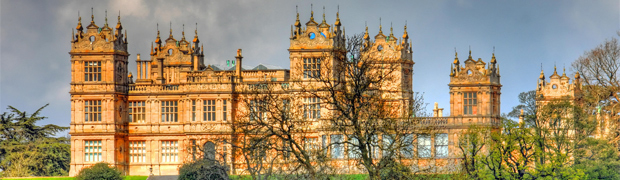
Mentmore Towers, Buckinghamshire (Image: john edward michael1 via flickr) Click to see large version
Architecturally, the house is distinctive for being one of the few to successfully imitate the scale and style of Wollaton Hall, Robert Smythson‘s masterpiece built in Nottinghamshire in the 1580s. Deliberately drawing inspiration from a classic of Elizabethan architecture, this was a political message about ‘fitting in’. However, the scale and exceptional quality of the work also made this a large and conspicuous statement of their financial standing. Mentmore is even built of the same Ancaster stone as Wollaton and copies the arrangement of the square corner towers and ornate stonework. However, it is missing the grand central tower of Wollaton; though there is a top-lit central hall around which the rooms are organised. One other amusing criticism raised was that it might have been somewhat imprudent to have sited the housemaids’ room just at the foot of the mens’ stairs…
Great Hall, Mentmore Towers (Image: A. D. White Architectural Photographs, Cornell University Library via flickr)
The tragedy of Mentmore is that it could have become one of the treasure houses of Europe. It had survived virtually unchanged, including with its spectacular collections, which were said to be the best in private hands outside of royalty, up until the death of the 6th Earl of Rosebery (he inherited from his father, who had married Baron Mayer’s only child, his daughter Hannah). Offered to the nation in lieu of £2m in inheritance taxes, the government of James Callaghan rejected the offer, demanding cash. After three years of discussions, and a campaign by individuals and organisations, the collections were sold, raising over £6m, with various national institutions spending around £2m in total to secure just a few choice items.
The house was then sold to the Marharishi Foundation, who it’s generally accepted, kept it well-maintained. It was then sold in 1999 to property developer Simon Halabi who had grand and unsympathetic plans for a luxury hotel. The financial crisis thankfully saw the end of those, however, the house is now regarded as ‘at risk‘ without an immediate restoration in sight – though with the possibility that it might be for sale.
Outcome: collection sold, future of house unclear, ‘at risk’
These two houses represent the high-point of the architectural and artistic endeavours of the Rothschilds, easily matching in scale and grandeur the houses their relations were also creating across Europe. Mentmore is a spectacular house in itself, even if it’s denied its collection, but Waddesdon encapsulates not only the personal enjoyment the family gained from creating these palaces, but also the philanthropic aspect which means that we can all now marvel at the ‘Goût Rothschild’ experience.
——————————————
Dear Readers, you’ll perhaps have noticed that I’ve now decided to split this topic into three parts as it appears I was being a little ambitious trying to get them all into two – the final instalment will follow shortly.
The landscape of the UK is one rich in our heritage of country houses. Each tells a tale of wealth, ambition and family life, yet, although each was built as a home, for many of them this is no longer the case. These houses can be grouped in many ways – by architect, region, style, size, etc – but there are very few that can be grouped together simply by family ownership. To acquire one country house is a mark of achievement, yet for an elite group of families, their success allowed them to amass a collection of houses. The Rothschilds were one such family and so effectively did they colonise an area of Buckinghamshire that it became known as ‘Rothschild-shire’. In this two-part article, we can look at the fortunes of their houses, and in them, see a snapshot of the fates of country houses across the country. This first part features Gunnersbury Park, Tring Park, Champneys and Halton House.
The Rothschilds are one of the most successful family businesses in the world; financiers to companies, countries and the considerably wealthy. Having become well-established in Frankfurt, the five sons of Mayer Amschel Rothschild set out for five European cities – London, Paris, Frankfurt, Naples and Vienna – in 1809-10 to expand the firm. By working closely together they flourished, creating a pan-European network which not only handled money but also information, making them the best informed and giving them a competitive advantage. Their business achievements naturally made the family exceptionally wealthy and, as was the pattern, their success translated into property, with the family building over 40 houses in the 19th and early 20th centuries across Europe.
Gunnersbury Park (Large Mansion), Middlesex (Image: Magnus Manske / Wikipedia)
In the UK, the Rothschilds waited until 1835 before acquiring their first country house, Gunnersbury Park, Middlesex. The estate had been home to Princess Amelia, daughter of George II, in the first Gunnersbury Park, designed by John Webb but inspired by Palladio’s Villa Badoer. After Amelia’s death in 1786, the house and estate were eventually bought by a speculator who demolished the house and sold the land in 13 lots. All bar two were bought by Alexander Copeland (10 lots in 1802 and a further 2 in 1806), business partner to the architect Henry Holland, who probably designed it. Unfortunately, the remaining two lots sold were immediately to the side of the new house and a second mansion was built, leading to the houses being imaginatively labelled the Small Mansion and Large Mansion. It was the latter which was bought by Nathan Meyer Rothschild, only a year before he died in July 1836. The house then passed down the Rothschilds until 1925 when Maria, recently widowed wife of Nathan’s grandson, Leopold de Rothschild, decided to sell the house and now 200-acre estate to Ealing and Action Borough Councils for just £130,000, for use as a public park – far less than if sold for development. Despite some local resistance, the park opened to great acclaim with the Large Mansion now the Gunnersbury Park Museum.
Outcome: municipal ownership; house a museum, estate a public park
Tring Park, Hertfordshire (Image: Tring Park School for the Performing Arts)
Although Gunnersbury Park was a country house, Nathan Mayer Rothschild had also rented Tring Park, Hertfordshire from 1838 as a more rural retreat. When the owners decided to sell, it was purchased with 3,643-acres (14.74 km sq) by Lionel Rothschild, (b. 1808 – d.1879), Nathan’s eldest son, in May 1872 for £230,000. He promptly gave it to his son Nathaniel Mayer Rothschild (Baron Rothschild from 1885), as a belated wedding present. The house is notable as one of the very few designed by Sir Christopher Wren and was built in c.1680 though later remodelled in 1786 by Sir Drummond Smith and again between 1874-78 by Lord Rothschild, who inserted a third story, added a new Smoking Room extension (which replaced the original conservatory and orangery) and generally gave a ‘French’ air to the house, under the plans of the architect George Devey (b.1820 – d.1886).
It was Lord Rothschild’s son, Walter (later 2nd Lord Rothschild), who perhaps made Tring Park notable through his obsession with natural history, and specifically, zoology. The Rothschilds have often fallen into preferring either ‘arts/sciences’ or ‘business’ and Walter was the former. Over the course of his life, he amassed one of the greatest natural history collections in the world; a vast array of specimens (including 2.5m butterflies – all mounted) which became the Walter Rothschild Zoological Museum, and which was eventually donated to the British Museum in 1937. Walter’s inability to manage his finances – mainly through overspending on the museum – meant that although he inherited the title, the house and estate went to his brother, but only after the death of his mother, who Walter continued to live with at Tring until her death in 1935. Walter died in 1937 and his nephew decided to break up the estate, but kept the house, which was used by the family bank in WWII to store documents. After the war, Lord Rothschild decided not to live at Tring and so sold it to become a performing arts school. Though the landscape remains, in 1975 in a particularly crass act of planning vandalism, the A41 Tring Bypass was built straight through the parkland, splitting it in two.
Another house related to Tring Park, though never a main family seat, was Champneys, in Wigginton, which served as the dower house for the main estate. This sizeable house had originally been built in 1874 in a French Second Empire style by Arthur Sutton Valpy, before being bought by Walter Rothschild’s parents in 1902. However, Walter’s mother, Emma Louise von Rothschild (b.1844 – d.1935), realising that her son wouldn’t marry, sold the house in 1925 to Stanley Lief, who created his first ‘Nature Cure Resort’, forming a brand which is still well known for its spas today.
Outcome: house became a health spa
Lionel Rothschild had also bought the Halton estate from Sir George Henry Dashwood in 1853, further extending the Rothschild domain in the Aylesbury Vale. The first house on the estate was a smaller, Palladian affair which had latterly been little used by the Dashwoods and fell into decay. The remnants of the house were finally demolished in early 1880 after Alfred Charles (b.1842 – d.1918), middle son of Lionel, inherited the 1,400-acre Halton estate in 1879. Over his lifetime he expanded the estate until it covered around 3,250-acres – but any aspiring landed gent requires a fine house as well as land; and the wealthy, educated Alfred was determined to live up to the family tradition.
Halton House, Buckinghamshire – detail of photo taken in 1921 (Image: Britain from Above / English Heritage) Click to see the RAF camp in the background.
A site for the new Halton House was swiftly chosen and work started in 1880. The architect is not confirmed but Mark Girouard believes it to have been William R. Rogers, the design partner of the builders, William Cubitt & Co. As was popular with the Rothschilds, Alfred decided that his house would be another in the French chateau-style – though perhaps more rigorously closer to the originals but with his own special additions, including a spectacular winter garden. The house was completed by July 1883, Alfred having employed a veritable army of labour to ensure swift progress, but the final interior fittings took another year. No expense was spared to ensure visitors impressed by the grand exterior could only be equally dazzled by the interior; every room a lavish statement of his wealth and fine taste, silk wallpaper, embellished by his superb art collection – every detail thought of, even down to the door knobs emblazoned with the Rothschild family crest.
Reaction was mixed to this luxurious new home, exemplified by Algernon West who described it as “an exaggerated nightmare of gorgeousness and senseless and ill-applied magnificence” but who later admitted that “lighted up and full of well-dressed people, it appeared quite tolerable“. Even his nephew Lionel de Rothschild described it as ‘looking like a huge wedding cake‘. Most of the objections appeared to sniff more at the lavish expense than real architectural criticism. Mark Girouard, writing in 1979, was far more generous, describing it as ‘splendidly Louise Seize with another sumptuous winter garden…a tour de force of Rothschild extravagance‘.
Halton House, Buckinghamshire (Image: Green Baron via Wikipedia)
Sadly, this was a house built for the age of grand entertaining, one which WWI ended. Alfred was deeply patriotic and having frequently used his political connections in the service of the government, wanted to help further. He offered the Halton estate to his friend Lord Kitchener and so the house became first an infantry camp, then for the engineers, then, once created, the Royal Air Force. With the house shuttered and neglected, the gardens and house declined, mirroring Alfred’s own failing health. After his death in 1918, the house was inherited by his nephew, Lionel, as “he was the only Rothschild without a country house” but he didn’t like it and so sold it to the RAF for a bargain £112,000. They quickly expanded the facilities and, in 1919, Halton House became the Officers’ Mess of RAF Halton; a role it still performs today.
Outcome: house and estate taken over for military use








 The Country Seat