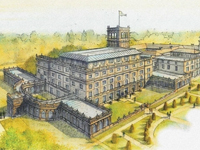
Proposal for Trentham Hall to be rebuilt as a hotel

Trentham Hall proposal, Staffordshire (Image: Property Week)

One of the greatest losses in the many country houses demolished in the 20th-century was that of Trentham Hall, the Staffordshire seat of the Dukes of Sutherland.  Originally a large Georgian house, it was rebuilt and greatly extended for the second Duke in the 1830s by the famous architect Sir Charles Barry, who was also responsible for the rebuilding of the Houses of Parliament.  The house became a celebrated venue for entertaining and was filled with fine works of art and sculpture.

Unfortunately the relentless expansion of the nearby Potteries areas of Staffordshire led to increasing amounts of pollution entering the rivers which fed the lakes and gardens designed by Capability Brown. By 1898 the smell was so bad that the house was effectively abandoned by 1907.  The Duke tried to donate the house and estate to the local council  in 1905 but was rejected so in 1912 the house was demolished.

The gardens were eventually opened to the public with the remaining outbuildings sitting rather forlornly around the blank space which marked out the site of the now lost house.  The gardens had been maintained and delighted generations of locals who would walk through the extensive terraces which led down to the now clean lake.  Now the 750-acre Trentham Gardens are part of a £100m project to bring back the glory of the earlier eras, with the centrepiece being the £35m recreation of the house as a 150-room luxury hotel following Barry’s original designs.

Despite the economic turmoil, the developers, who originally planned for completion by 2011, are still hopeful that they will be able to proceed with the project.   Although the hotel will not bring back the history and unique architecture of the house, the idea of recreating a lost country house is one to be encouraged.  Although many houses were demolished, the parkland and gardens were often simply abandoned and are still visible today.  Perhaps other estates might be encouraged to look at whether a new house might be the most appropriate use of the estate – after all, this was the purpose of their creation.

Full story: ‘Trentham rebuilt‘ [Property Week]

Still available for sale – the country houses proving difficult to sell

Despite the enthusiasm of the estate agents, it seems that some of the most impressive houses featured in the glossy adverts at the front of Country Life magazine are proving difficult to sell.  Whether this is due to a poor local market or unreasonable prices, or just bad luck, here are a few stunning country houses which are still looking for buyers.

Noseley Hall, Leicestershire (Image: Knight Frank)

Noseley Hall in Leicestershire has been in the family of the present Lord Hazelrigg for nearly 300 years but was put up for sale in April 2009 at a guide price of £14m for the grade-II* listed house plus the 1,200-acre estate.  Built in 1728 on the back of Northumberland coal mining wealth, the house is decorated with works of art (though fewer now following several auctions), and fine plasterwork.  However, Lord Hazelrigg admitted that the estate doesn’t cover the costs of running the house, and so he decided to sell, but it’s still listed on the Knight Frank website – and still with a guide price of £14m.   More details: ‘The last of the romantics‘ [Sunday Times]

Dowdeswell Court (Image from Savills)

Another house which has been for sale is Dowdeswell Court in Gloucestershire which was first advertised in 2005 and then sold for £4.75 but then came back on the market in summer 2009 with a guide price of £7.9m (and was featured in this blog).  When serial restorer James Perkins took on the house it had been a 46-room nursing home resulting in a huge restoration project and since he sold in 2005 has moved on to restoring other country houses including Aynhoe Park.  The grade-II house was built between 1833-35 by local architect Charles Paul of Cheltenham and was originally three storeys but during the 1920s the top storey was neatly removed.  The more manageable house is a beautiful example of neo-Classical detailing combined with modern comforts. The house is available through either Knight Frank or Savills.

Compton Pauncefoot Castle - Somerset (Image: Bidwells)

The final property for this list is the impossibly beautiful Compton Pauncefoot Castle in Somerset which has been for sale since 2006.   Built in 182o, the grade-II listed house sits in a 1,278-acre estate with 40-acres of stunning gardens and lakes.  Originally on the market for £22m, it failed to sell even during the boom years of 2007-8 and despite 20 buying agents being invited to a launch event, and being featured in the The Sunday Times, it’s now being sold at auction – though I suspect the reserve would be near the current price advertised on the agents websites of in excess of £17m.  Perhaps the fact that it’s only for sale as a whole may have put off those who might just want the house and immediate grounds – but this would deny the owner the certainty of privacy that the surrounding estate would bring.  The house is available through Bidwells and Knight Frank (who despite putting it as their lead advert in Country Life this week fail to have it on their website).

Credit crunch hits prices of country estates in Scotland

It sells but at what price? (Image: http://www.sxu.hu)

Despite the ever hopeful claims of the estate agents that a good country estate will always sell, it appears that, at least in Scotland, the average selling price has fallen sharply.

Research by the estate agents Strutt & Parker has shown that between 2008 and 2009 the average selling price of the 13 country estates – defined as “significantly more than a house with some land but not farms or forestry properties” – sold in that period the average price dropped by £2.6m. Of the 13 sold, seven were sold for less than the asking price.

Full story: ‘Country estates caught in credit crunch as prices halve in 12 months‘ [The Times]

Doddington Hall pyramid proposal

Doddington Hall, Lincolnshire (Image: doddingtonhall.com)

The financial pressures of owning a country house usually mean that the priority always has to be the main building with little left over for the kinds of follies, garden buildings and ‘eye-catchers’ which were a common enhancement in previous centuries.

Over the last few decades there have only be a few notable additions to parklands including the strikingly modern garden pavilion designed by I.M. Pei for the Keswicks in Wiltshire.  However even this has a practical use but in the spirit of landscapers such as ‘Capability’ Brown, a proposal has been submitted for a new pyramid to be built as an ‘eye-catcher’ at the end of a 1km walk at Doddington Hall in Lincolnshire.  Doddington is a beautiful, symmetrical, red-brick house designed by the celebrated Elizabethan architect Robert Smythson.  It also has the rare distinction of being one of the few houses to have never been sold since it was completed in 1600.

Fingers crossed that this interesting proposal will be approved and completed to continue an important tradition of folly building in English gardens.

Full story: ‘Plans for pyramid at Doddington Hall‘ [Lincolnshire Echo]

Moor Place goes to second viewings

Moor Place, Hertfordshire (Image: Strutt & Parker)

Agents from Strutt & Parker have reported that the stunning Grade-I listed Moor Place in Much Hadham, Hertfordshire, is receiving second viewings – though I doubt anyone would spend the offers-over-£17m asking price for the house and 781-acre estate without going back a few more times.

The beautiful red-brick house dates from 1779 with later additions, which combine to create an almost perfect view of a Georgian country house.  The house was built for James Gordon by the relatively unknown archictect Robert Mitchell who encased the originally Elizabethan house in an elegant facade with the south wing being rebuilt in 1907 by Sir Ernest Newton.  Inside a fine cantilevered stone staircase leads up to a master suite and five further bedrooms  on the first floor with five more on the floor above.  Downstairs the elegant staircase hall leads to a library, dining room and sunny drawing room. More accomodation is available in the 1886 Norman Shaw west wing.  All in all, this is a true trophy estate and the proximity to London means that the price tag is, judging by the viewings, not unrealistic.

Property details: ‘Moor Place, Hertfordshire‘ [Strutt & Parker]