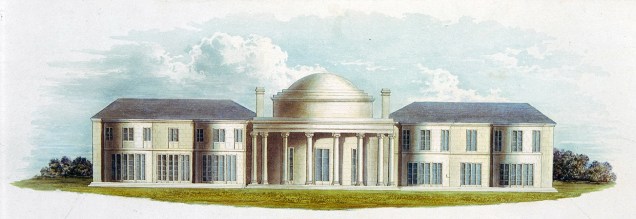
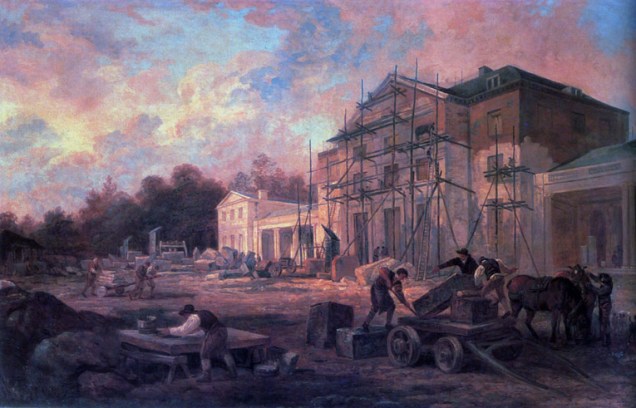
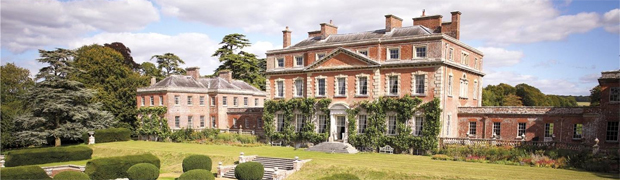
Greeks bearing gifts: Nicholas Revett, Trafalgar Park and the Origins of UK Neo-Classicism

William Blake poetically argued that it was possible to ‘To see a World in a Grain of Sand’; in the miniature is a reflection of something much greater.  With that in mind, to look upon the manifest beauties of a house such as Trafalgar Park in Wiltshire, it could seem strange to argue that one of the most important aspects of it is, in fact, a small hallway in the north wing. Yet, this hallway is one of the earliest architectural examples which form the genesis of neo-classicism; one of the most recognisable and prolific architectural styles which has proved to be enduringly influential in the design of country houses and also has come to dominate civic architecture.

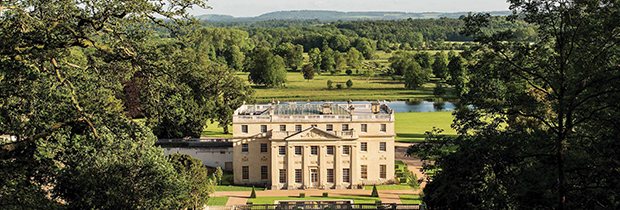
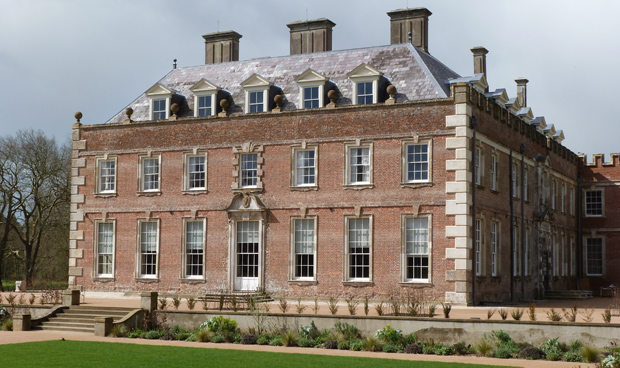
Trafalgar Park, Wiltshire (Image © Savills)

Neo-classical architecture permeates our built environment; banks, council and government buildings, and particularly country houses.  Drawing on the ancient monuments of Greece, the structured, hierarchical designs provided a convenient vocabulary that institutions, the state, and individuals could use to express their permanence and place in the natural order of society. Of course, this is the interpretation and not an objective set of laws but neo-classicism’s rationalist perspective, with its reliance on mathematical rigour, gave the impression that architecture and society both shared an underlying harmony in their precision and structure.

The Classical language of architecture had arrived in England through the widely admired and imitated Vitruvian principles as interpreted in Andrea Palladio’s I quattro libri dell’architettura. Inigo Jones had adopted this language and had created the foothold for the new style with his the Queen’s House in Greenwich (1616) and Banqueting House in Westminster (1619). However, his sources were Italian; the great monuments of Rome as measured and shown by Palladio. For some, though, this was derivative as the earliest Classical monuments were in Greece.

It ought to remembered that the fashion for the neo-classical was one which swept across Europe, not just the UK. As a rejection of the seemingly frivolous Rococo movement, it sought to instil a more high-minded set of ideals across the arts. To do this, writers such as Johann Joachim Winckelmann (regarded as one of the fathers of neo-classicism), stated that ‘The only way to become great is to imitate antiquity’. This required no mere slavish copying but a profound understanding obtained through study which enabled principled use of the Classical architectural language. Books such as Piranesi’s Le Antiquita Romane, a series of topographical views of Rome published in 1748, determined to prove the glory of Rome. However, others such as Richard Dalton (Museum Graecum et Aegyticum, 1751), le Comte de Caylus (Recueil d’Antiquities Eygyptiennes, Etrusques, Grecques et Romaines, 1752) and Julien David Le Roy (Les Ruines des plus beaux monuments de la Grece, 1758) argued for the superiority of the Hellenic originals.

Les Ruines des plus beaux monuments de la Grece (1758) - J.D. Le Roy
‘Ruines d’un Portique Dorique’ from Les Ruines des plus beaux monuments de la Grece (1758) – J.D. Le Roy

If true knowledge of Classical architecture required detailed study the options were limited unless fortunate enough to be able to undertake the arduous and expensive Grand Tour. The Society of Dilettanti, formed in the 1730s as a scholarly drinking club for aristocrats and others who had visited Italy, deliberately sought to influence fashion by sponsoring a more rigorous approach to the recording of the ancient ruins. Scholars had realised the value and fame which could be garnered from publishing books on the ruins they had visited but these were often the Roman versions of the Grecian originals and were often more decorative than accurate delineations.

Antiquities of Athens (Vol I) - James Stuart and Nicholas Revett (1762)
Antiquities of Athens (Vol I) – James Stuart and Nicholas Revett (1762)

In contrast, the most successful and influential of these publications was Antiquities of Athens by James ‘Athenian’ Stuart and Nicholas Revett, published in three folios in 1762, 1787 and 1794. Sponsored by the Society of Dilettanti, their approach produced detailed, measured architectural drawings from which other architects could accurately reproduce Grecian details. Stuart and Revett were both better known as connoisseurs of painting rather than as architects, but having lived in Rome for ten years prior to their departure in 1751 for Athens, they had a thorough knowledge of Roman artefacts.  This was crucial in establishing the authority of Antiquities of Athens when the first folio was published in 1762.

James Stuart (1713-1788) became known as James ‘Athenian’ Stuart on the reputation he established. He originally started his artistic career as a painter of fans and he was to continue with this work even after becoming an architect – the large allegorical ceiling painting in the tapestry room at Hagley Hall, painted in 1758-59, is one notable example. However, having established his fame, his drinking and erratic work habits meant that although he had a steady stream of work, patrons were sometimes reluctant to commission him, leaving his reputation somewhat diminished.  This is in contrast to his early years when having arrived in Rome in 1742, he established himself as judge of pictures, acting as a guide to aristocrats on their Grand Tour. In this manner he met Revett when he accompanied him, along with Matthew Brettingham and Gavin Hamilton, to Naples in 1748. That same year, he and Revett drafted their first Proposals for publishing an Accurate Description of the Antiquities of Athens, which, once accepted by the Society who became their sponsors, enabled them to undertake their investigation.

Nicholas Revett (1721-1804) was the second son of minor Suffolk gentry, his father being John Revett of Brandeston Hall. At the age of 21, Nicholas left Suffolk and moved to Rome to study under Marco Benefial, an important early neo-classical painter. It’s unclear where Revett was tutored in the precise skill of architectural drawing but clearly as a man of some talent and training he was undoubtedly proficient and it was he, not Stuart, who was principally responsible for the measured drawings of the monuments. According to one account in the Gentleman’s Magazine of March 1778 ‘Mr Stuart first caught the ideas of that science, in which (quitting the painter’s art) he afterwards made so conspicuous a figure.’  So why is the pupil known better than the master?

One of the key reasons is that although Revett’s name appeared on the title page, before publication he had sold his interest to Stuart after editorial differences.  Secondly, Revett, as a gentleman with a private income, wasn’t under the same financial pressure to practice and so his executed architectural commissions are scarce, primarily working for his friends. One such in his circle was Henry Dawkins; owner of Standlynch, later renamed Trafalgar Park.

Portico (added in 1766), Trafalgar Park, designed by Nicholas Revett (Image © Matthew Beckett)

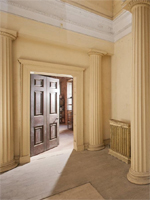
This commission, in 1766, was limited but Revett drew on his knowledge and the rich seam of material he had accumulated to produce a fine portico, based on the Temple of Apollo, Delos. Revett’s skill was in being able to take the elements of the temple and extend it to create a sophisticated composition. In addition to this, Revett was tasked with creating a vestibule at the junction of the north wing.  Within this limited space, Revett chose to create a miniature six-column temple apparently based on the Establishment of the Poseidoniasts, also at Delos, representing one of the (and possibly the) earliest interior use of Greek neo-classical architectural features.
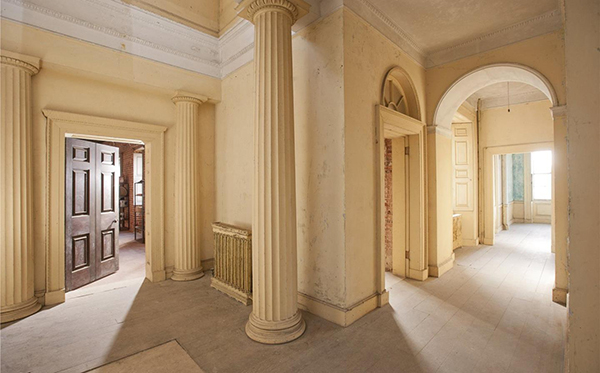
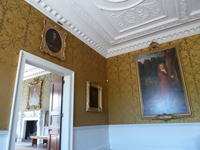
North Vestibule, Trafalgar Park, Wiltshire (Image © Savills)
North Vestibule , Trafalgar Park, Wiltshire (Image © Savills)
Detail of Trafalgar Park floorplan showing north vestibule layout (Image © Savills)

Revett contributed few other architectural examples, working mainly for friends such as Dawkins at Standlynch. Other commissions including adding a grand Ionic portico to the west front of West Wycombe Park, Buckinghamshire, for Sir Francis Dashwood in 1771, and later the Temple of Flora and the Island Temple between 1778-80.  Revett’s only other notable contribution is the church at Ayot St Lawrence, Hertfordshire, for Sir Lionel Lyde in 1778, which he designed as a temple with small, detached wings, linked with a columnar screen. James Lees-Milne thoroughly disliked it saying ‘It is stark, cold and foreign to its surroundings, in fact admittedly unsympathetic to its ostensible purpose as a christian conventicle in a small and humble parish. Quite frankly it was meant to be enjoyed as an ornamental temple of a nobleman’s park in a focal view from the mansion.’ Which is correct – and probably exactly what Revett had intended.

So if Revett has the garland for earliest neo-classical interior, who can claim the earliest exterior use? Although Antiquities of Athens was published in 1762, the drawings were at the disposal of Stuart and Revett.  The earliest Greek revival building is agreed to be the garden temple at Hagley Hall, built for Lord Lyttelton in 1758-59, which Stuart designed was based on The Hephaisteion in Athens. However, in 1985, Giles Worsley identified the earliest use of a Greek architectural element in a building as being two years earlier in 1756 when Earl Harcourt, a prominent member of the Society of Dilettanti, was rebuilding Nuneham House, Oxfordshire. Although the architect of the house is noted as Stiff Leadbetter, Lord Harcourt asserted such influence that the house can be regarded as more by the former than the latter.  Writing to a friend he stated that,

I have not placed my Venetian windows under an arch. Instead of springing the arch or compass point of the Venetian window from the cornish as other people have done, I have boldly adventured to follow a design of an old building which I have seen among Mr Stuart’s drawings of Athens, where the arch or circular part springs from the architrave itself, which, besides having a very good effect, obviates an objection which upon some occasions had been made to Venetian windows, that the light is too high in the room.

Harcourt’s inspiration for his variation on the standard Venetian window was Stuart’s drawing of the Aqueduct of Hadrian, a structure largely ruined when he visited and demolished by the end of that century. Stuart would go on to use this form of the window at only three other houses; once at The Belvedere, Kent, c.1775, once at the Prospect House, Wimpole, Cambridgeshire, c.1775, and once at Montagu House, London, c.1775-82, though unfortunately all these have now been demolished.

(left) Aqueduct of Hadrian from Antiquities of Athens (1794) (Image source: Aikaterini Laskaridis Foundation Library) | (right) Nuneham House, Oxfordshire (1754) (Image © Isisbridge on flickr)

The 1750s and 1760s saw the idea of architecture drawn from classical sources, whether Greek or Roman, become more widespread.  The birth of Greek neo-classicism in the UK can, in part, be traced to these examples and the men behind them, the wider adoption of this stylistic source was relatively slow. Neither Stuart nor Revett appeared to wish to be the figureheads for a new fashion, simply content to work as much as they wished, with Stuart taking more but his delivery tempered by his dissolute habits. Different strands of neo-classicism were being picked up by more ambitious architects such as Robert Adam, who had undertaken his own Grand Tour to Italy and Croatia and whose publication in 1764 of the Ruins of the Palace of the Emporer Diocletian at Spalatro gave his a scholarly foundation from which to launch his own style of neo-classicism which soon supplanted the previous Burlingtonian standard.

The overlooked North Vestibule at Trafalgar Park represents the quiet experimentation which was to plant seeds of the Hellenic neo-classical movement. This would find its true expression in the late-Georgian era when evangelists such as Thomas Hope would create a resurgence in interest and further burnish the reputations of both Stuart and Revett; men whose unequal fame has obscured the contribution which Revett made in enabling architects, regardless of experience or first-hand exposure, to all claim antiquity as their source.


Sales particulars: Trafalgar Park, Wiltshire – 33 acres, £12m (Savills.com)

Introduction to neo-classicism: ‘Style Guide: Neo-classicism‘ [V&A Museum]

A Hollandaise Source: Henry Holland’s Benham Park, Berkshire

As the costs of owning a country house mounted in the early-twentieth-century and eventually overwhelmed the finances of many families, so they sought alternative uses for their houses. Whether as a care home, school, or any of other myriad uses, few houses or their estates endured the experience unscathed. For those used as offices, the particular indignity of large, modern additions obliterated the immediate setting of a house, occasionally driving it into obscurity. Few who suffered this fate have ever escaped, yet a rare and beautiful survival – Benham Park in Berkshire – has not only escaped, but been wonderfully (partly) restored and is now offered for sale.  What is most remarkable though about this house are its connections to some of the most famous names of Georgian architecture, including Lancelot ‘Capability’ Brown, a young Henry Holland, and an even younger John Soane.

Benham Park, Berkshire (Image © Savills)

Nestled in a lush parkland, Benham Park is significant as a formative experience, in different ways, for both Holland and Soane; a house where the two would each contribute in different ways, each gaining experience which would serve them well in the future. The noted architectural historian Dorothy Stroud declared Holland ‘a designer of perception and originality’. Her tireless research underpins much of what is known about Holland and his work.

Detail of Henry Holland (1745-1806) Image © National Portrait Gallery

Henry Holland (b.1745 – d.1806) was one of the leading architects during the reign of George III. Today, his reputation has been overshadowed by his contemporaries who were more willing to engage in courting public notice, such as by exhibiting their work at the Royal Academy, which Holland never did. Chiding a friend in 1789, he stated ‘Pray no more public compliments to me. I began the world a very independent man and wish to hold it at arms length…I find myself already more the object of public notice than suits my disposition or plan of life’.

Henry Holland was the son of Henry Holland (1712-1785 – to avoid confusion, the father will be referred to as ‘the elder Holland’, any other mentions of Holland are the son) of Fulham. A successful master builder, he built many important houses in the middle years of the eighteenth-century and worked with architects such as Robert Adam, executing his alterations to Bowood in Wiltshire in 1761 and, in the same year, working at Ashridge House, Hertfordshire.  It was this latter commission which was to prove singularly important as it established a professional relationship between Holland senior and Lancelot ‘Capability’ Brown (b.1716 – d.1783), a landscape architect still revered today for his skill and imaginativeness. Brown’s particular ability was to be able to envision a whole landscape as it would be after the planting had reached maturity – to see its ‘capabilities’.

He was also noted architect, with even his rival Humphrey Repton praising the ‘comfort, convenience, taste, and propriety of design in the several mansions and other buildings which he planned’. The houses include Croome Court, Worcestershire (though the design may have been provided by Sanderson Miller), Corsham Court in Wiltshire (1761-64), Broadlands in Hampshire (1766-68), Fisherwick Park in Staffordshire (1766-74 – dem. 1814-16), Redgrave Hall in Suffolk (c.1770 – dem. 1946), Claremont House in Surrey (1771-74), and Cadland in Hampshire (1775-78 – later much enlarged – dem. c.1955).

Fisherwick Park, Staffordshire, painted by John Spyders (1786)

Although the initial connection was with the elder Holland, Brown would become central to both the professional and personal life of the younger Holland.  Although he never undertook a Grand Tour, his education was more practical, working with his father in the family business. Holland displayed aptitude and skill, taking on more responsibility but also his talent for design was becoming clear.  With his father’s connections, Holland was taken on as architectural assistant in 1771 by ‘Capability’ Brown who would, in time, hand over much of his design work to Holland, who would use these earlier designs as inspiration.  The closeness and respect between the two can be gauged by the marriage of Henry Holland to Brown’s daughter, Bridget, in 1773. Professionally, a measure of the level of joint enterprise between Colvin notes that Claremont and subsequent houses are jointly attributed to Holland.

Benham Park was an easy commission of Brown to secure, though it was likely that he was primarily thinking of his new partner when doing so. The probability that Brown would be commissioned was high as he was already working for the owner of the estate, William Craven, 6th Baron Craven (b. 1738 – d.1791), on another country house for him, Coombe Abbey, Warwickshire. Apparently under pressure from his wife, Elizabeth Berkeley, Lord Craven wrote to Brown saying ‘Lady Craven wishes to make some alterations here and to begin immediately’. Holland and Brown submitted their designs for a house in September 1773 using a similar pattern to Brown’s previous work with a neoclassical, two-storey main house with grand central portico.

Benham Park, Berkshire (Image © Savills)

The house was built between 1774-75, the final result a sympathetic marriage between an elegant yet imposing house and the Arcadian pleasures of a sculpted landscape.  Despite these fine attributes, Benham has been rather overlooked in the histories of both Brown and Holland with the latter clearly learning important lessons from one who designed with practicality in mind, but not to the exclusion of an element of drama. However, Holland was not without his own influence as Stroud notes that from the time he joined Brown’s office, the interior design evolved from a more robust Palladian character to the more restrained yet elegant style which was Holland’s hallmark. Claremont, Cadland, and Benham all display this style, indicating that although the shell of the house was more the work of Brown, the interiors were to Holland’s designs.

What’s remarkable about Holland was his almost precocious drive to build on a grand scale. Backed by his father’s capital and expertise, Holland leased in 1771, aged 26, eighty-nine acres of what is now Chelsea and Knightsbridge, including what is now Cadogan Place, and proceeded to speculatively design and build houses based around a miniature park or garden square. This high profile activity brought Holland his first major solo design for Brook’s club in Mayfair, London, a haunt of the Prince Regent and Whig aristocracy. This would lead to the Prince commissioning two major buildings from Holland; Carlton House and Brighton Pavilion. These two commissions plus Holland’s speculative building cemented his position within the highest social strata, creating future opportunities.

Undated print of Henry Holland's Brighton Marine Pavilion of 1786-87 (Image source Khan Academy)
Undated print of Henry Holland’s Brighton Marine Pavilion of 1786-87 (Image source Khan Academy)

Other significant commissions included the the refurbishment in 1787 of Althrop, Northamptonshire, for the 2nd Earl Spencer, including a full re-casing of the red-brick house in white mathematical tiles with stone dressings, a re-design of the gardens, and inside, a re-ordering of the accommodation including the creation of the noble triple libary, divided into sections by screens of Ionic columns. Another Whig patron was Francis, 5th Duke of Bedford, who had Holland complete some minor works to Bedford House before commissioning more extensive work, also in 1787, at his main house at Woburn Abbey. Holland was back at Broadlands in 1788 creating a new vestibule and inner hallway, the entrance marked by a new grand portico. In 1795, after a sojourn into theatres, Holland returned to grand country houses, with the rebuilding of Southill Park in Bedfordshire for Samuel Whitbread, of brewing fame. Again, as with Althorp, this was a refurbishment to the point of rebuild; the house encased, the accommodation extended and a new portico added. His last commission was again from Lord Spencer in 1801 to rebuilt his Wimbledon house, which had earlier burnt down, with a sophisticated villa in a severely plain style both inside and out. Sadly, this was demolished in 1949.

'Rebuilding of Southill' (1797) by George Garrard (Image © University of Texas)
‘Rebuilding of Southill’ (1797) by George Garrard (Image © University of Texas)

Benham Park was also important for another young, aspiring architect, Sir John Soane. As a young apprentice, Soane had joined Holland’s office in 1772 as a junior. At Benham, Soane was given the task of measuring up to create the final bills, a task he was to repeat at other locations, giving him a valuable insight into not only the process of building but also the business aspects. Although, sadly, almost all Holland’s papers and drawings were posthumously destroyed by his nephew, one of Holland’s account books is preserved in the Soane collection. Soane seems to have retained it as a valuable record and tool when setting up his independent practice. Benham therefore provided practical, aesthetic and business training to the young architect who no doubt admired Holland’s neo-classical approach before evolving his own distinctive response and style, which was to establish him as one of the leading architects of his age.

Benham Park in 1904 (detail) - note the large servants wing to the left, now demolished (Image source Stockcross History via Wikipedia)
Benham Park in 1904 (detail) – note the large servants wing to the left, now demolished (Image source Stockcross History via Wikipedia)

Benham survived largely unaltered into the twentieth-century until 1914 when the pediment was removed from the portico and replaced by a balustrade. This was echoed at the roof level where the pitch was lowered and obscured  by a pierced stone balustrade. The servants quarters were removed at the same time due to their poor condition. The house and estate remained with the Sutton baronets until 1982 when it as bought and converted into offices in 1983, with additional office blocks built next to the house. These were thankfully demolished as part of the latest restoration of the house and estate.

Benham Park - looking out over the lake (Image © Savills)
Benham Park – looking out over the lake (Image © Savills)

Benham Park, (Grade II*), is now offered for sale with 130 glorious acres for £26m. Inevitably for a house of such grandeur situated so close to London, there are approved plans for the house to become a ‘wellness’ centre with a huge (though thoughtfully designed) extension to the side and rear.  For me, as ever, this is a house which would be best served by being returned to it’s original purpose, that of a family home. For a new owner, they could revel in the knowledge that the house and landscape had been conceived by one of the great Georgian partnerships of Brown and Holland.  Standing under the portico today, much as where they and the young John Soane must have once stood, the latter on the cusp of his era-defining career, looking out at Brown’s landscape, they can appreciate this rare combination of architectural genius – truly a prize worth such a princely sum.


Estate agent particulars: ‘Benham Park, Berkshire‘ [Savills]

Brochure (PDF): ‘Benham Park, Berkshire‘ [Savills]

Listing description: ‘Benham Park‘ [Historic England]


Please note: Savills very kindly provided the images and brochure but had no input into the text.

A Sleeping Beauty: Ombersley Court, Worcestershire

The temptation when Country Life magazine arrives each week is to flick through the properties and make tabloid-esque comparisons about how a detached Regency villa in Dorset with space for a family, chickens, and an excitable spaniel, could be had for the price of a tatty flat in London. Yet sometimes these comparisons seem almost too unreal when faced with the exemplary beauty of a country house like Ombersley Court, Worcestershire, which, along with 39 beautifully wooded acres, has just been put up for sale for just £3.5m; the price of a 3-bed terrace house in Chelsea.

Ombersley Court, Worcestershire (© Savills)

Tucked away in a quiet corner of Worcestershire lies a house which, either through deliberate privacy or convenient obscurity, is little known to the world. Yet Grade-I listed Ombersley Court is one of the finest houses in Worcestershire, arguably even in the wider region, due not only to the sublime architecture and surrounding estate, but also the fine collection of paintings and artwork. The estate has long been the seat of the Sandys family who acquired the manor in the late sixteenth-century. The current house was originally built for the 1st Lord Sandys (b.1695 – d.1770) between 1723-26, replacing earlier monastic buildings on the site.  The house was designed by Francis Smith of Warwick (b.1672 – d.1738), one of the leading regional architects and, working with his brother William (b.1661- d.1724), ‘one of the most successful master builders in English architectural history’ (Colvin).

‘Smith of Warwick’, as Francis was more commonly known, was a clients ideal contractor due to his famous honesty and reliability, able to deliver buildings on time and on budget. His reputation spread amongst the Midlands gentry and aristocracy with almost all his work within a fifty-mile radius of Warwick.  Such was his standing that even the fractious Duchess of Marlborough (who had famously fallen out with Vanbrugh over Blenheim), demanded that for her house in Wimbledon, Surrey, ‘that Mr Smith of Warwickshire the Builder may be employed to make Contracts and to Measure the Work and to doe everything in his Way that is necessary to Compleat the Work as far as the Distance he is at will give him Leave to do’ (1732-33).

Smith’s solid reliability also manifested itself in his repetition of his well-developed plans and designs for houses, creating a distinctive style which is quite recognisable as his own. Broadly, this would be a three storey house with the centre section either projected or recessed, consistent fenestration, and relatively sparse external decoration, usually only decorative stone dressings such as keystones, quoins or balustraded parapets. This consistency was perhaps a double-edged sword, with the Hon. Daines Barrington stated in a letter in 1784, that although ‘all of them (are) convenient and handsome […] there is a great sameness in the plans, which proves he had little invention’.

Yet, this is to overlook that Smith was, at heart, a successful commercial builder whose understanding and appreciation for architectural ornament and variety was inevitably tempered by his determination to deliver the commission on time and on budget. As the architectural historian Sir Howard Colvin highlights, the core design is that of a standard seventeenth-century house such as Belton House, Lincolnshire, but with stylistic updates as fashions evolved.  ‘Smith’ houses such as Umberslade, Alfreton, and Wingerworth all share this readily accessible style, one which married domestic practicality with exterior grandeur.

Perhaps Smith’s greatest achievement was the tragically now-ruinous Sutton Scarsdale, Derbyshire; a house with a facade so stately as to rival Chatsworth. Built for the 4th Earl of Scarsdale in 1724, Sutton Scarsdale was one of the finest houses in the country. Although the form is familiar, the masterful control of a palisade of pilasters and columns topped with Corinthian capitals, gives it a gravitas, whilst the detailing such as the scrolled window surrounds to the projecting wings hint at Renaissance motifs; Fausto Rughesi (Santa Maria in Vallicella, 1605/06) filtered through William Talman (design for Thoresby House, 1685, – shown in Vitruvius Britannicus, C1, Pl.91) and James Gibbs (to whose designs Smith was building Ditchley Park, Oxfordshire, 1722).

derbyshire-Sutton_Scarsdale_Hall_circa_1900

One regret with Ombersley Court is that although the form and plan of the house and much of the superb unaltered early-Georgian internal decoration is still Smith, the exterior is now not his. The original design featured a hipped roof, and what looks to be pilasters, giving it the recognisable ‘Smith’ characteristics.  This was lost when the existing brick was refaced with ashlar in 1809 by the architect John Webb for Mary Sandys, the Marchioness of Downshire. In fairness though, this was a lucky escape as John Nash prepared a much more ambitious scheme in 1808, which proposed adding a two-storey pavilion to each side, linked by a seven-bay screen of giant Ionic columns, though this seems to have been rejected on cost.

Ombersley Court - proposed alteration by John Nash, 1808
Ombersley Court – proposed alteration by John Nash, 1808

One of the glories of the house are the interiors and especially the plasterwork and carving. With a desire for privacy which was rarely breached, few had seen the exceptional decorative work, except through the lens of a Country Life profile by Arthur Oswald in 1953. This extolled the virtues of many aspects including The Chippendale Room which featured bamboo framed silk wall pieces, remarking that ‘it is uncommon to find a Regency example as complete as this or as charming’. The rest of the house struck a careful tone of stately refinement; enough decoration to proclaim wealth and taste, but never excessive.

Ombersley Court - Hallway (© Savills)
Ombersley Court – Hallway (© Savills)
Ombersley Court - Drawing Room (© Savills)
Ombersley Court – Drawing Room (© Savills)
Ombersley Court - Morning Room (© Savills)
Ombersley Court – Morning Room (© Savills)

With the death of Lord Sandys in 2013 the house passed to Lady Sandys but following her recent death, concerns were raised and rebutted via letters in Country Life that this wonderful house would be forced (for complicated reasons) to become a care home; a fate which would have despoiled this jewel of a house. Instead, for the first time since it was built in 1724, it has been placed on the market. This is a house created by one of the finest craftsmen of the early-Georgian period, with connections to a wider, distinct Midlands architectural tradition which epitomises all that one would hope to see in a country seat. As an important house which deserves respect, one hopes that the new owner will appreciate this remarkable situation and that perhaps the best approach would simply be to buy the house and contents and perhaps another couple hundred acres to truly secure an Arcadian ideal, one which would be hard to better anywhere in the country.


Sales particulars: Omblersley Court, Worcestershire [Savills] – £3.5m with 39 acres

Listing description: Ombersley Court, Worcestershire [British Listed Buildings]

So, you made the 2016 Sunday Times Rich List – where to live?

The now annual round-up of the richest 1,000 people in the UK (whose wealth can be ascertained…!) has been published today in the Sunday Times (£). Although there are now a few less billionaires than last year in the UK, the minimum required to join the list has risen slightly to £103m. With 80% of the list members having made their own fortunes and having acquired the trappings of status along the way, it’s unsurprising that many will already own a country house. However, some may not and to help them out of this socially embarrassing predicament, below are some of the most interesting country houses for sale today (April 2016).

Ignoring any of the ‘new’ country houses which, unless by Craig Hamilton and a limited few others, are unlikely to be architecturally notable, this entirely subjective selection, focuses on those historic houses which can be regarded as such.

Hackwood Park, Hampshire (Image © Savills)

Many of the most impressive country estate sales are often conducted ‘off market’, offers and negotiations concluded in private; never receiving the splendour of an advert in Country Life. However, occasionally, one quietly appears which sets the pulses racing. What will probably be one of the most interesting houses to be offered publicly this year is Hackwood Park, Hampshire, a splendid Classical house (listed Grade-II*) with accompanying 260-acres.  Designed by Lewis William Wyatt (1777-1853), nephew to the more famous James Wyatt, Lewis developed a very successful country house practice, especially in Cheshire, including work at Lyme, Heaton and Tatton Parks, but has been rather sadly overlooked in the history of architecture (something I will try to address in another post). Looking through the photos of Hackwood House, his skill and ability in handling of the external form (which was a rebuilding of an earlier house) and the superb interiors demonstrates clearly why he enjoyed a productive career. No price is given for Hackwood House, but given the quality of the house, the location and the estate, I suspect that only those troubling the upper reaches of the Rich List need contact Savills.

Trafalgar Park, Wiltshire (Image © Savills)

Another house which certainly has grandeur in Trafalgar Park, Wiltshire – but it also hides a surprisingly important architectural statement. Built as Standlynch Park in 1733 by John James of Greenwich as a ‘villa’ for Sir Peter Vandeput, it was acquired by the nation in 1814 as a gift to Horatio Nelson, 1st Viscount Nelson, 1st Duke of Bronté to express England’s gratitude for doing his duty for his country and renamed ‘Trafalgar Park’. Unfortunately for Lord Nelson, as he had famously died in 1805, the house, titles and generous pension were given to his elder brother, the Rev. William Nelson and descended through the family until 1948 when they were no longer able to afford the upkeep when the Attlee government cancelled the Nelson Pension.

Corridor by Nicholas Revett, Trafalgar Park, Wiltshire (Image © Savills)

After a slightly choppy latter half of the 20th-century, the house was bought in 1997 by Michael Wade who over the years has lavished attention to restore the house in an exemplary fashion but now wishes to move on.  I was lucky enough to visit in April 2013 with the Georgian Group and can attest to the quality of the work, especially to the main block. And the surprising architectural statement; the North wing contains a ‘monumental’ hall designed in 1766 by Nicholas Revett who had published in 1762, with James ‘Athenian’ Stuart, ‘The Antiquities of Athens‘ which was the catalyst for the hugely popular Greek Revival style in England.  This house therefore contains the genesis for the Greek-influenced ‘Neoclassicism‘ of the Georgian period which is still much admired and copied today. So if your place on the Rich List means you have £12m (plus a few more to finish the restoration, including Revett’s incredibly important corridor and North wing), again, contact Savills.

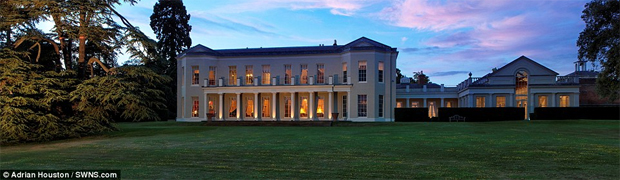
Woolmers Park, Hertfordshire (Image © Adrian Houston / SWNS.com)

The phrase ‘comprehensively renovated and extended‘, especially in relation to a grade-II* listed Georgian country house can sometimes send a chill down your spine, fearful that all that made it special has been smothered in the relentlessly, boringly bland ‘international hotel’ style. Thankfully although, Woolmers Park, Hertfordshire, has been restored to within an inch of its life and whilst perhaps too polished for some, overall, the essential charm of the country house and what could be called the Colefax-Fowler ‘look’ makes the main rooms look very elegant. Originally an 18th-century house, it was rebuilt between 1796-1802 for the 3rd Duke of Bridgewater, and then again between 1821-3 to designs by C.R. Cockerell, who probably added the Greek Doric colonnade on the south front. Bought by the Earl and Countess of Strathmore in the 1920s, it was then sold to Arthur Smith in 1949 and became home to the Hertfordshire Polo Club before being sold in 1997.  Now for sale again with 232-acres, Knight Frank have given it a guide price of £30m (don’t forget the eye-watering £3.5m stamp duty), which reflects that this is a house to which very little will need to be done to enjoy a country lifestyle.

For those a little further down the Rich List, below are some less pricey options but still would give the country house style to which many aspire:

  • Hall Place, Tonbridge, Kent – an unusually large house for the county, Victorian, with up to 226-acres – £8m [Strutt & Parker]
  • Manor Hall, Gloucestershire – 15th-century but updated including by the current owner Peter De Savery – £7.95m [Knight Frank]
  • Guyzance Hall, Northumberland – rebuilt 1894, now with 323-acres – £6m [Knight Frank]
  • Chedington Court, Dorset – built 1840 and altered 1894 in Jacobean style, now with ~50-acres – £5.95m [Savills]
  • Brandsby Hall, Yorkshire – built 1760s and well-proportioned, it now has some ‘interesting’ decor and needs a lot of work to fix  – £4.25m [Knight Frank]
  • Howsham Hall, Yorkshire – built 1610, the dramatic facade is dominated by beautiful mullioned windows – £4.25m [Savills]
Somerton Randle, Somerset (Image © Knight Frank)

Personally, if I was in the fortunate position of troubling the Rich List, the house I would beating a path to is the bucolically named, Somerton Randle, Somerset (£5.75m – Knight Frank). A compact grade-II listed country house built in the late 1700s, and now with 88-acres, the interiors are a wonderful example of regional Georgian style and retain an exceptional elegance.

Georgian Group Architectural Awards 2014

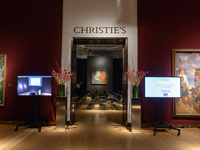
2014 Georgian Group Architectural Awards - hosted by Christies, sponsored by Savills (Image: Nick Harvey)
2014 Georgian Group Architectural Awards – hosted by Christies, sponsored by Savills (Image: Nick Harvey)

The efforts of those who choose, or inherit, the responsibility for the care of our nation’s heritage are often unacknowledged – and yet the custodians continue regardless.  Their dedication is such that they will make significant sacrifices in terms of time, personal comfort, and money to not only rescue buildings at risk but also just to keep others in good repair.  Now in its 12th year, the Georgian Group Architectural Awards (hosted by Christie’s, sponsored by Savills) take the opportunity to assess and recognise those who have done such sterling work, primarily in the restoration and re-use of Georgian buildings but also new buildings built in a sympathetic style.

The first category awarded is the main prize – Restoration of a Georgian Country House – which this year was jointly won by Hendre House, Carnarvonshire and St Giles House, Dorset.  These two projects are both remarkable as each house was in a parlous state and only through the dogged efforts of each owner have they been rescued and are now beautiful homes again.

Hendre House, Carnarvonshire, Wales (Image: Paul Barker / Country Life)
Drawing Room, Hendre House, Carnarvonshire, Wales

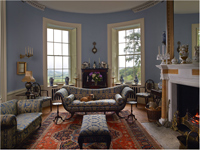
Hendre House enjoys an enviable position on the side of the Conwy valley, yet by the mid-20th century it had become a ruin after being abandoned in 1932.  In 2001, the derelict house was bought by Michael Tree, a man who had done much to raise awareness of the threats to Welsh architectural heritage and also on a practical level with the restoration of Trevor Hall. Hendre is a Regency gem which had been built in 1802 as a compact villa, orientated to take advantage of the stunning views. Perhaps the most remarkable aspect of the project is that Mr Tree decided to do much of the work himself, working with a local builder. The sensitive interior restoration involved the re-instatement of various elements which had been stripped out and were still on-site or recreated from existing fabric.  The shade of green used in the dining room is based on a paint fragment obtained from the ruined Edwinsford Hall and then used by Patrick Baty to create a new shade called ‘Edwinsford Green‘. Overall, this is a remarkable achievement both in terms of the scale but also the sensitivity brought to the restoration, allowing Hendre to re-join the sadly depleted ranks of Welsh country houses. (Country Life have a great gallery of photos of Hendre)

St Giles House, Dorset (Image: Matthew Beckett)

Considering the competition, one can appreciate why the committee decided that joint winners was the only way to recognise both Hendre and St Giles House, Dorset.  Now the seat of the 12th Earl of Shaftesbury, Nicholas Ashley-Cooper, the restoration is one not only of the physical fabric of the house but also of the family in the life of the area.  The core of St Giles House dates from 1660, but with later additions, some of which were removed by the current Earl’s father in the 1970s.  This programme of work was not completed, and although it reduced the house to a more manageable size, left unresolved the scars of where the additions had been removed.  The house was put into hibernation for a number of years before the current Earl moved back after unexpectedly inheriting both the title and the estate.

One of the fine rooms, St Giles House, Dorset (Image: Matthew Beckett)

Faced with the scale of work, others may have sold up and moved on, but all credit to Lord Shaftesbury (working with architect Philip Hughes), he has enthusiastically embraced the project which has comprised a complete restoration, to create not only living accommodation for the family but also to enable the rest of the house to function as a wedding and events venue.  Today, the quality of the interior  and sensitive exterior works belies the challenging state in which he took it on and enables the estate to once again become part of the fabric of local life.

Also on the shortlist in this category was the restoration of Corngreaves Hall, West Midlands by the private developer, Gr8space.  As regular readers of this blog will know that I’m very critical of developers who purchase ‘at risk’ country houses then submit huge ‘enabling development’ schemes far in excess of what’s required to restore the house, then build an estate, often unsympathetically, and then ‘forget’ to restore the house. Thankfully, in this case, although they didn’t win, the developer should be commended for their restoration of Corngreaves Hall.

Newly repainted Library, Kenwood House, London (Image: Matthew Beckett)

The winner of the next category – Restoration of a Georgian Interior – was rightly awarded for the exemplary work carried out at Kenwood House, north London.  The house is one of Robert Adam’s best works, the marriage of a wonderfully proportioned and detailed country house, with a series of elegant interiors.  Now in the care of English Heritage, the restoration took a rigorous approach to the investigation of the original decoration and having determined the scheme implemented by Adam, then sought to replace the more garish 19th-century decoration. The replacement of the extensive gilt work with the more historically accurate scheme, particularly in the Library, has created a dramatic interior space which brings home just how bold and creative Adam was in his designs.

Llanelly House, Carmarthenshire, Wales

Llanelly House justifiably won the Restoration of a Georgian Building in an Urban Setting category. An important townhouse, built in 1714, it had become a much misused building, hemmed in by busy town-centre roads and cut off from the parish church opposite. Under the inspired guidance of Craig Hamilton Architects and with some thankfully enlightened support from the local council, not only has the house been restored and found a use as a genealogy centre, but wider townscape changes have re-routed the roads and created a delightful urban space with this historic building proudly taking pride of place.

The category of Reuse of a Georgian Building was won by St George’s Church, Great Yarmouth, which has found a new life as a theatre.

Painshill Landscape Garden, Surrey (Image: Painshill Trust)

Painshill Landscape Garden, Surrey, has long been recognised as a fine example of a Georgian ‘country house’ parkland, even if it was created without a house at the centre. Winning the Restoration of a Georgian Garden or Landscape category recognises the exceptional work of the Painshill Trust in preserving what remains and the restoration of the many important garden buildings it contains.

Entrance front, Chitcombe House, Dorset (Image: Stuart Martin Architects)

One of the most exciting categories is the New Building in the Classical Tradition which was also awarded to joint winners. This category is the one which should demonstrate that the language of Classical architecture is still as relevant today and that its use does not automatically mean pastiche or unthinking decoration.  Chitcombe House, Dorset, designed by Stuart Martin Architects, won (in my humble opinion) on the strength and style of the entrance front.  Displaying a Dutch influence, with shades of Lutyens, it certainly creates the sense of arrival one would wish to have at a country house. However, the other side (for which I can’t find an image one now found [PDF] – thanks Tom) has two projecting bays connected by a loggia which seems almost an anti-climax after the interest created by the entrance.

Crucis Park, Gloucestershire (Image: Yiangou Architects)

The other winner is a superb design which marries both elegant proportions with fine and thoughtful detailing.  Crucis Park, Gloucestershire by Yiangou Architects, replaced a 1960s house with a compact house which draws on the traditions of local architecture but within the broader context of Queen Anne styling.   Although the two main fronts share the same historical form (a square with projecting centre – see Puslinch), the variations of the bold broken pediment above the front door, and the engaged colonnade on the other, create distinctive styling which subtly elevates the quality of the house. The interiors also feature some beautiful fireplaces and staircase.  This is the type of smaller country house architecture which should be encouraged as the correct continuation of the Classical tradition.

Overall, a very successful evening and credit should be given to the Georgian Group who have created awards that have established themselves as a benchmark by which Georgian restoration can be judged.  The annual event – made possible through the vital sponsorship of Savills (who had kindly invited me – thanks!) – not only rightly give praise and recognition to those directly engaged, but also generally raise the standard and awareness of architectural heritage and the huge efforts required to maintain it.  If there were space for one more award, I would like to see one to recognise ‘Restoration of Georgian Building by a Public Body’ to encourage the care of heritage within the public sector where it can sadly be all too often lacking.

Successive governments have retreated from their duties to help support the owners as custodians, not only by withdrawing grant support but equally with hostile measures such as applying full-rate VAT to repairs.  Consequently, the Georgian Group play a key role in acting as a ‘cheerleader’ for this vital part of the nation’s history, economy and, most importantly, our common heritage, which although mostly privately owned, enriches us all.

——————————————————————————–

Further information from The Georgian Group: