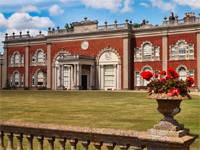
Welcome to the market: Lutyens’ The Salutation, Kent

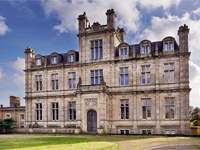
The Salutation, Kent (Image: Knight Frank)

The analogy between language and architecture is one that has often been made, particularly as fluency is the key measure of success in both fields.  An immature architect can make elementary mistakes with the grammar of a building style as much as any tourist abroad can when ordering dinner. In most cases, both novice architect and linguist can be understood but when compared to the more experienced practitioner, skill and mastery come sharply into relief.  Such a lesson by a master architectural linguist has just been launched on the market; The Salutation, in Sandwich, Kent; a beautiful piece of poetry which demonstrates the fluency of the architect in the language of Classicism.

Heathcote, Ilkley (Image: Thursday Dave via Flickr)

Lutyens’ career can largely be seen in three phases; the early years of the ‘Surrey-Tudor’, which evolved into the middle ‘Arts & Crafts’, and then the divergence into the bold ‘Classical’, and its particular variant, ‘Edwardian Baroque’.  That last switch can be seen quite dramatically in the brilliant Heathcote, Yorkshire, built 1906, where Lutyens playfully adopted and adapted the Classical motifs and style of Palladio and Scammozzi to create a wonderfully detailed villa, rich in style and quite unlike his previous work.  After the exuberance of Heathcote (which annoyed Pevsner, who although he commented that it was ‘Only a villa, but how grand the treatment!‘, also dismissed features such as the pilasters which ‘disappear’ into the continuous rustication (see ground floor either side of the windows) as ‘silly tricks‘). On a side note; Heathcote recently sold having previously been bought by a developer/vandal who wished to split the house into two, thus ruining Lutyens’ interior planning – fingers crossed the new owner is sympathetic to this wonderful house.

Lutyens was, of course, part of a longer tradition starting with the first English classical architects practising around the time of Sir Christopher Wren in the mid-17th Century including Hugh May, William Samwell, and Roger Pratt. These pioneers displayed a similar skill in Anglo-Classicism producing buildings such as Cassiobury House (May), the first Eaton Hall (Samwell) and the revolutionary Coleshill (Pratt).  Classicism has long had a place in British architecture, despite other fashions, and has shown its versatility in being used for all sizes of house, from palaces to the smaller country retreat – and it was in this latter requirement that Lutyens was commissioned to build The Salutation.

Located on the site of an old inn of the same name, it was built in 1911-12 in the Queen Anne style as a retreat for Gaspard Farrer, a partner in Barings Bank, and his two bachelor brothers. Lutyens’ clients were typically those who had made money in the decades either side of 1900; that high-point of the country-house lifestyle when staff, materials and labour were relatively cheap. If there is a ‘criticism’ of Lutyens it’s his generosity with regards to space with hallways, alcoves, and large staircases, such as at The Salutation where an extended landing serves as an overflow from the library.  Yet, each space serves a purpose in the plan, typically framing views along axes or as part of a route to the principal rooms which Lutyens often incorporated into houses.
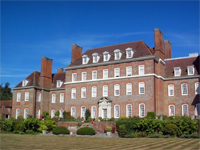
Great Maytham, Kent (Image: Stephen Nunney via Geograph)

The exterior of the house is a smaller derivation of his earlier and much grander Great Maytham, built 1910, for the Liberal MP, H.J. Tennant.  Following the exuberance of Heathcote (which most commentators seem to think came very close to pomposity), Lutyens took a more restrained path through Classicism (compared say, to Richard Norman Shaw at Bryanston House for Viscount Portman) and Great Maytham can be seen as a larger version of Samwell’s Eaton Hall, built 1675, or the smaller Puslinch in Devon, built 1720, with the latter showing clear similarities with The Salutation.

East terrace, The Salutation, Kent (Image: Country Life Picture Library)

The plan of The Salutation is based on the Palladian 3×3 grid but, importantly, Lutyens is able to adapt and amend this without losing the beauty of the proportions.  Gavin Stamp comments that, for Lutyens, his houses were ‘essentially romantic creations; that is, their form is determined by a picture in the architect’s mind‘ and another writer H.S. Goodhart-Rendel compared his ability to that of Wren in that they both had ‘the sculptor’s capacity of making beautiful shapes‘.  Country Life magazine said that it was a ‘dazzlingly suave yet restrained reinterpretation of the old Georgian idiom‘. It was this ability to combine a profound understanding of the Classical rules of architecture with originality which marked Lutyens out as one of the great architects.

To be given a measure of the importance the house, in 1950, it was the first 20th-century building to be given a Grade-I listing.  However, The Salutation suffered in the later 20th-century with the 1980s a particularly difficult time. Repeated attempts by developers were made to either split those graceful internal spaces into apartments or simply demolish it entirely and build on the 3-acre site, over which Lutyens (and possibly his long-term collaborator Gertrude Jekyll) had spent so much time and care crafting.

The Salutation from the garden (Image: Knight Frank)

Salvation for The Salutation came in the form of Dominic and Stephanie Parker who bought it in 2004 for £2.6m and have subsequently spent £3m on its restoration and who now run it as a luxury B&B. Now for sale at £4.5m, for someone with the budget, this could again be a superb home; combining the finest elements of the last boom of the country villa, designed by one of the greatest architects Britain has produced.  For the rest of us, if you’d like to see and experience staying in one of Lutyens finest small houses, I’d suggest booking soon.

———————————————————-

Sale particulars: ‘The Salutation‘ [Knight Frank]

If you’d like to stay; you can book through their website: ‘The Salutation

Video of Mr Parker talking about his decision to buy: ‘The Salutation was ‘like finding a diamond in a river‘ [2009, Kent Online]

Watch the Parker’s competing in a B&B TV competition: ‘Four in a bed‘ [Channel 4]

For more on Lutyens, I recommend Gavin Stamp’s ‘Edwin Lutyens Country Houses‘ [Amazon]

Support the legacy: ‘Lutyens Trust

Listing description: ‘The Salutation‘ [British Listed Buildings]

‘A brighter, richer landscape lies display’d’; the battles for the views of country houses

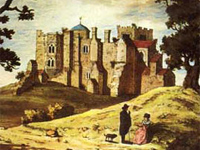
'View of the Thames from Richmond Hill' by Peter Tillemans c.1720-1723 (Image: Government Art Collection)
‘View of the Thames from Richmond Hill’ by Peter Tillemans c.1720-1723 (Image: Government Art Collection)

Looking out from the top of Richmond Hill in south west London,  towards Windsor Castle, is to take in one of the most famous and admired views of the Thames, one that includes glimpses of at least four significant country houses. One of those, the beautiful Marble Hill House, was also the site of a ‘battlefield’; but this is a heritage one, a battle to protect one country house in particular and that spectacular view.  The fight to protect the views surrounding country houses has been fought many times, but two from the modern era in particular, at Witley Park and Marble Hill House, are worth a closer look for the impact they had.

Folly castle in Hagley Park, built c.1747, designed by Sanderson Miller (Image: Matthew Beckett)

In earlier centuries, landowners had far greater power to determine what they saw from their drawing room windows.  With the rise of the landscape architect, mere history was an insufficient reason for a tree, stream, building or even an entire village, to be left alone where they interfered with the sight-lines.  With the new emphasis on a view terminating in some object of interest, ever grander follies, bastions, and sham ruins sprang from the ground; from a distance giving an air of ancient decay, but betrayed up close by the drying cement. Yet, ancient buildings also could be pressed into service as ‘eye-catchers’ – but only if they met with the approval of the landscaper and/or the owner.

The first ‘battle’ to be fought to protect a heritage asset which formed part of a view was between a duchess and her husband’s architect, and involved one of grandest houses in the country. Ironically, the battleground was a house built to celebrate a military victory, Blenheim Palace, but a fight almost as vicious was being waged between Sarah, 1st Duchess of Marlborough, and the architect, Sir John Vanbrugh (b.1664 – d.1726), one of the most remarkable men of that era.  Vanbrugh’s design for Blenheim was a tour-de-force of contemporary architecture; a spectacular palace which drew on the Continental Baroque style to create a house which was a set-piece of country house theatre.

Woodstock Manor, Oxfordshire (dem. 1720) (Image: courtesy of His Grace the Duke of Marlborough and Jarrold Publishing via Smithsonian Magazine)

The battle was fought over the ruins of the original Woodstock Manor, a house where King Henry II had romanced ‘fair Rosamund’ de Clifford, and which formed the original palace on the estate.  Having suffered under bombardment in the Civil War, large parts were in ruins.  However, Vanbrugh saw them not only as a historical artefact, but also as part of the grand conception of the landscaping; a precocious attempt at the Picturesque twenty-five years before William Gilpin conceived it.  Vanbrugh wrote to the Duchess, explaining:

That Part of the Park which is Seen from the North Front of the New Building, has Little Variety of Objects Nor dos the Country beyond it Afford any of Vallue, It therefore Stands in Need of all the helps that can be given, which are only Two; Buildings and Plantations. These rightly dispos’d will indeed Supply all the wants of Nature in that Place: And the Most agreable Disposition is to Mix them: in which this Old Manour gives so happy an Occasion for…So that all the Building left, (which is only the Habitable part and the Chappel) might Appear in Two Risings amongst ’em, it wou’d make One of the Most agreable Objects that the Best of Landskip Painters can invent. And if on the Contrary this Building is taken away; there then remains nothing but an Irregular, Ragged, Ungovernable Hill.

His appeals were in vain and the house razed to the ground in 1720.  The Duchess of Marlborough had a famously low opinion of architects and her dealings with Vanbrugh seemed to entrench this; his own case not helped by secretly making the Manor habitable again for his use but funded by the Duke’s money.  She was also devoted to the Duke and intended Blenheim to be his monument in life and for all time, and so she may not have wished to see another competing memorial to love from her windows.

Little changed in the following two centuries; if a landowner wished to reshape the view of his estate from his dining room, then so he shall.  Perhaps the ultimate expression of that was the occasional removal of an inconveniently sited village such as for Lord Cobham at Stowe c.1730, and Lord Harcourt at Nuneham Courtenay c.1750.

Some of the earliest effective challenges to this power only came much later from Victorian social activism which provided a platform for ideas to be confronted from the perspective of what was good for the people.  A landmark in the campaign for heritage protection of landscape centred around the now-lost mansion of Witley Park in Surrey.

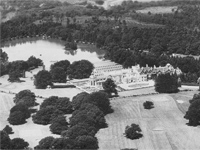
Witley Park, Surrey (Image: Lost Heritage - England's Lost Country Houses)
Witley Park, Surrey (Image: Lost Heritage – England’s Lost Country Houses) – click for more images of the house

The man responsible for raising the ire of the locals was one Whitaker Wright. A controversial financier who  made a fortune, lost a fortune, made another fortune and then bought the Witley Park estate and also the neighbouring South Park Farm estate from the Earl of Derby which included Hindhead Common and the famous Devil’s Punch Bowl.  To ‘improve’ the views from the house, Wright set 600 men to work, creating lakes and parkland but more worryingly, raising or levelling hills.  Without the legal frameworks we now rely on to protect the countryside and other areas of outstanding beauty for the common good, there was a real concern that Wright’s grandiose schemes would irreparably alter the local landscape.

Fortunately Wright’s other fanciful plans were his undoing; following the collapse of his companies in 1900 he was charged with fraud, found guilty, and dramatically committed suicide in court just after his sentencing hearing.  With his death the estate was put up for auction, and the locals who had been concerned about his landscaping efforts banded together and bought the sections of the estate which included the Devil’s Punch Bowl and Hindhead Common at auction in 1905. The locals then donated the land to the National Trust in 1906, becoming, in the process, the first Trust property to be managed by a local committee.

The idea that heritage was a national issue for the public good strengthened as organisations such as the National Trust and the Society for the Protection of Ancient Buildings who took up the cause.  At the heart of the heritage debate was a widespread concern about the threat to heritage from development – and Marble Hill House was a prime example.

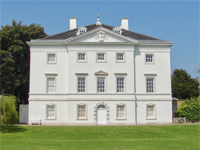
Marble Hill House, Surrey (Image: Maxwell Hamilton via Flickr)

Regarded as one of the finest Palladian villas in the country, the house was built between 1724-29 for Henrietta Howard, Countess of Suffolk and former mistress of George II. On her retirement from court, Lady Suffolk created a new one, centred around her and her villa.  Her friendship with the writer Alexander Pope and the ‘man of taste’ Horace Walpole (whose own house, Strawberry Hill is nearby), created a wide ranging literary, political, and artistic circle which only enhanced the reputation of that corner of the Thames.  The bright-white villa was an obvious reference point for those looking down from Richmond Hill and formed ‘this Earthly Elysium‘, appreciated by those without and within.

As Richmond and Twickenham grew as one of the most fashionable places to visit, so too did the number of artists who recorded the view in paintings, engravings, books and pamphlets. Yet, the rural nature of the suburb which had so impressed those who gazed upon it became increasingly threatened as Victorian London moved west.  With the death of the last owner, the widow of General Peel, in 1887, the house was increasingly viewed with avaricious eyes by developers. In 1901, a local newspaper quoted Jonathan Swift’s 1727 poem ‘Pastoral Dialogue between Richmond Lodge and Marble Hill‘:

Some South Sea broker from the City
Will purchase me, and more’s the pity,
Lay all my fine plantations waste
To fit them to his vulgar taste.

The article carried on to warn that ‘It is the demon builder who will in all probability destroy this historical desmesne with his exhibition of latter day villadom‘. That threat took a more concrete form that same year when, having been empty for ten years, it was finally sold to William Cunard (of the shipping family) who lived in nearby Orleans House (dem. 1926).  His plans involved the villa becoming the centrepiece to a suburban development (oh, how depressingly familiar this all sounds!), and so trees were felled and roads laid. However, the prospect of this view being lost galvanised public opinion, causing Cunard to pause.  The Architectural Review highlighted that with regards to the view:

…it is evident that the deep wedge of woodland formed by Marble Hill is its most necessary and indispensable part; that spoiled, the view tumbles to pieces, with an eyesore for its focus.

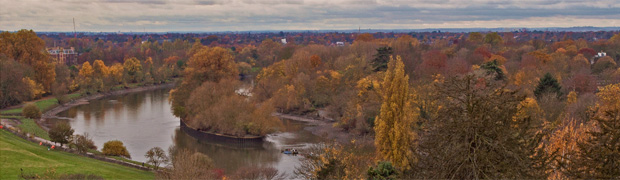
View from Richmond Hill, 2012 - Ham House can still be seen on the left, the only one now not obscured by trees. (Image: Kam Sanghera via Flickr)
View from Richmond Hill, 2012 – Ham House can still be seen on the left, the only one now not obscured by trees. (Image: Kam Sanghera via Flickr)

In July 1901, the Richmond Hill View Executive Committee was formed and, with continued interest from the press, kept up the pressure until in June 1902, following an Act of Parliament, the house was saved. The (slightly over-the-top) speeches on the day it opened to the public reflected a mood and an understanding of the value of heritage and why many fight to save it.  As the press reports stated:

They felt that a national view was at stake; that a historic view was at stake, nay, that a view that was necessary to the whole world was at stake…  It is not only the glory of London, but the glory of the British Empire; and it is one of those things which struck foreigners visiting this country with amazement and delight.

Tattershall Castle, Lincolnshire (Image: Richard Croft via geograph)

Looking beyond such giddy prose, those same core beliefs in the value and wonder of heritage can still be seen today.  Following the Marble Hill victory, further action such as in the Tattershall Castle controversy in 1910 showed that it was possible to mount an effective opposition.  Although not strong enough to prevent the worst excesses of the mass destruction of the country houses in the 1920s, 30s and 50s, these victories were critical in providing a cultural foundation, bolstered by wider appreciation through magazines such as Country Life, for the heritage protection movement which, despite many successes, continues to fight those battles today.

Bylaugh Hall: the hidden history to a remarkable restoration opportunity

Bylaugh Hall, Norfolk (Image: Chesterton Humberts)

Many country houses we can visit today are innately interesting; the design, the contents, the occupants, all tell a tale.  Sometimes though there are houses with a much richer past which not only have an immediate story to tell but also a much more complex history, one fascinating for anyone with an interest in how these houses came to be created. One such house which was recently launched – and amusingly described on Rightmove as a ‘60 bedroom detached house for sale‘ – is the remarkable Bylaugh Hall in Norfolk, an engineering marvel and architectural delight, which had a forced birth through litigation, which wasn’t wanted by the first owner, and where credit for the design hasn’t truly been given to the right architect.

Bylaugh is remarkable in many ways; some obvious, others less so.  Even its genesis came from beyond the grave as the controversial inherited wish of the last owner, Sir John Lombe Bt (b. c1731 – d.1817), a man whose fortune came from the family’s silk throwing mill in Derbyshire.  The Lombe’s were established Norfolk gentry whose original estate was at Great Melton, centred around Melton Hall (built in 1611 by the Anguish family) but now a ruin having been first tenanted and then, by the end of the 19th-century, abandoned.

Allegedly won by Sir John in a skewed card game, the Lloyds had owned the Bylaugh estate for a number of years, and even if the story is false, it was legitimately Sir John’s by c1796.  The Lombe’s were unusual in that their wealth largely came from industry, and one which was located outside of the county, but they quickly used their fortune to create the fourth largest estate in Norfolk, at over 13,000-acres by 1883.

Whatever house was already at Bylaugh was insufficient for Sir John so he resolved to build an entirely new one.  However, the house he had in mind was not the house which was built.  Sir John must have had a fair idea that he would not survive to see his grand plan to fruition but he certainly wasn’t going to let mere death cheat him of his ambition.  Having placed £20,000 in trust for the express purpose of building the house – though without approving a design – he died in 1817 (unmarried and childless), leaving his estate and his firm directions to his brother Edward. Here, the family history becomes a little complicated as Edward was his half brother, the product of an affair with a Norwich doctor’s wife.  Edward adopted the Lombe surname but was reluctant to take on the grand role envisioned by his late brother – which is perhaps why Sir John’s will was so prescriptive, and which led to a quite extraordinary court case.

Edward Lombe disputed with the executors of the estate the instruction to build the new house.  However, Sir John had been quite clear, including this fascinating clause in his will:

And whereas it is my wish and intention that a mansion house and suitable offices fit for the residence of the owner of my estate shall be erected on some convenient spot in the parish of Bylaugh in the county of Norfolk either in my lifetime or after my death and that if I shall not erect the same in my lifetime then that my said trustees shall forthwith after my death erect the same according to such plan as I shall in my lifetime approve of or if I shall die before such plan shall be prepared and completed then according to such plan as the trustees or trustee for the time being under this my will with the consent of the person for the time being beneficially entitled to the immediate freehold of my said manors &c under this my will shall think proper to adopt adhering as closely as possible situation and other incidental circumstances being considered to the plan of the house now the residence of Robert Marsham esquire at Stratton Strawless in the said county of Norfolk. (source)

Yet Edward resisted, delaying the start of the build for years by arguing with the executors, Mr Mitchell and Mr Stoughton, and stating that even if they built the house he wouldn’t live in it.  Finally, in 1828, he went to the Court of Chancery and demanded that the money, now having grown to £43,000, be placed with it and a judgement made as to whether he could overturn the provisions of his brother’s will. The case was still undecided in 1839, by which time the fund had grown to over £63,500, when Edward again pressed his case, with a decision finally being made in 1841 – against him.  The Vice-Chancellor said:

It appears to me to be impossible to read this passage in the will without seeing that there is in the plainest language an express trust for the erection of the mansion house which the trustees are forthwith after his death to commence and to proceed with the erecting of. I cannot conceive any words more plain.

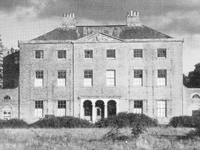
Stratton Strawless Hall, Norfolk - pre 1960 (Image: 'The Country Houses of Norfolk' by David Clarke)
Stratton Strawless Hall, Norfolk – pre 1960 (Image: ‘The Country Houses of Norfolk’ by David Clarke)

Which rather settled that. In the meantime, the executors had not been idle in their duties – but they weren’t as obedient as they might strictly have been.  Sir John had clearly stated that the house was to follow ‘as closely as possible‘ Sir Robert Masham’s house at Stratton Strawless; a three-storey (now two), strictly classical, almost Palladian house with a Tuscan-columned porch.  However, the executors ignored this provision and with possibly an eye to emphasising the esteemed family line and to help the new house blend in with the other seats in the area, they chose to create a historical ‘Jacobethan’-style house – but even that is not the one we see today.

Interestingly, although the current Bylaugh is rightly described as being designed by Charles Barry the younger and his partner, Robert Robinson Banks, few are aware that in 1822 the trustees had originally asked another noted architect, William Wilkins (b.1778 – d.1839), to draw up a plan, and his design showed a remarkable stylistic similarity to the one actually built 27 years later.

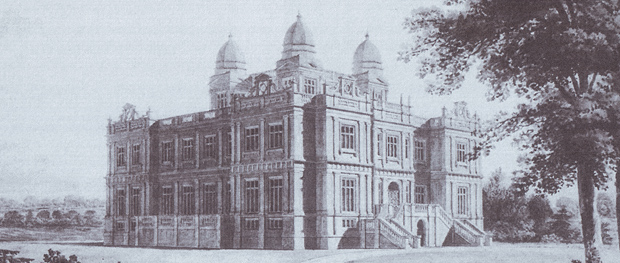
Unexecuted design for Bylaugh Hall by William Wilkins, 1822 (Image: Public Record Office MPA. 66.1 / 'William Wilkins, 1778-1839' - R.W. Liscombe)
Unexecuted design for Bylaugh Hall by William Wilkins, 1822 (Image: Public Record Office MPA. 66.1 / ‘William Wilkins, 1778-1839’ – R.W. Liscombe)

Although a noted proponent of the Greek Revival, Wilkins, like many an architect, was well-educated in other styles and could turn his hand if asked. Clearly inspired by the style of ‘Prodigy‘ houses such as Burghley and Longleat, he also drew on elements of buildings he had seen and studied – for example, the polygonal domes capping the raised central hall are copied from the Porta Honoris at Gonville and Caius College, Cambridge, on which Wilkins had written a scholarly article for the esteemed ‘Vetusta Monumenta‘ in 1809. Although each façade was similar, the entrance front was enlivened by a projecting centre bay above the door which was on the piano nobile, reached by an elegant split stair.

The plan of the house was also modern, rejecting a rambling layout, and firmly following the Palladian 3×3 grid on the ground floor.  Centred around a double-return staircase, this was an innovative layout for an early Victorian design – though one Wilkins the classicist would have been entirely comfortable with.  Essentially, he had designed a Palladian villa, dressed in the architectural garb of the ‘Jacobethan’ style.

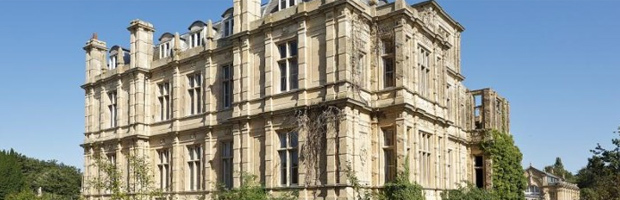
Bylaugh Hall today (Image: Chesterton Humberts)

Bylaugh Hall, as attributed to Barry and Banks in 1849, was perhaps better described as an updated version of Wilkins earlier plan – the core 3×3 layout remained, as did the external style, though some of the details such as the raised central hall and domes were removed, and the central staircase replaced by a saloon.  The construction did display some innovation, being one of the earliest steel-framed buildings and was considered a success with one rather giddy local newspaper exclaiming ‘Neither Holkham nor Houghton, those Norfolk wonders, can compare with it for either appearance or comfort‘.  Such wild exaggeration aside, this was a house at the forefront of domestic convenience and was commended in The Builder for having no corridors in the main block, which maximised the space.  It was completed in 1852 at a cost of £29,389, and by 1869 it was reported that £38,000 had been spent on the project, which would have included further works on estate buildings and landscaping (see photos of the house and grounds c1917).  An interesting aside is that during the delay in starting the money had grown to quite a considerable sum, more than enough for all the works.  Edward Lombe applied for the remainder but the Court demanded it be spent on bricks and mortar and so a 4-mile perimeter wall was constructed to satisfy this.

Ruined shell of Bylaugh Hall before restoration (Image: The Burrell Partnership)

It seems that no descendent ever loved the house.  By 1878, the then owner, Edward Henry Evans-Lombe, was renting the handsomely Classical Thickthorn Hall, before buying Marlingford Hall, whilst selling off outlying parts of the estate.  In 1917, Bylaugh Hall and the 8,150-acre estate were put up for auction in 140 lots but Edward sold it whole for £120,000, and the hall and 736-acre park were subsequently sold to the Marsh family.  Used by the RAF in WWII, it was sold in 1948 to a new owner who unsuccessfully planned to turn it into a nursing home.  At that nadir of country houses generally, a familiar pattern started; parts of the house were demolished and in June 1950 a 350-lot demolition sale was held which stripped the interiors of the house, creating a gaunt and sad shell.  So it remained until, in 1999, the house and a lodge was sold to a local sculptor who dreamt of fully restoring the house but with insufficient funds he was forced to restore just the Orangery (article by the engineers with lots of photos), intending it to be a wedding venue.  Other parts of the main house were parcelled up as investments and rebuilt but the plan faltered and then failed, leaving the partially restored house we see today.

So Bylaugh Hall is a house paid for by a man who never got to see it, with a design chosen by two men who ignored the last wishes of the patron, with credit for that design going to two men who relied heavily on another architect now obscured, for a beneficiary who really didn’t want it in the first place. A brilliant story richly illustrating the fascinating complexities of our country houses.

So what should happen to this superb house? Interestingly, the 557-acre Pavilion farm which surrounds the east and south of the house, and includes one of the original lodges, is also for sale, providing the opportunity for the right person to combine them both.  It would require real vision – the restoration work at Bylaugh Hall may be sound but the aesthetics are dire.  Given the budget, much of the existing restoration should be stripped right back and the interiors given the lavish attention they demand.  This is a house which cries out for sumptuous plasterwork and panelling, for grand rooms with fine wallpaper and filled with artworks and quality furniture. With the funds and the vision to take advantage of this rare opportunity, a restored Bylaugh Hall, combined with the farm and more land later, could once again create one of the finest estates in Norfolk.

—————————————————————————–

Property details

1917 auction catalogue:

Listing description: ‘Bylaugh Hall‘ [British Listed Buildings]
Merry Christmas and a Happy New Year

The east front of Hardwick Hall, Derbyshire, in the snow. (Image: National  Trust Picture Library)
The east front of Hardwick Hall, Derbyshire, in the snow. (Image: National Trust Picture Library)

It’s that time of year when I especially wished that I actually lived in a country house; the decorations, the roaring fire, the snow on the parkland. That said, I am lucky enough to write about and visit them – in 2012 I saw:

…and Buckingham Palace, twice (bit of advice: if going, book the last time slot of the day – it’s quiet and a pleasure.  Going in the middle of the day, not so much). Most of these visits were through organisations such as the Georgian Group, the Irish Georgians, and the Society of Architectural Historians of Great Britain. They, and of course, the National Trust, do excellent work – both practical and scholarly – and are well-worth joining if you’d like to find out more.  I was also lucky enough to attend the Attingham Trust 60th Anniversary Conference which was a wonderful opportunity to meet some real experts and also, unexpectedly, some friends of the blog.

Of course, I remain grateful for the incredible interest shown by the tens of thousands of visitors to the blog who kindly read my articles and comment.  I always appreciate feedback and thank you for taking the time to do so.  In mid-December, the blog hit the milestone of 250,000 page views in a year – so the milestone is now a benchmark and I hope to bring our country houses to an even wider audience next year.  Thank you also to all those who have signed up by email and on Twitter (@thecountryseat), which has proved to be a useful channel for sharing snippets of news and connecting with those interested in houses specifically, and heritage generally.

More contributors?

In 2013, I’m aiming to build on the successes of the last few years.  Of course, there will be more articles, however, I’m conscious that the frequency has dropped, mainly due to my ever busier day job.  I’d be interested to have your thoughts on whether you would like to read articles by other contributors? I have written all of them so far (bar a brilliant piece on ruins by Jeremy Musson back in 2011) but there are many other writers out there who would undoubtedly bring greater and wider expertise on country houses.  At the moment, I write mainly about the architecture (especially the exteriors) but would you be interested in someone writing about say, plasterwork, on specific houses, the contents, or other aspects? I’d also be keen to hear what you would not be interested in reading about. It’s possible that the blog could become a platform for experts in their respective fields who may not wish to maintain their own blog or go down the academic journal route.  Anyway, it’s just a thought and I’d be keen to have your feedback either in the comments below or via email.

Thank you again for your interest and I wish you all a very Merry Christmas and all the best for 2013.

Matthew

The estate office: country houses as corporate headquarters – and Barrington Hall, for sale

Barrington Hall, Hertfordshire (Image: Hamptons)

In many ways, a country house was often the headquarters of a business relating to both the estate and the affairs of the family who lived there.  This role was to be mirrored in the latter half of the 20th-century as firms sought to adopt the prestige of stately homes and set up their offices in the many country houses which were then available. What grander statement could a company make to clients and investors than to invite them to visit their stately offices?  Yet times changed, and over the years companies found it harder to justify such lavish accommodation, leading to a steady trickle of houses being sold – and the latest is Barrington Hall, Hertfordshire.

Shalford Park, Surrey (Image: (c) Allianz Insurance Plc via Shalford Village)
Shalford Park, Surrey (Image: (c) Allianz Insurance Plc via Shalford Village) – click for an excellent history of the house

The Second World War ushered in the modern era of offices in country houses.  With little by way of aerial bombing, few firms saw the need to move out of London and other cities in World War I, however, this danger had dramatically increased by 1939.  Faced with the significant logistical challenges in moving their vital paper-based records and operations, the late 1930s saw a number of companies actively scouting out possible alternatives, with country houses an ideal choice due to their size and seclusion.  This new lease of life enabled some houses to escape the demolisher’s pickaxe, such as at Shalford Park in Surrey.  A solid, well-proportioned Georgian house, the result of a rebuild of an older house in 1797, had been sold to Guildford Borough Council in 1938, but primarily to protect the land from development, with the intention that the house be demolished.  However, a lease was granted to the Cornhill Insurance Company (later part of Allianz Inc) who moved there in 1939, creating dormitories on the upper floors.  Cornhill were to remain at Shalford Park until 1955, but unfortunately the condition of the building had significantly deteriorated, and combined with it being in the ideal location for a new local water treatment works, meant that the house was demolished.

Wrest Park, Bedfordshire (Image: English Heritage)

One house which fared only slightly better from this type of arrangement was the beautiful Wrest Park, Bedfordshire.  A fanciful French château, it was built in the 1830s to the accomplished designs of the owner, Thomas de Grey, 2nd Earl de Grey, and features some of the finest, and earliest, Rococo Revival interiors in the country – of particular note is the spectacular staircase.  The house was sold in 1939 for £25,000 by John G. Murray to the Sun Insurance Company (later Sun Alliance) who bought it in anticipation of war. They promptly moved there from London once war had been declared, having made plans to ‘…alter the stable block and erect huts in the grounds for sleeping quarters, together with washing facilities and air-raid shelters … the stable block was the first area to receive our attention. The whole of the East Wing and the upper storey of the West Wing were to be converted for sleeping accommodation with toilet and washing facilities. The middle connecting section was also to be similarly altered, but it was later decided to make part of the upper storey into a communal long room.‘. Such scenes were undoubtedly repeated in many a country house – though such a use was preferable to the treatment meted out at the hands of enlisted men or children.

Cranbury Park, Hampshire (Image: Angus Kirk via flickr)

Other houses had the good fortune to secure relatively benign tenants for the duration of the war. The imposing Stratton Park, Hampshire, was built between 1803-06 by George Dance the Younger for Sir Francis Baring, Lord Northbrook, a founder of Barings Bank. Although it had been sold following the death of his descendent, Francis Baring, 2nd Earl of Northbrook in 1929, the house was bought back by Barings Bank in 1939 as their base for the duration of the conflict (though sadly it was demolished in 1960 by a later Baring who had bought it after the war).  The choice of house was possibly influenced by the fact that the Bank of England had decamped to the nearby beautiful Cranbury Park, also in Hampshire – and, coincidentally, also designed by George Dance the Younger, but built in 1780.  This little known house, still lived in today by the Chamberlayne family who commissioned it, has particularly impressive interiors; the hall and ballroom were described by Pevsner as an ‘unforgettable experience‘. Compared to the horrors of the bombing in London, what a strange pleasure it must have been to be stationed in such an environment.

Banqueting House, Wrest Park, Bedfordshire (Image: English Heritage)

The extensive alterations to even such an important house as Wrest Park indicated the level of damage such intensive use could bring to buildings which had not been designed for such a purpose.  The post-war era held many threats to country houses and use as offices saved many from the wave of destruction which led to the demolition of so many in the 1950s.  In 1949, Wrest Park was sold to the Ministry of Works, who leased it to the National Institute of Agricultural Engineering, later called Silsoe Research Institute which inflicted even more stress on the house and estate.  Although Simon Jenkins included it in his book ‘England’s Thousand Best Houses‘, he wrote that ‘The [Institute’s] outbuildings spoil the approach avenue and its abuse of the interior is dreadful.  The best of the reception rooms, the library, is packed with modern bookcases and computer equipment. Other rooms are cheaply kitted out for lectures and seminars.  It is like a Soviet academy of sciences camped in a St Petersburg palace.’. Thankfully the Institute closed in 2006 and the ground-floor rooms of the house (sadly, office space remains), along with the superb gardens and Thomas Archer‘s sublime Baroque banqueting house have been expertly restored by English Heritage.

Hursley House, Hampshire (Image: Sarah Graham via Panoramio/Geolocation)

The pressure to create more space is often the cause of the most damaging changes to a country house.  Simon Jenkins’ criticism of the additional buildings at Wrest Park can similarly be levelled at the extensive construction which has taken place at Hursley House, Hampshire, home of IBM UK.  The house itself was originally built between 1721-24, with ‘gentleman architect’ Sir Thomas Hewett acting as architectural consultant for Sir William Heathcote, and with further major reconstruction in 1902-03 to create the imposing Queen Anne house which appears in various marketing materials.  What the images don’t show is the huge campus (of fairly ugly buildings) which has sprung up so close to the house since IBM took over the site in 1958. A more intelligent approach to the siting of extra accommodation can be seen at the Computer Associates site at Ditton Park, Berkshire, where the new office buildings have been placed a sensitive distance from the main house.  If their priorities changed, the house could be sold and could resume a comfortably independent existence even if the offices remained in use.  Such a change might once have been expected at Donington Hall, Leicestershire, which served as the headquarters for the airline BMI for many years until the recent merger made it redundant.  Sadly, it’s actually unlikely that anyone would chose to live there as there would be no peace and quiet as the parkland has long been converted into the Donington Park race circuit, just half a mile south of the house.

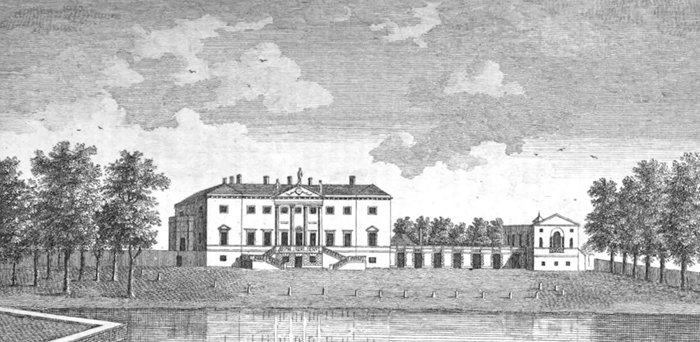
Barrington Hall, Hertfordshire (Image: from "A New Display of the Beauties of England" (London : 1776-1777))
Barrington Hall, Hertfordshire (Image: from “A New Display of the Beauties of England” London,  1776-1777) – click to see full size image

Sadly, it is uncommon for a house, once it has been used as offices, to escape such a fate being made permanent.  The alterations and additions can render the house a soulless shell with the grounds ruined beyond the possibility of economic rescue.  However, some have survived this role remarkably intact and, if the possibility presents itself, offer a remarkable opportunity to rescue a house and bring it back to the glory of being a single family home.  One such example is Barrington Hall, Hertfordshire, which has had something of a chequered history.  The original house (above) was built between c1735-40 for John Barrington to designs by John Sanderson (b.? – d.1774), a man who Colvin wrote was described as a competent ‘second-generation Palladian’, who worked on an impressive roster of houses including Hagley Hall, where he proved to be an accomplished designer of rococo decoration, Kelham Hall (burnt down 1857), Kirtlington Park, Pusey House, Langley Park, Copped Hall, and Kimberley Hall.

Barrington Hall, Hertfordshire (Image: Hamptons)

Barrington Hall remained unfinished (despite the engraving above) and was uninhabited for 128 years due to, what the estate agents refer to as, ‘bizarre and unfortunate events‘ (anyone with more details please do post a comment!). The house was eventually restored in 1867 by George Lowndes, a distant relative of John Barrington, who employed the Lincolnshire architect Edward Browning to remodel it in a Jacobean style. The changes created an attractive house with a varied and interesting form, featuring a series of handsome architectural details such as the ‘Dutch’ gables, quoins and a miniature ogee turret.  The house was bought by the Gosling family in 1903 who had merged ‘Goslings Bank‘ to create Barclays & Co in 1896. It was then sold in 1977 to the British Livestock Board who converted it to offices and then subsequently sold in 1980 to CPL Aromas LTD, a family perfumery firm who seem to have had some challenging times following an ill-fated public listing in 1994, which they reversed in 1999.  Having remained at Barrington Hall it now seems that the company has reviewed its requirements and decided that a stately home is a luxury no longer required.

Although originally offered several months ago for £5m (with 32.85-acres), it seems possible that a serious, but lower, offer could be successful.  It would probably take at least £2m to restore this fascinating house, creating the rich and lively interiors which it needs to match the exterior and bring it back to life, but whoever did so would have the pleasure and pride of having rescued an interesting country house from the drudgery of corporate service.

—————————————————————————–

Sales website: ‘Barrington Hall‘ [Hamptons] – which, by the way, is a pretty weak effort.  Nice photos but quite lacking in details.

Listing description: ‘Barrington Hall‘ [British Listed Buildings]

Know any more? If you’re aware of any other country houses of a similar size to Hursley House, Ditton Park, or Donington Park, please post a link (ideally) to a Google Map aerial view in the comments below.

N.B.: an earlier article on this blog (‘Converting country houses from commercial to residential: a sound investment?‘) looked at a few other examples including Gaddesden Place, Hertfordshire, now the headquarters for Xara software, and Benham Valance, Berkshire.