West Wycombe House at risk from high-speed rail link?

buckinghamshire-westwycombehouse
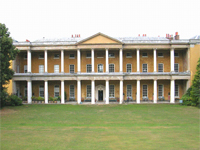
West Wycombe House

Concerns have been raised that the proposed route of the £34bn Network Rail project to provide a high-speed link to Scotland will severely compromise many areas of natural beauty and a large number of listed buildings including the setting of the Grade-I listed West Wycombe Park in Buckinghamshire.

The main problem lies in the fact that to achieve high speeds, the 1,500 miles of railway lines would need to be laid in the most direct line between two locations.  This would mean that the line would simply carve through the landscape, destroying areas of Special Scientific Interest and unspoilt countryside in the heart of the Chilterns such as the Misbourne valley.

One proposal of particular concern is to build tunnels beneath High Wycombe but the Chilterns Conservation Board (CCB) fear that the tunnel would surface near the historic village of West Wycombe – threatening the  stunning setting of the architecturally important West Wycombe House.  The Italianate-style house with it’s rococo gardens were built by Sir Francis Dashwood – of Hellfire Club fame – over a period of 60 years from 1740. The defining exterior feature is the rare double colonnade (see picture) which was certainly inspired by Palladio’s work in Italy such as the Palazzo Chiericati which Dashwood would have seen on his Grand Tour.  Further Palladian and neo-Classical flourishes in both the house and parkland make this house worthy of protection from crude spoilation by the planners.

More details: ‘High speed rail line will blight Chilterns‘ [Chilterns AONB]

Ouch – Melville House sold for £1.6m; down from £4.5m

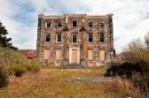
Melville House, Fife

In a cautionary tale of how ambitious restorations can come unstuck, Melville House has been sold for a ‘knock-down’ £1.6m by agents Knight Frank.  The 17th-century Palladian mansion boasted 11 bedrooms, seven receptions plus stables, a tennis court and even a cricket pitch.  It was built in 1697 for George, the 1st Earl of Melville, then secretary of state for Scotland by James Smith.  The 1st Earl died a few years after his creation was finished but the house remained in the Melville family until it was sold – along with the contents – in 1949.

It had been requisitioned by the Army as a barracks during the war (the probable damage from which led to the sale) and then became a hospital and subsequently a residential school before being sold to a developer for £400,000.  It was then sold on again in 2003 for £1m and the new owner then spent over £2m on restoration.  The latest owner has secured a bargain – here’s hoping it’s now in safe hands.

Full story: ‘Repossessed mansion sold for ‘knockdown’ price‘ [stv]

Mentmore’s London sibling for sale

Mentmore Towers
Mentmore Towers

Simon Halabi’s original plan was to develop a super-luxury, six-star club experience with members enjoying country facilities at Mentmore Towers, in Buckinghamshire, with a London base at the In and Out Club on Piccadilly.  However, the recent global crisis seemed to put the plans on hold and concerns had been raised (including in comments on earlier blog post: ‘Simon Halabi and Mentmore Towers’ – 17 July) as to whether sufficient maintenence was being undertaken at both locations.

The master plan appears to have now been changed with the news that the In and Out Club has been put up for sale.  Included in the deal are various neighbouring buildings which give the potential for the sale to raise up to £250m. It’s not known what Mr Halabi’s plans are but one can only hope that the money raised will benefit Mentmore Towers, preserving and protecting this important country house.

Full story: ‘Mayfair’s In and Out Club on market‘ [Financial Times]

Nocton Hall ‘amongst 10 most endangered’

Nocton Hall (Image from Wikipedia)

Nocton Hall suffered a devastating fire in 2004 and since then has remained a roof-less, though restorable, shell with no sign that the new owners have any inclination to rescue this interesting and attractive house.

The original Nocton Hall burnt down in 1834 and the new house was built by William Shearburn for the Earl of Ripon in 1841.  It was then taken over by the Air Ministry in 1940 for use as a hospital for RAF Nocton.  The RAF left in 1983 following which it became a residential home.  However, in the mid-1990s the business failed and it was bought by a local developer, Leda Properties.  A then sadly familiar story played out with the house ravaged by vandalism and theft before the ‘suspicious’ fire in 2004. 

The Victorian Society have now declared that the Grade-II listed Nocton Hall is one of their ‘Top 10 Most Endangered Buildings’ in the country.  Hopefully this will again focus some attention and, along with the concerns of locals, will perhaps prompt Leda Properties to declare their intentions.  One hopes that this is not another case of a developer hoping that further vandalism or fire will give them the opportunity to apply for permission to demolish.  Lincolnshire has lost far too many of it’s country houses already over the last 100 years – there is no reason beyond stubborn greed why Nocton Hall should be added to the list.

Full story: ‘Nocton Hall a ‘top 10’ endangered building‘ [Lincolnshire Echo]

Scraptoft Hall at risk from ‘rescue’

Scraptoft Hall
Scraptoft Hall

A proposal to restore Scraptoft Hall, a much-neglected Georgian mansion, as part of a large development scheme has been challenged by English Heritage. 

In what may be seen as a return to the mis-guided approaches of the 1970s and 80s, a local developer has dangled the ‘carrot’ of restoration of the Hall whilst seeking permission to build a huge 103-apartment retirement village in the grounds.

Scraptoft Hall was largely built in the early 1720s but the core dates back to the 1500s, however, in recent decades the elegant house had been adandoned and beset by theft and idiot vandals who had set fire to some areas. 

Harborough District Council is ‘minded’ to approve the plans but English Heritage has objected that the proposals would seriously compromise the setting of the hall. 

If approved this scheme would reduce this elegant house to a mere architectural curiousity in the middle of  a huge development.  The Council should reject this scheme – even if the developers claim it’s the only hope.  The sacrificing of the house to enabling development is make a mockery of heritage protection and would encourage other like-minded developers to consider that all old buildings with a bit of land are fair game for their destructive tendencies.

Details of the inquiry: Scraptoft Hall redevelopment inquiry

Full story: ‘Project ‘will restore Scraptoft Hall to its former glory’‘ [Leicester Mercury]