Seaton Deleval Hall nationalised

Seaton Deleval Hall

It’s been announced that the National Trust has today succeeded in it’s campaign to acquire Seaton Deleval Hall, regarded as one of the finest Baroque houses in England.  However, the success in securing the future of the hall has again come about as a result the damage caused by inheritage tax leading to treasures – usually art or antiques, but sometimes buildings – being taken into ‘national’ ownership rather than remaining in private hands.

Seaton Deleval Hall was built for Admiral George Deleval by Sir John Vanbrugh and was completed in 1871.  Vanbrugh’s other notable commissions included Castle Howard and Blenheim Palace.  However the house suffered a devastating fire in 1822 which gutted the central block which remained as a shell until 1980 when the 22nd Baron Hastings (Edward Delaval Henry Astley) partially restored it.

The 22nd Baron and his wife both died in 2007 triggering a significant inheritance tax bill.  It was this that led to the house being put up for sale and the start of  a fund-raising campaign to save it for the nation.  The house and 400 surrounding acres have now been accepted in lieu of £1.7m of tax (the first time since Calke Abbey in 1984) with the contents covering a further £3.2m.

The National Trust have generously contributed £6.9m to the endowment with a further £3m raised to cover other costs associated with opening it to the public.  The first visitors are expected to arrive in April 2010, part of an estimated 50,000 a year who will be able to see one of Vanbrugh’s masterpieces.

So whilst there is a success in that the house will now be secure and not carved up into flats, it’s still a shame that another part of our national architectural heritage is denied its primary function of being a home.  Inheritance tax has a pernicious creep – it can’t be avoided and just results in each generation selling off more historic artefacts to fund government budgets.  Give it a few hundred years and one conclusion could be that a majority of the crowning jewels of our artistic heritage including buildings, art and antiques could well end up being owned by a national organisation, be it the National Trust or the galleries.  For me, the art treasures of a nation are best located in the houses and families for whom they were produced or bought for, rather than part of a vast national archive, only brought out once a decade or less.  Inheritance tax makes a relatively small contribution to the national budget but it does have a disproportionate impact on our cultural heritage.

Full story: ‘National Trust saves stately home‘ [BBC News]

National Trust takes control of Seaton Delaval Hall‘ [The Art Newspaper]
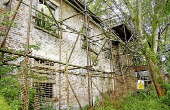
Fight for Elmswell Old Hall to carry on

Elmswell Old Hall (Image: Hull Daily Mail)

Campaigners have vowed to continue the twenty-year battle for Elmswell Old Hall despite the latest setback.  The house, near Driffield, was built in 1642 and the home of the seventeenth-century agricultural diarist Henry Best – but the last time someone lived in the house was in 1965.  Although Grade-II* listed and thought to be one of the first brick-built houses in Yorkshire, it has slowly fallen into such an advanced state of dereliction that the owners have requested permission, via an entity ironically named ‘Elmswell Heritage Ltd’, to partially demolish what remains and consolidate the rest as a ruin.

An alternative plan, supported by locals and the Yorkshire Buildings Preservation Trust, has been put forward by the Spitalfields Trust who have a long record of restoring Georgian townhouses and historic country houses including the recently for sale Shurland Hall.  This plan would not only consolidate what fabric of the building remains but would also then restore it for use as a home. However, a major obstacle is that the house and land are owned by the same estate who have made it clear that the plan was unfeasible as they would not sell land nor access to the house.

So the future for the house appears to be that of architectural curiosity, open occasionally for school visits and scholars.  Unless a miracle happens, is seems another piece of Yorkshire, and the nation’s, heritage has been effectively lost due to fifty-years of neglect by the owner and the local council who should’ve stepped in decades ago to protect the hall.

Full story: ‘Preservation fight goes on even after building demolition backed‘ [Yorkshire Post]

Quick news roundup: Gelli Aur, Raasay House, overseas buyers

Welsh mansion appeal for armed forces retreat‘ [BBC News]

Raasay House: ‘Work to start on fire hit centre‘ [BBC News]

Overseas buyers snapping up country houses‘ [Country Life]

Cherkley Court closes to the public

Cherkley Court, Surrey (Image: geograph.co.uk)

Despite the continued visitor success of the more famous country houses such as Castle Howard, the closure of Cherkley Court  in Leatherhead, Surrey, to the public shows that the smaller houses can find it much harder to make a profit.

The house was built in the 1860s but rebuilt in a French chateau-style following  a serious fire in 1893 and was home to the press baron Lord Beaverbrook. Now the charitable Beaverbrook Foundation which owns the house has decided that their funds can no longer subsidise the running of the house.  Previously the grounds had been open to the public and a new cafe and gift shop had been built in 2008 but even this failed to lift visitor numbers sufficiently. 

So what does the future hold?  The foundation have confirmed that it will honour all events and weddings already booked but will not be taking any more.  Although the house and estate was recently valued by Savills, it’s unlikely (though not impossible) that it might be put up for sale.  However this might actually be good solution as the many millions the sale would surely raise would be a healthy boost for the Foundation’s other charitable work but would also ensure that the house was in use which is the main protection against creeping neglect.  Fingers crossed that whatever the outcome, this interesting house is preserved for the future.

Full story: ‘Beaverbrook’s Leatherhead country home Cherkley Court closes to public‘ [Epsom Guardian]

Eshott Hall, Northumberland, finally sold

Eshott Hall, Northumberland (Image: telegraph.co.uk)

One event which can always creates a certain risk for country houses is the bankruptcy of the owner.  Once the contents have been sold, apart from the lack of maintenence, an empty house can be a magnet for the thieves who think nothing of stripping fixtures and fittings and even the lead off the roof.  So the news that Eshott Hall in Northumberland has now been sold following the bankruptcy of the owners is to be welcomed as hopefully the house will remain in use.

Full story: ‘Future of hall to become clear as sale nears‘ [The Journal]