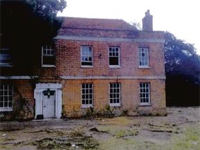
When the beautiful Grade-II* listed, Queen Anne-era Stanwick Hall came up for sale in 2006, many would have been surprised at the relatively low asking price of £1.1m.
Though the house came with seven bedroom and 11-acres in the Northamptonshire countryside, it also came with an ‘At Risk’ rating from English Heritage due to the structural problems.
Despite this it did sell and now Endemol have expressed an interest to the architect in charge of the restoration, Anthony Rickett, who has agreed to let them follow the work. It’s always pleasing to hear of houses being restored and it’s even better when the work is brought to the attention of the wider public so they can also appreciate the hard work that is done to maintain these vital pieces of our heritage.
Grafton New Hall, Cheshire (Image: Ushida Findlay Architects)
The building of a country house used to be the ultimate expression of success. It was the sign that a man had achieved much that he wished to do and was now able to devote time and resources to this rural ‘badge of honour’. Importantly, the success, learning, and attitude of the owner was to be expressed through his choice of architecture. This determined individualism led to a vast range of styles – French chateau, gothic, ne0-classical – but one style which is lacking is the modern(ist) country house.
The FT report highlights how, after the decline in country house ownership during the early 20th century, those few country houses which have been built have been largely of a Classical design. Indeed, when Ushida Findlay Architects proposed a radical ‘starfish’ design to replace the old Grafton Hall in Cheshire, the plan languished for years, never attracting an owner wishing to invest in the concept. However, permission has now been granted for the construction of a large Classical house by Robert Adam. This is another sign of the hold that this elegant style of architecture still not is aesthectically pleasing but also appeals to the ‘masculine’ objectives of building a house which states the power and wealth of the owner.
This attitude has moved modern country houses into the realm of the bespoke, ultra-luxury market and away from the aspirations of the merely wealthy. In many ways, it’s good to see our exsiting stock of houses being cared for but there is also an important architectural history which needs to be expanded through the building of high-quality, modern country houses – able to meet the demanding standards of the contemporary rich but also to push forward the design of one of the most important elements of British architecture.
It seems that, despite the claims of the owner/developer of Brook House in Tiptree, Essex, English Heritage haven’t said that the house should be demolished. Following on from the earlier story (Another house at risk from a developer: Brook House, Tiptree, Essex – 25/11/09) a local resident has flagged up a new story with EH now saying that although they believe the house to be in poor condition they have not said it should be demolished.
John Neale, English Heritage team leader for Essex, has confirmed that they are still examining the application – leaving the statements of the owner in his application to demolish looking somewhat precarious. Let’s hope that EH, and Colchester Council listen to the concerns of the local residents and Tiptree Parish Council and not only refuse the demolition but also serve an urgent works notice to save this interesting part of the local architectural heritage.


 The Country Seat