The growing silence: how many UK country houses were lost?

Slowly, then suddenly, many estates grew silent. Carriages no longer clattered down the drives. Entrance halls no longer echoed to voices. Kitchens went cold. Staff quarters were emptied. Then, the contents were sent to the auctioneers. Finally, the house was broken apart; hammers and pickaxes the new sounds as hundreds of years of history were reduced to rubble.

One key questions which architectural historians have been trying to answer for a number of years is just how many UK country houses have been lost? The answer, for now, is over three thousand. Each was a world on its own, but also part of the complex jigsaw of our national heritage.

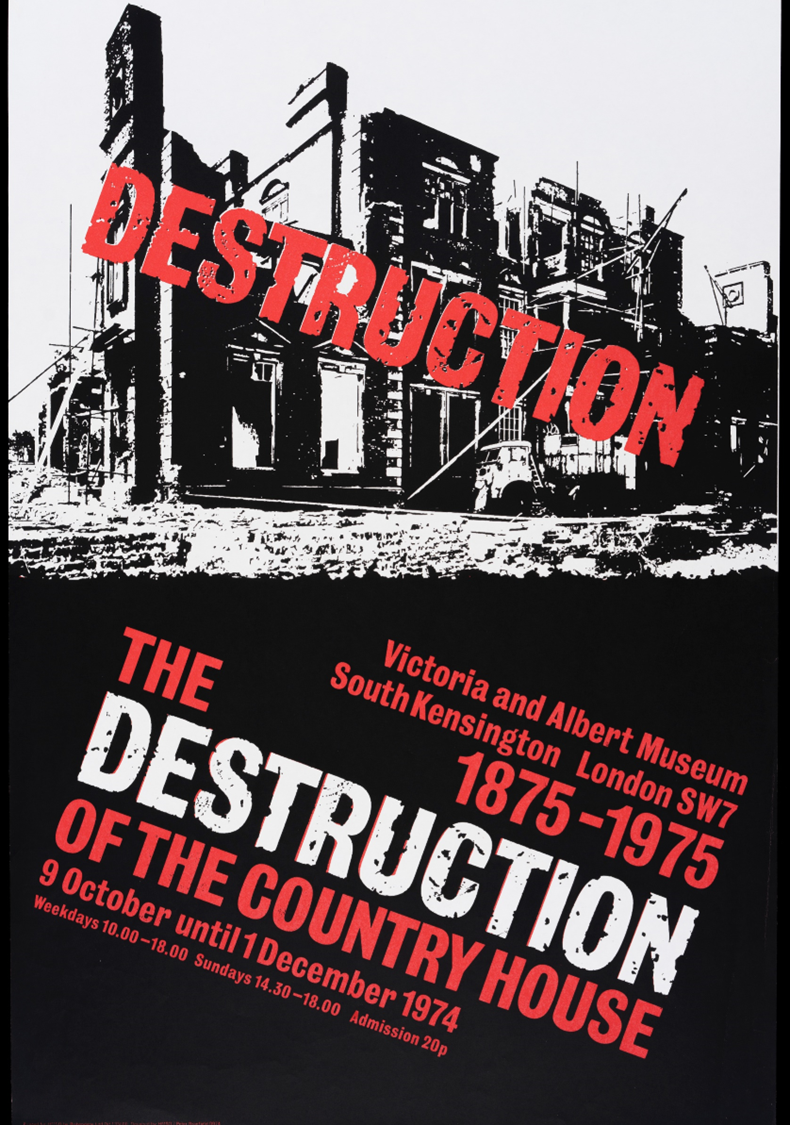
The genesis for this area of research was ‘The Destruction of the Country House‘ exhibition, which ran from 9 October – 1 December 1974 at the Victoria & Albert Museum in London. I have written about it on a number of occasions so if you would like more insights into it, you can read my article on the 40th anniversary or my reflections on the 50th anniversary.

The position of the landed elites was considered the bedrock of society. The families provided political leadership, social aspiration, and were the centre of the local economy through their employment and expenditure. Land ownership was the passport to this elite status; the open market a safety valve which enabled ‘new money’ to mix with the old, to want to emulate them rather than remove them. This allowed new families to fluidly move up from merely wealthy to established gentry or nobility. After a few generations, the land functioned as an older form of ‘green-washing’, the verdant parkland obscuring where the family had started. Within a few short centuries (though sometimes it was just decades), they had become the elite.

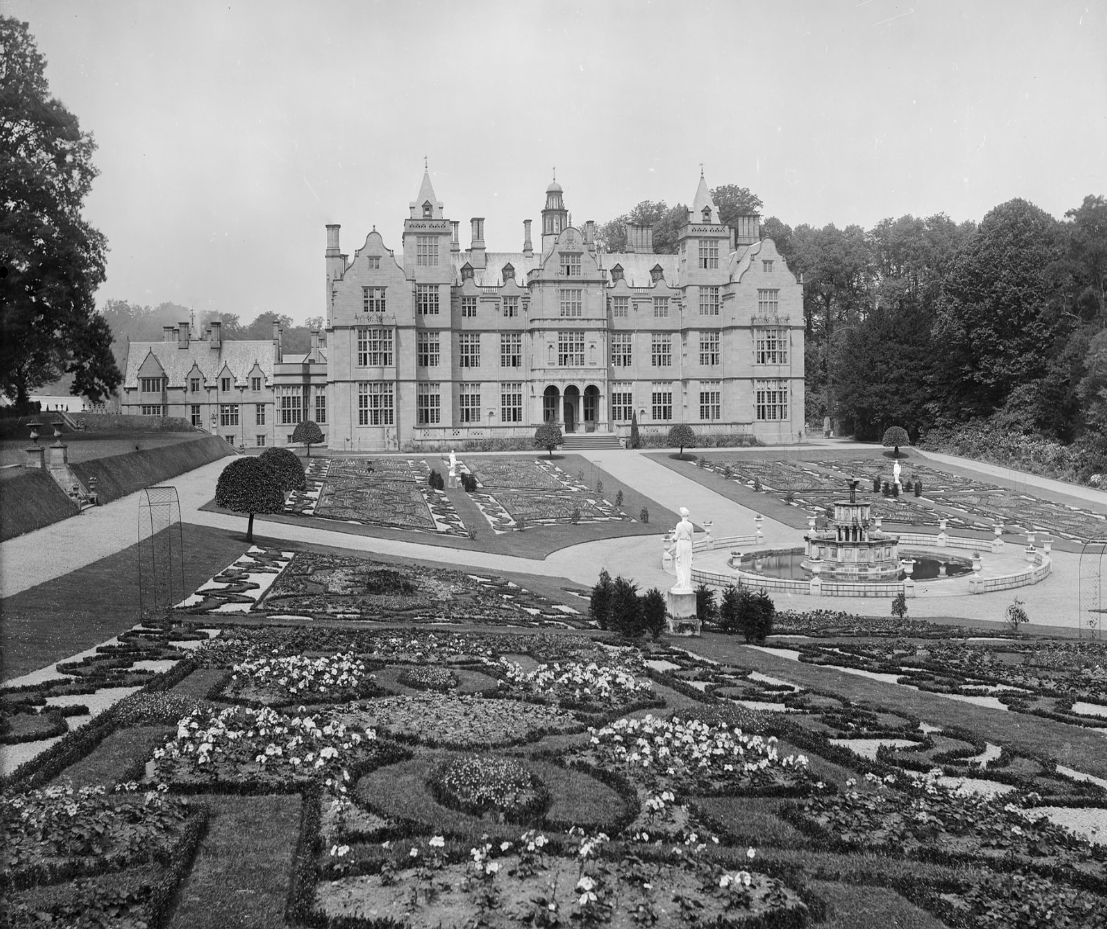
Rounton Grange, Yorkshire – seat of the Bell baronets, of Rounton Grange and Washington Hall (1885). House demolished 1954.

However, the first half of the twentieth century was, for the owner of these large houses, often financially, socially, and politically challenging. The repeal of the Corn Laws in 1846, which opened our markets to cheaper overseas produce, combined with the agricultural depressions of the latter-half of the nineteenth century, had undermined many of the assumptions about the financing of the country house. As debts grew, so the stark financial reality of the situation they were in began to dawn. For many, the path to recovery seemed to be to sell non-core assets such as artworks or outlying estates and hope that this would tide them over until their incomes, usually agricultural, recovered. For those who sold their land early and invested in the stock market, the crash of 1929, was another blow to their planning. As is so often the case, the markets remained against them longer than they could remain solvent.

When Aldous Huxley published his first novel, ‘Crome Yellow‘, in 1921, the challenge to the country house was already significant enough to feature as the fate of the imaginary Gobley Great Park;

‘A stately Georgian pile, with a façade sixteen windows wide; parterres in the foreground; huge, smooth lawns receding out of the picture to right and left. Ten more years of the hard times and Gobley, and all its peers, will be deserted and decaying. Fifty years, and the countryside will know the old landmarks no more. They will have vanished as the monasteries vanished before them.’.

Thankfully, Huxley’s apocalyptic vision wasn’t fully to come to pass. However, from the relatively low levels of losses in the nineteenth-century, the twentieth-century would bring decade after decade of destruction. It’s worth remembering that this was largely a crisis of the country house, not the wider estate. The land was considered more valuable as an income-generating asset and for the social prestige it conferred. Without the expense of the house – the maintenance, the staff, the general running costs – so the income was better able to meet their expenditures. Mr Micawber would be beaming with pride.

So, when seeking to bring their expenditure within the available income, the house was considered a necessary sacrifice. And with so many other families also facing a similar situation, the loss of any one house would be obscured by the loss of so many others. The problem with simple data is that it belies the dramatic local impact the loss of a house would have been. The country house and its estate embodied the idea of stability. The idea of a family owning the house and land and passing it down through the generations was – and arguably still is – embedded firmly in our national psyche, even if the family did change every few hundred years. The key difference in the twentieth-century was that there was often no other family to take their place.

In this dark era, houses languished on the market. This was often evidenced by adverts for the same properties appearing with sad regularity in magazines such as Country Life. It brought reminders of the increasing threats to the established order of the countryside into the drawing rooms and libraries of those most at risk.

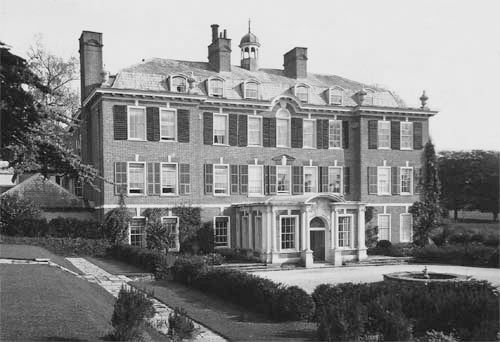
Typical advert in Country Life magazine. Key aspects to note: the house is unnamed (though I think it is the infamous Burwell Hall, demolished in 1958), the language emphasises cheapness: ‘moderate price’, ‘modern conveniences’, ‘inexpensive gardens’. (Advert from Country Life, 10 November 1923, pg. XIII)

Each week, beyond the adverts in Country Life, ‘The Estate Market’ page offered a running commentary on the changes. For example, the headline for that page on May 5th 1922, was stark: ‘Demand for small properties’, with the opening paragraph stating, ‘The brightest section of the market is that in which the smaller properties are dealt with…’. Coverage includes the sale of Sudbourne Hall, Suffolk, saying it had sold with 500 acres, having first been offered as a whole but failing to find a buyer, it had been split up. The house was later demolished in 1953.

Another paragraph is headed ‘Mansions as sanatoria’ and writes approvingly of how Lords Londonderry and Boyne have both ‘generously offered’ Seaham Hall and Brancepeth Castle respectively for ‘hospital purposes’. Specifically, it states that Seaham Hall ‘…has had to be closed in consequence of taxation and the heavy cost of upkeep.’ (it survived and is now a hotel). It also mentions that Rendlesham Hall, Suffolk, has been sold for use as a ‘…retreat for drug-addicts and inebriates…’. It was also later demolished in 1949.

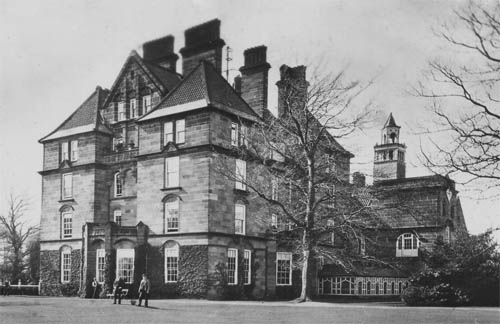
Sudbourne Hall, Suffolk, demolished in 1953 (Source: www.lostheritage.org.uk | More images)

During the nineteenth-century, the available data shows that there were fewer losses; approximately one a year. However, when considering the data, there are a few caveats to remember. Critically, the data for the nineteenth-century is thinner than the twentieth-century. Fewer books had been produced, research was sparse, and even confirming if a property was of sufficient stature to be classed as a country house is sometimes challenging. Fire and replacement by a new house were two of the most common reasons.

So how many have been lost?

Quoted in The Daily Telegraph magazine in 2007, the leading country house historian of the lost houses, the late John Harris, said that:

‘At the time [before the V&A exhibition], we reckoned that about 750 houses [in the UK] had been pulled down between 1880 and 1970. Now we know it’s about 1,800.’1

Sadly, John’s estimate was still too low – 1,800 doesn’t even cover England alone.

The gazetteer at the back of ‘The Destruction of the Country House‘ exhibition catalogue listed a total of 1,099 houses (740 for England, 313 Scotland, 46 Wales, with NI not included). This list had been compiled by John, Marcus Binney, and another researcher, Peter Reid, and explicitly stated it was not exhaustive. The total for England was updated with the publication in 2002 of ‘England’s Lost Houses‘ by Giles Worsley which added 445, to total 1,185 for England. However, Ian Gow’s ‘Scotland’s Lost Houses‘ in 2006 listed only 308 (5 fewer than before) but also included examples of houses in cities (which I have excluded from that total).

The task of taking the ground-breaking earlier research forward and to resurrect the memory of these otherwise obscured houses, has now been taken up by amateur enthusiasts, supported by the invaluable work of historians who have focused on specific areas. I started researching the English lost houses in 2006, compiling what I hoped would become the most comprehensive record. All the details, including detailed histories and thousands of images, are shared on the Lost Heritage website.

Using the same model, this was followed over the years by Dr Alastair Disley for Scotland, Dr Mark Baker for Wales, and Andrew Triggs for Northern Ireland (he also took on the much larger task of the Republic of Ireland).

Distribution of English lost country houses since 1800. Source: Matthew Beckett / www.lostheritage.org.uk

The scorecard of architectural losses

Each of these personal efforts has significantly increased the totals of lost houses with Scotland now standing at 545 (Disley), 390 for Wales (Baker), and 100 for Northern Ireland (Triggs – a particular achievement as they hadn’t been tallied previously).

The total number of lost houses for England alone has now exceeded John Harris’ original estimate for the whole of UK, having reached 2,019 (as at November 2024).

Overall, we can be confident that the number of UK country houses lost since 1800 now totals a remarkable 3,054.

Why does this matter? These houses and their particularly grand and hierarchical era and way of living has gone. It died, not in our leafy lanes, but in the battles and social change of the World Wars. The changes forced an evolution – and in that process, there are winners and losers. The tragedy was that the losers were often not inherently weaker houses, and in so many cases, they were some of the most interesting and significant. Beyond the random losses from fire and environmental causes, often what determined whether a house survived was their owners and their circumstances. For some, they were determined to ensure that the houses were reborn, albeit in a new way of living. For others, they were equally determined that that they would not pass what they saw as a burden to another generation.

In the specific losses to a family, and a locality, and to our architectural heritage, they were to be lamented. But in all of them, they possessed something of our shared heritage, and their loss, and the losses of the future, are pieces of the national jigsaw of our identity. As Simon Jenkins said, ‘Through them we hear the echo of our collective selves – and remember who we are.’2. We remember these parts of our history through the memory of these houses, and the roles they played in the life of our nation, both locally and nationally.

Request for help

If anyone has any further information on the lost country houses of England – either history, dates for losses, or family photos or recollections – please do contact me.


References:

1 – Campbell, Sophie, ‘Brideshead Detonated’ Telegraph Magazine, 20/01/2007
2 – Jenkins, Simon, ‘England’s Thousand Best Houses‘ (Penguin, 2004), vii

50 years on from ‘The Destruction of the Country House’ exhibition at the V&A


Below is the first of two exclusive articles marking the 50th anniversary. This piece delves into the inception of the exhibition and offers some additional reflections. The next article, to be published shortly, will provide an eagerly anticipated update on current research efforts to identify all the lost houses, featuring some significant news on the total count.


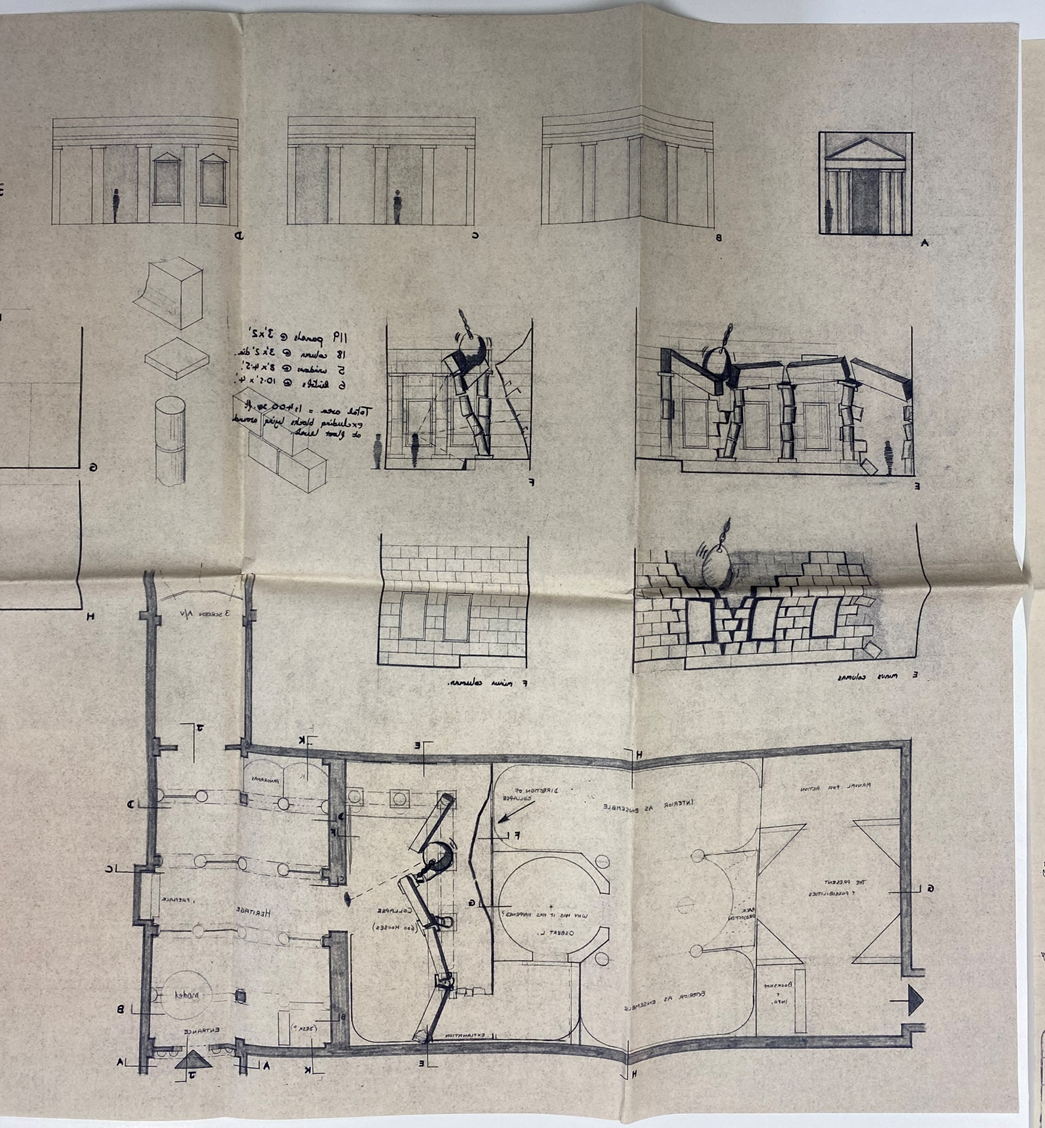
On 9 October 1974, on the day before the second general election of that year, the first visitors started making their way to the Victoria & Albert Museum to view the newly-opened exhibition: ‘The Destruction of the Country House: 1875 – 1975.’. Passing through the grand entrance to the monumental museum and then along the stately corridors would have heightened the shock as they entered a room to be faced with the toppling columns and seemingly endless photos of similar architecture which had been so ruthlessly demolished. However, as bad as the situation seemed – might the losses, though deeply regrettable, have been a catalyst for a better future for the country house?

Hall of Lost Houses, from the 1974 Destruction of the Country House exhibition at the V&A
Hall of Lost Houses, from the 1974 Destruction of the Country House exhibition at the V&A (Image © Robin Wade / Victoria & Albert Museum) reproduced by kind permission

Immersed in designer Robin Wade’s collapsing neo-classical portico, and as the late John Harris’ voice grimly intoned a roll call of the fallen, they may have wondered how such destruction could have been allowed.

Robin Wade, ‘V&A Museum: Gone, Going, Going’ (10th March 1974) (Image © Robin Wade / Victoria & Albert Museum) reproduced by kind permission

To survey the country houses losses in the UK over the last century is to be staggered as to the diversity of beauty and history which has been destroyed. That’s not to say that everything that’s been built should or can be preserved, but the sustained pattern of losses of country houses was cumulatively one of the largest of a particular building type since the Dissolution of the Monasteries. Although each loss was individual, collectively, it was certain to be noticed and mourned. As the then head of the V&A, Roy Strong, considered the situation, it was clear that the time had come to raise awareness of the losses – but could it also help prevent further destruction?

For Strong, working with Marcus Binney and John Harris, the aim of the emotionally-charged exhibition was to:

…draw the public’s attention to the country house as a major part of our national heritage, showing the tragic losses over the last century, stressing the need to preserve important houses with their contents and setting intact, emphasising the positive achievements over the past twenty-five years, and forcibly pointing to the problems that lie in the future.

Strong also wrote that:

…the threatened Wealth and Inheritance Taxes if applied to historic house owners will see … the end of a thousand years of English history and culture, as pell-mell the contents are unloaded into the saleroom, the houses handed over to the Government or demolished. I can’t tell you the horrors looming unless one fights and intrigues at every level behind the scenes.

The V&A exhibition was a landmark in a number of ways. Rarely has an exhibition in a major national museum been so overtly polemical – and political. The Observer newspaper stated that it was ‘the most emotive, propagandist exhibition ever to grace a public museum’s walls’. The Daily Mirror took a rather more dismissive tone, rather snarkily observing that:

Gad…our stately homes are grim! Life in Britain’s stately homes is becoming simply too awful for the coronet set. Dukes, baronets and earls have to use buckets to catch rain dripping through the roofs. They shiver in front of electric fires because the central heating is faulty. (Roger Todd, Daily Mirror, 9 October 1974)

The stark reality of life in the country house had been at the forefront of Roy Strong’s mind when considering their presentation. In a letter from Strong, dated 24 June 1974, to Sir Osbert Lancaster, the social cartoonist and proposed contributor to the exhibition, he highlighted some of the threats to the country house in the twentieth century, including; taxes, loss of heirs in WWI, partial demolition or dereliction, sales of art, land…everything, motorways, urban expansion, conversion to some other purpose, even the National Trust, before culminating in…opening to the public.

Roy Strong to Osbert Lancaster (21 June 1974) V&A Archive, MA/28/243/1

Although the tone is ambiguous, flippant or haughty depending on your perspective, it is interesting that many of the eventual solutions to the problem of the demolition of country house are included. Conversion to alternative uses, be it offices, schools, or hotels, has saved hundreds of houses. The National Trust have been saviours of some of the crown jewels and helped to change the narrative around the purpose of the country house. This has included developing new ways to engage the public and future generations (and continuing to do so), solidifying the cultural foundation of the country house as part of our national recreational and cultural identity.

The November 1974 general election ushered in a new Labour government, during the midst of turbulent economic times. A government which would be considering how to implement their manifesto commitment of “…a fundamental and irreversible shift in the balance of power and wealth in favour of working people and their families.”. It was a bold move by the V&A to try to defend the mansions of the wealthy – but this was also a collective national heritage, even if privately owned. Counter-intuitively, by highlighting that another strand of the national fabric was not only fraying but had serious holes, it may have skilfully blended into general concerns about the overall fate of the nation.

The V&A was not acting alone. As Adrian Tinniswood highlights in ‘Noble Ambitions‘, 1974 was the year in which the country house owners got organised. John Cornforth’s report ‘Country Houses in Britain – can they survive?‘, published that year (by the then almost activist Country Life magazine), painted a dramatic picture of the almost perfect storm which he felt might have led to a crisis within 8-15 years, but was now looming large in the immediate future. Despite his pessimism, Cornforth later wrote ‘The Country Houses Of England 1948-1998‘ in which he strikes a much happier tone, saying:

‘The history of the English houses in the past twenty-five years has proved to be infinitely more positive, and the view of the future more optimistic, than seemed conceivable at the time of The Destruction of the Country House exhibition…when their very existence was threatened by new taxes.’

Back in 1974, Cornforth’s rather gloomy views were echoed elsewhere. In June, Lord Grafton (qualifications: Duke of Grafton, chairman of SPAB, member of Historic Buildings Council, the National Trust’s Historic Buildings Representative in the East of England, and owner of Euston Hall) spoke in the House of Lords to raise with his noble friends/fellow house owners, and the government, that the proposed wealth tax, and a transfer tax to replace death duties, spelled disaster for the country house. The influential Times newspaper editorial also weighed in, and the newly formed lobby group, the Historic Houses Association, emphasised the economic benefits, whilst also organising a petition which garnered a remarkable 1.25m signatures. This level of public support was in some ways unsurprising given that by 1972, 43 million visits were made to the 800 houses and ancient monuments open to the public.

Looking back now, the assumption seemed to be that owners of country houses had almost a right to perpetually live in them, and that the state should subsidise this. There is an argument that the state should look after the interests of all subjects, to a greater or lesser extent, but the preservation of the institution of the country house was certainly presented as one where protecting the elite benefited the nation, tapping into a deep cultural reserve of respect or deference – rightly or wrongly.

The Destruction of the Country House exhibition poster (V&A Archive MA/24/132) produced by Peter Branfield for Her Majesty’s Stationary Office (reproduced with kind permission of Dr Oliver Cox/V&A)

So, although the exhibition was one of the most high profile actions in defence of the country house, it was not without wider support and deep foundations. A preservationist ‘ley line’ can be drawn through the exhibition, connecting it to Historic Buildings and Ancient Monuments Act of 1953, which extended heritage protection to inhabited buildings, leading to a dramatic decline in the number of houses being lost. Although there were other earlier voices raised in defence of our built heritage, including Sir John Vanbrugh’s argument, in 1709, to preserve Woodstock Manor. Of particular note was Philip Kerr, the 11th Marquess of Lothian (1882–1940), who was the catalyst for the National Trust Act of 1937, which created the Country Houses Scheme which saved so many more houses from destruction. Also intersecting our ‘ley line’ is the establishment of the various amenity societies; the Victorian Society in 1958, the Georgian Group in 1937, the Ancient Monuments Society in 1924, and the Society for the Protection of Ancient Buildings in 1877.

It’s also worth noting that the dates referenced in the title of the exhibition extended into the future, if by only a year. The implication was that the destruction was still an on-going process to be feared, though this underestimated the almost immediate positive impact that it would have. The genesis of the exhibition was usefully covered in a blog article I wrote for the 40th anniversary which I would recommend if you’d like some further thoughts.

The exhibition exemplified the challenge of the definition of the reason for the country house; was it a home, a rural business, or museum? Or did, by the nature of the sometimes competing, sometimes intersecting interests of the owners, society, and the state, demand it be all these at once. Legislation crafted to protect or promote one aspect, may impinge on the ability for it to fulfil its other roles, creating a tension which actively threatened the long-term sustainability of the house.

Yet, one reason the exhibition was so successful, and had such a positive impact, was that it also gave hope. Despite the tone of Strong’s letter to Osbert Lancaster, displays showed how country houses could be adapted to survive with many a house escaping demolition through conversion to a school, offices, or hospitality. Sensitive sub-division into apartments by thoughtful developers such as Kit Martin, also offered long-term solutions. Indeed, a number of Kit Martin’s conversions, such as Gunton Park, Burley on the Hill, and Stoneleigh Abbey, are still prized today.

View of the south front of Stoneleigh Abbey, Warwickshire. An Anglo-Baroque facade by Smith of Warwick surrounded by lush gardens and colorful flowers, set against a vibrant blue sky.
View of the south front of Stoneleigh Abbey, Warwickshire, which was converted into apartments in the late 1990s by Kit Martin. (Image © Stoneleigh Abbey Events)

John Harris not only credits the demonstration of alternative uses, but also that there was grant support (though this has now been largely removed). As Giles Worsley noted in his magisterial book ‘England’s Lost Houses‘ (2002) that by the time the exhibition opened, the tide had already turned and the numbers of houses being lost had abated. The demolition of large houses such as Warter Priory (Yorkshire) in 1972, or the threatened total loss of The Grange, Hampshire, (even if it was gutted) was now more of an outlier than a regular occurrence.

South front of Warter Priory, Yorkshire, which was significantly enlarged by the architects Smith and Broderick of Hull for Lord Nunburnholme. Demolished 1972. (Image: Lost Heritage)

Perhaps most importantly for country house conservation, the preservation of our wider architectural heritage, was the founding of SAVE Britain’s Heritage in 1975, by Marcus Binney, one of the co-curators of the exhibition. Binney has been an immense presence in campaigning across the country not only to fight for specific buildings but to change attitudes and the whole perception of the value of our nation’s architecture. Although he has been rightly recognised with an OBE and CBE, how he has not been given a knighthood for his work is one of those inscrutable mysteries. Sadly, the other curator, John Harris died in 2022 and will rightly be remembered as a brilliant architectural historian, with a sparkling wit and enormous fount of stories, particularly relating to his post-war exploration of these derelict mansions.


That the country house remains an easily accessible, and deeply symbolic, cultural touchpoint is a testament to strength of the concept, even though it is now rightly subject to a more honest examination of the history. A greater transparency only adds to the weight of interest in the houses and their extraordinary past, creating a flywheel effect to support further research. This doesn’t diminish the shorthand that the country house represents: beauty, tradition, continuity. To ensure that the concept of the country house remains viable, it has to be refreshed and reinterpreted. This synthesis of the realities of the present and the inheritance of the past, is what creates new opportunities for the country house, not only as an area of academic study, or as place of public culture and entertainment, but also, most critically, as a home.

Perhaps one of the most significant pieces of legislation in creating a sustainable future for the country house was not any of the heritage Acts. Until the Marriage Act 1994 the only ‘approved premises’ for a wedding ceremony was a church or registry office. After 1994, country houses were also considered appropriate venues, ushering in a new avenue for owners to secure an income from their asset. This brought about a fundamental change in the attitude towards the house, both from the owners, and now the wider public, who were now welcomed into these exclusive spaces. The emotional value invested in each occasion, has ensured that there is a ready army of those who will think fondly of a specific house, and often, the idea of the country house more generally.

Wedding ceremony taking place in Holkham’s famous Marble Hall (Image © Holkham Hall)

So what is the future of the country house? To imagine that their current situation and the opportunities they have are guaranteed is fanciful. A recent Law Commission report suggested that weddings could be held in “any safe and dignified location” including family homes, forests, and village halls. Given the rising cost of hiring premium venues such as country houses, this risks driving them back into the more gilded edges of society. The sharply rising cost of maintenance and operating such a house, either as a venue or as a home, increases the risk of benign or malign neglect – the former from the family who don’t wish to leave, but struggle to afford to stay, or the latter; those who only see the opportunities to replace an existing house with something more modern, whilst enjoying the benefits of a location which has been carefully crafted by previous generations.

However, the concept of the country house remains surprisingly endurable. As an aspirational token of success, it has rarely been bettered. Ultimately, the ‘Destruction of the Country House’ exhibition continued the evolution of the country house, further democratising the concept and ultimately helping to build the political and social framework which underpins their survival and success. The fortunes which provides the funding are continually made and lost, with the country house and estate hopefully continuing to stand proud of such vicissitudes for future generations to enjoy.

Acknowledgements

I am indebted and very grateful to Dr Oliver Cox, Head of Academic Partnerships at the V&A South Kensington, who very kindly shared the materials from his lecture in May 2024 on the genesis and impact of the exhibition and gave his permission to use them. His research was facilitated by the excellent V&A Archives team and I echo his gratitude to them.

Further reading

If you are interested in finding out more, then my Amazon bookshop as well as a range of non-fiction and fiction books on country houses has a specifically-selected list of books on lost country houses.

Inflamed passions: organised violence against UK country houses (part 3/3) – the Suffragettes

Following the account of the Birmingham riots in 1791, and those accompanied the Second Reform Bill in 1831, which destroyed a number a country houses, this final part of the series looks at the violent destruction in the 20th-century.

Suffragettes

With the slogan ‘Deeds not Words’, the call to action in the campaign for the right of women to vote was as clear as the potential for escalation.

Begbrook House, Frenchay, Gloucestershire – burnt down on 13 November 1913. A protest note and a copy of The Suffragette newspaper left at the scene connected the arson attack with the campaign for votes for women (Image from Frenchay Village Museum)

Although the Suffrage movement included a number of organisations, some favouring constitutional reform, others a more militant approach. The most prominent of the latter was the Women’s Social and Political Union (WSPU), which had started as a small Manchester-based organisation in 1905-06. Just a few years later, as its profile rapidly grew, it had become a well-organised, London-based group.

The WSPU’s early strategy focused on embarrassing the Liberal government by mass heckling any appearance by a minister. These tactics were effective; they either shut down the meeting, or the protesters were forcefully ejected – both results making their cause more prominent. However, as the meetings became increasingly all-ticketed and well-policed, how could they ensure that their voices were still heard?

Violence begets violence. The force with which the women protesters were met – including beatings, sexual assault, imprisonment, and force-feeding – created an atmosphere of retaliation. As they became increasingly disillusioned by the lack of progress using Parliamentary reform, by 1909, the situation had escalated, with over thirty incidents of the suffragettes attacking meetings, including stone-throwing. This sporadic use of violence continued until 1911, mainly aimed at those representing the government, either as ministers or civil servants.

After 1911, the range of acceptable targets expanded to include commercial interests and the property of those in government. Annie Kenney, who worked closely with the Pankhursts, stated that ‘that: ‘It was at this time [1912-13] that the burning of houses was resorted to. Both Christabel and her mother were against taking of human life, but Christabel felt the times demanded measures, and burning she knew would frighten both the public and Parliament.’ (Annie Kenney, Memoirs of a Militant (London, 1924), 187). Christabel Pankhurst wrote in 1913; ‘If men use explosives and bombs for their own purpose they call it war, and the throwing of a bomb that destroys other people is then described as a glorious and heroic deed. Why should a woman not make use of the same weapons as men. It is not only war we have declared. We are fighting for a revolution!’

The WSPU’s strategy rested on the belief that ‘There is something that governments care far more for than human life, and this is the security of property, and so it is through property that we shall strike the enemy.’. In a speech in Cardiff in March 1913, Emmeline Pankhurst vowed to strike at what she thought was most valued by society: ‘money, property and pleasure’. However, she was very clear that their target was property, and not people:

‘The Suffragettes have not done that, and they never will. In fact the moving spirit of militancy is deep and abiding reverence for human life.’.

And so the destruction of property became a proxy. The pillar boxes represented the state, the shops those commercial interests which supported the government, the homes of ministers and art works in public collections we all assaults which deliberately avoided targeting people.

With the righteous belief that ‘if it was necessary to win the vote they were going to do as much damage to property as they could’, the Suffragettes set about doing so, with country houses an especially tempting target, both for their impact and what they represented.

Whilst Emmeline Pankhurst was held in Holloway prison in April 1913, she recalls that ‘…my imprisonment [in 1912] was followed by the greatest revolutionary outbreak that had been witnessed in England since 1832’ and that ‘Many country houses—all unoccupied—were fired.’. This is repeated by Sylvia Pankhurst in her own account where she states that ‘Many large empty houses in all parts of the country were set on fire, including Redlynch House, Somerset, where damage was estimated at £40,000.’.

Nuneham Courtenay, Oxfordshire (Image © Global Retreat Centre)

On 13 July 1912, two Suffragettes made the first attempt to burn down a country house.

Helen Craggs was arrested at 1am in the garden of Nuneham Courtenay, Oxfordshire – though it’s unclear whether the target was the main house or possibly just the uninhabited east wing, as her co-conspirator Norah Smyth later suggested. The house had been home to the Harcourt family since it had been bought in 1712 by Sir Simon (later Viscount) Harcourt, the successful Solicitor General and Lord Chancellor under Queen Anne, for £17,000. The then owner, Lewis Harcourt, was a member of Prime Minister Herbert Asquith’s Liberal government, which had so strenuously resisted the demands for votes for women.

Nuneham Courtenay had also been an early target as Harcourt had discovered a bomb hidden in a tree in February 1907. He regarded this as ‘a delicate attention to me from the Female Suffragists‘, but it is a uncharacteristically early escalation, in a period when the campaign was still focused on parliamentary reform.

Five years later, Craggs’ bag was found to be carrying bottles of flammable oil, four tapers, two boxes of matches, twelve fire-lighters, picklocks, an electric torch, a glass-cutter – and a note.  The note – which rather politely started, ‘Sir’ – went on to state that as she had tried every method of peaceful protest and propaganda, ‘…that it has all been of no  avail, so now I have accepted the challenge…and I have done something drastic.’. Although Craggs was a member of the WSPU, and the proposed arson was to have been in their name, neither Emmeline or Christabel Pankhurst were apparently aware of the ultimately unsuccessful plan.

Levetleigh House, St Leonard’s, East Sussex, former home of Conservative MP for Hastings and Rye Arthur Du Cros, destroyed by Suffragettes, 15 April 1913 (Image from private collection). Watch a video of the aftermath of the attack

The key question of just how many houses were actually damaged or destroyed by the Suffragettes, seems to be unresolved.

In the late C.J. Bearman’s assessment of Suffragette militancy (An Examination of Suffragette Violence, (The English Historical Review , Apr., 2005, Vol. 120, No. 486 (Apr., 2005), pp.365-397)), he identified a total of 337 incidents which were claimed via the weekly reports in The Suffragette newspaper. Frustratingly, his article doesn’t include the list and his papers are currently inaccessibly (for me) in Hull University library.

However, another significant source is A.E. Metcalfe’s almost contemporary ‘Women’s Effort: A Chronicle of British Women’s Fifty Years’ Struggle for Citizenship 1865-1914‘, published in 1917. Her book includes tables of claimed attacks, with dates, estimated valuations of the amount of damage caused, and where they were reported – but only for January-July 1914. However, other sources give further incidents during this period, so below is an attempt at collating them into a single list of targeted country houses (‘AEM’ indicates Metcalfe’s records are the source).

1913

Date or MonthPropertyDamage assessmentComment
19 MarchTrevethan, Englefield Green, SurreyDestroyedOwned by Lord and Lady White
15 AprilLevetleigh House, St Leonards, SussexDestroyedOwned by Mr Arthur du Cros
AprilRoughwood, Chorleywood, HertfordshireDestroyed
9 MayFarington Hall, DundeeDestroyed
JuneBallikinrain Castle, StirlingshireSeverely damagedLater restored
JuneGranby House, WiltshireDestroyed
6 JulyRoyton Cottage, CheshireDestroyedOwned by Lord Leverhulme
13 JulyNuneham Courtenay, OxfordshireUndamaged
13 NovemberBegbrook House, GloucestershireDestroyedOwned by Hugh Thomas Coles
20 DecemberWestwood, Bath, SomersetDestroyed
21 DecemberAlstone Lawn Manor, GloucestershireSeverely damaged

1914

Date or MonthPropertyDamage assessmentComment
24 January‘Stratford Mansion’‘Gutted’AEM – unclear exactly which house this is in the entry in Metcalfe’s table
3 FebruaryHouse of Ross, PerthshireDestroyedAEM
3 FebruarySt. Fillans Castle, PerthshireDestroyedAEM
3 FebruaryAberuchill Castle, PerthshirePartially destroyedAEM
18 FebruaryWalton Heath, SurreySeverely damagedTwo bombs planted, one detonated. House being built for Lloyd George
24 FebruaryRedlynch House, SomersetDestroyedAEM
10 March‘Mansion’, Bruton, SomersetAEM
12 MarchRobertsland House, AyrshireDestroyedAEM
27 MarchAbbeylands House, BelfastDestroyedAEM
9 AprilSeaview House, BelfastDamagedAEM
10 AprilOrlands House, BelfastDestroyedAEM
22 AprilAnnadale House, BelfastDestroyedAEM
23 MayStoughton Grange, LeicestershireSlightly damaged
1 JuneThe Willows, BerkshireSlightly damagedAEM
1 JuneNevill Holt House, LeicestershireSlightly damagedAEM
6 June‘Mansion’, High Wycombe, BuckinghamshireDestroyedAEM
12 June‘Mansion’, NottinghamSlightly damagedAEM
29 JunePapplewick Hall, NottinghamSlightly damagedAEM
3 JulyBallymenoch House, UlsterDestroyedAEM
14 JulyCocken Hall, County DurhamSlightly damagedAEM
“The Willows”, Windsor, Berkshire, home of Mr and Mrs Dhunjibhoy Bomanji – slightly damaged in a suffragette arson attack on 1 June 1914 (Image © Private Collection). The house was later demolished sometime between 1938-1957 and replaced with smaller houses.

As quickly as the campaign had started, so it stopped; the WSPU suspended their militant campaign with outbreak of World War One in July 1914. The incredible efforts of women during the war – at home, in service, in factories and hospitals – brought many to their side and support for suffrage grew. On 6 February 1918, the Representation of the People Act of 1918 enfranchised over eight million women and in November of that year, the Parliament (Qualification of Women) Act 1918 was passed, allowing women to be elected as MPs. It would, however, take until 1928 before women finally were able to vote on the same terms as men.

The list above totals 31 attacks on country houses over the two-year period – less than 10% of the total number of significant actions Bearman identified. There are certainly others which I haven’t found yet (and if you know of other possible attacks on country houses, please add a comment below).

Although impressive as a list of targets, particularly given the lack of co-ordination and the inexperience of the protagonists, it demonstrates that country houses were certainly symbolic but were never the main focus for the campaign of destruction. One other aspect worth noting is the number of Suffragettes who were either Irish or active in Ireland – did their campaign inspire the later tactics of the independence movement which were to be so devastating to the country houses of Ireland?

Last flickers of protest

Since the Suffragettes campaign, the country house has largely remained immune from similar targeting though there seems to have been only two similar attacks since, both attached to the long tail of the Irish independence campaign.

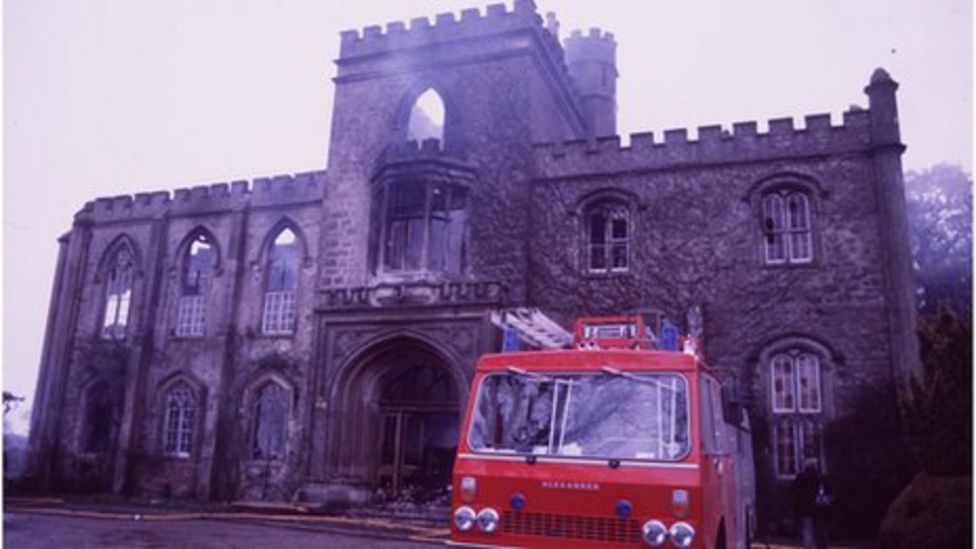
On 21 January 1981 at 9:45pm, an explosion blew the front doors open at Tynan Abbey, County Armagh. Armed members of the IRA rushed in and gunned down both 86-year old Sir Norman Stronge and his son, Sir James, who were sitting in the library. They then detonated incendiaries which destroyed much of the house and its valuable contents. The ruins remained until 1998 when they were cleared.

The aftermath of the IRA attack on Tynan Abbey, January 1981 (Image © BBC)

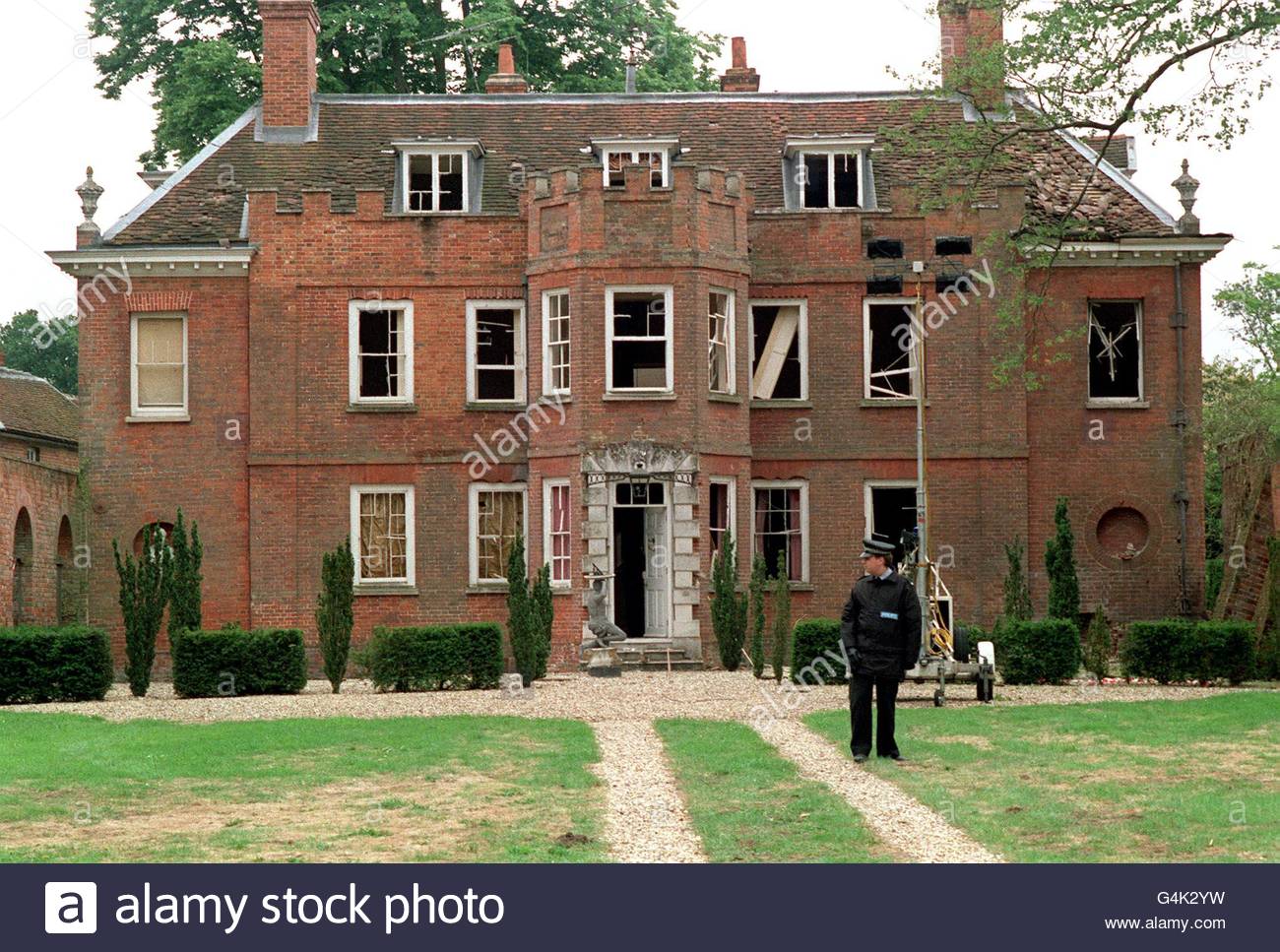
The most recent attack appears to have been the attempted bombing of the late Sir Alistair McAlpine (b.1942 – d.2014) at West Green House, Hampshire in 1990. McAlpine, scion of the famous family of building contractors and Conservative Party treasurer, was actually a tenant of the National Trust, the house having been bought by Sir Victor Sassoon and donated to them in 1957 (though they were not able to take possession until the end of a life tenancy in 1971).

Having found out that his name was on a list of IRA targets, McAlpine and his family left West Green House and moved to Italy. The IRA hadn’t received the change of address notice and on 13 June 1990 detonated a substantial device in the forecourt of the house, creating such extensive damage that the National Trust apparently considered demolition. Thankfully, they instead completed the structural repairs and then leased it to Marylyn Abbot to complete the internal works. It has remained her private home but with the gardens open between May-December and, since 2000, has hosted a yearly opera season.

Aftermath of the IRA bomb attack on West Green House, Hampshire, 13 June 1990 (Image © Alamy/Tim Ockenden)

So, this concludes the three-part series on the violent targeting of country houses in the UK – for religious, democratic, and political reasons.

Despite all that the country house symbolically represents and the myriad connections across society that they possess, the country house in the UK has, thankfully, largely escaped the broad and calculated devastation which has been visited on similar properties elsewhere. This is possibly due to the lack of a similar cause, or better security, or that destruction no longer has the same value, they do remain potent symbols, but ones that hopefully inspire, rather than enrage.


If you’d like to read the rest of the series:

The Country Seat in 2020

Eltham Palace, Kent (Image © Matthew Beckett)

This year has been a challenging one for everyone and my thoughts are with anyone who has suffered any direct experience with this dreadful virus. We can only be thankful for the incredible service and sacrifice of those on the front-line, particularly in the NHS, but throughout the entire public sector, who have all played their part.

On a personal level, the blog has been dormant as all my books were in storage whilst we undertook a home extension which, unfortunately, was delayed by the pandemic restrictions. Plus, there is a surprising amount of admin linked to having an extension. Anyway, between the extension, my actual day job, and looking after my family, writing about country houses was just not possible.

Happily, we did manage to visit two during the earlier easing of restrictions: Eltham Palace, Kent, and Athelhampton House, Dorset. Hopefully, once we are able, next year we’ll all be able to visit the many country houses which will need our support more than ever. If you can, it’s well worth to join one or more of the many organisations which have been helping to protect our country houses:

And if you can’t visit in person, the various architectural heritage organisations (who have also been financially disadvantaged), have been magnificent and several have been able to provide online lectures which can attended ‘live’ or watched again later for a very small fee:

Now the good news regarding this blog; there is a new article. In fact, it will be published in three parts as it became rather extensive. The first part will be published today, so that I can say that I have at least managed to publish at least once in 2020.

Thank you again for your interest and support and wishing you all the very best for 2021.

Athelhampton House, Dorset (Image © Matthew Beckett)

Supermodels: the rise and fall of architectural models of country houses

A William IV Cut-Card Model of an Unidentified Mansion, 1831 by John Bellamy (Image © Christie's - Sale of the Collection of Professor Sir Albert Richardson, P.R.A., Sep 17, 2013)
A William IV cut-card model of Newtown Park, Hampshire, dated 1831 by John Bellamy (Image © Christie’s – Sale of the Collection of Professor Sir Albert Richardson, P.R.A., Sep 17, 2013)

In a time before widespread literacy, a physical representation of what was intended to be built was a powerful aide to help ensure that the vision of the architect became the physical reality crafted by the builder.  Yet, the architectural model was more than this. Evolving from being a functional tool, it became an aspirational marketing device to demonstrate the proposed scheme but also as a three-dimensional business card for the architect and striking conversational piece for the wealthy patron who would possess both the miniature fantasy and the full-size reality of the design of their country house.

The role of the architectural model can be traced back to the earliest buildings, particularly the devotional and religious. Some of the oldest were found in Egyptian tombs, dating back over four thousand years, and represented functional spaces which may be required such as granaries or gardens. Later they were often displayed as a record of the beneficence of the donor (rather than skill of an architect), they appear in paintings or decorations being held as offerings (such as the 10th-century Vestibule Mosaic showing Justinian presenting the Hagia Sophia to Mary and Christ), or carved into their funerary monuments or other personal iconography such as portraits; all undoubtedly a handy aide-memoire to St Peter, come the reckoning on Judgement Day.

Detail of 17th-century portrait of Queen Marie Thérèse of France, as patron of the Cathedral of Notre-Dame de Paris (Studio of Beaubrun brothers) (Image: public domain via Wikipedia)

The creation of models of new buildings is recorded in the 15th-century with the renowned architect and theoretician Leon Battista Alberti (b.1402 – d.1472), stating that,

‘I always recommend the ancient builders’ practice by which not only drawings and pictures but also wooden models are made, so that the projected work can be considered and reconsidered, with the counsel of experts, in its whole and in all its parts.’

The fashion for the creation of architectural models as objects for study and decoration was one which grew with the interest and wider participation in what became known as the Grand Tour, particularly from the 1760s.  As wealthy young men would embark on extended study (and, if we’re honest, pleasure) tours of the Mediterranean and Middle East, so too did their desire to bring back a tangible memory of their time to display as a marker of their cultural and worldly sophistication.

Cork model of the Temple of Zeus or Apollo, Paestum (c. 1820), attributed to Domenico Padiglione. Courtesy of the Trustees of Sir John Soane's Museum
Cork model of the Temple of Zeus or Apollo, Paestum (c. 1820), attributed to Domenico Padiglione. ©Trustees of Sir John Soane’s Museum

Cork established itself as a popular material for the crafting of models of ancient ruins as it was intrinsically similar in its native form to the weathered appearance of the stones it was shaped to resemble. Light and easy to transport, it is easy to imagine that many hundreds of these were shipped back to country houses back in the UK as a reminder and an inspiration.  It is interesting to speculate how influential these romantically ruinous models were on the nascent Picturesque movement of the 1780s. The models may have generated not only new buildings but also the incorporation of existing ruins into new landscapes or the building of new ‘old’ ones too, energised by having at hand aesthetically compatible examples, steeped in irregularity and showing the forces of nature providing the finishing touches to the works of man.

For those who wished to show a more idealised representation of architectural purity, clearly the imprecise renderings of cork were not going to match their visions. In the 1780s, to demonstrate the beauty of the finer details of the classical world, entirely white, finely crafted ‘Plaster of Paris’ models started to be created.  Almost of these are thought to be the work of two French modellists, Jean-Pierre Fouquet (b.1752 – d.1829) and his son Francois (b.1787 – d.1870), who were based in Paris, trading as Fouquet et Fils.1 For architects, these models presented an alternative version of reality, one which enabled them to present their own schemes in a favourable context to the works of the ancient world.

Model of the ancient Greek Ionic temple on the Illisus, near Athens, 'restored', c.1800-1834, plaster of Paris. (Photo: © Sir John Soane’s Museum, London)
Model of the ancient Greek Ionic temple on the Illisus, near Athens, ‘restored’, c.1800-1834, plaster of Paris. (Photo: © Sir John Soane’s Museum, London)

Beyond the decorative role, the models were also naturally didactic; their representations of the ruins of the ancient world creating opportunities to teach those who would not otherwise be able to travel to see them. Of those who embraced this approach, the most prominent and inventive was Sir John Soane.  His collection was one of the largest but who was also able to use them as inspiration, as teaching aids to his pupils and marketing tool for those who visited his home/studio at Lincoln’s Inn Fields in London, where they can still be seen today in the restored model gallery.

“Many of the most serious disappointments that attend those who build would be avoided if models were previously made of the edifices proposed to be raised. No building – at least none of considerable size or consequence – should be begun until a correct and detailed model of all its parts has been made.”
– Sir John Soane (Royal Academy lecture, 1815)

Soane was drawing on his own experience but what had clearly been a well-established technique within the building trade and architectural profession – but just how frequently were these model houses created as part of the commissioning process? The key challenge is that so few are known to have survived that it’s difficult to draw broad conclusions from such a small selection. However, it is instructive to take a tour of a sample to see the range and skills deployed by architects and craftsmen to not only convince the patron but also to explore proposed designs at a stage when corrections were far easier to make.

Quidenham Hall, Norfolk - architectural model of c.1606 (Norwich Museum Service)
Quidenham Hall, Norfolk – architectural model of c.1606 (Norwich Museum Service)

One of the earliest known examples (and my thanks to Jeremy Musson for bringing it to my attention), is a beautifully detailed model of Quidenham Hall, Norfolk, dating from the early 1600s. The manor was bought by the Holland family from in 1572 and the model was created for the construction of the first house in 1606 – probably in the same year, as it would act as the visual guide for the builders and masons.

In the context of a less-educated age, the value of the model to the build process becomes more apparent, particularly for more complex designs such as Quidenham, with its detailed elevations including procession, recession, bows, pediments, crenellations, stepped gables, and chimneys.  A feature of the architectural models is that they can be explored, with the house dissembling either horizontally including the exterior walls, or just the interior floors, enabling a ‘fly-through’ so beloved of modern property programmes.  Clearly, being able to visualise the interior in relation to the exterior provided clarity as to the relationship between the designs for the rooms and their physical placement.

Quidenham Hall was subsequently extensively remodelled in the 18th-century with additional wings and the refacing of the entire house in a unifying neo-classical design. For us today, one value which was unexpected in the original construction of the model is that it allows us to know with a high degree of certainty what the original house looked like, despite these changes.

Model of Easton Neston, Northamptonshire, designed by Nicholas Hawksmoor, 1689 (Images © The Art Fund)
Model of Easton Neston, Northamptonshire, designed by Nicholas Hawksmoor, 1689 (Images © RIBA Collections)

The degree of craftsmanship which was invested in the models is perhaps best shown in the remarkable model of Nicholas Hawksmoor’s masterpiece, Easton Neston, in Northamptonshire. Dating from 1689, it is considered one of the most important models to have survived, due not only to the superb craftsmanship but also because it relates to the design of a house regarded as central to the development of the Anglo-Baroque aesthetic. The model was bought for £180,550 in 2005 when Baron Hesketh sold the contents and house and is now in the RIBA Architecture Study Rooms at the V&A in London.

Model for Tyringham, Buckinghamshire, (designed by Sir John Soane), made by Joseph Parkins, c.1793-1794, wood (© Sir John Soane Museum - number: X236)
Model for Tyringham, Buckinghamshire, (designed by Sir John Soane), made by Joseph Parkins, c.1793-1794, wood (© Sir John Soane Museum – number: X236)

Tyringham Entrance Front 3/5/13, (© Sir John Soane Museum)
Tyringham Entrance Front 3/5/13, (Image © Sir John Soane Museum)

Sir John Soane’s designs for Tyringham Hall, Buckinghamshire, are a particularly instructive example as model, drawings and house (the latter with minor later alterations) survive and can therefore be readily compared. Commissioned by the banker William Praed, the house took five years to build from 1793 to 1798, with the model being created in mahogany c.1793-1794 by Joseph Parkins, a joiner working on the project. This sophisticated approach of thoughtful, inventive but ultimately practical designs, high-quality presentation watercolours by Joseph Gandy, and equally polished miniature evocations show the exemplary professionalism of Soane and why he was one of the leading architects of the era and held in such high regard.

Model of Pyrgo Park, Romford, London (RIBA Collections)
Model of Pyrgo Park, Romford, London, 1851 (RIBA Collections)

A later example was the model created for Pyrgo Park, Essex (demolished c.1940). The house was built for Robert Field, who had inherited a largely derelict Tudor house and estate from his brother in 1836. The remains of the old house were demolished in 1851-52 and a new house built on the same site to a design commissioned from Thomas Allason (b.1790 – d.1852). In light of the architect’s death, in the same year as construction on the new house was due to start, the creation of the model in 1851, now held in the RIBA Collection, would have enabled the work to continue and for a house, faithful to the architect’s design, to be created.

Another architect to use models was George Devey (b.1820 – d. 1896) who produced them as a matter of course when proposing a design to a client.  The distinctive feature of Devey’s models, produced by a dedicated, in-house modeller who was ‘in constant work’, was their scale, being produced small enough to fit in custom, briefcase-sized boxes. These often beautiful models allowed Devey to dispense with creating perspective drawings, producing only elevations and plans, which were combined with the physical miniature they would see in front of them.

The Ledgers, model of proposed alterations - George Devey, c.1882 (Image © Jill Allibone)
The Ledgers, Surrey, model of proposed alterations – George Devey, c.1882 (Image © Jill Allibone)

Barton Manor, model of proposed alterations to the stables - George Devey, c.1873-74 (Image © Jill Allibone)
Barton Manor, model of proposed alterations to the stables – George Devey, c.1873-74 (Image © Jill Allibone)

Two more models are worthy of note due to their size and beautiful detailing. One of the tallest was for Fonthill Abbey, Wiltshire, the vast Gothic edifice built for William Beckford constructed between 1786-1807. The model was notable not only for its scale (built at a ratio of 1 inch to 10 feet), but also for its own evolutionary construction with the model corresponding in part to the earlier designs from 1799, but overall the composition is similar to the engravings from the 1820s. The irony is that this model, built of fragile card, survived more completely than the ill-fated abbey itself.

Model of Fonthill Abbey, Wiltshire, designed by James Wyatt. (Image © British Library)

Perhaps the most beautiful and largest is the proposed model for a new palace in Richmond, Surrey, designed by William Kent for King George II and Queen Caroline in 1735. Created in pearwood, the model is nearly two and half metres long and is exquisitely detailed, as one would expect of a presentation model to be shown to royalty.

Model of a proposed new palace for Richmond, 1735, designed by William Kent. (Image © The Royal Collection)

Clearly there is a long history of the use of models, with examples for houses both large and small from multiple notable architects and other evidence that these models were not an uncommon element in the design and construction of country houses. So, why are so few known to have survived? Without more primary, documentary evidence, conclusions necessarily have to be somewhat conjectural.

Some study has been made of architectural models, particularly by Professor John Wilton-Ely, who has stated that although frequently used, they were less used by the end of the eighteenth-century.  He also highlights that whilst models found favour with some architects, such as Soane, others such as William Chambers only used them occasionally, Wyatt only appears to have used it Fonthill and Longford Castle, Wiltshire, and that there are no known instances of their use by Robert Adam.

Additionally, one reason so few have survived is their role in the actual construction process; the frequent use on-site and the high-level of wear-and-tear likely to result from such treatment meant that those made from more fragile materials such as plaster or card were always at risk of being worn out and discarded.

For those which survived, their bulky nature would always be a factor in determining whether someone not only had the inclination but also the space to store them. Minutes and correspondence from within the Victoria & Albert Museum shows the ascending and waning fortunes of architectural models.  When the V&A first opened (called then, the Museum of Construction), models were given prominent billing and display space – though of the seventy-plus identified2 from the hundred known in the collection, only one is a house, surprisingly dating from 1936. The lack of country houses is stark, reflecting a level of  institutional disinterest from the outset and over the lifetime of the collection.  Cumbersome and unloved, the collection was removed from display in 1888 and put into store. After ownership was passed unenthusiastically between the various museums, the V&A reluctantly took them in 1916 (‘The items do not for the most part appear to be very desirable for us, either for exhibition or reserve‘) with some being selected for disposal, the minutes recording ‘their cremation‘.

Perhaps the most intriguing method of survival is the most charming – their use as dolls houses.  Once the model had served its purpose in design and construction, and perhaps served time as a conversation piece, one can easily imagine the children of the house being given a chance to recreate their lives in miniature. They also would serve as training for one day managing a country house of their own. So if you, or a relative, has an antique but surprisingly good quality or familiar looking dolls house in the attic, take a closer look…!

Melton Constable Hall Model (NWHCM : 1971.386) (Image © Gressenhall Farm and Workhouse - Norfolk Museums)
Melton Constable Hall Model (NWHCM : 1971.386) (Image © Gressenhall Farm and Workhouse – Norfolk Museums)

Perhaps the most impressive (and remarkable) surviving example is that of Melton Constable Hall, Norfolk, dating from the 1660s.  The architect of the now grade-I listed house is unconfirmed, particularly as there are no known drawings, but it is thought that the owner, Sir Jacob Astley, may have designed it himself. In such circumstances, the building of a model would have been a prudent step, both in confirming that his design was fit-for-purpose and for subsequent use during construction. The model of the house was then passed through generations of the Astley family children before being donated to the Norfolk Museum Service.

Another dolls house, this time at Greystoke Castle in Cumbria, was discovered to be a proposed eighteenth-century design for the enlargement of the pele tower.  Much of the work at Greystoke was completed by Anthony Salvin (b.1799 – d.1881) so it is possible that this an example of another architect using models as part of the process.

Today, the architectural model exists but as a method of celebration and display.  The model is less a functional representation of what will be and instead is a now a mechanism for the long-term appreciation of the finished building as sculpture.  It is curious to note that the model has moved from the purpose of remembrance to aspiration and back to the recreation of what has been lost. The sophistication of modern digital rendering has sadly removed the need for the model to help those commissioning a country house to visualise it.  However, in this we have have lost the physicality of the form and the sheer pleasure of the craftsmanship of a country house model; idealised but as yet unrealised.

Known complete models of houses

Do you know of any others? If so, please add a comment with details.

Summary list of examples (architect name and current location of the the model, in brackets, if either are known)


References

1 – ‘Plaster Casts: Making, Collecting and Displaying from Classical Antiquity to the Present’ – Rune Frederiksen, Eckart Marchand (Walter de Gruyter, 27 Sep 2010)

2 – Inside Outside: Changing Attitudes Towards Architectural Models in the Museums at South Kensington’ – LeslieFiona, Architectural History47 (2004), pp. 159200

Further reading

Happy New Year from The Country Seat

I hope this year has been good to you and that 2019 provides its fair measure of happiness, regardless of whatever life and the world decides to do.

Grade II*-listed Kingston Lisle, Oxfordshire, plus 257-acres sold in 2018 for £21.6m (Image © Strutt & Parker and Knight Frank)

This year the Country Seat blog has been quiet to say the least (just one post in April: ‘#Repton200: Humphry Repton, landscape gardener – and architect?’), for which I offer some apologies but can confirm that the blog is still live and I will continue to produce articles as and when I can. I also continue to update the research on lost English country houses at Lost Heritage, plus regular updates to Twitter for both: @thecountryseat and @lostheritage.

When I started the blog in 2009, it was (and remains) a personal interest written in my spare time.  I was also single and without children and having written about no country house topics, all were open for me.  Having now, in the last two and bit years, married and had two beautiful children, time is somewhat more limited, and, more surprisingly, after nearly three hundred posts, it is actually harder to find topics once an architect or house has been written about.  That said, I have an article almost ready to go for January…

Anyway, there are others also writing about country houses in the UK and Ireland so below are a few suggestions you should find very interesting:

  • If you use Facebook (and this group is pretty much the only reason I still do!), then Country Houses of the UK and Ireland is the gold standard for content and conduct. The chief contributor is the leading country house historian Nicholas Kingsley, who provides, almost daily, a full history of a country house with illustrations. The group is closed but membership is easy to obtain and will repay your interest.
  • Nicholas also writes a blog on the Landed families of Britain and Ireland which aims to provide a history of each landowning family with a detailed history of each house they have owned – it is truly epic in its scope.
  • If this wasn’t enough, Nicholas also updates the Charles Hind collection of country house images, which provides hours of happy browsing.
  • Another blog I rate as one of the very best is Handed On, which provides a detailed history of a country house which is selected on the basis that it is little-known, either by design or accident. The quality of research is impressive and it’s brilliantly written.
  • Covering the often related but entirely distinctive Irish country houses is The Irish Aesthete, a blog which has helped me enormously to discover more about a fascinating heritage.

Wishing you all again, a Happy New Year and thank you again for your continuing interest and support.

Matthew

#Repton200: Humphry Repton, landscape gardener – and architect?

Although principally known as a ‘landscape gardener’ – a job title he invented even if the role was already well-defined – Humphry Repton was clearly a man who understood that an estate was a composition of many parts and that architecture had a vital role to play in the success of his schemes. The challenge in assessing Repton’s contribution to architecture is that of his collaborations; what sprang from his inventive and knowledgeable mind, and what came from those he worked with, including his sons, John and George, and also that leading proponent of the Picturesque, John Nash.

Detail from Humphry Repton by Henry Bryan Hall, published by Longman & Co, after Samuel Shelley (1839) (NPG D5801 © National Portrait Gallery)
Detail from Humphry Repton by Henry Bryan Hall, published by Longman & Co, after Samuel Shelley (1839)
(NPG D5801 © National Portrait Gallery)

Humphry Repton (b.1752 – d.1818) had a lifelong passion for gardening, but it was not his first career.  After starting in business as a general merchant in Norwich, which failed, Repton decided to retire to the countryside and live with his sister and husband in Sustead, near Aylsham, in Norfolk.  With his father’s prosperity and sister’s indulgence, he developed his interest in botany and gardening.  After a brief period in 1783 as private secretary in Ireland to his neighbour William Windham of Felbrigg (he resigned after a month), Repton took a cottage near Romford, Essex, and decided to focus on turning his interest into a career.  Fortunately, circumstances meant that he was well placed to do so with his deep horticultural knowledge, his superlative skills as a watercolourist, which he used to create his visions in his beautifully produced Red Books, plus opportune timing, with the death of Lancelot ‘Capability’ Brown in 1783 creating a gap for someone with Repton’s grand ideas.

Although the setting of a house was a key consideration for any architect of the era, few  thought of themselves as landscape gardeners (Decimus Burton (b.1800 – d.1881) was something of an exception).  However, those who were of that profession seemed to not only have an opinion on architecture but also apparently felt confident that they could also practice in this as well as their primary domain. For Repton, although not trained as an architect, he saw architecture as ‘an inseparable and indispensable auxiliary‘ to his efforts. Repton was usually brought in after the house was complete and his plans would be presented in one of his famous Red Books, leather-bound volumes of his ideas for a specific property, in which he set out his vision of the landscape as it was, including the current house.  In it, Repton would often include his criticisms of what was there and include his suggestions for sympathetic alterations which would better enable the house to fit within his vision.

Detail showing example of possible changes to example house - Plate III of Repton's 'Sketches and hints on landscape gardening' (1794)
Detail showing possible changes to example house – Plate III, State B from Repton’s ‘Sketches and hints on landscape gardening‘ (1794) – source: copy held by University of Wisconsin and kindly shared online

A measure of Repton’s boundless confidence in his own abilities can be seen in whom he felt able to criticise for their architectural efforts, including Sir John Soane, probably the leading architect of his era.  Repton was commissioned to create a landscape at several of Soane’s commissions, usually appearing a year or two after completion, including at Mulgrave Castle, Moggerhanger House, Aynhoe Park, Holwood House and Honing Hall. In the case of the latter house, Soane had made extensive alterations in 1788, and in Repton’s Red Book, produced in 1792, he criticised Soane’s work saying:

The proportions of the house are not pleasing, it appears too high for its width, even where seen at any angle presenting two fronts; and the heaviness of a dripping roof always takes away from the elegance of any building above the degree of a farm house; it would not be attended with great expence to add a blocking course to the cornice, and this with a white string course under the windows, would produce such horizontal lines as might in some measure counteract the too great height of the house. There are few cases where I should prefer a red house to a white one, but that at Honing is so evidently disproportioned, that we can only correct the defects by difference of colour, while in good Architecture all lines should depend on depths of shadow produced by proper projections in the original design. (1)

In the illustrations in the Red Book for Honing Hall, Repton boldly showed the house, not as it was, but with his suggested improvements. Repton had form for his criticisms of Soane, having been asked, in 1790, to review the newly completed Tendring Hall, Suffolk, (demolished 1955) where he wrote:

…had I been previously consulted the house would neither have been so lofty in its construction nor so exposed in its situation.

For a man with no formal architectural training to be so forthright in his judgements gives a sense of Repton’s confidence in his own abilities.  Luckily (for Repton), it’s likely that the notoriously sensitive Soane never saw these criticisms and they maintained cordial relations for many years. Repton’s comment about rarely preferring a red house to a white one is also corroborated by other Red Books, including the designs for Stansted Hall, and Rivenhall Place, in Essex and Hatchlands Park, Surrey.

Images showing proposed exterior changes from H. Repton's Red Book for Hatchlands Park, Surrey (1800)
Images showing proposed exterior changes from H. Repton’s Red Book for Hatchlands Park, Surrey (1800) – source: The Morgan Library & Museum

Repton’s architectural contributions are often overlooked as he was never enough of an architect to be considered as one, and, in general, those primarily interested in his landscapes are insufficiently interested in his architecture.  A prime example of this (not mentioned in Colvin, or Stephen Daniels’ book, except buried in an endnote) is Repton’s vision for Port Eliot, Cornwall, the seat of Lord Eliot.  In 1792, in one of his earlier commissions, he was brought in for his advice on the estate. Repton assumed the role of architect and provided, in the Port Eliot Red Book, a broader set of broadly Gothic proposals which brought house, church, estate and even the nearby town into his remit. This expansive approach to his brief was a challenge for Sir John Soane who was asked in 1794 to contribute his ideas – but now within a Gothic framework set by Repton (a style to which Soane was hostile), whose designs had found a level of favour with Lord Eliot, and which he adapted.

One of the key questions when considering the architectural improvements suggested by Repton is to what degree they were his and what had been conceived by his eldest son John Adey Repton (b.1775 – d.1860). J.A. Repton had been a pupil to William Wilkins where he developed a profound understanding of Gothic architecture.  He had then moved in 1796 to the office of John Nash, with whom the elder Repton had established an arrangement to pass on any architectural commissions in exchange for 2.5% of the cost of the work – an agreement which Nash failed to honour, leading to the partnership being terminated in 1800.

Nash has a chequered reputation professionally and this extended to those in his office, including J.A. Repton but left to become his father’s assistant when the agreement between Nash and his father ended.  Nash was unfortunately a champion of the Picturesque but not of his assistants; he never acknowledged J.A. Repton’s significant contribution in various schemes. Unfortunately, John was to suffer the same issue to a certain extent with his father, though he was later clearly credited for his assistance ‘in the architectural department‘ for designs for a number of houses including Stratton Park, Scarisbrick, Panshanger, and others.

Detail from Port Eliot Red Book showing the house as found (© Eliots of Port Eliot)

Detail from Port Eliot Red Book showing the proposed changes to the house (© Eliots of Port Eliot)

In the Port Eliot Red Book, eighteen of the drawings are signed by the son and are probably his designs, however the scheme as a whole is attributed to the elder Repton, though he may have been angling for this to be a major commission for his son. Unfortunately for the Reptons, their grand vision for Port Eliot was never going to be realised, mainly due to financial constraints, though Soane was to provide an alternative scheme which he diplomatically managed to agree with Lord Eliot – much to Repton’s chagrin, later writing:

my beautiful plan for Port Eliot…my design for bringing together the house and the Abbey did not suit the fancy of my fanciful friend [Soane] (who knows but little about Gothic) so the plan was totally changed.

Repton’s architectural work was significant enough to merit inclusion in Howard Colvin’s seminal reference work, ‘A Biographical Dictionary of British Architects 1600-1840’.  The most important was the work at Welbeck Abbey in 1790 to remodel the east and west fronts (and the Red Book contains designs for an entirely new house) but the other entries are relatively insignificant – minor works in 1792 at Honing Hall, the enclosing of the courtyard at Sarsden House in 1795 to create a domed ‘hall of communication’, and a new entrance to Uppark in 1805. Beyond that, his association with John Nash meant he had an insight into the ‘cottage orne’ style and which Repton used in his design for a new ‘lodge of a new and singular description‘ comprising two thatched cottages on the Isle of Wight, one either side of the road.

Lodges at the entrance to Mr Simeon's grounds on the Isle of Wight, designed by H. Repton (Image from 'A New Picture of the Isle of Wight' by W. Cooke (1808)
Lodges at the entrance to Mr Simeon’s grounds on the Isle of Wight, designed by H. Repton (Image from ‘A New Picture of the Isle of Wight‘ by W. Cooke (1808)

Beyond that, his architectural contributions were mainly the designs within the books on landscape gardening.  The most important of these were ‘Sketches and hints on landscape gardening : collected from designs and observations now in the possession of the different noblemen and gentlemen, for whose use they were originally made : the whole tending to establish fixed principles in the art of laying out ground’, published early in his career in 1794, and the posthumous collection published in 1840, ‘The Landscape Gardening and Landscape Architecture of the late Humphry Repton’.

So, can Repton be considered an architect as well as a landscape gardener? On balance, his position seems to be more that of ‘frustrated architect but successful critic’. Repton doesn’t seem to have been able to establish a reputation as an expert on architecture, possibly because his commentary was often only available in the Red Books, with their naturally limited circulation. Also, his work was usually after the house was already built and often only recently finished, meaning the owner was unlikely to consider making significant changes very quickly, leaving few opportunities for him to showcase the talents he clearly thought he had.

However, his work was influential on the practices of contemporary and later architects, forcing them to acknowledge that their buildings did not exist in splendid isolation and had to be considered as whole; a three-dimensional, interactive, ever-changing landscape painting. Open, expansive parklands had the effect of placing the building on a visual plinth, majestic but with an aloof air. Repton firmly brought all the elements together, blending both Gothic with greenery and the Palladian with the planting.  His architectural contributions reflect this sensitivity and with more opportunities he may have been even more influential in the field of architecture, much as he dominated the landscapes represented so beautifully in his famous Red Books.


Further reading:


Sources:

(1) – Humphry Repton, Red Book for Honing Hall [1792], quoted in ‘The Surprising Discretion of Soane and Repton’ by Gillian Darley, in the Georgian Group Journal vol. XII 2002


Apologies for the long gap between articles – happily, just after I posted the last one in September 2017, our beautiful son was born. Mother and baby were, and remain, fine and his sister clearly loves him. However, as anyone with experience of small children knows, they’re justifiably demanding and, combined with having a day job, it’s meant I haven’t had the time to write, but as he gets a little older hopefully I should now be able to again…at least in some capacity, though they’ll remain sporadic.  Tweeting is easier to do regularly, so please do follow @thecountryseat and @lostheritage.  OK, on with the show…


Greeks bearing gifts: Nicholas Revett, Trafalgar Park and the Origins of UK Neo-Classicism

William Blake poetically argued that it was possible to ‘To see a World in a Grain of Sand’; in the miniature is a reflection of something much greater.  With that in mind, to look upon the manifest beauties of a house such as Trafalgar Park in Wiltshire, it could seem strange to argue that one of the most important aspects of it is, in fact, a small hallway in the north wing. Yet, this hallway is one of the earliest architectural examples which form the genesis of neo-classicism; one of the most recognisable and prolific architectural styles which has proved to be enduringly influential in the design of country houses and also has come to dominate civic architecture.

Trafalgar Park, Wiltshire (Image © Savills)

Neo-classical architecture permeates our built environment; banks, council and government buildings, and particularly country houses.  Drawing on the ancient monuments of Greece, the structured, hierarchical designs provided a convenient vocabulary that institutions, the state, and individuals could use to express their permanence and place in the natural order of society. Of course, this is the interpretation and not an objective set of laws but neo-classicism’s rationalist perspective, with its reliance on mathematical rigour, gave the impression that architecture and society both shared an underlying harmony in their precision and structure.

The Classical language of architecture had arrived in England through the widely admired and imitated Vitruvian principles as interpreted in Andrea Palladio’s I quattro libri dell’architettura. Inigo Jones had adopted this language and had created the foothold for the new style with his the Queen’s House in Greenwich (1616) and Banqueting House in Westminster (1619). However, his sources were Italian; the great monuments of Rome as measured and shown by Palladio. For some, though, this was derivative as the earliest Classical monuments were in Greece.

It ought to remembered that the fashion for the neo-classical was one which swept across Europe, not just the UK. As a rejection of the seemingly frivolous Rococo movement, it sought to instil a more high-minded set of ideals across the arts. To do this, writers such as Johann Joachim Winckelmann (regarded as one of the fathers of neo-classicism), stated that ‘The only way to become great is to imitate antiquity’. This required no mere slavish copying but a profound understanding obtained through study which enabled principled use of the Classical architectural language. Books such as Piranesi’s Le Antiquita Romane, a series of topographical views of Rome published in 1748, determined to prove the glory of Rome. However, others such as Richard Dalton (Museum Graecum et Aegyticum, 1751), le Comte de Caylus (Recueil d’Antiquities Eygyptiennes, Etrusques, Grecques et Romaines, 1752) and Julien David Le Roy (Les Ruines des plus beaux monuments de la Grece, 1758) argued for the superiority of the Hellenic originals.

Les Ruines des plus beaux monuments de la Grece (1758) - J.D. Le Roy
‘Ruines d’un Portique Dorique’ from Les Ruines des plus beaux monuments de la Grece (1758) – J.D. Le Roy

If true knowledge of Classical architecture required detailed study the options were limited unless fortunate enough to be able to undertake the arduous and expensive Grand Tour. The Society of Dilettanti, formed in the 1730s as a scholarly drinking club for aristocrats and others who had visited Italy, deliberately sought to influence fashion by sponsoring a more rigorous approach to the recording of the ancient ruins. Scholars had realised the value and fame which could be garnered from publishing books on the ruins they had visited but these were often the Roman versions of the Grecian originals and were often more decorative than accurate delineations.

Antiquities of Athens (Vol I) - James Stuart and Nicholas Revett (1762)
Antiquities of Athens (Vol I) – James Stuart and Nicholas Revett (1762)

In contrast, the most successful and influential of these publications was Antiquities of Athens by James ‘Athenian’ Stuart and Nicholas Revett, published in three folios in 1762, 1787 and 1794. Sponsored by the Society of Dilettanti, their approach produced detailed, measured architectural drawings from which other architects could accurately reproduce Grecian details. Stuart and Revett were both better known as connoisseurs of painting rather than as architects, but having lived in Rome for ten years prior to their departure in 1751 for Athens, they had a thorough knowledge of Roman artefacts.  This was crucial in establishing the authority of Antiquities of Athens when the first folio was published in 1762.

James Stuart (1713-1788) became known as James ‘Athenian’ Stuart on the reputation he established. He originally started his artistic career as a painter of fans and he was to continue with this work even after becoming an architect – the large allegorical ceiling painting in the tapestry room at Hagley Hall, painted in 1758-59, is one notable example. However, having established his fame, his drinking and erratic work habits meant that although he had a steady stream of work, patrons were sometimes reluctant to commission him, leaving his reputation somewhat diminished.  This is in contrast to his early years when having arrived in Rome in 1742, he established himself as judge of pictures, acting as a guide to aristocrats on their Grand Tour. In this manner he met Revett when he accompanied him, along with Matthew Brettingham and Gavin Hamilton, to Naples in 1748. That same year, he and Revett drafted their first Proposals for publishing an Accurate Description of the Antiquities of Athens, which, once accepted by the Society who became their sponsors, enabled them to undertake their investigation.

Nicholas Revett (1721-1804) was the second son of minor Suffolk gentry, his father being John Revett of Brandeston Hall. At the age of 21, Nicholas left Suffolk and moved to Rome to study under Marco Benefial, an important early neo-classical painter. It’s unclear where Revett was tutored in the precise skill of architectural drawing but clearly as a man of some talent and training he was undoubtedly proficient and it was he, not Stuart, who was principally responsible for the measured drawings of the monuments. According to one account in the Gentleman’s Magazine of March 1778 ‘Mr Stuart first caught the ideas of that science, in which (quitting the painter’s art) he afterwards made so conspicuous a figure.’  So why is the pupil known better than the master?

One of the key reasons is that although Revett’s name appeared on the title page, before publication he had sold his interest to Stuart after editorial differences.  Secondly, Revett, as a gentleman with a private income, wasn’t under the same financial pressure to practice and so his executed architectural commissions are scarce, primarily working for his friends. One such in his circle was Henry Dawkins; owner of Standlynch, later renamed Trafalgar Park.

Portico (added in 1766), Trafalgar Park, designed by Nicholas Revett (Image © Matthew Beckett)

This commission, in 1766, was limited but Revett drew on his knowledge and the rich seam of material he had accumulated to produce a fine portico, based on the Temple of Apollo, Delos. Revett’s skill was in being able to take the elements of the temple and extend it to create a sophisticated composition. In addition to this, Revett was tasked with creating a vestibule at the junction of the north wing.  Within this limited space, Revett chose to create a miniature six-column temple apparently based on the Establishment of the Poseidoniasts, also at Delos, representing one of the (and possibly the) earliest interior use of Greek neo-classical architectural features.

North Vestibule, Trafalgar Park, Wiltshire (Image © Savills)
North Vestibule , Trafalgar Park, Wiltshire (Image © Savills)

Detail of Trafalgar Park floorplan showing north vestibule layout (Image © Savills)

Revett contributed few other architectural examples, working mainly for friends such as Dawkins at Standlynch. Other commissions including adding a grand Ionic portico to the west front of West Wycombe Park, Buckinghamshire, for Sir Francis Dashwood in 1771, and later the Temple of Flora and the Island Temple between 1778-80.  Revett’s only other notable contribution is the church at Ayot St Lawrence, Hertfordshire, for Sir Lionel Lyde in 1778, which he designed as a temple with small, detached wings, linked with a columnar screen. James Lees-Milne thoroughly disliked it saying ‘It is stark, cold and foreign to its surroundings, in fact admittedly unsympathetic to its ostensible purpose as a christian conventicle in a small and humble parish. Quite frankly it was meant to be enjoyed as an ornamental temple of a nobleman’s park in a focal view from the mansion.’ Which is correct – and probably exactly what Revett had intended.

So if Revett has the garland for earliest neo-classical interior, who can claim the earliest exterior use? Although Antiquities of Athens was published in 1762, the drawings were at the disposal of Stuart and Revett.  The earliest Greek revival building is agreed to be the garden temple at Hagley Hall, built for Lord Lyttelton in 1758-59, which Stuart designed was based on The Hephaisteion in Athens. However, in 1985, Giles Worsley identified the earliest use of a Greek architectural element in a building as being two years earlier in 1756 when Earl Harcourt, a prominent member of the Society of Dilettanti, was rebuilding Nuneham House, Oxfordshire. Although the architect of the house is noted as Stiff Leadbetter, Lord Harcourt asserted such influence that the house can be regarded as more by the former than the latter.  Writing to a friend he stated that,

I have not placed my Venetian windows under an arch. Instead of springing the arch or compass point of the Venetian window from the cornish as other people have done, I have boldly adventured to follow a design of an old building which I have seen among Mr Stuart’s drawings of Athens, where the arch or circular part springs from the architrave itself, which, besides having a very good effect, obviates an objection which upon some occasions had been made to Venetian windows, that the light is too high in the room.

Harcourt’s inspiration for his variation on the standard Venetian window was Stuart’s drawing of the Aqueduct of Hadrian, a structure largely ruined when he visited and demolished by the end of that century. Stuart would go on to use this form of the window at only three other houses; once at The Belvedere, Kent, c.1775, once at the Prospect House, Wimpole, Cambridgeshire, c.1775, and once at Montagu House, London, c.1775-82, though unfortunately all these have now been demolished.

(left) Aqueduct of Hadrian from Antiquities of Athens (1794) (Image source: Aikaterini Laskaridis Foundation Library) | (right) Nuneham House, Oxfordshire (1754) (Image © Isisbridge on flickr)

The 1750s and 1760s saw the idea of architecture drawn from classical sources, whether Greek or Roman, become more widespread.  The birth of Greek neo-classicism in the UK can, in part, be traced to these examples and the men behind them, the wider adoption of this stylistic source was relatively slow. Neither Stuart nor Revett appeared to wish to be the figureheads for a new fashion, simply content to work as much as they wished, with Stuart taking more but his delivery tempered by his dissolute habits. Different strands of neo-classicism were being picked up by more ambitious architects such as Robert Adam, who had undertaken his own Grand Tour to Italy and Croatia and whose publication in 1764 of the Ruins of the Palace of the Emporer Diocletian at Spalatro gave his a scholarly foundation from which to launch his own style of neo-classicism which soon supplanted the previous Burlingtonian standard.

The overlooked North Vestibule at Trafalgar Park represents the quiet experimentation which was to plant seeds of the Hellenic neo-classical movement. This would find its true expression in the late-Georgian era when evangelists such as Thomas Hope would create a resurgence in interest and further burnish the reputations of both Stuart and Revett; men whose unequal fame has obscured the contribution which Revett made in enabling architects, regardless of experience or first-hand exposure, to all claim antiquity as their source.


Sales particulars: Trafalgar Park, Wiltshire – 33 acres, £12m (Savills.com)

Introduction to neo-classicism: ‘Style Guide: Neo-classicism‘ [V&A Museum]

A Hollandaise Source: Henry Holland’s Benham Park, Berkshire

As the costs of owning a country house mounted in the early-twentieth-century and eventually overwhelmed the finances of many families, so they sought alternative uses for their houses. Whether as a care home, school, or any of other myriad uses, few houses or their estates endured the experience unscathed. For those used as offices, the particular indignity of large, modern additions obliterated the immediate setting of a house, occasionally driving it into obscurity. Few who suffered this fate have ever escaped, yet a rare and beautiful survival – Benham Park in Berkshire – has not only escaped, but been wonderfully (partly) restored and is now offered for sale.  What is most remarkable though about this house are its connections to some of the most famous names of Georgian architecture, including Lancelot ‘Capability’ Brown, a young Henry Holland, and an even younger John Soane.

Benham Park, Berkshire (Image © Savills)

Nestled in a lush parkland, Benham Park is significant as a formative experience, in different ways, for both Holland and Soane; a house where the two would each contribute in different ways, each gaining experience which would serve them well in the future. The noted architectural historian Dorothy Stroud declared Holland ‘a designer of perception and originality’. Her tireless research underpins much of what is known about Holland and his work.

Detail of Henry Holland (1745-1806) Image © National Portrait Gallery

Henry Holland (b.1745 – d.1806) was one of the leading architects during the reign of George III. Today, his reputation has been overshadowed by his contemporaries who were more willing to engage in courting public notice, such as by exhibiting their work at the Royal Academy, which Holland never did. Chiding a friend in 1789, he stated ‘Pray no more public compliments to me. I began the world a very independent man and wish to hold it at arms length…I find myself already more the object of public notice than suits my disposition or plan of life’.

Henry Holland was the son of Henry Holland (1712-1785 – to avoid confusion, the father will be referred to as ‘the elder Holland’, any other mentions of Holland are the son) of Fulham. A successful master builder, he built many important houses in the middle years of the eighteenth-century and worked with architects such as Robert Adam, executing his alterations to Bowood in Wiltshire in 1761 and, in the same year, working at Ashridge House, Hertfordshire.  It was this latter commission which was to prove singularly important as it established a professional relationship between Holland senior and Lancelot ‘Capability’ Brown (b.1716 – d.1783), a landscape architect still revered today for his skill and imaginativeness. Brown’s particular ability was to be able to envision a whole landscape as it would be after the planting had reached maturity – to see its ‘capabilities’.

He was also noted architect, with even his rival Humphrey Repton praising the ‘comfort, convenience, taste, and propriety of design in the several mansions and other buildings which he planned’. The houses include Croome Court, Worcestershire (though the design may have been provided by Sanderson Miller), Corsham Court in Wiltshire (1761-64), Broadlands in Hampshire (1766-68), Fisherwick Park in Staffordshire (1766-74 – dem. 1814-16), Redgrave Hall in Suffolk (c.1770 – dem. 1946), Claremont House in Surrey (1771-74), and Cadland in Hampshire (1775-78 – later much enlarged – dem. c.1955).

Fisherwick Park, Staffordshire, painted by John Spyders (1786)

Although the initial connection was with the elder Holland, Brown would become central to both the professional and personal life of the younger Holland.  Although he never undertook a Grand Tour, his education was more practical, working with his father in the family business. Holland displayed aptitude and skill, taking on more responsibility but also his talent for design was becoming clear.  With his father’s connections, Holland was taken on as architectural assistant in 1771 by ‘Capability’ Brown who would, in time, hand over much of his design work to Holland, who would use these earlier designs as inspiration.  The closeness and respect between the two can be gauged by the marriage of Henry Holland to Brown’s daughter, Bridget, in 1773. Professionally, a measure of the level of joint enterprise between Colvin notes that Claremont and subsequent houses are jointly attributed to Holland.

Benham Park was an easy commission of Brown to secure, though it was likely that he was primarily thinking of his new partner when doing so. The probability that Brown would be commissioned was high as he was already working for the owner of the estate, William Craven, 6th Baron Craven (b. 1738 – d.1791), on another country house for him, Coombe Abbey, Warwickshire. Apparently under pressure from his wife, Elizabeth Berkeley, Lord Craven wrote to Brown saying ‘Lady Craven wishes to make some alterations here and to begin immediately’. Holland and Brown submitted their designs for a house in September 1773 using a similar pattern to Brown’s previous work with a neoclassical, two-storey main house with grand central portico.

Benham Park, Berkshire (Image © Savills)

The house was built between 1774-75, the final result a sympathetic marriage between an elegant yet imposing house and the Arcadian pleasures of a sculpted landscape.  Despite these fine attributes, Benham has been rather overlooked in the histories of both Brown and Holland with the latter clearly learning important lessons from one who designed with practicality in mind, but not to the exclusion of an element of drama. However, Holland was not without his own influence as Stroud notes that from the time he joined Brown’s office, the interior design evolved from a more robust Palladian character to the more restrained yet elegant style which was Holland’s hallmark. Claremont, Cadland, and Benham all display this style, indicating that although the shell of the house was more the work of Brown, the interiors were to Holland’s designs.

What’s remarkable about Holland was his almost precocious drive to build on a grand scale. Backed by his father’s capital and expertise, Holland leased in 1771, aged 26, eighty-nine acres of what is now Chelsea and Knightsbridge, including what is now Cadogan Place, and proceeded to speculatively design and build houses based around a miniature park or garden square. This high profile activity brought Holland his first major solo design for Brook’s club in Mayfair, London, a haunt of the Prince Regent and Whig aristocracy. This would lead to the Prince commissioning two major buildings from Holland; Carlton House and Brighton Pavilion. These two commissions plus Holland’s speculative building cemented his position within the highest social strata, creating future opportunities.

Undated print of Henry Holland's Brighton Marine Pavilion of 1786-87 (Image source Khan Academy)
Undated print of Henry Holland’s Brighton Marine Pavilion of 1786-87 (Image source Khan Academy)

Other significant commissions included the the refurbishment in 1787 of Althrop, Northamptonshire, for the 2nd Earl Spencer, including a full re-casing of the red-brick house in white mathematical tiles with stone dressings, a re-design of the gardens, and inside, a re-ordering of the accommodation including the creation of the noble triple libary, divided into sections by screens of Ionic columns. Another Whig patron was Francis, 5th Duke of Bedford, who had Holland complete some minor works to Bedford House before commissioning more extensive work, also in 1787, at his main house at Woburn Abbey. Holland was back at Broadlands in 1788 creating a new vestibule and inner hallway, the entrance marked by a new grand portico. In 1795, after a sojourn into theatres, Holland returned to grand country houses, with the rebuilding of Southill Park in Bedfordshire for Samuel Whitbread, of brewing fame. Again, as with Althorp, this was a refurbishment to the point of rebuild; the house encased, the accommodation extended and a new portico added. His last commission was again from Lord Spencer in 1801 to rebuilt his Wimbledon house, which had earlier burnt down, with a sophisticated villa in a severely plain style both inside and out. Sadly, this was demolished in 1949.

'Rebuilding of Southill' (1797) by George Garrard (Image © University of Texas)
‘Rebuilding of Southill’ (1797) by George Garrard (Image © University of Texas)

Benham Park was also important for another young, aspiring architect, Sir John Soane. As a young apprentice, Soane had joined Holland’s office in 1772 as a junior. At Benham, Soane was given the task of measuring up to create the final bills, a task he was to repeat at other locations, giving him a valuable insight into not only the process of building but also the business aspects. Although, sadly, almost all Holland’s papers and drawings were posthumously destroyed by his nephew, one of Holland’s account books is preserved in the Soane collection. Soane seems to have retained it as a valuable record and tool when setting up his independent practice. Benham therefore provided practical, aesthetic and business training to the young architect who no doubt admired Holland’s neo-classical approach before evolving his own distinctive response and style, which was to establish him as one of the leading architects of his age.

Benham Park in 1904 (detail) - note the large servants wing to the left, now demolished (Image source Stockcross History via Wikipedia)
Benham Park in 1904 (detail) – note the large servants wing to the left, now demolished (Image source Stockcross History via Wikipedia)

Benham survived largely unaltered into the twentieth-century until 1914 when the pediment was removed from the portico and replaced by a balustrade. This was echoed at the roof level where the pitch was lowered and obscured  by a pierced stone balustrade. The servants quarters were removed at the same time due to their poor condition. The house and estate remained with the Sutton baronets until 1982 when it as bought and converted into offices in 1983, with additional office blocks built next to the house. These were thankfully demolished as part of the latest restoration of the house and estate.

Benham Park - looking out over the lake (Image © Savills)
Benham Park – looking out over the lake (Image © Savills)

Benham Park, (Grade II*), is now offered for sale with 130 glorious acres for £26m. Inevitably for a house of such grandeur situated so close to London, there are approved plans for the house to become a ‘wellness’ centre with a huge (though thoughtfully designed) extension to the side and rear.  For me, as ever, this is a house which would be best served by being returned to it’s original purpose, that of a family home. For a new owner, they could revel in the knowledge that the house and landscape had been conceived by one of the great Georgian partnerships of Brown and Holland.  Standing under the portico today, much as where they and the young John Soane must have once stood, the latter on the cusp of his era-defining career, looking out at Brown’s landscape, they can appreciate this rare combination of architectural genius – truly a prize worth such a princely sum.


Estate agent particulars: ‘Benham Park, Berkshire‘ [Savills]

Brochure (PDF): ‘Benham Park, Berkshire‘ [Savills]

Listing description: ‘Benham Park‘ [Historic England]


Please note: Savills very kindly provided the images and brochure but had no input into the text.

A Sleeping Beauty: Ombersley Court, Worcestershire

The temptation when Country Life magazine arrives each week is to flick through the properties and make tabloid-esque comparisons about how a detached Regency villa in Dorset with space for a family, chickens, and an excitable spaniel, could be had for the price of a tatty flat in London. Yet sometimes these comparisons seem almost too unreal when faced with the exemplary beauty of a country house like Ombersley Court, Worcestershire, which, along with 39 beautifully wooded acres, has just been put up for sale for just £3.5m; the price of a 3-bed terrace house in Chelsea.

Ombersley Court, Worcestershire (© Savills)

Tucked away in a quiet corner of Worcestershire lies a house which, either through deliberate privacy or convenient obscurity, is little known to the world. Yet Grade-I listed Ombersley Court is one of the finest houses in Worcestershire, arguably even in the wider region, due not only to the sublime architecture and surrounding estate, but also the fine collection of paintings and artwork. The estate has long been the seat of the Sandys family who acquired the manor in the late sixteenth-century. The current house was originally built for the 1st Lord Sandys (b.1695 – d.1770) between 1723-26, replacing earlier monastic buildings on the site.  The house was designed by Francis Smith of Warwick (b.1672 – d.1738), one of the leading regional architects and, working with his brother William (b.1661- d.1724), ‘one of the most successful master builders in English architectural history’ (Colvin).

‘Smith of Warwick’, as Francis was more commonly known, was a clients ideal contractor due to his famous honesty and reliability, able to deliver buildings on time and on budget. His reputation spread amongst the Midlands gentry and aristocracy with almost all his work within a fifty-mile radius of Warwick.  Such was his standing that even the fractious Duchess of Marlborough (who had famously fallen out with Vanbrugh over Blenheim), demanded that for her house in Wimbledon, Surrey, ‘that Mr Smith of Warwickshire the Builder may be employed to make Contracts and to Measure the Work and to doe everything in his Way that is necessary to Compleat the Work as far as the Distance he is at will give him Leave to do’ (1732-33).

Smith’s solid reliability also manifested itself in his repetition of his well-developed plans and designs for houses, creating a distinctive style which is quite recognisable as his own. Broadly, this would be a three storey house with the centre section either projected or recessed, consistent fenestration, and relatively sparse external decoration, usually only decorative stone dressings such as keystones, quoins or balustraded parapets. This consistency was perhaps a double-edged sword, with the Hon. Daines Barrington stated in a letter in 1784, that although ‘all of them (are) convenient and handsome […] there is a great sameness in the plans, which proves he had little invention’.

Yet, this is to overlook that Smith was, at heart, a successful commercial builder whose understanding and appreciation for architectural ornament and variety was inevitably tempered by his determination to deliver the commission on time and on budget. As the architectural historian Sir Howard Colvin highlights, the core design is that of a standard seventeenth-century house such as Belton House, Lincolnshire, but with stylistic updates as fashions evolved.  ‘Smith’ houses such as Umberslade, Alfreton, and Wingerworth all share this readily accessible style, one which married domestic practicality with exterior grandeur.

Perhaps Smith’s greatest achievement was the tragically now-ruinous Sutton Scarsdale, Derbyshire; a house with a facade so stately as to rival Chatsworth. Built for the 4th Earl of Scarsdale in 1724, Sutton Scarsdale was one of the finest houses in the country. Although the form is familiar, the masterful control of a palisade of pilasters and columns topped with Corinthian capitals, gives it a gravitas, whilst the detailing such as the scrolled window surrounds to the projecting wings hint at Renaissance motifs; Fausto Rughesi (Santa Maria in Vallicella, 1605/06) filtered through William Talman (design for Thoresby House, 1685, – shown in Vitruvius Britannicus, C1, Pl.91) and James Gibbs (to whose designs Smith was building Ditchley Park, Oxfordshire, 1722).

derbyshire-Sutton_Scarsdale_Hall_circa_1900

One regret with Ombersley Court is that although the form and plan of the house and much of the superb unaltered early-Georgian internal decoration is still Smith, the exterior is now not his. The original design featured a hipped roof, and what looks to be pilasters, giving it the recognisable ‘Smith’ characteristics.  This was lost when the existing brick was refaced with ashlar in 1809 by the architect John Webb for Mary Sandys, the Marchioness of Downshire. In fairness though, this was a lucky escape as John Nash prepared a much more ambitious scheme in 1808, which proposed adding a two-storey pavilion to each side, linked by a seven-bay screen of giant Ionic columns, though this seems to have been rejected on cost.

Ombersley Court - proposed alteration by John Nash, 1808
Ombersley Court – proposed alteration by John Nash, 1808

One of the glories of the house are the interiors and especially the plasterwork and carving. With a desire for privacy which was rarely breached, few had seen the exceptional decorative work, except through the lens of a Country Life profile by Arthur Oswald in 1953. This extolled the virtues of many aspects including The Chippendale Room which featured bamboo framed silk wall pieces, remarking that ‘it is uncommon to find a Regency example as complete as this or as charming’. The rest of the house struck a careful tone of stately refinement; enough decoration to proclaim wealth and taste, but never excessive.

Ombersley Court - Hallway (© Savills)
Ombersley Court – Hallway (© Savills)

Ombersley Court - Drawing Room (© Savills)
Ombersley Court – Drawing Room (© Savills)

Ombersley Court - Morning Room (© Savills)
Ombersley Court – Morning Room (© Savills)

With the death of Lord Sandys in 2013 the house passed to Lady Sandys but following her recent death, concerns were raised and rebutted via letters in Country Life that this wonderful house would be forced (for complicated reasons) to become a care home; a fate which would have despoiled this jewel of a house. Instead, for the first time since it was built in 1724, it has been placed on the market. This is a house created by one of the finest craftsmen of the early-Georgian period, with connections to a wider, distinct Midlands architectural tradition which epitomises all that one would hope to see in a country seat. As an important house which deserves respect, one hopes that the new owner will appreciate this remarkable situation and that perhaps the best approach would simply be to buy the house and contents and perhaps another couple hundred acres to truly secure an Arcadian ideal, one which would be hard to better anywhere in the country.


Sales particulars: Omblersley Court, Worcestershire [Savills] – £3.5m with 39 acres

Listing description: Ombersley Court, Worcestershire [British Listed Buildings]