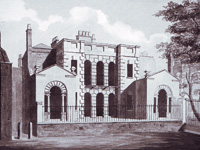
Purchasing the picturesque: Hampton Court and Lasborough Park for sale

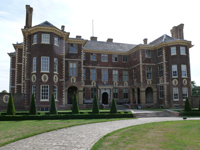
Hampton Court, Herefordshire - £12m, 935-acres (Image: Knight Frank)
Hampton Court, Herefordshire – £12m, 935-acres (Image: Knight Frank)

What is beauty? Though it is often in the eye of the beholder, some have attempted to define just what it is. In architecture, this can be seen in the development of the Picturesque ideal which sought to combine natural and man-made elements to compose a vision which would delight the eye and uplift the soul. Hampton Court in Herefordshire, and another house launched this week, Lasborough Park in Gloucestershire, can both be considered part of the Picturesque movement, even though the former took shape before the theory of the sublime and beautiful was brought to life and the latter was built just before the revival took hold.
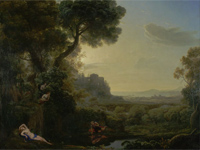
'Landscape with Narcissus and Echo' - Claude Lorrain, 1644 (Image: National Gallery)
‘Landscape with Narcissus and Echo’ – Claude Lorrain, 1644 (Image: National Gallery)

The origin of the Picturesque movement can, in part, be found in the philosophical writings of a much under-rated figure of the 17th-century, Anthony Ashley Cooper, the third Earl of Shaftesbury.  To him, nature ought to be imperfect and that, in turn, we ought to celebrate the untamed trees and serpentine rivers, those dark glades and tumbling crags. Unsurprisingly, the Earl found that the early Italian landscape paintings by Nicolas Poussin, Gaspard DughetClaude Lorrain and Salvator Rosa, reflected best this vision of a wilder natural world.  Landscapes had been unfashionable when Lord Shaftesbury first arrived in Italy in 1686, but by the turn of the century, they were in high demand amongst the grand tourists who carried these canvases back to the UK and into the popular taste of the nation.  These views married with Vanbrugh‘s early call in 1705 for a more natural approach to landscaping at Blenheim Palace, but found its true champion in William Kent in the 1730s, especially in his work at Rousham, Claremont and Stowe. The ideas were then developed further in 1757 in Edmund Burke’s ‘The Origin of our Ideas about the Sublime and the Beautiful‘ which, in its musing on aesthetics, distinguished between the latter, which was all about smooth lines and bold colours, whereas the former is about an awesome beauty on an almost fearful scale.

The death of Lancelot ‘Capability’ Brown in 1783 created a vacuum which led to the revival of the debate as to the most tasteful approach to landscaping.  The arguments were largely between Humphry Repton (who defended Brown’s ‘contrived natural’ approach of smooth curved borders and sweeping lawns which ran right up to the house) versus Sir Uvedale Price, 1st Baronet (b.1747 – d.1829), author of the ‘Essay on the Picturesque, As Compared with the Sublime and The Beautiful’ (1794), who, along with Richard Payne Knight, sought to create a more ‘robustly natural’ approach, where blasted tree stumps and ruins were also important.  This mirrored the first wave of the Picturesque to some extent, but this later flourish created a new passion to rediscover the beauty of the same painters whom Lord Shaftesbury had admired decades earlier.  Although neither Price or Knight worked on any gardens other than their own, their ideas were to have a dramatic impact on the settings of country houses, which were now considered as part of the overall composition rather than separate from it; formal gardens were swept away and snaking carriage drives now swept visitors through glades and past vistas before their arrival.

Detail from 'The Southeast Prospect of Hampton Court, Herefordshire' by Leonard Knyff, c1699 (Image: Wikimedia)
Detail from ‘The Southeast Prospect of Hampton Court, Herefordshire’ by Leonard Knyff, c1699 (Image: Wikimedia)

The grand formalism of the gardens of Hampton Court c1699 (above) contrasted with the asymmetrical grouping of the house. ‘The Southeast Prospect of Hampton Court, Herefordshire‘ by Leonard Knyff, shows how the grounds were a vision of control; of formal avenues and canals (see also the companion North prospect view). The house was, at this time, owned by the Coningsby family, having been bought by Sir Humphrey Coningsby in 1510 from a fellow courtier. His son became the first Earl of Coningsby and it remained in their family for 300 years.  Sir Richard Arkwright (1732-1792), who famously made his fortune from bringing the industrial revolution to the cotton industry, bought the house and 6,220-acres in 1810 for £226,325 (approx. £6.2m). His son, also Richard (1755-1843), made another fortune, before inheriting from his father in 1792, and invested in significant country houses, one for each of his five sons. However, the most significant changes came under his (fourth) son, John, who decided that ‘…of all the situations I know, there is none which suits my taste so well as Hampton Court‘ (funny that). After John’s marriage, the requirements of a growing family persuaded his father that the house needed to be enlarged.

The man chosen to design the work was Charles Hanbury-Tracy, a gentleman architect who had built his own home, Toddington Manor, between 1819-40, in his favoured ‘gothic collegiate’ style at a cost of £150,000 .  Though the style was sympathetic to Hampton Court, the relationship between architect and client became difficult. Another architect, John Atkinson, had pleaded with Hanbury-Tracy not to ‘make Hampton Court a cell to the Abbey of Toddington‘ but his determined views were at odds with Arkwright’s wife, who fell out with Hanbury-Tracy over the nursery arrangements, which led to nearly a decade of alterations and disagreements, especially as the costs mounted to eventually total over £30,000. John certainly preferred working with Joseph Paxton, who created the new conservatory, which was added in 1845-46. That said, the end result is one which successfully married old and new, creating a successful interpretation of domestic gothic and the picturesque.

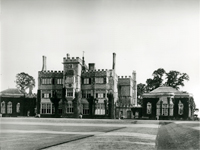
Lasborough Park, Gloucestershire - £12m, 55-acres (Image: Savills)
Lasborough Park, Gloucestershire – £12m, 55-acres (Image: Savills)

The Picturesque was a constant presence throughout the 18th-century but enjoyed a revival of interest in the 1790s and Lasborough Park represented the style just at the cusp of this.  Built in 1794 for Edmund Estcourt, his architect was James Wyatt, who enjoyed a rare skill in being able to master a number of different architectural styles – something which led later to his being unjustifiably underrated.  At Lasborough, Wyatt provided a continuation of the theme which John Martin Robinson in his book on the architect called a ‘toy-fort model‘; that is, a symmetrical house with battlements and corner turrets.  Wyatt had been using this pattern when working on various schemes for remodelling the interiors of Slane Castle since 1773 but it was only over ten years later that he was able to remodel the exterior, taking an irregular L-shape and bringing symmetry by adding matching towers.

Slane Castle, Co. Meath (Image: Slane Castle)

Wyatt’s design developed the tradition of the castellated residence; houses which had been either adapted from an older fortification or made to look like they might have done. Six decades before Wyatts’ work at Slane Castle, earlier versions, such as Howth Castle, Co. Dublin, which was altered significantly in 1738, are evidence that the style was already favoured and also incorporated an effort to create symmetry with the original keep on the left, mirrored in a new tower on the right.

The Picturesque style was popular in Ireland but initially as an import of the Protestant aristocracy and was viewed by some as an attempt to import a ‘little England’, a form of architectural and landscape colonialism. However, Ireland was particularly suited to the forms of the Picturesque which often worked in harmony with its natural beauty to form a unified creation which led the eye of the visitor from the grounds near the house, towards the middle distance, and then out to the wider landscape – much as a painter would structure their picture.
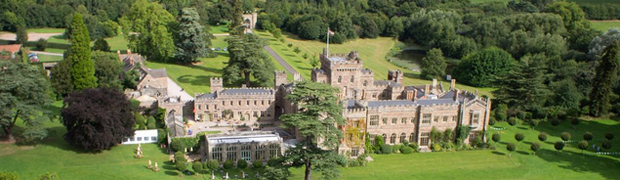
Hampton Court from south west (Image: Knight Frank)

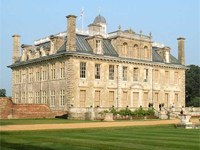
Hampton Court is one of the most important and impressive country houses to come to the market this year.  As part of our heritage, it embodies architectural developments which brought the country house from fortification to domestication, with a landscape which started with formal terraces but finished with flowing lawns.  The genesis of the more structured medieval revival form of Lasborough Park can be seen in the core of Hampton Court and in each of the subsequent alterations.  Both houses are valuable pieces of the nation’s architectural record and deserve owners who will appreciate them and hopefully both will remain as single family homes, enjoyed as they have for generations, for their Picturesque beauty.

——————————————————————-

For a more in-depth history of the Arkwrights and their time at Hampton Court, I recommend: ‘Champagne & Shambles – The Arkwrights and the Country House in Crisis‘ by Catherine Beale [Amazon]

Sales details:

Articles:

The finest SAVE, now for sale: Barlaston Hall, Staffordshire

Barlaston Hall, Staffordshire (Image: Knight Frank)

The wholesale destruction of UK country houses in the 1930s and 1950s was undoubtedly a tragic waste; not only of materials but also the embodied beauty and history of the hundreds of houses lost. Barlaston Hall, recently launched on the market for sale, and which was so valiantly fought for by SAVE Britain’s Heritage who famously bought it for £1, provides a case study which shows what might have been possible if circumstances had been different. How many more of our country houses might have survived to still be found nestled at the end of a tree-lined drive?

Collapse of Hague Hall, Yorkshire, due to mining subsidence, 1910 (Image: Lost Heritage)

The plight of the country house in the 20th-century struck at both the large and the small, the grand and the intimate.  A financial crisis could, in a generation, take a family from a secure status enjoying thousands of acres to one of ruin and a forced retreat from the family seat.  For some houses the demise was swift – for sale intact one year but the following year could see sales of contents, then fixtures and fittings, and finally the materials. The alternative fate for a number of houses was a lingering demise – abandoned, at risk from thieves and the weather, to an increasingly hostile environment with threats coming from every angle, even from below.

The elegant Barlaston Hall in Staffordshire was one house which fell firmly into the latter category. A remarkable house, it represented an important development of the Palladian tradition; the moment it moved from ‘copying’ to evolving.  The house was built c.1756-58 for Thomas Mills, a local lawyer, with the design convincingly attributed to Sir Robert Taylor (b.1714-1788).

Architecture was not his first choice of career. Taylor was the son of a master mason and sculptor, also called Robert, who was successful enough to build a villa in Woodford, Essex, but who was also rather profligate.  The father managed to get his son apprenticed to the sculptor Henry Cheere and on completing his time, found his father had just enough to send him on to Rome to study.  Whilst there, his father died so he came back to find his inheritance was no more than debts, but friends enabled him to set up as a sculptor and by 1744 he was sufficiently accomplished to be commissioned by Parliament and to carve the pediment of the Mansion House in the City of London.  It became clear that he paled in the shadow of his contemporaries – Roubiliac, Rysbrack and Scheemakers – so at the age of 40 he turned to architecture.

Outside influences often act as catalysts for development. In the same way that Blenheim Palace was enriched by Vanbrugh‘s theatrical experience, so Taylor had the advantage of his earlier, if unsuccessful, sculptural career which brought a more developed sense of shape, form, and movement to his architecture.  Colvin praises him as an architect of ‘considerable originality‘ and that ‘his villas…represented a new departure in country-house architecture‘. What Taylor provided was an evolution of the strict Palladian designs of the previous generation, marrying them to a more tolerant approach that allowed the interiors to be more Rococo, with decorative plasterwork and patterns, drawing on his knowledge of the original sources in Italy. Taylor created wonderfully elegant villas for his clientèle of bankers and merchants, who needed smaller houses for entertaining rather than seats for a rural family empire.

Braxted Park, Essex - note the octagonal window frames (Image: Braxted Park)
Braxted Park, Essex – note the octagonal window frames (Image: Braxted Park)

Although Taylor undoubtedly designed many buildings, he seems to have almost conspired to make it impossible to attribute them as he left no record of his practice and also apparently never signed his drawings.  There are, therefore, large gaps in both his chronological and stylistic history but starting with his first country house, Braxted Park, Essex in 1753-6, it is clear that his skill and legendary capacity for hard graft meant a sizeable output.

Harleyford Manor, Buckinghamshire (Image: Stephen Richards via Geograph)

Of particular note, in relation to Barlaston Hall, is Taylor’s design for Harleyford Manor, Buckinghamshire, in 1755. Part of a group of second-generation Palladians – along with Flitcroft, Keene, Paine, Ware, and Wright – Taylor saw Palladio as an inspiration but was not a slavish disciple.  The core principles relating to proportion and preserving a necessary elegance were respected but it was in the interpretation that they introduced variety.  At Harleyford, Taylor took a more vernacular style to the idea of the Villa Rotonda (a standalone villa with four equal fronts, allied with its landscape) but also combined with a sculptors appreciation that it should be attractive from all angles.

Asgill House, Richmond, Surrey (Image: Matthew Beckett)

Built between 1756-58, the layout and style of Barlaston Hall clearly shows the kinship with Harleyford. The elegant simplicity of the ground floor layout with the four principal rooms pushing out into the arms of the cross with a double-height central hall clearly can be derived from the Villa Rotonda but rotated on the axis to create more interior space, as opposed to the Rotonda’s open loggias.  One of the most distinctive features is the pleasing ‘chinese’-style woodwork, with octagonal window tracery on the exterior, a pattern mirrored in the library in the bookcase doors.  For one so early in his career, Taylor was showing remarkable invention, elegance and practicality, all of which served to launch his practice, which continued for 35 years. After Barlaston, further commissions such as Asgill House (1761-64) on the riverside at Richmond, Surrey, for his friend Sir Charles Asgill, also helped establish Taylor’s reputation.

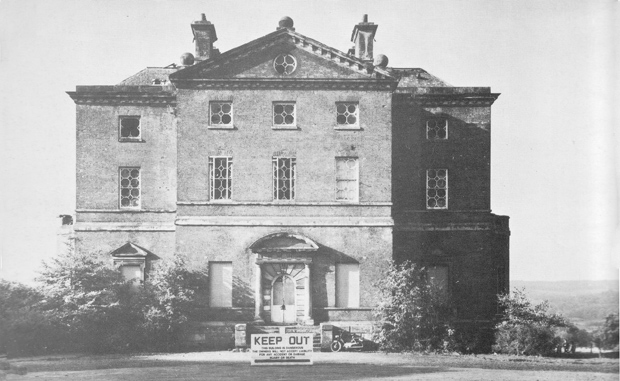
Not that any of this innovation and elegance mattered to the Wedgwood company who applied twice in the early 1980s to demolish Barlaston Hall.  The house and estate had been bought by the famous pottery firm in 1937 as part of a scheme to create a new factory and model village for their workers.  These were built some distance away but the now grade-I listed house was badly neglected with serious water damage causing it to become increasingly derelict, with ceilings and the staircase collapsing, and the structure affected by subsidence caused by coal-mining.  The house also sat across a geological fault and future mining plans risked the whole area sinking by about 40 feet.  Clearly, this was a house very much at risk.

Entrance front, Barlaston Hall, Staffordshire (Image: SAVE Britain's Heritage)
Entrance front, Barlaston Hall, Staffordshire (Image: SAVE Britain’s Heritage)

In 1981, the second application to demolish was called to public inquiry, due to the importance of the house, where the architectural conservation charity SAVE Britain’s Heritage argued the case for the preservation and restoration of the house. As Barlaston Hall had been designated as ‘outstanding’ this placed certain obligations on the National Coal Board who would be required to pay for not only repairs but also preventative measures, such as the huge concrete raft they devised to prevent further movement.  After a few days of arguments, Wedgwood decided that they would make a bold move and offer the house to SAVE for £1 on the condition that it was restored within five years or they could buy it back for £1 (after which the house would no doubt be swiftly demolished).  The then Secretary of SAVE, Sophie Andreae, immediately phoned the President, Marcus Binney (who was in the USA) with the news.  Conscious that he had to make a decision there and then, Marcus called Wedgwood’s bluff and bought Barlaston Hall.

Dining Room, Barlaston Hall, Staffordshire - 1981 (Image: SAVE Britain's Heritage)
Dining Room, Barlaston Hall, Staffordshire – 1981 (Image: SAVE Britain’s Heritage)

A few days later when Marcus was able to visit the house for the first time, the scale of the challenge became starkly apparent.  Stepping into the debris-strewn hallways, light shone through all three floors from gaping holes in the collapsed roof and 4″ cracks indicated where the subsidence was taking hold.  Although most of the fireplaces had been stolen, the good news was that much of the original plasterwork on the walls and the distinctive woodwork had survived.  SAVE immediately organised a temporary roof, after which, the house took nearly 2 years to fully dry out.  Specialist heritage builders and professionals swiftly set to work on both the structural and conservation issues.

East front, Barlaston Hall - 1981 / 2014 (Images: SAVE Britain's Heritage / Knight Frank)
East front, Barlaston Hall – 1981 / 2014 (Images: SAVE Britain’s Heritage / Knight Frank)

Although work had started well, delays in securing the necessary certificates from the Secretary of State meant that the National Coal Board then decided to try and renege on their agreement to fund the work.  SAVE sought leave for a judicial review which prompted the Secretary of State to immediately fulfil his promises, which ultimately forced the National Coal Board to capitulate from their shameful position and fund the repair and preventative works – and SAVE’s legal fees too.  With immediate funding secured, which was followed by further grants, the conservation work continued.  It was put up for sale in 1992 and bought by the current owners who have sensitively completed the restoration of this captivating and fascinating house.

That the value of a house can go from £1 to £2.3m in the space of 30 years shows that the fortunes of country houses can rise as swiftly as they fall.  Barlaston Hall not only represents an important link in our understanding of the domestic Anglo-Palladian tradition, but is also a testament to how determined action can succeed even against larger opponents.  Today, the house still stands proudly displayed from the road, a bold statement of hope and preserved beauty.

——————————————————————

If you would like to support the fight to preserve our architectural heritage, please do become a Friend of SAVE Britain’s Heritage.  You will receive a regular newsletter plus access to the online database of ‘buildings at risk’.  You can also follow them on Twitter: ‘@SAVEBrit‘.  I am on the Committee of SAVE.

——————————————————————

The sale was announced in Country Life magazine: ‘A Country House Reborn‘ [16 April 2014]

Sales particulars: ‘Barlaston Hall‘ [Knight Frank]

A more detailed account of SAVE’s fight: ‘Barlaston Hall‘ – the Wedgwood Museum also has a brief history of the house on their website but which skips over the bit where Wedgwood tried to have it demolished. For historical images, see ‘Neville Melkin’s Grand Tour of the Potteries‘.

William Kent, the reluctant Gothick

If asked what style of architecture one would associate with William Kent, one of the leading designers of the Georgian era, most would say Palladian and, if pushed, they might argue that his interiors are distinctly Baroque.  Yet Kent is also regarded as the creator of the ‘Gothick’ style of architecture; a blend of historical Gothic elements but applied, initially, within the structure of classical rules. This quickly evolved to have greater historical rigour, laying the groundwork for the more zealous interpretation by Victorians such as A.W.N. Pugin.  However, it could be argued that Kent was merely satisfying the stylistic whims of a patron and in his use of ‘Gothic’ elements, was actually continuing the Elizabethan practice of creating ‘symmetrical Gothic’, a visually impressive approach built on Renaissance principles.

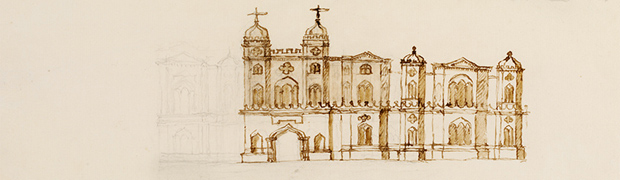
Design for the east front of Esher Place, c1732 (copyright: Merton Heritage & Local Studies Centre)

William Kent was born in 1685 in Bridlington, North Yorkshire, and displayed an early talent for drawing. Despite his parent’s modest means, he ‘had the good fortune to find some Gentlemen…to promote his studyes‘ who paid for him to travel to Italy in 1709, along with another talented young artist, John Talman.  Whilst there, Kent developed his skills in painting, but also in business as an agent for various young aristocrats on the Grand Tour, including Thomas Coke, later 1st Earl of Leicester, and Richard Boyle, 3rd Earl of Burlington, for whom Kent would help purchase paintings and other works of art. The latter connection with Lord Burlington, first professional, then as a friend, was to launch Kent’s career when they both returned to London in 1719, with Kent as the draughtsman of Burlington’s dream of a Palladian Britain.

It was the need for patronage which kept Kent in the thrall of Burlington and the circle of Palladians. Where Kent was given greater freedom, particularly in designing interiors and furniture, his natural inclination seems to have been towards a more Baroque style; a rich, florid escape from the strictures of the pure and elegant Roman style which Burlington so enthusiastically promoted.  So how did Kent become the father of ‘Gothick’, an architectural style characterised by the playful, historically-inaccurate application of medieval Gothic, the language of the cathedrals?

Hampton Court Palace east front of Clock Court - detail of capriccio landscape by William Kent, 1732 (copyright: British Museum)
Hampton Court Palace east front of Clock Court – detail of capriccio landscape by William Kent, 1732 (copyright: British Museum)

Kent’s first documented use of Gothick was in 1732-34 at Hampton Court Palace where he was commissioned to rebuild the east front of the Clock Court as accommodation for the Duke of Cumberland.  As a good Palladian, Kent originally proposed a classical scheme but Sir Robert Walpole, who had final approval over the design as First Lord of the Treasury, required that it be in keeping with the existing Tudor Gothic. Although originally there was only a much simpler door, Kent developed this and created a full gatehouse as a central focus of the front. Though now altered, Kent’s design drew on the existing architectural features, using ogee-domed octagonal turrets and a Gothick Venetian window. The interiors were also remodelled but here Kent’s enthusiasm for Gothick waned and he reverted to a more classical style of decoration.

On a side note, there is a suggestion that Kent’s actual first Gothick design was for a church tower at St Martin’s, Houghton in 1727.  Although the drawings in the Houghton archives are by Thomas Ripley, Kent had been involved with designs at Houghton since 1725 for the owner, Sir Robert Walpole, who, as previously mentioned, also instigated the use of Gothick at Hampton Court.

The most complete early use of this novel Gothick for a country house was at Esher Place, Surrey.  Having bought a 14th-century gatehouse, Wayneflete Tower (the only surviving part of a much larger quadrangular mansion) Henry Pelham, Prime Minister from 1743-54, lacked a house on his estate. Again, Kent proposed a Palladian solution – a compact villa which (minus dome and projecting portico) bears similarities with Lord Burlington’s Chiswick House, completed in 1729. Again, Kent was to be over-ruled by the client who wished for Wayneflete Tower to be more than a grand garden ornament – it had to be the centrepiece of the new house and this dictated the style.

Sketch design for the east front of Esher Place, William Kent, c1732 (copyright: Victoria & Albert Museum)

One can imagine Kent sitting down with pen and paper and, much as if learning a new language, started drawing out his new vocabulary.  Though the initial sketches show two classical wings grafted onto the tower, he also, importantly, was experimenting with a more varied facade, one which pushed forward and receded with canted windows and recessed bays. This movement was to be a key influence in the future, breaking down the more formal, flatter approaches which had previously dominated.  This experimentation also extended to the interiors with rooms taking on greater variety; octagons or rectangular rooms ending in canted bays.

Esher Place, Surrey - John Vardy, after William Kent, c1744 (copyright: London Borough of Lambeth)
Esher Place, Surrey – John Vardy, after William Kent, c1744 (copyright: London Borough of Lambeth)

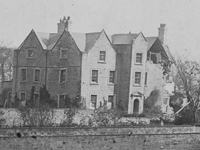
Kent’s final design (see at the top of the article) was an elegant solution and created a charming composition of a symmetrical house with the wings dominated by full-height canted bays and grand ogee-capped domes on the central tower. Unfortunately the scheme was watered-down in the execution – John Vardy‘s c.1744 engravings showing more austere wings without the bays and the tower without the domes. Even these were not to last as the new owner of the estate in 1805 pulled down the wings, leaving just the historic tower, before building a new house (the 1805 house is the south wing of the 1895 house) on the hill above – just as Kent had originally proposed to Pelham.

Proposed alterations to Honingham Hall, Norfolk, 1737, by William Kent (copyright: RIBA British Architectural Library)

After Esher Place, in the next of Kent’s Gothick experiments, in 1737 he produced a design for the remodelling of Honingham Hall, Norfolk, for the second son of Viscount Townshend. A year later, Kent came back with a more detailed plan which removed much of the Jacobean character of the house, which had originally been build c.1605, to dramatically alter the front with a mixture of the bays and recessions. Sadly neither of the designs where executed and the house itself was demolished in 1966.  However, this exercise gave Kent an opportunity to gain greater familiarity with Gothick detailing and elevations.

Rousham House, Oxfordshire (Image: Country Life Picture Library)

The only other significant house Kent was to design in this style was Rousham House, Oxfordshire, for Lieutenant General James Dormer in 1737 (note the same year as the first proposed design for Honingham Hall). This was a remodelling of a small, H-plan house built in the 1630s and so Kent’s design had to accommodate the inevitable compromises of an existing building.  This he did by taking elements of the Honingham design, including the crenellations and a central ogee-capped dome, and combining them with classical elements such as the two pavilions which flanked each side. The interiors were a mix of styles; the parlour was purely classical but the library (a drawing room since 1764) was Gothick (or oriental, or Moorish, depending on who you ask). The gardens are the celebrated delight of Rousham and the buildings were designed by Kent at the same time as the house but are almost all classical, bar a Gothick Corn Mill.

North front of Rousham House, Oxfordshire, 1739 (copyright: private collection)

Other Gothick projects by Kent such as the screens for Westminster and Gloucester Cathedrals, the Choir Fittings at York Minster, and various garden buildings all show a facility but not a fluency with the Gothic language. The same elements are used repeatedly within a variety of layouts and plans but without the detailed study of the original source buildings Kent seemed bound to his limitations.

Mount Edgcumbe, Devon - print drawn by T. Allom, engraved by C. Mottram. 1830
Mount Edgcumbe, Devon – print drawn by T. Allom, engraved by C. Mottram. 1830

Did Kent ‘create’ Gothick? Yes – and no.  The Elizabethans had long been creating houses which deployed the language of historical Gothic to their houses.  An article by Mark Girouard on ‘Elizabethan Architecture and the Gothic Tradition‘ (SAHGB, 1963) cites Burghley, Lincolnshire, where the house features a west front (built 1577-78) of towers and a turreted gatehouse, a north front (1585) dominated by Tudor-Gothic windows with a Gothic parapet, and the clock tower (1587) has an almost Gothic spire.  The Elizabethan ‘Prodigy’ houses featured an emphasis on the vertical with towers and squared-off bay windows such as Robert Smythson’s Worksop Manor.  Finally, the symmetry that underlies Kent’s work, can be seen in the Renaissance-influenced Elizabethan houses such as Longleat or Mount Edgcumbe.

What Kent did do was apply his natural love of a more lively baroque interpretation of Gothic design to create a style which, although it mainly influenced those he worked with, was an inspiration to a later group of designers such as John Vardy and Batty Langley.  Overall, Kent’s Gothick houses and interiors lack the commitment and historical rigour he displayed to the Palladian style or the verve and passion which characterised his Baroque efforts. Certainly a measure of his success is that Kent did create a new architectural language which fed the wider Georgian passion for the Picturesque. Here, at last, was a style which could break strict Classical regularity and substitute it with a rambling vision of finials and tracery.

——————————————————————————-

This article was clearly inspired by the superb exhibition: ‘William Kent: Designing Georgian Britain‘ (22 March – 13 July 2014). Definitely worth a visit if you are in London.

A brilliant tome (it’s huge) has been produced to coincide with the exhibition but easily works as a standalone reference: ‘William Kent: Designing Georgian Britain‘ by Susan Weber.

The Victoria & Albert Museum has an extensive collection of William Kent drawings

Romancing the stone; country houses built by love

Many a man has been driven to great lengths by love – and architecture is often a rewarding though insatiable mistress for such a passion.  Whether as an expression of love for a wife or a demonstration of a yearning, aching heart, each found that their country houses were caught in that very human desire to make real those Romantic desires which otherwise are sometimes only expressed in far more transient ways. Though sometimes love’s labours are lost to unrequited desires, often country houses were the ideal means to commemorate the passions which had created their happiness.

Osborne House, Isle of Wight - holiday home of Queen Victoria and Prince Albert (Image: English Heritage)
Osborne House, Isle of Wight – holiday home of Queen Victoria and Prince Albert (Image: English Heritage)

The motivations behind the choice of architecture or design or even the starting of the construction of a new country house is sometimes overlooked in the literature. The occasion of ennoblement was an important catalyst for a grander house and equally a marriage and new building project are often keen bedfellows – though often the new house was financed through the newly acquired wealth of the husband from his bride and was more an expression of his newly-bolstered financial strength.  With the status of the married woman somewhere equal to that of the china plates, for many, their influence was limited to the running of a home.  The choice of some furnishings and the interiors of the ‘female’ areas of the houses were often the accepted limits of the wife’s contribution – though there were exceptions such as Lady Leicester who, after 1759, was left £2,000 a year to finish several of the state rooms at Holkham Hall (n.b. website annoyingly plays birdsong automatically).

Syon House, Middlesex (Image: Syon House)

The choice of architect, interiors, furnishings, furniture and art were all reserved for the man as an expression of his taste and power. Writing of his design for Kimbolton Castle, the architect Sir John Vanbrugh said, “I’m sure this will make a Noble and Masculine Shew‘, and that in the exterior visitors would “See a Manly beauty in it when tis up…‘. Clearly reflecting the female taste, or even necessarily their comfort, was not high on an architects priorities. Although some enjoyed a level of luxurious indulgence, such as the Dowager Lady Egerton for whom James Wyatt created a sumptuous Pompeiian-style dressing room at Heaton Hall in the 1770s, perhaps the experience of the Duchess of Northumberland was more common.  When Robert Adam remodelled their London seat, Syon House, in the 1760s, he was careful to place the Duke’s private apartments in a separate area, accessed via a private staircase, whilst the Duchess’ dressing room enjoyed a much less secluded arrangement, as it was included in the main circuit of entertaining rooms.

Ham House, Surrey - now owned by the National Trust (Image: Matthew Beckett)
Ham House, Surrey – now owned by the National Trust (Image: Matthew Beckett)

Wives and widows were slowly asserting greater independence, often due to their personal wealth, but slowly changing attitudes did provide greater opportunities for their views and tastes to be heard and seen.  In the 17th-century, couples such as the Duke and Duchess of Lauderdale were acting very much in concert together in the design and furnishing of their home, Ham House. It had been the home of the Duchess and her father and she had fiercely held on to it during the dark years of the Civil War when he had been forced to escape abroad. After her marriage in 1672, Ham House became not only a symbol of their wealth, but also a testament to their shared love of travel and the finer things in life.

Dobroyd Castle, West Yorkshire (Image: wikipedia)

Romance was surely often part of the motivation to build; a golden word that could turn a mere building into architectural poetry. Dobroyd Castle in Todmorden was the creation of a wealthy local mill owner, John Fielden, to honour a promise after his intended bride, Ruth, a poor labourer’s daughter, had said, during their extended courtship, “Build me a castle and I’ll marry you.“.  This can be said with either a romantic or mercenary inflection but, in honour of St Valentine, let’s believe that her request was for a fairytale expression of their marriage.  At least it was not a pre-condition, as they married in 1857 and work started on the castle in 1866 with completion in 1869.  Designed by the little known architect John Gibson, throughout the house the initials of John and Ruth are carved into the building many times as a constant reminder of their love.

Luscombe Castle, Devon (Image: Country Life Picture Library)

The desire to do all one can for a wife, especially one who is ill, creates opportunities for love to be the patron of great architecture.  The delicate health of Dorothea Robinson, wife of Charles Hoare, a partner in the eponymous family bank, necessitated a more temperate climate and so an estate outside the small Devon coastal town of Dawlish was purchased. Requiring a house and not lacking in funds, Hoare commissioned the fashionable John Nash and Humphry Repton to create a retreat for rural recuperation.  With Repton’s help, Dorothea chose a most Picturesque site nestled in a secluded valley. Repton then recommended to Nash that it be in the ‘Character of a Castle’, and so Luscombe Castle was built between 1800-1804.  Considered one of the finest Regency houses, the external beauty is matched with a domestically convenient interior; a distilled version of Nash’s rather grander castle designs, but which perfectly suited the location and as a romantic reminder of a husband’s concern for his wife.

Kingston Lacy, Dorset (Image: wikipedia)

A love unrequited or thwarted is often a powerful force which can inspire many things.  For some, such as William Bankes, a prominent MP and renowned traveller, his enforced exile to escape a possible death penalty for being caught in a compromising situation with a soldier in Green Park in 1841, meant leaving his life’s work; the building and beautification of his Dorset home, Kingston Lacy. Subject to a punitive ‘outlawry‘ order, Bankes first escaped to France before settling in Venice. Bankes had been forced to give up, under threat of forfeiture, any legal title to his estates and contents to his brothers but he continued to be relatively well-funded and managed the building works at Kingston Lacy via detailed correspondence with the Clerk of Works.  One can only guess at the frustration of Bankes as he could only imagine how his plans were turning out, not only in relation to the building works but also the numerous pieces of art which he sent to Dorset.  Proving that for love, some will risk all, it is thought that Bankes risked imprisonment to be smuggled back into England in 1854 so that he might see his house and collection, which he had only been able to dream of, and give direction as to how it might be finished.

Wallington Hall, Northumberland (Image: Visit Northumberland)

By the Victorian era, it was often both the husband and the wife who would take increasingly equal roles, especially as the role of the house was firmly centred on entertaining; a role traditionally taken on by the wife. It also reflected a relatively more accommodating age when women were at last more broadly considered intelligent equals to men.  The increasing importance of women can also be seen in the literature where discussion of the creation of a house now talks more husband and wife, though still often with their roles demarcated to exteriors/interiors.  The wives often had their own circles of interest leading to interesting contributions such as at Wallington Hall in Northumberland where the Pre-Raphaelite painted decoration in the central hall is by the artist William Bell Scott, whom Lady Pauline Trevelyan met through her literary activities.

Osborne House, Isle of Wight (Image: English Heritage)

Perhaps the most famous husband and wife architectural collaboration in the Victorian era was the creation of the summer retreat at Osborne House on the Isle of Wight by Queen Victoria and her beloved husband, Prince Albert.  With a society leaning towards a more moral aspect, Victoria was determined that the royal family should be seen in step with it and so the planning of Osborne is not only to meet the needs of the family for entertaining but also, equally, that it be a family home. Indeed, writing to her daughter in 1858 from Windsor Castle, she tells how “I long for our cheerful and unpalacelike rooms at Osborne.”.  Her husband’s influence was the Italianate exterior, with the stucco work and belvedere towers, designed by the Prince and the London builder Thomas Cubitt, which matched his passion for Italian art, though Victoria was perhaps also influenced by the design of Trentham Hall, Staffordshire (by Sir Charles Barry) which was the home of her close friend the Duchess of Sutherland.  Osborne became the place she perhaps most associate with her husband and, after his death in 1861, it was one of the places she felt most at ease.

So, the building of a country house isn’t simply to mark ennoblement or new wealth, but can be an expression of love or passion between a couple, which one hopes might be more inspiring.  Certainly a love of country houses is something to be celebrated any day of the year.

—————————————————–

If you know of any other examples (and I’m sure there are many) please do add a comment below.

Happy Birthday Sir John Vanbrugh; the master of English Baroque

Portrait of John Vanbrugh (1664-1726) by Sir Godfrey Kneller (Image: Wikipedia)

One of the most exciting eras of British architecture was the Baroque; a unique fusion of Continental influences, leavened with a dash of characteristic restraint, which created something elegant, strident and theatrical – words which could equally describe the best known architect of that time, Sir John Vanbrugh, born 350 years ago this month.

Although much is known about his later life, his exact date of birth is not; simply that he was baptised on the 24 January 1664 (though he .  Born into a wealthy and well-connected family (his father was a sugar trader), his schooling and early career are still subject to some debate, with suggestions that he spent time working at a trading post in India.  The first solid evidence is his commission in January 1686 in the Earl of Huntingdon‘s foot regiment, though he was to leave in August that same year. After this, Vanbrugh engaged with the Whig cause and played a minor role in the Glorious Revolution of 1689 – though he was to miss the event itself as he spent four and half years in French prisons, including the Bastille, from September 1688 on (what Kerry Downes believes to be trumped up) charges of spying. Emerging in 1692, he had three months of enforced leisure in Paris until he could return to England, where he promptly joined the Navy, taking part in an attack on the French.  In the mid-1690s, he returned to London and became a playwright but also started developing his architectural career, perhaps in response to the changing social tastes in the late-1690s which found his bawdy Restoration comedies increasingly unacceptable.  A witty, intelligent and convivial character, Vanbrugh was never short of friends or connections.

Once Vanbrugh had decided to be an architect, he appears to have passionately embraced his new vocation – something noted by his contemporaries, including Jonathan Swift, who remarked that ‘Van’s genius, without thought or lecture, Is hugely turn’d to architecture‘. Most architects have to prove their skill with smaller projects but Vanbrugh was to start with possibly one of the most important commissions then available, Castle Howard for the Earl of Carlisle, and make such a dramatic entrance that his reputation was firmly established from then on.

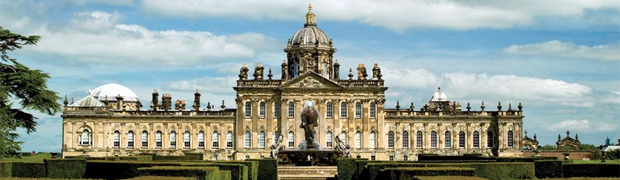
Castle Howard, Yorkshire (Image: Yorkshire Country House Partnership)

Broadly, the designs produced by Vanbrugh can be seen as a distillation and development of the work of three other architects; William Talman, Nicholas Hawksmoor and Sir Christopher Wren.  Talman had created the first Baroque country house, with his south and east fronts of Chatsworth House, completed in 1696.  Baroque had originated and developed in Italy with architects such Bernini, Borromini and da Cortona using the language of ancient Rome to express the majesty of the Catholic church, and also by French monarchs as a statement of their absolute power. Its use by the resolutely Whig Protestant 1st Duke of Devonshire, was perhaps a carefully calculated statement to both the monarch, to remind him that power now lay with them, and a snub to the Catholic church, that their chosen style across Europe was firmly owned by the Protestants in England.

'Goose Pie House', Whitehall - designed by Sir John Vanbrugh 1700 (Image: copyright of The Trustees of Sir John Soane's Museum, London)
‘Goose Pie House’, Whitehall – designed by Sir John Vanbrugh 1700 (Image: copyright of The Trustees of Sir John Soane’s Museum, London)

Vanbrugh, although closely allied with the Whigs and sympathetic to their preferred style, also showed a medieval influence, with a clear interest in the military architecture of the period. In both his commissions and his own home in London, ‘Goose Pie House‘ in Whitehall, he incorporated the martial vocabulary of turrets and towers, giving his work a more monumental aspect, a solidity which played well with the aristocratic patrons who wished to evoke their family history but also wished to live in contemporary luxury.

With Baroque as an astute political choice, Vanbrugh was also able to bring his theatrical flair to play with the rich language it provided.  Castle Howard is one of the finest buildings in the world, and certainly one of the grandest in the country – not a bad start for a novice.  Horace Walpole visited in 1772 and afterwards wrote:

Nobody had informed me at one view I should see a palace, a town, a fortified city, temples on high places, woods worthy of being a metropolis of Druids, the noblest lawn fenced by half the horizon and a mausoleum that would tempt me to be buried alive: in short, I have seen gigantic places before, but never a sublime one.

Lord Carlisle was a well-educated and well-travelled man whose Grand Tour had taken him across Europe, including, naturally, Rome.  Although William Talman had been first given the job, his irascible nature led to his firing, and so, in 1699, Carlisle gave his fellow Kit-Cat Club member, Vanbrugh, the chance of a lifetime.

Here, it is worth making clear that Vanbrugh’s houses, and especially Castle Howard, were joint enterprises with another exceptional architect; Nicholas Hawksmoor.  Assistant to Sir Christopher Wren, Hawksmoor was an expert on Classical architecture and drafting and also a sound project manager who helped deliver Vanbrugh’s ideas from paper to stone. Hawksmoor has often been given credit for the designs of Vanbrugh’s houses but it seems that, as John Summerson said, both were exceptional men, and that each was the perfect compliment to the other.

Drawing showing original plan for Castle Howard (Image: via Visiting Houses and Gardens)

Construction started on the east wing of Castle Howard in 1699 and was completed by 1703, with the main block finished in 1706, the principal apartments by 1712 and the most important interiors by 1715, at a total cost of £38,000.  And what a house Lord Carlisle got for his money – a composition of low wings, leading to a grand central block, decorated with vibrant stonework, culminating in the first dome to be used on a country house in the UK, with interiors which cleverly used light and space to create a theatrical effect to awe any visitor.  Drawing from an earlier design for Greenwich Hospital by Sir Christopher Wren, Vanbrugh’s imagination had been given full reign to develop a most remarkable response to his client’s commission, fused with the crisp execution of the work overseen by Hawksmoor.  Carlisle was delighted with his new palace – which proved both domestically convenient and warm – but the architectural ripples the house created led to wide admiration, with it even being included in the ‘bible’ of Palladianism, Vitruvius Britannicus.  The additional triumphs of the parkland buildings, also mostly by his hand, cemented the reception of this house and setting as one of the most brilliant to have been created anywhere in the country.

Blenheim Palace, Oxfordshire - entrance front (Image: Blenheim Palace)
Blenheim Palace, Oxfordshire – entrance front (Image: Blenheim Palace)

Vanbrugh’s success led to his second great commission, Blenheim Palace – though it was to be a much less happy experience for both client and architect. Whilst still working at Castle Howard, construction at Blenheim began in 1705.  Intended as a monumental tribute from a grateful nation to the Duke of Marlborough, it was also supposed to be a home. That demand for something which spoke not only to the stature of the recipient but also the generosity of the Royal patron, was perhaps the perfect commission for Vanbrugh and his imagination.  Sadly, relations between the architect and the Countess of Marlborough were fractious and Vanbrugh was eventually banned from the site and never visited his completed design.

Despite this, the building is an immense display of bravura – a vast testament to the breadth of imagination, which was reflected in the cost which spiralled from the Duke’s original suggestion of £40,000 to £300,000 by the time it was complete.  The design is broadly similar to that of Castle Howard but with an added degree of magnificence which elevates it using not only the sprawling scale but also the extensive decorative martial stonework to attain monumental status.  That the building had to be finished by Hawksmoor – who described himself as ‘a Loving Nurse that almost thinks her child her own‘ – doesn’t detract from one of the defining buildings of that age, a magnificent testament to Vanbrugh’s skill.

Kings Weston House, Bristol (Image: Country Life Picture Library)

Driven by his interest in military architecture, Vanbrugh’s other country house designs can also be seen to be drawing on his personal preference for the spirit of fortifications.  In 1707, whilst working on Kimbolton Castle, Huntingdonshire, he wrote in a letter ‘…I thought twas absolutely best, to give it Something of the Castle Air, tho’ at the Same time to make it regular‘.  With his next commission, Kings Weston House, in 1709-10, what starts as a compact and elegant villa is given the flavour of a castle above the roofline, with the chimneys grouped together in a central stack, evoking the idea of a keep.  At Lumley Castle it was the reverse, with an Italianate air being applied to a truly ancient castle.

The last three country houses Vanbrugh designed in the years before his death were perhaps some of his finest – concentrated distillations of his ideas but each given its own distinctive approach.  Seaton Delaval Hall is perhaps the best expression of the castle as country house; a central block with a keep-like mass in the centre, a bold entrance taking the form of a gatehouse, flanked by two turrets.  This formula is almost a hallmark of Vanbrugh (bar Kings Weston and Kimbolton which deviate) but the inventiveness of each shows that as with the English language, the architect was also a master of this architectural vocabulary.  Eastbury House in Dorset, merged elements of Blenheim, Kings Weston and Seaton Delaval whilst Grimsthorpe Castle is perhaps the best expression of the blend between that outline and the Classical style, creating a deeply satisfying design which delights to this day.

Grimsthorpe Castle, Lincolnshire (Image: Grimsthorpe estate)

Within his lifetime and much later, Vanbrugh was hugely influential, yet the fashion for Baroque was quickly to wane after his death in 1726 – Summerson points out that by 1728 it was the subject of caricature, and by 1730 presumed dead.  Anglo-Baroque offered an attractive stylistic path with a symmetry which felt natural to the British, but combined with a flair that gave real vibrancy wherever it was used.  350 years later, in our more pluralistic and accommodating age, Vanbrugh – and by extension Hawksmoor – would have been able to co-exist with Burlington and Flitcroft and the stage would have been set as with each new building they vied to win the architectural hearts of the nation. Perhaps our greatest regret with regards to Vanbrugh should be that the coming of Palladianism and its zealous evangelism was to end the development of Sir John’s more exciting and theatrical approach but today we can at least admire and fully appreciate his genius in stone.

———————————————————–

Further reading and visiting details

Biographies 

Houses

Castle Howard – still owned by the Lords Carlisle, open to the public

Blenheim Palace – still owned by the Dukes of Marlborough, open to the public

Kimbolton Castle – now a school, occasionally open to the public

Kings Weston House owned by Bristol Council, leased to a private individual, not open to the public, though the parkland is.

Lumley Castle – now a hotel

Seaton Delaval Hall – owned by the National Trust, open to the public

Eastbury House (demolished bar one wing) – privately owned, not open to the public

Grimsthorpe Castle – owned by a charitable trust for the de Eresby family, open to the public