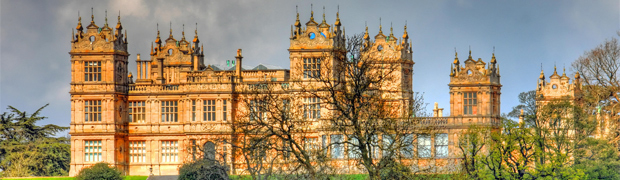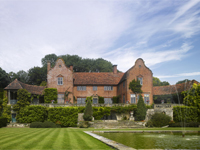
‘A land where it is always afternoon’; the life and talents of Philip Tilden

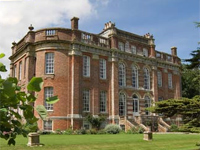
Port Lympne, Kent (Image: Country Life Picture Library)

One of the finest skills an architect can possess and cultivate is that of charm; the art of turning an encounter into an acquaintance into a client – and sometimes even a friend.  Such a skill can offer a balance to such flaws as he may have, whilst also being his most effective sales technique.  One such architect was Philip Tilden, a man whose own assessment of his talent and skills usually surpassed that bestowed by his peers.  Yet, Tilden was a sensitive man, attuned to how people wished to live in their houses and who developed a rapport within high society leading to an almost bewildering array of commissions; from the most domestic to the breathtakingly grandiose and who, along the way, managed to design houses for two UK Prime Ministers.

Philip Tilden (b.1887 – d.1956) was an avowed traditionalist.  His memoirs – ‘True Remembrances‘ (though others doubt this!) – which were published in 1954, are full of repeated laments of lost skills, modern taste, and the lack of style. Not that he was ‘anti’ modern materials, but more that he thought they should be used cautiously and subserviently to the traditional ones, saying “Instead of absorbing the new materials and techniques into the body of tradition, and digesting them, we have let them take control“.  His was a world where architecture was national (and hence the international Bauhaus would have been an anathema) and, for him, ‘…Britain was not the home of the acanthus and cypress – it is the home of the Gothic rose, the oak, the ash, and the parasitic ivy‘.

Though he made clear his emotional preference for the Gothic, it was part of a broader love of the ancient, in particular, of the old castles which he was called upon to restore – though circumstances would ensure that he would work with whichever building he was called to look at.  Tilden was a good architect – but not a great one.  Sir Edwin Lutyens, who was his contemporary but not his peer, once complained having seen Tilden’s additions to a house as ‘work so ill-conceived by a man who claims a following and dares to criticise‘.  But such criticism shouldn’t obscure Tilden’s more positive characteristics; his sympathy for historic fabric, his imagination, and his consummate networking skills.

The early part of the 20th-century was still an age where patronage was in the hands of the upper echelons of society.  If one could gain a foothold, the power of the related and intertwined networks of politics, business, and industry could provide a welter of opportunities for someone who could play the game.  Tilden was a master of this – his memoirs are an almost embarrassingly giddy series of anecdotes of he and his wife staying with Sir ——— or Lady ———-, and the delight the hosts and visitors apparently took in each others company.  It was through these connections which provided Tilden with his commissions – from the smallest artistic endeavours to the excessive.
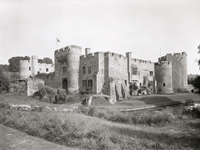
Allington Castle, Kent, 1928 (Image: Country Life Picture Library)

He joined the Architectural Association in 1905 and on graduating became an articled pupil to Thomas Edward Collcutt, whom he later went into partnership with, before establishing his own practice in 1917.  One of his first clients was Sir Martin Conway, 1st Baron Allington, the mountaineer, politician and art critic who once said “I have always liked the work of Mr Philip Tilden, but if anyone asks me why, I cannot fully say“.  Sir Martin and his much wealthier wife, Katrina, had discovered Allington Castle, Kent and both exclaimed ‘Of course we must have it!‘ and she had bought it in 1905. Some restoration work had been carried out before 1914, by W.D. Caroe, to make the ruined castle habitable but Tilden was brought in for further changes in 1918 and became firm friends with the Conways, working on the castle until 1932.
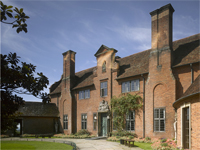
Entrance front, Port Lympne (Image: Country Life Picture Library)

It was this long period of friendship which enabled Tilden to extend his circle of useful connections.  One of these was Sir Louis Mallet, once our Ambassador to Turkey, who had led a cultivated and international life which had created a prized social circle.  It was through him that Tilden came to know and work with the wealthy Sir Philip Sassoon, the noted politician and art collector.  Sassoon was a renowned host and his architectural requirements were driven by this.  Herbert Baker had built the Cape Dutch-style Port Lympne for Sassoon in 1913/14 and when Sassoon wished to enhance Port Lympne after WWI, he called on Tilden.  With the confidence of wealth (related as he was to the Rothschilds), Sassoon gave full rein to his artistic and stylistic preferences which were far removed from the chaste reserve of the traditional English country house.  With dining room walls painted in lapis lazuli blue and lined with golden chairs and an opalescent ceiling, a Spanish courtyard, and a grand flight of steps in the garden, this was a house for show.
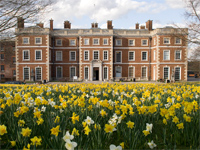
Trent Park, Enfield, north London (Image: Enfield Council via flickr)

Yet, barely had the works on Port Lympne been completed, when Sassoon bought Trent Park, in north London, in 1923, which was to become the centre of his social entertaining.  In contrast to the exuberance of his Kentish seaside retreat, Sassoon looked to Tilden to create a more traditional environment, one of lithographs and wallpaper, antiques and books.  This suited Tilden who created a hugely successful pleasure palace:

“…a dream of another world – the white-coated footmen serving endless courses of rich but delicious food, the Duke of York coming in from golf… Winston Churchill arguing over the teacups with George Bernard Shaw, Lord Balfour dozing in an armchair, Rex Whistler absorbed in his painting… while Philip himself flitted from group to group, an alert, watchful, influential but unobtrusive stage director – all set against a background of mingled luxury, simplicity and informality, brilliantly contrived…“.  (Robert Boothby. I Fight to Live (1947)
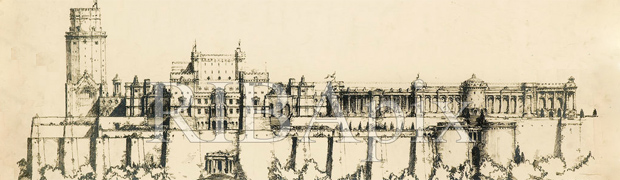
Proposal for Hengistbury Head by Philip Tilden for H. Gordon Selfridge (Image: RIBA Library Drawings Collection)

Tilden was happy to mix in these circles, both for the pleasure they brought and the commissions.  In 1919, Martin Conway and Tilden were at Allington when Conway burst out, ‘You know, Philip, Selfridge is going to build a castle‘. Of course, the ‘Selfridge’ was Gordon of the eponymous department store, who had enormous plans which almost matched his ego, but which certainly outstripped his finances.  We have previously looked at Selfridges’ fascinating plans in an earlier post (‘Harry Gordon Selfridge and his grand plans: Hengistbury Head‘) so no need to go into depth again but suffice to say that the whole episode showed that whilst Tilden could think big, he sometimes lacked the ability to tell his clients the honest truth about the prospects of being able to bring such grandiose schemes as Hengistbury Head or the Selfridges Tower into reality.

More successfully, Tilden was to create a home for a Prime Minister – but this isn’t about Chartwell.  The first PM Tilden worked for was David Lloyd George, the controversial Welsh Liberal, best known as the founder of the welfare state, who had met the architect at Port Lympne.  Lloyd George had decided in the summer of 1920 to purchase a plot of land in Churt, Surrey, where he could have a house built and gardens to tend.  The area he chose was, in fact, wind-swept hillside but compensated by the views.
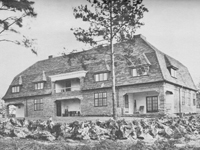
Bron-y-De, Churt, Surrey (Image: 'True Remembrances' by Philip Tilden)
Bron-y-De, Churt, Surrey (Image: ‘True Remembrances’ by Philip Tilden)

The house was to be called ‘Bron-y-de’, Welsh for ‘facing south’, which was a joke as the house faced north, even though he had bought the estate unseen at auction on the recommendation of his secretary who had assured him it faced south. In keeping with his character, it was a modest sized house – though one room had to be the same size as the Cabinet Room in Downing Street so that his habit of pacing could continue at the same length. Lloyd George was always in a hurry, and so Tilden designed the house so that only the ground floor was brick to reduce the drying time, with a huge mansard roof covering the first floor. Once word was out that the house was to be built, Tilden was deluged with offers of free fittings and materials, however, Lloyd George was a deeply scrupulous man who gave strict instructions that everything down to the last nail was to be paid for.  Despite his modesty, it became apparent that the house was too small, and so Tilden was again employed in 1921 & 1922 to extend the house.  Sadly, Bron-y-De burnt down in 1968.

Of course, the house Tilden is best known for is Chartwell (subject of the earlier guest article ‘Sir Winston Churchill, Chartwell, and Philip Tilden’ – National Trust ‘Uncovered’‘).  Another commission as a result of a long fireside chat at Port Lympne, Churchill asked Tilden to help adapt the Victorian home to his requirements. The chapter in Tilden’s memoirs about the project is almost more an encomium to his client, lavishing praise on all aspects of his life and his interest in Chartwell; ‘No client that I have ever had, considering his well-filled life, has ever spent more time, trouble, or interest in the making of his home than did Mr Churchill‘.  The house which resulted is certainly more practical than beautiful – though it achieves the original goal of allowing the undeniable pleasure of the superb views.
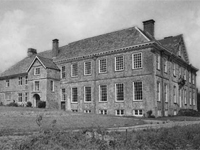
Dunsland House, Devon (Image: Lost Heritage - England's Lost Country Houses)
Dunsland House, Devon (Image: Lost Heritage – England’s Lost Country Houses)

Sassoon and his circle of friends was to bring work at other country houses such as Easton Lodge, Essex, Hill Hall, Essex, Saltwood Castle, Kent, Luscombe Castle, Devon, and Anthony House, Cornwall.  Of all the works Tilden deserves credit for, for me, his rescue of Dunsland House is perhaps the most admirable and the saddest.  Dunsland was one of the oldest houses in north Devon and had been owned by the Bickford family who had created a home with some of the most remarkable plasterwork to be found in the county.  Having owned the house for over 300 years it was finally sold in 1945 to a timber merchant who was interested only in the trees.

In 1949, Tilden was sent by the council to inspect the now seriously ‘at risk’ house. Realising that no-one else would be taking on the restoration, Tilden stepped up and bought it – and paid the timber merchant £5 for every tree he spared.  Using his own limited funds, Tilden brought a small section of the house back to a habitable state and moved in, but the project proved too much and he died in 1956.  His actions had staved off the immediate threat of complete collapse and the National Trust took over, finishing the restoration.  Sadly, in November 1967, just as the house was ready to open to the public, a fire broke out and completely destroyed it.
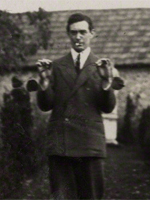
Philip Tilden, October 1925 (Image: National Portrait Gallery)

A sad loss of not only the house, but also what would have been a fitting reminder of one architect’s love of the ancient fabric of the nation’s built heritage; one who romantically thought that, ‘Most of those who build are interested in what has gone before, and their aim and object is to find out how to restore the present to something like a period that they imagine to be ‘a land where it is always afternoon‘.’  Tilden today is perhaps best remembered for what he didn’t build for Gordon Selfridge and the unexciting work at Chartwell, but he was certainly a principled and thoughtful architect whose views on heritage many would respect today.

———————————————————-

There is a fine selection of images of Port Lympne in the Country Life Picture Library

Further reading:

Guest article: ‘Sir Winston Churchill, Chartwell, and Philip Tilden’ – National Trust ‘Uncovered’

The garden front of Chartwell, Kent (Image: National Trust)

Some country houses are less of note than the people who were associated with them. For some, the architect will be the draw, but with a strange ‘Midas’-like power, any house associated with figures of great renown will always be remembered.  When asked to name the greatest UK Prime Minister, Sir Winston Churchill often  justifiably tops the polls, and his retreat, Chartwell in Kent, became his refuge, but also a burden which was only relieved late in his life. As is often the case with older houses, they require adaptation for modern life, and Chartwell was no different.  In an almost inverse to Churchill’s fame, the architect who worked on the house was the low-profile Philip Tilden, about whom we’ll find out more in a separate article.

Chartwell passed to the National Trust in 1965 and, this weekend it will be the focus of their ‘Uncovered‘ campaign which is exploring the British landscape.  As the event in the series most connected with a house, below is a guest article from Emily Christmas, Learning and Events Officer at Chartwell for the National Trust, exploring Churchill’s love of the countryside and why the house became so special to him.

——————————————————————–

I have no hesitation in saying that this site is for its size the most beautiful and charming I have ever seen.

These were the words used by Sir Winston Churchill to describe the property he purchased in 1922, which would become his family home for the following decades.

Looking South-East from the balcony at Chartwell towards the Studio and cottages, the view for which Churchill bought the House (Image: National Trust)

In his eyes, he was acquiring the land and the view far more than the house itself. And what visitors today might not realise is that what he saw back then was not the same Chartwell that can be seen today.

The house and gardens are very much the product of two minds: Sir Winston Churchill and his architect Philip Tilden. Even before the sale was completed, Tilden was at work preparing the house for reconstruction. Over the course of the following several years, work was undertaken to change the existing house into one that would take best advantage of the stunning views with which Sir Winston fell in love.

The history of the property isn’t well known, though the oldest part of the building is thought to have been a Tudor hunting lodge; and like most ancient sites in this part of Kent, there’s the oft-uttered myth that King Henry VIII stayed at Chartwell while on the way to visit his sweetheart Anne Boleyn at Hever. One of the rooms in the house was even named after him.

View of the front of the house at Chartwell, Kent, before acquisition by Sir Winston Churchill in 1922 (Image: National Trust)

Over the course of the following centuries it changed hands several times, became at one point a house for abandoned children, and in the 19th century the house, gardens, and outlying cottages began to take on something of the appearance that can be seen today.

Enamoured as he was with the views from Chartwell, Sir Winston Churchill immediately set to work rebuilding the house to best take advantage of Kentish weald.

The Colquhoun family, who had been in possession of the property for the previous century or so, had extended the house a fair bit, as can be seen in the photographs. However, to ensure the largest number of rooms had access to the stunning views, Churchill reduced the overall size of the house, creating in their place the rooms on the south-east terrace, which can be accessed through what is now Lady Churchill’s sitting room.

Chartwell, the garden front from the south (Image: National Trust)

The best indication of the change can be seen when viewing the house from the south-east side. The front of the house was also reduced and simplified to what can be seen today.

Visitors to the house today often remark upon the views when they walk out onto the pink terrace. Looking out across the North Downs, it’s not difficult to understand how Sir Winston felt when he first saw the place, despite the changes it has gone through over the past century.

——————————————————————–

Having withstood war, bombs, and even a hurricane, the property still boasts some of the most beautiful views to be found in Kent.  You can experience the views in person and visit during the National Trust ‘Chartwell Uncovered’ weekend of 21st-22nd September. Displays will include copies of some of the most iconic Churchill paintings of the landscape within the very views they depict, so it’s a rare opportunity to get insight into Churchill’s reflections on the land, his house, and his life.

View the full events programme for Chartwell Uncovered

Or find out more about the rest of our Uncovered campaign.

More views of the house can be found on the National Trust Picture Library

——————————————————————–

To coincide with the article, it seemed a good opportunity to look at the life and work of Philip Tilden; an architect with a complex life, who worked on a remarkable series of houses. Watch this space…

Thomas Archer: the unsung master of English Baroque, and the revival of Roehampton House

Roehampton House, SW London - Thomas Archer, 1712 (Image: St James)
Roehampton House, SW London – Thomas Archer, 1712 (Image: St James)

Thomas Archer is described as the most European, and certainly one of the most accomplished, of the English Baroque architects.  His later relative obscurity was mainly due to the misfortune that his contemporaries were some of the greatest British architects of any era.  However, looking at the examples we do have of his work, we can clearly see his virtuoso skill and creative talent written into the fabric of the buildings.  The recent restoration of Roehampton House, London, and its conversion into apartments, is a rare chance to live in an example of his work.

Umberslade Hall, Warwickshire (Image: Fine & Country estate agents)
Umberslade Hall, Warwickshire (Image: Fine & Country estate agents) – a house not designed by Thomas Archer.

In many ways, Thomas Archer (b.1668 – d.1743) was the quintessential ‘gentleman architect’. The youngest son of Thomas Archer M.P. of Umberslade Hall, Warwickshire, he studied at Trinity College, Oxford, but clearly had broader horizons as, after graduating in 1689, he immediately undertook a four-year Grand Tour, heading to Italy via Germany and Austria.  Almost nothing is known of his time in Italy, yet he must have studied the architecture and been influenced so heavily that this became his chosen profession.  However, as a man of independent means, for Archer, this was less about earning a living and more about the translation of a recognisably ‘European’ form of Baroque to his native country. His architectural career was to be one of successive highlights; broadly, each commission was for a notable patron and the work produced of exceptional quality.

North front, Chatsworth House, Derbyshire (Image: bronndave via flickr)

Archer’s gentry origins and Whig affiliations secured him a place at Court where he came to know one of the most powerful aristocrats, William Cavendish, the 4th Earl (1st Duke from 1694) of Devonshire.  Retiring to his estates during the reign of James II, in 1686 the Earl embarked on a programme to rebuild Chatsworth.  In doing so, he elevated the status and grandeur of the private country house to a level not seen since the Elizabethan Prodigy houses – but with the key difference that this was explicitly for non-Royal appreciation. The Duke found in Thomas Archer an enthusiastic collaborator, but one with the advantage of direct experience of the style of grand Italian architecture he so admired.  Chatsworth grew in phases, with the majestic south front begun in 1686, the east front in 1693 (both designed by William Talman), the west front in 1696 (possibly designed by the Duke), with Archer finally being given his opportunity, the north front, in 1705.  As the final phase, Archer had to unite the mismatched lengths of the east and west fronts, which he brilliantly achieved though the use of a visual distraction; a bowed central projection. The use of curves was to become a stylistic hallmark of Archer, one used repeatedly and almost uniquely in the work of the English Baroque architects.

No sooner had Archer secured his first commission than he simultaneously acquired his second; Heythrop House, Oxfordshire, for Charles Talbot, 1st Duke of Shrewsbury.  Unusually for a Talbot, the 1st (and only) Duke of Shrewsbury had converted from his Roman Catholic upbringing to Church of England, and had found favour at Court under Charles II, but he was required to live abroad between 1700-1706 and spent time in Italy.  Whilst there, his diary in 1704 records that he was given a draft plan for a house by Paolo Falconieri, Chamberlain to Grand Duke Cosimo III of Tuscany, and occasional amateur architect. Marcus Whiffen believes that it was this draft which was given to Archer and on which he based his design for Heythrop.  One piece of evidence for the Italian origins of the designs were the very large rooms (e.g. the hall being 32ft x 27ft, a drawing room of 47ft x 25ft) which take little account of the colder English climate.

Heythrop Park, Oxfordshire - Thomas Archer, 1706 (Image: Heythrop Park Hotel)
Heythrop Park, Oxfordshire – Thomas Archer, 1706 (Image: Heythrop Park Hotel)

Heythrop is a confident work which clearly draws its inspiration from the Italian Baroque, with an energetically decorated façade, showing stylistic connections to Bernini’s rejected design for the Louvre.  The grand Oxfordshire palazzo was probably completed by the early 1720s – though sadly the Duke did not live to see this, having died in 1718.  The interiors were designed by James Gibbs but were tragically lost in the huge fire which completely gutted the house in 1831. It remained a shell until 1870 when it was bought by Thomas Brassey as a wedding present for his third son and commissioned Alfred Waterhouse to rebuild the interior. Sold in 1926, it became a Jesuit college until 1969, when it then became the Natwest Bank training college (the latter two uses leading to the construction of extensive ancillary buildings), and then in 1999, it was sold again to become the hotel it remains today.

Top: Pavilion at Wrest Park - plan from Colen Campbell (Vitruvius Britannicus)  Bottom: S. Giovanni dei Fiorentini, Rome - plan by Michelanglo, from J. von Sandrart (Insignum Romae Templorum Prospectus)
Top: Pavilion at Wrest Park – plan from Colen Campbell (Vitruvius Britannicus)
Bottom: S. Giovanni dei Fiorentini, Rome – plan by Michelanglo, from J. von Sandrart (Insignum Romae Templorum Prospectus)

Although Thomas Archer was not responsible for the design of the main house at Wrest Park (the later house we see today was designed by the then owner, Thomas de Grey, 2nd Earl de Grey), he did create one of the finest garden pavilions in the country.  In 1711, Archer was commissioned by Henry Grey, 1st Duke of Kent, to build an elaborate pavilion to terminate the axial view, looking down the Long Canal, from the main house.  Again, Archer demonstrated his familiarity with Rome, using a version of Michelanglo’s unexecuted plan for the church of San Giovanni dei Fiorentini. This is still one of the most exciting buildings in the country; a distillation of Michelanglo, filtered through the English Baroque.

Continuing what must have been a busy period by Archer’s standards, in 1712 he also designed Roehampton House, south-west London, for Thomas Cary. To call the original design ‘dramatic’ is something of an understatement as the plate in Vitruvius Britannicus shows it with a grand, full-width broken pediment – though whether this was actually built or was, but later removed, is unclear.  The plan of the house itself was double-pile with flanking wings, though these were not built originally.  The house then passed through a number of aristocratic owners before being bought in 1910 by Canadian banker Arthur Morton Grenfell. It was Grenfell who commissioned Lutyens to extend the house – though the efforts were not to benefit him as he was declared bankrupt in 1914, before the interiors could be fully completed.

Archer’s next commission, also in 1712, was for Hurstbourne Priors [Park], Hampshire, though, intriguingly, the plan does not match the house that was built – two surviving pictures by John Griffier show a much plainer design.  Proving just what Archer intended and any differences to what was built would be almost impossible as the house was rebuilt by James Wyatt in c. 1780-85, then again by Beeston & Burmester after a fire in 1894 and finally demolished in 1965.  Intriguingly, Tim Mowl suggested that the ‘Bee House’ aka Andover Lodge, was also by Archer and represents an experiment with architectural forms.

Having achieved such success in his life, in 1715, Archer turned to designing his own home. The result was Hale Park, Hampshire, though the house which survives today is much altered following work by Henry Holland Junior in 1770, and further changes in the early and late 19th-century, which covered the brick in (a now unfortunately peachy) render, added a portico and raised the level of the forecourt. Also of note was Archer’s redesign of Hale Church, creating a slice of a Roman church in Hampshire.

After 1715, Archer seems to have curtailed his architectural work as he was given the lucrative post of ‘Controller of Customs’ at Newcastle and largely retired.  He is known to have designed Harcourt House for Robert Benson, Baron Bingley, which stood on the south side of Cavendish Square, London, until it was demolished in 1906.

Chettle House, Dorset (Image: Chettle House)

One of Archer’s last commissions, Chettle House in Dorset, could be argued to be his finest. Built c.1730, for George Chafin, who was a neighbour of Archer’s after he bought the nearby Hale Park, the house is a striking summary of the various elements which Archer had used so well in other buildings, but which here achieve a perfect balance.  The curved corners of the exterior (though raised later), along with the projection on the entrance front combine to make the house truly sculptural.

However, there are a number of other intriguing attributions, which Archer may have worked on during his career, with varying degrees of certainty.

  • Welford Park, Berkshire – Thomas married into the Archer family (no relation) and was asked to re-model the house; adding an extra storey and grand Ionic pilasters.
  • Chicheley Hall, Buckinghamshire – c.1703 – suggested by Arthur Oswald in Country Life but not given in Colvin.  Various elements such as the materials and certain details used on other Archer houses strongly indicate his involvement. Interiors now terribly ‘bland-ified’ as a conference venue.
  • Aynhoe Park, Northamptonshire – between 1707-11 – on stylistic grounds and the evidence of a payment to him from Hoare’s Bank of £39 15s. 6d. by Thomas Cartwright.  This work included the addition of a library, conservatory, stables, and a coach-house – though the first two were later altered by Soane in 1800-1.
  • Bramham Park, Yorkshire – c.1710 – no evidence but stylistically possible. Designed for Robert Benson, who we know commissioned Harcourt House in London.
  • Kingston Maurward, Dorset – c.1717-20 – suggested by Howard Colvin.
  • Marlow House, Buckinghamshire, built c.1720, is now largely agreed to have been by Archer due to the use of particular elements and that it was commissioned by John Wallop, 1st Earl of Portsmouth, for whom he had designed Hurstbourne Priors.
  • Serle’s House, Hampshire – built in 1730, this house has clear stylistic similarities with Archer’s earlier work. Now the Royal Hampshire Regiment museum.
  • Addiscombe House, Surrey – Marcus Whiffen argues that it is undoubtedly Archer, and it could well be, but unfortunately further inspection is frustrated by its demolition in the early 1860s. Images are shown on pages 42 & 44 of a PDF of a local book [note: 10mb download].

The challenge with looking at Archer’s work is that there is relatively little of it.  Without the financial pressures to work, he was able to be very selective in what he chose to do, and due to that scarcity, his work was under-appreciated and occasionally altered or demolished.  In what we do have we can see an exceptionally talented architect who, although living in the shadow of the more productive Wren, Vanbrugh, and Hawksmoor, nevertheless developed a distinctive and influential blend of English and continental Baroque architecture.

Roehampton House, Surrey (Image: St James)

Roehampton House offers a rare chance to experience both the genius of Archer and Lutyens – though here, clearly, the latter is happy to defer to the work of former and sympathetically embraces and extends it.  Though this is a house which has been ill-used in the past and suffered some damage in WWII, the latest phase has created what appears to be a fine restoration and conversion with a careful re-use of the interior features which have survived.  Although there are too many other buildings built too close to it, the quality of the original architecture has been allowed to shine to ensure that we can again see the work of Thomas Archer, one of the finest English architects we have heard too little about.

————————————————————

Disclosure: neither the developers, St James, nor their PR company, Luchford APM, have had any editorial input or control over this article, nor have I received anything. However, they have provided some details about the current project and the exterior photos. As always, topics and text on the blog are my choice and discretion.

————————————————————

A more detailed history can be found on historic paint consultant Patrick Baty’s page on Roehampton House

If you do fancy living there, prices start from £1.35m: Roehampton House [St James]

Rothschild-shire: the lost, the ‘cottage’, and the home (3/3)

Having seen the glories of the prodigiously grand Mentmore Towers and Waddesdon Manor in the previous article on ‘Rothschild-shire’, that part of Buckinghamshire which became the domain of the Rothschild family from the 1850s, this final one looks at the remaining three: the lost Aston Clinton House, the ‘cottage’, Ascott House, and the family home, Eythrope.

Aston Clinton House, Buckinghamshire (Image: Lost Heritage) - Click for more images
Aston Clinton House, Buckinghamshire (Image: Lost Heritage) – Click for more images

One of the tragedies of the history of the UK’s country houses has been the wholesale destruction of so many, mainly between 1930-1960.  Often, as a family fell on financial hard times, the house contents would be sold, followed later by the building itself, in the hope they could retain the estate.  Although, wealth was clearly not an issue for the Rothschilds, one of their houses, Aston Clinton House, has since been demolished – though, admittedly, long after they had left.

Possibly one of the (relatively) smaller of the Rothschild’s houses, Aston Clinton House was also unusual in that it grew from a smaller one, through a series of additions, to be a substantial home, rather than being a new build.  The original house was built sometime between 1770-1789 for General Gerard Lake, who laboured under the geographically diverse title of 1st Viscount of Delhi and Laswary and of Aston Clinton in the County of Buckingham. Never a grand seat, it was built in the style of a small hunting lodge, and passed through the Lake family until 1838 when the house and the accompanying 1,055-acres were sold for £23,426 to the 2nd Duke of Buckingham and Chandos, who saw the productive estate as a good investment.

Aston Clinton House Bucks, just before demolition (Image: Lost Heritage)

After the Duke’s death, it was initially put up for auction, largely unaltered, by the Duke’s son in 1848 but was withdrawn – but not before it had attracted the attention of the Rothschilds. Though “It is not like a fancy place”, it was bought for £26,000 as more of an investment but Sir Anthony Rothschild and his family moved in in 1853. Lady de Rothschild immediately took against the ‘small’ size and so Sir Anthony commissioned G.H. Stokes (Sir Joseph Paxton’s son-in-law, and who had previously worked at Mentmore) to significantly enlarge it, with works completed by the early 1860s.  The architect George Devey, who was to build his career around the Rothschilds, undertook more work between 1864-1877, on both the house and estate.

The house and estate passed through the family until it was sold in 1923, having served in WWI as the HQ for the Commanding Officer of the Twenty-First Division, then based at the nearby Halton estate (c.f. Halton House in part 1). Sold for just £15,000, it became a school – where Evelyn Waugh started his teaching career – before serving as a corporate HQ, then as a hotel in various guises before being bought by Buckinghamshire County Council and demolished c.1960. A training centre was built in its place, with only a few buildings remaining as a reminder of grander days.

Outcome: commercial use, demolished as surplus to requirements.

Ascott House, Buckinghamshire (Image: Peter J Dean via flickr)

George Devey was to play an important role in the Rothschilds’ architectural plans, as were the family central to his own success.  One of his most successful designs was for Ascott House, for Leopold de Rothschild, for whom he extended a small house dating from 1606 to create a rambling, many-gabled ‘cottage’ (though one with 30 bedrooms) as a more rural retreat than Leopold’s other seat at Gunnersbury Park (see Part 1). Although initially used just for hunting and recreation (with an emphasis on the outdoors as the house was built without a library, though one was later added), Leopold quickly realised that he needed more space for entertaining and so, in 1874, started a program of extensions which would continue until c.1888 with Devey, but also beyond, into the 1930s.

Ascott House, main door (Image: Peter J Dean via flickr)

Devey was an unusual Victorian architect in that he never exhibited his work or allowed his designs to be published, so secure was he in a bubble of aristocratic and wealthy clients who kept him constantly employed.  Mark Girouard regarded the houses Devey designed as the most interesting outside of the ShawNesfieldWebb circle, especially as he was regarded as having successfully developed a way of incorporating vernacular styles into his work.  He particularly favoured the idea of making houses look as though they had developed over time – and ideally that they be covered in ivy. Mary Gladstone (daughter of the Prime Minister) visiting in 1880, approvingly described Ascott as ‘a palace-like cottage, the most luxurious and lovely I ever saw‘. The flip-side to the accretive approach is that some of the layouts for his houses seem to stretch for long distances; at Goldings, Hertfordshire, it covered approximately 350ft from end-to-end (the house is now flats with sprawling, unimaginative development in the immediate grounds).

Ascott was inherited by Anthony Gustav de Rothschild from his mother in 1937 (Leopold having died in 1917) and he and his wife made further additions, including converting the billiard room into a library.  Although Anthony was very much involved with the family business he was also a renowned collector and the house is a treasure trove of fine paintings (including works by Gainsborough, Romney, Reynolds and Cuyp), 18th-century English furniture, books and over 400 pieces of Chinese ceramics. The house, gardens, and a small part of estate were donated by Anthony to the National Trust in 1947.  Much of the collection and the surrounding 3,200-acre estate is still owned by the family, and Sir Anthony’s son, Sir Evelyn de Rothschild still lives in part of the house, keeping the connection to the original creator alive.

Outcome: owned by the National Trust, family still partially in residence

Eythrope, Buckinghamshire (Image: John S. Pipkin via flickr)

And so to Eythrope, in Waddesdon, a house strangely  built without bedrooms as it was primarily intended as the daytime retreat for Alice de Rothschild, sister of  Baron Ferdinand de Rothschild, with whom she came to live.  Alice was independently wealthy (having inherited a large estate in Germany), strong-willed, and opinionated – all useful qualities, but less so to her brother, who was very similar. To reduce familial friction, Ferdinand suggested she build somewhere to while away the days and Eythrope was the solution. Alice bought the estate for £180,000 in 1875, and chose to build her ‘Pavilion’, as it was called, in a curve in the river.  As Alice had suffered from rheumatic fever, the damp of the river might have been dangerous had she been tempted to spend too long there so the design included no bedrooms. Problem solved.

The original house on the site had been built in the 1500s and was eventually inherited by Philip Stanhope, 3rd Earl of Chesterfield (d. 1726), but had been demolished in 1810—11 by Philip Stanhope, 5th Earl of Chesterfield.

Eythrope, Bucks - garden front (Image: crazybiker via flickr)
Eythrope, Bucks – garden front (Image: crazybiker via flickr)

As if to emphasise that this was Alice’s project, she chose not to use Gabriel-Hippolyte Destailleur, who was then working for her brother at Waddesdon. Instead, the new house at Eythrope was another commission for George Devey who had worked at various Rothschild houses including Mentmore, Ascott, Aston Clinton, and Tring Park – but Eythorpe is his most complete work for the family.  In rejecting her brother’s grandiose French style (though not totally as there are flashes of the French Renaissance), Alice opted for what Pevsner described as a ‘free neo-Tudor style’ creating a delightful rambling house framed by the river. Passed down from Alice de Rothschild (who inherited and also became the forthright guardian of Waddesdon after the death of her brother), it was inherited, along with Waddesdon, in 1922 by Dorothy and James A. de Rothschild, who added a large wing with bedrooms and bathrooms. After James’ death in 1957, and having given Waddesdon Manor to the National Trust, Dorothy moved to Eythrope and lived there for forty years.  On her death, the house and estate were inherited by her husband’s great nephew, Jacob Rothschild, 4th Baron Rothschild, whose home it remains today.

Outcome: the only house built by the Rothschilds and still wholly owned, and lived in, by them

——————————————

Although slightly off the usual ‘patch’, the Exbury estate, Hampshire, was another house where a Rothschild, Lionel Nathan de Rothschild, could give full rein to a passion; this time it was plants, specifically, rhododendrons and azaleas.  With a passion from an early age, the garden was always going to be spectacular, but Exbury House is also impressive and perhaps to be included in a future article.

——————————————

Previous articles in the series on the Rothschild’s houses:

——————————————

Fascinating ‘Lunch with the FT’ with Lord Rothschild at Eythrope

Visit Ascott House [National Trust]

Rothschild-shire: the grand and the glorious (2/3)

Waddesdon Manor, Buckinghamshire (Image: National Trust)

The Rothschilds were social, as well as financial, titans.  In the first part of this now three-part article on the country houses of the Rothschilds, we saw the family establish their firm in England and later elevating their social standing through their estates at Gunnersbury Park, Tring Park and the opulent Halton Hall. Part two covers the two greatest houses created by the Rothschilds; Waddesdon Manor and Mentmore Towers.

One supposedly defining characteristic of the Rothschild’s UK country houses is their preference for the Neo-Renaissance ‘French chateau’-style – but this is more due to the fame of one house.  In Europe, the family often (though not exclusively) built in a style that could be recognised as the dominant one for a particular country, but in the UK they opted for alternatives – or a policy of ‘Anything-but-Gothic’.  One theory is that the other styles lacked the Christian associations which Pugin had so firmly nailed to Gothic – but perhaps they were just being more European in their tastes.  However, they did develop a remarkably similar interior style; a rich, luxurious environment featuring heavy fabrics with fine art and furniture, which became known as ‘Goût Rothschild‘, and which heavily influenced the newly wealthy American plutocrats.

One of the greatest expressions of this combination of French exterior and lavish interior was found in the creation of the remarkable Waddesdon Manor, Buckinghamshire. Perhaps the most famous of the Rothschilds’ houses and also one of the grandest of the houses of the family in the UK.  Built between 1874-1883 for Baron Ferdinand de Rothschild (1839–1898) it was designed by Gabriel-Hippolyte Destailleur, who also designed the Imperial Mausoleum of Emperor Napoleon III in Farnborough in 1883, and had previously designed a townhouse for Albert de Rothschild in Vienna.

Aerial view of Waddesdon Manor, Buckinghamshire (Image: Waddesdon)

As Pevsner said in his entry on Waddesdon Manor, ‘Baron Ferdinand certainly got as much as anyone could have demanded‘. This was to be a building at the top end of country house construction – the 2,700-acres cost £240,000, with another £55,000 for levelling off the top of the hill for the site and creating access roads, and £87,000 for the completion of the shell, for a total of £382,000 (equivalent to £161m in 2012 using an average earnings comparison) – and this was before the fitting out of the sumptuous interiors. Finally, it was filled with his spectacular collection of paintings, objet d’art, tapestries, and furniture.

Tower Room, Waddesdon Manor (Image: Waddesdon)

The exterior of the house is a grand composition of various elements from châteaux such as BloisMaintenon, and Chambord, married with elements of Louis XIII and some older Louis XII details, as though the house had grown over time.  Yet, as befits such a house, it was rife with modern details; at its core, a steel frame which allowed the room layouts to vary by floor, multiple bathrooms with hot and cold running water, and electrification, including a chandelier which Queen Victoria reputedly spent 10-minutes simply turning off and on, having never seen such a thing before.

The house was the luxurious setting of a social high-life and remained in the Rothschild family until 1957 when James Armand de Rothschild, who had inherited it in 1922, bequeathed the house, 165-acres, and the splendid collections to the National Trust – along with the largest endowment they had received to ensure it remained perpetually well-maintained, with family involvement through the management committee.

Outcome: owned by National Trust, with family involvement

Mentmore Towers, Buckinghamshire (Image: wikipedia)

Waddeson Manor today is what Mentmore Towers also was – and, sadly, could so easily have been but for the blinkered lack of vision of a former government. Mentmore was the first of the great Rothschild palaces in Buckinghamshire, built between 1852-1854, and was designed by Joseph Paxton and his son-in-law, G.H. Stokes, for Baron Mayer Amschel de Rothschild. It was remarkable for not only its size but also the detail and thought that went into it, setting a benchmark for the family and a clear demonstration of their wealth.  It was also a statement to the rest of the Rothschild family about the success of the UK branch – so much so that when his Paris-based cousin, Baron James de Rothschild, saw it he engaged Paxton himself with the instruction “Build me a Mentmore, but twice the size“.  The result was the Château de Ferrières, just outside Paris, which caused Wilhelm I, the Emperor of Germany, on seeing it to exclaim that “No Kings could afford this! It could only belong to a Rothschild“.

Mentmore Towers, Buckinghamshire (Image: john edward michael1 via flickr) Click to see large version

Architecturally, the house is distinctive for being one of the few to successfully imitate the scale and style of Wollaton Hall, Robert Smythson‘s masterpiece built in Nottinghamshire in the 1580s.    Deliberately drawing inspiration from a classic of Elizabethan architecture, this was a political message about ‘fitting in’.  However, the scale and exceptional quality of the work also made this a large and conspicuous statement of their financial standing.  Mentmore is even built of the same Ancaster stone as Wollaton and copies the arrangement of the square corner towers and ornate stonework.  However, it is missing the grand central tower of Wollaton; though there is a top-lit central hall around which the rooms are organised.  One other amusing criticism raised was that it might have been somewhat imprudent to have sited the housemaids’ room just at the foot of the mens’ stairs…

Great Hall, Mentmore Towers (Image: A. D. White Architectural Photographs, Cornell University Library via flickr)

The tragedy of Mentmore is that it could have become one of the treasure houses of Europe.  It had survived virtually unchanged, including with its spectacular collections, which were said to be the best in private hands outside of royalty, up until the death of the 6th Earl of Rosebery (he inherited from his father, who had married Baron Mayer’s only child, his daughter Hannah).  Offered to the nation in lieu of £2m in inheritance taxes, the government of James Callaghan rejected the offer, demanding cash.  After three years of discussions, and a campaign by individuals and organisations, the collections were sold, raising over £6m, with various national institutions spending around £2m in total to secure just a few choice items.

The house was then sold to the Marharishi Foundation, who it’s generally accepted, kept it well-maintained.  It was then sold in 1999 to property developer Simon Halabi who had grand and unsympathetic plans for a luxury hotel.  The financial crisis thankfully saw the end of those, however, the house is now regarded as ‘at risk‘ without an immediate restoration in sight – though with the possibility that it might be for sale.

Outcome: collection sold, future of house unclear, ‘at risk’

These two houses represent the high-point of the architectural and artistic endeavours of the Rothschilds, easily matching in scale and grandeur the houses their relations were also creating across Europe.  Mentmore is a spectacular house in itself, even if it’s denied its collection, but Waddesdon encapsulates not only the personal enjoyment the family gained from creating these palaces, but also the philanthropic aspect which means that we can all now marvel at the ‘Goût Rothschild’ experience.

——————————————

Dear Readers, you’ll perhaps have noticed that I’ve now decided to split this topic into three parts as it appears I was being a little ambitious trying to get them all into two – the final instalment will follow shortly.

——————————————

Part One: ‘Rothschild-shire: the wider fate of UK country houses mirrored in a family (1/3)

Listed building descriptions: