Finest country seats: Mereworth Castle, Kent

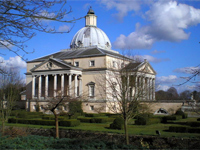
Mereworth Castle, Kent (Image: building-a-day via tumblr)

Many articles on this blog relate to houses which are in the news, on TV, or for sale but in the quieter months it becomes more challenging to find topics.  As I miss writing, this article is the first in an occasional series on country houses I have entirely subjectively chosen (though I’m happy to take suggestions) as being of particular interest and beauty. So, first up, one of my favourite houses; one which simultaneously is both exceptionally rare and beautiful – and one, sadly, I may possibly never get a chance to visit: Mereworth Castle  in Kent.

To understand why this house is so important, it’s necessary to take a brief trip to Italy, specifically, to the Veneto in the north.

Villa Capra, Italy (Image: Marco Bagarella via Wikipedia)

One of the most influential architects in relation to the style of UK buildings never actually built anything here.  Andrea Palladio (b.1508 – d.1580) invigorated the design of our built environment in a way many architects can only dream of through his innovative work in three areas; the urban palazzo, the rural villa, and churches.  Each, though distinct, shared a common architectural DNA that made Palladio’s work easier to understand which aided its adoption by others.  That’s not to say that his designs were simple or lacking artistic skill; it’s precisely their austere beauty which emphasises the thought which had gone into their proportions and decoration.

Palladio worked exclusively in the Veneto; that area of northern Italy centred around the wealth of Venice, but which had also created other cities which also grew rich and could express this through architecture.  Giovanni Rucellai, Alberti‘s patron, said “I think I have given myself more honour, and my soul more satisfaction, by having spent money than by having earned it, above all with regard to the building I have done.” Numerous trips to Rome, coupled with Palladio’s own diligent work in precisely measuring the Roman buildings and their details whilst he was there, gave him the architectural vocabulary to express what his patrons were trying to say to their neighbours, friends, and society at large.

His fame was well established (and undiminished even though dead) by the time English architect Inigo Jones made his first visit to Italy sometime between 1598–1603, but it was during a probable second trip in 1606 when he thoroughly absorbed the Palladian style, owning copies of Palladio’s most important work ‘I Quattro Libri dell’Architettura (‘The Four Books of Architecture‘, published in 1570). Jones returned and, using his influence, especially once he became Surveyor-General of the King’s Work, he started to develop and promote an Anglo-Palladian style.  One of the earliest and finest examples is the beautiful Banqueting House on Whitehall in London, the first neo-Classical building in the country, completed in 1622, which draws heavily on Palladian architecture and principles such as the double-cube.

Whether an architectural style gains traction and popularity depends on its ability to reasonably adapt to different areas and the challenges that this can present in terms of both materials and the climate.  One of the reasons Palladianism spread so far and became so entrenched is that its architectural DNA could evolve to meet the specific challenges of the UK climate – namely, it’s much colder and wetter here than on the sunny plains of Italy. The wide open loggias, small windows, fewer fireplaces and lack of guttering all meant that a literal translation of a Palladio design would quickly prove to be difficult to live in and rapidly deteriorate.

Villa Barbaro, Italy (Image: Marcok via Wikipedia)
Villa Barbaro, Italy (Image: Marcok via Wikipedia) – note the wide-open loggias

The popularity of the Grand Tour with young nobles meant that, for all the challenges, Palladianism was highly sought after as an expression of aristocratic taste and wealth.  The desire for Palladian homes combined with the environmental challenges meant that, in the UK, almost all designs for smaller country houses in that style were derivations of the Veneto originals.  However, for a few owners this was unacceptable – a higher level of architectural accuracy was required.
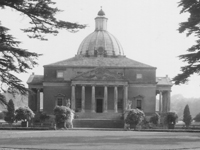
Mereworth Castle, Kent (Image: from an old postcard)

Mereworth Castle (built c1720-25) was one of these houses, along with Chiswick House, Middlesex (built 1729), Foot’s Cray Place, Kent (built 1754 – demolished 1949), and Nuthall Temple, Nottinghamshire (built 1757 – demolished 1929). Today, it is still the finest example of the direct translation of Palladio’s Villa Capra (or Rotonda) existing in the UK.  Designed for John Fane, later 7th Earl of Westmorland, by one of the chief proponents of Palladianism in the UK, Colen Campbell, producer of the famous ‘Vitruvius Britannicus‘, the book which was both the genesis and the bible for Georgian architecture in the UK and, by influence, Ireland and America.  Yet, as Nigel Nicholson points out in ‘Great Houses of Britain‘ why should ‘…a Scottish architect who had never been to Italy…chose to erect an Italian villa in the Weald of Kent for a patron who has likewise never set eyes on the Rotonda…‘? A good question indeed – and one Nicholson only partially answers.

In many ways the design is really architectural hero-worship.  Colen Campbell had started out working in Glasgow and idolised Palladio and, by extension, his representative in the UK, Inigo Jones.  Campbell had built one of the earliest Palladian country houses – Shawfield House – in 1713 and probably had a hand in the only earlier one; the wonderfully attractive and precocious Wilbury Park, Wiltshire, finished in 1710, designed by William Benson – owner and also architect, according to Campbell.  However, Campbell’s magnum opus wasn’t so much one building as many in the creation and illustration of ‘Vitruvius Britannicus‘ which cemented not only his reputation but also this continental style as the most fashionable of architectural choices – which is the most likely explanation for John Fane’s choice.

For all the many Palladian variations Campbell created for his books, Mereworth Castle was the house which remained closest to his idol’s work.  That said, he wasn’t above making alterations, most of which, were improvements.  One of the first things to note is that Mereworth is actually larger in volume than Villa Capra, perhaps for practical reasons but also possibly as a statement by the architect as to his ambition.  The changes he did make do actually indicate that Campbell was an architect of some skill and invention, for example, routing all 24 chimney flues he’d had to include through the double skin of the dome to vent by the lantern, thus avoiding unsightly chimneys ruining the skyline.

Mereworth Castle, Kent with one of the pavilions (Image: Country Life Picture Library)

The exterior has a wonderful rhythm as the porticos rise and fall as you circle the house, the swags decorating the pediments contrasting with the smooth stucco walls.  The setting is further enhanced by the matching pavilions which were added c.1740.  Rarely do additions to a house as sublime as Mereworth actually enhance it but the perfect proportions, placing and styling would make anyone think that Campbell himself designed them.  However, they remain a puzzle as to the architect as Campbell had died in 1729. Nicholson suggests they may have been by James ‘Athenian’ Stuart but Colvin makes a much stronger case for them being by Roger Morris, who worked in Campbell’s office and was certainly skilled enough to have created such brilliant additions.

Long Gallery, Mereworth Castle (Image: 'John Fowler: Prince of Decorators' by Martin Wood)
Long Gallery, Mereworth Castle (Image: ‘John Fowler: Prince of Decorators’ by Martin Wood)

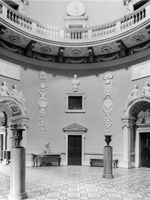
One of the great contrasts is between the pared back exterior and the lavishly decorated interior.  The Palladio homage continues with the house being organised around a soaring central circular hall which rises from the ground floor to the dome.  Fine plasterwork by Giovanni Bagutti decorates the doorcases with separate swags of flowers and fruit on the walls. The decoration of the hall is a preamble for the beauty of the other rooms. The Long Gallery was one of Campbell’s improvements over Palladio’s layout, replacing two smaller rooms with one dramatic space which was then  ‘...ornamented to within an inch of its life with every device in the early eighteenth-century decorator’s armoury…‘ (John Julius Norwich) with a beautiful coved ceiling with sumptuous frescos by Francesco Sleter.

Even Horace Walpole, the arch-Gothick evangelist, conceded when he visited in 1752 that although he thought the hall ‘a dark well‘ that such was the glory of the rest of the house ‘that I must own it has recovered me a little from Gothic‘. From Walpole, that is high praise indeed.
Saloon - Mereworth Castle (Image: Country Life Picture Library)
Saloon – Mereworth Castle (Image: Country Life Picture Library)

Mereworth Castle is a rich and exciting house – visually stunning, the perfect expression of the Anglo-Palladian villa with the austere exterior balanced by the dramatic interior plan and plasterwork.  That is has survived almost unaltered with only the most sympathetic additions is perhaps a testament to the powerful unity it has as a design.  As regular readers of this blog will know, I have a preference for country houses which retain their original purpose as homes for a wealthy single family. This has certainly been the good fortune which Mereworth has enjoyed, now being owned by Mahdi Al-Tajir, the former United Arab Emirates ambassador to the United Kingdom and owner of the Highland Spring bottled water company who bought it in 1976 for £1.5m.  The unfortunate downside is that we may never get to experience these remarkable houses but, on balance, it’s an acceptable trade if it means that a jewel such as Mereworth Castle is given the care and respect it richly deserves.  That said, perhaps some day I hope I will get the chance on a summer’s day, bathed in the warmest Kentish sunshine, to wander round this most splendid of country villas.

—————————————————————————

Listing description: ‘Mereworth Castle‘ [English Heritage]

More photos – exteriors/interiors:

Also of interest:

The estate office: country houses as corporate headquarters – and Barrington Hall, for sale

Barrington Hall, Hertfordshire (Image: Hamptons)

In many ways, a country house was often the headquarters of a business relating to both the estate and the affairs of the family who lived there.  This role was to be mirrored in the latter half of the 20th-century as firms sought to adopt the prestige of stately homes and set up their offices in the many country houses which were then available. What grander statement could a company make to clients and investors than to invite them to visit their stately offices?  Yet times changed, and over the years companies found it harder to justify such lavish accommodation, leading to a steady trickle of houses being sold – and the latest is Barrington Hall, Hertfordshire.

Shalford Park, Surrey (Image: (c) Allianz Insurance Plc via Shalford Village)
Shalford Park, Surrey (Image: (c) Allianz Insurance Plc via Shalford Village) – click for an excellent history of the house

The Second World War ushered in the modern era of offices in country houses.  With little by way of aerial bombing, few firms saw the need to move out of London and other cities in World War I, however, this danger had dramatically increased by 1939.  Faced with the significant logistical challenges in moving their vital paper-based records and operations, the late 1930s saw a number of companies actively scouting out possible alternatives, with country houses an ideal choice due to their size and seclusion.  This new lease of life enabled some houses to escape the demolisher’s pickaxe, such as at Shalford Park in Surrey.  A solid, well-proportioned Georgian house, the result of a rebuild of an older house in 1797, had been sold to Guildford Borough Council in 1938, but primarily to protect the land from development, with the intention that the house be demolished.  However, a lease was granted to the Cornhill Insurance Company (later part of Allianz Inc) who moved there in 1939, creating dormitories on the upper floors.  Cornhill were to remain at Shalford Park until 1955, but unfortunately the condition of the building had significantly deteriorated, and combined with it being in the ideal location for a new local water treatment works, meant that the house was demolished.

Wrest Park, Bedfordshire (Image: English Heritage)

One house which fared only slightly better from this type of arrangement was the beautiful Wrest Park, Bedfordshire.  A fanciful French château, it was built in the 1830s to the accomplished designs of the owner, Thomas de Grey, 2nd Earl de Grey, and features some of the finest, and earliest, Rococo Revival interiors in the country – of particular note is the spectacular staircase.  The house was sold in 1939 for £25,000 by John G. Murray to the Sun Insurance Company (later Sun Alliance) who bought it in anticipation of war. They promptly moved there from London once war had been declared, having made plans to ‘…alter the stable block and erect huts in the grounds for sleeping quarters, together with washing facilities and air-raid shelters … the stable block was the first area to receive our attention. The whole of the East Wing and the upper storey of the West Wing were to be converted for sleeping accommodation with toilet and washing facilities. The middle connecting section was also to be similarly altered, but it was later decided to make part of the upper storey into a communal long room.‘. Such scenes were undoubtedly repeated in many a country house – though such a use was preferable to the treatment meted out at the hands of enlisted men or children.

Cranbury Park, Hampshire (Image: Angus Kirk via flickr)

Other houses had the good fortune to secure relatively benign tenants for the duration of the war. The imposing Stratton Park, Hampshire, was built between 1803-06 by George Dance the Younger for Sir Francis Baring, Lord Northbrook, a founder of Barings Bank. Although it had been sold following the death of his descendent, Francis Baring, 2nd Earl of Northbrook in 1929, the house was bought back by Barings Bank in 1939 as their base for the duration of the conflict (though sadly it was demolished in 1960 by a later Baring who had bought it after the war).  The choice of house was possibly influenced by the fact that the Bank of England had decamped to the nearby beautiful Cranbury Park, also in Hampshire – and, coincidentally, also designed by George Dance the Younger, but built in 1780.  This little known house, still lived in today by the Chamberlayne family who commissioned it, has particularly impressive interiors; the hall and ballroom were described by Pevsner as an ‘unforgettable experience‘. Compared to the horrors of the bombing in London, what a strange pleasure it must have been to be stationed in such an environment.

Banqueting House, Wrest Park, Bedfordshire (Image: English Heritage)

The extensive alterations to even such an important house as Wrest Park indicated the level of damage such intensive use could bring to buildings which had not been designed for such a purpose.  The post-war era held many threats to country houses and use as offices saved many from the wave of destruction which led to the demolition of so many in the 1950s.  In 1949, Wrest Park was sold to the Ministry of Works, who leased it to the National Institute of Agricultural Engineering, later called Silsoe Research Institute which inflicted even more stress on the house and estate.  Although Simon Jenkins included it in his book ‘England’s Thousand Best Houses‘, he wrote that ‘The [Institute’s] outbuildings spoil the approach avenue and its abuse of the interior is dreadful.  The best of the reception rooms, the library, is packed with modern bookcases and computer equipment. Other rooms are cheaply kitted out for lectures and seminars.  It is like a Soviet academy of sciences camped in a St Petersburg palace.’. Thankfully the Institute closed in 2006 and the ground-floor rooms of the house (sadly, office space remains), along with the superb gardens and Thomas Archer‘s sublime Baroque banqueting house have been expertly restored by English Heritage.

Hursley House, Hampshire (Image: Sarah Graham via Panoramio/Geolocation)

The pressure to create more space is often the cause of the most damaging changes to a country house.  Simon Jenkins’ criticism of the additional buildings at Wrest Park can similarly be levelled at the extensive construction which has taken place at Hursley House, Hampshire, home of IBM UK.  The house itself was originally built between 1721-24, with ‘gentleman architect’ Sir Thomas Hewett acting as architectural consultant for Sir William Heathcote, and with further major reconstruction in 1902-03 to create the imposing Queen Anne house which appears in various marketing materials.  What the images don’t show is the huge campus (of fairly ugly buildings) which has sprung up so close to the house since IBM took over the site in 1958. A more intelligent approach to the siting of extra accommodation can be seen at the Computer Associates site at Ditton Park, Berkshire, where the new office buildings have been placed a sensitive distance from the main house.  If their priorities changed, the house could be sold and could resume a comfortably independent existence even if the offices remained in use.  Such a change might once have been expected at Donington Hall, Leicestershire, which served as the headquarters for the airline BMI for many years until the recent merger made it redundant.  Sadly, it’s actually unlikely that anyone would chose to live there as there would be no peace and quiet as the parkland has long been converted into the Donington Park race circuit, just half a mile south of the house.

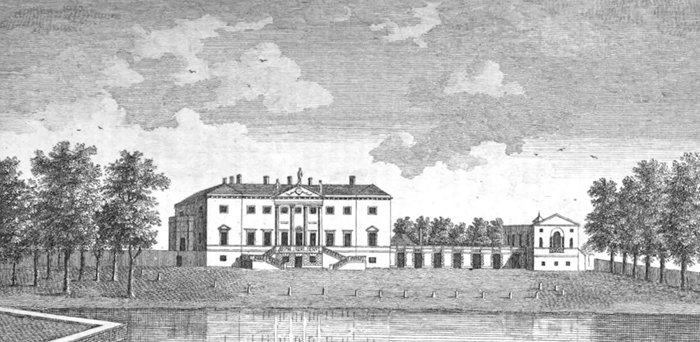
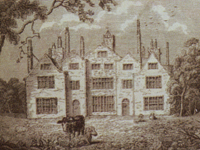
Barrington Hall, Hertfordshire (Image: from "A New Display of the Beauties of England" (London : 1776-1777))
Barrington Hall, Hertfordshire (Image: from “A New Display of the Beauties of England” London,  1776-1777) – click to see full size image

Sadly, it is uncommon for a house, once it has been used as offices, to escape such a fate being made permanent.  The alterations and additions can render the house a soulless shell with the grounds ruined beyond the possibility of economic rescue.  However, some have survived this role remarkably intact and, if the possibility presents itself, offer a remarkable opportunity to rescue a house and bring it back to the glory of being a single family home.  One such example is Barrington Hall, Hertfordshire, which has had something of a chequered history.  The original house (above) was built between c1735-40 for John Barrington to designs by John Sanderson (b.? – d.1774), a man who Colvin wrote was described as a competent ‘second-generation Palladian’, who worked on an impressive roster of houses including Hagley Hall, where he proved to be an accomplished designer of rococo decoration, Kelham Hall (burnt down 1857), Kirtlington Park, Pusey House, Langley Park, Copped Hall, and Kimberley Hall.

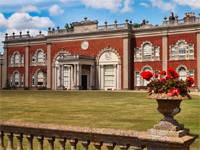
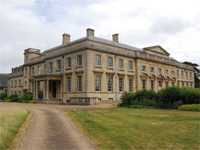
Barrington Hall, Hertfordshire (Image: Hamptons)

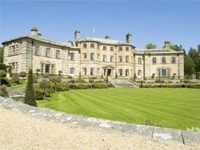
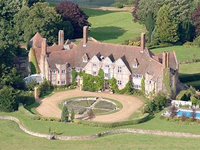
Barrington Hall remained unfinished (despite the engraving above) and was uninhabited for 128 years due to, what the estate agents refer to as, ‘bizarre and unfortunate events‘ (anyone with more details please do post a comment!). The house was eventually restored in 1867 by George Lowndes, a distant relative of John Barrington, who employed the Lincolnshire architect Edward Browning to remodel it in a Jacobean style. The changes created an attractive house with a varied and interesting form, featuring a series of handsome architectural details such as the ‘Dutch’ gables, quoins and a miniature ogee turret.  The house was bought by the Gosling family in 1903 who had merged ‘Goslings Bank‘ to create Barclays & Co in 1896. It was then sold in 1977 to the British Livestock Board who converted it to offices and then subsequently sold in 1980 to CPL Aromas LTD, a family perfumery firm who seem to have had some challenging times following an ill-fated public listing in 1994, which they reversed in 1999.  Having remained at Barrington Hall it now seems that the company has reviewed its requirements and decided that a stately home is a luxury no longer required.

Although originally offered several months ago for £5m (with 32.85-acres), it seems possible that a serious, but lower, offer could be successful.  It would probably take at least £2m to restore this fascinating house, creating the rich and lively interiors which it needs to match the exterior and bring it back to life, but whoever did so would have the pleasure and pride of having rescued an interesting country house from the drudgery of corporate service.

—————————————————————————–

Sales website: ‘Barrington Hall‘ [Hamptons] – which, by the way, is a pretty weak effort.  Nice photos but quite lacking in details.

Listing description: ‘Barrington Hall‘ [British Listed Buildings]

Know any more? If you’re aware of any other country houses of a similar size to Hursley House, Ditton Park, or Donington Park, please post a link (ideally) to a Google Map aerial view in the comments below.

N.B.: an earlier article on this blog (‘Converting country houses from commercial to residential: a sound investment?‘) looked at a few other examples including Gaddesden Place, Hertfordshire, now the headquarters for Xara software, and Benham Valance, Berkshire.

‘Floats like a butterfly’: the flights of the remarkable butterfly houses; Happisburgh Manor for sale

Happisburgh Manor, Norfolk (Image: The Beautiful House Company)

The design of country houses has been influenced by many things; politics, religion, the Greeks, the Romans, India, to name a few – but it’s rare for an insect to do so.  Yet for hundreds of years, the humble butterfly has inspired some remarkable houses, and for one lucky buyer, there is currently the rare chance to purchase Happisburgh Manor, one of the best of the Arts & Crafts versions of the ‘butterfly’ house.

Architects have long been inspired by nature, particularly in the decoration of the interiors.  Yet it would always be a greater challenge for the more organic forms to be accommodated by the hard-edges of brick and stone – but never underestimate the inventiveness of architects.  Although often thought of as a 19th-century/Arts & Crafts plan, the ‘butterfly’ actually has a single precedent dating from 1612-20.

Westwood Park, Worcestershire (Image: Knight Frank)

The definition of a butterfly plan house is ‘…where two or four wings of a house are constructed at an angle to the core, usually at approximately 45 degrees to the wall of the core building.‘.  The house which was the first manifestation of this plan is Westwood Park, Worcestershire, which, it is thought, was originally built as a conventional rectangular, three-storey hunting lodge. Begun in 1612, and although probably not originally intended, sometime before 1620 four full-height wings were added at 45 degrees, creating the distinctive shape we now know.  The reason for this innovative design is lost but is quite likely to be a response to the elevated location.  The butterfly plan is also known as the double-suntrap as it increases the number of rooms which benefit from their orientation towards the sun  and increases the number with views – hence its popularity with any number of seaside hotels.

The Chesters, Northumberland (Image: The Journal)
The Chesters, Northumberland (Image: The Journal) – link to news story about when it was put up for sale in 2009

Despite these advantages, the butterfly wasn’t to make another appearance for nearly three centuries until it appeared in Northumberland in 1891. The butterfly in this case was a house called The Chesters, which had originally been built in 1771 but which the leading Victorian architect Richard Norman Shaw had been commissioned to dramatically enlarge. Shaw’s scheme was bold and grand, adding three wings to create the butterfly (the service quarters obstruct the construction of the fourth ‘wing’), and linking the two southern arms with a grand colonnade – although Shaw strangely omitted to include many windows on the sunniest aspect.

The Chesters was the first of a series of these houses which appeared over the next two decades as an idea explored by a small group of architects.  Where the butterfly plan found its best expression was in the hands of the Arts & Crafts movement whose love of natural forms perhaps gave them a greater sensitivity to the opportunities it offered – either in the country or an urban setting (see ‘Baillie-Scott Corner‘ in Hampstead – Google streetview).

The next appearance of a butterfly plan in the countryside was initially in imagination only and shown in a drawing by Edward Schroeder Prior (b.1857 – d.1932) which was exhibited at the 1895 Royal Academy Summer Exhibition.  Prior had started his career in 1874, articled to Norman Shaw, which had a profound influence on the young architect as the older architect’s willingness to experiment with forms and materials probably helped give Prior the courage to follow his own determined views.  Prior became a leading light of the Arts & Crafts movement having had Philip Webb (regarded as one of the founding fathers of Arts & Crafts) as a mentor, as well as working with William Letherby, another leading thinker and friend of William Morris.

Drawing for The Barn, Exmouth, Devon by E.S. Prior - 1895 (Image: RIBA)
Drawing for The Barn, Exmouth, Devon by E.S. Prior – 1895 (Image: RIBA)

The drawing shown at the Royal Academy shares many similarities with the design Prior produced for a house known as The Barn, which was built in Exmouth, Devon in 1896-7.  The house was relatively modest in scale, and not quite a complete butterfly, but it demonstrated Prior’s commitment to the use of vernacular materials with the walls built of local sandstone and with stones from the beach and rivers embedded in the concrete.  One aspect of the butterfly plan is its ability to capture the sun and the break in the wings at the centre allows light to flood into the core of the house.  Sadly, the commitment to local materials included the use of traditional Devon thatch which, although treated to be incombustible, caught fire and gutted the house in 1906.  Although the house was rebuilt using the original walls, the interiors are not Prior’s.

Happisburgh Manor, Norfolk (Image: g7bmp via flickr)

The first “fully worked” four-wing butterfly was Happisburgh Manor, Norfolk, designed by  Detmar Blow in 1900.  Commissioned by the prominent local Cator family, the architectural writer Lawrence Weaver said, in 1909, that ‘[Blow] rightly determined that it should be characteristic of the locality, and he has succeeded so well that, …[if] any section were mixed up among a set depicting the village, it might be taken as belonging to any of the old houses nearby‘.  Interestingly, Blow credits inspiration for the design, not to Prior or Norman Shaw but to his friend, and also noted architect, Ernest Gimson who ‘…sent the little butterfly device on a postcard‘.  There is considerable ingenuity in the design and execution of the house, partially due to the tight £4,000 budget but also due to the local environment, with its blustery winds, sandy soil, and paucity of materials.  To create a house as brilliant as Happisburgh truly demonstrates the skill of an architect.

Papillon Hall, Leicestershire - demolished 1950 (Image: Lost Heritage)
Papillon Hall, Leicestershire – demolished 1950 (Image: Lost Heritage)

The next house was by the most famous of the architects of that period, Edwin Lutyens. In 1902, Lutyens was commissioned by Fred Bellville to remodel an existing house in Leicestershire called Papillon Hall, named after the original Huegenot family. Conveniently, ‘papillon’ is the French for ‘butterfly’ and Lutyens would have been aware of the architectural innovations going on elsewhere and obviously felt he would try his hand at this novel plan.  One of the challenges of the butterfly is that by placing the main rooms at angles this creates awkward spaces. However, Lutyens, as inventively as the other architects, used these spaces for staircases, and his particular innovation was to include the Basin Court as a single storey curved connection between the two ends of wings. As with The Barn, Papillon Hall was not to last long, being demolished in 1950 with only sparse rubble showing where was once one of Lutyens most interesting commissions. (Certainly not to be confused with this poor, modern ‘re-creation’ in Warwickshire which uses a very similar name!).

Voewood, Norfolk (Image: Voewood)

E.S. Prior’s next commission, Voewood, Norfolk (also known as Home Place and Holt Place) was perhaps his most successful use of the design.  Built between 1903-05 for the Rev. Percy Lloyd, this was a radical house; pulling together a fully developed butterfly plan, hyper-local materials, and great craftsmanship.  These together not only pushed the build cost from £12,000 to £60,000 but also created what Pevsner described as ‘a most violently idiosyncratic house‘; rich in local texture provided by a varied palate of materials mainly dug from the ground on which it stands.  The house unfortunately was tenanted almost as soon as it was built (apparently Lloyd’s wife didn’t like it!) before becoming a boys school from 1906-1914/15 and then a series of care and convalescence homes until it was bought around 10 years ago by rare book dealer Simon Finch who was exactly the right character to sensitively restore the house and make it a home again (though it can be rented).

Kelling Hall, Norfolk (Image: Albanpix via Daily Telegraph)

The only other notable house of this plan to be built in this period, Kelling Hall, also appeared in Holt, literally just down the road from Voewood. Kelling truly was a country seat for an industrialist as the man who commissioned it was Henry Deterding, one of the founders of the Royal Dutch Petroleum Company (which later became Shell). Deterding had seen and liked Voewood but commissioned another Arts & Crafts architect, Edward Maufe, to create a larger version of his neighbour.  The house certainly takes the concept of the butterfly too a larger scale but there’s no doubting the craft and innovation involved in creating one of the most interesting houses to lie at the centre of an estate. Proving its charm, the house was sold by Deterding’s grandson in 2008, along with its 1,600-acre estate, for £25m.

For all its charms and advantages, the butterfly house only enjoyed a relatively brief period of popularity.  By World War I, the relatively niche appeal of Arts & Crafts (at the time) and, afterwards, a post-war nation less tolerant of such quirky designs and more interested in the Modern, meant that architects moved away from suggesting it and instead largely headed back to the comfort of the classical or the more radical art deco, putting the butterfly into hibernation.

'Piddle' House, Hampshire - official name unknown (Image: Selway Joyce)
‘Piddle’ House, Hampshire – official name unknown (Image: Selway Joyce)

However, no good architectural idea is ever completely forgotten.  The most recent manifestation is Robert Adam’s response to the demanding requirements of a client who wished to maximise the views from a riverside site.  The architect’s website is sparse on details of both its name, the year that it was built or the exact location beyond saying it was near the River Piddle, Dorset, so we’ll call it ‘Piddle’ House, actually it’s called Hyde House (thanks Stephen – see comments), and it seems to have been built within the last 15 years.  Interestingly, it appears to blend elements of the Picturesque, with varied forms and heights whilst still adhering to the butterfly shape. Again, perhaps this shows the adaptability of this innovative plan.

The butterfly plan is complex and requires great skill to be manipulated correctly to achieve the correct balance internally and in the use of materials, which probably explains why it was never broadly adopted.  Short of commissioning your own, the chance to own a true ‘butterfly plan’ house is certainly a rare one, especially when the architect was one of the leading exponents of the idea who also ensured that the build quality was exemplary.  Happisburgh Manor has been for sale for several months and the price was recently cut from £975,000 to offers over £800,000.  This may reflect market weakness but also that, although freehold, Happisburgh is in danger from coastal erosion which may see the house become a beach-hut within the next century (but maybe longer, who knows!).  This would be a tragic end for this rare and special house and one can only hope that the next owners fully appreciate the beauty of their home and perhaps can find some way to save it.  And if the next owners ever read this, please can I visit before it does go?

————————————————————————–

Property details: ‘Happisburgh Manor‘ [Strutt & Parker]

Brochure: ‘Happisburgh Manor‘ [PDF, Strutt & Parker]

Listing description: ‘Happisburgh Manor‘ [British Listed Buildings]

News story – Westwood Park: ‘My £1.2m taste of Tudor living: Country house apartment with 3,000sq ft – and most is in the drawing room‘ [Daily Mail – 2009]

Article on Simon Finch and Voewood: Lifestyle – for House & Garden [Dominic Bradbury]

Article: ‘Arts and Crafts houses stand the test of time‘ [Daily Telegraph]

Other examples:

A country house at risk of demolition: Winstanley Hall – and how you can help save it

Winstanley Hall, Lancashire (Image: Paul Barker / SAVE Britain's Heritage)
Winstanley Hall, Lancashire (Image: Paul Barker / SAVE Britain’s Heritage)

That the headline above is even possible today is shocking; that it almost came with the acquiescence of English Heritage is even worse.  The wealth of Britain allowed the creation of thousands of wonderful country houses; stores of learning, art, literature, music and much more.  Yet hundreds have been lost, the contents scattered, the fixtures and fittings sold for a fraction of their worth and the history and visual value of these beautiful buildings lost to the demolisher’s pickaxe.  Many a country house has been restored from a serious state of dereliction, so for demolition to even be proposed is to be deplored. Winstanley Hall, near Wigan, has long been a cause for concern but a new campaign, run by SAVE Britain’s Heritage, hopes to quickly raise the funds needed to rescue this fascinating house.

The Country Seat blog is an off-shoot of my earlier interest and research into the lost country houses of England.  Initially sparked by the ruins of Guys Cliffe House in Warwickshire, I have been building on the remarkable work of Peter Reid, John Harris and Marcus Binney who produced an initial list of nearly 1,200 houses which had been lost since 1800.  This list formed the backbone of the ground-breaking 1974 exhibition at the Victoria & Albert Museum in London which dramatically brought home the shock that so much of our architectural heritage had been lost already and the then legal constraints were insufficient to stop it continuing. My list now totals over 1,800 houses which have been lost since 1800 – every county has been affected and each has their own sad roll-call of losses.

Hall of Lost Houses, from the 1974 Destruction of the Country House exhibition at the V&A
Uppark House, Sussex - on fire, 30 August 1989 (Image: National Trust)
Result of a bad workman and his tools: Uppark House, Sussex – on fire, 30 August 1989 (Image: National Trust)

Houses can be lost for a number of reasons but two of the main causes are fire and finances. Country houses are unfortunately particularly susceptible to fire; the wooden construction, the flammable contents, the open fires and the restoration work which often brings careless workmen with their blowtorches.  Beyond mitigating the risk, preventing these devastating blazes has always been a challenge.  Yet, diminishing or insufficient finances are equally pernicious but harder to combat as the decay can quietly take place over generations, with the realisation of the seriousness only coming too late.

Many houses were traditionally supported by their estates but the agricultural crisis of the 1880s led to a reduction in income which was largely staved off through the sale of contents, until, in the early 20th century, this was no longer sufficient and the houses themselves were demolished – at a stroke removing the running costs and raising funds through the sale of the materials.  This continued through that century, spiking in the 1920-30s and again in the 1950s, reaching a nadir in 1955 when a significant house was being demolished every five days.  This fascinating video below shows rare footage of a country house in Kent, Pickhurst Manor, as it was destroyed in the 1930s:

The impact of the ‘The Destruction of the Country House‘ exhibition cannot be over-stated in heritage terms. It can be said to have jump-started the heritage movement, creating the current mass interest in country houses which can still be seen today in the popularity of the National Trust and the many individual owners who open their houses to the public. It also led to the formation of SAVE Britain’s Heritage, which has since then been one of the countries most effective campaigning charities; saving not just country houses, but working to find viable uses for a broad range of historic buildings including factories, churches, offices, and, most recently, terraced housing threatened by the wasteful and pointless Pathfinder Scheme. In the interests of transparency: I am involved with SAVE as a member of the Committee which is consulted about current cases, but this post was not written at their request and the views expressed are my own.

Winstanley Hall, Lancashire - print
Winstanley Hall, Lancashire – print showing the original Elizabethan house

Which brings us to the Grade-II* Winstanley Hall. One of only three surviving Tudor buildings in that borough, the house was built shortly after James Bankes, a London goldsmith, bought the estate in 1595.  The core of the Elizabethan house, with its two projecting wings, can still be seen on the garden front of the house, thought the original gables were replaced by parapets during alterations designed by Lewis Wyatt in 1818-19.  It was Wyatt who created the new entrance tower to the west with its Ionic portico and his work can still be seen inside with some surviving plasterwork and the fine cantilevered staircase.  What makes Winstanley particularly interesting is that it contains layers of work but with each grafted onto the last making the house quite ‘readable’.  A new wing to the south-west was added in 1780, with further changes, marked by keystones, in 1843 and 1889.

The stable court is especially fascinating architecturally as it contains a range of different styles, chosen at the whim of the owner; Meyrick Bankes II.  This delightfully eccentric but still functional range of buildings reflect his life as a well travelled, well educated man and includes Norman, Tudor, and Baroque motifs (and even his own likeness) in the masonry which creates a varied design which adds to the charm of the setting.  The visual interest of the courtyard, combined with the house, really does set Winstanley apart as many houses have lost one or the other of these core elements which make up an estate.

The house started declining in the 1930s and was last occupied in the early 1980s, with the parkland being open-cast mined during the post-war period and later the M6 being built along the edge of the parkland.  However, the parkland has now been restored and the road, which is some distance to the west of the house, is hidden in a cutting and by banks of trees, resulting in the Winstanley estate forming a precious rural space on the edge of Wigan, still approached from the east along a long, secluded drive which dips in between romantically landscaped woodland.

When the family sold up, the house and 10-acres were bought by a local developer who submitted a scheme which proposed enabling development, even though, as Green Belt land, it was unlikely to succeed.  With the failure of this scheme, the house remained unused, sliding further into dereliction to the point where another scheme was suggested which would have involved the conversion of the buildings in the courtyard but would have resulted in the demolition of the main house – and it’s this shocking scheme which English Heritage almost approved in 2011 (though EH, to be fair, also cannot be praised highly enough for their saving of Danson House and Apethorpe Hall – which is still for sale, by the way).

Proposed restoration of Winstanley Hall (Image: Huw Thomas / SAVE Britain's Heritage)
Proposed restoration of Winstanley Hall (Image: Huw Thomas / SAVE Britain’s Heritage)

SAVE stepped in and prevented the demolition and has been working with leading consultants to draw up plans for emergency repairs but also to find a long-term, sustainable solution which not only preserves the house through re-use but also brings the other buildings in the complex to life.  The leading country house conversion architect Kit Martin along with the Morton Partnership, a leading firm of heritage surveyors, have been working with Roger Tempest of Broughton Hall (who has a track record of creating business space in estate buildings), in conjunction with the Landmark Trust, and the Heritage Trust for the North West, who have been consulted about creating heritage training skills opportunities.  The overall aim is to create a community which is not just residential but also hosts businesses and events, with public access via an exhibition space and café.

How you can help: English Heritage have agreed a major grant of £217,000 for the emergency works but SAVE urgently needs to raise a £50,000 contribution.  Any donation, large or small, will help rescue this wonderful house and estate and help prevent the loss of yet more of our heritage.  Since 1974 no house of this size or quality has been lost, so, if you can, please do help.

Ways to donate:

  • Online via the SAVE website
  • Phone: donate £3 or £5 by texting RESTORE3 (for £3) or RESTORE5 (for £5) to 70500. (This will cost £3 or £5 plus your standard message rate and 100% of your donation will go to SAVE Britain’s Heritage.)
  • Cheque: made payable to ‘SAVE Britain’s Heritage’ and sent to SAVE Britain’s Heritage, 70 Cowcross Street, London, EC1M 6EJ.

Thank you!

——————————————————————————

Full SAVE campaign brochure: ‘Help us Save Winstanley Hall‘ [PDF – SAVE Britain’s Heritage]

Photos of the house in better days ‘Winstanley Hall: gallery‘ [SAVE Britain’s Heritage]

A very unofficial tour: ‘Winstanley Hall‘ [YouTube]

A view of the interior: ‘Winstanley Hall‘ [WiganWorld]

Aerial view of the house and outbuildings: ‘Winstanley Hall‘ [Bing]

Listing description: ‘Winstanley Hall

Higher (country) seats of learning: country houses and current courses

Keele Hall, Staffordshire - now Keele University (Image: simon3k via flickr)
Keele Hall, Staffordshire – now Keele University (Image: simon3k via flickr)

Perhaps one of the most traditional images of university is that of the hallowed, ancient spires of Oxford and Cambridge.  The idea that wisdom is a product of experience can create a sense that perhaps historic surroundings might impart some of that wealth to those studying.  Of course, this isn’t always the case but, for various reasons, country houses formed the historic core of a number of new universities. There are now several courses (listed in a new page called ‘The Study‘) which examine UK country houses and their place in the architectural, artistic and cultural tapestry of our society.

Although country houses have a long tradition of becoming schools for those up to the age of 18 (a topic touched on in a previous post: ‘School’s out: seats of learning for sale‘), the requirements for higher education present a much tougher set of challenges.  To create a successful, broad-spectrum university requires a significant number of buildings, particularly for subjects such as engineering and the sciences.  The Robbins Report in 1963 recommended an expansion of higher education and was a catalyst for the establishment of a new wave of universities, often colloquially known as ‘red-brick’ (coined, apparently, by the University of Liverpool, inspired by their Victoria Building which is built from a distinctive red, pressed brick.).  Yet, many of these new universities could not be accommodated in already crowded city-centres and so the search was on for suitable locations.

Country houses were an obvious option; space, good locations, existing infrastructure, uncontaminated grounds – often landscaped, and easy to purchase as a single entity. Although by the 1960s, the tempo of the brutal country house demolitions of the 1950s had slowed, many a house owner was faced with a building often still suffering from the damage and neglect of WWII requisitioning, wider economic problems and a society increasingly unsympathetic to the landed classes.  To sell or even donate a house to an educational establishment seemed to be a solution to the problems which beset them.

Reed (formerly Streatham) Hall, Devon (Image: University of Exeter)

The ancient universities were housed in purpose-built facilities, the glory of the architecture often designed to reflect glory on the patron – be he king or cardinal.  The 19th-century university was often founded on industrial wealth and wishing to keep their trophies prominently displayed, the patrons ensured that the buildings were mostly urban-based in the cities.  So the earliest country house to become part of a university actually happened quite late; Streatham Hall was donated to the University College of the South West of England, based in Exeter, in 1922 by Alderman W.H. Reed, a former mayor of the city.  The house, surrounded by an arboretum of rare and beautiful trees collected from around the world by the Veitch family, was renamed Reed Hall to honour the benefactor and became the core of the new university as the first student accommodation, with new buildings rising around it.  The house is still there today at the centre of the campus and is used as an events and conference centre.

Keele Hall, Staffordshire - garden front (Image: Mr Ush via flickr)
Keele Hall, Staffordshire – garden front (Image: Mr Ush via flickr)

One owner who was probably grateful for the solution offered to him was Ralph Sneyd, owner of Keele Hall, Staffordshire.  Designed by that foremost of Victorian architects, Anthony Salvin, the house had been praised by William Eden Nesfield as one of the best-planned houses of its time, which may have been a back-handed compliment as later writers have decided that the garden front is generally criticised for being ‘too long for its height‘ (J. Allibone) and the ‘entrance front is confused rather than pictureseque‘ as, by this time, ‘His gift for calculated asymmetry was already on the wane‘ (M. Girouard).  The interior, however, was regarded as very well-designed for the needs of the bachelor Mr Ralph Sneyd (b.1793 – d.1870) who had commissioned it in the early 1850s, with a series of rooms to cater for the male pastimes of the Victorian gent.  Although let to Grand Duke Michael of Russia between 1901-10, it was nevertheless in decline by 1939. During WWII, the house was requisitioned and became a transit camp for troops with numerous huts and buildings appearing on the estate but the family had already moved out as financial struggles, which had started in 1902, made the house too expensive to be their home. After the war, Ralph Sneyd (the nephew of the one who had commissioned it) was probably more than happy when the local council bought the house and much of the estate for £31,000 in 1948.  The main house and the wartime buildings formed the core of the new university, allowing it to open relatively quickly in 1949.

Lamport Hall, Northamptonshire (Image: Mike Higginbottom / Interesting Times)

Other universities also took this route and re-purposed country houses or their estates (year is date it started being used):

Another notable country house linked to a university is Lamport Hall, Northamptonshire, an important, grade-I listed house which was once home to the Isham family until 1979 when Sir Gyles Isham, the 12th (but not the last) Baronet, bequeathed it, plus the contents and estate, to a charitable Trust.  That trust now runs the house as an education and conference centre which has long been a partner for the Centre for the Study of the Country House based at the University of Leicester.

Harlaxton Manor, Lincolnshire (Image: stemurphy4 / flickr)

Perhaps the most spectacular of houses to be used is Harlaxton Manor in Lincolnshire, which, since 1971 has been the British campus of the University of Evansville, Indiana, USA (though Stanford University had taken it over in 1965).  The exterior is a riot of gables, chimneys and decoration by Anthony Salvin, though the interior now enjoyed by generations of American students was by William Burn after Salvin and the owner, the wonderfully named Gregory Gregory, fell out. As a smaller outpost, it has not only been preserved with few external additions but also holds the tantalising prospect that, if the university decides it is surplus to requirements, could once again become a stunning country home. Also of note is the impressively restored Herstmonceux Castle in Sussex which was given to the Queen’s University of Canada in 1993.

Attingham Park, Shropshire (Image: Jonathan Davies / wikipedia)

Of course, it wasn’t just the formal universities who made use of country houses to become seats of higher education.  One of the best known is the beautiful Attingham Park, Shropshire, which was an adult education centre from 1946 until 1971.  Owned by the Lords Berwick, it was the 8th, and last, Thomas, who bequeathed it to the National Trust. However, the college was run by the decidedly New Age, Sir George Trevelyan who mixed serious study with rather more mystical pursuits.  One of Sir George’s greatest successes was the creation of the Attingham Summer School in 1952 which, through the Attingham Trust offers “…specialised study courses, primarily for people professionally engaged in the field, on country houses, their collections and settings, and on the history and contents of English royal palaces.“.  The courses still run today – though they do require rather deep pockets to attend. Dillington House in Somerset became an adult education centre in 1950, operated by North Somerset Council but still owned by Lord Cameron of Dillington.

And so it continues.  The latest is that grade-II* Hestercombe House in Somerset has been handed over to a Trust who not only wish to restore the house and fascinating gardens – with Georgian, Victorian and Edwardian phases including work done by Gertrude Jekyll – but also to establish, subject to HLF funding, a Centre for Landscape Studies.  This, it is anticipated, will host conferences, courses and hopefully become a national archive for conservation management plans.  Country houses are still proving their value with the house and grounds forming the justification and catalyst for new educational ventures.

———————————————————–

New on The Country Seat: ‘The Study

There is a new section called ‘The Study‘ where I hope to be able to keep an up-to-date list of courses at recognised UK educational institutions which are focused on, or have significant sections relating to, our wonderful country houses.  Please do let me know if you are aware of any I have undoubtedly missed, or any future updates.  I’m particularly keen to hear from institutions to make sure that we can try and generate interest in the long term for the more substantive degree and masters courses.  Feedback always welcome.

———————————————————–

News stories: