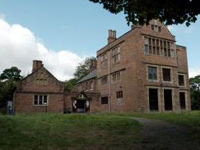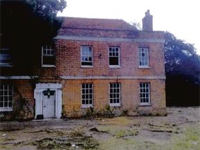
Another house at risk from a developer: Brook House, Tiptree, Essex

Brook House, Essex (Image: Daily Gazette)

It’s such a depressingly familiar pattern; a beautiful old house with grounds, falls into a state of neglect and is then bought by a developer.  With absolutely no incentive to maintain the house it slowly slips into a downward spiral of decay and vandalism until the inevitable request for demolition is presented to the council.  And it’s happening again.

Brook House in Tiptree, Essex is a classic, grade-II listed, red-brick Georgian village house  lacked an owner after the last member of the family died and now after being owned by a developer it has unsurprisingly reached a rather sad state.  The developer might be disappointed that no-one has yet burnt it down but nonetheless he had requested permission to demolish and replace it with several new houses saying that the house is beyond repair – all backed up by a survey which was commissioned by…the developer!   What’s perhaps worse is that English Heritage have also sided with the developer and agreed.  I despair. What is the point of EH if they fail to stand up when buildings are threatened like this?

Anyway, if you live within the area, please contact Colchester Council and ask them to not only refuse this vandalism but also to serve an enforcement notice to repair this lovely part of Tiptree’s heritage.

Full story: ‘Facing demolition: The Grade II listed building‘ [Daily Gazette]

Staley Hall to be restored – sort of

Stayley Hall, Stayleybridge

There appears to be an end in sight for the sorry saga of the neglect of Staley Hall in Staleybridge.  After being derelict for over 50-years, the grade-II listed, 400-year old house has been subject to indifference and some council apathy which has led to arson and massive deterioration in the fabric of the building.  All that remains now are the outer walls – all roofs, interior walls, floors, and decoration have been lost.  The building has reached such a poor condition that – although it pains me to say it – the developer’s proposal to demolish the shell and then reconstruct it as the facade for apartments does seem to be the only viable solution.

All this might have been avoided if the local council had taken this issue in hand at any time over the last few decades – such negligence is unfortunately all too common up and down the country as hard-pressed planning departments face budget and manpower cuts.  Unfortunately it’s the nation’s heritage which pays the price.

Full story: ‘‘Saddest house in England’ to be turned into flats‘ [Crain’s Manchester Business]

Bewsey Old Hall becomes developer’s excuse

cheshire-bewseyoldhall
Bewsey Old Hall

It’s a familiar story; an old house with a bit of ground has become a bit dilapidated but rather than it being carefully restored as a single family home a developer snaps it up as an ‘opportunity’.  Despite the obvious wealth of Cheshire (or perhaps because of it) approval has almost been given for Bewsey Old Hall to not only be converted into seven apartments but for *48* more units in six other blocks to be built on stilts in the grounds.  So the house goes from being the excuse to enable building to a mere architectural fascinator in the centre of large scale development.

Luckily the local councillors have collected thousands of signatures opposing the plans and are fighting a rearguard action despite the decision of the Government planning inspector who has crazily approved this vandalism. One final hope is that a parcel of Government-owned land which is required to enable the development may yet not be sold.  If the council are successful, here’s hoping that someone with money can buy the house and land and bring this house back to life.

Full story: ‘Last gasp to save Bewsey Old Hall‘ [This is Cheshire]

Nocton Hall ‘amongst 10 most endangered’

Nocton Hall (Image from Wikipedia)

Nocton Hall suffered a devastating fire in 2004 and since then has remained a roof-less, though restorable, shell with no sign that the new owners have any inclination to rescue this interesting and attractive house.

The original Nocton Hall burnt down in 1834 and the new house was built by William Shearburn for the Earl of Ripon in 1841.  It was then taken over by the Air Ministry in 1940 for use as a hospital for RAF Nocton.  The RAF left in 1983 following which it became a residential home.  However, in the mid-1990s the business failed and it was bought by a local developer, Leda Properties.  A then sadly familiar story played out with the house ravaged by vandalism and theft before the ‘suspicious’ fire in 2004. 

The Victorian Society have now declared that the Grade-II listed Nocton Hall is one of their ‘Top 10 Most Endangered Buildings’ in the country.  Hopefully this will again focus some attention and, along with the concerns of locals, will perhaps prompt Leda Properties to declare their intentions.  One hopes that this is not another case of a developer hoping that further vandalism or fire will give them the opportunity to apply for permission to demolish.  Lincolnshire has lost far too many of it’s country houses already over the last 100 years – there is no reason beyond stubborn greed why Nocton Hall should be added to the list.

Full story: ‘Nocton Hall a ‘top 10’ endangered building‘ [Lincolnshire Echo]

Could Viewhill House rise from the ashes?

Viewhill House, near Inverness, suffered a devasting fire two years ago which left it a ruined shell.  Since then it has been the subject of debate as to whether it can be saved or demolished and replaced a new development.  Unsurprisingly, a report by the developer has concluded that it should be demolished (what a surprise!) and has unfortunately been backed up by the local conservation officer.  What is interesting is that neither party has actually examined the building fully, claiming it’s too dangerous.  So on the basis of a fairly shallow investigation another part of Scotland’s heritage is imperilled.

The 170-year old  former home of Caledonian Canal engineer Joseph Mitchell, which was Category-B listed, had been empty for some time before the mysterious fire ripped through the house in 2007.  The developer had previously expressed his frustration that he wasn’t allowed to do as he wanted and level the site following the fire but luckily the council had taken a stronger line, demanding stabilisation works.

However, a recent assessment by independent historic buildings expert Scott Handley has concluded that the house can be saved. Mr Handley and the Inverness Civic Trust hope to present their report to the council in the hope of persuading them to preserve this interesting part of Inverness’ heritage before it becomes just yet another half-empty development of city flats.

Full story: ‘Mansion can be saved, says expert‘ [The Inverness Courier]