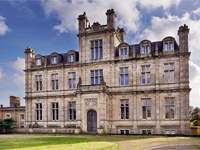
Bylaugh Hall: the hidden history to a remarkable restoration opportunity

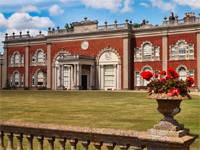
Bylaugh Hall, Norfolk (Image: Chesterton Humberts)

Many country houses we can visit today are innately interesting; the design, the contents, the occupants, all tell a tale.  Sometimes though there are houses with a much richer past which not only have an immediate story to tell but also a much more complex history, one fascinating for anyone with an interest in how these houses came to be created. One such house which was recently launched – and amusingly described on Rightmove as a ‘60 bedroom detached house for sale‘ – is the remarkable Bylaugh Hall in Norfolk, an engineering marvel and architectural delight, which had a forced birth through litigation, which wasn’t wanted by the first owner, and where credit for the design hasn’t truly been given to the right architect.

Bylaugh is remarkable in many ways; some obvious, others less so.  Even its genesis came from beyond the grave as the controversial inherited wish of the last owner, Sir John Lombe Bt (b. c1731 – d.1817), a man whose fortune came from the family’s silk throwing mill in Derbyshire.  The Lombe’s were established Norfolk gentry whose original estate was at Great Melton, centred around Melton Hall (built in 1611 by the Anguish family) but now a ruin having been first tenanted and then, by the end of the 19th-century, abandoned.

Allegedly won by Sir John in a skewed card game, the Lloyds had owned the Bylaugh estate for a number of years, and even if the story is false, it was legitimately Sir John’s by c1796.  The Lombe’s were unusual in that their wealth largely came from industry, and one which was located outside of the county, but they quickly used their fortune to create the fourth largest estate in Norfolk, at over 13,000-acres by 1883.

Whatever house was already at Bylaugh was insufficient for Sir John so he resolved to build an entirely new one.  However, the house he had in mind was not the house which was built.  Sir John must have had a fair idea that he would not survive to see his grand plan to fruition but he certainly wasn’t going to let mere death cheat him of his ambition.  Having placed £20,000 in trust for the express purpose of building the house – though without approving a design – he died in 1817 (unmarried and childless), leaving his estate and his firm directions to his brother Edward. Here, the family history becomes a little complicated as Edward was his half brother, the product of an affair with a Norwich doctor’s wife.  Edward adopted the Lombe surname but was reluctant to take on the grand role envisioned by his late brother – which is perhaps why Sir John’s will was so prescriptive, and which led to a quite extraordinary court case.

Edward Lombe disputed with the executors of the estate the instruction to build the new house.  However, Sir John had been quite clear, including this fascinating clause in his will:

And whereas it is my wish and intention that a mansion house and suitable offices fit for the residence of the owner of my estate shall be erected on some convenient spot in the parish of Bylaugh in the county of Norfolk either in my lifetime or after my death and that if I shall not erect the same in my lifetime then that my said trustees shall forthwith after my death erect the same according to such plan as I shall in my lifetime approve of or if I shall die before such plan shall be prepared and completed then according to such plan as the trustees or trustee for the time being under this my will with the consent of the person for the time being beneficially entitled to the immediate freehold of my said manors &c under this my will shall think proper to adopt adhering as closely as possible situation and other incidental circumstances being considered to the plan of the house now the residence of Robert Marsham esquire at Stratton Strawless in the said county of Norfolk. (source)

Yet Edward resisted, delaying the start of the build for years by arguing with the executors, Mr Mitchell and Mr Stoughton, and stating that even if they built the house he wouldn’t live in it.  Finally, in 1828, he went to the Court of Chancery and demanded that the money, now having grown to £43,000, be placed with it and a judgement made as to whether he could overturn the provisions of his brother’s will. The case was still undecided in 1839, by which time the fund had grown to over £63,500, when Edward again pressed his case, with a decision finally being made in 1841 – against him.  The Vice-Chancellor said:

It appears to me to be impossible to read this passage in the will without seeing that there is in the plainest language an express trust for the erection of the mansion house which the trustees are forthwith after his death to commence and to proceed with the erecting of. I cannot conceive any words more plain.
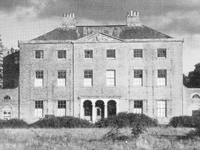
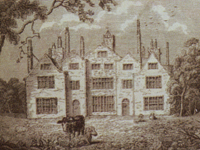
Stratton Strawless Hall, Norfolk - pre 1960 (Image: 'The Country Houses of Norfolk' by David Clarke)
Stratton Strawless Hall, Norfolk – pre 1960 (Image: ‘The Country Houses of Norfolk’ by David Clarke)

Which rather settled that. In the meantime, the executors had not been idle in their duties – but they weren’t as obedient as they might strictly have been.  Sir John had clearly stated that the house was to follow ‘as closely as possible‘ Sir Robert Masham’s house at Stratton Strawless; a three-storey (now two), strictly classical, almost Palladian house with a Tuscan-columned porch.  However, the executors ignored this provision and with possibly an eye to emphasising the esteemed family line and to help the new house blend in with the other seats in the area, they chose to create a historical ‘Jacobethan’-style house – but even that is not the one we see today.

Interestingly, although the current Bylaugh is rightly described as being designed by Charles Barry the younger and his partner, Robert Robinson Banks, few are aware that in 1822 the trustees had originally asked another noted architect, William Wilkins (b.1778 – d.1839), to draw up a plan, and his design showed a remarkable stylistic similarity to the one actually built 27 years later.
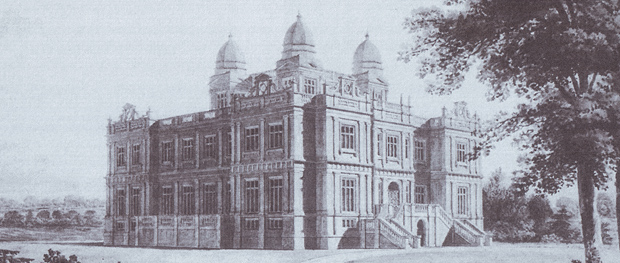
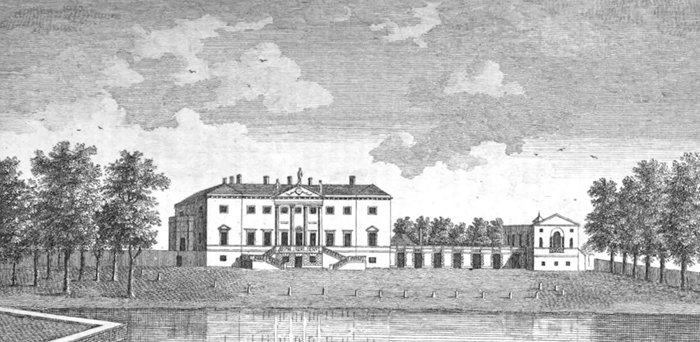
Unexecuted design for Bylaugh Hall by William Wilkins, 1822 (Image: Public Record Office MPA. 66.1 / 'William Wilkins, 1778-1839' - R.W. Liscombe)
Unexecuted design for Bylaugh Hall by William Wilkins, 1822 (Image: Public Record Office MPA. 66.1 / ‘William Wilkins, 1778-1839’ – R.W. Liscombe)

Although a noted proponent of the Greek Revival, Wilkins, like many an architect, was well-educated in other styles and could turn his hand if asked. Clearly inspired by the style of ‘Prodigy‘ houses such as Burghley and Longleat, he also drew on elements of buildings he had seen and studied – for example, the polygonal domes capping the raised central hall are copied from the Porta Honoris at Gonville and Caius College, Cambridge, on which Wilkins had written a scholarly article for the esteemed ‘Vetusta Monumenta‘ in 1809. Although each façade was similar, the entrance front was enlivened by a projecting centre bay above the door which was on the piano nobile, reached by an elegant split stair.

The plan of the house was also modern, rejecting a rambling layout, and firmly following the Palladian 3×3 grid on the ground floor.  Centred around a double-return staircase, this was an innovative layout for an early Victorian design – though one Wilkins the classicist would have been entirely comfortable with.  Essentially, he had designed a Palladian villa, dressed in the architectural garb of the ‘Jacobethan’ style.
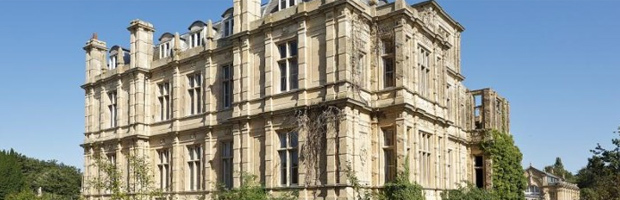
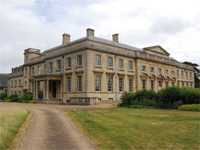
Bylaugh Hall today (Image: Chesterton Humberts)

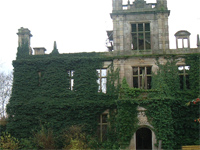
Bylaugh Hall, as attributed to Barry and Banks in 1849, was perhaps better described as an updated version of Wilkins earlier plan – the core 3×3 layout remained, as did the external style, though some of the details such as the raised central hall and domes were removed, and the central staircase replaced by a saloon.  The construction did display some innovation, being one of the earliest steel-framed buildings and was considered a success with one rather giddy local newspaper exclaiming ‘Neither Holkham nor Houghton, those Norfolk wonders, can compare with it for either appearance or comfort‘.  Such wild exaggeration aside, this was a house at the forefront of domestic convenience and was commended in The Builder for having no corridors in the main block, which maximised the space.  It was completed in 1852 at a cost of £29,389, and by 1869 it was reported that £38,000 had been spent on the project, which would have included further works on estate buildings and landscaping (see photos of the house and grounds c1917).  An interesting aside is that during the delay in starting the money had grown to quite a considerable sum, more than enough for all the works.  Edward Lombe applied for the remainder but the Court demanded it be spent on bricks and mortar and so a 4-mile perimeter wall was constructed to satisfy this.
Ruined shell of Bylaugh Hall before restoration (Image: The Burrell Partnership)

It seems that no descendent ever loved the house.  By 1878, the then owner, Edward Henry Evans-Lombe, was renting the handsomely Classical Thickthorn Hall, before buying Marlingford Hall, whilst selling off outlying parts of the estate.  In 1917, Bylaugh Hall and the 8,150-acre estate were put up for auction in 140 lots but Edward sold it whole for £120,000, and the hall and 736-acre park were subsequently sold to the Marsh family.  Used by the RAF in WWII, it was sold in 1948 to a new owner who unsuccessfully planned to turn it into a nursing home.  At that nadir of country houses generally, a familiar pattern started; parts of the house were demolished and in June 1950 a 350-lot demolition sale was held which stripped the interiors of the house, creating a gaunt and sad shell.  So it remained until, in 1999, the house and a lodge was sold to a local sculptor who dreamt of fully restoring the house but with insufficient funds he was forced to restore just the Orangery (article by the engineers with lots of photos), intending it to be a wedding venue.  Other parts of the main house were parcelled up as investments and rebuilt but the plan faltered and then failed, leaving the partially restored house we see today.

So Bylaugh Hall is a house paid for by a man who never got to see it, with a design chosen by two men who ignored the last wishes of the patron, with credit for that design going to two men who relied heavily on another architect now obscured, for a beneficiary who really didn’t want it in the first place. A brilliant story richly illustrating the fascinating complexities of our country houses.

So what should happen to this superb house? Interestingly, the 557-acre Pavilion farm which surrounds the east and south of the house, and includes one of the original lodges, is also for sale, providing the opportunity for the right person to combine them both.  It would require real vision – the restoration work at Bylaugh Hall may be sound but the aesthetics are dire.  Given the budget, much of the existing restoration should be stripped right back and the interiors given the lavish attention they demand.  This is a house which cries out for sumptuous plasterwork and panelling, for grand rooms with fine wallpaper and filled with artworks and quality furniture. With the funds and the vision to take advantage of this rare opportunity, a restored Bylaugh Hall, combined with the farm and more land later, could once again create one of the finest estates in Norfolk.

—————————————————————————–

Property details

1917 auction catalogue:

Listing description: ‘Bylaugh Hall‘ [British Listed Buildings]

Merry Christmas and a Happy New Year

The east front of Hardwick Hall, Derbyshire, in the snow. (Image: National  Trust Picture Library)
The east front of Hardwick Hall, Derbyshire, in the snow. (Image: National Trust Picture Library)

It’s that time of year when I especially wished that I actually lived in a country house; the decorations, the roaring fire, the snow on the parkland. That said, I am lucky enough to write about and visit them – in 2012 I saw:

…and Buckingham Palace, twice (bit of advice: if going, book the last time slot of the day – it’s quiet and a pleasure.  Going in the middle of the day, not so much). Most of these visits were through organisations such as the Georgian Group, the Irish Georgians, and the Society of Architectural Historians of Great Britain. They, and of course, the National Trust, do excellent work – both practical and scholarly – and are well-worth joining if you’d like to find out more.  I was also lucky enough to attend the Attingham Trust 60th Anniversary Conference which was a wonderful opportunity to meet some real experts and also, unexpectedly, some friends of the blog.

Of course, I remain grateful for the incredible interest shown by the tens of thousands of visitors to the blog who kindly read my articles and comment.  I always appreciate feedback and thank you for taking the time to do so.  In mid-December, the blog hit the milestone of 250,000 page views in a year – so the milestone is now a benchmark and I hope to bring our country houses to an even wider audience next year.  Thank you also to all those who have signed up by email and on Twitter (@thecountryseat), which has proved to be a useful channel for sharing snippets of news and connecting with those interested in houses specifically, and heritage generally.

More contributors?

In 2013, I’m aiming to build on the successes of the last few years.  Of course, there will be more articles, however, I’m conscious that the frequency has dropped, mainly due to my ever busier day job.  I’d be interested to have your thoughts on whether you would like to read articles by other contributors? I have written all of them so far (bar a brilliant piece on ruins by Jeremy Musson back in 2011) but there are many other writers out there who would undoubtedly bring greater and wider expertise on country houses.  At the moment, I write mainly about the architecture (especially the exteriors) but would you be interested in someone writing about say, plasterwork, on specific houses, the contents, or other aspects? I’d also be keen to hear what you would not be interested in reading about. It’s possible that the blog could become a platform for experts in their respective fields who may not wish to maintain their own blog or go down the academic journal route.  Anyway, it’s just a thought and I’d be keen to have your feedback either in the comments below or via email.

Thank you again for your interest and I wish you all a very Merry Christmas and all the best for 2013.

Matthew

The estate office: country houses as corporate headquarters – and Barrington Hall, for sale

Barrington Hall, Hertfordshire (Image: Hamptons)

In many ways, a country house was often the headquarters of a business relating to both the estate and the affairs of the family who lived there.  This role was to be mirrored in the latter half of the 20th-century as firms sought to adopt the prestige of stately homes and set up their offices in the many country houses which were then available. What grander statement could a company make to clients and investors than to invite them to visit their stately offices?  Yet times changed, and over the years companies found it harder to justify such lavish accommodation, leading to a steady trickle of houses being sold – and the latest is Barrington Hall, Hertfordshire.

Shalford Park, Surrey (Image: (c) Allianz Insurance Plc via Shalford Village)
Shalford Park, Surrey (Image: (c) Allianz Insurance Plc via Shalford Village) – click for an excellent history of the house

The Second World War ushered in the modern era of offices in country houses.  With little by way of aerial bombing, few firms saw the need to move out of London and other cities in World War I, however, this danger had dramatically increased by 1939.  Faced with the significant logistical challenges in moving their vital paper-based records and operations, the late 1930s saw a number of companies actively scouting out possible alternatives, with country houses an ideal choice due to their size and seclusion.  This new lease of life enabled some houses to escape the demolisher’s pickaxe, such as at Shalford Park in Surrey.  A solid, well-proportioned Georgian house, the result of a rebuild of an older house in 1797, had been sold to Guildford Borough Council in 1938, but primarily to protect the land from development, with the intention that the house be demolished.  However, a lease was granted to the Cornhill Insurance Company (later part of Allianz Inc) who moved there in 1939, creating dormitories on the upper floors.  Cornhill were to remain at Shalford Park until 1955, but unfortunately the condition of the building had significantly deteriorated, and combined with it being in the ideal location for a new local water treatment works, meant that the house was demolished.

Wrest Park, Bedfordshire (Image: English Heritage)

One house which fared only slightly better from this type of arrangement was the beautiful Wrest Park, Bedfordshire.  A fanciful French château, it was built in the 1830s to the accomplished designs of the owner, Thomas de Grey, 2nd Earl de Grey, and features some of the finest, and earliest, Rococo Revival interiors in the country – of particular note is the spectacular staircase.  The house was sold in 1939 for £25,000 by John G. Murray to the Sun Insurance Company (later Sun Alliance) who bought it in anticipation of war. They promptly moved there from London once war had been declared, having made plans to ‘…alter the stable block and erect huts in the grounds for sleeping quarters, together with washing facilities and air-raid shelters … the stable block was the first area to receive our attention. The whole of the East Wing and the upper storey of the West Wing were to be converted for sleeping accommodation with toilet and washing facilities. The middle connecting section was also to be similarly altered, but it was later decided to make part of the upper storey into a communal long room.‘. Such scenes were undoubtedly repeated in many a country house – though such a use was preferable to the treatment meted out at the hands of enlisted men or children.

Cranbury Park, Hampshire (Image: Angus Kirk via flickr)

Other houses had the good fortune to secure relatively benign tenants for the duration of the war. The imposing Stratton Park, Hampshire, was built between 1803-06 by George Dance the Younger for Sir Francis Baring, Lord Northbrook, a founder of Barings Bank. Although it had been sold following the death of his descendent, Francis Baring, 2nd Earl of Northbrook in 1929, the house was bought back by Barings Bank in 1939 as their base for the duration of the conflict (though sadly it was demolished in 1960 by a later Baring who had bought it after the war).  The choice of house was possibly influenced by the fact that the Bank of England had decamped to the nearby beautiful Cranbury Park, also in Hampshire – and, coincidentally, also designed by George Dance the Younger, but built in 1780.  This little known house, still lived in today by the Chamberlayne family who commissioned it, has particularly impressive interiors; the hall and ballroom were described by Pevsner as an ‘unforgettable experience‘. Compared to the horrors of the bombing in London, what a strange pleasure it must have been to be stationed in such an environment.

Banqueting House, Wrest Park, Bedfordshire (Image: English Heritage)

The extensive alterations to even such an important house as Wrest Park indicated the level of damage such intensive use could bring to buildings which had not been designed for such a purpose.  The post-war era held many threats to country houses and use as offices saved many from the wave of destruction which led to the demolition of so many in the 1950s.  In 1949, Wrest Park was sold to the Ministry of Works, who leased it to the National Institute of Agricultural Engineering, later called Silsoe Research Institute which inflicted even more stress on the house and estate.  Although Simon Jenkins included it in his book ‘England’s Thousand Best Houses‘, he wrote that ‘The [Institute’s] outbuildings spoil the approach avenue and its abuse of the interior is dreadful.  The best of the reception rooms, the library, is packed with modern bookcases and computer equipment. Other rooms are cheaply kitted out for lectures and seminars.  It is like a Soviet academy of sciences camped in a St Petersburg palace.’. Thankfully the Institute closed in 2006 and the ground-floor rooms of the house (sadly, office space remains), along with the superb gardens and Thomas Archer‘s sublime Baroque banqueting house have been expertly restored by English Heritage.

Hursley House, Hampshire (Image: Sarah Graham via Panoramio/Geolocation)

The pressure to create more space is often the cause of the most damaging changes to a country house.  Simon Jenkins’ criticism of the additional buildings at Wrest Park can similarly be levelled at the extensive construction which has taken place at Hursley House, Hampshire, home of IBM UK.  The house itself was originally built between 1721-24, with ‘gentleman architect’ Sir Thomas Hewett acting as architectural consultant for Sir William Heathcote, and with further major reconstruction in 1902-03 to create the imposing Queen Anne house which appears in various marketing materials.  What the images don’t show is the huge campus (of fairly ugly buildings) which has sprung up so close to the house since IBM took over the site in 1958. A more intelligent approach to the siting of extra accommodation can be seen at the Computer Associates site at Ditton Park, Berkshire, where the new office buildings have been placed a sensitive distance from the main house.  If their priorities changed, the house could be sold and could resume a comfortably independent existence even if the offices remained in use.  Such a change might once have been expected at Donington Hall, Leicestershire, which served as the headquarters for the airline BMI for many years until the recent merger made it redundant.  Sadly, it’s actually unlikely that anyone would chose to live there as there would be no peace and quiet as the parkland has long been converted into the Donington Park race circuit, just half a mile south of the house.

Barrington Hall, Hertfordshire (Image: from "A New Display of the Beauties of England" (London : 1776-1777))
Barrington Hall, Hertfordshire (Image: from “A New Display of the Beauties of England” London,  1776-1777) – click to see full size image

Sadly, it is uncommon for a house, once it has been used as offices, to escape such a fate being made permanent.  The alterations and additions can render the house a soulless shell with the grounds ruined beyond the possibility of economic rescue.  However, some have survived this role remarkably intact and, if the possibility presents itself, offer a remarkable opportunity to rescue a house and bring it back to the glory of being a single family home.  One such example is Barrington Hall, Hertfordshire, which has had something of a chequered history.  The original house (above) was built between c1735-40 for John Barrington to designs by John Sanderson (b.? – d.1774), a man who Colvin wrote was described as a competent ‘second-generation Palladian’, who worked on an impressive roster of houses including Hagley Hall, where he proved to be an accomplished designer of rococo decoration, Kelham Hall (burnt down 1857), Kirtlington Park, Pusey House, Langley Park, Copped Hall, and Kimberley Hall.

Barrington Hall, Hertfordshire (Image: Hamptons)

Barrington Hall remained unfinished (despite the engraving above) and was uninhabited for 128 years due to, what the estate agents refer to as, ‘bizarre and unfortunate events‘ (anyone with more details please do post a comment!). The house was eventually restored in 1867 by George Lowndes, a distant relative of John Barrington, who employed the Lincolnshire architect Edward Browning to remodel it in a Jacobean style. The changes created an attractive house with a varied and interesting form, featuring a series of handsome architectural details such as the ‘Dutch’ gables, quoins and a miniature ogee turret.  The house was bought by the Gosling family in 1903 who had merged ‘Goslings Bank‘ to create Barclays & Co in 1896. It was then sold in 1977 to the British Livestock Board who converted it to offices and then subsequently sold in 1980 to CPL Aromas LTD, a family perfumery firm who seem to have had some challenging times following an ill-fated public listing in 1994, which they reversed in 1999.  Having remained at Barrington Hall it now seems that the company has reviewed its requirements and decided that a stately home is a luxury no longer required.

Although originally offered several months ago for £5m (with 32.85-acres), it seems possible that a serious, but lower, offer could be successful.  It would probably take at least £2m to restore this fascinating house, creating the rich and lively interiors which it needs to match the exterior and bring it back to life, but whoever did so would have the pleasure and pride of having rescued an interesting country house from the drudgery of corporate service.

—————————————————————————–

Sales website: ‘Barrington Hall‘ [Hamptons] – which, by the way, is a pretty weak effort.  Nice photos but quite lacking in details.

Listing description: ‘Barrington Hall‘ [British Listed Buildings]

Know any more? If you’re aware of any other country houses of a similar size to Hursley House, Ditton Park, or Donington Park, please post a link (ideally) to a Google Map aerial view in the comments below.

N.B.: an earlier article on this blog (‘Converting country houses from commercial to residential: a sound investment?‘) looked at a few other examples including Gaddesden Place, Hertfordshire, now the headquarters for Xara software, and Benham Valance, Berkshire.

A country house at risk of demolition: Winstanley Hall – and how you can help save it

Winstanley Hall, Lancashire (Image: Paul Barker / SAVE Britain's Heritage)
Winstanley Hall, Lancashire (Image: Paul Barker / SAVE Britain’s Heritage)

That the headline above is even possible today is shocking; that it almost came with the acquiescence of English Heritage is even worse.  The wealth of Britain allowed the creation of thousands of wonderful country houses; stores of learning, art, literature, music and much more.  Yet hundreds have been lost, the contents scattered, the fixtures and fittings sold for a fraction of their worth and the history and visual value of these beautiful buildings lost to the demolisher’s pickaxe.  Many a country house has been restored from a serious state of dereliction, so for demolition to even be proposed is to be deplored. Winstanley Hall, near Wigan, has long been a cause for concern but a new campaign, run by SAVE Britain’s Heritage, hopes to quickly raise the funds needed to rescue this fascinating house.

The Country Seat blog is an off-shoot of my earlier interest and research into the lost country houses of England.  Initially sparked by the ruins of Guys Cliffe House in Warwickshire, I have been building on the remarkable work of Peter Reid, John Harris and Marcus Binney who produced an initial list of nearly 1,200 houses which had been lost since 1800.  This list formed the backbone of the ground-breaking 1974 exhibition at the Victoria & Albert Museum in London which dramatically brought home the shock that so much of our architectural heritage had been lost already and the then legal constraints were insufficient to stop it continuing. My list now totals over 1,800 houses which have been lost since 1800 – every county has been affected and each has their own sad roll-call of losses.

Hall of Lost Houses, from the 1974 Destruction of the Country House exhibition at the V&A
Uppark House, Sussex - on fire, 30 August 1989 (Image: National Trust)
Result of a bad workman and his tools: Uppark House, Sussex – on fire, 30 August 1989 (Image: National Trust)

Houses can be lost for a number of reasons but two of the main causes are fire and finances. Country houses are unfortunately particularly susceptible to fire; the wooden construction, the flammable contents, the open fires and the restoration work which often brings careless workmen with their blowtorches.  Beyond mitigating the risk, preventing these devastating blazes has always been a challenge.  Yet, diminishing or insufficient finances are equally pernicious but harder to combat as the decay can quietly take place over generations, with the realisation of the seriousness only coming too late.

Many houses were traditionally supported by their estates but the agricultural crisis of the 1880s led to a reduction in income which was largely staved off through the sale of contents, until, in the early 20th century, this was no longer sufficient and the houses themselves were demolished – at a stroke removing the running costs and raising funds through the sale of the materials.  This continued through that century, spiking in the 1920-30s and again in the 1950s, reaching a nadir in 1955 when a significant house was being demolished every five days.  This fascinating video below shows rare footage of a country house in Kent, Pickhurst Manor, as it was destroyed in the 1930s:

The impact of the ‘The Destruction of the Country House‘ exhibition cannot be over-stated in heritage terms. It can be said to have jump-started the heritage movement, creating the current mass interest in country houses which can still be seen today in the popularity of the National Trust and the many individual owners who open their houses to the public. It also led to the formation of SAVE Britain’s Heritage, which has since then been one of the countries most effective campaigning charities; saving not just country houses, but working to find viable uses for a broad range of historic buildings including factories, churches, offices, and, most recently, terraced housing threatened by the wasteful and pointless Pathfinder Scheme. In the interests of transparency: I am involved with SAVE as a member of the Committee which is consulted about current cases, but this post was not written at their request and the views expressed are my own.

Winstanley Hall, Lancashire - print
Winstanley Hall, Lancashire – print showing the original Elizabethan house

Which brings us to the Grade-II* Winstanley Hall. One of only three surviving Tudor buildings in that borough, the house was built shortly after James Bankes, a London goldsmith, bought the estate in 1595.  The core of the Elizabethan house, with its two projecting wings, can still be seen on the garden front of the house, thought the original gables were replaced by parapets during alterations designed by Lewis Wyatt in 1818-19.  It was Wyatt who created the new entrance tower to the west with its Ionic portico and his work can still be seen inside with some surviving plasterwork and the fine cantilevered staircase.  What makes Winstanley particularly interesting is that it contains layers of work but with each grafted onto the last making the house quite ‘readable’.  A new wing to the south-west was added in 1780, with further changes, marked by keystones, in 1843 and 1889.

The stable court is especially fascinating architecturally as it contains a range of different styles, chosen at the whim of the owner; Meyrick Bankes II.  This delightfully eccentric but still functional range of buildings reflect his life as a well travelled, well educated man and includes Norman, Tudor, and Baroque motifs (and even his own likeness) in the masonry which creates a varied design which adds to the charm of the setting.  The visual interest of the courtyard, combined with the house, really does set Winstanley apart as many houses have lost one or the other of these core elements which make up an estate.

The house started declining in the 1930s and was last occupied in the early 1980s, with the parkland being open-cast mined during the post-war period and later the M6 being built along the edge of the parkland.  However, the parkland has now been restored and the road, which is some distance to the west of the house, is hidden in a cutting and by banks of trees, resulting in the Winstanley estate forming a precious rural space on the edge of Wigan, still approached from the east along a long, secluded drive which dips in between romantically landscaped woodland.

When the family sold up, the house and 10-acres were bought by a local developer who submitted a scheme which proposed enabling development, even though, as Green Belt land, it was unlikely to succeed.  With the failure of this scheme, the house remained unused, sliding further into dereliction to the point where another scheme was suggested which would have involved the conversion of the buildings in the courtyard but would have resulted in the demolition of the main house – and it’s this shocking scheme which English Heritage almost approved in 2011 (though EH, to be fair, also cannot be praised highly enough for their saving of Danson House and Apethorpe Hall – which is still for sale, by the way).

Proposed restoration of Winstanley Hall (Image: Huw Thomas / SAVE Britain's Heritage)
Proposed restoration of Winstanley Hall (Image: Huw Thomas / SAVE Britain’s Heritage)

SAVE stepped in and prevented the demolition and has been working with leading consultants to draw up plans for emergency repairs but also to find a long-term, sustainable solution which not only preserves the house through re-use but also brings the other buildings in the complex to life.  The leading country house conversion architect Kit Martin along with the Morton Partnership, a leading firm of heritage surveyors, have been working with Roger Tempest of Broughton Hall (who has a track record of creating business space in estate buildings), in conjunction with the Landmark Trust, and the Heritage Trust for the North West, who have been consulted about creating heritage training skills opportunities.  The overall aim is to create a community which is not just residential but also hosts businesses and events, with public access via an exhibition space and café.

How you can help: English Heritage have agreed a major grant of £217,000 for the emergency works but SAVE urgently needs to raise a £50,000 contribution.  Any donation, large or small, will help rescue this wonderful house and estate and help prevent the loss of yet more of our heritage.  Since 1974 no house of this size or quality has been lost, so, if you can, please do help.

Ways to donate:

  • Online via the SAVE website
  • Phone: donate £3 or £5 by texting RESTORE3 (for £3) or RESTORE5 (for £5) to 70500. (This will cost £3 or £5 plus your standard message rate and 100% of your donation will go to SAVE Britain’s Heritage.)
  • Cheque: made payable to ‘SAVE Britain’s Heritage’ and sent to SAVE Britain’s Heritage, 70 Cowcross Street, London, EC1M 6EJ.

Thank you!

——————————————————————————

Full SAVE campaign brochure: ‘Help us Save Winstanley Hall‘ [PDF – SAVE Britain’s Heritage]

Photos of the house in better days ‘Winstanley Hall: gallery‘ [SAVE Britain’s Heritage]

A very unofficial tour: ‘Winstanley Hall‘ [YouTube]

A view of the interior: ‘Winstanley Hall‘ [WiganWorld]

Aerial view of the house and outbuildings: ‘Winstanley Hall‘ [Bing]

Listing description: ‘Winstanley Hall

Higher (country) seats of learning: country houses and current courses

Keele Hall, Staffordshire - now Keele University (Image: simon3k via flickr)
Keele Hall, Staffordshire – now Keele University (Image: simon3k via flickr)

Perhaps one of the most traditional images of university is that of the hallowed, ancient spires of Oxford and Cambridge.  The idea that wisdom is a product of experience can create a sense that perhaps historic surroundings might impart some of that wealth to those studying.  Of course, this isn’t always the case but, for various reasons, country houses formed the historic core of a number of new universities. There are now several courses (listed in a new page called ‘The Study‘) which examine UK country houses and their place in the architectural, artistic and cultural tapestry of our society.

Although country houses have a long tradition of becoming schools for those up to the age of 18 (a topic touched on in a previous post: ‘School’s out: seats of learning for sale‘), the requirements for higher education present a much tougher set of challenges.  To create a successful, broad-spectrum university requires a significant number of buildings, particularly for subjects such as engineering and the sciences.  The Robbins Report in 1963 recommended an expansion of higher education and was a catalyst for the establishment of a new wave of universities, often colloquially known as ‘red-brick’ (coined, apparently, by the University of Liverpool, inspired by their Victoria Building which is built from a distinctive red, pressed brick.).  Yet, many of these new universities could not be accommodated in already crowded city-centres and so the search was on for suitable locations.

Country houses were an obvious option; space, good locations, existing infrastructure, uncontaminated grounds – often landscaped, and easy to purchase as a single entity. Although by the 1960s, the tempo of the brutal country house demolitions of the 1950s had slowed, many a house owner was faced with a building often still suffering from the damage and neglect of WWII requisitioning, wider economic problems and a society increasingly unsympathetic to the landed classes.  To sell or even donate a house to an educational establishment seemed to be a solution to the problems which beset them.

Reed (formerly Streatham) Hall, Devon (Image: University of Exeter)

The ancient universities were housed in purpose-built facilities, the glory of the architecture often designed to reflect glory on the patron – be he king or cardinal.  The 19th-century university was often founded on industrial wealth and wishing to keep their trophies prominently displayed, the patrons ensured that the buildings were mostly urban-based in the cities.  So the earliest country house to become part of a university actually happened quite late; Streatham Hall was donated to the University College of the South West of England, based in Exeter, in 1922 by Alderman W.H. Reed, a former mayor of the city.  The house, surrounded by an arboretum of rare and beautiful trees collected from around the world by the Veitch family, was renamed Reed Hall to honour the benefactor and became the core of the new university as the first student accommodation, with new buildings rising around it.  The house is still there today at the centre of the campus and is used as an events and conference centre.

Keele Hall, Staffordshire - garden front (Image: Mr Ush via flickr)
Keele Hall, Staffordshire – garden front (Image: Mr Ush via flickr)

One owner who was probably grateful for the solution offered to him was Ralph Sneyd, owner of Keele Hall, Staffordshire.  Designed by that foremost of Victorian architects, Anthony Salvin, the house had been praised by William Eden Nesfield as one of the best-planned houses of its time, which may have been a back-handed compliment as later writers have decided that the garden front is generally criticised for being ‘too long for its height‘ (J. Allibone) and the ‘entrance front is confused rather than pictureseque‘ as, by this time, ‘His gift for calculated asymmetry was already on the wane‘ (M. Girouard).  The interior, however, was regarded as very well-designed for the needs of the bachelor Mr Ralph Sneyd (b.1793 – d.1870) who had commissioned it in the early 1850s, with a series of rooms to cater for the male pastimes of the Victorian gent.  Although let to Grand Duke Michael of Russia between 1901-10, it was nevertheless in decline by 1939. During WWII, the house was requisitioned and became a transit camp for troops with numerous huts and buildings appearing on the estate but the family had already moved out as financial struggles, which had started in 1902, made the house too expensive to be their home. After the war, Ralph Sneyd (the nephew of the one who had commissioned it) was probably more than happy when the local council bought the house and much of the estate for £31,000 in 1948.  The main house and the wartime buildings formed the core of the new university, allowing it to open relatively quickly in 1949.

Lamport Hall, Northamptonshire (Image: Mike Higginbottom / Interesting Times)

Other universities also took this route and re-purposed country houses or their estates (year is date it started being used):

Another notable country house linked to a university is Lamport Hall, Northamptonshire, an important, grade-I listed house which was once home to the Isham family until 1979 when Sir Gyles Isham, the 12th (but not the last) Baronet, bequeathed it, plus the contents and estate, to a charitable Trust.  That trust now runs the house as an education and conference centre which has long been a partner for the Centre for the Study of the Country House based at the University of Leicester.

Harlaxton Manor, Lincolnshire (Image: stemurphy4 / flickr)

Perhaps the most spectacular of houses to be used is Harlaxton Manor in Lincolnshire, which, since 1971 has been the British campus of the University of Evansville, Indiana, USA (though Stanford University had taken it over in 1965).  The exterior is a riot of gables, chimneys and decoration by Anthony Salvin, though the interior now enjoyed by generations of American students was by William Burn after Salvin and the owner, the wonderfully named Gregory Gregory, fell out. As a smaller outpost, it has not only been preserved with few external additions but also holds the tantalising prospect that, if the university decides it is surplus to requirements, could once again become a stunning country home. Also of note is the impressively restored Herstmonceux Castle in Sussex which was given to the Queen’s University of Canada in 1993.

Attingham Park, Shropshire (Image: Jonathan Davies / wikipedia)

Of course, it wasn’t just the formal universities who made use of country houses to become seats of higher education.  One of the best known is the beautiful Attingham Park, Shropshire, which was an adult education centre from 1946 until 1971.  Owned by the Lords Berwick, it was the 8th, and last, Thomas, who bequeathed it to the National Trust. However, the college was run by the decidedly New Age, Sir George Trevelyan who mixed serious study with rather more mystical pursuits.  One of Sir George’s greatest successes was the creation of the Attingham Summer School in 1952 which, through the Attingham Trust offers “…specialised study courses, primarily for people professionally engaged in the field, on country houses, their collections and settings, and on the history and contents of English royal palaces.“.  The courses still run today – though they do require rather deep pockets to attend. Dillington House in Somerset became an adult education centre in 1950, operated by North Somerset Council but still owned by Lord Cameron of Dillington.

And so it continues.  The latest is that grade-II* Hestercombe House in Somerset has been handed over to a Trust who not only wish to restore the house and fascinating gardens – with Georgian, Victorian and Edwardian phases including work done by Gertrude Jekyll – but also to establish, subject to HLF funding, a Centre for Landscape Studies.  This, it is anticipated, will host conferences, courses and hopefully become a national archive for conservation management plans.  Country houses are still proving their value with the house and grounds forming the justification and catalyst for new educational ventures.

———————————————————–

New on The Country Seat: ‘The Study

There is a new section called ‘The Study‘ where I hope to be able to keep an up-to-date list of courses at recognised UK educational institutions which are focused on, or have significant sections relating to, our wonderful country houses.  Please do let me know if you are aware of any I have undoubtedly missed, or any future updates.  I’m particularly keen to hear from institutions to make sure that we can try and generate interest in the long term for the more substantive degree and masters courses.  Feedback always welcome.

———————————————————–

News stories: