Want to work in an Adam-designed office? Cumbernauld House for sale

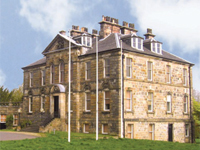
Cumbernauld House, Lanarkshire

One alternative to demolition for a country house whose time as a home had come to an end was conversion to offices.  Many houses were thus saved from the wreckers pickaxe although some conversions were more sensitive than others, with some unfortunate houses being reduced to shells with the historic interiors severely compromised.  Some were very successful such as Donington Hall (headquarters to BMI), Mamhead House (formerly HQ to a local construction firm but well looked after and now back as a home) and Gaddesden Place (now home to a software company).

One such house which was converted in 1955 and in need of a sympathetic new owner is the grade-A listed Cumbernauld House in North Lanarkshire, currently for sale at offers over £1m.  Built for the Earl of Wigton in 1731, the house was designed by William Adam (1689-1748), one of the leading architects of his day, and includes some of his typical flourishes such as arched windows, channelled masonry and carved tympana.  Although the Adam interiors were lost in a serious 1877, the reconstructed interior is still noteworthy.  Currently empty, this house deserves a new lease of life and would make a suitable and impressive headquarters – although part of me does faintly hope that someone might want to take on the challenge of turning it back into a home.

More details: ‘Cumbernauld House‘ [SAVE Britain’s Heritage] – as Building of the Month this link may not work after Feb 2010 but there is a dedicated website at : www.cumbernauldhouse.com

Credit crunch hits prices of country estates in Scotland

It sells but at what price? (Image: http://www.sxu.hu)

Despite the ever hopeful claims of the estate agents that a good country estate will always sell, it appears that, at least in Scotland, the average selling price has fallen sharply.

Research by the estate agents Strutt & Parker has shown that between 2008 and 2009 the average selling price of the 13 country estates – defined as “significantly more than a house with some land but not farms or forestry properties” – sold in that period the average price dropped by £2.6m. Of the 13 sold, seven were sold for less than the asking price.

Full story: ‘Country estates caught in credit crunch as prices halve in 12 months‘ [The Times]

Caldwell House – a nearly-lost Adam classic

Caldwell House, Scotland (Image: intriguing_rly@livejournal)

Sometimes houses suffer in so many ways and yet, despite their eventual condition, it’s still possible to imagine them being restored to something approaching their former glory.  Caldwell House near Paisley in Scotland is definitely one that would require a purchaser with deep pockets and a slightly cavalier approach to budgeting – but they would be rescuing a classic house by the famous Scottish architect Robert Adam.

In 1773, Baron Mure of Caldwell commissioned Adam to design a grand home for him. For Adam it was to be the last of the ‘castle’ houses he designed, a style he’d started with at Ugbrooke House in Devon (1760s) and Mellerstain House in Berwickshire (1770).

It remained the family home of the Mures until 1909.  In the 1920s the House was sold to Glasgow Corporation and became a hospital for mentally handicapped children. The institutional changes were severe and included the removal of the main staircase to accomodate a lift shaft and the addition of numerous poor-quality outbuildings.  After the hospital closed in 1985 the usual pattern of neglect and vandalism set in, with a major fire in 1995 resulting in serious damage to the interiors and the loss of the roof.  In spite of being a Grade A listed building, it is now empty and has sadly been neglected and allowed to decay and has been on the Scottish Civic Trust’s Buildings at Risk register for some years.

As this shocking set of photos show, the house is now in a terrible condition.  However, the shell still evocative and it’s rural location would ensure privacy and so ought not to be written off yet.  Perhaps the family motto of the Mures – “Duris Non Frangar”, which means, “not to be broken by adversity” – would be an appropriate one to bear in mind when taking on this monumental restoration.

Scottish castle rental remains popular

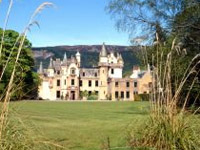
Aldourie Castle, Scotland (Image: castlesandcottages.co.uk)

Despite the recent financial troubles it seems that there is still many who happy to pay up to £25,000 per week to stay in the best Scottish castles, such as Aldourie (right), over the New Year.  Sue Bourne of ‘Castles and Cottages‘ has about 50 castles available for rent with many booked over the festive period – though she noted that people are booking later either to try to secure discounts or even just to ensure they have the job to support such an expense.

These rentals provide a valuable revenue stream which helps to offset the huge cost of running these houses and it’s encouraging to see that demand is holding up.  Extensive void periods may have an impact in terms of the funds available for the essential maintenance or restoration these houses require.   So ‘hurrah’ for the wealthy!

Full story: ‘Scottish castles keep the downturn at bay‘ [ft.com]

Quick news roundup: Gelli Aur, Raasay House, overseas buyers

Welsh mansion appeal for armed forces retreat‘ [BBC News]

Raasay House: ‘Work to start on fire hit centre‘ [BBC News]

Overseas buyers snapping up country houses‘ [Country Life]