Thomas Archer: the unsung master of English Baroque, and the revival of Roehampton House

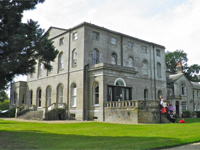
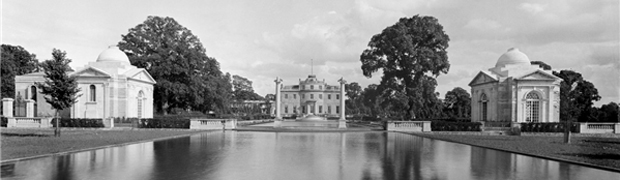
Roehampton House, SW London - Thomas Archer, 1712 (Image: St James)
Roehampton House, SW London – Thomas Archer, 1712 (Image: St James)

Thomas Archer is described as the most European, and certainly one of the most accomplished, of the English Baroque architects.  His later relative obscurity was mainly due to the misfortune that his contemporaries were some of the greatest British architects of any era.  However, looking at the examples we do have of his work, we can clearly see his virtuoso skill and creative talent written into the fabric of the buildings.  The recent restoration of Roehampton House, London, and its conversion into apartments, is a rare chance to live in an example of his work.

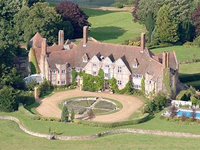
Umberslade Hall, Warwickshire (Image: Fine & Country estate agents)
Umberslade Hall, Warwickshire (Image: Fine & Country estate agents) – a house not designed by Thomas Archer.

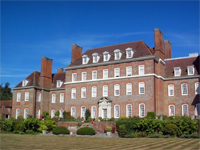
In many ways, Thomas Archer (b.1668 – d.1743) was the quintessential ‘gentleman architect’. The youngest son of Thomas Archer M.P. of Umberslade Hall, Warwickshire, he studied at Trinity College, Oxford, but clearly had broader horizons as, after graduating in 1689, he immediately undertook a four-year Grand Tour, heading to Italy via Germany and Austria.  Almost nothing is known of his time in Italy, yet he must have studied the architecture and been influenced so heavily that this became his chosen profession.  However, as a man of independent means, for Archer, this was less about earning a living and more about the translation of a recognisably ‘European’ form of Baroque to his native country. His architectural career was to be one of successive highlights; broadly, each commission was for a notable patron and the work produced of exceptional quality.

North front, Chatsworth House, Derbyshire (Image: bronndave via flickr)

Archer’s gentry origins and Whig affiliations secured him a place at Court where he came to know one of the most powerful aristocrats, William Cavendish, the 4th Earl (1st Duke from 1694) of Devonshire.  Retiring to his estates during the reign of James II, in 1686 the Earl embarked on a programme to rebuild Chatsworth.  In doing so, he elevated the status and grandeur of the private country house to a level not seen since the Elizabethan Prodigy houses – but with the key difference that this was explicitly for non-Royal appreciation. The Duke found in Thomas Archer an enthusiastic collaborator, but one with the advantage of direct experience of the style of grand Italian architecture he so admired.  Chatsworth grew in phases, with the majestic south front begun in 1686, the east front in 1693 (both designed by William Talman), the west front in 1696 (possibly designed by the Duke), with Archer finally being given his opportunity, the north front, in 1705.  As the final phase, Archer had to unite the mismatched lengths of the east and west fronts, which he brilliantly achieved though the use of a visual distraction; a bowed central projection. The use of curves was to become a stylistic hallmark of Archer, one used repeatedly and almost uniquely in the work of the English Baroque architects.

No sooner had Archer secured his first commission than he simultaneously acquired his second; Heythrop House, Oxfordshire, for Charles Talbot, 1st Duke of Shrewsbury.  Unusually for a Talbot, the 1st (and only) Duke of Shrewsbury had converted from his Roman Catholic upbringing to Church of England, and had found favour at Court under Charles II, but he was required to live abroad between 1700-1706 and spent time in Italy.  Whilst there, his diary in 1704 records that he was given a draft plan for a house by Paolo Falconieri, Chamberlain to Grand Duke Cosimo III of Tuscany, and occasional amateur architect. Marcus Whiffen believes that it was this draft which was given to Archer and on which he based his design for Heythrop.  One piece of evidence for the Italian origins of the designs were the very large rooms (e.g. the hall being 32ft x 27ft, a drawing room of 47ft x 25ft) which take little account of the colder English climate.

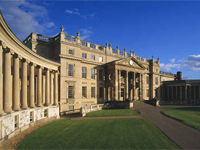
Heythrop Park, Oxfordshire - Thomas Archer, 1706 (Image: Heythrop Park Hotel)
Heythrop Park, Oxfordshire – Thomas Archer, 1706 (Image: Heythrop Park Hotel)

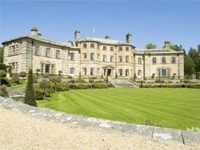
Heythrop is a confident work which clearly draws its inspiration from the Italian Baroque, with an energetically decorated façade, showing stylistic connections to Bernini’s rejected design for the Louvre.  The grand Oxfordshire palazzo was probably completed by the early 1720s – though sadly the Duke did not live to see this, having died in 1718.  The interiors were designed by James Gibbs but were tragically lost in the huge fire which completely gutted the house in 1831. It remained a shell until 1870 when it was bought by Thomas Brassey as a wedding present for his third son and commissioned Alfred Waterhouse to rebuild the interior. Sold in 1926, it became a Jesuit college until 1969, when it then became the Natwest Bank training college (the latter two uses leading to the construction of extensive ancillary buildings), and then in 1999, it was sold again to become the hotel it remains today.

Top: Pavilion at Wrest Park - plan from Colen Campbell (Vitruvius Britannicus)  Bottom: S. Giovanni dei Fiorentini, Rome - plan by Michelanglo, from J. von Sandrart (Insignum Romae Templorum Prospectus)
Top: Pavilion at Wrest Park – plan from Colen Campbell (Vitruvius Britannicus)
Bottom: S. Giovanni dei Fiorentini, Rome – plan by Michelanglo, from J. von Sandrart (Insignum Romae Templorum Prospectus)

Although Thomas Archer was not responsible for the design of the main house at Wrest Park (the later house we see today was designed by the then owner, Thomas de Grey, 2nd Earl de Grey), he did create one of the finest garden pavilions in the country.  In 1711, Archer was commissioned by Henry Grey, 1st Duke of Kent, to build an elaborate pavilion to terminate the axial view, looking down the Long Canal, from the main house.  Again, Archer demonstrated his familiarity with Rome, using a version of Michelanglo’s unexecuted plan for the church of San Giovanni dei Fiorentini. This is still one of the most exciting buildings in the country; a distillation of Michelanglo, filtered through the English Baroque.

Continuing what must have been a busy period by Archer’s standards, in 1712 he also designed Roehampton House, south-west London, for Thomas Cary. To call the original design ‘dramatic’ is something of an understatement as the plate in Vitruvius Britannicus shows it with a grand, full-width broken pediment – though whether this was actually built or was, but later removed, is unclear.  The plan of the house itself was double-pile with flanking wings, though these were not built originally.  The house then passed through a number of aristocratic owners before being bought in 1910 by Canadian banker Arthur Morton Grenfell. It was Grenfell who commissioned Lutyens to extend the house – though the efforts were not to benefit him as he was declared bankrupt in 1914, before the interiors could be fully completed.

Archer’s next commission, also in 1712, was for Hurstbourne Priors [Park], Hampshire, though, intriguingly, the plan does not match the house that was built – two surviving pictures by John Griffier show a much plainer design.  Proving just what Archer intended and any differences to what was built would be almost impossible as the house was rebuilt by James Wyatt in c. 1780-85, then again by Beeston & Burmester after a fire in 1894 and finally demolished in 1965.  Intriguingly, Tim Mowl suggested that the ‘Bee House’ aka Andover Lodge, was also by Archer and represents an experiment with architectural forms.

Having achieved such success in his life, in 1715, Archer turned to designing his own home. The result was Hale Park, Hampshire, though the house which survives today is much altered following work by Henry Holland Junior in 1770, and further changes in the early and late 19th-century, which covered the brick in (a now unfortunately peachy) render, added a portico and raised the level of the forecourt. Also of note was Archer’s redesign of Hale Church, creating a slice of a Roman church in Hampshire.

After 1715, Archer seems to have curtailed his architectural work as he was given the lucrative post of ‘Controller of Customs’ at Newcastle and largely retired.  He is known to have designed Harcourt House for Robert Benson, Baron Bingley, which stood on the south side of Cavendish Square, London, until it was demolished in 1906.
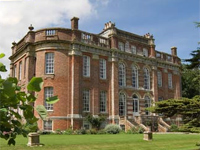
Chettle House, Dorset (Image: Chettle House)

One of Archer’s last commissions, Chettle House in Dorset, could be argued to be his finest. Built c.1730, for George Chafin, who was a neighbour of Archer’s after he bought the nearby Hale Park, the house is a striking summary of the various elements which Archer had used so well in other buildings, but which here achieve a perfect balance.  The curved corners of the exterior (though raised later), along with the projection on the entrance front combine to make the house truly sculptural.

However, there are a number of other intriguing attributions, which Archer may have worked on during his career, with varying degrees of certainty.

  • Welford Park, Berkshire – Thomas married into the Archer family (no relation) and was asked to re-model the house; adding an extra storey and grand Ionic pilasters.
  • Chicheley Hall, Buckinghamshire – c.1703 – suggested by Arthur Oswald in Country Life but not given in Colvin.  Various elements such as the materials and certain details used on other Archer houses strongly indicate his involvement. Interiors now terribly ‘bland-ified’ as a conference venue.
  • Aynhoe Park, Northamptonshire – between 1707-11 – on stylistic grounds and the evidence of a payment to him from Hoare’s Bank of £39 15s. 6d. by Thomas Cartwright.  This work included the addition of a library, conservatory, stables, and a coach-house – though the first two were later altered by Soane in 1800-1.
  • Bramham Park, Yorkshire – c.1710 – no evidence but stylistically possible. Designed for Robert Benson, who we know commissioned Harcourt House in London.
  • Kingston Maurward, Dorset – c.1717-20 – suggested by Howard Colvin.
  • Marlow House, Buckinghamshire, built c.1720, is now largely agreed to have been by Archer due to the use of particular elements and that it was commissioned by John Wallop, 1st Earl of Portsmouth, for whom he had designed Hurstbourne Priors.
  • Serle’s House, Hampshire – built in 1730, this house has clear stylistic similarities with Archer’s earlier work. Now the Royal Hampshire Regiment museum.
  • Addiscombe House, Surrey – Marcus Whiffen argues that it is undoubtedly Archer, and it could well be, but unfortunately further inspection is frustrated by its demolition in the early 1860s. Images are shown on pages 42 & 44 of a PDF of a local book [note: 10mb download].

The challenge with looking at Archer’s work is that there is relatively little of it.  Without the financial pressures to work, he was able to be very selective in what he chose to do, and due to that scarcity, his work was under-appreciated and occasionally altered or demolished.  In what we do have we can see an exceptionally talented architect who, although living in the shadow of the more productive Wren, Vanbrugh, and Hawksmoor, nevertheless developed a distinctive and influential blend of English and continental Baroque architecture.

Roehampton House, Surrey (Image: St James)

Roehampton House offers a rare chance to experience both the genius of Archer and Lutyens – though here, clearly, the latter is happy to defer to the work of former and sympathetically embraces and extends it.  Though this is a house which has been ill-used in the past and suffered some damage in WWII, the latest phase has created what appears to be a fine restoration and conversion with a careful re-use of the interior features which have survived.  Although there are too many other buildings built too close to it, the quality of the original architecture has been allowed to shine to ensure that we can again see the work of Thomas Archer, one of the finest English architects we have heard too little about.

————————————————————

Disclosure: neither the developers, St James, nor their PR company, Luchford APM, have had any editorial input or control over this article, nor have I received anything. However, they have provided some details about the current project and the exterior photos. As always, topics and text on the blog are my choice and discretion.

————————————————————

A more detailed history can be found on historic paint consultant Patrick Baty’s page on Roehampton House

If you do fancy living there, prices start from £1.35m: Roehampton House [St James]
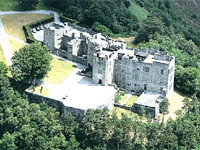
Guest blogger – Amicia de Moubray: ‘White knights – the 20th-century castle rescuers’

The castle is often part of the imagination of many children; for the boys as a scene of battles, for the girls usually as a romantic backdrop.  As adults, this love of castles can take many forms but for those with a real passion and deep pockets, the castle can also become a home.  As part of my initiative to broaden the contributors to this blog, Amicia de Moubray, contributor to magazines such as Country Life and The Architect’s Journal as well as an author on books on interiors, has drawn from her latest book, ‘Twentieth Century Castles in Britain‘, to look at the bold men and women who realised that childhood dream of creating or restoring a castle.

—————————————————————

For those of a heightened romantic persuasion the chance to rescue a ruined castle and bring it back to life after centuries of woeful neglect is the ultimate fantasy.

Detail of aerial view of Castle Drogo, Devon, showing the spectacular location (Image: National Trust on Dartmoor) - click for complete image
Detail of aerial view of Castle Drogo, Devon, showing the spectacular location (Image: National Trust on Dartmoor) – click for complete image

At the beginning of the twentieth century wealthy Americans along with an ever burgeoning steady stream of new British millionaires were in hot pursuit of decaying castles to restore.  They were both drawn to a deeply nostalgic vision of an older England far removed from their industrial or mercantile past.  The prospect of living in a castle drenched in history is immensely attractive.  It offers both a beguiling form of escapism and a tangible link with the past.  Some arriviste English tycoons opted to build new edifices such as Julius Drewe who commissioned Sir Edwin Lutyens to design Castle Drogo in Devon. But others like Lord Armstrong at Bamburgh Castle in Northumberland settled for imposing their stamp on existing historic structures.

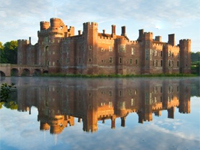
Herstmonceux Castle, East Sussex (Image: Herstmonceux Castle)

The magazine Country Life established in 1897, played an important role in the story of the castle in Britain in the 20th-century.  This was mainly because of the patronage of Edward Hudson, who himself employed Lutyens to restore Lindisfarne Castle in Northumberland for his summer residence and also nearly bought Lympne Castle in Kent.  Hudson promoted a gentle picturesque image of old England through the pages of his magazine.  Then, as now, architectural enthusiasts pored over the magazine’s enticing property advertisements eagerly alighting on slumbering forlorn castles ripe for renovation.    And there were plenty.  Nowhere was this trend more evident than in the south-east of England, where in the early years of the twentieth century five decrepit ancient castles – Leeds, Hever, Saltwood, Allington (all in Kent) and Herstmonceux (in Sussex) were sold to new owners who took great delight in restoring them with swaggering Edwardian panache, giving them a new lease of life.

Interestingly the restoration of four of the five castles was financed by American money (Herstmonceux being the exception) to the horror of commentators who were mourning the death of the old social order:  ‘The power of the purse of American millionaires also tends greatly to the vanishing of much that is English – the treasures of English art, rare pictures and books, and even of houses’, lamented P.H. Ditchfield in ‘Vanishing England’ published in 1911.

Luckily for the castle enthusiasts who wanted to combine the joys of living in a medieval dream with a smart life in London, the proximity of Kent and Sussex to the capital meant that castles abounded within striking distance of the metropolis.

Bodiam Castle, East Sussex (Image: National Trust Images/Matthew Antrobus)

The heady allure of a castle is magnetic.  Lord Curzon was utterly bewitched by Bodiam Castle from the moment he first saw it and Sir Martin Conway described seeing Allington Castle for the first time with his wife as ‘The beauty of it was overwhelming, it took our breath away and for the moment we were speechless’.  It is easy to understand how they poured money into making them habitable again. Adam Nicolson encapsulates the sentiments of many a would-be castle-restorer when summing up his grandmother Vita Sackville-West’s restoration of Sissinghurst Castle:  ‘there was a chance here to revitalize a one-great but deeply neglected place, to take a ruin and make it flower’.

Amongst the most lavish restorations was Lady Baillie’s transformation of ramshackle Leeds Castle into a smart Jazz Age country house boasting a sprung ebony dance floor for dancing in the Saloon, six new bathrooms, each clad from top to bottom in a different coloured marble, two En-Tout-Cas tennis courts, a nine-hole golf course and a large swimming pool complete with a wave machine.  Dozens of local builders were employed as well as several French and Italian craftsmen imported by the interior designer, Armand Albert Rateau (1882-1938). The foreign workers travelled weekly from London by train in a special Southern Railway coach emblazoned ‘Leeds Castle’ only.

Leeds Castle, Kent (Image: Sarah Dawson - Sez_D via flickr) - click to see complete image
Leeds Castle, Kent (Image: Sarah Dawson – Sez_D via flickr) – click to see complete image

‘WANT BUY CASTLE IN ENGLAND’ read the terse wire the American newspaper tycoon Randolph Hearst sent to his English agent, Alice Head in August 1925.

Interestingly Randolph Hearst rejected Leeds Castle after Alice Head wired him ‘…quite unique as antiquity but needs expenditure large sum to make it habitable not a bath in place only lighting oil lamps servants quarters down dungeons…. could be made fit to live in by spending about four thousand’.  This would no doubt have resulted in a spartan sort of abode as Lady Baillie is reported to have envisaged spending £100,000 on Leeds.

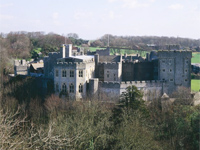
Hearst eventually settled for the remote St. Donat’s in Glamorganshire.  The plus side was that the castle had already been sensitively restored a few years earlier by Morgan Williams, a noted Welsh antiquarian.

St Donat's Castle, Glamorganshire, Wales (Image: The Royal Commission on the Ancient and Historical Monuments of Wales)
St Donat’s Castle, Glamorganshire, Wales (Image: The Royal Commission on the Ancient and Historical Monuments of Wales)

In true bombastic American tycoon manner, Hearst transformed the castle into a plutocrat’s palace, overlaid with romantic connotations, in which to entertain his international guests who included Winston Churchill, Errol Flynn, the Mountbattens and Ivor Novello.  The thirty-two new bathrooms put such demand on the existing reservoir that a water main was laid from Bridgend some 9 miles distant.  The engineer from the South Wales Electricity Power Company was astonished to be asked for connections for all manner of cutting-edge electrical gadgets including electric clocks and private hairdressing apparatus. His other clients in the area were still wary of electricity, limiting themselves to a solitary light in the middle of rooms.

Alas, Hearst was only to visit St. Donat’s five times for a total occupation just short of four months.

It is interesting to speculate what would have happened to all these castles if these wealth folk had not come to their rescue.  Would they now be in the ownership of English Heritage conserved as manicured ruins?

We must salute the valiant castle restorers and thank them for making the architectural history of the castle in the twentieth century a gripping tale.

Text by Amicia de Moubray, choice of links and images by Matthew Beckett.

—————————————————————

Amicia’s superb book: ‘Twentieth Century Castles in Britain‘ [Amazon]

You can follow her on Twitter too: ‘ademoubray

Many of the castles mentioned are open to the public so are well worth a visit.

Previous guest blog: ‘Guest blogger: Jeremy Musson – ‘English Ruins: an odyssey in English history’

Soane’s happy commission: Tyringham Hall for sale

Tyringham Hall, Buckinghamshire (Image: Savills)

Six of the most happy years of my life‘ is how Sir John Soane described his commission to build what is regarded as one of his finest works: Tyringham Hall, Buckinghamshire.  Although altered, the house forms an important link in the development of both Soane’s architectural and professional skill; an ideal commission which gave full scope to his genius.  It also has the rare distinction of benefiting from another British architectural giant, Sir Edwin Lutyens, who created some of his best but also smallest work there. Now having been restored, the house is for sale; an early and clear candidate for the most important house to be sold in 2013.

Letton Hall, Norfolk (Image: Chris & Angela Pye via Flickr)

Sir John Soane built only eighteen complete country houses, mainly between 1780-1800, so each house is an important step in tracing the evolution of his distinctive style.  Burnham Westgate was Soane’s first major remodelling (covered in an earlier blog post: ‘For sale: a Soanian springboard‘ Oct 2011) but his first entirely new house was Letton Hall, Norfolk. Built between 1784-92 for B.G. Dillingham, Soane had convinced Dillingham to demolish, rather than alter, the existing Old Hall which he had inherited that year.  Soane’s early working practices, honed through smaller commissions, emphasised extensive discussions with the client at the early stages, and the creation of a wooden model to help them visualise the proposed scheme (created in 1785 – after work had started – at the cost of £6 11s).  Letton also demonstrated several of what we regard as ‘Soanian’ architectural traits: the compact villa design, pale bricks, beautiful proportions and the cantilevered, top-lit staircase.

Stowe House, Buckinghamshire (Image: e-architect)

Soane’s practice now progressed steadily with commissions for new houses at Tendring Hall and Shotesham, along with other works on varying scales.  His growing reputation for not only excellent designs but also for completing work on time and within budget led to his name being circulated amongst the right type of clients who could provide the opportunities Soane hoped for. Drawn by his friend, Lord Camelford, into increasingly political circles, he became friends with the powerful Marquis of Buckingham, who owned two great estates at Stowe and Wotton.  In August 1792, it was Buckingham who took Soane to visit the banker William Praed at his property, Tyringham, which his wife had inherited and which was conveniently close to the Marquis, in whom rested his political and business ambitions.  Needing a house to match his intended status, Praed initially commissioned Soane to remodel the existing Elizabethan manor house. However, after some Soanian persuasion, in June 1793 he decided that an entirely new house would best serve his needs – much to the architect’s undoubted relief.

Soane displayed a particular flair when designing an entirely new house.  Although at the  core of his houses was a Palladian villa, as John Summerson notes, Soane was able to ‘…twist it into something much more complicated with sequences of shaped rooms ingeniously interlocked, and lobbies introduced to effect harmonious transitions‘.  It was this imagination which Soane brought to the Tyringham commission and which created one of his early masterpieces, with flashes of brilliance, both inside and out.

One of the first is the now Grade-I listed monumental arch gateway leading from the main road; a building of such elegance and novelty that it had Pevsner in raptures, describing it as ‘a monument of European importance…it is entirely independent of period precendent, a sign of daring only matched at that moment by what Ledoux was designing in France [e.g. Hôtel Thellusson] and Gilly in Germany‘.  Leading to the house, the drive curves gently away, allowing the house to slowly come into view.  Soane designed the approach, incorporating an elegant humpbacked bridge with balustrades which curve at each end, away from the road, creating a delicate curl.  Arriving at the house, the exterior can also immediately be identified as by Soane, with typical details including the bow-front, the beautiful proportions and the superb detailing, such as the giant Ionic columns and Greek-key frieze.

The interior was to be the finest conception of the whole scheme; a dramatic, exciting series of spaces which would have delighted the visitor.  At the core of the plan was a device which Soane would re-use in later projects but on a monumental scale; the ‘tribune’, a top-lit inner hall.  To look at the plan is to understand the level of trust that William Praed displayed in Soane as, on entering the house, the first space encountered was dramatic as it was domestically redundant: a windowless ante-chamber lit only by the front door and flanking windows behind you, and through another doorway at the far end.  Passing through the room, flanked by four columns supporting a typical Soane shallow dome, you then stepped through the doorway and into the brightly lit central tribune; a Damascene moment of drama.  Forming the top of the T to the dark antechamber, the tribune then led to either the library, the drawing room or the stairs; each decorated in a typical Soane style. Though compact, the house and estate are both impressive and manageable, the perfect combination for a rising, ambitious banker who mixed in aristocratic company.

However, the house and estate today is not the same one Soane created.  Between 1907-19, a series of unfortunate changes were made to designs by the architect Ernst Eberhard von Ihne, his decorator Florian Kulikowski and another architect, Charles Rees, who implemented Von Ihne’s plans which swept away much of Soane’s interior decoration.  They also added an ill-proportioned copper dome, a tea cosy on a champagne bottle, which has the strange visual effect of elongating the columns.  With an estate of only 59-acres, it’s unfortunate that a series of 9 or 10 houses were built to the immediate north-east of the main house. Equally sad, the most important section of Soane’s considered drive to the house is now in separate ownership; the humpbacked bridge part of the public highway and worse, the road then continues down through that wonderful arch which so delighted Pevesner (how long before some careless driver seriously damages one or the other?) – follow the drive via Google StreetView.

Bathing and Music Pavilions, Tyringham Hall (Image: Country Life Picture Library)

Thankfully what is still intact is one of Sir Edwin Lutyens‘ finest garden schemes.  Between 1924-28, Lutyens was commissioned by the then owners, the Koenigs, a family of Silesian bankers, to create a garden ‘for the recreation of spirit and body‘.  Standing each side of a huge 72m pool, once thought to be the largest of its type in Europe, are two temples; one a bathing pavilion, the other of Music.  Reminiscent of Thomas Archer‘s sublime Pavilion at Wrest Park (1709-11), Lutyens’ interpretation is pared back, less ornamented, but equally impressive – indeed, he himself thought it faultless and would apparently sit in there on his own.

The current vendor, Anton Bilton and family, has lavished millions on restoring the house and grounds (though, he confirms not as much as the £10m previously reported) since buying it for £2.5m in 2001.  However, the £18m asking price quoted in The Sunday Times Home section (28/04/13) seems ambitious; £10m-12m feels more appropriate considering the way the house and estate have been compromised with the now non-private approach, the small housing estate to the east of the main house and the loss of Soane’s original interiors.  Make no mistake, this is still a superb house and sets the bar high for any other house offered for sale this year to be considered as attractive or as interesting.

——————————————————————

Property details: ‘Tyringham Hall‘ – £18m, 59-acres [Savills] Strangely, there is no brochure yet and the launch, through double fold-out spread in Country Life (1 May 2013), feels a touch late.  One wonders whether the Bilton’s were offered a chance to do the Sunday Times piece before Savills were ready and took it anyway?

Excellent selection of photos:

If you wish to find out more about Sir John Soane and are in London, visit his house at Lincolns Inn Fields, which is a museum to his life and work: ‘Sir John Soane’s Museum

Welcome to the market: Lutyens’ The Salutation, Kent

The Salutation, Kent (Image: Knight Frank)

The analogy between language and architecture is one that has often been made, particularly as fluency is the key measure of success in both fields.  An immature architect can make elementary mistakes with the grammar of a building style as much as any tourist abroad can when ordering dinner. In most cases, both novice architect and linguist can be understood but when compared to the more experienced practitioner, skill and mastery come sharply into relief.  Such a lesson by a master architectural linguist has just been launched on the market; The Salutation, in Sandwich, Kent; a beautiful piece of poetry which demonstrates the fluency of the architect in the language of Classicism.

Heathcote, Ilkley (Image: Thursday Dave via Flickr)

Lutyens’ career can largely be seen in three phases; the early years of the ‘Surrey-Tudor’, which evolved into the middle ‘Arts & Crafts’, and then the divergence into the bold ‘Classical’, and its particular variant, ‘Edwardian Baroque’.  That last switch can be seen quite dramatically in the brilliant Heathcote, Yorkshire, built 1906, where Lutyens playfully adopted and adapted the Classical motifs and style of Palladio and Scammozzi to create a wonderfully detailed villa, rich in style and quite unlike his previous work.  After the exuberance of Heathcote (which annoyed Pevsner, who although he commented that it was ‘Only a villa, but how grand the treatment!‘, also dismissed features such as the pilasters which ‘disappear’ into the continuous rustication (see ground floor either side of the windows) as ‘silly tricks‘). On a side note; Heathcote recently sold having previously been bought by a developer/vandal who wished to split the house into two, thus ruining Lutyens’ interior planning – fingers crossed the new owner is sympathetic to this wonderful house.

Lutyens was, of course, part of a longer tradition starting with the first English classical architects practising around the time of Sir Christopher Wren in the mid-17th Century including Hugh May, William Samwell, and Roger Pratt. These pioneers displayed a similar skill in Anglo-Classicism producing buildings such as Cassiobury House (May), the first Eaton Hall (Samwell) and the revolutionary Coleshill (Pratt).  Classicism has long had a place in British architecture, despite other fashions, and has shown its versatility in being used for all sizes of house, from palaces to the smaller country retreat – and it was in this latter requirement that Lutyens was commissioned to build The Salutation.

Located on the site of an old inn of the same name, it was built in 1911-12 in the Queen Anne style as a retreat for Gaspard Farrer, a partner in Barings Bank, and his two bachelor brothers. Lutyens’ clients were typically those who had made money in the decades either side of 1900; that high-point of the country-house lifestyle when staff, materials and labour were relatively cheap. If there is a ‘criticism’ of Lutyens it’s his generosity with regards to space with hallways, alcoves, and large staircases, such as at The Salutation where an extended landing serves as an overflow from the library.  Yet, each space serves a purpose in the plan, typically framing views along axes or as part of a route to the principal rooms which Lutyens often incorporated into houses.

Great Maytham, Kent (Image: Stephen Nunney via Geograph)

The exterior of the house is a smaller derivation of his earlier and much grander Great Maytham, built 1910, for the Liberal MP, H.J. Tennant.  Following the exuberance of Heathcote (which most commentators seem to think came very close to pomposity), Lutyens took a more restrained path through Classicism (compared say, to Richard Norman Shaw at Bryanston House for Viscount Portman) and Great Maytham can be seen as a larger version of Samwell’s Eaton Hall, built 1675, or the smaller Puslinch in Devon, built 1720, with the latter showing clear similarities with The Salutation.

East terrace, The Salutation, Kent (Image: Country Life Picture Library)

The plan of The Salutation is based on the Palladian 3×3 grid but, importantly, Lutyens is able to adapt and amend this without losing the beauty of the proportions.  Gavin Stamp comments that, for Lutyens, his houses were ‘essentially romantic creations; that is, their form is determined by a picture in the architect’s mind‘ and another writer H.S. Goodhart-Rendel compared his ability to that of Wren in that they both had ‘the sculptor’s capacity of making beautiful shapes‘.  Country Life magazine said that it was a ‘dazzlingly suave yet restrained reinterpretation of the old Georgian idiom‘. It was this ability to combine a profound understanding of the Classical rules of architecture with originality which marked Lutyens out as one of the great architects.

To be given a measure of the importance the house, in 1950, it was the first 20th-century building to be given a Grade-I listing.  However, The Salutation suffered in the later 20th-century with the 1980s a particularly difficult time. Repeated attempts by developers were made to either split those graceful internal spaces into apartments or simply demolish it entirely and build on the 3-acre site, over which Lutyens (and possibly his long-term collaborator Gertrude Jekyll) had spent so much time and care crafting.

The Salutation from the garden (Image: Knight Frank)

Salvation for The Salutation came in the form of Dominic and Stephanie Parker who bought it in 2004 for £2.6m and have subsequently spent £3m on its restoration and who now run it as a luxury B&B. Now for sale at £4.5m, for someone with the budget, this could again be a superb home; combining the finest elements of the last boom of the country villa, designed by one of the greatest architects Britain has produced.  For the rest of us, if you’d like to see and experience staying in one of Lutyens finest small houses, I’d suggest booking soon.

———————————————————-

Sale particulars: ‘The Salutation‘ [Knight Frank]

If you’d like to stay; you can book through their website: ‘The Salutation

Video of Mr Parker talking about his decision to buy: ‘The Salutation was ‘like finding a diamond in a river‘ [2009, Kent Online]

Watch the Parker’s competing in a B&B TV competition: ‘Four in a bed‘ [Channel 4]

For more on Lutyens, I recommend Gavin Stamp’s ‘Edwin Lutyens Country Houses‘ [Amazon]

Support the legacy: ‘Lutyens Trust

Listing description: ‘The Salutation‘ [British Listed Buildings]

‘Floats like a butterfly’: the flights of the remarkable butterfly houses; Happisburgh Manor for sale

Happisburgh Manor, Norfolk (Image: The Beautiful House Company)

The design of country houses has been influenced by many things; politics, religion, the Greeks, the Romans, India, to name a few – but it’s rare for an insect to do so.  Yet for hundreds of years, the humble butterfly has inspired some remarkable houses, and for one lucky buyer, there is currently the rare chance to purchase Happisburgh Manor, one of the best of the Arts & Crafts versions of the ‘butterfly’ house.

Architects have long been inspired by nature, particularly in the decoration of the interiors.  Yet it would always be a greater challenge for the more organic forms to be accommodated by the hard-edges of brick and stone – but never underestimate the inventiveness of architects.  Although often thought of as a 19th-century/Arts & Crafts plan, the ‘butterfly’ actually has a single precedent dating from 1612-20.

Westwood Park, Worcestershire (Image: Knight Frank)

The definition of a butterfly plan house is ‘…where two or four wings of a house are constructed at an angle to the core, usually at approximately 45 degrees to the wall of the core building.‘.  The house which was the first manifestation of this plan is Westwood Park, Worcestershire, which, it is thought, was originally built as a conventional rectangular, three-storey hunting lodge. Begun in 1612, and although probably not originally intended, sometime before 1620 four full-height wings were added at 45 degrees, creating the distinctive shape we now know.  The reason for this innovative design is lost but is quite likely to be a response to the elevated location.  The butterfly plan is also known as the double-suntrap as it increases the number of rooms which benefit from their orientation towards the sun  and increases the number with views – hence its popularity with any number of seaside hotels.

The Chesters, Northumberland (Image: The Journal)
The Chesters, Northumberland (Image: The Journal) – link to news story about when it was put up for sale in 2009

Despite these advantages, the butterfly wasn’t to make another appearance for nearly three centuries until it appeared in Northumberland in 1891. The butterfly in this case was a house called The Chesters, which had originally been built in 1771 but which the leading Victorian architect Richard Norman Shaw had been commissioned to dramatically enlarge. Shaw’s scheme was bold and grand, adding three wings to create the butterfly (the service quarters obstruct the construction of the fourth ‘wing’), and linking the two southern arms with a grand colonnade – although Shaw strangely omitted to include many windows on the sunniest aspect.

The Chesters was the first of a series of these houses which appeared over the next two decades as an idea explored by a small group of architects.  Where the butterfly plan found its best expression was in the hands of the Arts & Crafts movement whose love of natural forms perhaps gave them a greater sensitivity to the opportunities it offered – either in the country or an urban setting (see ‘Baillie-Scott Corner‘ in Hampstead – Google streetview).

The next appearance of a butterfly plan in the countryside was initially in imagination only and shown in a drawing by Edward Schroeder Prior (b.1857 – d.1932) which was exhibited at the 1895 Royal Academy Summer Exhibition.  Prior had started his career in 1874, articled to Norman Shaw, which had a profound influence on the young architect as the older architect’s willingness to experiment with forms and materials probably helped give Prior the courage to follow his own determined views.  Prior became a leading light of the Arts & Crafts movement having had Philip Webb (regarded as one of the founding fathers of Arts & Crafts) as a mentor, as well as working with William Letherby, another leading thinker and friend of William Morris.

Drawing for The Barn, Exmouth, Devon by E.S. Prior - 1895 (Image: RIBA)
Drawing for The Barn, Exmouth, Devon by E.S. Prior – 1895 (Image: RIBA)

The drawing shown at the Royal Academy shares many similarities with the design Prior produced for a house known as The Barn, which was built in Exmouth, Devon in 1896-7.  The house was relatively modest in scale, and not quite a complete butterfly, but it demonstrated Prior’s commitment to the use of vernacular materials with the walls built of local sandstone and with stones from the beach and rivers embedded in the concrete.  One aspect of the butterfly plan is its ability to capture the sun and the break in the wings at the centre allows light to flood into the core of the house.  Sadly, the commitment to local materials included the use of traditional Devon thatch which, although treated to be incombustible, caught fire and gutted the house in 1906.  Although the house was rebuilt using the original walls, the interiors are not Prior’s.

Happisburgh Manor, Norfolk (Image: g7bmp via flickr)

The first “fully worked” four-wing butterfly was Happisburgh Manor, Norfolk, designed by  Detmar Blow in 1900.  Commissioned by the prominent local Cator family, the architectural writer Lawrence Weaver said, in 1909, that ‘[Blow] rightly determined that it should be characteristic of the locality, and he has succeeded so well that, …[if] any section were mixed up among a set depicting the village, it might be taken as belonging to any of the old houses nearby‘.  Interestingly, Blow credits inspiration for the design, not to Prior or Norman Shaw but to his friend, and also noted architect, Ernest Gimson who ‘…sent the little butterfly device on a postcard‘.  There is considerable ingenuity in the design and execution of the house, partially due to the tight £4,000 budget but also due to the local environment, with its blustery winds, sandy soil, and paucity of materials.  To create a house as brilliant as Happisburgh truly demonstrates the skill of an architect.

Papillon Hall, Leicestershire - demolished 1950 (Image: Lost Heritage)
Papillon Hall, Leicestershire – demolished 1950 (Image: Lost Heritage)

The next house was by the most famous of the architects of that period, Edwin Lutyens. In 1902, Lutyens was commissioned by Fred Bellville to remodel an existing house in Leicestershire called Papillon Hall, named after the original Huegenot family. Conveniently, ‘papillon’ is the French for ‘butterfly’ and Lutyens would have been aware of the architectural innovations going on elsewhere and obviously felt he would try his hand at this novel plan.  One of the challenges of the butterfly is that by placing the main rooms at angles this creates awkward spaces. However, Lutyens, as inventively as the other architects, used these spaces for staircases, and his particular innovation was to include the Basin Court as a single storey curved connection between the two ends of wings. As with The Barn, Papillon Hall was not to last long, being demolished in 1950 with only sparse rubble showing where was once one of Lutyens most interesting commissions. (Certainly not to be confused with this poor, modern ‘re-creation’ in Warwickshire which uses a very similar name!).

Voewood, Norfolk (Image: Voewood)

E.S. Prior’s next commission, Voewood, Norfolk (also known as Home Place and Holt Place) was perhaps his most successful use of the design.  Built between 1903-05 for the Rev. Percy Lloyd, this was a radical house; pulling together a fully developed butterfly plan, hyper-local materials, and great craftsmanship.  These together not only pushed the build cost from £12,000 to £60,000 but also created what Pevsner described as ‘a most violently idiosyncratic house‘; rich in local texture provided by a varied palate of materials mainly dug from the ground on which it stands.  The house unfortunately was tenanted almost as soon as it was built (apparently Lloyd’s wife didn’t like it!) before becoming a boys school from 1906-1914/15 and then a series of care and convalescence homes until it was bought around 10 years ago by rare book dealer Simon Finch who was exactly the right character to sensitively restore the house and make it a home again (though it can be rented).

Kelling Hall, Norfolk (Image: Albanpix via Daily Telegraph)

The only other notable house of this plan to be built in this period, Kelling Hall, also appeared in Holt, literally just down the road from Voewood. Kelling truly was a country seat for an industrialist as the man who commissioned it was Henry Deterding, one of the founders of the Royal Dutch Petroleum Company (which later became Shell). Deterding had seen and liked Voewood but commissioned another Arts & Crafts architect, Edward Maufe, to create a larger version of his neighbour.  The house certainly takes the concept of the butterfly too a larger scale but there’s no doubting the craft and innovation involved in creating one of the most interesting houses to lie at the centre of an estate. Proving its charm, the house was sold by Deterding’s grandson in 2008, along with its 1,600-acre estate, for £25m.

For all its charms and advantages, the butterfly house only enjoyed a relatively brief period of popularity.  By World War I, the relatively niche appeal of Arts & Crafts (at the time) and, afterwards, a post-war nation less tolerant of such quirky designs and more interested in the Modern, meant that architects moved away from suggesting it and instead largely headed back to the comfort of the classical or the more radical art deco, putting the butterfly into hibernation.

'Piddle' House, Hampshire - official name unknown (Image: Selway Joyce)
‘Piddle’ House, Hampshire – official name unknown (Image: Selway Joyce)

However, no good architectural idea is ever completely forgotten.  The most recent manifestation is Robert Adam’s response to the demanding requirements of a client who wished to maximise the views from a riverside site.  The architect’s website is sparse on details of both its name, the year that it was built or the exact location beyond saying it was near the River Piddle, Dorset, so we’ll call it ‘Piddle’ House, actually it’s called Hyde House (thanks Stephen – see comments), and it seems to have been built within the last 15 years.  Interestingly, it appears to blend elements of the Picturesque, with varied forms and heights whilst still adhering to the butterfly shape. Again, perhaps this shows the adaptability of this innovative plan.

The butterfly plan is complex and requires great skill to be manipulated correctly to achieve the correct balance internally and in the use of materials, which probably explains why it was never broadly adopted.  Short of commissioning your own, the chance to own a true ‘butterfly plan’ house is certainly a rare one, especially when the architect was one of the leading exponents of the idea who also ensured that the build quality was exemplary.  Happisburgh Manor has been for sale for several months and the price was recently cut from £975,000 to offers over £800,000.  This may reflect market weakness but also that, although freehold, Happisburgh is in danger from coastal erosion which may see the house become a beach-hut within the next century (but maybe longer, who knows!).  This would be a tragic end for this rare and special house and one can only hope that the next owners fully appreciate the beauty of their home and perhaps can find some way to save it.  And if the next owners ever read this, please can I visit before it does go?

————————————————————————–

Property details: ‘Happisburgh Manor‘ [Strutt & Parker]

Brochure: ‘Happisburgh Manor‘ [PDF, Strutt & Parker]

Listing description: ‘Happisburgh Manor‘ [British Listed Buildings]

News story – Westwood Park: ‘My £1.2m taste of Tudor living: Country house apartment with 3,000sq ft – and most is in the drawing room‘ [Daily Mail – 2009]

Article on Simon Finch and Voewood: Lifestyle – for House & Garden [Dominic Bradbury]

Article: ‘Arts and Crafts houses stand the test of time‘ [Daily Telegraph]

Other examples: