Caldwell House – a nearly-lost Adam classic

Caldwell House, Scotland (Image: intriguing_rly@livejournal)

Sometimes houses suffer in so many ways and yet, despite their eventual condition, it’s still possible to imagine them being restored to something approaching their former glory.  Caldwell House near Paisley in Scotland is definitely one that would require a purchaser with deep pockets and a slightly cavalier approach to budgeting – but they would be rescuing a classic house by the famous Scottish architect Robert Adam.

In 1773, Baron Mure of Caldwell commissioned Adam to design a grand home for him. For Adam it was to be the last of the ‘castle’ houses he designed, a style he’d started with at Ugbrooke House in Devon (1760s) and Mellerstain House in Berwickshire (1770).

It remained the family home of the Mures until 1909.  In the 1920s the House was sold to Glasgow Corporation and became a hospital for mentally handicapped children. The institutional changes were severe and included the removal of the main staircase to accomodate a lift shaft and the addition of numerous poor-quality outbuildings.  After the hospital closed in 1985 the usual pattern of neglect and vandalism set in, with a major fire in 1995 resulting in serious damage to the interiors and the loss of the roof.  In spite of being a Grade A listed building, it is now empty and has sadly been neglected and allowed to decay and has been on the Scottish Civic Trust’s Buildings at Risk register for some years.

As this shocking set of photos show, the house is now in a terrible condition.  However, the shell still evocative and it’s rural location would ensure privacy and so ought not to be written off yet.  Perhaps the family motto of the Mures – “Duris Non Frangar”, which means, “not to be broken by adversity” – would be an appropriate one to bear in mind when taking on this monumental restoration.
Are you restoring a country house?

Country houses are always popular subjects for TV programme and can be a great way of highlighting the good work done by so many hard-pressed owners (or even those not so hard-pressed!).  They can also provide an unrivalled opportunity to attract interest in houses in need of some care and attention. The BBC is searching for owners restoring decaying country houses for a new series.  Ideally, the families would have historic links with the property and would demonstrate the challenge of preserving their house in the context of 21st century demands.

If you think you and property fit the bill, contact Katherine Phillips at Endemol either by phone on 0333 577 7740 or email homes@endemoluk.com

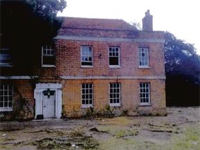
Good news for Brook House?

Brook House, Essex

A new development in the long running saga of Brook House in Tiptree, Essex has opened the possibility for some good news.  As had been reported here before, the lovely red-brick house in the heart of Tiptree was subject to an application to demolish from the owner who claimed that it was beyond repair.

However, photos taken recently show that the house is actually in very good condition and pressure from heritage organisations such as SAVE Britain’s Heritage have led to a spotlight being shone on the plans. 

It’s now been reported that the application has been withdrawn.  It’s the slow, piecemeal loss of fine houses such as this over the last fifty years which has left our towns all the poorer visually. Hopefully there will now be discussions where the starting premise is that the house should be restored as an important part of Tiptree’s architectural heritage.

Call for country houses to get tax breaks

 The Historic Houses Association have highlighted that there is an estimated backlog of repairs totalling £390m.  In recognition of local and sometimes national importance of these houses and their role in stimulating local economic activity, Edward Harley, president of the HHA has urged politicians to provide sympathetic tax breaks and also to allow those house with significiant public benefit to be allowed to apply for lottery funds.

Full story: ‘Country house owners ‘need tax breaks and lottery funds’‘ [Daily Telegraph]

Ranton Abbey to be resurrected – or replaced?

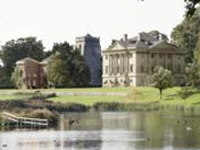
Ranton Abbey, Staffordshire (Image: Knight Frank)

When the historic Ranton Abbey was accidentally set alight and gutted in 1942 by the Dutch troops stationed there, it was likely that it would go the way of many other houses and simply be demolished. Yet the Earls of Lichfield, who owned the 300-acre estate, simply left it and focused on turning the land into a first-class shoot, allowing the house to slowly collapse, leaving just the ivy-clad walls visible today.

The death of the 5th Earl, the famous photographer Patrick Lichfield, in 2005, prompted the family to look again at the estate.  However, rather than simply sell it they decided to obtain planning permission for the building of a new house and have now put both for sale at £3.5m.  Although an obvious course of action, the choices made seem a bit odd.  The new house is strongly Palladian in design but the projections produced so far have it sited so close to the red-brick shell of the old house, and the grey stone of the church, that it seems to have almost landed there by accident.  It certainly does not seem to appear at home in this location and appears almost arbitrary, resulting in three large architectural elements fighting for prominence in a small area.

As the respected architectural writer Marcus Binney says in the ‘Bricks and Mortar’ supplement of Friday’s Times newspaper, surely the better option would be to restore the original house.  This would bring back the balance which existed before and remove at once the obvious difficulties of leaving the old house as a giant garden ornament to compete with the new house.  Whoever buys the estate and planning permission will hopefully think again about this scheme and look seriously at restoration.

Full story: ‘Historic homes: restoration dilemma‘ [The Times]

Property details: ‘Ranton Abbey, Staffordshire‘ [Knight Frank]