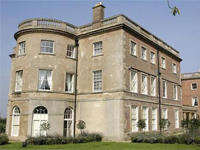
Hagley Hall, Worcestershire (Image: Hagley Hall website)
When the listed building restrictions were originally introduced the compensation for not being to do exactly as you wished with your house was that the government would provide grants towards maintainence. Obviously successive governments have seen these funds as an easy target when seeking cost cuts and so despite the legitimate limits on changes still being enforced, the cost of the work was now largely borne by the owner.
So the news that English Heritage are atleast providing matched funding to the tune of £210,000 for much needed repairs and conservation work to the beautiful Hagley Hall in Worcestershire is to be very much welcomed. Now, if only they could perhaps prise open the coffers of the lottery funds to provide further grants we might actually be able to claim that we truly support our built heritage.
Despite fears that country houses would suffer during these turbulent times it seems that at least one has bucked the trend and reported a 17 per cent year-on-year increase in vistor numbers. Staff at the grade-I listed masterpiece by Vanbrugh and Hawksmoor had expected the worse and sensibly shelved plans and looked for cost savings in anticipation of a financial shortfall which failed to materialise as the phenomenon of the ‘staycation’ boosted visitor numbers.
The need to re-examine budgets and expenditure at the beginning of the year has probably been a blessing in disguise for many houses as they have had to focus on the essentials and hopefully will now have a clearer idea of the most effective areas to spend their money. One can only hope that the new awareness of these efficiencies will be maintained to ensure that our heritage has the maximum amount of money available to ensure they continue to be enjoyed by future generations.
There appears to be an end in sight for the sorry saga of the neglect of Staley Hall in Staleybridge. After being derelict for over 50-years, the grade-II listed, 400-year old house has been subject to indifference and some council apathy which has led to arson and massive deterioration in the fabric of the building. All that remains now are the outer walls – all roofs, interior walls, floors, and decoration have been lost. The building has reached such a poor condition that – although it pains me to say it – the developer’s proposal to demolish the shell and then reconstruct it as the facade for apartments does seem to be the only viable solution.
All this might have been avoided if the local council had taken this issue in hand at any time over the last few decades – such negligence is unfortunately all too common up and down the country as hard-pressed planning departments face budget and manpower cuts. Unfortunately it’s the nation’s heritage which pays the price.
There are always options for those who have the sensitivity to own an interesting house rather than a simply expensive one.
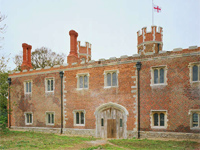
Shurland Hall (Image: Jackson-Stops)
Shurland Hall, Eastchurch – Kent
Shurland Hall was the gatehouse to a once impressive and important house built between 1510 and 1518 by Sir Thomas Cheyne and visited by Henry VIII in 1532 but now demolished. The final residents of the house were troops billeted there during WWI who did enough damage to ensure that it was uninhabitable. In 1996, the local council spent £200,000 to install supportive scaffolding to arrest the deterioration in the structure. In 2006, a further grant of £300,000 was made to restore the facade and roof and this work has now been completed by the Spitalfields Trust. This beautiful Grade-II* building is now for sale via Jackson-Stops for offers in excess of £2,000,000 – hopefully to someone who can complete the restoration sympathetically.
Grade-I listed Clifton Hall shot into the headlines in September 2008 when the owner walked away from the house and returned it to the mortgage company claiming that he and his family had been driven out by ghosts (‘Spooked businessman flees ‘haunted’ mansion‘). The house includes 10-bedrooms, 7 receptions, large cellars, 2.5-acres of grounds along with voices, knocks, apparitions and blood spots appearing on bed-linen. If you don’t believe in ghosts then this house could be an absolute bargain; an advert in the Home section of the Sunday Times (15 November 2009) lists the price as £2.5m but on the agents website it’s down to £1.5m. So pack your holy water and book a viewing.
Property details: ‘Clifton Hall‘ [FHP Living] (interesting that none of the big agencies have taken this instruction…)
The 7th Annual Georgian Group Architectural Awards have again highlighted that there are still those who will take on a neglected house and breathe new life into it. Of particular interest is the winner of the ‘Restoration of a Georgian Country House‘ category, Cairness House in Aberdeenshire.
This interesting and elegant house was originally built in the 1790s as the centrepiece of a 9000-acre estate by the architect James Playfair for Charles Gordon. The house remained with the family until 1938 after which it unfortunately experience a prolonged period of decline over the next 70 years including use as a farmhouse and even bedsits, and was riddled with dry rot. Julio Soriano-Ruiz and Khalil Hafiz Khairallah are to be loudly applauded for showing that these houses can be restored and that the excuses of the developers, whose claims of dry rot has resulted in the demolition of other houses up and down the country, should never be accepted at face value.



 The Country Seat