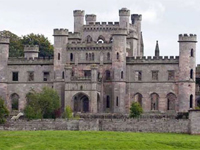
Lowther Castle to be partially restored

Lowther Castle, Cumbria (Image: dailymail.co.uk)

Empty since 1942, Lowther Castle was used during WWII as a weapons research lab and the grounds as a practice ground for tanks who did their best to destroy the ornaments, fountains, paths and gardens.  The house was not lived in again and in 1957 was unroofed and abandoned as a shell, leaving it as an ornament in the gardens of the 3,000-acre estate.  The castle deteriorated over the passing decades until it was overgrown and the central tower was in danger of collapse and was featured in the 2008 Buildings at Risk register. However, this decay is about to be arrested and ambitious plans are afoot to partially restore the tower and invest in the gardens and park.

An application has been lodged to restore the gardens including the kilometre-long central avenue and create an indoor garden within the shell of the house once this has been stabilised.  The work is expected to cost up to £9m but will attract 160,000 vistors a year to the attraction, generating £10m for the local economy.

Although the loss of the castle as a house is lamentable it’s encouraging to see that the shell and estate still have such value which will hopefully secure the future for this elegant building for future generations.  Who knows, one day it may be possible for the Lowthers to restore the castle and move back in?

Full story: ‘Move to restore Lowther Castle could see gardens open in 2010‘ [The Cumberland News]

Castle Drogo under seige – from rain

Castle Drogo, Devon (Image: wikipedia)

The last castle to be built in the UK, Castle Drogo, occupies a commanding position far up the Teign Gorge in Devon.  Designed by Sir Edwin Lutyens and built in the 1910s and 1920s and finally finished in 1931 for the wealthy businessman Julius Drewe, the Grade-I listed house is a brilliant modern interpretation of a castle combined with the comforts of a country house.

It was also one of the last houses to be built entirely in granite, the local stone of the area.  The grey stone and the clever massing of towers and wings give the house a solid, impregnable air but the house is under attack from the elements, with rain penetration causing serious concern.  The many flat roofs hidden behind the battlements started causing problems only two years after the house was finished and ever since it has been a constant battle to keep the house watertight.

House manager Bryher Mason told BBC News: “I wouldn’t be surprised to walk into a room one morning and find a section of the ceiling having fallen in because the metalwork in the ceiling has failed.”

The National Trust, who have cared for it since it was handed to them in 1974, have instigated a restoration and repair programme on the many roofs, which will include the replacement of all 13,000 window panes, and has been estimated to cost £10m, and will be completed by 2016.

Full story: ‘Leaking castle needs £10m repairs‘ [bbc.co.uk]

Shrubland Hall finally sold

When the Grade-II* listed Shrubland Hall near Ipswich in Suffolk was put on the market for £23m in 2006 it included over 40 cottages, several farms, over 1,400 acres and one of the finest Italianate houses in the country. The house was originally designed by James Paine in the 1770s it was extensively altered by Sir Charles Barry in the 1840s.  Lord de Saumurez had decided to start afresh with a grand country house auction rarely seen such a scale since the 1950s, and which included Meissen porcelain, paintings, and many fine pieces of Georgian furniture.  The sale was a roaring success but the house itself languished on the market as the especially as the growing global credit crunch limited the desire for buyers wealthy enough to take on the 40,000 sq ft. house.

However, after three years, and selling off much of the estate in smaller lots, the house plus a few hundred acres of parkland including the listed gardens designed by Sir Humphrey Repton, has now finally been sold for £6.5m to a London businessman.  It will now be interesting to see how the estate develops as without the larger estate it will be simply a home supported by income from elsewhere.  Here’s hoping that the new owner fully understands and appreciates the architectural gem they have acquired.

Full story: ‘Shrubland Hall sold‘ [Evening Star 24]

New Hudson’s Guide 2010 launched

The latest edition of that ‘bible’ of country house visiting, ‘Hudson’s Historic Houses and Gardens, Castles and Heritage Sites‘, has just been launched. Described in their own words as “a definitive guide to the best historic houses and gardens, castles and heritage sites that Britain has to offer.”.  Useful not only for your weekend trips but also for events and weddings – so get out there and support our beautiful houses!

Seaton Deleval Hall nationalised

Seaton Deleval Hall

It’s been announced that the National Trust has today succeeded in it’s campaign to acquire Seaton Deleval Hall, regarded as one of the finest Baroque houses in England.  However, the success in securing the future of the hall has again come about as a result the damage caused by inheritage tax leading to treasures – usually art or antiques, but sometimes buildings – being taken into ‘national’ ownership rather than remaining in private hands.

Seaton Deleval Hall was built for Admiral George Deleval by Sir John Vanbrugh and was completed in 1871.  Vanbrugh’s other notable commissions included Castle Howard and Blenheim Palace.  However the house suffered a devastating fire in 1822 which gutted the central block which remained as a shell until 1980 when the 22nd Baron Hastings (Edward Delaval Henry Astley) partially restored it.

The 22nd Baron and his wife both died in 2007 triggering a significant inheritance tax bill.  It was this that led to the house being put up for sale and the start of  a fund-raising campaign to save it for the nation.  The house and 400 surrounding acres have now been accepted in lieu of £1.7m of tax (the first time since Calke Abbey in 1984) with the contents covering a further £3.2m.

The National Trust have generously contributed £6.9m to the endowment with a further £3m raised to cover other costs associated with opening it to the public.  The first visitors are expected to arrive in April 2010, part of an estimated 50,000 a year who will be able to see one of Vanbrugh’s masterpieces.

So whilst there is a success in that the house will now be secure and not carved up into flats, it’s still a shame that another part of our national architectural heritage is denied its primary function of being a home.  Inheritance tax has a pernicious creep – it can’t be avoided and just results in each generation selling off more historic artefacts to fund government budgets.  Give it a few hundred years and one conclusion could be that a majority of the crowning jewels of our artistic heritage including buildings, art and antiques could well end up being owned by a national organisation, be it the National Trust or the galleries.  For me, the art treasures of a nation are best located in the houses and families for whom they were produced or bought for, rather than part of a vast national archive, only brought out once a decade or less.  Inheritance tax makes a relatively small contribution to the national budget but it does have a disproportionate impact on our cultural heritage.

Full story: ‘National Trust saves stately home‘ [BBC News]

‘National Trust takes control of Seaton Delaval Hall‘ [The Art Newspaper]