The growing silence: how many UK country houses were lost?

Slowly, then suddenly, many estates grew silent. Carriages no longer clattered down the drives. Entrance halls no longer echoed to voices. Kitchens went cold. Staff quarters were emptied. Then, the contents were sent to the auctioneers. Finally, the house was broken apart; hammers and pickaxes the new sounds as hundreds of years of history were reduced to rubble.

One key questions which architectural historians have been trying to answer for a number of years is just how many UK country houses have been lost? The answer, for now, is over three thousand. Each was a world on its own, but also part of the complex jigsaw of our national heritage.

The genesis for this area of research was ‘The Destruction of the Country House‘ exhibition, which ran from 9 October – 1 December 1974 at the Victoria & Albert Museum in London. I have written about it on a number of occasions so if you would like more insights into it, you can read my article on the 40th anniversary or my reflections on the 50th anniversary.

The position of the landed elites was considered the bedrock of society. The families provided political leadership, social aspiration, and were the centre of the local economy through their employment and expenditure. Land ownership was the passport to this elite status; the open market a safety valve which enabled ‘new money’ to mix with the old, to want to emulate them rather than remove them. This allowed new families to fluidly move up from merely wealthy to established gentry or nobility. After a few generations, the land functioned as an older form of ‘green-washing’, the verdant parkland obscuring where the family had started. Within a few short centuries (though sometimes it was just decades), they had become the elite.
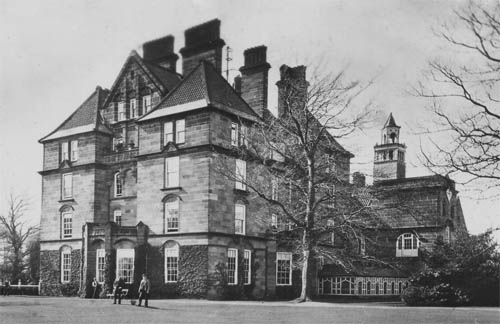
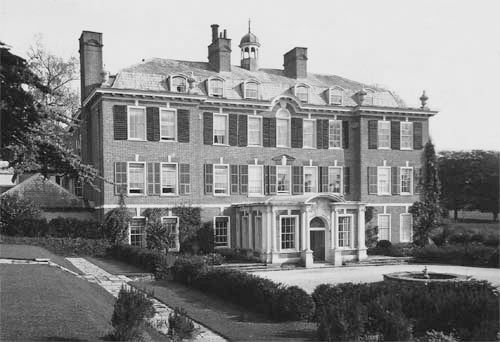
Rounton Grange, Yorkshire – seat of the Bell baronets, of Rounton Grange and Washington Hall (1885). House demolished 1954.

However, the first half of the twentieth century was, for the owner of these large houses, often financially, socially, and politically challenging. The repeal of the Corn Laws in 1846, which opened our markets to cheaper overseas produce, combined with the agricultural depressions of the latter-half of the nineteenth century, had undermined many of the assumptions about the financing of the country house. As debts grew, so the stark financial reality of the situation they were in began to dawn. For many, the path to recovery seemed to be to sell non-core assets such as artworks or outlying estates and hope that this would tide them over until their incomes, usually agricultural, recovered. For those who sold their land early and invested in the stock market, the crash of 1929, was another blow to their planning. As is so often the case, the markets remained against them longer than they could remain solvent.

When Aldous Huxley published his first novel, ‘Crome Yellow‘, in 1921, the challenge to the country house was already significant enough to feature as the fate of the imaginary Gobley Great Park;

‘A stately Georgian pile, with a façade sixteen windows wide; parterres in the foreground; huge, smooth lawns receding out of the picture to right and left. Ten more years of the hard times and Gobley, and all its peers, will be deserted and decaying. Fifty years, and the countryside will know the old landmarks no more. They will have vanished as the monasteries vanished before them.’.

Thankfully, Huxley’s apocalyptic vision wasn’t fully to come to pass. However, from the relatively low levels of losses in the nineteenth-century, the twentieth-century would bring decade after decade of destruction. It’s worth remembering that this was largely a crisis of the country house, not the wider estate. The land was considered more valuable as an income-generating asset and for the social prestige it conferred. Without the expense of the house – the maintenance, the staff, the general running costs – so the income was better able to meet their expenditures. Mr Micawber would be beaming with pride.

So, when seeking to bring their expenditure within the available income, the house was considered a necessary sacrifice. And with so many other families also facing a similar situation, the loss of any one house would be obscured by the loss of so many others. The problem with simple data is that it belies the dramatic local impact the loss of a house would have been. The country house and its estate embodied the idea of stability. The idea of a family owning the house and land and passing it down through the generations was – and arguably still is – embedded firmly in our national psyche, even if the family did change every few hundred years. The key difference in the twentieth-century was that there was often no other family to take their place.

In this dark era, houses languished on the market. This was often evidenced by adverts for the same properties appearing with sad regularity in magazines such as Country Life. It brought reminders of the increasing threats to the established order of the countryside into the drawing rooms and libraries of those most at risk.

Typical advert in Country Life magazine. Key aspects to note: the house is unnamed (though I think it is the infamous Burwell Hall, demolished in 1958), the language emphasises cheapness: ‘moderate price’, ‘modern conveniences’, ‘inexpensive gardens’. (Advert from Country Life, 10 November 1923, pg. XIII)

Each week, beyond the adverts in Country Life, ‘The Estate Market’ page offered a running commentary on the changes. For example, the headline for that page on May 5th 1922, was stark: ‘Demand for small properties’, with the opening paragraph stating, ‘The brightest section of the market is that in which the smaller properties are dealt with…’. Coverage includes the sale of Sudbourne Hall, Suffolk, saying it had sold with 500 acres, having first been offered as a whole but failing to find a buyer, it had been split up. The house was later demolished in 1953.

Another paragraph is headed ‘Mansions as sanatoria’ and writes approvingly of how Lords Londonderry and Boyne have both ‘generously offered’ Seaham Hall and Brancepeth Castle respectively for ‘hospital purposes’. Specifically, it states that Seaham Hall ‘…has had to be closed in consequence of taxation and the heavy cost of upkeep.’ (it survived and is now a hotel). It also mentions that Rendlesham Hall, Suffolk, has been sold for use as a ‘…retreat for drug-addicts and inebriates…’. It was also later demolished in 1949.

Sudbourne Hall, Suffolk, demolished in 1953 (Source: www.lostheritage.org.uk | More images)

During the nineteenth-century, the available data shows that there were fewer losses; approximately one a year. However, when considering the data, there are a few caveats to remember. Critically, the data for the nineteenth-century is thinner than the twentieth-century. Fewer books had been produced, research was sparse, and even confirming if a property was of sufficient stature to be classed as a country house is sometimes challenging. Fire and replacement by a new house were two of the most common reasons.

So how many have been lost?

Quoted in The Daily Telegraph magazine in 2007, the leading country house historian of the lost houses, the late John Harris, said that:

‘At the time [before the V&A exhibition], we reckoned that about 750 houses [in the UK] had been pulled down between 1880 and 1970. Now we know it’s about 1,800.’1

Sadly, John’s estimate was still too low – 1,800 doesn’t even cover England alone.

The gazetteer at the back of ‘The Destruction of the Country House‘ exhibition catalogue listed a total of 1,099 houses (740 for England, 313 Scotland, 46 Wales, with NI not included). This list had been compiled by John, Marcus Binney, and another researcher, Peter Reid, and explicitly stated it was not exhaustive. The total for England was updated with the publication in 2002 of ‘England’s Lost Houses‘ by Giles Worsley which added 445, to total 1,185 for England. However, Ian Gow’s ‘Scotland’s Lost Houses‘ in 2006 listed only 308 (5 fewer than before) but also included examples of houses in cities (which I have excluded from that total).

The task of taking the ground-breaking earlier research forward and to resurrect the memory of these otherwise obscured houses, has now been taken up by amateur enthusiasts, supported by the invaluable work of historians who have focused on specific areas. I started researching the English lost houses in 2006, compiling what I hoped would become the most comprehensive record. All the details, including detailed histories and thousands of images, are shared on the Lost Heritage website.

Using the same model, this was followed over the years by Dr Alastair Disley for Scotland, Dr Mark Baker for Wales, and Andrew Triggs for Northern Ireland (he also took on the much larger task of the Republic of Ireland).

Distribution of English lost country houses since 1800. Source: Matthew Beckett / www.lostheritage.org.uk

The scorecard of architectural losses

Each of these personal efforts has significantly increased the totals of lost houses with Scotland now standing at 545 (Disley), 390 for Wales (Baker), and 100 for Northern Ireland (Triggs – a particular achievement as they hadn’t been tallied previously).

The total number of lost houses for England alone has now exceeded John Harris’ original estimate for the whole of UK, having reached 2,019 (as at November 2024).

Overall, we can be confident that the number of UK country houses lost since 1800 now totals a remarkable 3,054.

Why does this matter? These houses and their particularly grand and hierarchical era and way of living has gone. It died, not in our leafy lanes, but in the battles and social change of the World Wars. The changes forced an evolution – and in that process, there are winners and losers. The tragedy was that the losers were often not inherently weaker houses, and in so many cases, they were some of the most interesting and significant. Beyond the random losses from fire and environmental causes, often what determined whether a house survived was their owners and their circumstances. For some, they were determined to ensure that the houses were reborn, albeit in a new way of living. For others, they were equally determined that that they would not pass what they saw as a burden to another generation.

In the specific losses to a family, and a locality, and to our architectural heritage, they were to be lamented. But in all of them, they possessed something of our shared heritage, and their loss, and the losses of the future, are pieces of the national jigsaw of our identity. As Simon Jenkins said, ‘Through them we hear the echo of our collective selves – and remember who we are.’2. We remember these parts of our history through the memory of these houses, and the roles they played in the life of our nation, both locally and nationally.

Request for help

If anyone has any further information on the lost country houses of England – either history, dates for losses, or family photos or recollections – please do contact me.


References:

1 – Campbell, Sophie, ‘Brideshead Detonated’ Telegraph Magazine, 20/01/2007
2 – Jenkins, Simon, ‘England’s Thousand Best Houses‘ (Penguin, 2004), vii

A Sleeping Beauty: Ombersley Court, Worcestershire

The temptation when Country Life magazine arrives each week is to flick through the properties and make tabloid-esque comparisons about how a detached Regency villa in Dorset with space for a family, chickens, and an excitable spaniel, could be had for the price of a tatty flat in London. Yet sometimes these comparisons seem almost too unreal when faced with the exemplary beauty of a country house like Ombersley Court, Worcestershire, which, along with 39 beautifully wooded acres, has just been put up for sale for just £3.5m; the price of a 3-bed terrace house in Chelsea.

Ombersley Court, Worcestershire (© Savills)

Tucked away in a quiet corner of Worcestershire lies a house which, either through deliberate privacy or convenient obscurity, is little known to the world. Yet Grade-I listed Ombersley Court is one of the finest houses in Worcestershire, arguably even in the wider region, due not only to the sublime architecture and surrounding estate, but also the fine collection of paintings and artwork. The estate has long been the seat of the Sandys family who acquired the manor in the late sixteenth-century. The current house was originally built for the 1st Lord Sandys (b.1695 – d.1770) between 1723-26, replacing earlier monastic buildings on the site.  The house was designed by Francis Smith of Warwick (b.1672 – d.1738), one of the leading regional architects and, working with his brother William (b.1661- d.1724), ‘one of the most successful master builders in English architectural history’ (Colvin).

‘Smith of Warwick’, as Francis was more commonly known, was a clients ideal contractor due to his famous honesty and reliability, able to deliver buildings on time and on budget. His reputation spread amongst the Midlands gentry and aristocracy with almost all his work within a fifty-mile radius of Warwick.  Such was his standing that even the fractious Duchess of Marlborough (who had famously fallen out with Vanbrugh over Blenheim), demanded that for her house in Wimbledon, Surrey, ‘that Mr Smith of Warwickshire the Builder may be employed to make Contracts and to Measure the Work and to doe everything in his Way that is necessary to Compleat the Work as far as the Distance he is at will give him Leave to do’ (1732-33).

Smith’s solid reliability also manifested itself in his repetition of his well-developed plans and designs for houses, creating a distinctive style which is quite recognisable as his own. Broadly, this would be a three storey house with the centre section either projected or recessed, consistent fenestration, and relatively sparse external decoration, usually only decorative stone dressings such as keystones, quoins or balustraded parapets. This consistency was perhaps a double-edged sword, with the Hon. Daines Barrington stated in a letter in 1784, that although ‘all of them (are) convenient and handsome […] there is a great sameness in the plans, which proves he had little invention’.

Yet, this is to overlook that Smith was, at heart, a successful commercial builder whose understanding and appreciation for architectural ornament and variety was inevitably tempered by his determination to deliver the commission on time and on budget. As the architectural historian Sir Howard Colvin highlights, the core design is that of a standard seventeenth-century house such as Belton House, Lincolnshire, but with stylistic updates as fashions evolved.  ‘Smith’ houses such as Umberslade, Alfreton, and Wingerworth all share this readily accessible style, one which married domestic practicality with exterior grandeur.

Perhaps Smith’s greatest achievement was the tragically now-ruinous Sutton Scarsdale, Derbyshire; a house with a facade so stately as to rival Chatsworth. Built for the 4th Earl of Scarsdale in 1724, Sutton Scarsdale was one of the finest houses in the country. Although the form is familiar, the masterful control of a palisade of pilasters and columns topped with Corinthian capitals, gives it a gravitas, whilst the detailing such as the scrolled window surrounds to the projecting wings hint at Renaissance motifs; Fausto Rughesi (Santa Maria in Vallicella, 1605/06) filtered through William Talman (design for Thoresby House, 1685, – shown in Vitruvius Britannicus, C1, Pl.91) and James Gibbs (to whose designs Smith was building Ditchley Park, Oxfordshire, 1722).

derbyshire-Sutton_Scarsdale_Hall_circa_1900

One regret with Ombersley Court is that although the form and plan of the house and much of the superb unaltered early-Georgian internal decoration is still Smith, the exterior is now not his. The original design featured a hipped roof, and what looks to be pilasters, giving it the recognisable ‘Smith’ characteristics.  This was lost when the existing brick was refaced with ashlar in 1809 by the architect John Webb for Mary Sandys, the Marchioness of Downshire. In fairness though, this was a lucky escape as John Nash prepared a much more ambitious scheme in 1808, which proposed adding a two-storey pavilion to each side, linked by a seven-bay screen of giant Ionic columns, though this seems to have been rejected on cost.

Ombersley Court - proposed alteration by John Nash, 1808
Ombersley Court – proposed alteration by John Nash, 1808

One of the glories of the house are the interiors and especially the plasterwork and carving. With a desire for privacy which was rarely breached, few had seen the exceptional decorative work, except through the lens of a Country Life profile by Arthur Oswald in 1953. This extolled the virtues of many aspects including The Chippendale Room which featured bamboo framed silk wall pieces, remarking that ‘it is uncommon to find a Regency example as complete as this or as charming’. The rest of the house struck a careful tone of stately refinement; enough decoration to proclaim wealth and taste, but never excessive.

Ombersley Court - Hallway (© Savills)
Ombersley Court – Hallway (© Savills)

Ombersley Court - Drawing Room (© Savills)
Ombersley Court – Drawing Room (© Savills)

Ombersley Court - Morning Room (© Savills)
Ombersley Court – Morning Room (© Savills)

With the death of Lord Sandys in 2013 the house passed to Lady Sandys but following her recent death, concerns were raised and rebutted via letters in Country Life that this wonderful house would be forced (for complicated reasons) to become a care home; a fate which would have despoiled this jewel of a house. Instead, for the first time since it was built in 1724, it has been placed on the market. This is a house created by one of the finest craftsmen of the early-Georgian period, with connections to a wider, distinct Midlands architectural tradition which epitomises all that one would hope to see in a country seat. As an important house which deserves respect, one hopes that the new owner will appreciate this remarkable situation and that perhaps the best approach would simply be to buy the house and contents and perhaps another couple hundred acres to truly secure an Arcadian ideal, one which would be hard to better anywhere in the country.


Sales particulars: Omblersley Court, Worcestershire [Savills] – £3.5m with 39 acres

Listing description: Ombersley Court, Worcestershire [British Listed Buildings]

The Inadvertent Innovation: Country Life and Property Advertising

Over the last four centuries, the marketing of property has seen relatively few innovations. Those with money and the desire to establish themselves in society would seek out those with knowledge on which estates might be available.  However, the launch of Country Life magazine 120 years ago this month heralded a sea change in the marketing of the landed lifestyle. No longer did the buyer have to rely solely on what they found; now Country Life, through advertising and market reports, brought a selection of the choicest properties right into the drawing rooms of the aspiring elite. The continuing success of the magazine suggests that our desire for the grandeur and leisure of rural society is undimmed over a century later.

Country Life was the idea of Edward Hudson (b.1854 – d.1936), a successful magazine printer, who recognised a gap in the market for a publication which reflected the rural lifestyle of a wealthy elite and, importantly, those who wished to join them.  Conveniently for Hudson, he already had one publication which catered to a significant traditional interest, Racing Illustrated, but lacklustre sales meant it was ripe to be incorporated as a component part of the new magazine. The first issue of Country Life was published on 8 January 1897 and from the outset it was noted for the high quality of the content and, importantly, of the production, with heavy paper and fine photographs.

Country Life Illustrated, 8 January 1897, p. 3

As with most magazines of the time, the front cover and first page were adverts for all manner of essentials such as ‘Cadbury’s Cocoa’ and slightly more obscure (‘Old Grans Special Toddy‘, ‘Vigor’s Horse-Action Saddle – A Perfect Substitute for the Live Horse‘). However, below the grand ‘Country Life Illustrated‘ masthead is a single full page, rich in some of the finest country houses in the land – and all for sale or to let. It’s also noteworthy that this innovative layout was the work of the single firm of land agents, Walton & Lee of Edinburgh, through whom these properties were available.

As today, properties were sold for a number of reasons but, in an age when the loss of the family seat was considered a serious failing in society, financial embarrassment was often the single strongest reason for a property to appear for sale.  Until the twentieth-century, the majority of property transactions for country houses were primarily about the land; the actual house was usually a secondary consideration as, if you felt it wasn’t suitable, you could always rebuild it in a style or scale until it was. Intelligence regarding which estates were for sale was passed around through social networks, partly to preserve privacy, but often as a way of discretely finding a buyer. Local solicitors also played an extensive and dominant role in the sale of property, often using their extensive and intimate knowledge of local families to know who might be open to offers or to find suitable investments, especially as, since 1804, they held the monopoly on conveyancing.

In 1897, the second Agricultural Depression was hitting the income of those landowners who were heavily dependent on income from their estates.  The financial crisis that this created was the catalyst which forced a number of estates to be put on the market. Equally, death dealt its usual cruel blow with estates being sold in part or in total to meet the stipulations of wills, particularly if the only offspring were daughters, often married to a gentleman with his own estate and little need for a part share in another.

'In the Grafton country...' Advert for Writtlebury Lodge, Northamptonshire, Country Life Illustrated, 8 January 1897, p. 3
‘In the Grafton country…’ Walton & Lee advert for Writtlebury Lodge, Northamptonshire, Country Life Illustrated, 8 January 1897, p. 3

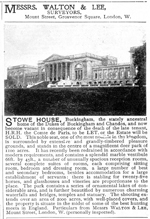
The houses shown in that first edition are certainly varied. Ranging from the grandeur of Stowe House to ‘a charming, moderate-sized manorial estate’, each warranted a small but densely-worded description. In contrast to today where a house of the importance of Stowe would most likely be either sold off-market or launched with all the fanfare modern country house estate agency can muster with multi-page, glossy, full page photo adverts. Although, with the exception of Stowe, all were anonymous, of the nine houses advertised, it’s possible to identify six of them:

Column 1

  • SALE: Writtlebury Lodge, Northamptonshire, with 6,700 acres (demolished 1972)
  • SALE: Unidentified ‘moderate-sized Manorial Estate’, South Devon, with 600 acres
  • SALE: Unidentified ‘unique specimen of an early English country house’, Sussex or Surrey, with 42 acres

Column 2

  • TO LET: Maesllwch Castle, Radnorshire, with shooting over 20,000 acres
  • TO LET: Charlecote Park, Warwickshire, with 250 acres (now National Trust)
  • SALE: Apethorpe, Northamptonshire, with 5,000 acres (now a private home again)

'Stowe House, Buckingham', 'In the Grafton country...' Advert, Country Life Illustrated, 8 January 1897, p. 3
‘Stowe House, Buckingham’, Walton & Lee advert, Country Life Illustrated, 8 January 1897, p. 3

Column 3

  • TO LET or SALE: Stowe House, Buckinghamshire, with 1,100 acres (now a school)
  • TO LET: Addington Manor, Buckinghamshire, with ‘parks and grounds’ (demolished 1926)
  • TO LET: Rigmaden Park, YorkshireUnidentified ‘fine Mansion’, North of England with sporting rights over 4,000 acres (thanks to a reader for the identification)

This selection in one week is almost unimaginable now – to have one house such as Stowe or Charlecote advertised for sale would be remarkable; to have those plus other grand houses showed the scale of the crisis which was quietly afflicting the established rural order. As financial circumstances forced retrenchment for families from the larger houses to their smaller ones (or sometimes from the countryside altogether), so Country Life offered a new and effective route for marketing these properties to those who had risen in the heady world of Victorian industry and finance and who now sought to install themselves as the inheritors of the old social order through the possession of their estates.

The photos of the houses for sale also echoed that Country Life also emphasised a new stylistic aesthetic in the photographs which accompanied the articles on specific houses; one which departed from a common representation of country houses; notably by removing the people and all signs of daily life. Whether this was the choice of Edward Hudson or the photographers is unknown, but engravings and images of country houses from earlier periods often showed them as the hubs of rural and social activity. Outdoor views displayed workers in the fields, the aristocracy enjoying the pleasures of the house and parkland, and coaches riding down lanes, whilst interior views were full of noble pursuits.

The bucolic ideal was important in times of political and social turmoil.  Such scenes, although partly a simple tool for demonstrating scale, also promoted the idea of the paternal landowner to those within the landowning classes, those who wished to join them, and others who had simply obtained a copy, perhaps through a lending library.  Note how often the sky is calm, the lake waters placid, and the animals docile or obedient – there are no signs of disharmony. This can be seen in J.P. Neale‘s famous series of views of country seats published between 1819-1823, soon after the tumult of the Napoleonic Wars:

Detail from 'Sunning-Hill Park, Berkshire' drawn by J.P. Neale (Image from Rare Old Prints)
Detail from ‘Sunning-Hill Park, Berkshire’ drawn by J.P. Neale (Image from Rare Old Prints)

The compliant and dutifully grateful cows enjoying the benefits of the parkland at Langley Park, Buckinghamshire:

Detail from 'Langley Park, Buckinghamshire' drawn by J.P. Neale (Image from Rare Old Prints)
Detail from ‘Langley Park, Buckinghamshire’ drawn by J.P. Neale (Image from Rare Old Prints)

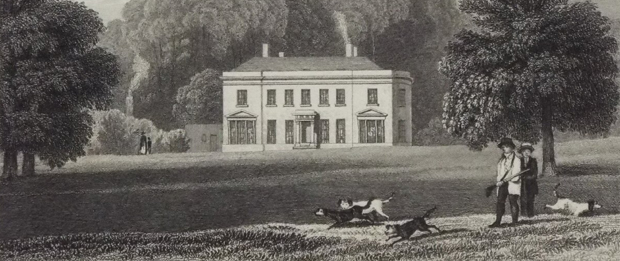
Take the later scene presented in J.M. Gilbert’s image, drawn in 1832, the year of the Great Reform Bill which extended voting to all men who owned property worth ten pounds or more in yearly rent, of Newlands, Hampshire, which includes a vignette of rural husbandry with the men taking instructions from an agent with the house looking benignly down:

Detail from 'Newlands, The Seat of Mrs Whitby' by J.M. Gilbert, 1832, from 'Grove's Views of Lymington' (Image from Rare Old Prints)
Detail from ‘Newlands, The Seat of Mrs Whitby’ by J.M. Gilbert, 1832, from ‘Grove’s Views of Lymington’ (Image from Rare Old Prints)

Interior views often showed the aristocratic families at leisure. This was partly due to the romanticisation of the country house which can, in part, be attributed to the popular historical novels of Sir Walter Scott who, as noted by the writer Thomas Carlyle, that they

‘have taught all men this truth … that the bygone ages of the world were actually filled with living men, not by protocols, state papers, controversies and abstractions of men’.

For example, in Nash’s ‘The Mansions of England in the Old Time‘ published between 1839-49, the domestic scenes feature prominent groups of people going about their daily lives as imagined as an aristocratic set-piece where all the clothes were fine, the people good looking, and the activities noble.

'The Gallery, Knole House, near Sevenoaks, Kent'. Joseph Nash. (Image © Victoria and Albert Museum, London - Museum no. 2996-1876)
‘The Gallery, Knole House, near Sevenoaks, Kent’. Joseph Nash. (Image © Victoria and Albert Museum, London – Museum no. 2996-1876)

This is not to say that all followed such an approach. Many artists such as the Rev. F.A.O. Morris in his famous ‘Picturesque Views of Seats of the Noblemen and Gentlemen of Great Britain and Ireland‘ published 1866 emphasised the houses, showing no signs of people.

Country Life therefore was both following the precedent of some earlier artists but also by so rigorously applying this view of the houses and the popularity of the magazine spreading this ideal far and wide, so the perception of country houses as denuded of evidence of life was one which was almost in contrast to the warm, sympathetic portrayal of the families in the accompanying text.

Walton & Lee maintained their tenacious grip on the important first page of advertising in Country Life from 1897 until 1912.  In that year, as a measure of the success of Country Life in establishing itself as one of the prime avenues for the sale of property, Howard Frank, of Knight, Frank & Rutley, bought Walton & Lee specifically to secure that  coveted advertising space. Though their reign at the forefront of advertising country estates had ended, their influence in the presentation of property was to remain and can be seen today. Evidence of this is in both the continued hold Knight Frank maintain on the first page of advertising, and the stylistic aesthetic which the estate agents and Country Life established as the standard for the photographic presentation of country houses for sale and exalted in numerous publications.


Country Life wrote their own retrospective on property advertising in 2007 for the 110th anniversary: ‘Wanted: Property for a Gentleman’ [Country Life]

Welcome to the market: Lutyens’ The Salutation, Kent

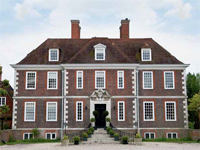
The Salutation, Kent (Image: Knight Frank)

The analogy between language and architecture is one that has often been made, particularly as fluency is the key measure of success in both fields.  An immature architect can make elementary mistakes with the grammar of a building style as much as any tourist abroad can when ordering dinner. In most cases, both novice architect and linguist can be understood but when compared to the more experienced practitioner, skill and mastery come sharply into relief.  Such a lesson by a master architectural linguist has just been launched on the market; The Salutation, in Sandwich, Kent; a beautiful piece of poetry which demonstrates the fluency of the architect in the language of Classicism.

Heathcote, Ilkley (Image: Thursday Dave via Flickr)

Lutyens’ career can largely be seen in three phases; the early years of the ‘Surrey-Tudor’, which evolved into the middle ‘Arts & Crafts’, and then the divergence into the bold ‘Classical’, and its particular variant, ‘Edwardian Baroque’.  That last switch can be seen quite dramatically in the brilliant Heathcote, Yorkshire, built 1906, where Lutyens playfully adopted and adapted the Classical motifs and style of Palladio and Scammozzi to create a wonderfully detailed villa, rich in style and quite unlike his previous work.  After the exuberance of Heathcote (which annoyed Pevsner, who although he commented that it was ‘Only a villa, but how grand the treatment!‘, also dismissed features such as the pilasters which ‘disappear’ into the continuous rustication (see ground floor either side of the windows) as ‘silly tricks‘). On a side note; Heathcote recently sold having previously been bought by a developer/vandal who wished to split the house into two, thus ruining Lutyens’ interior planning – fingers crossed the new owner is sympathetic to this wonderful house.

Lutyens was, of course, part of a longer tradition starting with the first English classical architects practising around the time of Sir Christopher Wren in the mid-17th Century including Hugh May, William Samwell, and Roger Pratt. These pioneers displayed a similar skill in Anglo-Classicism producing buildings such as Cassiobury House (May), the first Eaton Hall (Samwell) and the revolutionary Coleshill (Pratt).  Classicism has long had a place in British architecture, despite other fashions, and has shown its versatility in being used for all sizes of house, from palaces to the smaller country retreat – and it was in this latter requirement that Lutyens was commissioned to build The Salutation.

Located on the site of an old inn of the same name, it was built in 1911-12 in the Queen Anne style as a retreat for Gaspard Farrer, a partner in Barings Bank, and his two bachelor brothers. Lutyens’ clients were typically those who had made money in the decades either side of 1900; that high-point of the country-house lifestyle when staff, materials and labour were relatively cheap. If there is a ‘criticism’ of Lutyens it’s his generosity with regards to space with hallways, alcoves, and large staircases, such as at The Salutation where an extended landing serves as an overflow from the library.  Yet, each space serves a purpose in the plan, typically framing views along axes or as part of a route to the principal rooms which Lutyens often incorporated into houses.

Great Maytham, Kent (Image: Stephen Nunney via Geograph)

The exterior of the house is a smaller derivation of his earlier and much grander Great Maytham, built 1910, for the Liberal MP, H.J. Tennant.  Following the exuberance of Heathcote (which most commentators seem to think came very close to pomposity), Lutyens took a more restrained path through Classicism (compared say, to Richard Norman Shaw at Bryanston House for Viscount Portman) and Great Maytham can be seen as a larger version of Samwell’s Eaton Hall, built 1675, or the smaller Puslinch in Devon, built 1720, with the latter showing clear similarities with The Salutation.

East terrace, The Salutation, Kent (Image: Country Life Picture Library)

The plan of The Salutation is based on the Palladian 3×3 grid but, importantly, Lutyens is able to adapt and amend this without losing the beauty of the proportions.  Gavin Stamp comments that, for Lutyens, his houses were ‘essentially romantic creations; that is, their form is determined by a picture in the architect’s mind‘ and another writer H.S. Goodhart-Rendel compared his ability to that of Wren in that they both had ‘the sculptor’s capacity of making beautiful shapes‘.  Country Life magazine said that it was a ‘dazzlingly suave yet restrained reinterpretation of the old Georgian idiom‘. It was this ability to combine a profound understanding of the Classical rules of architecture with originality which marked Lutyens out as one of the great architects.

To be given a measure of the importance the house, in 1950, it was the first 20th-century building to be given a Grade-I listing.  However, The Salutation suffered in the later 20th-century with the 1980s a particularly difficult time. Repeated attempts by developers were made to either split those graceful internal spaces into apartments or simply demolish it entirely and build on the 3-acre site, over which Lutyens (and possibly his long-term collaborator Gertrude Jekyll) had spent so much time and care crafting.

The Salutation from the garden (Image: Knight Frank)

Salvation for The Salutation came in the form of Dominic and Stephanie Parker who bought it in 2004 for £2.6m and have subsequently spent £3m on its restoration and who now run it as a luxury B&B. Now for sale at £4.5m, for someone with the budget, this could again be a superb home; combining the finest elements of the last boom of the country villa, designed by one of the greatest architects Britain has produced.  For the rest of us, if you’d like to see and experience staying in one of Lutyens finest small houses, I’d suggest booking soon.

———————————————————-

Sale particulars: ‘The Salutation‘ [Knight Frank]

If you’d like to stay; you can book through their website: ‘The Salutation

Video of Mr Parker talking about his decision to buy: ‘The Salutation was ‘like finding a diamond in a river‘ [2009, Kent Online]

Watch the Parker’s competing in a B&B TV competition: ‘Four in a bed‘ [Channel 4]

For more on Lutyens, I recommend Gavin Stamp’s ‘Edwin Lutyens Country Houses‘ [Amazon]

Support the legacy: ‘Lutyens Trust

Listing description: ‘The Salutation‘ [British Listed Buildings]

‘So you made the 2012 Sunday Times Rich List…’ – a selection of country houses for sale

Spring is upon us: the birds are singing, the flowers are blooming, the drizzle is almost incessant – *sigh*. One bright spot is each week’s increasingly heavy Country Life magazine; the extra weight from the greater number of property adverts which signal the launch of the late spring/early summer (hah!) country house sales push. Below is a round-up of some of the most interesting and beautiful properties currently for sale, all entirely and subjectively chosen by me.

Bletchingdon Park, Oxfordshire (Image: Knight Frank)

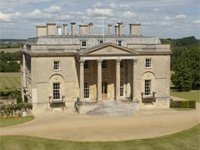
The most impressive house to be offered for sale this year so far has to be the beautiful Bletchingdon Park, Oxfordshire [Knight Frank]. One of the relatively few Palladian villas in the county, it can easily hold its own with the others such as Kirtlington Park (completed in 1746) and Nuneham Courtenay (built 1756).  Bletchingdon Park was slightly late to the Palladian party, being built in 1782 for Arthur Annesley, Viscount Valentia, to the designs of James Lewis (b. c1751 – d.1820).  Lewis was mostly employed as surveyor of various charitable hospitals in London and near counties but he also completed a clutch of excellent country houses including Eydon Hall, Hackthorn Hall, and Lavington Park (now Seaford College). Owned since 1993 by Dr Michael Peagram, a philanthropist and chemicals industrialist, the grade-II* house has been obviously well cared for and offers the highly desirable combination of an imposing facade, superb views, 127-acres and elegant interiors which includes a wonderful sweeping, top-lit staircase – if you have £20m.

Cockfield Hall, Suffolk (Image: Savills)

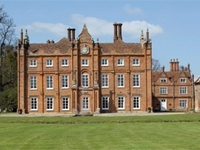
For those who prefer an alternative to the architectural austerity of Palladianism, then Suffolk offers a wealth of brick houses; statements just as bold, but in a different language. Cockfield Hall, Suffolk [£5m, 74-acres, Savills] has a grand façade, galleried great hall, a wealth of rich plasterwork ceilings, and a range of estate buildings in the same style.  Although mainly built in 1613, the windows were sashed c1770 and the overall look is largely due to later Victorian enhancements, including the upper storey, gables, the great hall and various Tudor motifs.  That said, it is undeniably attractive as the changes work well together.

Highfields Park, East Sussex (Image: Knight Frank)

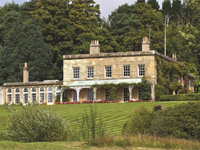
There is often something just so elegant about Regency houses, particularly the smaller country villas which echoed the style and features of much larger and grander houses. Highfields Park, East Sussex,  [£5.75m, Knight Frank] is set in 191-acres, and overlooks its own lake and out to the countryside.  The house has grown as the ambitions and wealth of the owners allowed; a ballroom being added to the east and a swimming pool beyond that. Awkwardly, access to latter is through the former so just be careful not to schedule a pool party at the same time as your formal dances; though, on the upside, it will be easy to tell which guest is supposed to be at which party.

Ayton Castle, Scotland (Image: Knight Frank)

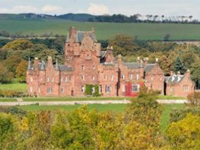
Previously offered for sale in May 2011 for £3m and now re-listed, Ayton Castle, Scotland [offers over £2.2m / Knight Frank] is a sprawling confection of Scots Baronial motifs; the design the work of two of the best architects working in Scotland at the time, now set in 159-acres.  The house was originally built in 1851 for William Mitchell-Innes who commissioned the talented James Gillespie Graham. Graham was known for his work in the Scots Baronial style which became so popular in the Victorian era, notably on the praise of Sir Walter Scott and the Queen’s remodelling of Balmoral.  Yet, Graham was a rare architect comfortable working in various styles; neo-classical at Blythswood House or semi-ecclesiastical Gothic at Cumbusnethan Priory (now tragically a ruined shell).  Ayton was later extended in 1860, with the addition of a billiard room and an enlarged drawing room by David Bryce.  Bryce, perhaps, more than any other architect, can be argued to be responsible for the legacy of Scots Baronial, if only through his prolific output of more than 230 buildings including many country houses such as Craigends (dem. 1971), Panmure House (dem. 1955), Torosay Castle and Dalmore House (burnt out 1969). Considering the tragic swathe cut through his work, it’s a shame that legacy wasn’t appreciated.

Honourable Mentions

There are, of course, many other good houses featured in Country Life but some would not be regarded as the seat of an estate – but they are still wonderful country houses; albeit ones with very large gardens and worth a mention.  A couple here are proper country seats but just haven’t made it to the list above:

Bradwell Lodge, Essex (Image: Matthew Beckett) - for sale: £2.25m through Jackson-Stops & Staff
Bradwell Lodge, Essex (Image: Matthew Beckett) – for sale: £2.25m through Jackson-Stops & Staff

Bradwell Lodge, Essex – a house of contrasts and a mixture of architecture; a Tudor core, latter additions by Robert Adam, Robert Smirke the elder, and Quinlan Terry, with decoration by Angelica Kauffman. The library/small dining room in the projecting bay on the ground floor is particularly elegant with twisted-wire screens to the bookcases. Grade-II*, 26-acres, £2.25m [Jackson-Stops & Staff]

Broadwell Manor, Gloucestershire – grade-II*, 35-acres, excess £8m [Knight Frank]

Burnham Westgate Hall, Norfolk – a fascinating early house by Sir John Soane which has previously featured on this blog (‘For sale: a Soanian springboard‘). Grade-II*, 38-acres, £6.5m (down from £7m) [Knight Frank]

Glansevern Hall, Powys – an apparently unique property in that it is the only complete house designed and build by the architect Joseph Bromfield and which also features some impressive gardens. Grade-II*, 80-acres, £4.5m [Balfours]

Rainthorpe Hall, Norfolk – grade-I, 18.7-acres, excess £2.95m [Strutt & Parker]

Roundhill Manor, Somerset – grade-II, 280-acres, £6m [Savills]

—————————————————————————

For other updates on country houses for sale do sign up for the excellent British and Irish Stately Homes blog, which is written by Andrew Triggs who frequently contributes comments on this blog.