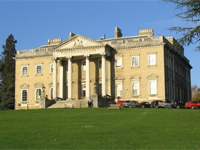
A rural power house; literally – Fairfield House, Somerset

Fairfield House, Somerset (Image: Anthony Kersting)

To describe a country seat as a ‘power house’ was usually to allude to its status economically, politically, certainly as a local employer, usually even in matters of style. Yet, these houses also indirectly, and sometimes very directly, played an important part in the provision of the electricity which has grown to power our everyday lives.  Power stations play an obvious central role and their expansion has often been controversial.  In earlier decades, a local power house was sometimes sacrificed to the demands of industry and the needs for power stations, but now, for some, particularly Fairfield House in Somerset, they have proven to be a windfall.

Country estates have a long history of being the beneficiaries of the need for power. In medieval times, the natural resources of an estate, such as a fast-flowing river or extensive woodland would be harnessed or harvested to drive local industry.  The most productive land could prove especially valuable if it could support the entire production cycle such as for bread, with corn grown on the estate, being ground in the windmill or mill on the river, before being sold in the market in a town owned by the local lord, who, at each stage would profit.  As the Industrial Revolution flourished, so the need for power grew, leading landowners to fully exploit the natural resources which lay beneath their land as well, with coal becoming a leading creator of Victorian fortunes.

Methley Hall, Yorkshire - demolished 1963 (Image: Lost Heritage)

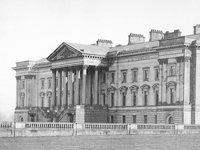
Yet, the almost insatiable need for power, and the coal which generated it, has also consumed some of our country houses, including one of the grandest, and threatens some even today.  One of the greatest threats from mining is subsidence caused by extensive mine workings which simply followed the coal seam – wherever it may lead.  Given the choice between a loss of income or the loss of the family seat, it was rarely the house which won.  It was, of course, the northern counties which were worst affected; Methley Hall, seat of the Earls of Mexborough, was eventually ruined by the coal workings which surrounded it (an issue even when Country Life visited in 1907) and demolished in 1963.  Kippax Park, once the second longest country house in the country, stood in the way of an open-cast coal mine which eventually consumed it in the late 1950s.  In County Durham, Coxhoe Hall, was eventually bought by the local coal board who proceeded to demolished it in 1956 to avoid having to fix the structural issues they had created.
Hamilton Palace, Lanarkshire, Scotland - demolished 1919 (Image: Wikipedia) - more info from Virtual Reconstruction website

This is, inevitably, just a small selection of some of the many losses but easily the most spectacular casualty of coal mining would be Hamilton Palace in Lanarkshire. Built for the Dukes of Hamilton, the Palace was the epitome of aristocratic wealth, creating both a home and a collection which would rival the best in Europe.  Built on the incredible wealth generated by the Lanarkshire coalfields they owned, the 10th Duke, Alexander, enclosed the existing house in a grand Classical embrace. The one-room deep extension of the house, in 1819, accommodated not only the many works of art he had acquired on his Grand Tour but also many of the treasures inherited from the fabulous collection of William Beckford which came via the Duke’s wife, who was Beckford’s youngest daughter.  Yet those same coalfields eventually fatally undermined the house, and faced with such a substantial problem, and not lacking other houses to move to, the decision was taken in 1919 to demolish the Palace – the most serious loss to Scottish country house architecture in the last 200 years.

Others houses were even more directly affected by the need for power stations which, ironically, shared similar requirements with the aristocracy for their homes; a level site with good access to roads (and later rail), a ready water supply and space to expand.  In the dark days of the mid-twentieth century, for an impoverished owner, the offer to be bought out by the local power company must have been very attractive – and perhaps may have helped their guilt by feeling that it was contributing to national infrastructure; though often the house had already gone.

Drakelow Hall, Derbyshire (Image: Lost Heritage)

One house which certainly matched these criteria was Drakelow Hall, Staffordshire, seat of 28 generations of the Gresley family and which, declared Country Life in 1902, “…is one of those seats of ancient eminence which win the regard of all Englishmen.“. Situated above the River Trent, the house was perhaps best known for the Painted Dining Room by Paul Sandby which was completed in 1793.  Sadly, declining family fortunes led to its sale in 1933, followed by ill-fated ventures such as a country club and motor racing circuit before the house was demolished in 1938, though, fortunately, a section of the Dining Room was saved by the V&A.  In 1948, the huge Drakelow Power Station rose on the site, attracted by the sizable 707-acre estate and its proximity to the river, and railways, road and, most importantly, the East Midlands coalfields. Hams Hall in Warwickshire similarly vanished under the same demands. One house which was rescued was Barlaston Hall in Staffordshire, a wonderful small villa by Sir Robert Taylor, which was bought for £1 by SAVE Britain’s Heritage to prove that it was possible to restore it.  The house is now again a home as a result of their valiant efforts. However, even today, subsidence from old coal workings threatens other houses such as at Wentworth Woodhouse, where the owner, Clifford Newbold, has lodged a claim for £100m in compensation to fund the stabilisation and restoration of this magnificent house.

The requirements for nuclear power stations were different in that they were obviously less dependent on proximity to the raw fuel but they did require vast quantities of water for cooling so were often sited on the coast – which thankfully also meant fewer houses would be affected. Of those, the small manor house at Calder Hall had already gone by the time the decision was taken to built the UK’s first nuclear reactor on the site in 1947. So although the opportunities for landowners are now primarily around wind turbines, a report in the Sunday Times (13 Nov 2011) highlights the windfalls from owning the land adjacent to a nuclear power station scheduled for expansion.

Main entrance - Fairfield House, Somerset (Image: Anthony Kersting)

Lady Elizabeth Gass, Lord Lieutenant of Somerset, and current owner of the 6,000-acre family estate, recently accepted a £50m offer from EDF to purchase 230-acres of farmland which will become the proposed Hinckley C power station.  The Fairfield House estate (a prime candidate for the Handed On blog of lesser-known seats) has descended through the Palmer-Acland-Wood-Fuller families for 800 years and has never been sold. The current part-Elizabethan house was begun in about 1580, but with later changes in 1633 to change it from a medieval courtyard layout to the more familiar E-plan which we see today.  Excitingly, traces of the old house are still embedded in the fabric today, with a cell for those awaiting the justice of the local magistrate and, once revealed behind some 19th-century plasterwork in the attics, the original finely-carved late-medieval roof timbers of a first floor hall.

The future of this wonderful estate is now secure and stands as a testament to how changing patterns of land use which once threatened and toppled grand houses can also enrich a country estate.  That it is going to support a rare survivor of familial descent is an added bonus and I hope Lady Gass feels rightly proud of her success.

————————————————————————————-

More details: ‘£50m deal as Somerset wind turbine land goes to nuclear plant‘ [This is Somerset]

Listing description: ‘Fairfield House, Somerset‘ [British Listed Buildings]

————————————————————————————-

An apology: you may have noticed that I haven’t been able to publish as frequently as I’d like but just to reassure you that this is definitely not due to any slackening of interest on my part but simply due to my day job requiring a greater commitment at the moment.  This hopefully will be temporary and as we go into the Spring I can pick up the pace again – but in the meantime, please do take time to re-read some of the old posts you may not have seen, and hopefully discover something new amongst the archives.

Thanks for your patience.

Matthew

For sale: a Soanian springboard – Burnham Westgate Hall, Norfolk

Burnham Westgate Hall, Norfolk (Image: Savills)

For any architect starting out, the early commissions are perhaps the most important; establishing them both in terms of not only their designs but also how they operate in the execution.  In architectural terms, the early buildings of some architects are sometimes less prized, and therefore protected, than their later works which benefit from the full measure of their developed skill and experience.  In that light, Burnham Westgate Hall deserves to be cherished as not only a fine house but also the first substantial country house project of Sir John Soane.  It provided the springboard for one of our finest architects and is important for the promise shown but also for securing one of the most important prizes in the Georgian era: patronage.

For someone who ended up a knight of the realm, with fame and a noble client list, Sir John Soane (b.1753 – d.1837) had a very ordinary start in life as the son of a bricklayer from Goring-on-Thames, near Reading.  Patronage and connections were to define Soane’s personal and professional life, providing opportunities to establish himself in a way that his competitors, often connected from birth, already enjoyed.  Almost nothing is known of his early life but his obvious talent must have been spotted as he entered the office of George Dance the Younger in 1768, though only starting as errand boy, via an introduction by James Peacock, an employee of Dance who knew Soane’s older brother.

Claremont, Surrey (Image: Claremont Fan Court School)

His talent and work ethic propelled Soane to join the Royal Academy Schools in 1772, where he quickly won the silver medal for a measured drawing of the facade of Inigo Jones’ Banqueting House.  What was particularly clear during Soane’s time at the Royal Academy was his ambition and an industriousness that was to serve him well in later periods, combined with an attention to detail which proved to be a blessing in his professional life.  In 1776, he won the Academy gold medal, which made him eligible to compete for the highly coveted King’s travelling scholarship which, for someone of Soane’s limited financial means, would be his only chance to see Italy first-hand.  Soane had heard that George III thought him a suitable candidate and so he rashly gave up his position with Henry Holland (where Soane was known to have assisted on three country house commissions: Claremont in Surrey, Benham Park in Berkshire, and Cadland in Hampshire (dem. 1953)) only to find out that Sir Joshua Reynolds had intervened to demand the winner of the scholarship be by vote from the Academicians. This delayed his departure by a year but it was put to good use completing smaller tasks for Henry Holland such as estimating bills and measuring work which exposed him to clients such as Thomas Pitt, 1st Baron Camelford; a man of noted taste and an amateur architect who was to prove particularly important in Soane’s career.  Though delayed, in 1777 Soane set off on the single most important trip of his life to Italy; one which was to establish him professionally and socially.

Arch of TItus, Rome - drawing by Sir John Soane
Arch of TItus, Rome – drawing by Sir John Soane

The Grand Tour had become an institution amongst the younger aristocrats as a way of experiencing the glories of classical art and architecture in their native environments.  It was also a fine opportunity for the wealthy to indulge their passion for art collecting but, for novice architects, days were largely spent measuring and recording the wonders of Roman architecture.  On a more practical level, Soane would have seen and experienced during his time with Dance and Holland how useful family and professional networks were in securing commissions.  In Italy, Soane worked assiduously to develop his own connections; travelling with his friend Robert Furze Brettingham (nephew of the famous architect Matthew Brettingham the Elder who had designed the original Burnham Westgate Hall, then called Polstede Hall) and visiting the English Coffee House; a central meeting point for the English nobility abroad, whom Soane courted as clients.

Soane's proposed design for Downhill, Northern Ireland (Image: Sir John Soane's Museum) - click to see full sketchbook page
Soane’s proposed design for Downhill, Northern Ireland (Image: Sir John Soane’s Museum) – click to see full sketchbook page

Patronage could also be a double-edged sword, with the ambitions of the client giving what could turn out to be false hope to an architect.  Of all those Soane met in Italy, Frederick Hervey, Bishop of Derry, later the 4th Earl of Bristol, was a prime example of the capricious client – though despite the Earl’s failure to deliver, he did introduce Soane, once again, to Thomas Pitt, Lord Camelford, and cousin of William Pitt the younger, and who became a lifelong friend, supporter, mentor and patron.  Soane had fallen under the influence of the Earl, a charming, witty aristocrat who had a growing reputation for being a difficult client.  How much Soane knew of this is unclear but after travelling through Naples and Sicily for many weeks together discussing architecture, Soane believed he would be given a handsome commission to improve Downhill (now a ruin), the Earl’s rather bleak seat, set in the coastal hills of County Derry, Northern Ireland. However, after persuading Soane to cut short his travels by a year and luring him over to Ireland in 1780, after six fruitless and frustrating weeks with the disagreeable Earl not committing to any of Soane’s designs, he left Ireland in despair, seriously out of pocket, and with the hopes of his first significant commission of his architectural career in tatters.

Rustic dairy at Hammels Park, Hertfordshire (Image: Sotheran's)
Rustic dairy at Hammels Park, Hertfordshire (Image: Sotheran’s)

Back in London, Soane’s wealthy and well-connected friends, particularly those he had made in Italy, and especially Pitt, sought to ease his plight by asking for his designs for smaller estate buildings or their own houses, such as for his friend John Stuart at Allanbank, Berwickshire.  Again, although the smaller projects were built, the larger plans failed to materialise – the only one of significance being some limited  alterations to Petersham Lodge, one of Lord Camelford’s homes.  After this, Soane took on a few smaller commissions from other clients which allowed him to develop his skills as an architect, not just in designing but the delivery of the projects, including the elegant dairy in the fashionable rustique, Rousseau-esque style at Hammels Park, Hertfordshire for the Hon. Philip Yorke, later 3rd Earl of Hardwick – another of his Italy contacts.

Proposed design for Allanbank, Berwickshire by Sir John Soane (Image: Sir John Soane Museum)

However, it was his main supporter, Lord Camelford, who provided the largest commission in 1783, the one which elevated Soane from dreamer of grand plans but only executor of small estate buildings.  Camelford’s wife had inherited Burnham Westgate Hall and now her husband wished to create a seat of suitable standing near to that other fulcrum of political influence in north Norfolk, Holkham Hall, home of the Earl of Leicester.  Burnham Westgate is curious in that it is one of the early examples of Soane’s practice of reusing his designs.  Compare Burham Westgate Hall today with the unexecuted design illustrated right which Soane completed for John Stuart at Allenbank – the overall form of the house is similar, differing only in the striking chimneys and the size of the flanking wings.  Soane seemed to do this less as he grew as an architect but it can be seen in his bow-fronted design for Saxlingham Rectory and enlarged version seen on the south front of Tendring Hall (dem. 1955), and even more directly between Shotesham Hall in Norfolk and Piercefield near Chepstow.

Burnham Westgate Hall has perhaps been a little overlooked in the literature, perhaps suffering from being overshadowed by Soane’s next project: his first solo, entirely new-build house; Letton Hall, which was started in the following year in 1784.  However, the innovation of Letton could only be created on a sound architectural foundation which Soane had spent years building; the smaller commissions of temples, kennels and interiors, before Burnham Westgate gave him the opportunity to demonstrate that he was capable of working on a project of that size.  Bar the limited and hotly contested public works, private country houses were some of the most significant commissions available to any architect and Burnham Westgate was Soane’s calling card; his proof of his ability, imagination and practical ability to deliver a fine house suitable for those in upper society.  That it is a close variation on a earlier design can be forgiven considering the nascent stage of his career; this sale offers a new owner the chance to own the project which gave Sir John Soane the springboard which helped establish this most brilliant of architects.

————————————————————————————–

Property details: ‘Burnham Westgate Hall‘ – £7m, 38-acres [Savills]

Detailed listing description: ‘Burnham Westgate Hall‘ [British Listed Buildings]

Further information:

————————————————————————————–

A Salvin for sale: Mamhead House, Devon

Mamhead House, Devon (Image: Strutt & Parker)

One of the pleasures of running your own blog about country houses is that you get to play favourites.  I’m often asked which is my favourite but this is a difficult one to answer; is it the one I want to live in (currently Bragborough Hall, Northamptonshire), the one I most want to visit (Mereworth Castle, Kent), or one that I think is just stunning (Bruern Abbey, Oxfordshire)?  However, there are some which just hold a special affection – and that, for me, has to be Mamhead House in Devon, partly for its beauty and also for no better reason than it having been local to where I grew up.

Mamhead’s main claim to fame is that it was the project which established one of the best Victorian architects; Anthony Salvin (b.1799 – d.1881).  Described as a pioneer of Gothic Revival architecture, Salvin could be seen as the secular equivalent to the religiously driven Pugin. Both sought to restore Gothic as the traditional form of design most suited to the nation, but whereas Pugin saw this as a devotional mission to return Britain to how it might have been had the Reformation never occurred, Salvin saw Gothic as the form which was best suited to our landscape and aesthetics.  Salvin’s historically rigorous approach saw him create some of the most interesting country houses of the Victorian era – and Mamhead is a rare example which has now been restored to its former glory.

According to Mark Girouard, Salvin’s reputation appropriately rests on his country houses, dismissing his churches as ‘seldom interesting‘, and that it’s ‘hard to regret‘ that his designs for larger buildings such as the new Houses of Parliament and the Carlton Club were never built.  However, in the sphere of the country house; his success rested on his ability to combine three elements; “the domestic or castellated architecture of the Middle Ages and the Tudors; the design techniques of the Picturesque; and the needs of the Victorian upper classes“*.

The first Mamhead House, Devon shown c.1826, demolished c.1828

Salvin specialised in the restoration and modernisation of ancient buildings, building on a precocious interest in medieval architecture which saw him elected to the Society of Antiquaries in 1824, aged just 24.  His obvious scholarly talent marked him as someone to watch but it’s still unclear exactly how he secured his first commission at Mamhead – especially as he replaced a more experienced architect whose plans he then had to adapt.  The owner, a merchant called Robert Newman, had commissioned Charles Fowler, who had designed a classical house to replace the existing house (altered by Robert Adam for the Earl of Lisburne in 1774), which Newman appears to have decided not to proceed with, possibly seeing the winds of fashion shift towards the Gothic.  He may also have been influenced having seen Kitley (now a hotel), also in south Devon, which had been remodelled by George Stanley Repton between 1820-25, in one of the first attempts at authentic Elizabethan.  This change of heart gave Salvin his opportunity.

Moreby Hall, Yorkshire (Image: Country House Picture Library)

For Pevsner, Mamhead was the house which established Salvin as the chief Victorian architect for large country houses in the Tudor style. Salvin was constrained in that he was working from the existing symmetrical plan and denied the chance to introduce the projection and recession of elements so traditional with Gothic.  However, this plan does have tradition in that it has the feel of an Elizabethan E-plan house; though one where the main door has been moved to the corner rather than the expected middle. These minor quibbles were to be later offset by the masterly later additions.  Mamhead’s cost of £20,000 was financed from income, so although work started in 1827-8, the final interiors (strangely being the entrance hall) weren’t finished until seven years later.  During this time Salvin’s knowledge and experience grew – not least through his second commission for a new country house; Moreby Hall in Yorkshire, built between 1828-32. Here he enjoyed a freedom to create and developed his own arrangement of a central, two-storey hall off which came the main rooms and which also allowed warm air to circulate – not only visually impressive but also practical.

Conservatory - Mamhead House, Devon (Image: Devon Life)

It was perhaps the later additions of stables and the conservatory at Mamhead where Salvin clearly demonstrated the flair which marked the original thinking of a great architect.  Rather than continue strictly in the same style, the stables were now to be housed in a mock, red sandstone castle, modelled on Belsay Castle in Northumberland, slightly above and behind the house, with the conservatory in a more correct Gothic design.  The conservatory is a beautifully elegant single-storey extending from the north-west of the main house featuring four Perpendicular windows leading to a two-storey pavilion leading to the garden.  The skyline features many pinnacles with an interior decorated with carved scrolls and verses, shields, and carved panels – all in stark contrast to the rather severe fortifications which Salvin chose for the stables at the other end of the house.

Harlaxton Manor, Lincolnshire (Image: stemurphy4 / flickr)

Mamhead is fascinating as it not only shows early brilliance in an architect’s career but unusually also is a house which shows all the styles in which he worked – both the Gothic and the fortified.  Salvin’s skill with the Gothic form and vocabulary perhaps found its greatest expression in his third country house commission: Harlaxton Manor in Lincolnshire; a fantastical composition which took full advantage of its location and the wealth of the owner.

Harlaxton must be seen to be believed and even when one has seen it, it is not always easy to believe it.” said Mark Girouard – and who can disagree?  Harlaxton takes the elements of Gothic and Elizabethan but then injects the visual flair to give it a skyline to rival Kirby Hall, Burghley or the lost Richmond Palace. The house is almost theatrical but coherent enough that the look isn’t overwhelmed by any element.  Inside, the most spectacular feature is the famous Cedar Staircase which seeks to match the outside with an unexpected Baroque interior.  The design demonstrates how quickly Salvin’s skills had developed, with the work at Harlaxton starting just three years after Mamhead.

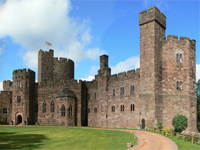
Peckforton Castle, Cheshire (Image: the pepper tree / flickr)

By contrast, Peckforton Castle would be recognisable to a medieval knight as a useful fortification.  Rising prominently above the relatively flat Cheshire countryside, the imposing red sandstone castle is very much in the tradition of BurgesCastell Coch for the Marquess of Bute, and the later Castle Drogo by Lutyens.  However, a significant difference is the much greater degree of historical accuracy, perhaps appropriate considering it was visually challenging the truly medieval Beeston Castle on a neighbouring hilltop, but also to reflect the benevolent feudalism of the owner, John Tollemache who spent huge sums on buildings and homes for his workers.  However, the widespread public discontent at that time, with the risks of mobs and rioting, meant that it is also possible that Tollemache chose a castle with the intention that it be defensible.  So successful was Salvin’s design that even a critic (fellow architect George Gilbert Scott) called it a “…a perfect model of a Medieval fortress…“.  I think Salvin enjoyed the challenge of this design; a rare chance to build an uncompromising castle in a way which hadn’t been necessary for 500 years, fully taking advantage of his encyclopaedic knowledge of fortifications.  Today, despite being badly damaged in a recent arson attack, the castle is still a fascinating example of his work.

Apart from ecclesiastical work and alterations to existing houses such as Warwick, Alnwick and Dunster castles, he also designed a number of notable country houses including, in addition to those already mentioned: Cowesby Hall, Scotney Castle, Parham Park, Skutterskelfe Hall (one of Salvin’s rare Classical designs), Crossrigg Hall, Keele Hall, and Thoresby Hall, which still survive today.  Sadly, Flixton Hall, Campsea Ash High House, Congham High House, Stoke Holy Cross Hall and Hodnet Hall have all either been completely demolished or, in the case of the latter, significantly reduced.

Salvin was one of those rare Victorian architects whose work started strongly and just got better.  To have the opportunity to purchase the first major work at Mamhead is a rare privilege and one that I hope the new owner will recognise and appreciate.

Sales details: ‘Mamhead House‘ – £8m, 164-acres [Strutt & Parker]

Lovely article with many photos in ‘Devon Life’: ‘Mamhead House

More details:

———————————————————————————-

* source: foreward to ‘Anthony Salvin: Pioneer of Gothic Revival Architecture‘ by Dr Jill Allibone which I can highly recommend, and which was very helpful for this posting.

‘An agreeable surprise’ – the country house and garden sculpture

Statue - Castle Howard, Yorkshire (Image: Paul Barker / Country Life Picture Library)
Statue – Castle Howard, Yorkshire (Image: Paul Barker / Country Life Picture Library)

The country house has long been at a nexus of art, display and tourism with the treasures, mainly statues, collected by the owner shown in a grand gallery which often formed one of the main staterooms.  Whereas the house provided the setting for the art, outdoors, the gardens and parkland provided a setting not only for the house but also for the many sculptural works they had acquired – a trend which continues today, though often with a necessarily more commercial edge.

The first country house owners to place statues in their English gardens were the Romans.  However, as homes became castles, gardens fell from favour and with them, the ornaments to decorate them.   The trend for statuary only really returned with the Tudors and their love of the outdoor space as an extension of the symbolism they incorporated into the architecture of their houses.  One of the earliest collectors, and most acquisitive, was Thomas Howard Arundel, 2nd Earl of Arundel, who, as a youth, had been at the excavation of the Roman Forum, which had sparked a live-long passion for antiquities.  Arundel amassed one of the greatest collections of the age, rivalling that of the King, including a famed selection of Graeco-Roman statues found in Turkey, which became known as the ‘Arundel Marbles‘. These statues were then displayed at both their town and country seats, both indoors and out – though later, by the mid-17th-century, as a result of the uncertainties of the Civil War, John Evelyn found the Marbles “…miserably neglected, & scattred up & downe about the Gardens & other places of Arundell-house.”.  The statues were later donated to the Ashmolean Museum where they remain today.

The later rise and popularity of the Georgian grand tour firmly embedded the desire to purchase statues along with the requisite paintings. They provided a visual clue as to both the learning and wealth of the owner and so were displayed prominently, especially indoors where they might be shown in the entrance hall where guests would inevitably look at them as they waited. Some of the most famous dedicated indoor galleries include those at Holkham Hall, Norfolk, Chatsworth, Derbyshire, and Woburn Abbey, Bedfordshire (though sadly now not as shown in previous link as it’s now a wedding venue).  Other notable galleries, though now lost due to dispersal or demolition, were those at Clumber Park, Ickworth House and Hamilton Palace, the latter described as “…peopled with bronze statuary on Irish black marble bases polished to such a gloss that they reflected the pavement like a mirror.“.

Chiswick House, Middlesex (Image: curry15 / flickr)

Outside, the display was no less formal – symmetry and structure dominated.  However, by the 1730s, the more formal display of statues outdoors gave way to a more naturalistic style whereby they became almost secreted amongst a more informal – but no less planned – landscape.  One thing often forgotten now is that we see gardens after over 250 years of growth, but when first planted they would have been much sparser giving the ornaments greater prominence.  The return of the Roman influence can be closely linked with the rise of Palladianism and the influence of Lord Burlington and his circle; most notably, the brilliant designer William Kent. Other notable influences include Batty Langley, who published his ‘New Principles of Gardening‘ in 1728 and Stephen Switzer’s ‘Ichnographica Rustica‘, published in 1718 – the latter of which was the first to show serpentine walks and streams. Life also imitated art, with the popularity of the Arcadian visions of painters such as Claude Lorrain, Nicholas Poussin, and Salvator Rosa also inspiring those who collected the paintings to attempt to bring them to life.

Temple - Studley Royal Gardens, Yorkshire (Image: Matthew Beckett)
Temple – Studley Royal Gardens, Yorkshire (Image: Matthew Beckett)

The more secure and rising wealth of the 1730s enabled owners to create larger estates and so giving them more space to indulge their plans.  However, no stream will rival a raging river so to create a sense of theatre, the landscape was used and moulded to create a series of views which took advantage or distant landmarks or by introducing elements such as statues, temples and obelisks.  Often these gardens were designed to entertain the knowledgeable visitor with allusions to myths and noble virtues – though in one lesser known example, the owner of the famous Vauxhall Gardens in London, built a darker memento mori‘ garden at Denbies, his home in Surrey.

However, the main aim was to delight and to stimulate emotions. One of the most famous Georgian gardeners, Philip Miller, wrote in his 1739 edition of his ‘Gardener’s Dictionary’:

“In laying out these walks through woods there should be a great regard had to the neighbouring country, so as whenever there are any distant objects which appear to the sight, there should be openings to which the serpentine walks should lead, from whence objects may be viewed, which will be an agreeable surprise to strangers…”

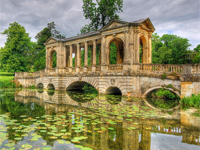
Bridge - Stowe House, Buckinghamshire (Image: Evoljo / flickr)
Bridge – Stowe House, Buckinghamshire (Image: Evoljo / flickr)

These principles were translated according to the whims and finances of owners across the country, leading from the sublime creations of Stowe, Stourhead and Studley Royal to many lesser known and private gardens.

The statuary could sometimes cause the odd drama. Dallam Towers, Cumbria was archly described by Pevsner as “…undoubtedly the finest Georgian facade in the county; but what the visitor may not realise is that, behind all the stucco, there’s the finest Queen Anne facade in the county.“. Between the facade and the landscape once stood (or perhaps still stands) a line of statues standing guard between the garden and the ha-ha. Yet this line is slightly marred by one of the statues being headless – the unfortunate outcome of a 1820s dinner which led to a very ‘well-refreshed’ Lord Milthorpe.  Thinking he had seen a poacher, he grabbed a rifle, and despite the protests of his guests, he duly dispatched the ‘poacher’/statue; a loss for the world of garden ornaments but perhaps a gain for the forces of law and order.

With such vast quantities of marble scattered out the gardens, occasionally a prized statue may slip slowly into obscurity. This can lead to discoveries in the same way that an Old Master may be found in the attic, so they can also be found in the shrubbery, such as this rare Chinese Ming tomb horse or the lucky owner of a castle somewhere in northern Europe who had a statue by the Renaissance sculptor Adriaen de Vries.

The tradition of sculpture in the gardens of country houses is certainly alive and well today and has developed beyond the more formal Roman statuary towards a decidedly more contemporary ethos – though perhaps more commercial than for simple pleasure.

'Huge Sudeley Bench' by Pablo Reinoso at Sudeley Castle (Image: Christies)
‘Huge Sudeley Bench’ by Pablo Reinoso at Sudeley Castle (Image: Christies)

At the beautiful Sudeley Castle in Gloucestershire, Christies are holding their selling exhibition of contemporary sculpture from luminaries such as Marcel Wanders, Marc Quinn and Pablo Reinoso.  Over in Sussex, the Cass Sculpture Foundation at Goodwood, hosts a regularly changing line-up with a focus on supporting emerging talent along with the more established artists such as Lynn Chadwick and Anish Kapoor.  One more recent venue is the Jupiter Artland at Bonnington House in Scotland, just outside Edinburgh.  The vision the Wilsons, who own the house, Jupiter Artland features large-scale works such as the monumental ‘Life Mounds’ by Charles Jencks’ who specialises in landscape art that I suspect would appeal to the likes of ‘Capability’ Brown if he were around today.

These are just some of the examples of contemporary schemes which are taking place across the country. Each is enlivening the grounds of a house and again maintaining that artistic thread which has been spun out over hundreds of years, linking country houses, an owners’ taste and some of the best art in the country.

————————————————————————–

More wonderful examples of works available outdoors can be seen in the Country Life Picture Library collection.

This blog post is a little off my usual patch so I’m grateful for the research of David Stuart in ‘Georgian Gardens

Finest prospects: the artist and the country house (and a challenge)

The country house has always been a trophy to be admired and enjoyed.  Yet, in the age before mass media and transportation made it easier to see these fine houses, often the only way to remind yourself and, more importantly, guests to your London townhouse, of your rural wealth and power was through the rather special branch of art that is the country house portrait.  Though originally European, it found new and invigorating life once it had crossed the Channel, creating an important and fascinating record of the lives, tastes and architecture of the landed classes. We also have a mystery house in a painting to find…

The country house first started appearing in paintings in France, with one of the very earliest depictions being that of the Duc de Berry’s houses and estates in 1416 by Pol de Limbourg.  These paintings served not only as reminders of wealth but also as practical tools for the running of extensive estates. The earliest English contemporary of these paintings is a 15th-century portrait of John of Kentchurch with a view of Kentchurch Court, Herefordshire in the background.  Although the depiction of the country house was a primarily European feature, it was still a relatively niche pursuit until the late 1500s, with painters more usually employed to portray the religious, historical or mythological.

Detail of 'An Aerial View of Tottenham Park, Wiltshire' by Pieter Andreas Rysbrack (after 1737) - this picture hung for many years in the estate office.

The trade in country house views was particularly popular in the Netherlands, where a demand for topographical engravings combined with many estates created a ready market.  The genesis of the English tradition is also to be found here as the Royalist aristocracy fled to the region during the Civil War. The connections made at this time were to prove fruitful for the many painters who followed their current and prospective patrons back across the Channel after the the Restoration in 1660. Before then, views of a country house were usually part of an estate survey, bar a few exceptions such as those of Conway Castle in c.1600, Nonsuch Palace and Richmond Palace c.1620, and the ‘King’s houses’ by Alexander Kierincx in 1639-40.  It was the famous engraver Wenceslas Hollar who completed the first significant set; five views of Albury House in Surrey in the late 1630s. Hollar was also significant in establishing the new fashion for these views once confidence was restored in the late 1650s.

The Restoration of Charles II gave new life to the art, with Dutch artists eager to record the newly invigorated estates of the aristocracy.  Without the artistic constraints often found in Europe, the style of the art in England was largely determined by the owner rather than royal preference.  By the 1680s, the country house portrait was as well established, as well  as those of the family, and reflected both pride and change.  Views were often painted to record the old house before it was swept away or remodelled or after the work had finished to showcase their new seat.

One of the finest artists of this period was Leonard Knyff who had arrived in England in around 1676 but whose first country house painting, completed in 1696, is of Dunham Massey, Cheshire.  A few more paintings followed, but his master work was a collection of eighty engraved views published (by Johannes Kip) in 1707 under the title ‘Britannia Illustrata: Or Views of Several of the Queen’s Palaces, also of the Principal seats of the Nobility and Gentry of Great Britain…’.  It remains one of the finest records of the country houses of the period – today, even individual prints can sell for hundreds of pounds and full copies of the book for tens of thousands.

Detail of 'Westwood, Worcestershire' published 1709 for "Britannia Illustrata: Or Views of Several of the Queen's Palaces, also of the Principal seats of the Nobility and Gentry of Great Britain...." by Johannes Kip & Leonard Knyff
Detail of 'Westwood, Worcestershire' published 1709 for "Britannia Illustrata" by Johannes Kip & Leonard Knyff

From the 1700s, the composition of the paintings shifts to include, and give greater prominence to, sporting activities and also the setting of the house, particularly the gardens. With sports such as riding and hunting being such a key part of the enjoyment and reputation of an estate, it was natural that these should feature in any artistic celebration.   As the fashions for landscaping and elaborate gardens took hold, so to did a desire for these to also be included in such detail that the house became a much smaller element, subsumed into a wider bucolic vision.  The more ‘survey’-like paintings showed in almost cartographic detail the layout of the gardens with the tree-lined rides radiating away from the house.

'Lowther Castle, Westmorland, Seen from a Distance by 'Day' in 1810' - J.M.W. Turner

This trend was not only driven by the owners who were very proud of their new environment but also because it was a natural continuation of the earlier work of these artists, as recorders of landscapes. John Harris argues that it would be difficult to confirm the exact influence which art exerted over landscaping but the popularity of landscape painters such as Claude Lorrain, coincided with the popularity of advocates of the more natural landscape such as Humphrey Repton and Lancelot ‘Capability’ Brown in the 1760s.  Parkland now moved from the more formal ‘boxes’ which Knyff had so accurately portrayed, and was now shown as a more rural, naturalistic form, the landscape now dominating the picture.  How far this style departed from formal country house portraiture can be seen in the works of J.M.W. Turner who frequently reduced the house to a mere smudge in the distance – and even when the house featured clearly, it was subordinate to the overall setting and atmosphere.  That’s not to say that the ‘Claudian’ view was the only one – the preferences of the owners for clear visions of their seats kept artists such as William Hodges, James Barret, William Marlow, and Theodore de Bruyn busy too.

By the mid-1800s there had been a marked decline in the demand for these type of paintings. Improved communications meant that houses were no longer so remote, and with the advent of mass printing, publishing filled the demand for images of the houses as typified by the eleven volumes of J.P. Neale’s ‘Views of the Seats of Noblemen and Gentlemen‘ (1818-1829).  Owners of houses were also now increasingly from the new wealthy who had their powerbases in cities and the country house was merely a retreat. By 1880, photography was also firmly supplanting oil paint as the medium of choice, as shown by the success of photographers such as Bedford Lemere, and, by the 1900s, the success of magazines such as Country Life which placed a high priority on using only the best photos.

Detail of 'Carclew, Cornwall' by Algernon Newton (house built 1720s, burnt out in 1934) - painting commissioned for the family which owned it at the time of the fire

However, in the last twenty years, a resurgent interest amongst country house owners has again created a demand for the country house portrait.  Artists such as Algernon Newton, Julian Barrow, James Hart Dyke, Jonathan Warrender, and Marcus May have led the way in continuing the tradition.  One artist has even been responsible for creating a country house which only existed in one of his paintings. Felix Kelly had painted an imaginary scene of Palladio’s Villa Rotunda within an English landscape; inspired by this, Sebastian de Ferranti then commissioned the architect Julian Bicknell to translate this art into reality, completing the house in 1986.

These important paintings are now, for some houses, the only record of how they were before later changes obscured or obliterated them forever. For many others, they are a wonderful reminder of the beauties of architecture and are a unique and invaluable record of our country houses.

—————————————————————-

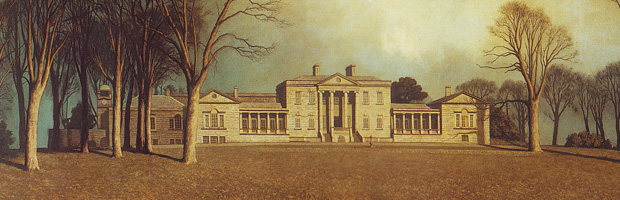
Detail from 'Portrait Group' (1936) - William Bruce Ellis Ranken
Detail from 'Portrait Group' (1936) - William Bruce Ellis Ranken - click for full painting

The Challenge: can you identify the mystery house in this painting?

Detail from 'Portrait Group' (1936) - William Bruce Ellis Ranken

The catalyst for this post about country houses in paintings was an email I received from Wendy & Gordon Hawksley who are working to re-establish the reputation of William Bruce Ellis Ranken (1881-1941). A famous artist in his day, he socialised with the great and good and painted many of them before fading into obscurity after his death.  This painting was exhibited at the Royal Academy in 1936 (this is also the year it was painted) under the title of ‘Portrait Group’ but as yet it has not been possible to identify either the sitters or the house. And so to the challenge: simply, can we identify the house – almost certainly English or Irish, Palladian, engaged columns to the front (a la Kedleston Hall) with flanking curved colonnaded wings facing a large reflecting pool.  Obviously there may be some degree of artistic licence but it seems likely that this was the home of the subjects of the portrait. Suggestions either via the comments below or via email to me.  No prizes I’m afraid beyond a credit here and the happy thought that art history is slightly richer for your efforts.

—————————————————————-

For a more in-depth history and many images (and to which this post is much indebted)  I recommend ‘The Artist and the Country House: from the Fifteenth Century to the Present Day‘ by the ever-brilliant John Harris – unfortunately now out of print.