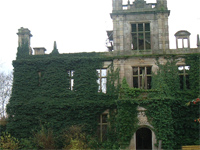
Houses of gods: country houses converted to religion and the sale of Hawkstone Hall

The 1920s and 30s may be remembered for many things, but it probably wouldn’t be for having any great public affection for the grand houses which had so dominated the landscape agriculturally, economically and politically.  Faced with the reality of the long slump in revenue from the land and wider economic difficulties, country house owners found themselves between the rock of their own financial situations and the hard place of a nation broadly unsympathetic to their difficulties.  Many an owner may have offered up a prayer for some form of divine intervention to alleviate their situation – and the miracle which appeared which saved their house, though not their lifestyles, was religious orders purchasing these grand piles for their ministries.  With the recent launch on the market of the impressive Hawkstone Hall in Shropshire, the cycle turns again, as it looks like the wealthy will rescue the religious.

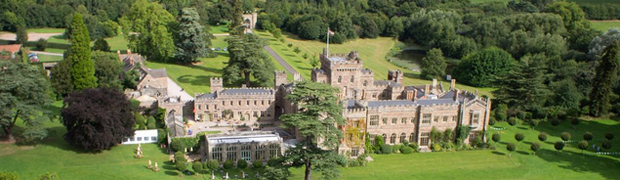
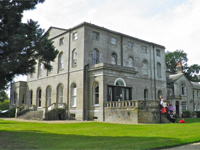
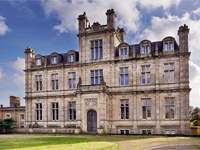
Hawkstone Hall, Shropshire (Image: Gerard Carroll via flickr)

A nobleman’s residence in the medieval period was often a castle but this dramatically changed following Henry VIII’s Dissolution of the Monasteries between 1536-41.  The aftermath created one of the greatest transfers of land (in the 1530s, they were estimated to hold approx 16% of England) and property as the riches of these institutions were either given to favoured courtiers or sold, creating instant country estates.  Yet, at that time, they were seen more as industrial units; great agricultural establishments which brought in great wealth, with the beautiful priory churches often stripped for their materials. However, for some owners, the buildings were a fine opportunity to create a house – and what better way of creating the impression of an ancient family than with an ancient seat, especially if it came with prized feudal rights.

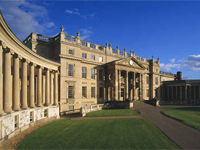
Lacock Abbey, Wiltshire (Image: Arnhel de Serra / National Trust)

The suppression of the monasteries and convents brought to an end many of the longest standing communities but did give a boost to the secular, non-defensive country house. Many older houses today, both large and small, can trace their origins back to monastic roots, including (a small sample, admittedly):

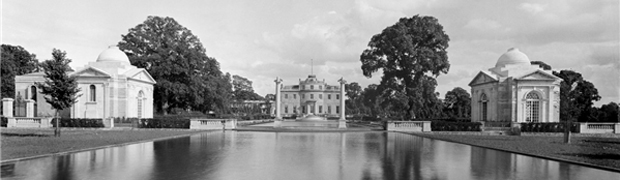
Mapledurham, Oxfordshire (Image: scoutjacobus via flickr)

Of course, there is a long history of country houses being used for religious purposes as many recusant families continued practising their Catholic faith at great risk to themselves both financially and physically, such as at Mapledurham in Oxfordshire or Hintlesham Hall in Essex.  This secrecy led to the creation of many ingenious methods of hiding not only the chapels (either in attics such as at Ufton Court, Berkshire, or by being disguised as bedrooms) and items of their faith but also the priests themselves, usually in ‘priest holes‘ which could be concealed behind panelling and walls (e.g. at Harvington Hall – still owned by the Archdiocese of Birmingham), in chimneys, under fireplaces and so on.

Despite Catholic worship becoming legal again in 1791, there were still restrictions on Catholics in public office until 1829, and it was still viewed with some suspicion. A further influx in the 1790s was due to the French Revolution which forced many orders back across the Channel.  For any order seeking to establish itself, it was certainly easier to take over a country house as it would often meet their requirements in terms of seclusion and accommodation but without the challenges of trying to build a new convent or monastery. One of the earliest was the purchase of East Bergholt Old Hall, Suffolk which was bought in the 1850s but there have been many others since, including:

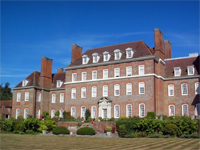
Mentmore Towers, Buckinghamshire (Image: EPR Architects)

Catholics may have had the longer history but others have also taken the same route. Perhaps the most famous of these was the spectacular Mentmore Towers, Buckinghamshire, designed by Joseph Paxton and built between 1852-54 for the Rothschilds, which was bought by the followers of the Marharishi Yogi to serve as the UK headquarters for the World Government of the Age of Enlightenment. This followed the scandalous refusal by the then Labour government to accept it for the nation with its incredible collections in lieu of just £2m inheritance tax and the subsequent sale which netted several times that. Others include:

There don’t appear to be any clear records of which houses have been used as convents/monasteries so it remains anecdotal (there’s probably a good PhD topic in there somewhere) but it’s possible that hundreds of houses have served in this use, especially if convent schools and retreats (e.g Capernwray Hall and Kinmel Hall) are included. For many of these, it’s likely that this alternative use saved them from joining the ranks of those demolished.

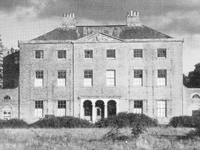
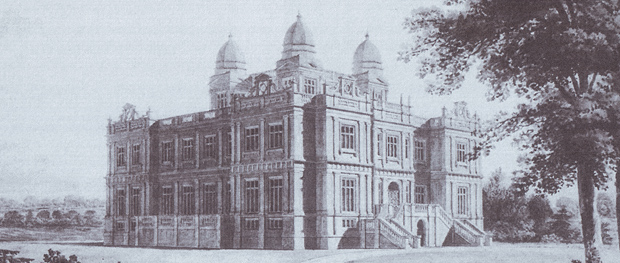
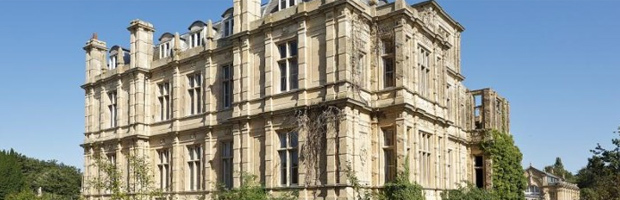
For the past 85 years, grade-I listed Hawkstone Hall has been a seminary and also a retreat for Catholic clergy.  The house was originally built in 1720 for Richard Hill (b.1655 – d.1727), a traveller and diplomat who had made a fortune through what was described as ‘lucrative arithmetick‘, and consisted of just the main block.  The design of this section is quite unique, certainly to the area, and pre-dates designs later shown in Campbell’s ‘Vitruvius Britannicus‘ published in 1715-25.  Although it shares certain elements with other houses (Buckingham House, Chatsworth – east front), neither the listing description nor Colvin have details on the original architect so it is open to conjecture as to who designed it and where they got their inspiration (if anyone does know/have any suggestions, please do add a comment below or contact me).

Hawkstone Park, Shropshire (Image: Peter-snottycat via flickr)

Hawkstone was then inherited by his son Sir Rowland Hill, 1st Baronet (1705–1783), who added the wings as part of an enlargement in 1750, but who also, more importantly, started the landscaping for which the estate was to become famous.  Taking advantage of a natural rocky outcrop, Hill created a series of walkways on the cliffs, view points and follies which attracted many visitors.  This grew to such an extent that Sir Richard Hill, 2nd Baronet (b.1733 – d.1808) wrote the first guidebook for the park and also built the ‘Hawkstone Inn’ to cater for the visitors. Such was its reputation that Dr Samuel Johnson came to see and was duly impressed, remarking on “…the awfulness of its shades, the horror of its precipices….“. Johnson also commented that he thought there ought to be more water and so Sir Richard commissioned landscape designer William Emes, who created the Hawk River which still flows to the north-west of the house.  Hawkstone Park had become one of the most popular attractions in the country by the time of his death in  1808 and remained so under the care of his brother, Sir John Hill, 3rd Baronet (b.1740 – d.1824), who inherited.

Sadly, it was to be the next generation who sowed the seeds of the families financial troubles.  The house and park were inherited by Sir Rowland Hill, 4th Baronet Hill of Hawkstone, 2nd Viscount Hill (1800–1875) who, through extravagance or mismanagement, lost much of the family fortune. Inside, he commissioned, between 1832-4, various alterations including a new drawing room from Sir Matthew Wyatt, whilst in the grounds he carved a hugely expensive new drive through a cliff and built The Citadel, a strange castle-like dower house.  He even toyed with the idea of relocating the entire house to the other side of the river.

Such spending was always likely to lead to difficulties and the 3rd Viscount, Rowland Clegg-Hill, (b.1833 – d.1895), never managed to re-establish the fortune and was bankrupt by the time of his death.  This forced a sale of the contents and then the splitting up of the estate in 1906.  The park, with the many follies, tunnels and caves, was sold off and is now run as part of the Hawkstone Park hotel. The Hall was bought by George Whitely, later Baron Marchamley of Hawkstone, a wealthy mill and brewery owner and MP, who made minor alterations; reducing the height and length of the projecting wings and to the interior.

The house was then sold to the Roman Catholic Redemptorists who have remained there until a recent review of their activities prompted them to put the house, with its 7-acres of gardens and 81-acres of grounds, up for sale for £5m.  Any purchaser looking to make this a home again will need to demolish the ugly accommodation block tucked away behind the left wing and will also have to consider what they wish to do with the large chapel which was added in 1932; perhaps if bought by a non-religious family it would make a superb music room.  For a house which exhibits such architectural interest and grandeur, it seems like a fair price and one hopes it will attract someone willing to invest to recreate what could be one of the finest homes in Shropshire.

———————————————————–

Property details:

News story: ‘Hawkstone Hall goes up for sale with a £5m price‘ [Shropshire Star]

Official website: ‘Hawkstone Hall

Country House Rescue – Season 4: Chapel Cleeve Manor, Somerset

Chapel Cleeve Manor, Somerset (Image: Webbers)

Many have bought things on a whim; it’s quite something for that thing to be a huge country house which once played host to royalty and celebrity.  When plans don’t work out and problems mount, it can be understandable for a family with generations of emotional attachment to a house to doggedly carry on, but the owner of Chapel Cleeve Manor in Somerset, who features in this weeks ‘Country House Rescue‘ (Thursday 21 June, 20:00, Channel 4), displays a rare level of stoicism.

Chapel Cleeve would be a fascinating house even if it wasn’t on television, but sadly its decline is all to familiar.  The origins of the house lie as a medieval inn for pilgrims visiting the now lost St Mary’s Chapel and travelling to the Cistercian abbey at Cleeve, which owned much of the land in the area until it was surrendered to the Crown in 1536.  The estates then passed to the Earls of Sussex in 1538 who held it until 1602, after which it passed through a number of owners, including Lord Foley of Kidderminster in the early 1700s.

When the new house was built, the remains of the inn, dating from 1423, were then incorporated as part of the north-west wing of the house as it is today.  The house, built between 1818-1823, was designed by Richard Carver (b. c1792 – d.1862) whom Colvin believes to be the ‘R. Carver’, a pupil of Sir Jeffry Wyatville who submitted work for display in The Royal Academy in 1811 and 1812, before establishing his practice in Somerset and eventually rising to be County Surveyor.  Best known for his many churches, Colvin is critical saying “…though occasionally showing some originality in plan (e.g. Theale, and the octagonal Blackford), are poorly detailed, and were despised by serious Gothic Revivalists.” He was damned by the Ecclesiologist in 1844 as having “…proved himself entirely ignorant of the principles of Ecclesiastical Architecture.” He may have been grateful that his Tudor Gothic design for Chapel Cleeve Manor was outside their remit and so escaped their ire.

Dining Room - Chapel Cleeve Manor, Somerset (Image: Webbers)
Dining Room – Chapel Cleeve Manor, Somerset (Image: Webbers)

Just under a century after Carver finished, the house was enjoying what was to prove to be its heyday.   Bought by the Lysaght family, wealthy from their corrugated-steel business, the original five bay house, featuring a central octagonal entrance hall with a top-lit staircase, was extended between 1913-14 with a sympathetic addition which increased the size of the house to over 27,000 sq ft, with salons, a ballroom and a 100-ft long gallery. Of particular note are the high-quality interior plasterwork ceilings which were created by one of the leading Arts-and-Crafts sculptors; George Percy Bankart. Staffed by 50 servants, the house played host to the young Princesses Elizabeth and Margaret, and with Fred Perry staying for tennis parties.

The death in 1951 of G.S. Lysaght triggering punitive death duties which forced the sale of the house and, worse, the sale of parts of the grounds as building plots.  The dense woodland which had thus far shielded the manor was now largely obliterated with housing claustrophobically creeping up on three sides. Perhaps the expectation was that the house would not survive and further housing could be built, but the house then enjoyed a resurgence when it became a hotel in the 1960s and 70s, becoming the place to be in the area. However, when that business closed, the rot, both metaphorically and physically, set in, so that when it was bought by the current owner for 14 years of Chapel Cleeve, Jeannie Wilkins, in 1998 ‘there was not one habitable room‘.

Chapel Cleeve Manor, Somerset (Image: Webbers)

Having spent £360,000 purchasing the property with her partner and with the help of two skilled friends, they started the mammoth task of restoring the house.  Correctly starting with the roof, it took two years to complete the task of making it watertight, with the restoration of the Edwardian wing taking many of the subsequent years.  The restoration was to a high standard, with care being taken to reinstate the many various mouldings and panelling, with the overall intention being to create six flats in the house, five of which could then be let – but, as with all the best laid plans, it went awry.

The inevitable challenges of finding an agreeable path through the stringent planning rules governing this Grade-II* listed house caused delays, and, sadly, Ms Wilkins relationship ended, following which she bought out her ex-partner, leaving her in sole charge of a vast partially-restored mansion with its 150-ft façade and spectacular views over the nearby hills.  With an income of just £5,000 per year from renting out a cottage in the grounds she faces a huge backlog of repairs (only 18 rooms are habitable out of 45 in total) and the costs of restoring it, which she estimates at around £500,000 (so, at least £750,000 – as anyone who has watched Grand Designs will know!).

Chapel Cleeve was offered for sale in early 2010 at £1.695m (and featured in a post at the time: ‘The start of the rush? Country houses for sale in the Sunday Times Home section‘), but it is still available. The combination of the restoration challenges, general economic climate and the severely compromised situation of the house – reduced to just 7-acres surrounded by a drab housing estate – have driven Ms Wilkins to call for the help of Simon Davis and ‘Country House Rescue’ to inject some new ideas – which he does, though none are the financial miracle she may have been hoping for.

In many ways, Ms Wilkins’ commitment to the house has to be admired – her dedication has almost certainly saved it from joining the sad, long list of lost houses.  However, it might be argued that her unwillingness to drop the asking price (especially considering the cost of the works outstanding) is also again putting the house at risk. A house of this size would ideally have much larger grounds to provide seclusion and planners ought to insist on a minimum 500-metre ‘green-belt’ around each house which would help protect their long-term viability. Undoubtedly Jeannie Wilkins deserves a just reward for the incredible work she has put in, but a quick sale at a reasonable price would certainly not only be best for her, but also for the long-term future of the house.

——————————————————————————

Sales details: ‘Chapel Cleeve Manor‘ [Fine & Country]

Official website: ‘Chapel Cleeve Manor

Listing description: ‘Chapel Cleeve Manor‘ [British Listed Buildings]

News articles:

Country House Rescue – Series 4 [Channel 4]

‘So you made the 2012 Sunday Times Rich List…’ – a selection of country houses for sale

Spring is upon us: the birds are singing, the flowers are blooming, the drizzle is almost incessant – *sigh*. One bright spot is each week’s increasingly heavy Country Life magazine; the extra weight from the greater number of property adverts which signal the launch of the late spring/early summer (hah!) country house sales push. Below is a round-up of some of the most interesting and beautiful properties currently for sale, all entirely and subjectively chosen by me.

Bletchingdon Park, Oxfordshire (Image: Knight Frank)

The most impressive house to be offered for sale this year so far has to be the beautiful Bletchingdon Park, Oxfordshire [Knight Frank]. One of the relatively few Palladian villas in the county, it can easily hold its own with the others such as Kirtlington Park (completed in 1746) and Nuneham Courtenay (built 1756).  Bletchingdon Park was slightly late to the Palladian party, being built in 1782 for Arthur Annesley, Viscount Valentia, to the designs of James Lewis (b. c1751 – d.1820).  Lewis was mostly employed as surveyor of various charitable hospitals in London and near counties but he also completed a clutch of excellent country houses including Eydon Hall, Hackthorn Hall, and Lavington Park (now Seaford College). Owned since 1993 by Dr Michael Peagram, a philanthropist and chemicals industrialist, the grade-II* house has been obviously well cared for and offers the highly desirable combination of an imposing facade, superb views, 127-acres and elegant interiors which includes a wonderful sweeping, top-lit staircase – if you have £20m.

Cockfield Hall, Suffolk (Image: Savills)

For those who prefer an alternative to the architectural austerity of Palladianism, then Suffolk offers a wealth of brick houses; statements just as bold, but in a different language. Cockfield Hall, Suffolk [£5m, 74-acres, Savills] has a grand façade, galleried great hall, a wealth of rich plasterwork ceilings, and a range of estate buildings in the same style.  Although mainly built in 1613, the windows were sashed c1770 and the overall look is largely due to later Victorian enhancements, including the upper storey, gables, the great hall and various Tudor motifs.  That said, it is undeniably attractive as the changes work well together.

Highfields Park, East Sussex (Image: Knight Frank)

There is often something just so elegant about Regency houses, particularly the smaller country villas which echoed the style and features of much larger and grander houses. Highfields Park, East Sussex,  [£5.75m, Knight Frank] is set in 191-acres, and overlooks its own lake and out to the countryside.  The house has grown as the ambitions and wealth of the owners allowed; a ballroom being added to the east and a swimming pool beyond that. Awkwardly, access to latter is through the former so just be careful not to schedule a pool party at the same time as your formal dances; though, on the upside, it will be easy to tell which guest is supposed to be at which party.

Ayton Castle, Scotland (Image: Knight Frank)

Previously offered for sale in May 2011 for £3m and now re-listed, Ayton Castle, Scotland [offers over £2.2m / Knight Frank] is a sprawling confection of Scots Baronial motifs; the design the work of two of the best architects working in Scotland at the time, now set in 159-acres.  The house was originally built in 1851 for William Mitchell-Innes who commissioned the talented James Gillespie Graham. Graham was known for his work in the Scots Baronial style which became so popular in the Victorian era, notably on the praise of Sir Walter Scott and the Queen’s remodelling of Balmoral.  Yet, Graham was a rare architect comfortable working in various styles; neo-classical at Blythswood House or semi-ecclesiastical Gothic at Cumbusnethan Priory (now tragically a ruined shell).  Ayton was later extended in 1860, with the addition of a billiard room and an enlarged drawing room by David Bryce.  Bryce, perhaps, more than any other architect, can be argued to be responsible for the legacy of Scots Baronial, if only through his prolific output of more than 230 buildings including many country houses such as Craigends (dem. 1971), Panmure House (dem. 1955), Torosay Castle and Dalmore House (burnt out 1969). Considering the tragic swathe cut through his work, it’s a shame that legacy wasn’t appreciated.

Honourable Mentions

There are, of course, many other good houses featured in Country Life but some would not be regarded as the seat of an estate – but they are still wonderful country houses; albeit ones with very large gardens and worth a mention.  A couple here are proper country seats but just haven’t made it to the list above:

Bradwell Lodge, Essex (Image: Matthew Beckett) - for sale: £2.25m through Jackson-Stops & Staff
Bradwell Lodge, Essex (Image: Matthew Beckett) – for sale: £2.25m through Jackson-Stops & Staff

Bradwell Lodge, Essex – a house of contrasts and a mixture of architecture; a Tudor core, latter additions by Robert Adam, Robert Smirke the elder, and Quinlan Terry, with decoration by Angelica Kauffman. The library/small dining room in the projecting bay on the ground floor is particularly elegant with twisted-wire screens to the bookcases. Grade-II*, 26-acres, £2.25m [Jackson-Stops & Staff]

Broadwell Manor, Gloucestershire – grade-II*, 35-acres, excess £8m [Knight Frank]

Burnham Westgate Hall, Norfolk – a fascinating early house by Sir John Soane which has previously featured on this blog (‘For sale: a Soanian springboard‘). Grade-II*, 38-acres, £6.5m (down from £7m) [Knight Frank]

Glansevern Hall, Powys – an apparently unique property in that it is the only complete house designed and build by the architect Joseph Bromfield and which also features some impressive gardens. Grade-II*, 80-acres, £4.5m [Balfours]

Rainthorpe Hall, Norfolk – grade-I, 18.7-acres, excess £2.95m [Strutt & Parker]

Roundhill Manor, Somerset – grade-II, 280-acres, £6m [Savills]

—————————————————————————

For other updates on country houses for sale do sign up for the excellent British and Irish Stately Homes blog, which is written by Andrew Triggs who frequently contributes comments on this blog.

School’s out: seats of learning for sale

One of the many uses to which our country houses have been successfully adapted to is that of schooling – from the grandest such as Stowe and Bryanston to the many smaller houses which have delighted and terrified children in equal measure for many years.  Even as recently as April 2010, Wispers in Sussex, was sold to a London primary school as a satellite to their main campus. Yet for all the fond memories held by generations of youngsters, private schools and educational colleges are facing their own periods of austerity, forcing some to close.  With closure comes a rare opportunity for a house to once again become a home – though such a move is fraught with practical, and sometimes political, challenges.

Urchfont Manor, Wiltshire (Image: Augustus Photographic via flickr)

One of the bonuses of writing this blog is to discover houses so little known that, despite their obvious beauty, they seldom appear in books.  Urchfont Manor, Wiltshire is a classic example of this. Currently a residential college, this stunning smaller William and Mary country house was built around 1678 for William Pynsent, a wealthy London barrister, who would have been well-aware of the latest architectural fashions. The architect is unconfirmed but, with the hipped roof and projecting, pedimented centrepiece, it appears to draw inspiration from houses such as Horseheath Hall, Cambridgeshire (though 7-bays to Horseheath’s eleven) designed by Sir Roger Pratt in 1663-5 (dem.1777), and also clear stylistic similarities with houses such as  the north and south fronts of Fawley Court, Buckinghamshire (built 1684-5, by Sir Christopher Wren) and Puslinch, Devon (a late proponent of the style, being built c1720).  One curious anecdote, told to Sir John Julius Norwich, was that the house was substantially altered, creating the elegant east front, about twelve years after construction to designs by William Talman – but Colvin doesn’t mention it and no firm evidence has appeared to support this…so far.

Puslinch House, Devon (Image: Devon Rural Archive)

Urchfont is a fascinating and enchanting smaller manor house which successfully plays the neat visual trick of looking larger than it is – at least from some angles. The two key views of the house are from the main road from the village, which gave a clear view of the east front and the road running below the south front (the house was once more visible; maps from 1880s show only a few clumps of trees, much fewer than there are now).  If one only saw these two fronts, one might think this a large, cube-shaped house – but move round to the north and the house is clearly only one room deep on the east front. A lovely piece of social aggrandisement.  The house passed through various families and was tenanted before being bought by another lawyer, Hamilton Rivers-Pollock, in 1928, who lived there until his death in 1941.  It then became a home for London children suffering from tuberculosis, and was then bought in 1945 by Wiltshire County Council as a residential college.  Now, faced with cutbacks,  the council have decided to sell up, amid much local controversy, giving this beautiful house an opportunity to once again become a home.

The Hill, Abergavenny, Monmouthshire (Image: Cooke & Arkwright)

Across the country in Monmouthshire, The Hill, as the name implies, sits rather proudly on the edge of Abergavenny.  Built in the mid-18th century, the house sits in 20-acres of gardens (which are included on the Register of Parks and Gardens of Special Historic
Interest in Wales) from a once larger estate, the residential spread of the town having crept up towards it.  Sadly, poor planning has led to a small residential estate taking up the grounds to the east of the house, and further buildings associated with its time as a college now stand between them and the house.  This makes it exceptionally unlikely that the house would become a single-family home again but potentially a high-quality development, replacing the modern buildings and respecting the grounds, could offer a workable solution.

Bedgebury Park, Kent (Image: Knight Frank)

On a larger scale, the curse of the associated buildings also blights Bedgebury Park, Kent. The original house of the estate, seat of the influential Culpepper family, financed by a flourishing iron business based on the clay-ironstone on which it sits, was to the east of the current grand mansion (now a lake), and played host to Elizabeth I, who visited in August 1573.  The current house was built in 1688 for Sir James Hayes, a man who had become wealthy through  his wife’s inheritance and financing the recovery of jewels and gold from a sunken Spanish ship.  Sir John Cartier bought it in 1789 and added some impressive plasterwork and the chain of lakes on the estate.  Following Cartier’s death,  Bedgebury was bought by one of the Duke of Wellington’s most trusted men, Field Marshal Viscount Beresford.  He commissioned Alexander Roos c.1838 and the subsequent extensive alterations and the addition of the cross wings to create the H-shape, obscured the red-brick original behind an impressive cladding of warm, honey-coloured sandstone ashlar, creating a house which positively glows in the sun. Inherited by Alexander Beresford Hope in 1854, he made his mark on the house by adding the impressive Neo-Classical stairhall and the striking mansard roof.

Stairhall created c.1850s, Bedgebury Park, Kent (Image: Knight Frank)

The house was bought by the Church Education Corporation with 200-acres in 1919, opening as a school with just five pupils in 1920.  It quickly grew and new buildings were added in the grounds providing extra teaching and residential facilities, before closing in 2006.  Now offered at £7.5m, the grade-II* house sits in a 90-acre estate awaiting its future.  The brochure mentions that the local planning department are open to the idea of it becoming a single unit residence again – a possibly tempting prospect for a billionaire who needs an impressive house, a small estate, and doesn’t mind having to demolish the modern school buildings which have sprung up.  Considering the quality of the interiors, this must surely be a feasible prospect, especially in light of the recent sale of Park Place for £140m which proved that there are those willing to pay exceptional prices for the best quality properties.

Apethorpe Hall, Northamptonshire (Image: English Heritage)

For those seeking to move into a former school which has been partially restored to the highest standards and now only requires the finishing touches (if you have a couple of million pounds available), then possibly the finest option would be Apethorpe, Northamptonshire.  This fascinating Tudor/Jacobean/Elizabethan house has played a supporting role in royal entertainments for 500 years and features some of the finest plaster ceilings in the country – and became a particularly grand school between the late 1940s and 1982, when it closed. Bought by an absentee owner, it languished for years, flirting with dereliction.  Finally, intervention by English Heritage brought it into their care and it’s currently for sale for offers around £5m (English Heritage reputedly spent £7m on the rescue so far), and would require another approximately £4m to complete the restoration.  On an remarkable side note; the fact that Apethorpe was saved from the usual vandalism, arson and theft which so often afflicts empty buildings, was largely due to the tireless efforts of the caretaker, George Kelley, who carried on even though he wasn’t being paid to do so.

The most recent closure (at least partially) is of St Michael’s in Tawstock, Devon.  Originally known as Tawstock Court, it was built in 1787 in a provincial Gothick style to replace an Elizabethan house which burnt down that same year.  Although the staff and parents have made heroic efforts to save it, the concern for them is that the house will fall into the hands of developers who will convert it into flats – and considering the poor job most do of such a task, their concerns are very valid.

In these straitened times, sadly a number of parents and councils will be forced to economise and schools, usually private, may well close.  Sad though this will inevitably be for the many current and former pupils, it does also offer a possibility that these houses may revert to their former role for which they were designed – and few would argue that the spectacular Marshcourt in Hampshire, designed by Lutyens, was better off as a school. However, as the roll call of struggling schools lengthens, it is important that the future of the often wonderful buildings, which gave each school their character, are given due priority to ensure an appropriate transition and restoration if the opportunity arises for them to return to being family homes.

————————————————————————

Original story: ‘Urchfont Manor sale row erupts‘ [Gazette and Herald]

Listed building description: ‘Bedgebury Park, Kent‘ [British Listed Buildings]

A poor prognosis: Great Barr Hall, Staffordshire

Great Barr Hall, Staffordshire (Image: English Heritage)

Many of the houses featured in this blog are shown as a celebration of the brilliance of our architects and craftsmen in creating one of the finest bodies of buildings of their type in the world.  Yet, in abundance is, perhaps inevitably, failure; where an interesting house becomes a victim of circumstance, policy, incompetence or, sometimes, all of the above.  Great Barr Hall, once outside Birmingham, now encircled by advancing urbanisation, is a sad example of where a house can languish and deteriorate whilst deliberate vandalism and institutional lethargy condemn it to its fate – and unless something is done soon, Great Barr Hall will join the already far-too-long list of the lost country houses of England.

Great Barr Hall c1800 (Image: artist known / sourced from Bill Dargue)

Despite its current sorry state, Great Barr Hall was once a sizable house – though precisely how large is unclear.  An early print in 1798 Stebbing Shaw’s ‘History and Antiquities of Staffordshire‘ shows a 11-bay castellated house with four corner turrets but the present house is 9-bays.  For comparison, it’s interesting to note the stylistic similarities with Syon House in west London, a seat of the Dukes of Northumberland, though it is also 9-bays wide and has an imposing porte cochere.

What is known is in the 1760s, Sir Joseph Scott, then head of a family line which had been in the area for 600 years, built a new house in a ‘gothick’ style.  The original architect is unknown but Stebbing Shaw describes how ‘The present possessor [Joseph Scott], about the year 1767, began to exercise his well known taste and ingenuity upon the old fabric, giving it the pleasing monastic appearance it now exhibits – and has since much improved it by the addition of a spacious dining room at the east end, and other rooms and conveniences‘. If Scott was his own architect, perhaps he was, in part, inspired by the remodelling of Syon House by Robert Adam which started in that same year.

Sir Joseph Scott’s original extensive works led to some financial difficulties and so, from 1785, he moved to the Continent and rented the house out.  The lease was taken by Samual Galton junior, a controversial Birmingham Quaker, banker,  gun manufacturer, and intellectual who hosted meetings of the Lunar Society at Great Barr Hall leading to it becoming a noted crossroads for industrial ideas, a crucible for the Midlands industrial growth and the wider Industrial Revolution.

Where Great Barr becomes particularly interesting from our point of view is with the arrival of the young architect John Nash and his business collaborator and famous landscaper, Humphrey Repton. Nash was there to provide the buildings which Repton needed to complete his  gardening visions. This worked well for both men; Nash was to pay Repton 2.5% for any work the latter passed his way so Nash charged his clients the then rather high fee of 7%, giving him a 4.5% fee. There is no record of Nash ever putting any work towards Repton – but Nash benefited with work on over one hundred estates. There seems to be some uncertainty as to exactly when Nash started working there but John Summerson gives the date as 1800 for the construction of a gothic archway to the adjacent chapel, but other works such as the gate lodges, an icehouse and a new steeple for the chapel started in 1797 and were probably also by Nash and Repton.

Corsham House, Wiltshire - copper engraved print published in The Beauties of England and Wales, 1813 (Image: Ancestry Images)

About this time, the house was also updated to create the appearance we can just make out today – but it hasn’t been confirmed that Nash was the architect.  However, there are tantalising clues that it could well be by him. Nash had been developing his particular style of Picturesque gothic during his time in Wales and had been applying it with varying degrees of success since then during alterations at Kentchurch Court, Herefordshire, (1795) and at Corsham House, Wiltshire (1797 – a disaster due to poor workmanship with Nash’s work later demolished).  Yet, some of the architectural fingerprints of each of these can be seen in Great Barr.  Externally, one such feature is the crenellations applied to both the roof and the tops of the projecting towers, another is the hooded Elizabethan-style windows. Another interesting piece of the jigsaw is a house which Nash was working on in 1800 in Buckinghamshire,  Chalfont Park, which bears not only a superficial stylistic similarity but also one of form – a long rectangular main body with a projecting 3-bay centre.  However, Chalfont Park was also altered by Anthony Salvin in 1840 so it’s not possible to tell how much of the gothic detailing is Nash’s.

The Scott’s return in 1797 prompted the works of Repton and Nash before further work in 1830 and 1848 which included moving the entrance from the west side to the north.  In 1863, a chapel was built to a design thought to be by Sir George Gilbert Scott, though it was never consecrated and so became a billiard room.

The replacement windows (Image: Simon Cornwell) - click to see 'before and after'

The house remained with the Scotts until the house became a hospital for the mentally ill in 1918 following the death of Lady Bateman-Scott in 1909.  As is usual, the institutional nature of hospital use was not kind to the house.  Beyond the extensive network of buildings which marched across Repton’s parkland (and the south eastern corner of the estate being carved up by the M6 motorway), the house itself had a modern two-storey extension added in 1925 and in 1955 the clock tower, stables and much of the east wing were demolished.  In the 1960s, some sensitive architectural ‘genius’ removed the two splendid first-floor oriel windows which flanked the main entrance and inserted a pair of non-matching government-issue casement windows.

The current plight of Great Barr Hall can largely be laid at the door of Bovis Homes and John Prescott, formerly the Deputy Prime Minister, and the one who eventually signed off on the architectural blight that now affects the house.  Considering that the hospital buildings were in two distinct campuses, one to the north west and another to the north east, if there had to be development, replacing the buildings to the NW would have placed them furthest from the house, with the advantage of creating a more complete parkland around the house, with the possibility of re-instating, to some extent, the earlier Picturesque drive.  To hope that someone of Prescott’s aesthetic insensibilities would see such a solution was always forlorn but one might hope that someone on the local council or in English Heritage might have proposed a more sensitive outcome.  Sadly it was not to be and now a large development of 445 executive-style homes has been built, the closest being scarcely a hundred metres from the back of the house.  Worse, following the sale of the house to a building preservation trust, little progress has been made, with questions now being asked about the trust’s failure to restore it as promised earlier.  It was again put up for sale in May 2011 by the Trust at the unrealistic price of £2.2m with the option to buy a further 100-acres of parkland – with the threat of even more development.

Despite some architectural uncertainties, what is clear is that those charged with its care in the recent decades have failed.  Perhaps this is a broader failure of policy, that without an explicit mandate to determine that the architectural heritage must be managed, maintained and preserved as far as is possible, it will fall to all-to-fallible councillors to look beyond their own short-term interests; sadly, an unlikely prospect.  The NHS generally has a poor record of managing historical assets once it has no further use for them e.g Sandhill Park, and Stallington Hall are just two examples and don’t forget that Soane’s Moggerhanger survived despite the NHS, not because of it. A strong national policy should provide a clear strategy for preservation of heritage assets taken over by the state rather than just relying on existing listed buildings legislation.  In Great Barr Hall’s sad circumstance, one can only hope that someone will be able to extract the money owed as part of the enabling development, which can then be devoted to restoring this interesting and significant house so that it once again can be something for the local residents to be proud of, rather than the monument to NHS, central government and local council incompetence which it is today.

————————————————————————

Still for sale? (thanks to Andrew for spotting this): Great Barr Hall might still be for sale – there is a page with details but it’s not listed on the agent’s website: ‘Great Barr Hall‘. Now listed for £3m but with 150-acres but with another 100-acres of parkland by separate negotiation.   Considering the Building Preservation Trust paid just £900,000 for the entire site this seems a little odd – perhaps someone will enlighten us.

————————————————————————

Listing description: ‘Great Barr Hall‘ [British Listed Buildings]

‘At Risk’ Register entry: ‘Great Barr Hall‘ [English Heritage]

Recent history of house and some proposals for rescue

News stories:

For sale: a Soanian springboard – Burnham Westgate Hall, Norfolk

Burnham Westgate Hall, Norfolk (Image: Savills)

For any architect starting out, the early commissions are perhaps the most important; establishing them both in terms of not only their designs but also how they operate in the execution.  In architectural terms, the early buildings of some architects are sometimes less prized, and therefore protected, than their later works which benefit from the full measure of their developed skill and experience.  In that light, Burnham Westgate Hall deserves to be cherished as not only a fine house but also the first substantial country house project of Sir John Soane.  It provided the springboard for one of our finest architects and is important for the promise shown but also for securing one of the most important prizes in the Georgian era: patronage.

For someone who ended up a knight of the realm, with fame and a noble client list, Sir John Soane (b.1753 – d.1837) had a very ordinary start in life as the son of a bricklayer from Goring-on-Thames, near Reading.  Patronage and connections were to define Soane’s personal and professional life, providing opportunities to establish himself in a way that his competitors, often connected from birth, already enjoyed.  Almost nothing is known of his early life but his obvious talent must have been spotted as he entered the office of George Dance the Younger in 1768, though only starting as errand boy, via an introduction by James Peacock, an employee of Dance who knew Soane’s older brother.

Claremont, Surrey (Image: Claremont Fan Court School)

His talent and work ethic propelled Soane to join the Royal Academy Schools in 1772, where he quickly won the silver medal for a measured drawing of the facade of Inigo Jones’ Banqueting House.  What was particularly clear during Soane’s time at the Royal Academy was his ambition and an industriousness that was to serve him well in later periods, combined with an attention to detail which proved to be a blessing in his professional life.  In 1776, he won the Academy gold medal, which made him eligible to compete for the highly coveted King’s travelling scholarship which, for someone of Soane’s limited financial means, would be his only chance to see Italy first-hand.  Soane had heard that George III thought him a suitable candidate and so he rashly gave up his position with Henry Holland (where Soane was known to have assisted on three country house commissions: Claremont in Surrey, Benham Park in Berkshire, and Cadland in Hampshire (dem. 1953)) only to find out that Sir Joshua Reynolds had intervened to demand the winner of the scholarship be by vote from the Academicians. This delayed his departure by a year but it was put to good use completing smaller tasks for Henry Holland such as estimating bills and measuring work which exposed him to clients such as Thomas Pitt, 1st Baron Camelford; a man of noted taste and an amateur architect who was to prove particularly important in Soane’s career.  Though delayed, in 1777 Soane set off on the single most important trip of his life to Italy; one which was to establish him professionally and socially.

Arch of TItus, Rome - drawing by Sir John Soane
Arch of TItus, Rome – drawing by Sir John Soane

The Grand Tour had become an institution amongst the younger aristocrats as a way of experiencing the glories of classical art and architecture in their native environments.  It was also a fine opportunity for the wealthy to indulge their passion for art collecting but, for novice architects, days were largely spent measuring and recording the wonders of Roman architecture.  On a more practical level, Soane would have seen and experienced during his time with Dance and Holland how useful family and professional networks were in securing commissions.  In Italy, Soane worked assiduously to develop his own connections; travelling with his friend Robert Furze Brettingham (nephew of the famous architect Matthew Brettingham the Elder who had designed the original Burnham Westgate Hall, then called Polstede Hall) and visiting the English Coffee House; a central meeting point for the English nobility abroad, whom Soane courted as clients.

Soane's proposed design for Downhill, Northern Ireland (Image: Sir John Soane's Museum) - click to see full sketchbook page
Soane’s proposed design for Downhill, Northern Ireland (Image: Sir John Soane’s Museum) – click to see full sketchbook page

Patronage could also be a double-edged sword, with the ambitions of the client giving what could turn out to be false hope to an architect.  Of all those Soane met in Italy, Frederick Hervey, Bishop of Derry, later the 4th Earl of Bristol, was a prime example of the capricious client – though despite the Earl’s failure to deliver, he did introduce Soane, once again, to Thomas Pitt, Lord Camelford, and cousin of William Pitt the younger, and who became a lifelong friend, supporter, mentor and patron.  Soane had fallen under the influence of the Earl, a charming, witty aristocrat who had a growing reputation for being a difficult client.  How much Soane knew of this is unclear but after travelling through Naples and Sicily for many weeks together discussing architecture, Soane believed he would be given a handsome commission to improve Downhill (now a ruin), the Earl’s rather bleak seat, set in the coastal hills of County Derry, Northern Ireland. However, after persuading Soane to cut short his travels by a year and luring him over to Ireland in 1780, after six fruitless and frustrating weeks with the disagreeable Earl not committing to any of Soane’s designs, he left Ireland in despair, seriously out of pocket, and with the hopes of his first significant commission of his architectural career in tatters.

Rustic dairy at Hammels Park, Hertfordshire (Image: Sotheran's)
Rustic dairy at Hammels Park, Hertfordshire (Image: Sotheran’s)

Back in London, Soane’s wealthy and well-connected friends, particularly those he had made in Italy, and especially Pitt, sought to ease his plight by asking for his designs for smaller estate buildings or their own houses, such as for his friend John Stuart at Allanbank, Berwickshire.  Again, although the smaller projects were built, the larger plans failed to materialise – the only one of significance being some limited  alterations to Petersham Lodge, one of Lord Camelford’s homes.  After this, Soane took on a few smaller commissions from other clients which allowed him to develop his skills as an architect, not just in designing but the delivery of the projects, including the elegant dairy in the fashionable rustique, Rousseau-esque style at Hammels Park, Hertfordshire for the Hon. Philip Yorke, later 3rd Earl of Hardwick – another of his Italy contacts.

Proposed design for Allanbank, Berwickshire by Sir John Soane (Image: Sir John Soane Museum)

However, it was his main supporter, Lord Camelford, who provided the largest commission in 1783, the one which elevated Soane from dreamer of grand plans but only executor of small estate buildings.  Camelford’s wife had inherited Burnham Westgate Hall and now her husband wished to create a seat of suitable standing near to that other fulcrum of political influence in north Norfolk, Holkham Hall, home of the Earl of Leicester.  Burnham Westgate is curious in that it is one of the early examples of Soane’s practice of reusing his designs.  Compare Burham Westgate Hall today with the unexecuted design illustrated right which Soane completed for John Stuart at Allenbank – the overall form of the house is similar, differing only in the striking chimneys and the size of the flanking wings.  Soane seemed to do this less as he grew as an architect but it can be seen in his bow-fronted design for Saxlingham Rectory and enlarged version seen on the south front of Tendring Hall (dem. 1955), and even more directly between Shotesham Hall in Norfolk and Piercefield near Chepstow.

Burnham Westgate Hall has perhaps been a little overlooked in the literature, perhaps suffering from being overshadowed by Soane’s next project: his first solo, entirely new-build house; Letton Hall, which was started in the following year in 1784.  However, the innovation of Letton could only be created on a sound architectural foundation which Soane had spent years building; the smaller commissions of temples, kennels and interiors, before Burnham Westgate gave him the opportunity to demonstrate that he was capable of working on a project of that size.  Bar the limited and hotly contested public works, private country houses were some of the most significant commissions available to any architect and Burnham Westgate was Soane’s calling card; his proof of his ability, imagination and practical ability to deliver a fine house suitable for those in upper society.  That it is a close variation on a earlier design can be forgiven considering the nascent stage of his career; this sale offers a new owner the chance to own the project which gave Sir John Soane the springboard which helped establish this most brilliant of architects.

————————————————————————————–

Property details: ‘Burnham Westgate Hall‘ – £7m, 38-acres [Savills]

Detailed listing description: ‘Burnham Westgate Hall‘ [British Listed Buildings]

Further information:

————————————————————————————–

A Salvin for sale: Mamhead House, Devon

Mamhead House, Devon (Image: Strutt & Parker)

One of the pleasures of running your own blog about country houses is that you get to play favourites.  I’m often asked which is my favourite but this is a difficult one to answer; is it the one I want to live in (currently Bragborough Hall, Northamptonshire), the one I most want to visit (Mereworth Castle, Kent), or one that I think is just stunning (Bruern Abbey, Oxfordshire)?  However, there are some which just hold a special affection – and that, for me, has to be Mamhead House in Devon, partly for its beauty and also for no better reason than it having been local to where I grew up.

Mamhead’s main claim to fame is that it was the project which established one of the best Victorian architects; Anthony Salvin (b.1799 – d.1881).  Described as a pioneer of Gothic Revival architecture, Salvin could be seen as the secular equivalent to the religiously driven Pugin. Both sought to restore Gothic as the traditional form of design most suited to the nation, but whereas Pugin saw this as a devotional mission to return Britain to how it might have been had the Reformation never occurred, Salvin saw Gothic as the form which was best suited to our landscape and aesthetics.  Salvin’s historically rigorous approach saw him create some of the most interesting country houses of the Victorian era – and Mamhead is a rare example which has now been restored to its former glory.

According to Mark Girouard, Salvin’s reputation appropriately rests on his country houses, dismissing his churches as ‘seldom interesting‘, and that it’s ‘hard to regret‘ that his designs for larger buildings such as the new Houses of Parliament and the Carlton Club were never built.  However, in the sphere of the country house; his success rested on his ability to combine three elements; “the domestic or castellated architecture of the Middle Ages and the Tudors; the design techniques of the Picturesque; and the needs of the Victorian upper classes“*.

The first Mamhead House, Devon shown c.1826, demolished c.1828

Salvin specialised in the restoration and modernisation of ancient buildings, building on a precocious interest in medieval architecture which saw him elected to the Society of Antiquaries in 1824, aged just 24.  His obvious scholarly talent marked him as someone to watch but it’s still unclear exactly how he secured his first commission at Mamhead – especially as he replaced a more experienced architect whose plans he then had to adapt.  The owner, a merchant called Robert Newman, had commissioned Charles Fowler, who had designed a classical house to replace the existing house (altered by Robert Adam for the Earl of Lisburne in 1774), which Newman appears to have decided not to proceed with, possibly seeing the winds of fashion shift towards the Gothic.  He may also have been influenced having seen Kitley (now a hotel), also in south Devon, which had been remodelled by George Stanley Repton between 1820-25, in one of the first attempts at authentic Elizabethan.  This change of heart gave Salvin his opportunity.

Moreby Hall, Yorkshire (Image: Country House Picture Library)

For Pevsner, Mamhead was the house which established Salvin as the chief Victorian architect for large country houses in the Tudor style. Salvin was constrained in that he was working from the existing symmetrical plan and denied the chance to introduce the projection and recession of elements so traditional with Gothic.  However, this plan does have tradition in that it has the feel of an Elizabethan E-plan house; though one where the main door has been moved to the corner rather than the expected middle. These minor quibbles were to be later offset by the masterly later additions.  Mamhead’s cost of £20,000 was financed from income, so although work started in 1827-8, the final interiors (strangely being the entrance hall) weren’t finished until seven years later.  During this time Salvin’s knowledge and experience grew – not least through his second commission for a new country house; Moreby Hall in Yorkshire, built between 1828-32. Here he enjoyed a freedom to create and developed his own arrangement of a central, two-storey hall off which came the main rooms and which also allowed warm air to circulate – not only visually impressive but also practical.

Conservatory - Mamhead House, Devon (Image: Devon Life)

It was perhaps the later additions of stables and the conservatory at Mamhead where Salvin clearly demonstrated the flair which marked the original thinking of a great architect.  Rather than continue strictly in the same style, the stables were now to be housed in a mock, red sandstone castle, modelled on Belsay Castle in Northumberland, slightly above and behind the house, with the conservatory in a more correct Gothic design.  The conservatory is a beautifully elegant single-storey extending from the north-west of the main house featuring four Perpendicular windows leading to a two-storey pavilion leading to the garden.  The skyline features many pinnacles with an interior decorated with carved scrolls and verses, shields, and carved panels – all in stark contrast to the rather severe fortifications which Salvin chose for the stables at the other end of the house.

Harlaxton Manor, Lincolnshire (Image: stemurphy4 / flickr)

Mamhead is fascinating as it not only shows early brilliance in an architect’s career but unusually also is a house which shows all the styles in which he worked – both the Gothic and the fortified.  Salvin’s skill with the Gothic form and vocabulary perhaps found its greatest expression in his third country house commission: Harlaxton Manor in Lincolnshire; a fantastical composition which took full advantage of its location and the wealth of the owner.

Harlaxton must be seen to be believed and even when one has seen it, it is not always easy to believe it.” said Mark Girouard – and who can disagree?  Harlaxton takes the elements of Gothic and Elizabethan but then injects the visual flair to give it a skyline to rival Kirby Hall, Burghley or the lost Richmond Palace. The house is almost theatrical but coherent enough that the look isn’t overwhelmed by any element.  Inside, the most spectacular feature is the famous Cedar Staircase which seeks to match the outside with an unexpected Baroque interior.  The design demonstrates how quickly Salvin’s skills had developed, with the work at Harlaxton starting just three years after Mamhead.

Peckforton Castle, Cheshire (Image: the pepper tree / flickr)

By contrast, Peckforton Castle would be recognisable to a medieval knight as a useful fortification.  Rising prominently above the relatively flat Cheshire countryside, the imposing red sandstone castle is very much in the tradition of BurgesCastell Coch for the Marquess of Bute, and the later Castle Drogo by Lutyens.  However, a significant difference is the much greater degree of historical accuracy, perhaps appropriate considering it was visually challenging the truly medieval Beeston Castle on a neighbouring hilltop, but also to reflect the benevolent feudalism of the owner, John Tollemache who spent huge sums on buildings and homes for his workers.  However, the widespread public discontent at that time, with the risks of mobs and rioting, meant that it is also possible that Tollemache chose a castle with the intention that it be defensible.  So successful was Salvin’s design that even a critic (fellow architect George Gilbert Scott) called it a “…a perfect model of a Medieval fortress…“.  I think Salvin enjoyed the challenge of this design; a rare chance to build an uncompromising castle in a way which hadn’t been necessary for 500 years, fully taking advantage of his encyclopaedic knowledge of fortifications.  Today, despite being badly damaged in a recent arson attack, the castle is still a fascinating example of his work.

Apart from ecclesiastical work and alterations to existing houses such as Warwick, Alnwick and Dunster castles, he also designed a number of notable country houses including, in addition to those already mentioned: Cowesby Hall, Scotney Castle, Parham Park, Skutterskelfe Hall (one of Salvin’s rare Classical designs), Crossrigg Hall, Keele Hall, and Thoresby Hall, which still survive today.  Sadly, Flixton Hall, Campsea Ash High House, Congham High House, Stoke Holy Cross Hall and Hodnet Hall have all either been completely demolished or, in the case of the latter, significantly reduced.

Salvin was one of those rare Victorian architects whose work started strongly and just got better.  To have the opportunity to purchase the first major work at Mamhead is a rare privilege and one that I hope the new owner will recognise and appreciate.

Sales details: ‘Mamhead House‘ – £8m, 164-acres [Strutt & Parker]

Lovely article with many photos in ‘Devon Life’: ‘Mamhead House

More details:

———————————————————————————-

* source: foreward to ‘Anthony Salvin: Pioneer of Gothic Revival Architecture‘ by Dr Jill Allibone which I can highly recommend, and which was very helpful for this posting.

Inspired by Park Place? Other country houses for sale to restore

The recent restoration and sale of Park Place was certainly on an epic scale – £42m to buy, a further £100m to complete – but thankfully not all projects need be so expensive (though they’ll never be cheap).  The story of the country house has, for many, featured a cycle of ascendency, enlargement, and enjoyment, followed by neglect but – hopefully – rescue. As the annual SAVE Britain’s Heritage ‘Building’s at Risk’ Register sadly makes all too clear there are any number of country houses which have reached quite a serious state of disrepair, even dereliction. Yet even for these there may be someone who is willing to step up and rescue part of the nation’s architectural heritage. Houses in need of a saviour are often for sale, their forlorn state in Country Life magazine a stark contrast to their better loved brethren.

The UK generally has a much more positive attitude towards restoration than many other countries.  The Victorians would often be tempted to restore an ancient seat due to the contemporary popularity of the romantic notions of ‘Ye Olde England’.  Living in an Elizabethan or Jacobean house gave the owner associations with older family lines (not necessarily their own) and was a short-cut to perceived greater respectability.  Today, those who take on a restoration of one of our beautiful older houses are rightly lauded over those who simply buy a super-sized Barrett home.  Yet, restoration requires sensitivity and a willingness to submit an individual’s grand designs to work within the boundaries of the listed building regulations and the character of the house.

Marske Hall, Yorkshire (Image: Carter Jonas)

One house with hidden character and which will require careful planning is Maerske Hall, Yorkshire.  Originally built by the Hutton family in 1597, they were still in residence in 1730 when the house was rebuilt and extended in a Classical style. The grade-II* house was mainly used for shooting parties by the family in the 19th-century saving it from alteration but in the 20th it was threatened with requisition by the Army in WWII.  Luckily the family were able to arrange for pupils from Scarborough College to take up residence instead which saved it from the worst damage.  After the war, it again came near to destruction, as it was sold in 1947 to local builders George Shaw and his son George William who intended to demolish it for the materials.  However, they baulked at taking down such a lovely house and so sympathetically converted it into 10 apartments.  Still divided but now empty it is for sale at £2.5m with 19-acres of beautiful, mature gardens, and presents a fascinating opportunity to recreate a single family home. For more on the history, there’s a brochure: ‘Marske Hall‘ PDF [Carter Jonas].

Walton Hall, Derbyshire (Image: Knight Frank)

For those wanting a more straight-forward restoration, Walton Hall, Derbyshire perhaps offers a more appealing option.  This fine and elegant grade-II* house, prominently sited above Walton on Trent, was built between 1724 -1729 to designs by the architect Richard Jackson. The most striking feature are the full-height pilasters, giving dignity to a slowly deteriorating house which has become such a concern as to be listed on the English Heritage ‘At Risk’ register.  Inside, the most impressive feature is the grand staircase, reputedly copied from a building in The Hague.  The house is basically habitable but requires significant sensitive restoration, hence the price; £1.5m for the house plus just 7.5-acres.  That said, once restored this will be a quintessential Georgian  house to be enjoyed for generations.

Felix Hall, Essex (Image: Savills)

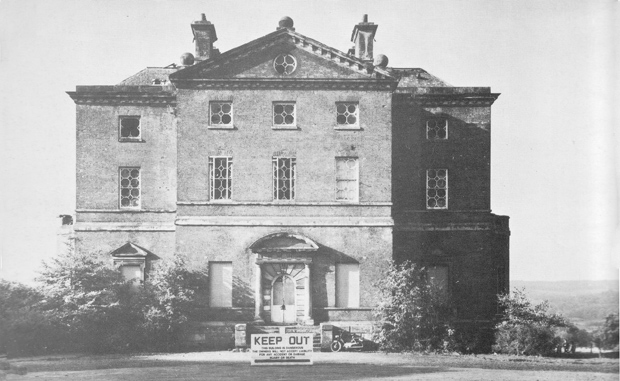
For those who prefer a real challenge then the next two houses could be ideal.  The first is Felix Hall, situated just outside Kelvedon, Essex – the picture (right) immediately showing the scale of the challenge.  At its core, this house is firmly in the tradition of the Palladian villa with a compact footprint but featuring wonderful architectural flourishes such a fine portico (added in 1825) and, to the rear, four engaged columns and a pediment.  Originally built between 1760-2, it was purchased by the Weston family of Rivenhall Place in 1793 and was significantly extended with flanking wings in the early 19th-century, possibly on the occasion of Charles Callis Weston’s  ennoblement as Lord Weston of Rivenhall in 1833.  However, as with many larger houses, a reduction in  size was thought prudent and so in 1939 the two wings were removed, leaving just a 7-bay central section.  Sadly, during the course of renovations it caught fire, completely gutting the fine interiors leaving the gaunt shell with the proud Ionic columns we can see today.  The remains were bought in 1953 and the basement rooms restored as an occasional country retreat but this is a house crying out for a full restoration (for which there is planning permission).  However, the estate buildings such as the nearby stables have been separately converted and there is only a small amount of land – it would be lovely if the new owner could also purchase the buildings and gardens and if they could also acquire the field in front, they could create a superb small parkland in which to truly display the house.

Piercefield House, Monmouthshire (Image: darkcell / flickr)

Another shell available is the one I would be heading for: Piercefield, near Chepstow, Wales.  Designed by the peerless Sir John Soane in 1785 for George Smith, the actual completion of the house was delayed until 1793.  Of particular interest  here is that the design is not entirely unique – Soane appears to have used very similar plans for Shotesham Park in Norfolk which was also built in 1785, although that house was brick with stone dressings, whilst Piercefield is faced entirely with stone. The house was sold 1794 as Mr Smith had run into some financial difficulties and it was bought by Sir Mark Wood who employed Joseph Bonomi to add a saloon and a winding staircase – though not the two pavilions as has been suggested.  The house was sold in 1926 by the Clay family, who had bought it in 1861, to Chepstow Racecourse who abandoned it, leaving it become increasingly derelict, apparently helped by American troops stationed nearby in WWII who used the house for target practice.  After 90 years of neglect, the house still has the power to impress with its refined façade and elegant temple pavilions.  Although on the market for over six years the price has remained at a rather ambitious £2m (although it does include 129 grade-I listed acres of parkland). However, recent comments by the director of the race course have indicated that they might entertain offers of around £1m; though, of course, the restoration bill would be many times that – but what a prize at the end!

Ruperra Castle, Wales (Image: Jeffrey Ross - Estate Agent)

Even further down the scale of dereliction is another important house, also in Wales, which has been stubbornly mis-priced.  Ruperra Castle near Newport is one of the few ‘mock’ castles designed for pleasure and not as defensive installations – a subject examined in more detail in an earlier blog post related to Ruperra: ‘Developer shows sense; Ruperra Castle for sale‘ (Sept 2010).  Few of these style of houses were built and Ruperra’s importance derives from it being one of the earliest of the country houses of this type, having been built in 1626.  Sadly, many of the other examples have been lost (most recently, fire gutting the interior of Lulworth Castle in 1929) so for someone Ruperra offers the opportunity to not only restore an architectural gem but also to be able to enjoy the same stunning views which attracted Thomas Morgan to build there in the first place.  Unfortunately, although the owner has now switched agents, the price is still ambitious at £1.5m – especially considering the immense challenges and costs of restoration and the location.  Hopefully, as with Piercefield, the owner ought to be willing to entertain realistic offers and allow the house to be saved before it is lost forever.

Perhaps the last is stretching it to call it a restoration opportunity as Bellamour Hall, Staffordshire now exists only as two walls and a few piles of stones!

Restoration is never a cheap or easy approach but the satisfaction and pride in knowing that the work has saved another part of our architectural heritage must be immense.  For too long our country houses have been under threat from neglect, vandalism and poor maintenance and the selection above (and there are more) show that the degrees of restoration and commitment required can vary dramatically.  That said, I can only hope someone is out there with the wealth and sensitivity to take on these houses and bring them back to life.

Possibly for sale – a landmark for landowners: Crichel House, Dorset

Crichel House, Dorset (Image: BNPS / Daily Mail)

When to believe the rumours? Occasionally one of the old families will decide that they no longer wish to hold onto the estate which has been the family seat for many years – sometimes centuries. When these estates come to market they usually attract a significant price-tag which truly reflects their beauty, significance and acreage.  If the unconfirmed rumours which feature very prominently on page 2 of the Sunday Times (26 June 2011) are to be believed, then the Marten family of Crichel House in Dorset have decided to sell – almost 60-years after the family won a decision against the government of the day which became a landmark in the rights of landowners against government.

Crichel House is widely regarded as one of the best houses in the county – indeed, John Julius Norwich states that it “…possesses the most spectacular series of state rooms in all Dorset.“.  Crichel started off as a modest house in 1743; hastily built to replace a charming Elizabethan house which was burnt down in 1742.  This smaller seat of a country squire – brick-built and just five bays by seven – was for Sir William Napier, who left it to his nephew, Humphry Sturt, in 1765.  Sturt had inherited not only his uncle’s house and wealth but had also married well. He didn’t feel the house was grand enough for a man of his fortune, and so embarked on an impressive rebuild, creating a house “…so immensely enlarged that it has the appearance of a mansion of a prince more than that of a country gentleman.” (Hutchin’s ‘History of Dorset‘ – 1774).

Dining Room, Crichel House, Dorset (Image: A. E. Henson / Country Life Picture Library)

Sturt, using an unknown architect (though thought to be from nearby Blandford), effectively wrapped a new house around the old one to the east and the west, and linking the two on the south front with an impressive recessed portico and suite of rooms on the first floor.  However, the need to accommodate the dimensions of the old house created a slightly cramped feeling to the first floor elevations.  However, all is forgiven by the splendid interiors which are, in parts, a curious mix of early Georgian created late (e.g. the staircase, the library), and fashionable later Georgian, particularly in the stunning Hall, Dining Room and Drawing Room where Adam-style plasterwork reigns.  The latter rooms were probably designed by James Wyatt who was working nearby at Milton Abbey and at Bryanston.  The Dining Room is considered the finest room in the house; a coved ceiling framing delicate plasterwork and decorative panels in the style of Cipriani and Angelica Kauffmann.

So, how did part of the Crichel estate become so significant that it became immortalised as a set of planning procedures known as the ‘Crichel Down Rules’? In part, it was due to the bureaucratic arrogance of the post-War era which meant the Civil Service felt able to deal rather high-handedly with anyone, and particularly landowners who were not popular under Attlee’s socialist government. In 1937, 742-acres of Crichel Down had been compulsorily bought as part of a larger area for use as a bombing range. Churchill had given a very public commitment in the House of Commons in 1942 that land purchased in this way would be offered back to the original owners once it was no longer required for the original purpose.

Hinton Ampner, Dorset (Image: ec1jack / flickr)

However, there was an even greater danger of compulsory purchase for houses which had been adapted for wartime use under the ‘Requisitioned Land and War Works Act (1945)’ (sections 8 & 9 Geo. 6 c.43 in case you were wondering!) which gave officials the right to buy, regardless of the wishes of the former owner or any previous assurances. At Hinton Ampner in Hampshire where Ralph Dutton (the 8th and last Lord Sherborne), having just finished an extensive remodelling in 1939 only to be turfed out by a girls school, received a letter saying that the Royal Observatory were interested as a new Royal Observatory.  Dutton took the day off work at the Foreign Office and was on the doorstep when the officials arrived and gave an impassioned speech about the importance of the house, how it had been in the family for generations and that losing it would be akin to an amputation. The officials apparently looked somewhat embarrassed but gave no sign of retreating until a short note arrived a little later confirming that they were taking Hurstmonceaux Castle instead.

At Crichel Down, the government had decided to retain the land as a new model farm.  Lt-Cdr George Marten (who had married Mary Sturt, the only child of the 3rd Lord Alington), began a vigorous one-man campaign to examine the conduct and procedures of the relevant departments.  In doing so, he exposed a series of administrative errors as officials tried to evade the requirement to offer back the land and retain it for the government’s use.  Eventually, in 1954, public and press criticism led to the minister in charge, Sir Thomas Dugdale, resigning in one of the first examples of a minister taking responsibility even though he had not been involved in the earlier decisions and the land was sold back to the Martens.  To avoid a repeat of such failings, new planning rules regarding compulsory purchase were drawn up which are today known as the ‘Crichel Down Rules’ and are a vital part of the framework protecting landowners from the sometimes autocratic decisions of officials.

The death of Mary Marten in 2010 (her husband pre-deceased her) led to the recent sale of some of the contents of the house including a small collection of Asian jade ornaments which raised some £12.5m.  However, if the rumours are right, the rest of the house and 5,000-acre estate are also quietly on the market with an estimated price tag of around £100m, which, if it sold as a whole estate, would make it the most expensive sale ever outside of London.  It’s always a regret when families no longer wish to keep an estate which has been in the family for centuries, however, with the demands of sibling equality it is understandable that each of the six children – five females, one male – should wish to share their inheritance.  It would be a wonderful outcome if it could be bought in its entirety and remain one of the most important estates in Dorset, with the glorious Crichel House at it’s heart.

————————————————————————-

Update – 7 July 2013: Crichel House has been sold

Daily Mail confirms that the house plus 400-acres has been bought by Richard L. Chilton, a US hedge fund billionaire.  Initial reports indicate that he is a ‘conservationist’ having rescued other houses in the States so it seems promising that he is the right buyer; one with both the right attitude and pockets deep enough to do the house justice.  Though sadly it’s the end of an era for the Marten family, one hopes that this next phase will see the house restored to its former glory.

And if Mr Chilton happens to read this, it would be great to get your perspective – please do email me.

————————————————————————-

More images – both interior and exterior: ‘Crichel House, Dorset‘ [Country Life Picture Library]

‘Take a Chance on Me’ – Buildings at Risk Register 2011

'Take a Chance on Me' - 2011 SAVE Buildings at Risk Register

Despite the obvious deep and passionate interest society has with historic buildings every year the SAVE Britain’s Heritage Buildings at Risk Register highlights just how many properties are still under threat from neglect and those in power who believe the only good building is a new one with their name on the opening ceremony plaque.  The 2011 BaR register – ‘Take a Chance on Me‘ – has just been published and sadly, as always, it contains some country houses which really deserve a better fate.

Perhaps the one of the most attractive, both architecturally and in terms of being a  case for restoration is Blackborough Hall, near Cullompton in Devon. This elegant, if thoroughly dilapidated grade-II house, is a remnant of the grand building plans of the Earl of Egremont whose many-columned main house, Silverton Park, was demolished in 1902.  The house is actually two, as when built in 1838, it formed one house at the front and a second at the rear for the local rector.  In recent years it became a car scrap yard which covers most of the immediate grounds and would obviously need clearing first – though I suspect the costs could be made back through selling some of the classic cars. The house is currently for sale for a nice round £1m and has been listed with Winkworths who, after an initially poor showing, have now managed to put a few more photos and a floor-plan online.

Elvaston Castle, Derbyshire (Image: Steve Tomkinson / Friends of Elvaston Castle)

Elvaston Castle in Derbyshire has a grade-II* listing putting it in the top 4% of buildings nationally but that hasn’t stopped it making an entry into the Register this year.  Originally built in 1633 for the Earls of Harrington it was largely rebuilt in a ‘Gothick’ style c.1817 to designs by James Wyatt.  Now owned and managed by Derbyshire County Council (who had a fairly poor record in the 20th-century of demolishing country houses in their ‘care’) it is today mostly vacant and with the Council now claiming it can’t afford to maintain it they are seeking a developer to get them out of a hole of their own making.  Luckily an active local campaigning group – the Friends of Elvaston Castle – have been objecting to these plans and trying to force the Council to face up to their responsibilities – though perhaps there is an opportunity for someone else to come up with a viable plan.

Stone Cross Mansion, Cumbria (Image: HiddenShadow / 28dayslater)
Stone Cross Mansion, Cumbria (Image: HiddenShadow / 28dayslater) - click for more images of the house today

Stone Cross Mansion, Cumbria presents the interesting confusion of a Scots Baronial design in England.  Built in the 1870s by a stubborn man, one Myles Kennedy, who wanted to buy Conishead Priory for £30,000, but who met an equally stubborn vendor who wouldn’t accept less than £35,000.  Mr Kennedy may have come to regret his obstinacy when presented with the final bill which totalled nearly £45,000.  The sum reflected the high quality of the workmanship, particularly the impressive High Victorian Gothic grand hall (scroll down) which originally had a fine staircase which was later removed when the house became a special school to make it easier to play indoor football (seriously, where do they find these people?!).  The house then became a corporate headquarters during which it time it was restored to a high-standard before falling into neglect.  Repeated enabling development proposals have been rejected (not that the council is against it) so this house either needs someone willing to restore the house on the back of a sensitive ED proposal – or, ideally, someone to rescue this house and make it a home again.

Plas Gwynfryn, Wales (Image: SAVE Britain's Heritage)

Another house which would make a fantastic home is Plas Gwynfryn in south Wales.  This house has been featured before on this blog (‘Orphan seeks new carers: Plas Gwynfryn, Gwynedd‘) which sparked some passionate debate in the comments about who the owner is – and that same unresolved question is why the house makes an appearance in the BaR this year. Built in 1866 to replace an earlier one, this distinctive house – described in the listing description as ‘romantically assymetrical’ – was a hospital in WWII, before becoming an orphanage and then a hotel before a serious fire in 1982 gutted it.  Although in a derelict condition this house can be restored and would once again be a fine part of the local architectural heritage.

The Register is available from 1 June 2011 priced at £15 (£13 to Friends of SAVE) and can be ordered from the SAVE website. The BaR contains many other types of property so even if your budgets are less lavish than these house might require it is well worth having a look.  Of course, SAVE does superb work across the country to protect our architectural heritage and I would strongly urge everyone to become a Friend to help support their efforts (well, I would say that as I’m on the Committee – but I’d also say it anyway!) which will also give you access to the online version of the BaR register which contains hundreds of other potential future success stories.

——————————————————————————–

A more comprehensive list of country houses currently at risk can be found on my Lost Heritage website: ‘Houses at Risk