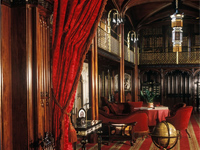
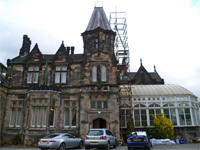
Country House Rescue – Series 4: Meldon Park, Northumberland

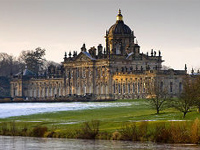
Meldon Park, Northumberland (Image: Meldon Park)

One of the joys of Country House Rescue is to bring to light some of the lesser known houses. The subject of this week’s edition (12 July, 20:00, Channel 4), Meldon Park in Northumberland, can certainly be said to be one of the ‘illustrious obscure‘.  This is also perhaps an apt description of the architect, who was one of the most prolific in the north east of England yet surprisingly little known beyond that, though the house also features later work by another who was certainly famous. Yet, such noble associations do not pay the bills so, despite a 3,800-acre estate, the Cookson family have called in the services of Simon Davis to provide ideas to help keep the house in the family.
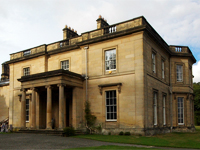
Entrance front, Meldon Park (Image: lawrencecornell via flickr)

Meldon Park is certainly an elegant essay in the neo-Classical; golden brown sandstone in a compact and elegant design with some superb subtle detailing which denotes the hand of a finer architect.  The entrance front, though only three bays wide, features a grand porch with four free-standing (or ‘tetrastyle prostyle’ if you’d prefer the architectural terms) Ionic columns, projecting from a slight recession of the middle bay, with the corners of the building marked by shallow pilasters.

The architect of the now grade-II* Meldon Park was the regionally prolific John Dobson (b.1787 – d.1865) – a name famous in the north east but, due to his geographic focus, one less known nationally.  Dobson was born in Chirton, County Durham, and showed an early talent for drawing which led, at the age of 15, to his becoming a pupil of leading Newcastle architect David Stephenson.  On completing his studies in 1809, Dobson moved to London to develop his skills further, studying under the famous watercolourist John Varley. In London, Dobson became friends with the artist Robert Smirke and his two architect sons Robert (who designed the main facade of the British Museum) and Sydney (who later married Dobson’s daughter).  Despite the urging of his friends to stay in London, Dobson moved back to Newcastle where he established his practice, becoming (reputedly) the only architect between York and Edinburgh, except for Ignatius Bonomi in Durham.

Jesmond Towers, Newcastle (Image: GeordieMac Pics via flickr)

Dobson proved to be an exceptionally capable architect; not only could he produce beautiful and convincing watercolours of proposed projects, he was also technically competent, to the extent that his daughter claimed he ‘…never exceeded an estimate, and never had a dispute with a contractor‘. Dobson is perhaps best remembered for designing much of central Newcastle, and in particular, the beautiful curved train shed at the Central station.  Despite his urban output, Dobson was also extensively involved in projects outside of the towns, designing or altering over sixty churches and more than a hundred country houses; the latter principally commissioned by the beneficiaries of the wealth of the Industrial Revolution. Dobson was a rare architect in that he was competent in designing in both the picturesque style of Tudor Gothic (such as at Beaufront Castle and Jesmond Towers) and the classical style of the Greek Revival – and it was in the latter that he truly excelled. Although Howard Colvin praises his careful siting of the houses, high-quality finish and precise and scholarly detailing, he thought Dobson had a tendency to exaggerate the scaling, creating an overall look which might be considered bleak. Yet, this is more an academic criticism; those today looking on the many houses he worked on would consider them to be handsome examples of the flourishing of the country house which resulted from the new wealth in the north east.
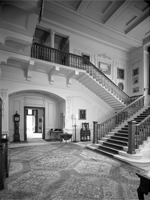
Stair hall, Meldon Park (Image: Country Life Picture Library)

Meldon Park was to be one of Dobson’s finest of his Greek Revival designs.  Built in 1832 for Isaac Cookson, at a cost of £7,188 1s 1d (about £5m today if compared with average earnings), it was a sizeable house with extensive service accommodation and extending to a beautiful Orangery, even if the main house was comparatively small.  That said, the rooms are bright and well-proportioned with a grand Imperial central staircase, with its deep coffered ceiling described by Pevsner as being ‘the size of one in a London club‘.  The staircase was later reworked by no lesser figure than Sir Edwin Lutyens, who replaced the original metal balustrades with wooden ones and added decorative plaster panels.

Isaac Cookson was the third generation to manage the family manufacturing interests and had taken charge of his father’s glass works, developing them into one of the country’s leading makers, along with a very successful chemical works.

Longhirst Hall, Northumberland (Image: Longhirst Hall Hotel)

Cookson had previously employed Dobson to design part of a speculative urban development in Newcastle and combined with his earlier country house work at neighbouring Mitford Hall, Longhirst (with its striking entrance portico) and Nunnykirk halls, Dobson was a natural choice when looking to create his refined country seat.

As owners of a glass works, it was natural that the house would be well-lit; the bright interior a result of the large windows which graced the main rooms on the south and east sides.  Yet, Meldon Park actually marks a turning point.  The brilliant Mark Girouard, writing in Country Life in 1966, pointed out that:

In rooms like this, one realises just how much Georgian architecture developed in the course of the late 18th and early 19th centuries, as windows grew bigger and more and more effort was made to link the inside of the house visually with the landscape.  Meldon shows the development at its final stage; soon a reaction was to begin and the Victorians turned away from the sun and immersed themselves in increasing gloom.   In this as in other aspects Meldon represents in a very convincing way, the last flowering of the Georgian country house tradition.

So Meldon Park represents not only the work of one of the finest architects to have worked in the north east but also marks a key point in the development of British architecture; the high-water mark of Georgian elegance before the more insular and muscular Victorian style swept over the north of England.  The house is also one of those rare survivals where it is still owned and lived in by descendants of the person who commissioned it, sitting in its own huge estate.  This is a house which seems to be clearly loved by the owners who have worked incredibly hard to ensure they can remain there especially when the house is less of an attraction for visitors as previous generations had sold the art collection.  Judging by their new website and other news stories about their expanded and diversified activities it seems that they were also willing to listen to Simon Davis’ advice and act on it and such pragmatism can only be applauded and will hopefully be rewarded.

——————————————————————————

Official website: ‘Meldon Park

Photos from Country Life: Meldon Park [Country Life Picture Library]

Listed building description: ‘Meldon Park, Northumberland‘ [British Listed Buildings]

Want to stay there? Meldon Park: East Wing Apartment

Country House Rescue – Series 4 [Channel 4]

Country House Rescue – Episode 5 [Channel 4]

For more information about the architect: ‘John Dobson 1787-1865: Architect of the North East‘ – Thomas Faulkner & Andrew Greg

Country House Rescue – Season 4: Colebrooke Park, N. Ireland

Colebrooke Park, Co. Fermanagh, Northern Ireland (Image: Colebrooke Park)

Country House Rescue has proved to be one of the most interesting of programmes featuring the many varied mansions which the UK is lucky to enjoy.  Rather than the more glamorous recent series showing life at Chatsworth, or Jeremy Musson’s brilliant ‘Curious House Guest‘, Country House Rescue has shown the sometimes harsh reality of owning these homes, despite the lazy jibes in the wider media about families living in a state of supposed luxury.  The programmes have shown the hard work and sense of duty these families possess, though this is sometimes overshadowed by the friction which change can bring, and which is often what is broadcast.  Yet, with a new presenter for the new series (starting Thursday 14 June), perhaps the commitment of the owners and the sheer beauty of their houses will come more to the fore.

In the first three series, Ruth Watson has proved to be an entertaining, if no-nonsense, deliverer of some rather stark home truths to owners up and down the country. For series four, a new presenter, Simon Davis, (favourite houses: Sezincote, Blenheim, Mount Stuart, Villa Emo, Babington House) takes the helm and steers a more collaborative and involved course as he stays at the houses, with the families, to experience their day-to-day life, including the hardships; at one house he spent an extremely cold night after the family admitted they never turn on the heating as it costs £30 per hour to run. It will be interesting to see how the new messenger is received and whether a less assertive style will bring greater success – though many will undoubtedly miss Ruth’s acerbic commentary.

The houses to feature in the new series are now known: Colebrooke Park, Bantry House, Chapel Cleeve Manor, Craufurdland Castle, Great Fulford, Meldon Park (thank you Andrew); starting with Colebrooke Park in Co. Fermanagh in Northern Ireland; the first time the show has been to that part of the UK.

Colebrooke Park is a fascinating example of the varied fortunes of the country house over the last two centuries; a story marked by wealth and also decline, but also one driven by a continued commitment to a house by generations of one family. Home to the Brooke family for over 350 years, the current owner, the 3rd Viscount Brookeborough (a prominent peer, one of the 92 hereditaries sitting in the House of Lords) received what many would regard as an unenviable inheritance in 1980 when he took on the decaying and empty family seat.

Of course, as with many houses, they had had a heyday.  Once the centre of one of the five largest estates in the area, which had reached a peak of almost 28,000-acres in 1876, the house had been home to a succession of prominent politicians and soldiers including the 1st Viscount, the longest serving Prime Minister of Northern Ireland (1943-63). However, agricultural changes, taxation, and the Troubles, meant that the estate slowly shrank to just over a thousand acres, with a similarly reduced income insufficient to maintain a house of this size.

Castle Coole, Northern Ireland (Image: Stephen McKay / Geograph.ie)

The house itself is a rather austere neo-Classical design; a two-storey, nine-bay block only enlivened by a grand pedimented portico with Ionic columns.  The house was built in 1820 for Henry Brooke (b.1770 – d.1834) who was created a baronet in 1822 (second creation), as a statement of his position, but one which was to be built on a budget – though a substantial one; the house was completed for £10,381 – approx £7m today.  Sir Henry had inherited the house and estate from a rather profligate uncle and clearing the debts and establishing a comfortable fortune had taken three decades – the house was a reward and a monument to his sound management.  Despite being a cautious man, Sir Henry still succumbed to the suggestions of his architect that he compete with the nearby Castle Coole by James Wyatt (built 1790-97), increasing the dimensions of the house so that it was larger, and then later in the summer, approving the enlargement of the Library to 36ft by 18ft.

Rise Hall, Yorkshire (Image: Pastscape)

For those who regularly watch TV programmes featuring country houses, Colebrooke Park may trigger a vague sense of deja vue.  This is because the house is, bar a few details, quite similar in design to Sarah Beeny’s Rise Hall in Yorkshire (mentioned in this previous blog post).  Both houses were built around the same time but by different architects; Colebrooke in 1820 by William Farrell and Rise Hall in 1815-20 by Watson and Pritchett.  Yet it is likely that this was more co-incidence than copying as there is a clear architectural lineage for the ‘rectangular block with portico’ style of house which goes back to Colen Campbell‘s masterpiece of architectural propaganda, Vitruvius Britannicus.  Published in 1715, this collection of designs helped shift the national preference away from the more florid Baroque houses of Vanbrugh toward a simpler architectural style; one which Campbell himself exemplified with his quite radical first design for Wanstead Hall, Essex. Although Wanstead as built was significantly different in the detailing, the core architectural idea was for a rectangular central block, fronted by a bold, pedimented portico.  This was to be one of the most influential designs produced by an architect; shaping national taste, it was widely imitated for decades afterwards – see Prior Park in Bath, built in the 1730s and 40s, and Adlington Hall, Cheshire, built in the 1750s, and even today.  Of course, this design is a derivative of the rectangular, double-pile plan developed by Sir Roger Pratt at Coleshill, Berkshire (built 1650-64, burnt down 1952).

Wanstead House I by Colen Campbell - first proposed design - 1715
Wanstead House I by Colen Campbell – first proposed design – 1715

Despite the grandeur, the agricultural depression in the 1880s hit the estate and the decline began. This was only arrested by the return in 1918 after WWI of Sir Basil Brooke who instituted changes to bring the estate back. It was, though, a struggle; many rooms were left unused in the 1930s and by 1939 the timber was being felled as ‘the only way to save Colebrooke’.  Poor tax planning meant that when Lord Brookeborough died in 1973 the contents of the house had to be sold to pay the death duties, leaving a rather forlorn house for the present Lord Brookeborough when he took over in 1980.  Realising the scale of the challenge, an architect was engaged to explore what options were available; including the dreaded conversion to a golf club with the grounds becoming fairways.

Colebrooke Park, Northern Ireland (Image: Colebrooke Park)

Luckily, a better solution was found; the house became an exclusive country sports destination, with sporting rights over 10,000-acres and the Viscount and Viscountess welcoming the guests as though friends into their home.  The house was sensitively adapted to meet both the requirements of discerning visitors and official regulations whilst preserving the architectural fabric of the house to the greatest extent.  Despite their success, the Viscount and his wife wish to pass on the house and 1,100-acre estate to their nephew in an even more robustly healthy condition; hence the invitation to Country House Rescue.   It will be fascinating to see if this series presents radically different ideas to those proposed by Ruth Watson.  Obviously one hopes that whatever happens, the solutions enable the families to remain in their homes whilst providing sufficient income to not only maintain them but invest in them to give them a stronger future.

—————————————————————

A more detailed history of Colebrooke Park [Colebrooke Park]

TV makeover for stately home‘ [Belfast Newsletter]

Country House Rescue – Series 4 [Channel 4] – Colebrooke Park (episode 1: Thursday 14 June – 20:00)

Country House Rescue – Series Listing [Wikipedia]

‘On behalf of a grateful nation’: country houses given to military leaders

Nations have always found ways to reward those subjects who have rendered some greater or lesser service.  In earlier centuries, this often took the form of positions at Court which came with a salary, prestige, and unrivalled opportunities to feather one’s nest.  Titles have also always been popular, ranging from a baronetcy for those who have hosted the monarch for a weekend, to dukedoms and earldoms for the upper echelons of Court and on the battlefield – and it’s this latter category who have also enjoyed that rare gift of an entire country estate, in recognition of their services.  Such largesse is now unthinkable but the practice of rewarding military leaders in this way only fell from favour perhaps later than might be imagined.

Blenheim Palace, Oxfordshire (Image: Blenheim Palace via flickr)

The grandest and most spectacular of these gifts is Blenheim Palace in Oxfordshire – though the intrigues for both monarch, recipient, recipient’s wife, and architect make it something of a mixed blessing.  The recipient was certainly worthy of such a grand prize; John Churchill, 1st Duke of Marlborough had risen through numerous victories to elevate and secure Britain’s place in the world, defeated the ambitions of various European leaders, and created the peace which ushered in the Georgian era.  These glorious victories provoked such a feeling of patriotic pride that even his critics praised him.  So how to reward such a man for such remarkable achievements?

Great Hall and Eastern Corridor, Blenheim Palace (Image: Country Life Picture Library)

Blenheim Palace was to represent many things – explicitly a national monument to the defeat of Louis XIV’s plans for European domination at the Battle of Blindheim in 1704, the considerations of it as a house were somewhat secondary. It embodied the idea that whereas previously the glory of the nation was demonstrated through the palaces of the Monarchy, Blenheim was the first which sought to do this though a private individual.  However, Marlborough’s close ties with Queen Anne would inevitably mean the prestige would reflect onto her and the nation. Work started in 1705 and, writing in 1709, the architect of the house, Sir John Vanbrugh stated,

‘Tho’ ordered to be a Dwelling house for the Duke of Marlborough and his posterity [it was] at the same time by all the world esteemed and looked on as a publick edifice, raised for a Monument of the Queen’s glory.’

The Queen had already resolved to gift the estate at Woodstock but the agreement on paying for the construction of the house was a murkier affair.  Royal patronage could cut both ways as the Marlboroughs and Vanbrugh found out.

Vanbrugh was the ideal choice for a building of this nature.  His background in theatre design gave him an understanding of dramatic effect and his relative inexperience and lack of formal training meant his imagination was bolder than others.  The commission at Blenheim required such a mind; the resulting spectacular building was a monument to power and prestige, incorporating military forms and details to reflect the occasion, but was also one of the most complete expressions of English Baroque.  Yet despite his fabulous wealth, the Duke was determined that the state would show its gratitude by paying for the construction, though he had originally intended the budget to be no more than £40,000 (approx £5m).  Wren had estimated £90,000 – £100,000, however the final cost totalled nearly £300,000 (approx £38m) for which the Treasury eventually was liable (proving that for government projects it was ever thus!).

Castle Howard, Yorkshire (Image: Castle Howard)

Such overruns were to be expected where the intention had been to build something like Castle Howard – only bigger. However, the Duchess opposed such a scheme saying: ‘I never liked any building so much for the show and vanity, as for its usefulness and convenience.‘ With such an attitude, friction with Vanbrugh was inevitable. Political changes hadn’t helped; a new government and Treasurer in 1710 slowed payments to almost nothing.  In 1711, the Duchess also fell out quite acrimoniously with her childhood friend, the Queen, leading, in part, to the Duke losing his official posts and the Marlborough’s going into self-imposed exile.  The accession of George I in 1714 brought them back into favour and work progressed again, though constant conflict between the Duchess and Vanbrugh led to his resignation in November 1716, saying: “You have your end Madam, for I will never trouble you more.  Unless the Duke of Marlborough recovers so far [he had suffered a stroke in 1716], to shelter me from such intolerable Treatment.‘ Work proceeded under Vanbrugh’s right-hand man, Nicholas Hawksmoor, to the original plans, with the family taking up residence in 1719, and work largely complete by 1725. Sadly though, the Duke never got to see this, having died in 1722; his monument incomplete, his reputation assailed, and his architect grievously estranged from his masterpiece.

It seems only some of the lessons of Blenheim had been remembered by the time the next gift was proposed for an equally illustrious general, Arthur Wellesley, 1st Duke of Wellington.  Again, a superb leader who had defeated plans for European domination, Wellington – the Iron Duke – was certainly worthy of such a reward. Rather than receiving a direct gift from the monarch, it was decided that the nation would provide £600,000 (approx £38m) for the purchase of an estate and the building of a suitable house. Rather than just provide the money, in 1817, Parliamentary trustees were appointed to oversee the purchase.  The Duke knew his limitations and called upon the architect Benjamin Dean Wyatt (son of James Wyatt) who promptly, even before a site had been found, drew up plans for a ‘Waterloo Palace’ which, in his words, would have “…a very magnificent & imposing effect” without “the monstrous expense of a Fabrick extended to the dimensions of Blenheim [or] Castle Howard“.  Despite his professed aim, this would have been an enormous house; designed around three sides of a courtyard, it featured two flanking pavilions, with the main house centred on a huge domed hall, with suites of grand rooms surrounding it.  Perhaps of particular interest was the severely Neo-Classical decoration, with few of the architectural flourishes which distinguish Blenheim.  This might have reflected the notably austere Duke’s taste but even this plan was rejected.

Stratfield Saye, Hampshire (Image: Historic Houses Association)

Given the Duke’s preference to be near London, the house and estate chosen was Stratfield Saye in Hampshire, after rejecting Uppark in Sussex due to the poor land, and was bought from the Pitt family for £263,000; a significant portion of the funds available. Though this may have been a factor in the eventual rejection of the plans in 1817, another was that the Duke was in the process of spending £40,000 anonymously purchasing Apsley House in London, for the use of his almost bankrupt brother who had previously lived there with his soon-to-be-ex wife.  That house also required significant work and, faced with the need to maintain two houses, the Duke abandoned the plans for the new palace, and concentrated on updating and modernising the existing house at Stratfield Saye.  Both houses are still lived in by the Wellesley family, though Apsley is now part-owned by English Heritage and open to the public – and absolutely worth a visit if in London.

Bemersyde House, Scotland (Image: Kevin Rae / Geograph)

We may think the practice of the nation buying a country seat for a military leader was the product of the more deferential Georgian and Victorian eras when such actions by government would be less subject to widespread scrutiny, but the latest example occurred in the 1920s.   Field Marshal Douglas Haig, 1st Earl Haig, was a controversial figure as commander of British forces in WWI. Although he won, the horrendous loss of life left him with battered reputation which has only recently been revised. In the immediate aftermath of WWI, we, the victors, did feel grateful and Haig was created the 1st Earl Haig (with a subsidiary viscountcy and a subsidiary barony), given the thanks of both Houses of Parliament, plus £100,000 (though he had asked for £250,000) to enable him to live in the manner befitting a senior peer.  Haig chose Bemersyde House in the Scottish Borders, originally built in 1535 as a pele tower, to become, as it still is, the seat of the Haig family, the purchase funded by the grateful taxpayer.

Cefntilla Court, Monmouthshire (Image: Knight Frank)

It wasn’t only the ultimate leaders who could benefit from public largesse, though in the case of Cefntilla Court, Wales, the gift missed the mark by a generation.  Field Marshal FitzRoy James Henry Somerset, 1st Baron Raglan, was the Duke of Wellington’s right-hand man who was later blamed (then exonerated) for the huge losses resulting from the ill-fated Charge of the Light Brigade in the Crimean War.  Lord Raglan’s health suffered from the stress of the campaign and he died whilst on duty in June 1855.  However, such was the admiration for the man that a ‘Raglan Memorial Committee’ was formed and by 1858 was able to present Cefntilla Court, as commemorated by a plaque at the house which reads:

This house with 238 acres of land was purchased by 1623 of the friends, admirers and comrades in arms of the late Field Marshal Lord Raglan GCB and presented by them to his son and his heirs for ever in a lasting memorial of affectionate regard and respect.

Sadly, it seems that ‘for ever’ is a shorter time than they imagined as the house and estate are now for sale following a strange inheritance whereby the 5th Lord Raglan wrote his younger brother, now the 6th Lord Raglan, and the brother’s son, out of his will.  The house was instead left to another nephew, Henry van Moyland, who currently lives in Los Angeles and works as a recruitment consultant. With no deep ties to the estate, he has chosen to sell, splitting the title and estate for the first time since the gift was bestowed.  Legally, there is nothing to be done but it does seem regrettable that the whim of one Lord Raglan should lead to such an outcome, especially as it was the express intention of the donors that it should remain in the family.

That said, it is remarkable that three out of the four houses featured here are still owned by the families who were given them – a continuous link to the thanks of the nation as expressed through architecture and prestige. Though it may not happen now, or again in the future, such gifts are another part of the rich tapestry of our country house history.

——————————————————————–

Sales particulars: ‘Cefntilla Court‘ [£2m, 350-acres – Knight Frank]

More details: ‘The disinheritance of Lord Raglan’s nephew and future title holder causes split in family‘ [Wales Online]

“To add a library to a house is to give that house a soul”; the rise of the country house library

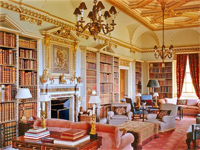
Long Library, Eastnor Castle, Herefordshire (Image: Eastnor Castle)

In country houses, perhaps the greatest indulgence is to be able to create on a much grander scale. Not for them a few flowers beds; no, there are acres of careful horticulture, nor do they have small dining rooms, or a few pictures.  Yet few rooms in a large country house are as impressive as one which boasts a well-stocked library; regimented rows of bound knowledge, reflecting the interests and passions of generations. Yet libraries are more fluid than many imagine; with their creation sometimes comes their dispersal, but this is a cycle, with those books then finding another shelf, helping build the portrait of their new owner, one title at a time.

Books have always had a greater intrinsic value than just the words or knowledge they contain.  Having developed from clay tablets, via way of papyrus, to animal skins, books became spectacular art works in their own right in the hands of the monasteries whose illuminated manuscripts spoke of their devotion through beautiful calligraphy and iridescent miniature paintings. The effort involved made them scarce so the wider collecting of books largely only became possible due to mass production following the invention of the printing press by Johannes Gutenberg in 1439.

Although books had formed part of the interests of the royal family since the 14th-century, it wasn’t until the rise of the post-Reformation Tudor bureaucrats who, influenced by the Renaissance, sought to use knowledge, rather than battle prowess, as their means to advancement.  Education was now seen as key and this was reflected in the growth and composition of the gentleman’s library for centuries to come.  Yet, there were still a remarkable number of the gentry who had little interest in books, a trend which grew stronger the further from Court they lived; Girouard notes that in the 1560s, ninety-two out of 146 Northumberland nobles were unable to sign their name, and that in 1601, Bess of Hardwick kept only six books at Hardwick Hall.

Library (1675), Ham House, Surrey (Image: Country Life Picture Library)

As intellectual pursuits became more acceptable so too did acquiring books in larger numbers.  Paintings of ‘gentleman’s closets’, which held all things most precious to the man of the house, often showed books, and in quantity; an inventory in 1556 for Sir William More at Loseley in Surrey records that he had amassed 273.  Earlier libraries are recorded for the fifth Earl of Northumberland who had created both ‘Lord’s’ and a ‘Lady’s’ libraries by 1512 at Leconfield Castle (demolished 17th century). By the late 16th-century there is the first written reference to the building of bookcases in the form we recognise today; two French craftsmen were working at Longleat in 1563 fitting out the library there (though it was sadly lost in the fire in 1567).  The earliest dedicated library to survive in a private house is at Ham House, Surrey which dates from 1675, installed for the Duke of Lauderdale.

Long Library, Holkham Hall, Norfolk (Image: Holkham Hall)

So how did we arrive at the grand, sumptuous libraries which grace many country houses?  As with so much of that which is beautiful, the elevation of the library can be largely attributed to the Georgians.  The right of passage that was the Grand Tour meant that, increasingly, a wealthy young man would return from several years in Italy having (hopefully) spent his days studying ruins, architecture, art, and sculpture – and, as with all good tourists, he accumulated souvenirs.  Not just any old trinkets; these mementos took the form of paintings and freshly faked statuary but also many books, not only for their education, but also as a way of demonstrating to those back home the wonders which they had seen.  This led to the creation of some of the finest libraries in the country, such as the Long Library created by Thomas Coke at Holkham Hall, as the intellectual interests of the owner found expression through the hundreds, if not thousands, of leather-bound tomes which now lined a dedicated room.

Nanswhyden House, Cornwall (Image: courtesy of Charlie Hoblyn)

Books were now not just the exclusive interest of the man of the house but had become a resource for the whole family and their guests. With the upper-classes now expecting a certain level of culture from those in their social sphere, education became an important part of polite society. To have a library was a reflection on the owner, who gained from them even if he hadn’t read them. Owners provided access to their books to their guests but, as the works were probably also the only significant source of knowledge for many miles, to a select few in local society.  One notable example was at the grand Nanswhyden House, Cornwall which was built in 1740 by Robert Hoblyn and featured a library which “…occupied two rooms, the longest of which was 36ft in length, 24ft broad and 16ft high…” and contained over 25,000 volumes.  Hoblyn intended that his books were “…designed as a standing library for the county, to which, every clergyman and author, who had the design of publishing, were to have the readiest access.”

Library (before the fire), Sledmere House, Yorkshire (Image: Country Life)

There was also unofficial access for the staff; at the beautiful Sledmere House, Micheal Kenneally, who arrived as pantry boy and rose to be butler, recalls that when he first arrived he was told to familiarise himself with the house.  In the Library, he noticed a book called ‘Miller’s Sexual Systems‘ on a shelf. “I thought, I’ll read that when I get the  chance. It was seven years before I got the opportunity, and when I opened it, it was the sex life of plants and flowers. After waiting for seven years!“.  The decoration of the Library at Sledmere was designed by the  celebrated plasterer Joseph Rose (b.1723 – d.1780) and completed in 1794.  So proud was Sir Christopher Sykes of this fine and elegant space, he commissioned local draughtsman Thomas Malton to record it.  Two hundred copies of the finished drawing were then created, which Sir Christopher sent to his friends, virally spreading the glory of a spectacular library.  Christopher Hussey, writing about it in 1949, said ‘architecturally designed libraries are a feature of several of Adam’s country houses, notably Kenwood. But this one surpasses them all in majesty of conception, suggesting rather the library of a college or learned and wealthy society; indeed in the space allotted to it, in the amount of shelf room, and in the beauty of its decoration it is surely the climax of the Georgian conception of the library as the heart and soul of the country house‘. Sadly, the original was destroyed in a devastating fire in 1911, though luckily the family still had the original plans, in addition to photographs taken by Country Life in 1897, and so it was rebuilt to exactly the same design as before – after all, how can one improve on such a fine room.

Library, Arundel Castle, Sussex (Image: Country Life)

The role of the library changed in the Regency and Victorian periods.  During the day it was the informal family sitting room, but during evening entertaining it took the mantle of drawing room for the gentleman, as opposed to the formal drawing room which increasingly became the domain of the ladies.  As such, it reflected the status of the man of the house, becoming more masculine, but also richly decorated and furnished to ensure that guests would be comfortable as they admired their surroundings.  Notable libraries of the period include the gloriously gothic Arundel Castle (see also: article in Country Life), the elegant Tatton Park, and the simply spectacular Eastnor Castle (see image at top of the article).

The county house library perhaps reached its zenith in the 1880s as often stable ownership had accumulated a wealth of some of the finest books ever produced.  The intellectualism of the Georgian and Victorian eras had elevated knowledge and learning and exploited them to create the wealth which now funded the artistic pursuits of the social elite.  For all the appreciation of books, notable libraries such as the collection at Stowe had been auctioned off in the 1820s, and following the agricultural depression of the late 19th-century, many libraries up and down the land were plundered as a source of income.  However, today, many still boast thousands of volumes on myriad topics, each part of the historical collage of the family, and creating what are often one of the most admired and beautiful rooms in any country house.

Feel free to add a comment below sharing which is your favourite country house library.

For lots of photos, the ‘Most Beautiful Libraries of the World’ website has a dedicated section: ‘Country House Libraries‘.

—————————————————————————

*NEW* – ‘The Library’ on The Country Seat

To coincide with this I have published a new page on the blog; The Library.  I regularly receive emails asking for book recommendations so this will provide a selection of books on UK country houses which hopefully readers of this blog will find of interest.  The links are to Amazon and I do get a commission if one is bought (though the price you pay is the same) but the money will be re-invested in my library which will benefit the blog.  I now have most of the ‘easier’ books to get hold of and now face the challenge of acquiring the scarcer, more expensive, volumes, so it all helps.

A silver lining to an industrial cloud; the Mersey mansions of the Victorian elite

To join the landed gentry you previously needed to have no connection with the vulgar business of actually making money. Even if you had bought a significant house and estate, to be truly accepted (and not be cast off into social Siberia) a gentleman would have to sell all his business interests and retire to live off the proceeds.  Yet, times changed and as it became acceptable to mix business and pleasure, so the requirements of the new gentry altered as they became unwilling to be too far from their sources of wealth, particularly around the great Victorian cities.  Smaller country houses and weekend villas with reduced estates sprang up to meet this new demand, with Liverpool being a prime example of these forces.  Later, as the cities grew, fortunes waned and housing pressures increased, many of these houses were lost; yet, occasionally, a rare survivor appears such as Calderstones Park Mansion House in Liverpool.

Harewood House, Yorkshire (Image: Lee Elvin via flickr)

The Georgian era truly challenged the mystique of inherited wealth and royal patronage being the primary route to social elevation (though both helped).  Money talks, and the vast wealth being created, and the men making it, could not be ignored.  No family exemplified this more than the Lascelles family of Yorkshire. Although the family had been in the county for many years, their purchase of the Harewood estate in 1739 for £63,827 (for an estate of 6000-8000 acres) was with wealth generated only relatively recently.  Henry Lascelles (b. 1690 – d. 1753) had made his fortune largely between 1715 and 1730 as a plantation owner, victualling contractor and Collector of Customs in Barbados. It was his son, Edwin, who, having inherited his father’s vast fortune, set about, between 1759-71, building the grand house we see at Harewood today, to designs by John Carr of York who had already built the stables.  The vast expense of paying Carr, plus Robert Adam for the interiors, Angelica Kauffman and Biagio Rebecca for internal decorative painting, Thomas Chippendale for the superb furniture, and ‘Capability’ Brown for the beautiful grounds hardly made any serious dent in the family fortune.  On Edwin’s death in 1795, he reportedly had an income of £50,000 per year, of which half came from the West Indies business interests.  It was this mercantile wealth which established one of the great houses of the 18th-century, elevated the family to the peerage and enabled them to become a local political force, all in the space of just 60 years – something not possible on the limited and sometimes uncertain income of an estate alone.

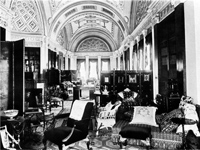
Picture gallery, Dawpool, Cheshire (Image: H Bedford Lemere, Bedford Lemere & Co / copyright: English Heritage/NMR)

The 19th-century only saw this trend accelerate with the great wealth of the cities now a serious challenge to the old inherited wealth of the land. This was especially true since, following political reform, land holdings were not always necessary to secure power and influence.  Now the owners could indulge their preferences, as not all of them, having been born, brought up, educated, worked and having made their fortunes in the cities, would feel a natural attachment to the countryside, beyond the social cachet it brought.  Rising land values from the mid-19th-century also would have been a factor which might have put off the hard-headed businessman – better value to invest in the most luxurious house possible.  Yet, the allure of the country seat was still strong as a recognised symbol of success so around each major Victorian city could be found these mini ‘pleasure’ estates; with Liverpool being a classic example.

Hafodunos Hall, Wales in 1954 (Image: RCAHMW) - burnt out in 2004

For some, their fortunes financed the Victorian version of the Lascelles, with the acquisition of large estates and the building of the great houses away from the dirt and noise of the cities, such as at Hafodunos Hall (sadly burnt out by morons in 2004) by George Gilbert Scott for H.R. Sandbach (son of a Liverpool West India merchant). Yet for some of these gentleman there was no shame in being near to the industrial heart which pumped their fortunes – but that didn’t mean they had to compromise on luxury or convenience. Soon, many large houses with small estates populated the edges of the city.  Writing in 1873, the journalist Patricius Walker said:

Crowds of comfortable and luxurious villas besprinkle the country for miles round Liverpool, inhabited by ship-owners, ship-insurers, corn merchants, cotton brokers, emigrant agents, etc, etc, men with “on foot on sea, and one on shore,” yet to one thing constant ever – namely, money-making – and therein duly successful.

These captains of industry and commerce were also able to take advantage of the newly developed railways; becoming early commuters, able to spend the day at the office yet still escape at the end, back to their slice of bucolic charm.

The merchant palaces of Liverpool were, broadly, either those which were built as villas with substantial gardens near the large pleasure parks such as Sefton, or, taking advantage of the rail links, based outside the city in areas such as a the Wirral, just across the Mersey.

Holmestead, Cheshire (Image: openlyJane via skyscrapercity)

One particularly fine example of ‘rural urban’ villa was Holmestead on Mossley Hill, set in its own extensive grounds just to the east of the elegant and very desirable Sefton Park.  What is remarkable is that many of the larger houses still survive, albeit in an altered form; some becoming flats or care-homes.  The house was originally built in the 1840s in a Gothic style and effectively doubled in size in 1869-70 by the then owner, Michael Belcher, a local cotton broker. Urban ‘society’ of the newly wealthy mirrored the practices of those in the countryside as shown by William Imrie, owner of the house at the turn of the 19th-century and formerly of the famous White Star line, and also a patron of the Arts-and-Crafts movement.  He held regular concerts in his music room – a grand space, decorated with William Morris’ ‘Acanthus‘ pattern wallpaper, with the imposing ‘The Tree of Forgiveness‘ by Edward Burne-Jones on one wall, and Spencer Stanhope’s ‘Why Seek Ye the Living Amongst the Dead‘ on another. Remarkably, the house has survived and is still a single family home.

Dawpool, Cheshire - dem. 1927 (Image: H Bedford Lemere, Bedford Lemere & Co / copyright: English Heritage/NMR)

One of the grandest houses of them all was also connected to the White Star Line.  Dawpool was the pet project of Thomas Henry Ismay, the man who built a company large enough to launch the Titantic. Although was not conceived as the centre of a landed estate, it was certainly designed to showcase the power of his empire.  Designed by the leading architect, Richard Norman Shaw, the house, started in 1882, was a monument to Ismay’s wealth and meant to last – the local red sandstone was finely shaped and even the screws being finest brass.  The house took four years to build at a cost of over £50,000 – equivalent to over £3.5m today, a colossal sum compared to the average £80 per year the skilled ship-worker took home. Yet, the house was to survive less than half a century. After Ismay’s death in 1899, the widowed Mrs Ismay said that the house had given her husband pleasure every day – but without that driving force, it languished before being sold, becoming an orthopaedic hospital in WWI, before being sold again, and then demolished in 1927 [more history and photos available on Lost Heritage: Dawpool].

Calderstones House, Liverpool (Image: Liverpool Confidential)

Although some have been demolished and most of the houses have lost their extensive grounds, one rare survivor, Calderstones House, gives a rare insight into the once-gilded edges of Liverpool.  The now grade-II listed house was built in 1823 for Joseph Need Walker, a lead shot manufacturer, who built an elegant late-Georgian design (architect unknown) with a Doric portico which looked out over carefully tended gardens and parkland.  In 1875, the house and grounds were sold for £52,000 to Charles MacIver, a shipping magnate who had spent 35 years with the Cunard Line. The house and grounds were sold in 1902 to the Liverpool Corporation for £42,000 and became one of the city’s finest parks (John Lennon apparently used to hang about there) with the house used as offices for their Parks departments with a public tea-room and, to the rear, a stage for concerts.

Faced with severe budget cuts, Liverpool Council are now exploring what options are available, with a sale the preferred outcome.  Sadly, it is extremely unlikely to become a home again; to carve out sufficient space and access from a public space would be extremely controversial, with security a further worry.  The two most likely options are that it is taken on as a public facility with commercial aspects such as concerts and refreshments, or that it will languish, becoming progressively more dilapidated.  Sadly, local government generally has often shown a rather careless attitude to heritage assets in their care -though in recent years they have improved markedly from the 1950s and 60s when some (Derbyshire being particularly notorious) would simply demolish the historic buildings, especially country houses.

The current period of austerity is forcing councils to re-examine their assets and objectively analyse the most cost-effective way of operating – a process open to the risk of losing elements of what makes an area locally distinctive.  This is especially true when ‘heritage’ and ‘arts’ are seen (falsely) as relatively ‘high-brow’ interests – this creates a challenge for everyone to be aware of what their councils own, and to monitor whether there are any signs of them seeking to cut corners and creating conditions which threaten the heritage assets.  They hold these in trust for the local area and, if necessary, councils need to be forcefully reminded of their obligations to this generation and the ones which follow to care for the built environment which contributes so much to local identity.

Articles:

Further reading: Merchant Palaces: Liverpool and Wirral Mansions Photographed by Bedford Lemere (Photographers of Liverpool) (disclosure: this is an Amazon associates link – the price you pay is the same but I’m experimenting to see if I can help offset costs with Amazon affiliate links).