40 years on from the ‘Destruction of the Country House’ exhibition

Many was the time I stood in that exhibition watching the tears stream down the visitors’ faces as they battled to come to terms with all that had gone.’ – Sir Roy Strong [Diaries, 1974]

'Destruction of the Country House' exhibition, 1975 - V&A
‘Destruction of the Country House’ exhibition, 1975 – V&A

In October 1974, one of the most influential exhibitions ever staged by a UK museum opened at the Victoria & Albert Museum.  The ‘Destruction of the Country House‘ laid bare the scale and depth of the losses the UK had suffered, showing how four centuries of architectural tradition and achievement in country houses had been severely damaged by the depredations of the 20th-Century. It was conceived as a dramatic display to waken the nation to the threat faced by country houses and the danger faced by all aspects of heritage.  This was in an age with weak legal protection and which seemed to be growing ever more apathetic, or even hostile, to the idea of preserving what represented the cultural character of the UK.  The exhibition was a huge success, not only in terms of the impact on the public, but also in being the catalyst for a long-term shift in how we seek to save and manage our heritage.  From 13-21 September, a new exhibition at the V&A, ‘Country House – Past, Present & Future‘, seeks to revisit this ground-breaking event and look at the future of the country house.

Thorington Hall, Suffolk - demolished 1949 (Image: Lost Heritage / Tiger Aspect Productions)
Thorington Hall, Suffolk – demolished 1949 (Image: Lost Heritage / Tiger Aspect Productions)

By the 1970s, relatively few people would have been aware of the parlous state of a significant number of country houses and how many had been lost in the demolition binges of the 1930s and the 1950s.  However, that there was a crisis was recognised not only by the owners of the houses, but also by the government which in 1948 had created a committee to look at ‘Houses of Outstanding Historic or Architectural Interest’ and tasked it:

To consider and report what arrangements might be made by the Government for the preservation, maintenance and use of houses of outstanding historic or architectural interest which might otherwise not be preserved, including, where desirable, the preservation of a house and its contents as a unity.

The committee’s conclusions, which became known as the Gowers Report, were published in 1950 and the tone could be determined from the first paragraph which stated that ‘What our terms of reference require us to consider is not whether houses…should be preserved, but how this is to be done‘. The report made a number of recommendations including the creation of the Grade listing system we are so familiar with today, combined with tax concessions to which owners would be entitled, and also financial assistance for which they may be eligible. The aim to create a legal framework where restrictions on the rights of the private owner were compensated by financial incentives to ensure the preservation of these houses.

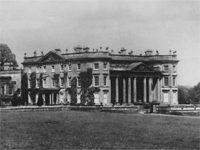
Trentham Hall, Staffordshire - in its heyday and during demolition in 1912 after being polluted by nearby industry  (Images: Lost Heritage)
Trentham Hall, Staffordshire – in its heyday and during demolition in 1912 after being polluted by nearby industry  (Images: Lost Heritage)

Yet, by the early 1970s it was clear that the crisis had not been solved, as demonstrated by the title of a report published in 1972: ‘Country Houses of Britain – can they survive?‘. Written by noted architectural historian John Cornforth, he sought to explore why the issues surrounding the sustainability of the country house had not yet been resolved, but also to cast the debate in a new era of soaring inflation, economic malaise, and with threatened punitive taxes on the asset rich (though cash poor).

In was at this time that Sir Roy Strong had conversations with Christopher Gibbs but the core of the idea came from John Harris, now noted architectural historian, but also a keen fisherman who, in his youth in the 1950s, had surveyed many an abandoned parkland and empty country house whilst fishing the ornamental lakes (adventures later recounted in his book No Voice from the Hall: Early Memories of a Country House Snooper). Combined with Marcus Binney, then at Country Life, they conceived and created this most remarkable exhibition, quite unlike any before or since.

Hall of Lost Houses, from the 1974 Destruction of the Country House exhibition at the V&A
Hall of Lost Houses, from the 1974 ‘Destruction of the Country House’ exhibition at the V&A

Designed by Robin Wade, the layout took visitors through a short display showing the glories of the country house, but then, as they turned a physical and symbolic corner, were faced with an almost full-height portico tumbling to the ground.  On the pillars and walls were photos of some of the hundreds already lost, whilst in the background, John Harris sombrely intoned a roll-call of their names.

Original poster advertising the Destruction of the Country House exhibition - 1974 (Image: Victoria & Albert Museum)
Original poster advertising the Destruction of the Country House exhibition – 1974 (Image: Victoria & Albert Museum)

The exhibition captured the public imagination, with queues forming to see it at the weekends and the catalogue becoming a best-seller.  Yet, it wasn’t just the public who were captivated by it; in the last week, the Queen, Princess Margaret, Lord Mountbatten, and various government ministers all visited too.  1975 was designated the European Architectural Heritage Year and so focused minds on how to help ensure the survival of the nation’s heritage. This resulted in further legislation which strengthened the legal protection afforded to buildings.   The exhibition also led Marcus Binney to form SAVE Britain’s Heritage, a campaigning charity which took a far more pro-active approach than had traditionally been the case, achieving many notable successes, as it continues to do so today.

Politically, the exhibition could not have opened at a more awkward time – just two days before a general election which brought in a Labour government whose proposed ‘wealth tax’ would have made private ownership of most of these houses unsustainable, probably leading to further wholesale demolition.  Yet, the exhibition also has been identified as ‘…a pivotal moment in the history of country house preservation and heritage politics more generally.’ (Ruth Adams). In truth, a shift had started, as shown by the strong reaction to the proposals by John Baring to demolish The Grange in Hampshire in 1972 which prompted angry exchanges of letters via The Times. However, after the exhibition, no longer were country houses an elite interest for just the owners or art historians, but now the public started to identify with them as part of their national heritage, as something which embodied characteristics and history which they wished to be saved. That broad public sense of attachment to heritage has grown and become almost a natural part of the national psyche (apart from, it seems, in the minds of developers and their occasionally pocket planning committees).

For me personally, the lost country houses were the subject which were the catalyst for my own passion for country houses, leading to the creation of the Lost Heritage website in 2005. The aim is to create the most comprehensive list of all notable lost English country houses – and as far as I’m aware, is the only current ongoing research into the topic. Having seen the ruin of Guy’s Cliffe House about ten years ago, I then started trying to find out more, with two of the most important sources being the superb Catalogue of the exhibition and Giles Worsley‘s later book, the beautiful and elegiac ‘England’s Lost Houses‘.  These contained a gazetteer of known losses – the version in the Catalogue compiled by John Harris and Peter Reid, with Giles’ list building on theirs to take the total to 1,169.  John had estimated that as many as 2,000 had been lost since 1800 and after nearly a decade, sadly my Lost Heritage research has a total of 1,925 (as at Sept 2014), largely proving him correct.

The ‘Destruction of the Country House’ was as much a platform as an exhibition. Although aimed at the public, it was also a touchstone for a wide variety of heritage interests to coalesce and focus their energies and arguments. This helped to create a society which increasingly understood and appreciated heritage but also one which felt there was some collective responsibility towards its defence.  One can only hope that, as a nation, we can continue to recognise the importance of the country house, as well as heritage more broadly, to ensure that those in the future can continue to appreciate their beauty and the rich cultural history they represent.


Events – 2014


Further reading

An academic assessment of the impact of the exhibition: ‘The V&A, The Destruction of the Country House and the Creation of ‘English Heritage‘ – Ruth Adams [Museums & Society]
A theatre of innovation: Cragside, Northumberland

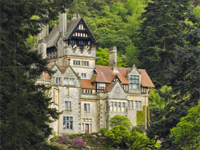
Cragside, Northumberland (Image: ©National Trust Images/Simon Fraser)

One hundred and fifty years ago, as 1863 drew to a close, the great industrialist Lord Armstrong may have reflected on a year in which innovation was sweeping across so many areas of life and, perhaps, his own future plans for his new country house at Cragside, Northumberland.  Country houses have often been at the nexus of innovation as they contain just the right mix of elements; namely a fashion for novelty, complex issues to be solved and a desire to impress others, along with the resources to experiment.  Cragside was to be a fine example of all these desires, a joint effort between an inventor owner and an inventive architect.

1863 was another year of great industrial developments as diverse as the running of the first Underground trains in London and the patenting of TNT, both of which would have far-reaching consequences.  That driving spirit of creativity spurred the Victorian engineer to look at many challenges, both large and small, seeking solutions which provided greater utility and comfort, though often tempered by the conservatism or financial reluctance of the owner.

Comfort and luxury are not always as synonymous as they are today and tales are legion of freezing country houses where one bathroom (used only for bathing naturally) served a whole house.  Owners of older aristocratic houses often felt little need to modernise; after all, if you had hot and cold running servants ferrying coal and water about the house this was often cheaper than a full refurbishment.  Worse, such improvements might be seen as nouveaux-riche (and therefore vulgar), unhealthy, or, worse, American. By contrast, the new money aristocrats in the Victorian era often had worked their way from less distinguished backgrounds and were keen to use anything which provided a better life – and also gave them the social bragging rights of novelty.

Bowood House, Wiltshire (demolished 1955-56) (Image: Lost Heritage - England's Demolished Country Houses)
Bowood House, Wiltshire (demolished 1955-56) (Image: Lost Heritage – England’s Demolished Country Houses)

Open fires have been the mainstay of country houses for hundreds of years but central heating – either steam, hot air or hot water – started making a comeback in the late Georgian period (remember the Romans introduced it first). The library at Bowood House, Wiltshire was thought to be the first modern room to be centrally heated when it was introduced in the 1790s (although it wasn’t all that successful).  Other centrally heated single rooms were to be found at Pakenham Hall, Co. Westmeath in 1807 where ‘The immense hall so well-warmed by hot air that the children play in it from morning to night‘.  The first multi-room ducted hot-air arrangements could be found at Coleshill, Berkshire in 1814, and Abercairny, Perthshire in 1829. Steam proved difficult to control (though it was installed by Sir Walter Scott at Abbotsford in 1823) so other early examples were either hot air (Osmaston Manor – 1846-49, Flixton – 1847, or Tortworth Court – 1849-52) or hot water via radiators (Mentmore Towers – 1850-55).  These systems rarely extended beyond the entrance areas, hallways and main downstairs rooms.

Osmaston Manor, Derbyshire (demolished 1965) (Image: Lost Heritage - England's Demolished Country Houses)
Osmaston Manor, Derbyshire (demolished 1965) (Image: Lost Heritage – England’s Demolished Country Houses)

Ventilation was always a challenge and the unpleasant accumulation of stale air and the smell of gas was exacerbated by the higher building standards of the Victorians which reduced drafts.  Many houses such as Kelham Hall, Mentmore, Dobroyd Castle and Wykehurst Place had ventilation shafts fitted in individual rooms but they were fairly inefficient.  One of the most advanced systems was created in 1846-49 for Francis Wright, a wealthy ironmaster, at his home Osmaston Manor in Derbyshire.  A single intake near the kitchen drew air from outside before heating it and distributing it around the house.  Coal fires in individual rooms then drew the stale air towards them but the flues all took the air downwards into a central extractor system which vented though a single huge 150-ft chimney in the kitchen garden, thus eliminating the need for huge chimneys in the main house (though it had smaller ones).  Sadly the house was demolished in 1965, thus denying us the chance to marvel at the ingenuity.

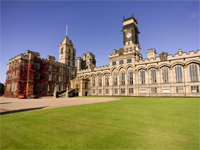
Carlton Towers, Yorkshire (Image: Landed Houses)

Bathrooms and indoor plumbing were often a great source of inconvenience. Even as late as 1873, such a grand house as Carlton Towers, Yorkshire, had no bathrooms with washing still undertaken via hand-filled basins and hip baths.  By contrast, Stoke Rochford Hall in 1839 had fifteen and by 1874 Wykehurst had the then radical innovation of each bedroom being a suite with its own bathroom.  A number of country houses were demolished for reasons of inconvenience with a  lack of bathrooms often cited, especially as the complexities of adding them to older houses was to prove insurmountable, either technically or financially.

Such challenges were often a catalyst for innovation – particularly if the owner was one of the industrial titans of the age, a man as comfortable in the workshop as the boardroom. Although William Armstrong (b.1810 – d.1900), 1st Baron Armstrong (after 1887), started his professional life as a solicitor he was able to turn his analytical mind to practical challenges as much as legal ones.  The genesis of his engineering career stemmed from his love of fishing where he noticed how inefficient waterwheels were and so designed a much more efficient water-powered engine. He successfully showed it could be used to hydraulically power cranes and thus improve the speed of cargo unloading at the docks.  This formed the basis for Armstrong’s engineering firm in 1847 and his first fortune.  The firm’s greatest fame/infamy came due to the later armaments work which Armstrong had turned to when he read that the British Army had difficulties with heavy field guns during the Crimean War. Success here with his revolutionary design and, later naval versions, led to the creation of a shipbuilding firm which won orders throughout the world, generating his second fortune.

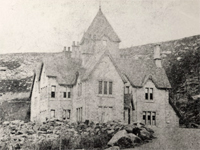
The Lodge 'Cragside', dated 1864-6, before Norman Shaw's editions at Cragside, Northumberland (Image: ©National Trust Images)
The Lodge ‘Cragside’, dated 1864-6, before Norman Shaw’s editions at Cragside, Northumberland (Image: ©National Trust Images)

Armstrong’s obviously busy and productive life gave him great status in Newcastle-upon-Tyne and beyond and his main home in the city was a grand, if heavy, suburban creation called Jesmond Dene House.  As befitted any Victorian man of wealth and social stature and due to the pressures of running his businesses, Armstrong sought a country retreat.  Having visited the Rothbury area as a child, he looked there for a suitable estate, eventually buying in 1863 the then small shooting lodge and 20-acres of land which formed part of a steep-sided valley through which ran the Debdon Burn. Over the next few years, as Armstrong came to reduce his involvement in his businesses, Cragside became a passion; a place to retreat but also to enjoy more domestic challenges with the help of one of the most brilliant architects of the age, Richard Norman Shaw. Armstrong eventually came to own 16,000-acres of Northumberland, including Bamburgh Castle, of which 1,759-acres surrounded Cragside in which he had planted over 7m trees and innumerable rhododendrons.

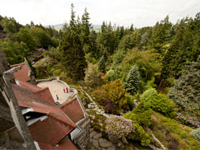
View from the Terrace, Cragside (Image: ©National Trust Images/John Millar)

Between 1869-84, Cragside was transformed into a modern Victorian plutocrats palace, but one incorporating all conceivable innovations, powered by his own hydraulic engines. The first challenge was the location, which was ideal for a small lodge but cramped for the house which it eventually supported.  The steep hillside meant that space for expansion either had to be created through excavation or by building up the ground.  What it lost in convenience, it gained in views; spectacular vistas overlooking the remote Northumberland countryside.  Unfortunately, those views – both from and of the house – are now somewhat obscured by some of those same trees planted by Armstrong.

One of four of the original electric lamps at Cragside (Image: ©National Trust Images/James Dobson)

It was inside the house that the inventive mind of both owner and architect could really find effect.  For Shaw, Armstrong was an ideal patron, offering none of the conservative reticence he might have found in other clients, able to offer either his innovations or those of his friends. By December 1880, Cragside was the first private house in the UK (and Girouard thinks possibly in the world) to have electric light comprehensively installed, thanks to Armstrong’s friendship with Joseph Swan, with his eponymous filament bulbs throughout. Power for these innovations came from Armstrong’s own hydroelectric engines, running from the Burn below.

With the luxury of his own cheap and apparently limitless power supply, Armstrong and Shaw’s opportunities were myriad.  In addition to the lighting, the central heating system was also driven by a hydraulic engine.  That same power source also enabled the kitchen to boast a hydraulically-powered spit with the heavy pots in the conservatories moved by hydraulic machinery, with an electric sewing machine and electric communication throughout the house and even out to a shooting lodge on the moor.

View of Cragside (Image: ©National Trust Images/John Millar)

To his contemporaries, Cragside must have seemed beyond ingenious – a place grown from an inhospitable hillside, packed with innovations.  The house became a significant marketing tool for Armstrong as visits from his prospective customers, including the King of Siam, the Shah of Persia and the Crown Prince of Afghanistan, gave him the chance to demonstrate the advanced technology they could be buying into, a true theatre of innovation.  The Prince and Princess of Wales also visited in August 1884, thus giving the royal seal of approval to such a modern approach to the traditions of the country house.

Cragside passed to the National Trust in 1977, sadly missing the best of Armstrong’s picture collection (sold in 1910), but cared for and open so we can enjoy seeing the products of two great Victorian minds.  Despite being the genesis of domestic hydroelectric power, a gas turbine was installed in 1895 to provide more power before being connected to the National Grid in 1945.  However, in early 2014, the National Trust is again installing a modern hydroelectric screw to once more generate electricity for the house providing a welcome return of innovation.

———————————————————

Article: ‘Hydro-electricity restoration work starts at Cragside‘ [BBC News]

Official site: ‘Cragside‘ [National Trust]

160+ images: ‘Cragside‘ [National Trust Images]

Soane’s happy commission: Tyringham Hall for sale

Tyringham Hall, Buckinghamshire (Image: Savills)

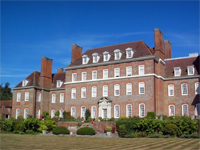
Six of the most happy years of my life‘ is how Sir John Soane described his commission to build what is regarded as one of his finest works: Tyringham Hall, Buckinghamshire.  Although altered, the house forms an important link in the development of both Soane’s architectural and professional skill; an ideal commission which gave full scope to his genius.  It also has the rare distinction of benefiting from another British architectural giant, Sir Edwin Lutyens, who created some of his best but also smallest work there. Now having been restored, the house is for sale; an early and clear candidate for the most important house to be sold in 2013.

Letton Hall, Norfolk (Image: Chris & Angela Pye via Flickr)

Sir John Soane built only eighteen complete country houses, mainly between 1780-1800, so each house is an important step in tracing the evolution of his distinctive style.  Burnham Westgate was Soane’s first major remodelling (covered in an earlier blog post: ‘For sale: a Soanian springboard‘ Oct 2011) but his first entirely new house was Letton Hall, Norfolk. Built between 1784-92 for B.G. Dillingham, Soane had convinced Dillingham to demolish, rather than alter, the existing Old Hall which he had inherited that year.  Soane’s early working practices, honed through smaller commissions, emphasised extensive discussions with the client at the early stages, and the creation of a wooden model to help them visualise the proposed scheme (created in 1785 – after work had started – at the cost of £6 11s).  Letton also demonstrated several of what we regard as ‘Soanian’ architectural traits: the compact villa design, pale bricks, beautiful proportions and the cantilevered, top-lit staircase.

Stowe House, Buckinghamshire (Image: e-architect)

Soane’s practice now progressed steadily with commissions for new houses at Tendring Hall and Shotesham, along with other works on varying scales.  His growing reputation for not only excellent designs but also for completing work on time and within budget led to his name being circulated amongst the right type of clients who could provide the opportunities Soane hoped for. Drawn by his friend, Lord Camelford, into increasingly political circles, he became friends with the powerful Marquis of Buckingham, who owned two great estates at Stowe and Wotton.  In August 1792, it was Buckingham who took Soane to visit the banker William Praed at his property, Tyringham, which his wife had inherited and which was conveniently close to the Marquis, in whom rested his political and business ambitions.  Needing a house to match his intended status, Praed initially commissioned Soane to remodel the existing Elizabethan manor house. However, after some Soanian persuasion, in June 1793 he decided that an entirely new house would best serve his needs – much to the architect’s undoubted relief.

Soane displayed a particular flair when designing an entirely new house.  Although at the  core of his houses was a Palladian villa, as John Summerson notes, Soane was able to ‘…twist it into something much more complicated with sequences of shaped rooms ingeniously interlocked, and lobbies introduced to effect harmonious transitions‘.  It was this imagination which Soane brought to the Tyringham commission and which created one of his early masterpieces, with flashes of brilliance, both inside and out.

One of the first is the now Grade-I listed monumental arch gateway leading from the main road; a building of such elegance and novelty that it had Pevsner in raptures, describing it as ‘a monument of European importance…it is entirely independent of period precendent, a sign of daring only matched at that moment by what Ledoux was designing in France [e.g. Hôtel Thellusson] and Gilly in Germany‘.  Leading to the house, the drive curves gently away, allowing the house to slowly come into view.  Soane designed the approach, incorporating an elegant humpbacked bridge with balustrades which curve at each end, away from the road, creating a delicate curl.  Arriving at the house, the exterior can also immediately be identified as by Soane, with typical details including the bow-front, the beautiful proportions and the superb detailing, such as the giant Ionic columns and Greek-key frieze.

The interior was to be the finest conception of the whole scheme; a dramatic, exciting series of spaces which would have delighted the visitor.  At the core of the plan was a device which Soane would re-use in later projects but on a monumental scale; the ‘tribune’, a top-lit inner hall.  To look at the plan is to understand the level of trust that William Praed displayed in Soane as, on entering the house, the first space encountered was dramatic as it was domestically redundant: a windowless ante-chamber lit only by the front door and flanking windows behind you, and through another doorway at the far end.  Passing through the room, flanked by four columns supporting a typical Soane shallow dome, you then stepped through the doorway and into the brightly lit central tribune; a Damascene moment of drama.  Forming the top of the T to the dark antechamber, the tribune then led to either the library, the drawing room or the stairs; each decorated in a typical Soane style. Though compact, the house and estate are both impressive and manageable, the perfect combination for a rising, ambitious banker who mixed in aristocratic company.

However, the house and estate today is not the same one Soane created.  Between 1907-19, a series of unfortunate changes were made to designs by the architect Ernst Eberhard von Ihne, his decorator Florian Kulikowski and another architect, Charles Rees, who implemented Von Ihne’s plans which swept away much of Soane’s interior decoration.  They also added an ill-proportioned copper dome, a tea cosy on a champagne bottle, which has the strange visual effect of elongating the columns.  With an estate of only 59-acres, it’s unfortunate that a series of 9 or 10 houses were built to the immediate north-east of the main house. Equally sad, the most important section of Soane’s considered drive to the house is now in separate ownership; the humpbacked bridge part of the public highway and worse, the road then continues down through that wonderful arch which so delighted Pevesner (how long before some careless driver seriously damages one or the other?) – follow the drive via Google StreetView.

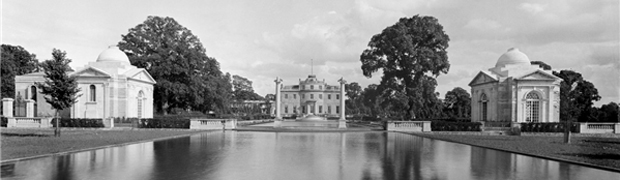
Bathing and Music Pavilions, Tyringham Hall (Image: Country Life Picture Library)

Thankfully what is still intact is one of Sir Edwin Lutyens‘ finest garden schemes.  Between 1924-28, Lutyens was commissioned by the then owners, the Koenigs, a family of Silesian bankers, to create a garden ‘for the recreation of spirit and body‘.  Standing each side of a huge 72m pool, once thought to be the largest of its type in Europe, are two temples; one a bathing pavilion, the other of Music.  Reminiscent of Thomas Archer‘s sublime Pavilion at Wrest Park (1709-11), Lutyens’ interpretation is pared back, less ornamented, but equally impressive – indeed, he himself thought it faultless and would apparently sit in there on his own.

The current vendor, Anton Bilton and family, has lavished millions on restoring the house and grounds (though, he confirms not as much as the £10m previously reported) since buying it for £2.5m in 2001.  However, the £18m asking price quoted in The Sunday Times Home section (28/04/13) seems ambitious; £10m-12m feels more appropriate considering the way the house and estate have been compromised with the now non-private approach, the small housing estate to the east of the main house and the loss of Soane’s original interiors.  Make no mistake, this is still a superb house and sets the bar high for any other house offered for sale this year to be considered as attractive or as interesting.

——————————————————————

Property details: ‘Tyringham Hall‘ – £18m, 59-acres [Savills] Strangely, there is no brochure yet and the launch, through double fold-out spread in Country Life (1 May 2013), feels a touch late.  One wonders whether the Bilton’s were offered a chance to do the Sunday Times piece before Savills were ready and took it anyway?

Excellent selection of photos:

If you wish to find out more about Sir John Soane and are in London, visit his house at Lincolns Inn Fields, which is a museum to his life and work: ‘Sir John Soane’s Museum

Welcome to the market: Lutyens’ The Salutation, Kent

The Salutation, Kent (Image: Knight Frank)

The analogy between language and architecture is one that has often been made, particularly as fluency is the key measure of success in both fields.  An immature architect can make elementary mistakes with the grammar of a building style as much as any tourist abroad can when ordering dinner. In most cases, both novice architect and linguist can be understood but when compared to the more experienced practitioner, skill and mastery come sharply into relief.  Such a lesson by a master architectural linguist has just been launched on the market; The Salutation, in Sandwich, Kent; a beautiful piece of poetry which demonstrates the fluency of the architect in the language of Classicism.

Heathcote, Ilkley (Image: Thursday Dave via Flickr)

Lutyens’ career can largely be seen in three phases; the early years of the ‘Surrey-Tudor’, which evolved into the middle ‘Arts & Crafts’, and then the divergence into the bold ‘Classical’, and its particular variant, ‘Edwardian Baroque’.  That last switch can be seen quite dramatically in the brilliant Heathcote, Yorkshire, built 1906, where Lutyens playfully adopted and adapted the Classical motifs and style of Palladio and Scammozzi to create a wonderfully detailed villa, rich in style and quite unlike his previous work.  After the exuberance of Heathcote (which annoyed Pevsner, who although he commented that it was ‘Only a villa, but how grand the treatment!‘, also dismissed features such as the pilasters which ‘disappear’ into the continuous rustication (see ground floor either side of the windows) as ‘silly tricks‘). On a side note; Heathcote recently sold having previously been bought by a developer/vandal who wished to split the house into two, thus ruining Lutyens’ interior planning – fingers crossed the new owner is sympathetic to this wonderful house.

Lutyens was, of course, part of a longer tradition starting with the first English classical architects practising around the time of Sir Christopher Wren in the mid-17th Century including Hugh May, William Samwell, and Roger Pratt. These pioneers displayed a similar skill in Anglo-Classicism producing buildings such as Cassiobury House (May), the first Eaton Hall (Samwell) and the revolutionary Coleshill (Pratt).  Classicism has long had a place in British architecture, despite other fashions, and has shown its versatility in being used for all sizes of house, from palaces to the smaller country retreat – and it was in this latter requirement that Lutyens was commissioned to build The Salutation.

Located on the site of an old inn of the same name, it was built in 1911-12 in the Queen Anne style as a retreat for Gaspard Farrer, a partner in Barings Bank, and his two bachelor brothers. Lutyens’ clients were typically those who had made money in the decades either side of 1900; that high-point of the country-house lifestyle when staff, materials and labour were relatively cheap. If there is a ‘criticism’ of Lutyens it’s his generosity with regards to space with hallways, alcoves, and large staircases, such as at The Salutation where an extended landing serves as an overflow from the library.  Yet, each space serves a purpose in the plan, typically framing views along axes or as part of a route to the principal rooms which Lutyens often incorporated into houses.

Great Maytham, Kent (Image: Stephen Nunney via Geograph)

The exterior of the house is a smaller derivation of his earlier and much grander Great Maytham, built 1910, for the Liberal MP, H.J. Tennant.  Following the exuberance of Heathcote (which most commentators seem to think came very close to pomposity), Lutyens took a more restrained path through Classicism (compared say, to Richard Norman Shaw at Bryanston House for Viscount Portman) and Great Maytham can be seen as a larger version of Samwell’s Eaton Hall, built 1675, or the smaller Puslinch in Devon, built 1720, with the latter showing clear similarities with The Salutation.

East terrace, The Salutation, Kent (Image: Country Life Picture Library)

The plan of The Salutation is based on the Palladian 3×3 grid but, importantly, Lutyens is able to adapt and amend this without losing the beauty of the proportions.  Gavin Stamp comments that, for Lutyens, his houses were ‘essentially romantic creations; that is, their form is determined by a picture in the architect’s mind‘ and another writer H.S. Goodhart-Rendel compared his ability to that of Wren in that they both had ‘the sculptor’s capacity of making beautiful shapes‘.  Country Life magazine said that it was a ‘dazzlingly suave yet restrained reinterpretation of the old Georgian idiom‘. It was this ability to combine a profound understanding of the Classical rules of architecture with originality which marked Lutyens out as one of the great architects.

To be given a measure of the importance the house, in 1950, it was the first 20th-century building to be given a Grade-I listing.  However, The Salutation suffered in the later 20th-century with the 1980s a particularly difficult time. Repeated attempts by developers were made to either split those graceful internal spaces into apartments or simply demolish it entirely and build on the 3-acre site, over which Lutyens (and possibly his long-term collaborator Gertrude Jekyll) had spent so much time and care crafting.

The Salutation from the garden (Image: Knight Frank)

Salvation for The Salutation came in the form of Dominic and Stephanie Parker who bought it in 2004 for £2.6m and have subsequently spent £3m on its restoration and who now run it as a luxury B&B. Now for sale at £4.5m, for someone with the budget, this could again be a superb home; combining the finest elements of the last boom of the country villa, designed by one of the greatest architects Britain has produced.  For the rest of us, if you’d like to see and experience staying in one of Lutyens finest small houses, I’d suggest booking soon.

———————————————————-

Sale particulars: ‘The Salutation‘ [Knight Frank]

If you’d like to stay; you can book through their website: ‘The Salutation

Video of Mr Parker talking about his decision to buy: ‘The Salutation was ‘like finding a diamond in a river‘ [2009, Kent Online]

Watch the Parker’s competing in a B&B TV competition: ‘Four in a bed‘ [Channel 4]

For more on Lutyens, I recommend Gavin Stamp’s ‘Edwin Lutyens Country Houses‘ [Amazon]

Support the legacy: ‘Lutyens Trust

Listing description: ‘The Salutation‘ [British Listed Buildings]

‘A brighter, richer landscape lies display’d’; the battles for the views of country houses

'View of the Thames from Richmond Hill' by Peter Tillemans c.1720-1723 (Image: Government Art Collection)
‘View of the Thames from Richmond Hill’ by Peter Tillemans c.1720-1723 (Image: Government Art Collection)

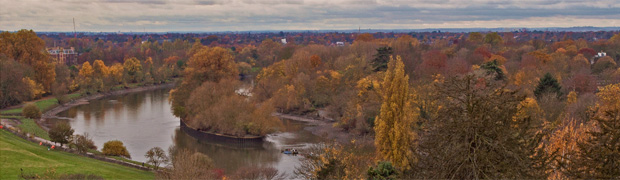
Looking out from the top of Richmond Hill in south west London,  towards Windsor Castle, is to take in one of the most famous and admired views of the Thames, one that includes glimpses of at least four significant country houses. One of those, the beautiful Marble Hill House, was also the site of a ‘battlefield’; but this is a heritage one, a battle to protect one country house in particular and that spectacular view.  The fight to protect the views surrounding country houses has been fought many times, but two from the modern era in particular, at Witley Park and Marble Hill House, are worth a closer look for the impact they had.

Folly castle in Hagley Park, built c.1747, designed by Sanderson Miller (Image: Matthew Beckett)

In earlier centuries, landowners had far greater power to determine what they saw from their drawing room windows.  With the rise of the landscape architect, mere history was an insufficient reason for a tree, stream, building or even an entire village, to be left alone where they interfered with the sight-lines.  With the new emphasis on a view terminating in some object of interest, ever grander follies, bastions, and sham ruins sprang from the ground; from a distance giving an air of ancient decay, but betrayed up close by the drying cement. Yet, ancient buildings also could be pressed into service as ‘eye-catchers’ – but only if they met with the approval of the landscaper and/or the owner.

The first ‘battle’ to be fought to protect a heritage asset which formed part of a view was between a duchess and her husband’s architect, and involved one of grandest houses in the country. Ironically, the battleground was a house built to celebrate a military victory, Blenheim Palace, but a fight almost as vicious was being waged between Sarah, 1st Duchess of Marlborough, and the architect, Sir John Vanbrugh (b.1664 – d.1726), one of the most remarkable men of that era.  Vanbrugh’s design for Blenheim was a tour-de-force of contemporary architecture; a spectacular palace which drew on the Continental Baroque style to create a house which was a set-piece of country house theatre.

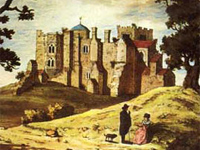
Woodstock Manor, Oxfordshire (dem. 1720) (Image: courtesy of His Grace the Duke of Marlborough and Jarrold Publishing via Smithsonian Magazine)

The battle was fought over the ruins of the original Woodstock Manor, a house where King Henry II had romanced ‘fair Rosamund’ de Clifford, and which formed the original palace on the estate.  Having suffered under bombardment in the Civil War, large parts were in ruins.  However, Vanbrugh saw them not only as a historical artefact, but also as part of the grand conception of the landscaping; a precocious attempt at the Picturesque twenty-five years before William Gilpin conceived it.  Vanbrugh wrote to the Duchess, explaining:

That Part of the Park which is Seen from the North Front of the New Building, has Little Variety of Objects Nor dos the Country beyond it Afford any of Vallue, It therefore Stands in Need of all the helps that can be given, which are only Two; Buildings and Plantations. These rightly dispos’d will indeed Supply all the wants of Nature in that Place: And the Most agreable Disposition is to Mix them: in which this Old Manour gives so happy an Occasion for…So that all the Building left, (which is only the Habitable part and the Chappel) might Appear in Two Risings amongst ’em, it wou’d make One of the Most agreable Objects that the Best of Landskip Painters can invent. And if on the Contrary this Building is taken away; there then remains nothing but an Irregular, Ragged, Ungovernable Hill.

His appeals were in vain and the house razed to the ground in 1720.  The Duchess of Marlborough had a famously low opinion of architects and her dealings with Vanbrugh seemed to entrench this; his own case not helped by secretly making the Manor habitable again for his use but funded by the Duke’s money.  She was also devoted to the Duke and intended Blenheim to be his monument in life and for all time, and so she may not have wished to see another competing memorial to love from her windows.

Little changed in the following two centuries; if a landowner wished to reshape the view of his estate from his dining room, then so he shall.  Perhaps the ultimate expression of that was the occasional removal of an inconveniently sited village such as for Lord Cobham at Stowe c.1730, and Lord Harcourt at Nuneham Courtenay c.1750.

Some of the earliest effective challenges to this power only came much later from Victorian social activism which provided a platform for ideas to be confronted from the perspective of what was good for the people.  A landmark in the campaign for heritage protection of landscape centred around the now-lost mansion of Witley Park in Surrey.

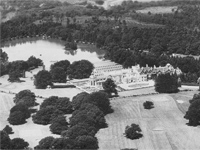
Witley Park, Surrey (Image: Lost Heritage - England's Lost Country Houses)
Witley Park, Surrey (Image: Lost Heritage – England’s Lost Country Houses) – click for more images of the house

The man responsible for raising the ire of the locals was one Whitaker Wright. A controversial financier who  made a fortune, lost a fortune, made another fortune and then bought the Witley Park estate and also the neighbouring South Park Farm estate from the Earl of Derby which included Hindhead Common and the famous Devil’s Punch Bowl.  To ‘improve’ the views from the house, Wright set 600 men to work, creating lakes and parkland but more worryingly, raising or levelling hills.  Without the legal frameworks we now rely on to protect the countryside and other areas of outstanding beauty for the common good, there was a real concern that Wright’s grandiose schemes would irreparably alter the local landscape.

Fortunately Wright’s other fanciful plans were his undoing; following the collapse of his companies in 1900 he was charged with fraud, found guilty, and dramatically committed suicide in court just after his sentencing hearing.  With his death the estate was put up for auction, and the locals who had been concerned about his landscaping efforts banded together and bought the sections of the estate which included the Devil’s Punch Bowl and Hindhead Common at auction in 1905. The locals then donated the land to the National Trust in 1906, becoming, in the process, the first Trust property to be managed by a local committee.

The idea that heritage was a national issue for the public good strengthened as organisations such as the National Trust and the Society for the Protection of Ancient Buildings who took up the cause.  At the heart of the heritage debate was a widespread concern about the threat to heritage from development – and Marble Hill House was a prime example.

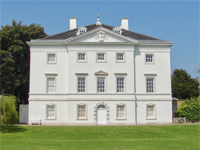
Marble Hill House, Surrey (Image: Maxwell Hamilton via Flickr)

Regarded as one of the finest Palladian villas in the country, the house was built between 1724-29 for Henrietta Howard, Countess of Suffolk and former mistress of George II. On her retirement from court, Lady Suffolk created a new one, centred around her and her villa.  Her friendship with the writer Alexander Pope and the ‘man of taste’ Horace Walpole (whose own house, Strawberry Hill is nearby), created a wide ranging literary, political, and artistic circle which only enhanced the reputation of that corner of the Thames.  The bright-white villa was an obvious reference point for those looking down from Richmond Hill and formed ‘this Earthly Elysium‘, appreciated by those without and within.

As Richmond and Twickenham grew as one of the most fashionable places to visit, so too did the number of artists who recorded the view in paintings, engravings, books and pamphlets. Yet, the rural nature of the suburb which had so impressed those who gazed upon it became increasingly threatened as Victorian London moved west.  With the death of the last owner, the widow of General Peel, in 1887, the house was increasingly viewed with avaricious eyes by developers. In 1901, a local newspaper quoted Jonathan Swift’s 1727 poem ‘Pastoral Dialogue between Richmond Lodge and Marble Hill‘:

Some South Sea broker from the City
Will purchase me, and more’s the pity,
Lay all my fine plantations waste
To fit them to his vulgar taste.

The article carried on to warn that ‘It is the demon builder who will in all probability destroy this historical desmesne with his exhibition of latter day villadom‘. That threat took a more concrete form that same year when, having been empty for ten years, it was finally sold to William Cunard (of the shipping family) who lived in nearby Orleans House (dem. 1926).  His plans involved the villa becoming the centrepiece to a suburban development (oh, how depressingly familiar this all sounds!), and so trees were felled and roads laid. However, the prospect of this view being lost galvanised public opinion, causing Cunard to pause.  The Architectural Review highlighted that with regards to the view:

…it is evident that the deep wedge of woodland formed by Marble Hill is its most necessary and indispensable part; that spoiled, the view tumbles to pieces, with an eyesore for its focus.

View from Richmond Hill, 2012 - Ham House can still be seen on the left, the only one now not obscured by trees. (Image: Kam Sanghera via Flickr)
View from Richmond Hill, 2012 – Ham House can still be seen on the left, the only one now not obscured by trees. (Image: Kam Sanghera via Flickr)

In July 1901, the Richmond Hill View Executive Committee was formed and, with continued interest from the press, kept up the pressure until in June 1902, following an Act of Parliament, the house was saved. The (slightly over-the-top) speeches on the day it opened to the public reflected a mood and an understanding of the value of heritage and why many fight to save it.  As the press reports stated:

They felt that a national view was at stake; that a historic view was at stake, nay, that a view that was necessary to the whole world was at stake…  It is not only the glory of London, but the glory of the British Empire; and it is one of those things which struck foreigners visiting this country with amazement and delight.

Tattershall Castle, Lincolnshire (Image: Richard Croft via geograph)

Looking beyond such giddy prose, those same core beliefs in the value and wonder of heritage can still be seen today.  Following the Marble Hill victory, further action such as in the Tattershall Castle controversy in 1910 showed that it was possible to mount an effective opposition.  Although not strong enough to prevent the worst excesses of the mass destruction of the country houses in the 1920s, 30s and 50s, these victories were critical in providing a cultural foundation, bolstered by wider appreciation through magazines such as Country Life, for the heritage protection movement which, despite many successes, continues to fight those battles today.