‘A land where it is always afternoon’; the life and talents of Philip Tilden

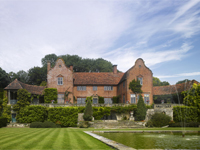
Port Lympne, Kent (Image: Country Life Picture Library)

One of the finest skills an architect can possess and cultivate is that of charm; the art of turning an encounter into an acquaintance into a client – and sometimes even a friend.  Such a skill can offer a balance to such flaws as he may have, whilst also being his most effective sales technique.  One such architect was Philip Tilden, a man whose own assessment of his talent and skills usually surpassed that bestowed by his peers.  Yet, Tilden was a sensitive man, attuned to how people wished to live in their houses and who developed a rapport within high society leading to an almost bewildering array of commissions; from the most domestic to the breathtakingly grandiose and who, along the way, managed to design houses for two UK Prime Ministers.

Philip Tilden (b.1887 – d.1956) was an avowed traditionalist.  His memoirs – ‘True Remembrances‘ (though others doubt this!) – which were published in 1954, are full of repeated laments of lost skills, modern taste, and the lack of style. Not that he was ‘anti’ modern materials, but more that he thought they should be used cautiously and subserviently to the traditional ones, saying “Instead of absorbing the new materials and techniques into the body of tradition, and digesting them, we have let them take control“.  His was a world where architecture was national (and hence the international Bauhaus would have been an anathema) and, for him, ‘…Britain was not the home of the acanthus and cypress – it is the home of the Gothic rose, the oak, the ash, and the parasitic ivy‘.

Though he made clear his emotional preference for the Gothic, it was part of a broader love of the ancient, in particular, of the old castles which he was called upon to restore – though circumstances would ensure that he would work with whichever building he was called to look at.  Tilden was a good architect – but not a great one.  Sir Edwin Lutyens, who was his contemporary but not his peer, once complained having seen Tilden’s additions to a house as ‘work so ill-conceived by a man who claims a following and dares to criticise‘.  But such criticism shouldn’t obscure Tilden’s more positive characteristics; his sympathy for historic fabric, his imagination, and his consummate networking skills.

The early part of the 20th-century was still an age where patronage was in the hands of the upper echelons of society.  If one could gain a foothold, the power of the related and intertwined networks of politics, business, and industry could provide a welter of opportunities for someone who could play the game.  Tilden was a master of this – his memoirs are an almost embarrassingly giddy series of anecdotes of he and his wife staying with Sir ——— or Lady ———-, and the delight the hosts and visitors apparently took in each others company.  It was through these connections which provided Tilden with his commissions – from the smallest artistic endeavours to the excessive.
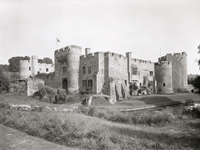
Allington Castle, Kent, 1928 (Image: Country Life Picture Library)

He joined the Architectural Association in 1905 and on graduating became an articled pupil to Thomas Edward Collcutt, whom he later went into partnership with, before establishing his own practice in 1917.  One of his first clients was Sir Martin Conway, 1st Baron Allington, the mountaineer, politician and art critic who once said “I have always liked the work of Mr Philip Tilden, but if anyone asks me why, I cannot fully say“.  Sir Martin and his much wealthier wife, Katrina, had discovered Allington Castle, Kent and both exclaimed ‘Of course we must have it!‘ and she had bought it in 1905. Some restoration work had been carried out before 1914, by W.D. Caroe, to make the ruined castle habitable but Tilden was brought in for further changes in 1918 and became firm friends with the Conways, working on the castle until 1932.
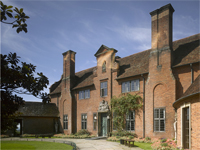
Entrance front, Port Lympne (Image: Country Life Picture Library)

It was this long period of friendship which enabled Tilden to extend his circle of useful connections.  One of these was Sir Louis Mallet, once our Ambassador to Turkey, who had led a cultivated and international life which had created a prized social circle.  It was through him that Tilden came to know and work with the wealthy Sir Philip Sassoon, the noted politician and art collector.  Sassoon was a renowned host and his architectural requirements were driven by this.  Herbert Baker had built the Cape Dutch-style Port Lympne for Sassoon in 1913/14 and when Sassoon wished to enhance Port Lympne after WWI, he called on Tilden.  With the confidence of wealth (related as he was to the Rothschilds), Sassoon gave full rein to his artistic and stylistic preferences which were far removed from the chaste reserve of the traditional English country house.  With dining room walls painted in lapis lazuli blue and lined with golden chairs and an opalescent ceiling, a Spanish courtyard, and a grand flight of steps in the garden, this was a house for show.
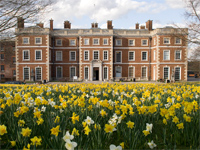
Trent Park, Enfield, north London (Image: Enfield Council via flickr)

Yet, barely had the works on Port Lympne been completed, when Sassoon bought Trent Park, in north London, in 1923, which was to become the centre of his social entertaining.  In contrast to the exuberance of his Kentish seaside retreat, Sassoon looked to Tilden to create a more traditional environment, one of lithographs and wallpaper, antiques and books.  This suited Tilden who created a hugely successful pleasure palace:

“…a dream of another world – the white-coated footmen serving endless courses of rich but delicious food, the Duke of York coming in from golf… Winston Churchill arguing over the teacups with George Bernard Shaw, Lord Balfour dozing in an armchair, Rex Whistler absorbed in his painting… while Philip himself flitted from group to group, an alert, watchful, influential but unobtrusive stage director – all set against a background of mingled luxury, simplicity and informality, brilliantly contrived…“.  (Robert Boothby. I Fight to Live (1947)
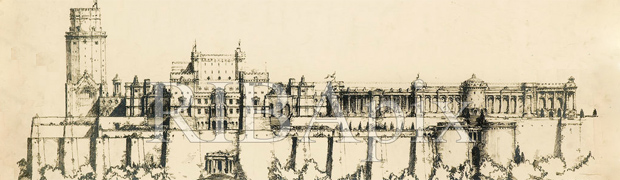
Proposal for Hengistbury Head by Philip Tilden for H. Gordon Selfridge (Image: RIBA Library Drawings Collection)

Tilden was happy to mix in these circles, both for the pleasure they brought and the commissions.  In 1919, Martin Conway and Tilden were at Allington when Conway burst out, ‘You know, Philip, Selfridge is going to build a castle‘. Of course, the ‘Selfridge’ was Gordon of the eponymous department store, who had enormous plans which almost matched his ego, but which certainly outstripped his finances.  We have previously looked at Selfridges’ fascinating plans in an earlier post (‘Harry Gordon Selfridge and his grand plans: Hengistbury Head‘) so no need to go into depth again but suffice to say that the whole episode showed that whilst Tilden could think big, he sometimes lacked the ability to tell his clients the honest truth about the prospects of being able to bring such grandiose schemes as Hengistbury Head or the Selfridges Tower into reality.

More successfully, Tilden was to create a home for a Prime Minister – but this isn’t about Chartwell.  The first PM Tilden worked for was David Lloyd George, the controversial Welsh Liberal, best known as the founder of the welfare state, who had met the architect at Port Lympne.  Lloyd George had decided in the summer of 1920 to purchase a plot of land in Churt, Surrey, where he could have a house built and gardens to tend.  The area he chose was, in fact, wind-swept hillside but compensated by the views.
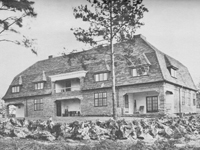
Bron-y-De, Churt, Surrey (Image: 'True Remembrances' by Philip Tilden)
Bron-y-De, Churt, Surrey (Image: ‘True Remembrances’ by Philip Tilden)

The house was to be called ‘Bron-y-de’, Welsh for ‘facing south’, which was a joke as the house faced north, even though he had bought the estate unseen at auction on the recommendation of his secretary who had assured him it faced south. In keeping with his character, it was a modest sized house – though one room had to be the same size as the Cabinet Room in Downing Street so that his habit of pacing could continue at the same length. Lloyd George was always in a hurry, and so Tilden designed the house so that only the ground floor was brick to reduce the drying time, with a huge mansard roof covering the first floor. Once word was out that the house was to be built, Tilden was deluged with offers of free fittings and materials, however, Lloyd George was a deeply scrupulous man who gave strict instructions that everything down to the last nail was to be paid for.  Despite his modesty, it became apparent that the house was too small, and so Tilden was again employed in 1921 & 1922 to extend the house.  Sadly, Bron-y-De burnt down in 1968.

Of course, the house Tilden is best known for is Chartwell (subject of the earlier guest article ‘Sir Winston Churchill, Chartwell, and Philip Tilden’ – National Trust ‘Uncovered’‘).  Another commission as a result of a long fireside chat at Port Lympne, Churchill asked Tilden to help adapt the Victorian home to his requirements. The chapter in Tilden’s memoirs about the project is almost more an encomium to his client, lavishing praise on all aspects of his life and his interest in Chartwell; ‘No client that I have ever had, considering his well-filled life, has ever spent more time, trouble, or interest in the making of his home than did Mr Churchill‘.  The house which resulted is certainly more practical than beautiful – though it achieves the original goal of allowing the undeniable pleasure of the superb views.
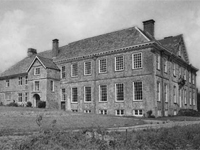
Dunsland House, Devon (Image: Lost Heritage - England's Lost Country Houses)
Dunsland House, Devon (Image: Lost Heritage – England’s Lost Country Houses)

Sassoon and his circle of friends was to bring work at other country houses such as Easton Lodge, Essex, Hill Hall, Essex, Saltwood Castle, Kent, Luscombe Castle, Devon, and Anthony House, Cornwall.  Of all the works Tilden deserves credit for, for me, his rescue of Dunsland House is perhaps the most admirable and the saddest.  Dunsland was one of the oldest houses in north Devon and had been owned by the Bickford family who had created a home with some of the most remarkable plasterwork to be found in the county.  Having owned the house for over 300 years it was finally sold in 1945 to a timber merchant who was interested only in the trees.

In 1949, Tilden was sent by the council to inspect the now seriously ‘at risk’ house. Realising that no-one else would be taking on the restoration, Tilden stepped up and bought it – and paid the timber merchant £5 for every tree he spared.  Using his own limited funds, Tilden brought a small section of the house back to a habitable state and moved in, but the project proved too much and he died in 1956.  His actions had staved off the immediate threat of complete collapse and the National Trust took over, finishing the restoration.  Sadly, in November 1967, just as the house was ready to open to the public, a fire broke out and completely destroyed it.
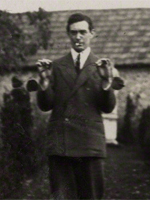
Philip Tilden, October 1925 (Image: National Portrait Gallery)

A sad loss of not only the house, but also what would have been a fitting reminder of one architect’s love of the ancient fabric of the nation’s built heritage; one who romantically thought that, ‘Most of those who build are interested in what has gone before, and their aim and object is to find out how to restore the present to something like a period that they imagine to be ‘a land where it is always afternoon‘.’  Tilden today is perhaps best remembered for what he didn’t build for Gordon Selfridge and the unexciting work at Chartwell, but he was certainly a principled and thoughtful architect whose views on heritage many would respect today.

———————————————————-

There is a fine selection of images of Port Lympne in the Country Life Picture Library

Further reading:

Guest article: ‘Sir Winston Churchill, Chartwell, and Philip Tilden’ – National Trust ‘Uncovered’

The garden front of Chartwell, Kent (Image: National Trust)

Some country houses are less of note than the people who were associated with them. For some, the architect will be the draw, but with a strange ‘Midas’-like power, any house associated with figures of great renown will always be remembered.  When asked to name the greatest UK Prime Minister, Sir Winston Churchill often  justifiably tops the polls, and his retreat, Chartwell in Kent, became his refuge, but also a burden which was only relieved late in his life. As is often the case with older houses, they require adaptation for modern life, and Chartwell was no different.  In an almost inverse to Churchill’s fame, the architect who worked on the house was the low-profile Philip Tilden, about whom we’ll find out more in a separate article.

Chartwell passed to the National Trust in 1965 and, this weekend it will be the focus of their ‘Uncovered‘ campaign which is exploring the British landscape.  As the event in the series most connected with a house, below is a guest article from Emily Christmas, Learning and Events Officer at Chartwell for the National Trust, exploring Churchill’s love of the countryside and why the house became so special to him.

——————————————————————–

I have no hesitation in saying that this site is for its size the most beautiful and charming I have ever seen.

These were the words used by Sir Winston Churchill to describe the property he purchased in 1922, which would become his family home for the following decades.

Looking South-East from the balcony at Chartwell towards the Studio and cottages, the view for which Churchill bought the House (Image: National Trust)

In his eyes, he was acquiring the land and the view far more than the house itself. And what visitors today might not realise is that what he saw back then was not the same Chartwell that can be seen today.

The house and gardens are very much the product of two minds: Sir Winston Churchill and his architect Philip Tilden. Even before the sale was completed, Tilden was at work preparing the house for reconstruction. Over the course of the following several years, work was undertaken to change the existing house into one that would take best advantage of the stunning views with which Sir Winston fell in love.

The history of the property isn’t well known, though the oldest part of the building is thought to have been a Tudor hunting lodge; and like most ancient sites in this part of Kent, there’s the oft-uttered myth that King Henry VIII stayed at Chartwell while on the way to visit his sweetheart Anne Boleyn at Hever. One of the rooms in the house was even named after him.

View of the front of the house at Chartwell, Kent, before acquisition by Sir Winston Churchill in 1922 (Image: National Trust)

Over the course of the following centuries it changed hands several times, became at one point a house for abandoned children, and in the 19th century the house, gardens, and outlying cottages began to take on something of the appearance that can be seen today.

Enamoured as he was with the views from Chartwell, Sir Winston Churchill immediately set to work rebuilding the house to best take advantage of Kentish weald.

The Colquhoun family, who had been in possession of the property for the previous century or so, had extended the house a fair bit, as can be seen in the photographs. However, to ensure the largest number of rooms had access to the stunning views, Churchill reduced the overall size of the house, creating in their place the rooms on the south-east terrace, which can be accessed through what is now Lady Churchill’s sitting room.

Chartwell, the garden front from the south (Image: National Trust)

The best indication of the change can be seen when viewing the house from the south-east side. The front of the house was also reduced and simplified to what can be seen today.

Visitors to the house today often remark upon the views when they walk out onto the pink terrace. Looking out across the North Downs, it’s not difficult to understand how Sir Winston felt when he first saw the place, despite the changes it has gone through over the past century.

——————————————————————–

Having withstood war, bombs, and even a hurricane, the property still boasts some of the most beautiful views to be found in Kent.  You can experience the views in person and visit during the National Trust ‘Chartwell Uncovered’ weekend of 21st-22nd September. Displays will include copies of some of the most iconic Churchill paintings of the landscape within the very views they depict, so it’s a rare opportunity to get insight into Churchill’s reflections on the land, his house, and his life.

View the full events programme for Chartwell Uncovered

Or find out more about the rest of our Uncovered campaign.

More views of the house can be found on the National Trust Picture Library

——————————————————————–

To coincide with the article, it seemed a good opportunity to look at the life and work of Philip Tilden; an architect with a complex life, who worked on a remarkable series of houses. Watch this space…

Finest country seats: Mereworth Castle, Kent

Mereworth Castle, Kent (Image: building-a-day via tumblr)

Many articles on this blog relate to houses which are in the news, on TV, or for sale but in the quieter months it becomes more challenging to find topics.  As I miss writing, this article is the first in an occasional series on country houses I have entirely subjectively chosen (though I’m happy to take suggestions) as being of particular interest and beauty. So, first up, one of my favourite houses; one which simultaneously is both exceptionally rare and beautiful – and one, sadly, I may possibly never get a chance to visit: Mereworth Castle  in Kent.

To understand why this house is so important, it’s necessary to take a brief trip to Italy, specifically, to the Veneto in the north.

Villa Capra, Italy (Image: Marco Bagarella via Wikipedia)

One of the most influential architects in relation to the style of UK buildings never actually built anything here.  Andrea Palladio (b.1508 – d.1580) invigorated the design of our built environment in a way many architects can only dream of through his innovative work in three areas; the urban palazzo, the rural villa, and churches.  Each, though distinct, shared a common architectural DNA that made Palladio’s work easier to understand which aided its adoption by others.  That’s not to say that his designs were simple or lacking artistic skill; it’s precisely their austere beauty which emphasises the thought which had gone into their proportions and decoration.

Palladio worked exclusively in the Veneto; that area of northern Italy centred around the wealth of Venice, but which had also created other cities which also grew rich and could express this through architecture.  Giovanni Rucellai, Alberti‘s patron, said “I think I have given myself more honour, and my soul more satisfaction, by having spent money than by having earned it, above all with regard to the building I have done.” Numerous trips to Rome, coupled with Palladio’s own diligent work in precisely measuring the Roman buildings and their details whilst he was there, gave him the architectural vocabulary to express what his patrons were trying to say to their neighbours, friends, and society at large.

His fame was well established (and undiminished even though dead) by the time English architect Inigo Jones made his first visit to Italy sometime between 1598–1603, but it was during a probable second trip in 1606 when he thoroughly absorbed the Palladian style, owning copies of Palladio’s most important work ‘I Quattro Libri dell’Architettura (‘The Four Books of Architecture‘, published in 1570). Jones returned and, using his influence, especially once he became Surveyor-General of the King’s Work, he started to develop and promote an Anglo-Palladian style.  One of the earliest and finest examples is the beautiful Banqueting House on Whitehall in London, the first neo-Classical building in the country, completed in 1622, which draws heavily on Palladian architecture and principles such as the double-cube.

Whether an architectural style gains traction and popularity depends on its ability to reasonably adapt to different areas and the challenges that this can present in terms of both materials and the climate.  One of the reasons Palladianism spread so far and became so entrenched is that its architectural DNA could evolve to meet the specific challenges of the UK climate – namely, it’s much colder and wetter here than on the sunny plains of Italy. The wide open loggias, small windows, fewer fireplaces and lack of guttering all meant that a literal translation of a Palladio design would quickly prove to be difficult to live in and rapidly deteriorate.

Villa Barbaro, Italy (Image: Marcok via Wikipedia)
Villa Barbaro, Italy (Image: Marcok via Wikipedia) – note the wide-open loggias

The popularity of the Grand Tour with young nobles meant that, for all the challenges, Palladianism was highly sought after as an expression of aristocratic taste and wealth.  The desire for Palladian homes combined with the environmental challenges meant that, in the UK, almost all designs for smaller country houses in that style were derivations of the Veneto originals.  However, for a few owners this was unacceptable – a higher level of architectural accuracy was required.

Mereworth Castle, Kent (Image: from an old postcard)

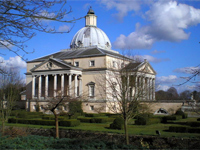
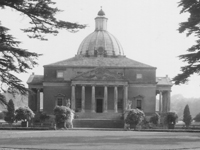
Mereworth Castle (built c1720-25) was one of these houses, along with Chiswick House, Middlesex (built 1729), Foot’s Cray Place, Kent (built 1754 – demolished 1949), and Nuthall Temple, Nottinghamshire (built 1757 – demolished 1929). Today, it is still the finest example of the direct translation of Palladio’s Villa Capra (or Rotonda) existing in the UK.  Designed for John Fane, later 7th Earl of Westmorland, by one of the chief proponents of Palladianism in the UK, Colen Campbell, producer of the famous ‘Vitruvius Britannicus‘, the book which was both the genesis and the bible for Georgian architecture in the UK and, by influence, Ireland and America.  Yet, as Nigel Nicholson points out in ‘Great Houses of Britain‘ why should ‘…a Scottish architect who had never been to Italy…chose to erect an Italian villa in the Weald of Kent for a patron who has likewise never set eyes on the Rotonda…‘? A good question indeed – and one Nicholson only partially answers.

In many ways the design is really architectural hero-worship.  Colen Campbell had started out working in Glasgow and idolised Palladio and, by extension, his representative in the UK, Inigo Jones.  Campbell had built one of the earliest Palladian country houses – Shawfield House – in 1713 and probably had a hand in the only earlier one; the wonderfully attractive and precocious Wilbury Park, Wiltshire, finished in 1710, designed by William Benson – owner and also architect, according to Campbell.  However, Campbell’s magnum opus wasn’t so much one building as many in the creation and illustration of ‘Vitruvius Britannicus‘ which cemented not only his reputation but also this continental style as the most fashionable of architectural choices – which is the most likely explanation for John Fane’s choice.

For all the many Palladian variations Campbell created for his books, Mereworth Castle was the house which remained closest to his idol’s work.  That said, he wasn’t above making alterations, most of which, were improvements.  One of the first things to note is that Mereworth is actually larger in volume than Villa Capra, perhaps for practical reasons but also possibly as a statement by the architect as to his ambition.  The changes he did make do actually indicate that Campbell was an architect of some skill and invention, for example, routing all 24 chimney flues he’d had to include through the double skin of the dome to vent by the lantern, thus avoiding unsightly chimneys ruining the skyline.

Mereworth Castle, Kent with one of the pavilions (Image: Country Life Picture Library)

The exterior has a wonderful rhythm as the porticos rise and fall as you circle the house, the swags decorating the pediments contrasting with the smooth stucco walls.  The setting is further enhanced by the matching pavilions which were added c.1740.  Rarely do additions to a house as sublime as Mereworth actually enhance it but the perfect proportions, placing and styling would make anyone think that Campbell himself designed them.  However, they remain a puzzle as to the architect as Campbell had died in 1729. Nicholson suggests they may have been by James ‘Athenian’ Stuart but Colvin makes a much stronger case for them being by Roger Morris, who worked in Campbell’s office and was certainly skilled enough to have created such brilliant additions.

Long Gallery, Mereworth Castle (Image: 'John Fowler: Prince of Decorators' by Martin Wood)
Long Gallery, Mereworth Castle (Image: ‘John Fowler: Prince of Decorators’ by Martin Wood)

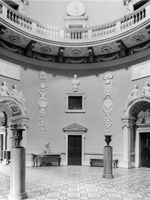
One of the great contrasts is between the pared back exterior and the lavishly decorated interior.  The Palladio homage continues with the house being organised around a soaring central circular hall which rises from the ground floor to the dome.  Fine plasterwork by Giovanni Bagutti decorates the doorcases with separate swags of flowers and fruit on the walls. The decoration of the hall is a preamble for the beauty of the other rooms. The Long Gallery was one of Campbell’s improvements over Palladio’s layout, replacing two smaller rooms with one dramatic space which was then  ‘...ornamented to within an inch of its life with every device in the early eighteenth-century decorator’s armoury…‘ (John Julius Norwich) with a beautiful coved ceiling with sumptuous frescos by Francesco Sleter.

Even Horace Walpole, the arch-Gothick evangelist, conceded when he visited in 1752 that although he thought the hall ‘a dark well‘ that such was the glory of the rest of the house ‘that I must own it has recovered me a little from Gothic‘. From Walpole, that is high praise indeed.

Saloon - Mereworth Castle (Image: Country Life Picture Library)
Saloon – Mereworth Castle (Image: Country Life Picture Library)

Mereworth Castle is a rich and exciting house – visually stunning, the perfect expression of the Anglo-Palladian villa with the austere exterior balanced by the dramatic interior plan and plasterwork.  That is has survived almost unaltered with only the most sympathetic additions is perhaps a testament to the powerful unity it has as a design.  As regular readers of this blog will know, I have a preference for country houses which retain their original purpose as homes for a wealthy single family. This has certainly been the good fortune which Mereworth has enjoyed, now being owned by Mahdi Al-Tajir, the former United Arab Emirates ambassador to the United Kingdom and owner of the Highland Spring bottled water company who bought it in 1976 for £1.5m.  The unfortunate downside is that we may never get to experience these remarkable houses but, on balance, it’s an acceptable trade if it means that a jewel such as Mereworth Castle is given the care and respect it richly deserves.  That said, perhaps some day I hope I will get the chance on a summer’s day, bathed in the warmest Kentish sunshine, to wander round this most splendid of country villas.

—————————————————————————

Listing description: ‘Mereworth Castle‘ [English Heritage]

More photos – exteriors/interiors:

Also of interest:

School’s out: seats of learning for sale

One of the many uses to which our country houses have been successfully adapted to is that of schooling – from the grandest such as Stowe and Bryanston to the many smaller houses which have delighted and terrified children in equal measure for many years.  Even as recently as April 2010, Wispers in Sussex, was sold to a London primary school as a satellite to their main campus. Yet for all the fond memories held by generations of youngsters, private schools and educational colleges are facing their own periods of austerity, forcing some to close.  With closure comes a rare opportunity for a house to once again become a home – though such a move is fraught with practical, and sometimes political, challenges.

Urchfont Manor, Wiltshire (Image: Augustus Photographic via flickr)

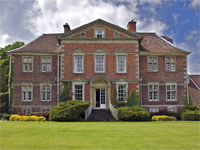
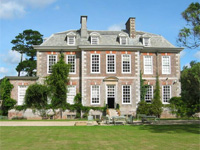
One of the bonuses of writing this blog is to discover houses so little known that, despite their obvious beauty, they seldom appear in books.  Urchfont Manor, Wiltshire is a classic example of this. Currently a residential college, this stunning smaller William and Mary country house was built around 1678 for William Pynsent, a wealthy London barrister, who would have been well-aware of the latest architectural fashions. The architect is unconfirmed but, with the hipped roof and projecting, pedimented centrepiece, it appears to draw inspiration from houses such as Horseheath Hall, Cambridgeshire (though 7-bays to Horseheath’s eleven) designed by Sir Roger Pratt in 1663-5 (dem.1777), and also clear stylistic similarities with houses such as  the north and south fronts of Fawley Court, Buckinghamshire (built 1684-5, by Sir Christopher Wren) and Puslinch, Devon (a late proponent of the style, being built c1720).  One curious anecdote, told to Sir John Julius Norwich, was that the house was substantially altered, creating the elegant east front, about twelve years after construction to designs by William Talman – but Colvin doesn’t mention it and no firm evidence has appeared to support this…so far.

Puslinch House, Devon (Image: Devon Rural Archive)

Urchfont is a fascinating and enchanting smaller manor house which successfully plays the neat visual trick of looking larger than it is – at least from some angles. The two key views of the house are from the main road from the village, which gave a clear view of the east front and the road running below the south front (the house was once more visible; maps from 1880s show only a few clumps of trees, much fewer than there are now).  If one only saw these two fronts, one might think this a large, cube-shaped house – but move round to the north and the house is clearly only one room deep on the east front. A lovely piece of social aggrandisement.  The house passed through various families and was tenanted before being bought by another lawyer, Hamilton Rivers-Pollock, in 1928, who lived there until his death in 1941.  It then became a home for London children suffering from tuberculosis, and was then bought in 1945 by Wiltshire County Council as a residential college.  Now, faced with cutbacks,  the council have decided to sell up, amid much local controversy, giving this beautiful house an opportunity to once again become a home.

The Hill, Abergavenny, Monmouthshire (Image: Cooke & Arkwright)

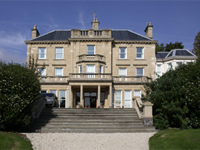
Across the country in Monmouthshire, The Hill, as the name implies, sits rather proudly on the edge of Abergavenny.  Built in the mid-18th century, the house sits in 20-acres of gardens (which are included on the Register of Parks and Gardens of Special Historic
Interest in Wales) from a once larger estate, the residential spread of the town having crept up towards it.  Sadly, poor planning has led to a small residential estate taking up the grounds to the east of the house, and further buildings associated with its time as a college now stand between them and the house.  This makes it exceptionally unlikely that the house would become a single-family home again but potentially a high-quality development, replacing the modern buildings and respecting the grounds, could offer a workable solution.

Bedgebury Park, Kent (Image: Knight Frank)

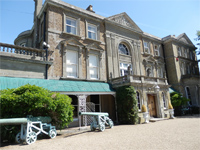
On a larger scale, the curse of the associated buildings also blights Bedgebury Park, Kent. The original house of the estate, seat of the influential Culpepper family, financed by a flourishing iron business based on the clay-ironstone on which it sits, was to the east of the current grand mansion (now a lake), and played host to Elizabeth I, who visited in August 1573.  The current house was built in 1688 for Sir James Hayes, a man who had become wealthy through  his wife’s inheritance and financing the recovery of jewels and gold from a sunken Spanish ship.  Sir John Cartier bought it in 1789 and added some impressive plasterwork and the chain of lakes on the estate.  Following Cartier’s death,  Bedgebury was bought by one of the Duke of Wellington’s most trusted men, Field Marshal Viscount Beresford.  He commissioned Alexander Roos c.1838 and the subsequent extensive alterations and the addition of the cross wings to create the H-shape, obscured the red-brick original behind an impressive cladding of warm, honey-coloured sandstone ashlar, creating a house which positively glows in the sun. Inherited by Alexander Beresford Hope in 1854, he made his mark on the house by adding the impressive Neo-Classical stairhall and the striking mansard roof.

Stairhall created c.1850s, Bedgebury Park, Kent (Image: Knight Frank)

The house was bought by the Church Education Corporation with 200-acres in 1919, opening as a school with just five pupils in 1920.  It quickly grew and new buildings were added in the grounds providing extra teaching and residential facilities, before closing in 2006.  Now offered at £7.5m, the grade-II* house sits in a 90-acre estate awaiting its future.  The brochure mentions that the local planning department are open to the idea of it becoming a single unit residence again – a possibly tempting prospect for a billionaire who needs an impressive house, a small estate, and doesn’t mind having to demolish the modern school buildings which have sprung up.  Considering the quality of the interiors, this must surely be a feasible prospect, especially in light of the recent sale of Park Place for £140m which proved that there are those willing to pay exceptional prices for the best quality properties.

Apethorpe Hall, Northamptonshire (Image: English Heritage)

For those seeking to move into a former school which has been partially restored to the highest standards and now only requires the finishing touches (if you have a couple of million pounds available), then possibly the finest option would be Apethorpe, Northamptonshire.  This fascinating Tudor/Jacobean/Elizabethan house has played a supporting role in royal entertainments for 500 years and features some of the finest plaster ceilings in the country – and became a particularly grand school between the late 1940s and 1982, when it closed. Bought by an absentee owner, it languished for years, flirting with dereliction.  Finally, intervention by English Heritage brought it into their care and it’s currently for sale for offers around £5m (English Heritage reputedly spent £7m on the rescue so far), and would require another approximately £4m to complete the restoration.  On an remarkable side note; the fact that Apethorpe was saved from the usual vandalism, arson and theft which so often afflicts empty buildings, was largely due to the tireless efforts of the caretaker, George Kelley, who carried on even though he wasn’t being paid to do so.

The most recent closure (at least partially) is of St Michael’s in Tawstock, Devon.  Originally known as Tawstock Court, it was built in 1787 in a provincial Gothick style to replace an Elizabethan house which burnt down that same year.  Although the staff and parents have made heroic efforts to save it, the concern for them is that the house will fall into the hands of developers who will convert it into flats – and considering the poor job most do of such a task, their concerns are very valid.

In these straitened times, sadly a number of parents and councils will be forced to economise and schools, usually private, may well close.  Sad though this will inevitably be for the many current and former pupils, it does also offer a possibility that these houses may revert to their former role for which they were designed – and few would argue that the spectacular Marshcourt in Hampshire, designed by Lutyens, was better off as a school. However, as the roll call of struggling schools lengthens, it is important that the future of the often wonderful buildings, which gave each school their character, are given due priority to ensure an appropriate transition and restoration if the opportunity arises for them to return to being family homes.

————————————————————————

Original story: ‘Urchfont Manor sale row erupts‘ [Gazette and Herald]

Listed building description: ‘Bedgebury Park, Kent‘ [British Listed Buildings]

The Country House Revealed – Clandeboye, County Down

Clandeboye, County Down (Image: Paul Barker / Country Life Picture Library)

One of the great glories of the private incomes afforded to previous generations was the ability to indulge in their passions.  Given the opportunity, many of us would similarly be happy to devote our lives to our interests and, for some, in doing so they have created great collections – not just of art, but in the fields of anthropology, Egyptology, armour, botany…the range is endless.  In this week’s ‘The Country House Revealed‘, Dan Cruickshank visits Clandeboye in County Down, Northern Ireland; seat of a branch of the Guinness family, but also home to an impressive collection of artefacts.

Clandeboye (also sometimes known by the original name Ballyleidy) sits in a 2,000-acre estate in the heart of the Ulster countryside – a smart, elegantly Georgian seat; the design semi-Soanian (originally), part-the-owner (later additions).  The professional architect involved was a former pupil of Sir John Soane, Robert Woodgate, to whose designs the house was built in 1801-4.  Woodgate had a brief career, cut short by his early death in 1805, having joined Soane’s practice as an apprentice in 1788, before graduating in 1791 and then being sent to Ireland to Baronscourt, Co. Tyrone (note the triffid-like march of the wind turbines now marring the skyline!), to supervise the building Soane’s commission of a new house for the Marquess of Abercorn.

Clandeboye, for the 2nd Baron Dufferin, was one of Woodgate’s earliest commissions and is unusual, ignoring the more common ‘Palladian’ central block with flanking wings layout, of houses at the time.  At Clandeboye, whilst still Soanian in it’s style, the layout is focussed on two wings at right-angles to each other with the corner due south taking maximum advantage of both the setting and the sun.  All-in-all, a good, competent design by a well-trained young architect – though perhaps lacking some of the drama a more experienced architect might have brought to the plan.

What is particularly special about Clandeboye today is that it contains the remarkable and diverse collections of the wonderfully named Frederick Temple Hamilton-Temple-Blackwood, 5th Baron Dufferin and Claneboye (note the different spelling of the title).  A prominent politician and administrator, he served as Governor General of Canada  (1872-1879) and Viceroy of India (1884-1888).  The Lord Dufferin was also something of a radical social reformer and fell out with the PM, Gladstone, believing that the land ought to be owned by the farmers.  Not content with just arguing for this, he sold off much of the 18,000-acres the family had amassed, leaving the estate we see today.

Very well-educated, Lord Dufferin, as with many other wealthy Victorians, used the opportunities of his many diplomatic postings to acquire large quantities of objects – not just the usual art and furniture but curiosities from around the globe.  This led to a new programme of work in the mid-19th century to enlarge the house to display these prizes, resulting in a large west wing.  Dufferin had toyed for years with grand plans for the complete rebuilding of Clandeboye to a faux-Elizabethan nostalgic ideal.  After a few years, his tastes changed and he then sought out Benjamin Ferrey to provide a French-chateaux style house – but again this came to nothing.  In 1865, his preferences had ebbed back towards a more ‘romantic’ style and he began a long collaboration with William Henry Lynn, who then advised Dufferin on the alterations to Clandeboye which are what we see today.   One aspect of the process which probably infuriated Lynn was, as Harold Nicolson has described, that Lord Dufferin’s ‘passion for glass roofing was… uncontrolled‘, leading to the broad use of skylights.  Considering how Soane, and therefore probably Woodgate, sought to carefully manage the effects of light, this crude flooding of the interior spaces may not have met with approval from the original architect.

Today, the contents of the house can be seen as a snapshot of the passions and interests of a wealthy aristocrat at the height of the British Empire. Victorian Britain seemed to foment this type of collector with other houses similarly becoming self-indulgent museums – though often with a great intellectual rigour which helped drive forward our understanding of the world and science.

Quex Park, Kent (Image: ..george / flickr)

For example, Quex Park in Kent became the showcase of the Powell-Cotton family, who, over six generations, created a superb collection of natural history with specimens taken during Major Percy Horace Gordon Powell-Cotton’s expeditions to Africa,which has subsequently been expanded by later generations.  Another showcase was Goodrich Court (dem. 1950) which was designed by the owner Sir Samuel Rush Meyrick specifically to accommodate his world-renowned collection of arms and armour which forms an important part of the incredible Wallace Collection in London.

Didlington Hall, Norfolk - demolished 1950/52 (Image: Lost Heritage)

As at Clandeboye, Egypt has long held a fascination in Britain.  One early and noted collection was assembled by William Amherst Tyssen-Amherst (the 1st Baron Amherst) at Didlington Hall in Norfolk (dem. 1950/52).  By chance, Lord Amherst employed a Mr Samuel Carter, a well-known artist to paint at the house, and he would often bring his son, who spent many an hour in the extensive Egyptian museum in the house.  That son was Howard Carter who famously went on to discover Tutankhamun’s Mask with George Herbert, 5th Earl of Carnarvon.  Highclere Castle also holds a small but important collection of Egyptian antiquities amassed by the 5th Earl and which are now on display in a purpose-built gallery in the cellars of the house.

Waddesdon Manor, Buckinghamshire (Image: National Trust)

Perhaps the greatest example of a house built to show a collection is Wadddesdon Manor in Buckinghamshire; that slice of French architecture which enchantingly appears in the middle of the English countryside.  Funded by the vast Rothschild fortunes, the mansion, designed by Gabriel Hippolyte Destailleur, was built between 1874-1889 for Baron Ferdinand de Rothschild primarily to showcase what must easily be one of the finest collections of Dutch and English paintings and French art, tapestries and furniture.  Used only in the summer months for parties and entertaining this was the ultimate expression of the desire to use a private residence as a gallery – or was it merely a gallery with bedrooms?

So Clandeboye is part of a long and fine tradition of the wealthy owners of large houses not merely adding a scattering of objet d’art to show-off the taste of their interior decorators. These houses are true collections, in some cases museums, even monuments, to the eclectic passions of their owners.  The wide-ranging nature of these collections demonstrates one of the many benefits of single family ownership, such as at Clandeboye, where intellect and wealth can be combined over generations to create a rich and interesting tapestry that no public organisation would be likely to be imitate; and our nation would be all the poorer without it.

————————————————————————————–

Official website: ‘The Country House Revealed‘ [BBC2]

A wonderful interview (and slideshow) with the Countess of Dufferin and Ava: ‘The Marchioness‘ [wmagazine]

The Clandeboye estate: official website / history [clandeboye.co.uk]