How to lose money on a country house: Compton Bassett, Wiltshire

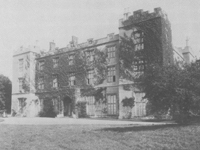
Compton Bassett House, Wiltshire (demolished 1929)

[This article was originally published in 2010]

The news that Robbie Williams is to sell his country house, Compton Bassett in Wiltshire, for a potential £1m loss shows that with the wrong property it is still possible to buck the generally rising trend in prices by overpaying in the first place.

The Basset family (after whom the village was named) had first built a timber-framed house in the 13th-century. By 1553, the new owner of the manor, Sir John Mervyn (d. 1566) rebuilt the house using a reported 260 oaks, which gives some indication of the size of the house. It was still standing in 1659 and was recorded as being on a U-shaped plan, open to the south east. In 1663, the house and estate were sold to Sir John Weld, of the ancient Dorset family. He made significant changes, spending the colossal sum of £10,000 between 1663-1672 to build the sides up to 130ft and 110ft to create a large rectangle and to then cover over the courtyard. Originally, the house was in a soft, white stone but this renewed in brick in 1814, with the rest of the house following in the late 19th-century, during which it also gained the battlements. 

Sir John also added the distinctive corner turrets; a stylistic device which echoed the form of a castle which bears some similarity to the Weld family’s main country seat, Lulworth Castle in Dorset,. This was built as a hunting lodge in 1610 by Thomas Howard, 3rd Lord Bindon, and bought by Humphrey Weld (John’s elder brother) in 1641, but sadly gutted in a devastating fire in 1929. As Humphrey Weld died (in 1684) without a male heir, Lulworth Castle passed to John’s son William who seems to have chosen it as his family seat and sold Compton Bassett in 1700.  

The house passed through various owners until it was inherited by George Walker Heneage (d. 1875) who, by 1828 had established an estate covering 1,813 acres in the area. It was Walker Heneage’s grandson, Godfrey, who eventually inherited the estate in 1901 but then sold it in 1918 to the Co-Operative Wholesale Society who sold it again in 1929.  It was bought by one E.G. Harding who then parcelled up the estate and sold it off piecemeal. 

That period was a dark time for the country house in the UK with many being demolished. The house was bought by Captain Sir Guy Benson who sadly decided that he would rather live in the stables and so this wonderful house was levelled in the early 1930s and the stables converted in 1935 into the new Compton Bassett House.  Unlike other successful conversions of stables, this one was obviously designed as a functional building and lacked the grace of so many of the stable buildings we can still see today and so did not lend itself to being the main house.   Not that it has stopped various owners over the years trying.

Compton Bassett, Wiltshire (former stables) (Image: Panoramio)

The latest project was started in 1998 by the then owner Paul Cripps and was to take six months and cost £500,000 but ended up taking three years and costing £3m.  The house was then launched on the property market in 2007 at an eye-watering £8.5m (no doubt to try and recover some of the lavish overspending on the interior) for the house plus 71-acres.  After languishing for many months Robbie finally bought it for £8.1m but never really settled here, preferring his life in the US.  So now it is back on the market with Savills (but not listed on their website) for a reported asking price of £7.5m – but once you factor in all the costs involved from buying and selling, Robbie should be about a million down from when he bought it.  This also assumes he’d get that price – losses could rise if, remarkably, there was someone else out there who liked the look of the house but decided that it was still too expensive and drove the price down further.  To be honest, when compared with some of the other properties Savills have available in Wiltshire for around £6m (e.g. Langley House or Midway Manor) why anyone would chose this one is beyond me.

n.b. the interior and floor plans can be seen in this article in Variety magazine in 2013 when it was again on the market for £5.5m: In Case You Missed It: Robbie Williams

*Update* 2010

Savills have added Compton Bassett to their website so if you have £7.5m and really feel that this house is the best way to spend it, then have a look at the details: Savills: Compton Bassett

*Update* February 2021

So, it turns out that Mr Williams was not able to sell the house in 2010 or 2013 or 2016 when it was variously reporting as being relisted. Again, in 2021, there is renewed interest as he plans to move with his family to a new house in Switzerland and has no plans to stay in a house he (and his daughter) now feel is ‘creepy’.

Robbie Williams selling £9 million ‘haunted’ Wiltshire mansion in Switzerland move (Evening Standard)


25/02/2021: article updated with further details on the history of the house and the current situation regarding Mr Williams.

The start of the rush? Country houses for sale in the Sunday Times Home section

Sandley, Dorset (Image: Knight Frank)

The usual spring rush of country houses coming to market has been later this year – a combination of the hangover from the uncertainty in the market of the last couple of years along with that of the General Election.  That traditional shop-window of the country house – the Home section of the Sunday Times – has this week (16 May 2010) heralded what it sees at the start of the rush by including three pages of those for sale.

For those who like their country houses to look traditional from the outside but prefer a more modern interior then the Grade-II listed, six-bedroom Sandley in Dorset, set in 178-acres, might be perfect – if you have the necessary £9m.  The owners decided that the rather ‘quaint’ style of the house was not for them and so they spent ‘a couple of million pounds’ and over two years to strip it back and then make it look very ‘London’.  Personal taste is the final arbiter for whether you think this is a good thing – but not all tastes are the same and it can mean that the appeal of the country house is taken to new markets.

Ebberly House, Devon (Image: Savills)

However, if your tastes are more usual and traditional then there are other options. Holt Manor in Wiltshire, set in 94-acres, mixes both old and new with a more traditional interior cleverly concealing the latest in sound, television and security systems.  With parts dating back to the 12-th century, the Grade-II listed house has been thoroughly modernised whilst still being a recognisably English country house. £5.95m [Holt Manor: Knight Frank]

If, however, you are looking for a more architecturally impressive house, the Ebberly House, near Winkleigh in Devon, could well be the house for you.   Designed by Thomas Lee, a student of Sir John Soane, Ebberly was described by Pevsner as an ‘unusual and attractive house’ and was the first to sell in Devon for over £1m when it sold in 1997.  The Grade-II* listed house possibly benefited from Soane’s personal influence as he was working nearby at Castle Hill which may explain the elegant, and very Soanian, top-lit oval stair hall with its fine cantilevered wooden staircase and curved doors, or the drawing room divided using three shallow arches. Set in  250-acres it has a wonderful estate featuring 20-acres of woodland, estate cottages generating £20,000 p/a in rental income, and spectacular views across to Dartmoor. It was also given an excellent and detailed write-up in Country Life – always a good seal of approval.  [Ebberly House: Savills]

Chapel Cleeve Manor, Somerset (Image: Webbers)

Perhaps one of the most interesting of the houses featured is unfortunately only given a photo and no details is Chapel Cleeve Manor in Minehead, Somerset. Perhaps now not strictly a country house as it only has 7-acres, at £1.695m for 17+ bedrooms, it may seem a bargain for someone who wants to live in a country house but doesn’t want the responsibility of an estate. Although such a situation a hundred years ago could have led to the demolition of the house as happened to so many others. Yet, with so much wealth now generated without the need for a large estate to support the house, it’s now entirely reasonable for someone to take on and enjoy such a pleasing Gothic-Revival house. The house has been used as a conference venue for a number of years but with careful restoration this could be rescued from commercial use and be a spectacular home for someone who requires a lot of space. [Chapel Cleeve Manor: Webbers]

So has the rush started?  Nobody really knows and asking estate agents is never an exact science.  Several house which have been launched recently are still waiting to find new owners but the right house launched at the right time for the right price usually does find the right buyer.

Full story: ‘The landscape has changed‘ [The Sunday Times: Home section]

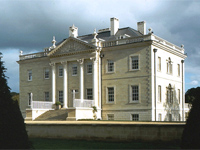
Ferne Park, Wiltshire: the building of a modern Classical masterpiece

Ferne House, Wiltshire (Image: Q&F Terry, Architects)

The English country house is considered our greatest contribution to the field of architecture – the unified vision of house and landscape combined with fine interiors, superb furnishings and exceptional art collections.  Yet in the 20th-century, it seemed that after Lutyens we largely lost our ability to excel in their creation – the new country houses seemed shadows of our earlier confidence, lacking the grand flair, and certainly the detailing, which had so defined the Georgian Classical house.  This was partially due to financial circumstances but also due to the influence of modernism which sought to re-interpret the country house in a new language – and it often didn’t translate well.

Yet, there are signs that given the right client and the right architect, we can again create the sort of country houses which will be admired in 200 years. Country Life magazine this week (5 May 2010) features one of the best country houses to be built in the last 70 years; Ferne Park in Wiltshire, winner of the Georgian Group award for the Best Modern Classical House in 2003.

This is a house built in the finest traditions of the English country house – with its clear use of the Palladian vocabulary but skilfully reinterpreted for the location and the needs of the client, Lady Rothermere.  The architect responsible, Quinlan Terry, has been responsible for some excellent buildings but this may well be his best.  The new house, built in 2000-2, was on the site of a previous Georgian mansion called Ferne House which was demolished in 1965 having fallen into a poor condition.  By rebuilding on the same site, Terry had a setting which was simply waiting for a new house to be created.

The local authority had already set the requirement that the new house must be Classical so both client and architect drew on other houses they knew such as Came House (Dorset) and Castletown Cox (Ireland), and were able to develop a distinctive plan for the site.  The house also cleverly has contrasting fronts with the dramatic views to the north matched by the stately columns and pediment, whilst the south, with the gentler views into Dorset, using a simpler facade.

Ferne Park has revived hope that it is possible to build a successful Classical house which is recognisably a continuation of the the glorious Georgian traditions which have created so many of the houses we love today.

More pictures of the house: Ferne House, Wiltshire [Quinlan & Francis Terry, Architects]


Part II of the article will be published in the 12 May 2010 edition of Country Life.