Syngenta’s shame: proposed demolition of Dalton Grange, Hudderfield

To paraphrase: ‘all that is required for heritage to be lost, is for good people to do nothing‘.  Sometimes this can be through deliberately ignoring a situation or through lack of awareness that a situation even exists. So, this is a quick post to highlight the shamefully poor justification that Syngenta Ltd have proposed as reason to demolish the mistreated but ‘hugely characterful’ Dalton Grange in Huddersfield.

Dalton Grange, Huddersfield, Yorkshire (Image: Huddersfield Examiner)

Syngenta Ltd is a Swiss-based, global agri-business with revenues of over $14bn and profits of over $1.6bn (2013) – and I have no problem with that at all; big business provides jobs but it also creates local responsibilities.  The corporate website is bathed in the language of sustainability and waste reduction – noble, certainly, but sadly in Huddersfield, they appear to not be interested in following these aims.

A recent application was made by Syngenta to Kirklees Council to demolish Dalton Grange; a building the Victorian Society have identified in their response as being locally significant, both historically and architecturally.  They note that it was built in 1870 by prominent local industrialist Henry Brook, of J.H. Brook & Sons of Bradley Mills (both north and south mills at Bradley Mills are listed Grade II).  Sited on a hill, the house is:

…a sturdy and handsome essay in baronial Gothic, with a prominent castellated turret providing dramatic views of the building at the end of its drive. It is a hugely characterful building and is set in large terraced gardens that in recent years have been restored in order to provide the beautiful landscaped setting that it once enjoyed.
Consultee Responses: Victorian Society
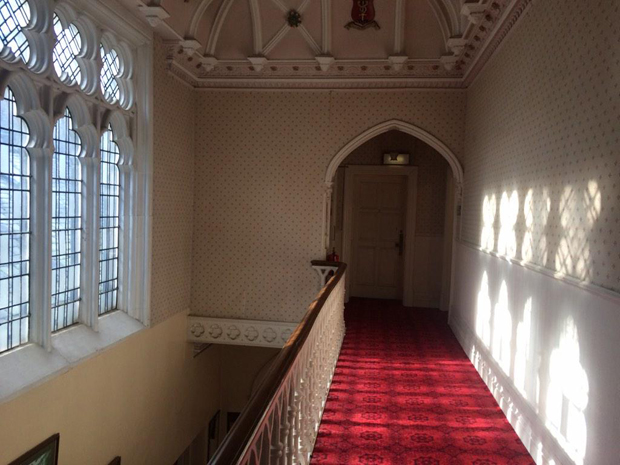
Dalton Grange staircase (Image: Dalton Grange)

Care for a local area should be integral to how a company operates, respecting the traditions and heritage which surround their sites.  In both local terms and in relation to national guidelines, the bar needs to be set high to justify the loss of heritage – so how do Syngenta address this:

Reason for demolition: No foreseeable future use for the building. In addition there are anticipated excessive costs associated with ongoing maintenance & refurbishment
Source: Application 2014/68/91888/W

Allow me to paraphrase: ‘Syngenta can’t be bothered to use this heritage asset which is in their care and it’s looking a bit expensive to look after in the way we are supposed to, so we would prefer it if we could just get rid of it.‘ In some meeting, this must have seemed like a quick solution. Hold on though, we’d better think of something we can usefully use this space for once we’ve cleared it. What inspiring solution can we find? What might conceivably justify this lost of a building which has been part of the Huddersfield landscape for nearly 150 years – let’s look at their application again, specifically section 5:

Please describe details of the proposed restoration of the site: A possible outcome is that parking provision for a number of cars will be made available to help ease traffic problems during stadium events.

A car park. Well done, Syngenta.  Speaking to the Huddersfield Examiner, Syngenta community relations manager (ha ha!), Carl Sykes said “This is a private building on private industrial land.” Which I think is his way of saying ‘It’s none of your business’. He continues:

“Times have changed and now they don’t want to run a social club and we no longer have a use for the building. [Or ‘if we can’t have it, no-one can have it’]

“We’re looking to keep skilled manufacturing jobs in Huddersfield for future generations, we cannot continue to subsidise a tired and decaying building that is becoming beyond economic repair.

“We know there is asbestos in the building and attempts to renovate or modify the building would run into tens of thousands of pounds.” [Asbestos is now the new dry rot – used to justify any sort of historic demolition]

“When the demolition is completed, we shall explore how we might use the land to give some real value to the area, rather than becoming a shuttered up, rotting, old building. [Of course, if you sold it to someone who cared about Huddersfield’s heritage it would avoid the fate you are clearly planning for it]

“For example, the land could be used for allotments or maybe stadium match day parking.” [Oh yes, that’s definitely better. What a fine swap].

This is symptomatic of the casual way in which heritage is being treated up and down the country.  Although there are some great examples of sensitive corporate care for heritage assets, there are many others – from small developers to global multi-national agri-businesses – who fail to recognise that heritage is to be cared for and respected.
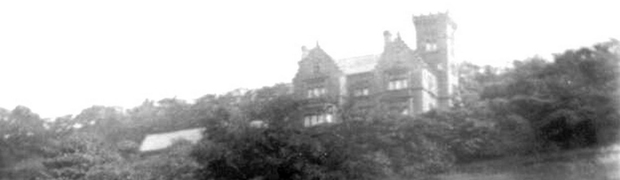
Dalton Grange, Yorkshire (Image: Huddersfield Examiner)

Kirklees Council also need to take the role expected of them and reject (forcefully) this casual destruction of historic buildings which are an integral part of the character of their local area. Syngenta may be a major local employer but that’s all the more reason to stand firm and provide a precedent that will ensure that the local residents know that the Council cares about protecting a local environment, rich in character and heritage.  The Huddersfield Daily Examiner, should also be leading a campaign to save their heritage, giving voice to those who live in the area who, if asked, would almost certainly prefer to retain a fine old historic house – an article published on 21 March 2015 does start this with a suitably sceptical headline: ‘Proposed demolition of Dalton Grange sparks outrage‘.
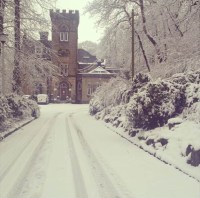
Dalton Grange in the snow (Image: Dalton Grange)

Of course, perhaps Dalton Grange isn’t the most spectacular building or in the best condition or in the best position, on the edge of a huge Syngenta production plant but it is separated by a pleasant band of woodland so it would not impact the integrity of their site if they sold it. And perhaps that plant won’t always be there but during their tenure they should ensure that they show respect to local architectural heritage which has been there since long before them.  To demolish the house on such flimsy grounds as ‘maintenance is a bit expensive’ and ‘we fancy a car park’ would be a shameful episode.  Syngenta should immediately withdraw the application, explain how they are going to restore Dalton Grange or sell it, and help find a sustainable long-term use (in line with their professed corporate philosophy) for this small but locally important part of Huddersfield’s heritage.

——————————————————————————————————

Prior notification for demolition of building: Dalton Grange, 19, Bradley Mills Road, Rawthorpe, Huddersfield, HD5 9PR [2014/68/91888/W]

Proposed demolition of Dalton Grange sparks outrage‘ [Huddersfield Examiner]

Victorian Society

Dalton Grange

The Country House Revealed – Wentworth Woodhouse, Yorkshire

Wentworth Woodhouse, Yorkshire - east front (Image: dykwia / flickr)
Wentworth Woodhouse, Yorkshire – east front (Image: dykwia / flickr)

If asked to name the largest and grandest country houses in Britain, many would list obvious candidates; Chatsworth, Belvoir, Castle Howard, Petworth, but few would name Wentworth Woodhouse in Yorkshire, the house featured in the next episode of Dan Cruickshank’s ‘The Country House Revealed‘ [Tuesday 31 May – 21:00 – BBC2]. One of the largest private homes in Europe, this leviathan slowly slipped into obscurity since family feuds and a vindictive Socialist minister caused the house to decline from being the greatest to being neglected.  Now, after ten years of hard work by the current owner, the house makes its first steps back towards the public stage – but is the price of the resurrection perhaps too high?

Wentworth Woodhouse - west front (Image: Matthew Beckett)

One of the triumphs of Wentworth Woodhouse is that the design of the house is coherent and powerful despite its size – extending to 606ft from tower-to-tower, to create the longest front in the country*.  Yet, the house is also one of two sides, the grand Classical east front, and the earlier, Baroque west front.  To have a house of such contrasting styles might indicate very separate plans of construction, yet a plan of proposed works dating from before 1725 and possibly as early as 1716, shows that the Earls Fitzwilliam had every intention to build on such a scale, with just the design itself changing.  The west side, the luxurious, decorated Baroque face, was raised between 1724-28 was long thought to be to a design by Ralph Tunnicliffe, a local architect who had worked on Wortley Hall and Calke Abbey, Derbyshire (1722). Yet, his work bears more familiarity with the Classical east front – so who designed the first stage?

Beningbrough Hall, Yorkshire (Image: nickrick90 / flickr)

Richard Hewlings in an article in Country Life magazine (17 February 2010) makes a solid case for the work being by the very well-regarded York architect, William Thornton (b. c.1670 – d.1721), who had previously worked on the joinery at Castle Howard, and designed Beningborough Hall. The latter of these (according to Colvin) showed a familiarity with Roman Baroque architecture as shown in Rossi’s ‘Studio d’architecttura civile‘ (pub. 1702-21).  Hewlings argues that because Beningbrough can be attributed to Thornton and that the same Rossi-inspired architectural elements can be seen in both houses, it makes Thornton (having definitely owned a copy of Rossi) the one most likely to have designed Wentworth Woodhouse – with his early death contributing towards his obscurity.

Wanstead House III, Essex - proposed design by Colen Campbell as shown in 'Vitruvius Britannicus'

So Tunnicliffe designed the east front. Well, mostly. His 1734 design can very clearly be seen as derived from that most important of Palladian houses, Wanstead House, in Essex (built 1715 – dem. 1822).  The original architect of Wanstead, Colen Campbell, produced three designs (known as I, II, and III) which drew on the form of Castle Howard but stripped of much of the architectural verbosity which so offended the more austere Palladians. This design was to form the backbone for several generations of large country houses particularly in the boom years of the 1730s and -40s.  Yet, even though work started in 1731, in 1735 the Earl of Malton thought it best to have Tunnicliffe’s design reviewed by a greater authority, that of Lord Burlington, the ‘chief’ Palladian.  This proved timely as Tunnicliffe died in 1736 and so responsibility passed to Henry Flitcroft, a Burlington protege.  Flitcroft’s external alterations were relatively minor; adding pedestals to the portico columns, changing the shape of the attic windows, (he also provided designs for several rooms) but his engagement there was to last until work finished in 1770.

One obvious question is just why the house was so large? Beyond the usual demonstration of the scale of the family’s wealth and status, the house also had to be of such a size to accommodate the vast entertainments which the Watson-Wentworth’s needed to hold occasionally as part of their seduction of such a large and sparsely populated county.  Up to a 1,000 locals – nobles, gentry and simple gentleman alike – might be invited, with each given a ticket indicating which room they were to go to (and, by implication, their social status).  Another, seemingly more petty, reason was that Lord Malton’s father had inherited the estate in 1695; much to the shock and annoyance of another (politically opposed) relative, Thomas Wentworth, who lived nearby at Stainborough.  He responded by enlarging his own seat, Wentworth Castle (now a sadly much altered training college), in a grand style, ensuring that Lord Malton couldn’t be seen to ‘lose’.

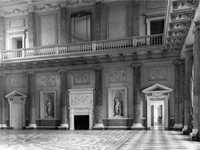
The Marble Hall, Wentworth Woodhouse (Image: (c) Country Life Picture Library)

One of the most breath-taking aspects of this need to impress are the interiors; boasting 25 ‘fine’ rooms of the highest quality, whereas by comparison, Buckingham Palace has 20 of a similar standard, Blenheim around eight, Castle Howard perhaps three or four.  These rooms are centred around the glorious central Marble Hall; 60ft square, 40ft high, with rooms leading off to the left and right including the Great Dining Room, the Van Dyck Room, the State Dressing Room and the Long Gallery.

That the Fitzwilliam family no longer live in Wentworth Woodhouse is one of the great sadnesses of the many families forced from their ancestral homes.   At one point this grand house boasted some of the finest furniture, a priceless collection of art including statues  and many paintings by such artists as Van Dyck, Reynolds, Mytens, Hoppner, Lawrence, Claude Lorraine, and a major collection of Stubbs’s work.  Yet, for all the wealth and power, it was founded on primogeniture and coal – both of which undermined the house in their own way.

The births of previous Earls Fitzwilliam had usually taken place in Wentworth Woodhouse and had been witnessed.  However the birth of the 7th Earl in the 1890s took place in the wilds of Canada for reasons which have never been fully explained, leading to members of the family levelling allegations that a settlers son had been swapped at birth for the daughter the Countess was thought to have really given birth to.  This eventually led to a split in the family as to where the title and the vast inheritance should descend.  With primogeniture determining it must go to the eldest legitimate male heir, this was only settled with a court case in 1952 between two brothers.  The ‘winner’ was the younger son who subsequently married an older lady, and therefore never producing an heir. On his death in 1979, the long title of the Earls Fitzwilliam died out – though not before the last Earl had a huge bonfire of 16 tonnes of family papers to permanently cloak their history.  The estate is now held by Lady Juliet Tadgell nee Wentworth-Fitzwilliam with the family still owning 80,000-acres of Yorkshire and 50,000-acres of Cambridgeshire – and the art collection.

Mining at Wentworth Woodhouse (house circled)

It was the coal that physically undermined the house – both above ground and below. The post-war Socialist government was determined to break-up what it saw as the privileged elite.  One particularly bigoted ideologue was Manny Shinwell, then the Minister for Fuel and Power, decided that as part of his campaign of class warfare he would mine the coal under the park and house – even when told it was low-grade and not worth the effort.  He also ignored the pleas of the local miners and their representatives who had always enjoyed excellent relations with the Fitzwilliams who were widely regarded as one of the best mine owners in the country.  Shinwell’s workers destroyed the park which the miners had enjoyed for years and also dumped the spoil to within yards of the house.  Rather than live there the family moved out – though not before securing the use of the house as a teacher training college which no doubt saved the house from demolition.

However, the mining might yet save the house – though the proposed solution contains considerable risk.  Part of the mining deep underground left a column to support the house – but it wasn’t large enough leading to subsidence which has caused parts of the house to sink by up to 3ft. The house was bought for just £1.5m (£7 per sq ft!) by London architect Clifford Newbold in 1999 and he and his family have spent the last decade carefully restoring the house in conjunction with the conservation architects Purcell Triton Miller and engineers Arup.  Now the family are ready to launch legal action to secure £100m in compensation for the negligent mining under the house.  Using this money, they will obtain further funding to develop the huge stables (built by John Carr in 1768) as office space and also “...two new contemporary buildings that replace the former college accommodation and will support the Stables office building through provision of further office accommodation. These sunken ‘green roofed’ buildings will be designed so that they do not have any detrimental visual impact on the open spaces of the landscape of Wentworth Woodhouse.” (from the official press release).  This can be understood and can be supported so long as the commitment to the minimise the impact to the estate (which is now just 90-acres) is successful.

What gives some concern are the plans for the main house as a “…publicly accessible restored museum to the central and grandest rooms, as well as a 70 suite luxury hotel and spa to the remainder.“. This will necessarily have a significant impact on the structure of the house – and I’m not convinced it’s the entirely right plan.  This house should be the Chatsworth of Yorkshire – a grand house, filled with art and life – and though the plans for the museum will be put into action, there is no word as to whether the rooms will be furnished?  If so, by who?  Will the V&A have an outpost? Perhaps I miss the idea of a family living there, using these rooms – though where to find a family able to take on such a monumental task? Just imagine if the Fitzwilliams had been able to move back in? I do wish the Newbold family every possible success but only if the plans respect the history and importance of the house and it’s not just used as an architectural prop for a multi-use residential, hotel and office space development.

———————————————————————

* – that it was the longest was the subject of an amusing bet in 1750 between Sir John Bland of Kippax Park and Lord Rockingham (as the Watson-Wentworths had now become) as to whose house was longest – Sir John lost by just 6ft.  Kippax Park was later demolished and the area open-cast mined.

Many more images of the house, grounds and stables can be seen in the Country Life Picture Library: ‘Wentworth Woodhouse‘ [countrylifeimages]

More about the house and estate: ‘Wentworth Woodhouse‘ [wikipedia]

Official website: ‘The Country House Revealed‘ [BBC2]

More about life in Wentworth Woodhouse: Part 1 and Part 2 [countryhousereader]

Local news report: ‘Wentworth Woodhouse: Newbold family bagged mansion for just £1.5m‘ [thestar]

Ripples of Palladio: Forcett Hall, Yorkshire for sale

Forcett Hall, Yorkshire (Image: GSC Chartered Surveyors)

For those of us who love our country houses, the weekly delight of the new Country Life magazine are the many pages of houses for sale.  Although the space is usually dominated by the major players such as Knight Frank, Savills etc, a particular joy is when you discover, tucked away with a smaller agent, an especially good house which deserves to be better known.

One recent house which falls neatly into this category is Forcett Hall, near Richmond in North Yorkshire.  Grade-I listed, this house forms part of the spread northwards of the fashionable ideas of Lord Burlington and the Palladians. ‘Palladianism’ (as it became known) formed a new movement and became the dominant architectural taste from around 1710 until around 1750 but which is still very popular and influential today.

The Palladians were largely influenced by the work of the Italian architect Andrea Palladio (b.1508 – d.1580) whose work, particularly around Vicenza, drew heavily on the ancient classical form of Roman architecture.  The ideas were spread to Britain initially through the work of Inigo Jones, a multi-talented theatrical designer to the Court who also became the Royal Surveyor of Works which gave him the platform to spread the ideas of Italian Renaissance architectural classicism to these shores, starting with the Queen’s House in Greenwich, London.

Wanstead House, Essex

Key to the spread of these new ideas were two books, volumes 1 & 2 of ‘Vitruvius Britannicus‘, which took the form of a folio of one hundred classical buildings, published by the architect Colen Campbell.  Campbell also created one of the most important buildings of early Palladianism, Wanstead House in Essex, (dem. 1824) which re-interpreted the form of Vanbrugh‘s Baroque Castle Howard but in a new, more austere architectural language.  This was then followed by Wilbury House, Wiltshire, designed and built in 1710 by William Benson who succeeded Sir Christopher Wren as Surveyor of Works.  Wanstead inspired several derivatives in the years following its completion including Moor Park, Hertfordshire (1720s by Thornhill and Leoni), Wentworth Woodhouse, Yorkshire (alterations of 1733 by Flitcroft), Nostell Priory, Yorkshire (1733 by Paine) and Prior Park, Wiltshire (1735 by John Wood I).

Chiswick House, Middlesex (Image: curry15 / flickr)

Richard Boyle (b.1694 – d.1753), the 3rd Lord Burlington and 4th Earl of Cork, played a  significant role in firmly establishing Palladianism as a movement through his own influence, patronage and his circle of followers.  Burlington employed Colen Campbell to remodel his London house (taking over the work started by his rival James Gibbs) but Burlington was also a skilled architect, building the beautiful Chiswick House, in west London, in 1729, not so much as a home (it contains only state rooms) but as an architectural statement of his new principles.

One of Burlington’s protégés who assisted him as clerk of works on some of his earlier projects was Daniel Garrett (b.? – d.1753).  A measure of his competency can be seen in a letter sent in 1737 by Sir Thomas Robinson to Lord Carlisle regarding proposed works to complete the Mausoleum at Castle Howard:

“My Lord Burlington has a much better opinion of Mr Garrett’s knowledge and judgement than of Mr Flitcroft’s or any person whatever, except Mr [William] Kent…”

Stanwick Park, Yorkshire - dem. 1923 (Image: Lost Heritage)

However, despite his skill, Garrett was dismissed from his role in the Office of Works in 1737 for ‘not attending his duty’.  This was probably related to his absences caused by his own growing architectural practice in the north of England.  In 1735 he was remodelling Wallington Hall, Northumberland for Sir Walter Blackett, in 1736 he was at Castle Howard, and in 1737 he was working for Lord Derby, and between 1739-40 working for Sir Hugh Smithson, Bart, (later 1st Duke of Northumberland) on the rebuilding of Stanwick Park, Yorkshire (sadly demolished in 1923). He was later to work at other distinguished houses including Raby Castle in Co. Durham, Warwick Castle, Northumberland House in London (dem. 1874), Horton House in Northamptonshire (dem. 1936), Uppark in Sussex, Kippax Park in Yorkshire (dem. 1956-59) and most notably Foots Cray Place in Kent (dem. 1950).

This gives a measure of Garrett’s skill and his client list.  It was following his work at Stanwick that he started work at Forcett Hall in 1740 – though there does seem to be some debate as to what he did.  A list at Alnwick Castle says that the house is by ‘Mr Garrett for Mr Shuttleworth’, the latter being Richard Shuttleworth, the local MP who commissioned the house, whose family owned the estate between 1582-1785.  Although the estate agents state that the design of the house can be attributed to him as a rebuild following a fire in 1726, Howard Colvin thought him an unoriginal architect but skilled in providing handsome houses and instead only gives him a now demolished part of the east wing, the lodges and park entrance, the ceiling of the saloon (copied from the dining room at Chiswick House), and the grotto.

Forcett Hall, Yorkshire - as drawn by Samuel Buck

So if he didn’t design the main block, here’s an alternative theory; the house wasn’t completely burnt down in 1726 but was just seriously damaged, and Garrett gave a Palladian flavour to the house as part of the restoration.  The south front of the original house was drawn by Samuel Buck in his usual technically flawed idiosyncratic style (see right).  This is the same view in the picture of the house at the top of the post but the current house lacks the projecting wings but it does share the exact same form of three storeys over a semi-sunken basement.  Looking at the main house now (there’s an excellent picture on flickr: Forcett Hall – and also see the paintings in the comments), it could be argued that the elements of Palladianism – Ionic pilasters, quoins, external staircase have merely been applied to the house rather than forming a fundamental part of the design.  By excavating the semi-sunken basement (note the level of the lawn to the left), Garrett creates not only the appearance of a piano nobile, but also creates the space to add the staircase which is also in a typical Palladian style (and appears to be a modified form of the one at Stourhead as shown in ‘Vitruvius Britannicus) – but which seems to be an addition rather than a focus.  Elements such as the pilasters with their Scamozzi Ionic capitals almost seem to be copied from the entrance front of Marble Hill House in Twickenham (built 1724-29 by Roger Morris). Conversely, the north (entrance) front of Forcett is almost a different house; looking far more like an Italian villa than a Yorkshire country house (and I’m sure I recognise it from somewhere…).  Or perhaps I’m completely wrong and it is a new house, the design of which exposed the limitations of the architect.

This is a fascinating house, well worthy of it’s grade-I listing, though the photos on flickr show it’s in need of some care and restoration to fully bring out the beauty of this wonderful house.  The interior boasts some fine plasterwork and the house is set in a perfect small park which includes a 17-acre lake, no public footpaths and a grotto.  If someone is looking for a house with privacy but also a history to be explored there are few better houses available.

Property details: ‘Forcett Hall‘ [GSC Chartered Surveyors] – comes with over 230-acres, guide price £5.5m.

Property brochure [PDF]: ‘Forcett Hall‘ [GSC Chartered Surveyors]

——————————————————————————

British and Irish Stately Homes blog – more property for sale

This is also a good point to highlight another blog you should find interesting.  British and Irish Stately Homes is written by Andrew who is a frequent contributor to the comments in this parish.   Featuring houses for sale, TV programmes involving country houses, books on the topic plus much more it covers some more of the areas I just don’t have time to!  Do bookmark it, subscribe and let Andrew know if you spot anything you think ought to be added.

The front line: the campaigners for country houses

Apethorpe Hall, Northamptonshire (Image: English Heritage)

Despite the image of wealth and power a country house might create, in reality their existence is far more precarious – as can be seen with nearly 1,800 houses lost over the last two centuries.  A house facing the threats of being uninhabited without a concerned, well-funded owner with an inclination to keep it in good repair can quickly deteriorate leaving another gap in the tapestry of the countryside.  Sometimes it requires someone other than concerned locals and architectural historians to highlight and campaign on behalf of those ‘at risk’ so here’s a quick round-up of the main English organisations fighting on behalf of country houses and who are very worthy of support.

English Heritage inhabits a prime position in view of its role in defining and, in conjunction with local authorities, implementing the statutory protection of our built heritage.  Its role can be traced back to the Ancient Monuments Act of 1882 – though the legislation specifically excluded privately owned houses. The responsibilities were exercised through various government departments until it became a quango in 1984.  As well as being responsible for the listing system and the annual production of the various ‘at risk’ registers (focussing mainly on grade-I and -II* properties), EH is also directly responsible for various country houses including Brodsworth Hall (Yorkshire), Rufford Abbey (Nottinghamshire), Hill Hall and Audley End (Essex), Kirby Hall (Northamptonshire), Witley Court (Worcestershire), Stokesay Castle (Shropshire), and Apethorpe Hall (Northamptonshire).   It’s at the grade-I listed Apethorpe where EH has done some of it’s most interesting work; taking a direct role in the restoration of one of the finest Elizabethan/Jacobean houses in the country following a long period of neglect. Since 2008, the house has been for sale for around £5m – though there is a compulsory £4m list of renovations, and if you want complete privacy expect to pay another £8m to fully reimburse EH otherwise you have to open it for 28 days a year; so a nice round £20m to restore, furnish and keep as your own. However, this is a role that I fully support them in taking on – they should be there as owner and restorer of last resort for threatened grade-I houses.  Now perhaps we can interest them in the sadly deriorating Melton Constable Hall in Norfolk…?

Another important group of campaigners are recognised in the 1968 Town and Country Planning Act which formalised the role of what are known as ‘amenity societies‘; that is, well-established voluntary societies who are experts in their areas, who must, by law, be informed of any applications for listed building consent to demolish listed buildings in whole or in part in England and Wales.

One of the best known is the Georgian Group who cover a period broadly from 1700-1837.  The society was established in 1937 and has long campaigned for the sensitive restoration and retention of not only the buildings but the many important, and sometimes sadly overlooked, internal features which are a key part of the character of a building.  Current active campaigns and cases they are involved in include Bank Hall in Lancashire and Trewarthenick House in Cornwall and many others. They also produce a scholarly annual research journal which provides a much more in-depth view of aspects of Georgian architecture.  Access for the wonderful trips to houses not normally open to the public are worth joining for alone.

Eaton Hall, Cheshire (by Alfred Waterhouse - dem. 1961) (Image: Lost Heritage)

The Victorian Society (which also covers Edwardian buildings too) was formed in 1958 at a time when almost all things Victorian were disliked and an easy target for demolition.  Founded at the suggestion of Anne, Lady Rosse, along with her influential friends such as Sir John Betjeman and Sir Nicklaus Pevsner, the Society has fought some notable battles; losing some such as Euston Station but winning others, such as the soon-to-reopen St Pancras Midland Grand Hotel building.  Victorian country houses have suffered badly as, although designed by eminent architects such as Richard Norman Shaw and Alfred Waterhouse, they were often built on a much grander and therefore less economically sustainable scale and at the times of greatest threat (the 1930s and 1950s) had few friends to argue on their behalf.  Luckily though this has changed – but with the predominant ‘gothic-revival’ style being quite polarising, threats to houses from this period will always be present. Again, well worth joining.

Perhaps more controversially for this blog, it’s also worth bearing in mind the Twentieth Century Society.  Although the focus of the houses usually covered is before 1900, there has been a growing recognition that some of the country houses built in the 20th-century were well-planned and architecturally pleasing, even if they sometimes replaced a much more attractive Georgian or Victorian house.  It does seem to take about 50 years after a style has passed from being fashionable for it to be appreciated, so I suspect there will be a growing realisation that we need to protect the work of those such as Francis Johnson, Craig Hamilton, Quinlan Terry, and Robert Adam (amongst many others) in the future.

The Society for the Protection of Ancient Buildings (SPAB) is, as its name makes clear, not usually concerned with country houses as they are relatively ‘modern’ in terms of its remit.  However, they do immensely important work in promoting good repair practice to all buildings and their courses have taught generations of owners and craftsmen to respect the country houses and to approach any work required with a more ‘heritage’ mindset.

Although not ‘amenity societies’, two other organisations deserve a mention. The first is the Historic Houses Association which acts on behalf of the private owners of country houses and often lobby government to make them aware of the immense work done by the individual owners to maintain their slice of the national architectural heritage.  It may seem unfashionable in wider society to support the wealthy but they are the ones not only maintaining their homes to the exacting standards of English Heritage, but also restoring and rescuing houses and converting them back into homes again – and for that they deserve our thanks.

The Grange, Hampshire (Image: mpntod / Wikipedia)

The other organisation is one in which I have an interest having worked with them for several years: SAVE Britain’s Heritage.  Founded in 1974, SAVE have taken a very active stance on campaigning, willing to create media interest at short notice, but also to take time to produce some excellent research on houses at risk with thoughtful proposals for their re-use.  These campaigns have saved houses such as Calke Abbey in Derbyshire, The Grange in Hampshire, Barlaston Hall in Staffordshire (where SAVE bravely took on the house for £1!), and, working with Kit Martin, have acted as a catalyst for the saving of other houses through conversion into apartments.  Supporting SAVE’s work and becoming a Friend also gives access to their extensive ‘Buildings at Risk Register’ which features over 800 properties, including several country houses, which are in need of rescue – could it be you?

It is also worth keeping an eye out for local activists and campaigns which can also be remarkably successful at highlighting buildings at risk but can also sometimes take a more direct role; see the wonderful work at Poltimore, Devon, Bank Hall, Lancashire, and Copped Hall, Essex.  These are just three examples where concerned locals have organised themselves and presented a credible alternative and prevented the complete loss of the house.

All of these organisations are worth joining but economics being what they are it can be best to join a national organisation and then another to focus on the period which you prefer.  Joining up means that you are helping to support research but also active campaigns to ensure that as much of our built heritage is passed on to future generations.

———————————————————

I realise this selection is not comprehensive and is quite national in focus and deficient in regional organisations but this will be remedied in another post once I’ve had time to learn a bit more about who’s out there.

– Matthew

———————————————————

Make a date: the strange world of the calendar house

Knole, Kent (Image: Matthew Beckett)

One of the main satisfactions of having a house built is that, as it’s your money, you get to decide the style, design, scale and detail according to your whims.  With many of the stranger flights of fancy now curtailed by cost or planning controls it’s interesting to look at earlier houses built without such restraints and, in particular, those which incorporated horological elements creating the phenomena of the ‘calendar house’; that is, where the architecture was influenced according to the number of days, weeks or months in a year.

The genesis of the calendar house appears to have been in the intellectually fertile Elizabethan period when the elite of society revelled in the advances of science,  mathematics and astronomy.  They also had a great love of the ‘device’ which in the 16th-century meant any ingenious or original shape or concept. Mark Girouard, in his excellent book ‘Elizabethan Architecture – Its Rise and Fall, 1540 – 1640‘, states that although there are precursors to the idea of an entire building as a device – which can be seen in the designs of Henry VIII’s forts and and contemporaries’ gatehouses – this was its extent.

Under the Elizabethans, this idea can be seen to grow – from gatehouses to entrance fronts to courtyards (before they disappear) and the whole house is the device.  Yet for all the intellectual attraction, the idea of the form of a house being dictated by the calendar is actually quite rare.   In fact, Girouard’s book doesn’t mention the idea at all, as technically the first house to incorporate these principles, Knole in Kent, was built in 1604 by one of her courtiers, Thomas Sackville, 1st Earl of Dorset, a year after Elizabeth I‘s death.

The principle of the calendar house is that the number of external doors, windows or panes of glass, chimneys, or staircases etc should total either 4 (the number seasons), 7 (days in a week), 12 (months in a year), or 365 (days in a year).  So in Knole’s case, the calendar is represented through the 365 rooms, 52 staircases and 7 courtyards.  It is this choice of the number of which elements that provides the variation to the theme and can lead to the creation of palaces such as Knole. It also helps explain the relative scarcity of these houses as they require a certain commitment from the owner to complete the build and not compromise on the plans for fear of spoiling the totals.

Scout Hall, Yorkshire (Image: boxfriendly / urbexforums)

One of the most compact of the calendar houses was built in 1681 – Scout Hall in Yorkshire. This wonderful house – which would give Hardwick Hall a run for its money for the phrase ‘more glass than wall’ – was built for a local silk merchant, John Mitchell, by an unknown designer and includes 365 panes of glass and 52 doors.  Considering the rarity of calendar houses, it’s interesting to consider how this concept suddenly appeared over 70 years after the first and several hundred miles north.  Perhaps Mitchell’s trade had taken him south and he had been to, or heard of, Knole.  Who knows?  What we do know is that this grade-II* house has been on the ‘buildings at risk register‘ for many years and has been derelict since the 1980s.

aberdeenshire-cairnesshouse
Cairness House, Aberdeenshire

The next appearance of a calendar house is in the far north at Cairness House in Aberdeenshire, designed by the renowned architect James Playfair and built between 1791-97 for Charles Gordon of Cairness and Buthlaw as the centrepiece of his 9,000-acre estate.  What’s particularly remarkable about the house is that it resolutely neo-classical in design – a very unlikely style to marry with such a whim.  Yet Charles Gordon had something of the Elizabethan love of the ‘device’ as the design contains numerous Masonic and pagan symbols with even the overall layout of the house making the initials ‘CH’.

Holme Eden Hall, Cumbria (Image: Smiths Gore estate agents)

It would be another forty years before the idea would be used again – this time in Cumbria in the construction of Holme Eden Hall in 1837. Built in a Tudor gothic style for a local cotton mill owner, Peter Dixon, to designs by John Dobson, a prolific local architect responsible for the remodelling of Newcastle-upon-Tyne and who worked on over one hundred country houses.  Dobson had the rare facility of being able to competently design in many styles so it’s possible that the idea of the calendar house came from the owner; this time featuring 365 panes of glass, 52 chimneys, 12 passageways, 7 entrances and 4 storeys.  The choice of the number of which elements was probably dictated by the budget as Dixon couldn’t have afforded to construct a house on the scale of Knole.  After becoming a convent, the house fell into some decay but was converted by intelligent developers who kept the theme going and created 12 apartments, each named after a month.

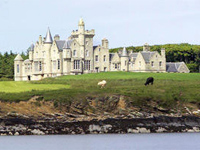
Balfour Castle, Isle of Shapinsay, Scotland (Image: Balfour Castle)

The next house appears in Scotland again; Balfour Castle on the Isle of Shapinsay. This was a remodelling of an existing house by the famous Scottish architect David Bryce, who did so much to popularise the ‘Scots Baronial’ style we now associate with the country.  The owner was David Balfour whose grandfather had originally purchased the house and estate in 1782. The Bryce alterations were completed in just two years from 1847 and the calendar theme this time produced 365 panes of glass, 52 rooms, 12 exterior doors, and 7 turrets.

Bradgate House, Leicestershire - dem. 1925 (Image: Lost Heritage)

Bradgate House, Leicestershire was built in 1854 for the extravagant George Harry Grey, the 7th Earl of Stamford, though it was only to survive 70 years before being demolished in 1925.  A gentleman sportsman with a liking for the Turf, the 7th Earl was probably inspired by the contemporary Victorian fashion of connecting families with their real (or sometimes imagined) ancestral past and building an Elizabethan style house would remind everyone that the Grey family had first been elevated to the peerage by Queen Elizabeth I.  Exactly why he chose a calendar scheme is unknown but the house included 365 windows, 52 rooms and 12 main chimneys.

The Towers, Didsbury, Lancashire (Image: Paul F Hamlyn)

Although perhaps not strictly a country seat, The Towers, in Didsbury, Lancashire was built between 1868-72 as a rural escape for the proprietor and editor of the Manchester Guardian, John Edward Taylor.  Designed by Thomas Worthington in a bold gothic style, it was reputed to have cost £50,000 to build – equivalent to around £3.3m today, and features 365 windows, 52 rooms and 12 towers.  Pevsner appears conflicted about it describing it as both ‘…grossly picturesque in red brick and red terra cotta’ but also as ‘the grandest of all Manchester mansions’.  It was subsequently purchased in 1920 for just £10,000 and became the headquarters for the British Cotton Industry Research Association and became known as the Shirley Institute, before becoming rental offices sadly surrounded by bland office blocks.

Bedstone Court, Shropshire was designed in a completely different style – mock Elizabethan – but again followed the pattern with 365 windows, 52 rooms, 12 chimneys and 7 external doors.  The house was designed for Sir Henry Ripley by Thomas Harris, and had survived largely intact despite changing from use as a home to a school, until a serious fire in 1996 severely damaged large sections of the house necessitating extensive restoration.

Avon Tyrrell, Hampshire (Image: Avon Tyrrell Activity Centre)

Avon Tyrrell, Hampshire, completed in 1891 and now grade-I listed, was, as far as is known, the last calendar house to be built in the UK and incorporates 365 windows, 52 rooms, 12 chimneys, and 7 external entrances. Designed by the distinguished Arts & Crafts architect W.R. Lethaby, a founding member of the architectural conservation charity the Society for the Protection of Ancient Buildings, he was also particularly interested in architectural theory and design, so it is likely that he would have suggested the idea of the calendar house to Lord Manners. The client was a wealthy racehorse owner who built the house on the back of his winnings from a famous bet he made in 1881, that he could buy, train and ride the winner of the 1882 Grand National – which he did.  Lord Manners donated the house to the “Youth of the Nation” and it is now an activity centre.

Considering that the idea of the calendar house was essentially Elizabethan in conception, it’s interesting to note that only one was built in that time, with the next in the late 17th-century, one in the 18th-century, but that it was the Victorians who produced the most.  Perhaps this was a reflection of their interest in time, order and structure but also a revival in the Elizabethan delight in science and challenges.  As a distinct group of houses they deserve to be better known – and in the case of Scout Hall, it deserves to be treated as a priority for rescue and restoration before it runs out of time.

—————————————————————————————–

Two other houses may also be calendar houses but I haven’t been able to reliably confirm this:

  • Kinmel Hall, north Wales – said to have 365 windows on the front elevation, 52 chimneys and 12 external doors.
  • Welcombe House, Warwickshire – now a hotel and has undergone significant alterations but is supposed to have 365 windows, 52 chimneys, 12 fireplaces and 7 entrances.

Can anyone confirm these? Thanks, Matthew