The fascinating first series of ‘Country House Rescue’ showed all to clearly that ownership of a country house is no passport to an easy life of luxury. In fact, it demonstrated that being the ‘lord of the manor’ brings with it many responsibilities which can take a significant toll both physically but most importantly financially.
On Thursday 4 March at 20:00 on Channel 4 the next series of ‘Country House Rescue‘ starts in Wales with the owner of Plas Teg; a grade-I listed Jacobean house which has remained remarkably unchanged since it was built in 1610. However, for the owner who gave up her glamorous life in Notting Hill when she moved to this 20,000sq ft house, it has proved to be a constant struggle to maintain this important house. Hopefully Ruth can provide some of her usual robust advice to help get Plas Teg on the path to a more secure future.
Often the course of the country estate over the last 100 years has been for the land to be gradually sold off, starting with the outlying areas, and moving closer until just the house and it’s immediate gardens remain intact. At Leonardslee in Sussex the process was eventually taken one step further with the house being sold off. This, however, may about to be reversed.
Sir Edmund Loder bought the manor house and 225-acre gardens from his inlaws in 1889 and soon opened them to the public. Over the next five generations, the Loder family added to the planting and landscaping to create what is now one of the only 163 grade-I listed gardens in the country. Despite the family still owning the gardens the grade-II listed Italianate manor house, built in 1853 and featuring a 900 sq ft central hall decorated with Ionic columns, was sold off separately in the 1980s and became offices. The gardens grew in reputation so it was something of a shock when in April 2008 it was announced that they were being put up for sale by Robin Loder for £5m through the estate agency Savills. Cleverly, the company who owned the house also announced they were open to offers at around £3.25m for the house.
The Times is now reporting that after nearly two years on the market, the gardens have been sold to a private businessman and are likely to close to the public. They are also reporting that the house may also be under offer at £2.75m to the same businessman giving him a perfect opportunity to once again recreate a stunning small estate which, with the addition of the house, could be worth in the region of £10m. Though a sad day for the many garden-lovers who have made many a pilgrimage to wander among the wallabies, it’s an encouraging reversal of the trend for houses to lose the control of the landscape which so often perfectly frames them.
Following earlier concerns, sources have confirmed that the grade-I listed former ‘showplace of Wales’, Gwrych Castle, is once again for sale.
After many years as a deteriorating ruin, it’s outlook improved when the castle was finally sold for £860,000 in 2007 to City Services Ltd (trading as Clayton Homes – a separate company to Clayton Hotels which is still trading). They soon announced ambitious plans to convert it into a luxury 5-star hotel using the original layout as the starting point. Initial work on site has included the removal of over 1,900 tons of asbestos and debris from within the shell and the vegetation stripped from the exterior. The site was ready for restoration to start and Donald Insall architects were working on the designs for restoration.
Unfortunately 2007 was the height of the property market and the subsequent fall hit many companies including Clayton Homes which went into administration on 12 August 2009. Deloitte (Leeds) were appointed as administrators and have been quietly marketing the assets including Gwrych Castle. This was highlighted by the story of the businessman who was viewing the castle as a possible site for his ‘psychic school’ when he conveniently saw a ghost at a window. Kevin Horkin has apparently submitted a bid for around £850,000 – which may secure him the site but to complete the project to the required standard will require at least another £6m-12m depending on his ambitions. This is a significant level of investment if he is to restore this wonderful house to the appropriate standard. Hopefully Cadw, the Welsh equivalent to English Heritage, will keep a very close eye on the project and ensure that any plans are at least to the same standard as those approved for Clayton Homes.
Many people have taken a keen interest in Gwyrch Castle and had hoped that the sale would lead to this once grand house again taking a key role in the local area and also to save this important part of their architectural heritage. It would be tragedy if the work already done to create a secure and viable foundation for restoration was allowed to deteriorate again – the house must be sold to a sympathetic owner who has both the vision and funds to complete this project in a way which befits this beautiful house.
A country house was traditionally the centrepiece of an estate usually absorbing huge amounts of money in running costs and improvements. This model was sustainable when the estate or other source was sufficient to provide the necessary income but today often a family can inherit a large house with all the costs but not the means to fully maintain it.
In another example of the diversification that has allowed so many of our country estates to survive, aristocratic families are now offering the chance for those willing to pay from £1,000 per day to experience life as it is for those lucky enough to live in these beautiful homes. A Suffolk firm, ‘More than Good Manners‘ arranges these luxury stays with an emphasis sharing in some of the best country pursuits in houses such as Sennowe Park, the grand Edwardian family home of Thomas Cook and his descendants.
Some may complain that these are a devaluation of the grandeur of the country houses and the families who live there. However it could be argued that there is a long tradition of these houses hosting visitors for gain when years ago the monarch would be lavishly entertained in hope that honours or privileges would be bestowed on the hosts. This modern twist on the theme sees income being provided in a way which doesn’t greatly increase the wear and tear on the fabric of the house and is largely in keeping with the original purpose of the house as a centre for leisure.
Although the country houses are often impressive in themselves there is always heightened interest when they are associated with a grand title. Unfortunately the 12th Duke of Devonshire, in an article in today’s Sunday Times magazine, believes that the concept of aristocracy is dead and that if the current government succeed in removing the last remaining hereditary peers he will take this as a sign from the public and would be willing to give up his own.
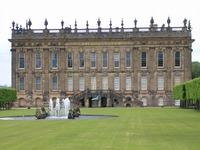
To me this seems very sad as his own title comes with 300 years of history and in some ways it’s not his to declaim as his heirs may be willing to keep it going. The family seat of Chatworth in Derbyshire is synonymous with the Devonshire title following the recent films and books and to lose it is as much a commercial loss as it is one of heritage. Perhaps he might consider just not using it and placing it in abeyance until his death and then it can be used or not as his son wishes. I can’t believe that the current legislation is a fair reflection of the will of the people who generally have a greater respect for the nations heritage and traditions than those currently in charge.
Update issued on behalf of the Duke of Devonshire [22 Feb 2010]
“Sir
Further to reports in the press I would like to clarify my position on the use of the Devonshire title. Should hereditary peers be removed from the House of Lords I would indeed strongly consider dropping the public use of my title, as I believe that I would have to consider and respond to any future democratic mandate against hereditary peerage. However, my principle duty will continue to be to preserve and enhance Chatsworth itself for future generations and I remain immensely respectful of my Devonshire predecessors who have bequeathed us this very special place.



 The Country Seat