Still available for sale – the country houses proving difficult to sell

Despite the enthusiasm of the estate agents, it seems that some of the most impressive houses featured in the glossy adverts at the front of Country Life magazine are proving difficult to sell.  Whether this is due to a poor local market or unreasonable prices, or just bad luck, here are a few stunning country houses which are still looking for buyers.

Noseley Hall, Leicestershire (Image: Knight Frank)

Noseley Hall in Leicestershire has been in the family of the present Lord Hazelrigg for nearly 300 years but was put up for sale in April 2009 at a guide price of £14m for the grade-II* listed house plus the 1,200-acre estate.  Built in 1728 on the back of Northumberland coal mining wealth, the house is decorated with works of art (though fewer now following several auctions), and fine plasterwork.  However, Lord Hazelrigg admitted that the estate doesn’t cover the costs of running the house, and so he decided to sell, but it’s still listed on the Knight Frank website – and still with a guide price of £14m.   More details: ‘The last of the romantics‘ [Sunday Times]

Dowdeswell Court (Image from Savills)

Another house which has been for sale is Dowdeswell Court in Gloucestershire which was first advertised in 2005 and then sold for £4.75 but then came back on the market in summer 2009 with a guide price of £7.9m (and was featured in this blog).  When serial restorer James Perkins took on the house it had been a 46-room nursing home resulting in a huge restoration project and since he sold in 2005 has moved on to restoring other country houses including Aynhoe Park.  The grade-II house was built between 1833-35 by local architect Charles Paul of Cheltenham and was originally three storeys but during the 1920s the top storey was neatly removed.  The more manageable house is a beautiful example of neo-Classical detailing combined with modern comforts. The house is available through either Knight Frank or Savills.
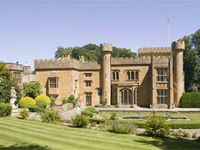
Compton Pauncefoot Castle - Somerset (Image: Bidwells)

The final property for this list is the impossibly beautiful Compton Pauncefoot Castle in Somerset which has been for sale since 2006.   Built in 182o, the grade-II listed house sits in a 1,278-acre estate with 40-acres of stunning gardens and lakes.  Originally on the market for £22m, it failed to sell even during the boom years of 2007-8 and despite 20 buying agents being invited to a launch event, and being featured in the The Sunday Times, it’s now being sold at auction – though I suspect the reserve would be near the current price advertised on the agents websites of in excess of £17m.  Perhaps the fact that it’s only for sale as a whole may have put off those who might just want the house and immediate grounds – but this would deny the owner the certainty of privacy that the surrounding estate would bring.  The house is available through Bidwells and Knight Frank (who despite putting it as their lead advert in Country Life this week fail to have it on their website).

Remembering the lost country houses of Suffolk

Each county in England has suffered the loss of at least some of its wealth of country houses.  Although nearly 1,800 have been identified so far, it’s clear that some counties, such as Somerset, escaped relatively lightly whilst others such as Yorkshire were severely depleted.  Of course, the losses are not simply about numbers as these can mask the importance of the individual houses.  One county which has been deprived of not only a significant number but also some houses of national importance is Suffolk in East Anglia.  Financed by early wealth from the wool trade followed by large scale agriculture, Suffolk boasts some of the finest houses in the country including Somerleyton Hall (built for rail magnate Samuel Morton Peto), Ickworth (the spectacular home of the Marquesses of Bristol), and superb Elizabethan Long Melford Hall.

Yet Suffolk has also lost nearly 60 other country houses of all ages and styles to both fashion, finance and fire.   A new book focussing on these losses called ‘Lost Country Houses of Suffolk‘ (Boydell & Brewer, 2010) has just been published by a Suffolk author W.M. Roberts.  This superbly produced and researched book highlights 40 of these now vanished houses, including the larger houses such as the beautiful Rushbrooke Hall, and the lavish Flixton Hall, but also the smaller ones such as Assington Hall, and provides detailed histories of the ascendancy of the houses before explaining their demise.  Lavishly illustrated, the book is also a wealth of detail with further details and sources for anyone, be they genealogist or local historian, looking to research even deeper.

The book is available direct from the publisher or via Amazon or all good bookshops.

Full disclosure: I contributed a little of my research into England’s lost country houses to this book but I make no gain from sales.

Holnest Park House to be restored

Holnest Park House, Dorset (Image: Greenslade Taylor Hunt)

Following the devastating fire which brought down the roof of the central section of the house, one of the other residents has said that although serious, the house would be restored – but he estimated that it would cost around £500,000.  Guy Wadsworth, whose son Freddy discovered the fire, has been forced to move out of the house temporarily but said “It’s repairable but it is a big job — it’s not a write-off by any means.”.  It has been confirmed by fire investigators that the blaze was caused by an electric blanket which had been tuned on but that without a thermostat it simply kept heating up until it caught fire.

Unfortunately fire is one of the greatest risks facing country houses today and although in this case the house can be restored, it still won’t bring back the historical fabric which has been lost.

Full story: ‘Exeter Castle home for Guy after fire‘ [Express & Echo]

Credit crunch hits prices of country estates in Scotland

It sells but at what price? (Image: http://www.sxu.hu)

Despite the ever hopeful claims of the estate agents that a good country estate will always sell, it appears that, at least in Scotland, the average selling price has fallen sharply.

Research by the estate agents Strutt & Parker has shown that between 2008 and 2009 the average selling price of the 13 country estates – defined as “significantly more than a house with some land but not farms or forestry properties” – sold in that period the average price dropped by £2.6m. Of the 13 sold, seven were sold for less than the asking price.

Full story: ‘Country estates caught in credit crunch as prices halve in 12 months‘ [The Times]

Drop added to ocean – grant to Hafodunos Hall

Hafodunos Hall, Denbighshire (Image: SnakeCorp on flickr)

When idiot arsonists set light to grade-I listed Hafodunos Hall in 2004 they largely destroyed one of not only North Wales’ best country houses but also one of Sir George Gilbert Scott’s finest works.  Built in 1861-6 at a cost of £30,000 for Henry R. Sandbach, son of Samuel Sandbach, a Liverpool merchant and shipowner who had bought the original, 17th-century house in 1831.  Hafodunos was also designed with Sandbach’s collection of sculpture including works by John Gibson (1790-1866) which were incorporated into the walls and left exposed after the fire (but now removed for safe-keeping).

So a glorious house by one of the greatest Victorian architects which featured some of his trademark interiors including decorated doors, ribbed ceilings and fine chimneypieces was reduced to a burnt out shell and has remained as such despite attempts to sell the house and begin restoration.  As the house continues to deteriorate efforts have been made to limit the damage through grants.  The latest from Cadw (the Welsh version of English Heritage) is for £21,000 to pay for emergency work to stabilise the structure – which if you look at this gallery on flickr you’ll see is a drop in the ocean compared to total required for full restoration.  However, any work is positive so hopefully this will help preserve what remains until a more secure future for the house can be found.

Full story: ‘Heritage cash boost for Denbighshire landmarks‘ [Denbighshire Visitor]