The last castle to be built in the UK, Castle Drogo, occupies a commanding position far up the Teign Gorge in Devon. Designed by Sir Edwin Lutyens and built in the 1910s and 1920s and finally finished in 1931 for the wealthy businessman Julius Drewe, the Grade-I listed house is a brilliant modern interpretation of a castle combined with the comforts of a country house.
It was also one of the last houses to be built entirely in granite, the local stone of the area. The grey stone and the clever massing of towers and wings give the house a solid, impregnable air but the house is under attack from the elements, with rain penetration causing serious concern. The many flat roofs hidden behind the battlements started causing problems only two years after the house was finished and ever since it has been a constant battle to keep the house watertight.
House manager Bryher Mason told BBC News: “I wouldn’t be surprised to walk into a room one morning and find a section of the ceiling having fallen in because the metalwork in the ceiling has failed.”
The National Trust, who have cared for it since it was handed to them in 1974, have instigated a restoration and repair programme on the many roofs, which will include the replacement of all 13,000 window panes, and has been estimated to cost £10m, and will be completed by 2016.
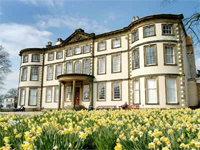
Sewerby Hall, Yorkshire (Image: East Riding Council)
Sewerby Hall has secured £50,000 to develop further it’s plans for a £2.6m restoration of the house.
The grade-I listed Sewerby Hall was inherited by John Graeme in 1714 who promptly rebuilt the house which is the core of the current building. The Graeme family owned Sewerby unti 1934 and in intervening 200 years made many alterations to create the elegant house which survives today.
The Council are proposing to redevelop the outbuildings such as the former laundry block to provide the necessary visitor facilities. The house will also be restored but encouragingly the Council have said that they “will work closely with planning and architectural colleagues, English Heritage, the Heritage Lottery Fund and other specialist advisors to take the project forward to the next stage” – which sounds encouragingly sensitive in contrast to the plans of other councils (see earlier post on Forty Hall in Middlesex). Of course, the proof of how sensitive they will be will only become apparent when the plan is published but hopefully this project will not only protect but enhance this important house.
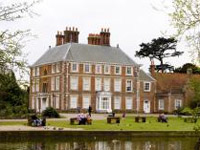
Enfield Council’s proposed renovation plan for Forty Hall in Enfield has been given the go-ahead by the council planners. However, the plan seems to verge on invasive and to contravene best practice guidelines from organisations such as the Society for the Protection of Ancient Buildings which recommend preserving as much historic material as possible to show how a building has developed. The changes are part of plan funded with nearly £2m in grants from the Heritage Lottery Fund.
The Grade-I listed house was originally built in 1629 for Sir Nicholas Rainton, a City Alderman, President of St Bartholomew’s Hospital and Lord Mayor of London. The house passed through various owners until bought in 1895 by Major Henry Bowles who made many changes including a new staircase with stained glass incorporating his family’s coat of arms.
However, rather than respect it as an important example of one of the many smaller mansions built on the edges of the then city but now subsumed into the suburbs, the council seem determined to make their own extensive changes. An illuminating quote was given when the HLF grant was announced: “This gives us a unique chance to re-model the Hall completely to make sure that every aspect of it is planned and coordinated to make it the top visitor attraction that it should be.” [enfield.gov.uk]. Among the changes the council have proposed are:
installation of a lift shaft,
removal of the entrance porch,
construction of a glazed roof to the central courtyard, and
replacement of the main staircase.
It’s the latter that seems to be the most worrying change as the staircase was an important part of the history of the house. The Victorian Society has raised their objection to this loss. Interestingly, the press release inspired news story doesn’t mention whether English Heritage or the Society for the Protection of Ancient Buildings have given their approval.
Also of concern is the intention to redocorate the interior which will be carried out “by detailed investigation of historic finishes” – which doesn’t say that they will follow the evidence of the past.
All in all this seems to be a council who have approved their own plans to make many insensitive and substantial changes to a Grade-I listed building in an attempt to create a ‘theme-park’ pastiche of an old house. Perhaps a more considered approach would not only preserve more of the historic fabric the council seem so willing to rip out but would also offer cost savings.
The plans still require approval from the Secretary of State, John Denham, before they can be implemented so there is hope yet that this apparently inappropriate scheme might yet be modified so that whilst still meeting the council’s aim of increasing access and improving facilites it’s much more sensitive to this elegant house.
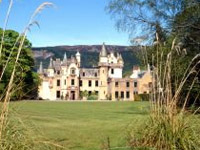
Despite the recent financial troubles it seems that there is still many who happy to pay up to £25,000 per week to stay in the best Scottish castles, such as Aldourie (right), over the New Year. Sue Bourne of ‘Castles and Cottages‘ has about 50 castles available for rent with many booked over the festive period – though she noted that people are booking later either to try to secure discounts or even just to ensure they have the job to support such an expense.
These rentals provide a valuable revenue stream which helps to offset the huge cost of running these houses and it’s encouraging to see that demand is holding up. Extensive void periods may have an impact in terms of the funds available for the essential maintenance or restoration these houses require. So ‘hurrah’ for the wealthy!
Dissington Hall was largely derelict when it was bought by Eric Brown in 1968, despite the then preference for new properties. A senior dentist and dental lecturer, he was not the obvious buyer for such a large Georgian house but he and his wife had fallen in love with it and now were determined to rescue it from its long decline. Their success and love of the building has been passed on to his son Michael, who was just four when he moved in, and it is now he and his family who have completed this labour of love and brought back into use this elegant house.
The house was originally built for the Collingwood family in 1797 who had been commissioned the architect William Newton (b.1730 – d.1798) in 1794. Newton had designed a number of significant local country houses including Capheaton Hall (1758), Backworth Hall (1778), Howick Hall (1782), Whitfield Hall (1785) before his work at Dissington. Dissington Hall is an elegant design with a first-floor string course to relieve the mass of the vertical elevation and a ground floor cornice which was a Newton characteristic. It was built in the local sandstone in fine Ashlar with the blocks being so finely cut that the joins are near-invisible. Further changes where made between 1820 and 1850 with a new clock tower, stables, porch, alterations to the roofline and the additions of a new servant’s stair.
Despite the obvious quality of the house, it was to suffer much during World War II when it was requisitioned. It served as a dormitory for 50 WAFF ladies who worked at the Polish Airforce Headquarters at Ousden Aerodrome, a hospital and, at one point, a TNT storage depot. These various roles caused many poor quality or poorly planned alterations along with the general damage caused by huge numbers of people. Perhaps the single biggest cause of damage was a bomb dropped in 1940 which caused cracking to the east and south elevations. Following the war, the house was unoccupied and so was the target of thieves who, in 1947, stole all the lead from the main roof. Water penetration followed, combined with some earlier alterations which lead to long and inefficient guttering which frequently leaked. This led to extensive outbreaks of both wet and dry rot which have all had to be conquered.
The story brightens from 1955 when it was bought by the local Sharrett family who lived there and carried out some restoration before selling it to the Brown family in 1968. Michael recalls that they only lived in a small part of the house as much of the rest was then uninhabitable with sections of the roof having fallen in. Since then, the house has been painstakingly restored and is now filled with antiques and appropriate fittings. The Browns have even managed to acquire the original architectural plans. The house has been a wedding and conference venue since 1992 but is also, perhaps most importantly, still their family home; a heartening example of how dedication can rescue and protect a key piece of our local architectural heritage.


 The Country Seat