Want to work in an Adam-designed office? Cumbernauld House for sale

Cumbernauld House, Lanarkshire

One alternative to demolition for a country house whose time as a home had come to an end was conversion to offices.  Many houses were thus saved from the wreckers pickaxe although some conversions were more sensitive than others, with some unfortunate houses being reduced to shells with the historic interiors severely compromised.  Some were very successful such as Donington Hall (headquarters to BMI), Mamhead House (formerly HQ to a local construction firm but well looked after and now back as a home) and Gaddesden Place (now home to a software company).

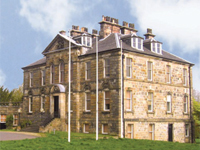
One such house which was converted in 1955 and in need of a sympathetic new owner is the grade-A listed Cumbernauld House in North Lanarkshire, currently for sale at offers over £1m.  Built for the Earl of Wigton in 1731, the house was designed by William Adam (1689-1748), one of the leading architects of his day, and includes some of his typical flourishes such as arched windows, channelled masonry and carved tympana.  Although the Adam interiors were lost in a serious 1877, the reconstructed interior is still noteworthy.  Currently empty, this house deserves a new lease of life and would make a suitable and impressive headquarters – although part of me does faintly hope that someone might want to take on the challenge of turning it back into a home.

More details: ‘Cumbernauld House‘ [SAVE Britain’s Heritage] – as Building of the Month this link may not work after Feb 2010 but there is a dedicated website at : www.cumbernauldhouse.com

Holnest Park House to be restored

Holnest Park House, Dorset (Image: Greenslade Taylor Hunt)

Following the devastating fire which brought down the roof of the central section of the house, one of the other residents has said that although serious, the house would be restored – but he estimated that it would cost around £500,000.  Guy Wadsworth, whose son Freddy discovered the fire, has been forced to move out of the house temporarily but said “It’s repairable but it is a big job — it’s not a write-off by any means.”.  It has been confirmed by fire investigators that the blaze was caused by an electric blanket which had been tuned on but that without a thermostat it simply kept heating up until it caught fire.

Unfortunately fire is one of the greatest risks facing country houses today and although in this case the house can be restored, it still won’t bring back the historical fabric which has been lost.

Full story: ‘Exeter Castle home for Guy after fire‘ [Express & Echo]

Drop added to ocean – grant to Hafodunos Hall

Hafodunos Hall, Denbighshire (Image: SnakeCorp on flickr)

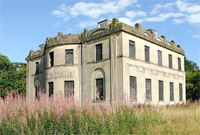
When idiot arsonists set light to grade-I listed Hafodunos Hall in 2004 they largely destroyed one of not only North Wales’ best country houses but also one of Sir George Gilbert Scott’s finest works.  Built in 1861-6 at a cost of £30,000 for Henry R. Sandbach, son of Samuel Sandbach, a Liverpool merchant and shipowner who had bought the original, 17th-century house in 1831.  Hafodunos was also designed with Sandbach’s collection of sculpture including works by John Gibson (1790-1866) which were incorporated into the walls and left exposed after the fire (but now removed for safe-keeping).

So a glorious house by one of the greatest Victorian architects which featured some of his trademark interiors including decorated doors, ribbed ceilings and fine chimneypieces was reduced to a burnt out shell and has remained as such despite attempts to sell the house and begin restoration.  As the house continues to deteriorate efforts have been made to limit the damage through grants.  The latest from Cadw (the Welsh version of English Heritage) is for £21,000 to pay for emergency work to stabilise the structure – which if you look at this gallery on flickr you’ll see is a drop in the ocean compared to total required for full restoration.  However, any work is positive so hopefully this will help preserve what remains until a more secure future for the house can be found.

Full story: ‘Heritage cash boost for Denbighshire landmarks‘ [Denbighshire Visitor]

Holnest Park House seriously damaged by fire – may collapse

Holnest Park House, Dorset (Image: Bournemouth Echo)

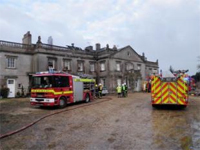
Earlier today, the Grade-II listed Holnest Park House in Dorset suffered a serious fire which has gutted the central section of the house leaving the core at risk of collapse.  The fire started in one of the seven flats through the careless use of an electric blanket which lacked a thermostat and simply heated up until it caught fire.  The fire destroyed the two flats in the central section but the 60 firemen in attendance were able to prevent the blaze spreading to the wings.

The Georgian house was built in 1768, and rebuilt in the 1830s, on land formerly owned by the Bishops of Salisbury. It became a secondary seat of the Sawbridge-Erle-Drax family through marriage, and so was regularly tenented as the family were mainly based at Charborough Park (a large house also in Dorset) and Olantigh Towers in Kent.

The house was sold in 1919 and then used as military hospital for injured servicemen during WWII.  It was subsequently sold to timber merchants who stripped the park of it’s fine trees even felling the avenue to the house, and then selling the land off for agriculture.  The house then became an island in the middle of the fields, neglected until someone decided to ill-advisedly convert this remote house into a nightclub.  The left-hand side was divided up and much damage done to the interior during this process.  The right-hand side became (or was) houses.  After the inevitable failure of the nightclub the rest of the house was converted into further apartments.

Fire is one of the most worrying dangers faced by country houses as they can be started so easily, especially during renovations, and due to the materials used in construction the fire can spread quickly.  Of course, this danger is increased where a house has been split into multiple apartments as there are now more sources of ignition such as kitchens.  Older houses are usually not fitted with many of the modern fire safety features as this would compromise the historic fabric of the building meaning there is a extra responsibility for the owners to be vigilant.

Although the intial reports indicate that the fire-damaged section of the house has been declared structurally unsafe,  it’s hoped that restoration will be possible.  Insurance can cover the cost of re-instatement but it can’t bring back the historical aspect of what’s been lost.

Full story: ‘Fire hit Dorset stately home at risk of collapsing‘ [BBC News] / ‘Fire at stately home caused by electric blanket‘ [Bournemouth Echo]

Pell Well Hall finally sold – but will buyer finish the job?

Pell Well Hall (Image from Strutt & Parker)

After abandonment, institutional use, and a serious fire, there is finally some good news for Pell Well Hall.  It’s reported that an offer has been accepted and finally the house can move to what will hopefully be the final stages of restoration.   Originally with an asking price of £750,000 the offer accepted was £550,000 – but with estimated costs of between £2m – £5m to complete the restoration.

With such a huge project and the need for significant financing, the hope is that the new purchaser will complete the work sooner rather than later.  However, after neglect and fire the original interior has been entirely lost meaning that in many senses this is a recreation rather than a strict restoration.  Perhaps leaving some evidence of this sad state would be an honest approach – and heaven forbid that the interior ends up as just some identikit footballers Surrey mansion.  This a special house and deserves a careful hand on the design and budget.

Full story: ‘New owner for historic hall as offer accepted‘ [Shropshire Star]

Beauty – but at what price?‘ [Daily Telegraph]