Although Britain is a relatively small island it still has the capacity to hide some spectacular buildings which, unless opened to the public, can remain a secret. One such house, featured this week in Country Life magazine (February 17) is Wentworth Woodhouse in Yorkshire, thought to be the largest private residence in Europe and for Marcus Binney “unquestionably the finest Georgian house in England”.
Built over a 25 year period from 1724 for Thomas Watson-Wentworth, Marquess of Rockingham, it is twice as wide as Buckingham Palace and boasts over a 1,000 windows, 365 rooms and five miles of underground passageways. The stable block appears to be a large country house but is merely the lodging for up to 100 horses. Inside the main house, the Earls FitzWilliam enjoyed a priceless art collection which included works by Titian, Van Dyck, Guido, and Raphael.
Yet this was a house to be blighted by the bitter class-war hatred of the post-war Labour government and questions of inheritance. In April 1946, heavy machinery moved into Wentworth Park to pointlessly mine low-grade coal right up to the back door of the house on the express instruction of Manny Shinwell, the minister of fuel and power. A old-school left-winger, Shinwell was given options to save the parkland and gardens but was determined to press on despite representations from the local miners who had been very well treated by successive generations of FitzWilliams.
Once mining finished the FitzWilliams leased the house as a training college and retreated to 40-rooms but even then lived mostly elsewhere. Questions about the legitimacy of the inheritance led the last Earl to order a vast bonfire in 1972 of 16 tons of family papers, some dating back to medieval times, which burnt for three weeks.
Yet, despite its size the house escaped the fate of so many large houses in England and merely languished in obscurity. Sold with just 30-acres in 1988 by the daughter of the last Earl it was bought by Wensley Haydon-Baillie who promised investment but in 1998 it was repossessed. It was then sold for the unbelievably low price of £1.5m (equivalent to just £7 per sq ft) to the architect Clifford Newbold whose careful restoration work has been praised and beautifully photographed in this weeks Country Life.
—————————————————————————–
*Update* May 2011 – I have written a more extensive write-up on the architectural history of the house in response to the episode of ‘The Country House Revealed‘
When Gwrych Castle was finally sold in June 2006 after twenty years of neglect, dereliction, fires and theft, there was much praise and relief locally that the once-beautiful “showplace of Wales” was to be rescued. Bought by Yorkshire-based Clayton Hotels for £860,000, they estimated that once planning permission had been secured, the restoration would take between 2-3 years and cost an estimated £6m – however three years later, the major part of the restoration work has yet to start.
Built between 1819-1825 for Lloyd Hesketh Bamford-Hesketh, grade-I listed Gwrych was one of the largest ‘castlellated mansions’ in Europe, part of a ‘gothick’ revival which included some of Britain’s most picturesque country houses such as Eastnor Castle, East Cowes Castle, Lea Castle, and Castel Coch and many more. Following its sale by the 13th Earl of Dundonald in 1946 it was opened to the public in various forms and under various owners until 1989. The failure of the redevelopment plans led to the castle being left unprotected against the ravages of the weather, travellers, and vandals, leaving the castle a mere shell, the fine interiors rotting in piles in the collapsed ground floor.
The plans unveiled by Clayton Hotels in 2007 showed that the castle would be fully restored and largely based on the original layout. Mark Baker of the Gwrych Castle Preservation Trust, who had campaigned since he was 11 to save the castle, welcomed the plans and for many it seemed that the end was in sight. In February 2009, Wales Online (‘Welsh ruin to be transformed with techniques fit for royal home‘) trumpeted how the design work for the restoration was starting under the care of Donald Insall, one of the best conservation architects in the UK. However, in May 2009, a story on BBC News (‘Slow economy delays hotel plans‘) explained that the slow economy had delayed plans and also the cost for the project had risen to between £12-14m.
Now a recent story (‘Clitheroe man haunted by ghostly image in castle window‘) about a ghost in a window included some interesting quotes which raise some questions about the status of the project – or perhaps just the intended future clients.
A Lancashire businessman who combines being an optician with “psychic management” claimed to have taken a picture of a girl standing at a window where there is no floor. Kevin Horkin claimed he was visiting the site as “I buy property and was looking at the castle with the view buying it.” and the story ends by saying that “Kevin has put a bid in for the castle which he hopes to turn into a luxury psychic retreat.”. Despite the obvious convenience of a psychic who wants to open a hotel taking one of the clearest ever pictures of a ghost, it does raise questions about why he is saying the hotel is for sale? The Clayton Hotels website is one page with an email link and with the dramatic rise in restoration costs and the difficulties of the property markets, is the castle being quietly marketed ‘off the record’? Perhaps the quotes are misconstrued, or perhaps Clayton will refurbish the house but lease it Mr Horkin, but either way, Clayton Hotels should perhaps clarify exactly what is happening to this iconic part of Wales’ architectural heritage especially as so many people have spent so long campaigning for its rescue.
There is always a temptation when any country house and estate comes to the market for the land to be built over with residential developments which provide a quick and relatively easy profit – even if it does ruin forever the setting of the house. Usually the houses are snuck through under the cover of ‘enabling development’ with a promise that this will secure the long-term future of the house. Grade-II* listed Sandhill Park in Somerset is an interesting example of where this fails if the development is build in an inappropriate location and a council who apparently haven’t ensured that at least some of the profits are invested in the house.
The main house at Sandhill Park was built around 1720, for the John Perriam, the MP for Minehead and inherited in 1767 by his grandson John Lethbridge (who was knighted in 1804) and remained in the Lethbridge family until 1913. On inheriting Sandhill Park in 1815, Sir Thomas Buckler Lethbridge, the 2nd Baronet (b. 1778 – d.1849) added a grand portico to the main house and large wings to the rear. The main house was substanially rebuilt in the 19th century giving it the distinctive and elegant sandstone ashlar look it retains today. These changes were funded through debt which burdened the family for years but ensured that no further major changes were made. However, following the death in 1902 of Sir Wroth Acland Lethbridge, the 4th Baronet, the family moved out and the house was let until it was sold, along with 4,000 acres, in 1913. It was subsequently bought in 1929 by Somerset County Council for use as a hospital and was requisitioned as a military hospital during WWII. After the war, it became a psychiatric hospital until it closed in 1992 since which the house has remained unused.
The assumption appears to have been that the house could not be returned to being a family home which appears to have given the green light to the estate being built on and the conversion of the house with further building works to the rear, again turning a wonderful country house into a mere afterthought in a large development. Planning permission was initially refused for what is now known as the Lethbridge Park housing estate which has been built to the east of the main house with the nearest property being just 100-metres away. The only access for this estate is a small road to the north – the opposite direction to the town – which forces all traffic through a country lane before joining the main road back to Bishops Lydeard. It’s not possible to walk to the town so even to get a paper the residents must use their car. Surely it would have been better to site the estate away from the house and use the parkland nearest the town? The isolated residents gain no benefit from being so close to the house and the council’s decision has merely ensured more traffic on the local roads whilst compromising the setting of the main house.
This development has made it harder to sell the house as a home as the roofs of the new houses are visible from the main house. But perhaps this was part of the plan as the Knight Frank sales particulars explain that planning permission has been granted for the conversion of the main house into apartments with many more houses being built to the rear of the house. However, as the house and 145-acres are now for sale for £2.75m it appears that after completing the residential development, the owners have decided to pocket the profits, sell the ‘difficult’ part and run. This is apparently a prime example of a fine, though misused house being failed by the local council who are supposed to protect it. How did they get planning permission for such an inappropriately sited development? Why did the council not insist that the house be restored? Why are the old derelict hospital buildings still standing – surely they should have been removed as a minimum? The council seem to have decided that it’s better to have two inappropriately sited developments rather than looking after an important part of their local architectural heritage.
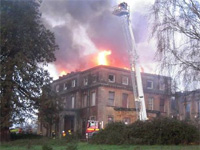
Update – 22 November – Sandhill Park seriously damaged by fire
Fire at Sandhill Park - 22 Nov 2011 (Image: Lucy Robert Shaw / This is Somerset)
Sadly, as so often happens with uninhabited country houses, Sandhill Park has suffered a serious fire which has affected large parts of the house. The mysterious blaze started on the first floor (and considering there are no services to the house, this has to be suspicious) and quickly spread through the rest of the first and upper floors. The huge quantities of water the fire brigade would have had to have used have almost certainly brought down the ceilings in the rooms below and the now serious damp house will be extremely vulnerable to wet rot. If it is proved that the fire was arson, it’s a terrible indictment of the NHS for abandoning the property and the local council for approving such a ridiculous housing scheme which has made it harder to sell the house – compounded by their ineffectiveness in getting the old hospital buildings removed and the house restored in the first place.
I can only hope the owner was insured and is able to take protective measures to mitigate the fire and water damage and to somehow get ownership of this fine house into the hands of someone who can care for and restore it. Anything less would be an architectural tragedy and would reflect badly on those involved. However, if history is any guide, I suspect we will shortly see an application to demolish, claiming that it is ‘dangerous’ (usually this is not remotely true and just a developers excuse) and more bland housing will march across this once fine parkland, a poor memorial to the heritage of the town.
The project to restore an important Devon country house, which is finally being rescued after being neglected since the 1970s, has received a significant boost. English Heritage has awarded a £500,000 grant which will allow major work to continue on making Poltimore House watertight and safe for the ongoing restoration work.
The grade-II*-listed house has been a familiar sight to anyone who has driven on the M5 near Exeter who would have seen it slowly deteriorating since it ceased being a hospital in 1975. Originally the Bampfylde family seat, Poltimore was originally built in the 1550s with this part now forming a still visible core section of the house. It was greatly extended in 18th-century with the work including a Rococo-style saloon and then again in the 19th-century with the addition of a grand imperial staircase.
The decline started when the Bampfyldes finally left the house in 1921 after the death of the third Baron Poltimore, and put it up for sale. For many houses this was a prelude to demolition but Poltimore escaped by becoming a boarding school for until 1939 when it then became temporary home for Dover College during WWII. After the war the house became a nursing home and remained in use as a hospital until 1975. Once empty, the decline accelerated rapidly with thefts of lead, fireplaces and other fittings including the entire balustrade from the staircase. The damage was compounded by serious arson attack which destroyed the roof.
The journey back from total dereliction started in 1997 when the house was acquired by the Buildings at Risk Trust before being taken over by the Poltimore House Trust in 1999. Their intention is fully restore the house for mixed use with commercial aspects combined with community and arts use. A large and active group of Friends of the house have tirelessly campaigned to save this important piece of Devon’s heritage and English Heritage are to be congratulated for such a large contribution towards the estimated £5.5m restoration bill.
More information including details of the planned restoration: ‘Poltimore House‘
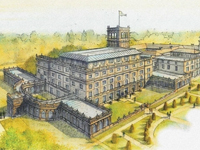
Trentham Hall proposal, Staffordshire (Image: Property Week)
One of the greatest losses in the many country houses demolished in the 20th-century was that of Trentham Hall, the Staffordshire seat of the Dukes of Sutherland. Originally a large Georgian house, it was rebuilt and greatly extended for the second Duke in the 1830s by the famous architect Sir Charles Barry, who was also responsible for the rebuilding of the Houses of Parliament. The house became a celebrated venue for entertaining and was filled with fine works of art and sculpture.
Unfortunately the relentless expansion of the nearby Potteries areas of Staffordshire led to increasing amounts of pollution entering the rivers which fed the lakes and gardens designed by Capability Brown. By 1898 the smell was so bad that the house was effectively abandoned by 1907. The Duke tried to donate the house and estate to the local council in 1905 but was rejected so in 1912 the house was demolished.
The gardens were eventually opened to the public with the remaining outbuildings sitting rather forlornly around the blank space which marked out the site of the now lost house. The gardens had been maintained and delighted generations of locals who would walk through the extensive terraces which led down to the now clean lake. Now the 750-acre Trentham Gardens are part of a £100m project to bring back the glory of the earlier eras, with the centrepiece being the £35m recreation of the house as a 150-room luxury hotel following Barry’s original designs.
Despite the economic turmoil, the developers, who originally planned for completion by 2011, are still hopeful that they will be able to proceed with the project. Although the hotel will not bring back the history and unique architecture of the house, the idea of recreating a lost country house is one to be encouraged. Although many houses were demolished, the parkland and gardens were often simply abandoned and are still visible today. Perhaps other estates might be encouraged to look at whether a new house might be the most appropriate use of the estate – after all, this was the purpose of their creation.



 The Country Seat