Often the course of the country estate over the last 100 years has been for the land to be gradually sold off, starting with the outlying areas, and moving closer until just the house and it’s immediate gardens remain intact. At Leonardslee in Sussex the process was eventually taken one step further with the house being sold off. This, however, may about to be reversed.
Sir Edmund Loder bought the manor house and 225-acre gardens from his inlaws in 1889 and soon opened them to the public. Over the next five generations, the Loder family added to the planting and landscaping to create what is now one of the only 163 grade-I listed gardens in the country. Despite the family still owning the gardens the grade-II listed Italianate manor house, built in 1853 and featuring a 900 sq ft central hall decorated with Ionic columns, was sold off separately in the 1980s and became offices. The gardens grew in reputation so it was something of a shock when in April 2008 it was announced that they were being put up for sale by Robin Loder for £5m through the estate agency Savills. Cleverly, the company who owned the house also announced they were open to offers at around £3.25m for the house.
The Times is now reporting that after nearly two years on the market, the gardens have been sold to a private businessman and are likely to close to the public. They are also reporting that the house may also be under offer at £2.75m to the same businessman giving him a perfect opportunity to once again recreate a stunning small estate which, with the addition of the house, could be worth in the region of £10m. Though a sad day for the many garden-lovers who have made many a pilgrimage to wander among the wallabies, it’s an encouraging reversal of the trend for houses to lose the control of the landscape which so often perfectly frames them.
Following earlier concerns, sources have confirmed that the grade-I listed former ‘showplace of Wales’, Gwrych Castle, is once again for sale.
After many years as a deteriorating ruin, it’s outlook improved when the castle was finally sold for £860,000 in 2007 to City Services Ltd (trading as Clayton Homes – a separate company to Clayton Hotels which is still trading). They soon announced ambitious plans to convert it into a luxury 5-star hotel using the original layout as the starting point. Initial work on site has included the removal of over 1,900 tons of asbestos and debris from within the shell and the vegetation stripped from the exterior. The site was ready for restoration to start and Donald Insall architects were working on the designs for restoration.
Unfortunately 2007 was the height of the property market and the subsequent fall hit many companies including Clayton Homes which went into administration on 12 August 2009. Deloitte (Leeds) were appointed as administrators and have been quietly marketing the assets including Gwrych Castle. This was highlighted by the story of the businessman who was viewing the castle as a possible site for his ‘psychic school’ when he conveniently saw a ghost at a window. Kevin Horkin has apparently submitted a bid for around £850,000 – which may secure him the site but to complete the project to the required standard will require at least another £6m-12m depending on his ambitions. This is a significant level of investment if he is to restore this wonderful house to the appropriate standard. Hopefully Cadw, the Welsh equivalent to English Heritage, will keep a very close eye on the project and ensure that any plans are at least to the same standard as those approved for Clayton Homes.
Many people have taken a keen interest in Gwyrch Castle and had hoped that the sale would lead to this once grand house again taking a key role in the local area and also to save this important part of their architectural heritage. It would be tragedy if the work already done to create a secure and viable foundation for restoration was allowed to deteriorate again – the house must be sold to a sympathetic owner who has both the vision and funds to complete this project in a way which befits this beautiful house.
When Gwrych Castle was finally sold in June 2006 after twenty years of neglect, dereliction, fires and theft, there was much praise and relief locally that the once-beautiful “showplace of Wales” was to be rescued. Bought by Yorkshire-based Clayton Hotels for £860,000, they estimated that once planning permission had been secured, the restoration would take between 2-3 years and cost an estimated £6m – however three years later, the major part of the restoration work has yet to start.
Built between 1819-1825 for Lloyd Hesketh Bamford-Hesketh, grade-I listed Gwrych was one of the largest ‘castlellated mansions’ in Europe, part of a ‘gothick’ revival which included some of Britain’s most picturesque country houses such as Eastnor Castle, East Cowes Castle, Lea Castle, and Castel Coch and many more. Following its sale by the 13th Earl of Dundonald in 1946 it was opened to the public in various forms and under various owners until 1989. The failure of the redevelopment plans led to the castle being left unprotected against the ravages of the weather, travellers, and vandals, leaving the castle a mere shell, the fine interiors rotting in piles in the collapsed ground floor.
The plans unveiled by Clayton Hotels in 2007 showed that the castle would be fully restored and largely based on the original layout. Mark Baker of the Gwrych Castle Preservation Trust, who had campaigned since he was 11 to save the castle, welcomed the plans and for many it seemed that the end was in sight. In February 2009, Wales Online (‘Welsh ruin to be transformed with techniques fit for royal home‘) trumpeted how the design work for the restoration was starting under the care of Donald Insall, one of the best conservation architects in the UK. However, in May 2009, a story on BBC News (‘Slow economy delays hotel plans‘) explained that the slow economy had delayed plans and also the cost for the project had risen to between £12-14m.
Now a recent story (‘Clitheroe man haunted by ghostly image in castle window‘) about a ghost in a window included some interesting quotes which raise some questions about the status of the project – or perhaps just the intended future clients.
A Lancashire businessman who combines being an optician with “psychic management” claimed to have taken a picture of a girl standing at a window where there is no floor. Kevin Horkin claimed he was visiting the site as “I buy property and was looking at the castle with the view buying it.” and the story ends by saying that “Kevin has put a bid in for the castle which he hopes to turn into a luxury psychic retreat.”. Despite the obvious convenience of a psychic who wants to open a hotel taking one of the clearest ever pictures of a ghost, it does raise questions about why he is saying the hotel is for sale? The Clayton Hotels website is one page with an email link and with the dramatic rise in restoration costs and the difficulties of the property markets, is the castle being quietly marketed ‘off the record’? Perhaps the quotes are misconstrued, or perhaps Clayton will refurbish the house but lease it Mr Horkin, but either way, Clayton Hotels should perhaps clarify exactly what is happening to this iconic part of Wales’ architectural heritage especially as so many people have spent so long campaigning for its rescue.
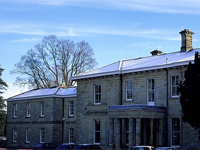
There is always a temptation when any country house and estate comes to the market for the land to be built over with residential developments which provide a quick and relatively easy profit – even if it does ruin forever the setting of the house. Usually the houses are snuck through under the cover of ‘enabling development’ with a promise that this will secure the long-term future of the house. Grade-II* listed Sandhill Park in Somerset is an interesting example of where this fails if the development is build in an inappropriate location and a council who apparently haven’t ensured that at least some of the profits are invested in the house.
The main house at Sandhill Park was built around 1720, for the John Perriam, the MP for Minehead and inherited in 1767 by his grandson John Lethbridge (who was knighted in 1804) and remained in the Lethbridge family until 1913. On inheriting Sandhill Park in 1815, Sir Thomas Buckler Lethbridge, the 2nd Baronet (b. 1778 – d.1849) added a grand portico to the main house and large wings to the rear. The main house was substanially rebuilt in the 19th century giving it the distinctive and elegant sandstone ashlar look it retains today. These changes were funded through debt which burdened the family for years but ensured that no further major changes were made. However, following the death in 1902 of Sir Wroth Acland Lethbridge, the 4th Baronet, the family moved out and the house was let until it was sold, along with 4,000 acres, in 1913. It was subsequently bought in 1929 by Somerset County Council for use as a hospital and was requisitioned as a military hospital during WWII. After the war, it became a psychiatric hospital until it closed in 1992 since which the house has remained unused.
The assumption appears to have been that the house could not be returned to being a family home which appears to have given the green light to the estate being built on and the conversion of the house with further building works to the rear, again turning a wonderful country house into a mere afterthought in a large development. Planning permission was initially refused for what is now known as the Lethbridge Park housing estate which has been built to the east of the main house with the nearest property being just 100-metres away. The only access for this estate is a small road to the north – the opposite direction to the town – which forces all traffic through a country lane before joining the main road back to Bishops Lydeard. It’s not possible to walk to the town so even to get a paper the residents must use their car. Surely it would have been better to site the estate away from the house and use the parkland nearest the town? The isolated residents gain no benefit from being so close to the house and the council’s decision has merely ensured more traffic on the local roads whilst compromising the setting of the main house.
This development has made it harder to sell the house as a home as the roofs of the new houses are visible from the main house. But perhaps this was part of the plan as the Knight Frank sales particulars explain that planning permission has been granted for the conversion of the main house into apartments with many more houses being built to the rear of the house. However, as the house and 145-acres are now for sale for £2.75m it appears that after completing the residential development, the owners have decided to pocket the profits, sell the ‘difficult’ part and run. This is apparently a prime example of a fine, though misused house being failed by the local council who are supposed to protect it. How did they get planning permission for such an inappropriately sited development? Why did the council not insist that the house be restored? Why are the old derelict hospital buildings still standing – surely they should have been removed as a minimum? The council seem to have decided that it’s better to have two inappropriately sited developments rather than looking after an important part of their local architectural heritage.
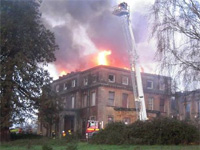
Update – 22 November – Sandhill Park seriously damaged by fire
Fire at Sandhill Park - 22 Nov 2011 (Image: Lucy Robert Shaw / This is Somerset)
Sadly, as so often happens with uninhabited country houses, Sandhill Park has suffered a serious fire which has affected large parts of the house. The mysterious blaze started on the first floor (and considering there are no services to the house, this has to be suspicious) and quickly spread through the rest of the first and upper floors. The huge quantities of water the fire brigade would have had to have used have almost certainly brought down the ceilings in the rooms below and the now serious damp house will be extremely vulnerable to wet rot. If it is proved that the fire was arson, it’s a terrible indictment of the NHS for abandoning the property and the local council for approving such a ridiculous housing scheme which has made it harder to sell the house – compounded by their ineffectiveness in getting the old hospital buildings removed and the house restored in the first place.
I can only hope the owner was insured and is able to take protective measures to mitigate the fire and water damage and to somehow get ownership of this fine house into the hands of someone who can care for and restore it. Anything less would be an architectural tragedy and would reflect badly on those involved. However, if history is any guide, I suspect we will shortly see an application to demolish, claiming that it is ‘dangerous’ (usually this is not remotely true and just a developers excuse) and more bland housing will march across this once fine parkland, a poor memorial to the heritage of the town.
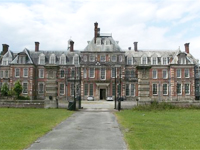
When Kinmel Hall was bought in March 2006 by an investment company it was almost immediately advertised on their website as a ‘a unique development opportunity’ with plans for use as either hotel, spa, offices, conference venue or apartments. Yet, nearly four years later, this impressive mansion is still languishing without a clear future.
The Kinmel estate was bought in 1786 using the vast wealth generated for the Hughes family in the eighteenth century through their half-ownership of the copper mine in Parys mountain which generated up to £150,000 a year at it’s peak (equivalent today to about £200m measured against average earnings). The Hughes family lived in the house already there until it was rebuilt in 1842-3 in a Palladian style designed by the famous Georgian architect Thomas Hopper for the 1st Lord Dinorben. When this house burnt down shortly afterwards in 1848 their huge income meant that an even larger house could be built to replace it. Designed by William Nesfield in a monumental chateau-style and built between 1871-76 it was for an age of lavish house parties and featured 52 bedrooms and accomodation for 60 live-in staff. The Hughes family lived there until 1929 when it became a health spa, then a hospital during WWII and then a school from 1945 until a large fire forced them out in 1975. Restored in the 1980s, it was sold several times before being purchased by Derbyshire Investments who still own it today.
The original descendants of the Hughes’ still own the 5,000-acre Kinmel estate – all that remains of their original holding of 85,000 acres they once owned across the area. The grade-I listed Hall and the 18 acres of walled gardens would make a magical location for what ever final purpose is decided – but the important task is to determine that future. I suppose it’s too much to hope that it will again be a family home but any sensitive use which preserves this historic house as part of Wales’ architectural heritage is to be encouraged.


 The Country Seat