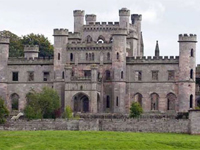
Moor Place goes to second viewings

Moor Place, Hertfordshire (Image: Strutt & Parker)

Agents from Strutt & Parker have reported that the stunning Grade-I listed Moor Place in Much Hadham, Hertfordshire, is receiving second viewings – though I doubt anyone would spend the offers-over-£17m asking price for the house and 781-acre estate without going back a few more times.

The beautiful red-brick house dates from 1779 with later additions, which combine to create an almost perfect view of a Georgian country house.  The house was built for James Gordon by the relatively unknown archictect Robert Mitchell who encased the originally Elizabethan house in an elegant facade with the south wing being rebuilt in 1907 by Sir Ernest Newton.  Inside a fine cantilevered stone staircase leads up to a master suite and five further bedrooms  on the first floor with five more on the floor above.  Downstairs the elegant staircase hall leads to a library, dining room and sunny drawing room. More accomodation is available in the 1886 Norman Shaw west wing.  All in all, this is a true trophy estate and the proximity to London means that the price tag is, judging by the viewings, not unrealistic.

Property details: ‘Moor Place, Hertfordshire‘ [Strutt & Parker]

House of the week for sale: Abbey House, Dorset

Abbey House, Dorset (Image: savills.com)

The New Year period can be a very quiet time for the sale of country houses.  This can often be easily seen in the much-thinner-than-usual selection of property adverts at the front of Country Life magazine, the weekly bible of the country house.  However, someone has obviously decided to steal a march on the spring rush by putting a stunning home on the market; Abbey House in Witchampton, Dorset.

The Grade-II* listed property was originally built in the early 16th century and is thought to be the first brick-built house in Dorset.  Formerly known as Witchampton Manor, it has 5 reception rooms, 8 bedrooms, 5 bathrooms (you might want to do something about that), plus the usual selection of outbuildings. The 6.8-acres of beautiful gardens also includes river frontage – perhaps an eco-alternative to the swimming pool.

This is a jaw-droppingly lovely house and I suspect with the currently dearth of decent larger homes on the market the owners may well have timed the sale very well as the bonus money from the City looks to find a country hole to escape to.

More details: ‘Abbey House, Dorset‘ [savills.com]

The hunt for the lost contents of Strawberry Hill

Strawberry Hill, Middlesex (Image: World Monuments Fund)

Although Horace Walpole’s large and impressive art collection initially remained at Strawberry Hill after his death in 1797, it was later sold off by his heir in a 24-day sale in 1842.  With the sale, one of the best collections of it’s time of art, furniture, cermanics, glassware and manuscripts was scattered.

Now the Strawberry Hill Trust who look after the house are trying to find some of the objects in the collection with a view to borrowing or even purchasing some of the items.  In particular, if you know the whereabouts of:

  • Roman funerary urn;
  • mirror with portrait of Viscount Malpas;
  • ornate Turkish dagger;
  • Gothic dining table;
  • basalt Bust of Vespasian

For more details about each of the items, see the story at The Art Newspaper:

Full story: ‘Strawberry Hill on the hunt for lost Walpole treasures‘ [The Art Newspaper]

Lowther Castle to be partially restored

Lowther Castle, Cumbria (Image: dailymail.co.uk)

Empty since 1942, Lowther Castle was used during WWII as a weapons research lab and the grounds as a practice ground for tanks who did their best to destroy the ornaments, fountains, paths and gardens.  The house was not lived in again and in 1957 was unroofed and abandoned as a shell, leaving it as an ornament in the gardens of the 3,000-acre estate.  The castle deteriorated over the passing decades until it was overgrown and the central tower was in danger of collapse and was featured in the 2008 Buildings at Risk register. However, this decay is about to be arrested and ambitious plans are afoot to partially restore the tower and invest in the gardens and park.

An application has been lodged to restore the gardens including the kilometre-long central avenue and create an indoor garden within the shell of the house once this has been stabilised.  The work is expected to cost up to £9m but will attract 160,000 vistors a year to the attraction, generating £10m for the local economy.

Although the loss of the castle as a house is lamentable it’s encouraging to see that the shell and estate still have such value which will hopefully secure the future for this elegant building for future generations.  Who knows, one day it may be possible for the Lowthers to restore the castle and move back in?

Full story: ‘Move to restore Lowther Castle could see gardens open in 2010‘ [The Cumberland News]

Castle Drogo under seige – from rain

Castle Drogo, Devon (Image: wikipedia)

The last castle to be built in the UK, Castle Drogo, occupies a commanding position far up the Teign Gorge in Devon.  Designed by Sir Edwin Lutyens and built in the 1910s and 1920s and finally finished in 1931 for the wealthy businessman Julius Drewe, the Grade-I listed house is a brilliant modern interpretation of a castle combined with the comforts of a country house.

It was also one of the last houses to be built entirely in granite, the local stone of the area.  The grey stone and the clever massing of towers and wings give the house a solid, impregnable air but the house is under attack from the elements, with rain penetration causing serious concern.  The many flat roofs hidden behind the battlements started causing problems only two years after the house was finished and ever since it has been a constant battle to keep the house watertight.

House manager Bryher Mason told BBC News: “I wouldn’t be surprised to walk into a room one morning and find a section of the ceiling having fallen in because the metalwork in the ceiling has failed.”

The National Trust, who have cared for it since it was handed to them in 1974, have instigated a restoration and repair programme on the many roofs, which will include the replacement of all 13,000 window panes, and has been estimated to cost £10m, and will be completed by 2016.

Full story: ‘Leaking castle needs £10m repairs‘ [bbc.co.uk]