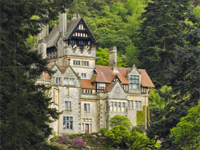
A theatre of innovation: Cragside, Northumberland

Cragside, Northumberland (Image: ©National Trust Images/Simon Fraser)

One hundred and fifty years ago, as 1863 drew to a close, the great industrialist Lord Armstrong may have reflected on a year in which innovation was sweeping across so many areas of life and, perhaps, his own future plans for his new country house at Cragside, Northumberland.  Country houses have often been at the nexus of innovation as they contain just the right mix of elements; namely a fashion for novelty, complex issues to be solved and a desire to impress others, along with the resources to experiment.  Cragside was to be a fine example of all these desires, a joint effort between an inventor owner and an inventive architect.

1863 was another year of great industrial developments as diverse as the running of the first Underground trains in London and the patenting of TNT, both of which would have far-reaching consequences.  That driving spirit of creativity spurred the Victorian engineer to look at many challenges, both large and small, seeking solutions which provided greater utility and comfort, though often tempered by the conservatism or financial reluctance of the owner.

Comfort and luxury are not always as synonymous as they are today and tales are legion of freezing country houses where one bathroom (used only for bathing naturally) served a whole house.  Owners of older aristocratic houses often felt little need to modernise; after all, if you had hot and cold running servants ferrying coal and water about the house this was often cheaper than a full refurbishment.  Worse, such improvements might be seen as nouveaux-riche (and therefore vulgar), unhealthy, or, worse, American. By contrast, the new money aristocrats in the Victorian era often had worked their way from less distinguished backgrounds and were keen to use anything which provided a better life – and also gave them the social bragging rights of novelty.
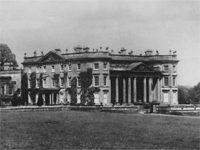
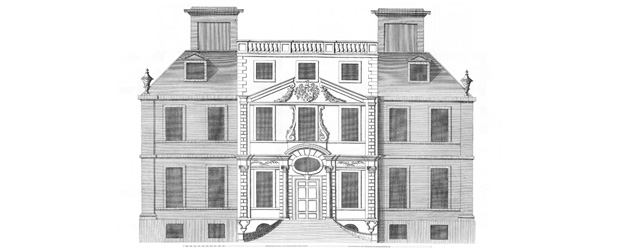
Bowood House, Wiltshire (demolished 1955-56) (Image: Lost Heritage - England's Demolished Country Houses)
Bowood House, Wiltshire (demolished 1955-56) (Image: Lost Heritage – England’s Demolished Country Houses)

Open fires have been the mainstay of country houses for hundreds of years but central heating – either steam, hot air or hot water – started making a comeback in the late Georgian period (remember the Romans introduced it first). The library at Bowood House, Wiltshire was thought to be the first modern room to be centrally heated when it was introduced in the 1790s (although it wasn’t all that successful).  Other centrally heated single rooms were to be found at Pakenham Hall, Co. Westmeath in 1807 where ‘The immense hall so well-warmed by hot air that the children play in it from morning to night‘.  The first multi-room ducted hot-air arrangements could be found at Coleshill, Berkshire in 1814, and Abercairny, Perthshire in 1829. Steam proved difficult to control (though it was installed by Sir Walter Scott at Abbotsford in 1823) so other early examples were either hot air (Osmaston Manor – 1846-49, Flixton – 1847, or Tortworth Court – 1849-52) or hot water via radiators (Mentmore Towers – 1850-55).  These systems rarely extended beyond the entrance areas, hallways and main downstairs rooms.
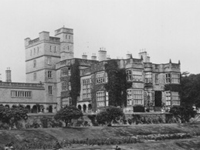
Osmaston Manor, Derbyshire (demolished 1965) (Image: Lost Heritage - England's Demolished Country Houses)
Osmaston Manor, Derbyshire (demolished 1965) (Image: Lost Heritage – England’s Demolished Country Houses)

Ventilation was always a challenge and the unpleasant accumulation of stale air and the smell of gas was exacerbated by the higher building standards of the Victorians which reduced drafts.  Many houses such as Kelham Hall, Mentmore, Dobroyd Castle and Wykehurst Place had ventilation shafts fitted in individual rooms but they were fairly inefficient.  One of the most advanced systems was created in 1846-49 for Francis Wright, a wealthy ironmaster, at his home Osmaston Manor in Derbyshire.  A single intake near the kitchen drew air from outside before heating it and distributing it around the house.  Coal fires in individual rooms then drew the stale air towards them but the flues all took the air downwards into a central extractor system which vented though a single huge 150-ft chimney in the kitchen garden, thus eliminating the need for huge chimneys in the main house (though it had smaller ones).  Sadly the house was demolished in 1965, thus denying us the chance to marvel at the ingenuity.
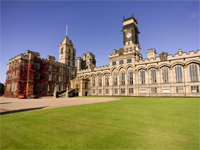
Carlton Towers, Yorkshire (Image: Landed Houses)

Bathrooms and indoor plumbing were often a great source of inconvenience. Even as late as 1873, such a grand house as Carlton Towers, Yorkshire, had no bathrooms with washing still undertaken via hand-filled basins and hip baths.  By contrast, Stoke Rochford Hall in 1839 had fifteen and by 1874 Wykehurst had the then radical innovation of each bedroom being a suite with its own bathroom.  A number of country houses were demolished for reasons of inconvenience with a  lack of bathrooms often cited, especially as the complexities of adding them to older houses was to prove insurmountable, either technically or financially.

Such challenges were often a catalyst for innovation – particularly if the owner was one of the industrial titans of the age, a man as comfortable in the workshop as the boardroom. Although William Armstrong (b.1810 – d.1900), 1st Baron Armstrong (after 1887), started his professional life as a solicitor he was able to turn his analytical mind to practical challenges as much as legal ones.  The genesis of his engineering career stemmed from his love of fishing where he noticed how inefficient waterwheels were and so designed a much more efficient water-powered engine. He successfully showed it could be used to hydraulically power cranes and thus improve the speed of cargo unloading at the docks.  This formed the basis for Armstrong’s engineering firm in 1847 and his first fortune.  The firm’s greatest fame/infamy came due to the later armaments work which Armstrong had turned to when he read that the British Army had difficulties with heavy field guns during the Crimean War. Success here with his revolutionary design and, later naval versions, led to the creation of a shipbuilding firm which won orders throughout the world, generating his second fortune.
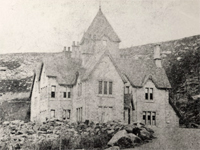
The Lodge 'Cragside', dated 1864-6, before Norman Shaw's editions at Cragside, Northumberland (Image: ©National Trust Images)
The Lodge ‘Cragside’, dated 1864-6, before Norman Shaw’s editions at Cragside, Northumberland (Image: ©National Trust Images)

Armstrong’s obviously busy and productive life gave him great status in Newcastle-upon-Tyne and beyond and his main home in the city was a grand, if heavy, suburban creation called Jesmond Dene House.  As befitted any Victorian man of wealth and social stature and due to the pressures of running his businesses, Armstrong sought a country retreat.  Having visited the Rothbury area as a child, he looked there for a suitable estate, eventually buying in 1863 the then small shooting lodge and 20-acres of land which formed part of a steep-sided valley through which ran the Debdon Burn. Over the next few years, as Armstrong came to reduce his involvement in his businesses, Cragside became a passion; a place to retreat but also to enjoy more domestic challenges with the help of one of the most brilliant architects of the age, Richard Norman Shaw. Armstrong eventually came to own 16,000-acres of Northumberland, including Bamburgh Castle, of which 1,759-acres surrounded Cragside in which he had planted over 7m trees and innumerable rhododendrons.
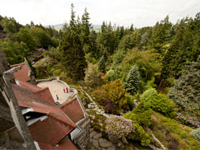
View from the Terrace, Cragside (Image: ©National Trust Images/John Millar)

Between 1869-84, Cragside was transformed into a modern Victorian plutocrats palace, but one incorporating all conceivable innovations, powered by his own hydraulic engines. The first challenge was the location, which was ideal for a small lodge but cramped for the house which it eventually supported.  The steep hillside meant that space for expansion either had to be created through excavation or by building up the ground.  What it lost in convenience, it gained in views; spectacular vistas overlooking the remote Northumberland countryside.  Unfortunately, those views – both from and of the house – are now somewhat obscured by some of those same trees planted by Armstrong.
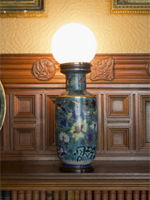
One of four of the original electric lamps at Cragside (Image: ©National Trust Images/James Dobson)

It was inside the house that the inventive mind of both owner and architect could really find effect.  For Shaw, Armstrong was an ideal patron, offering none of the conservative reticence he might have found in other clients, able to offer either his innovations or those of his friends. By December 1880, Cragside was the first private house in the UK (and Girouard thinks possibly in the world) to have electric light comprehensively installed, thanks to Armstrong’s friendship with Joseph Swan, with his eponymous filament bulbs throughout. Power for these innovations came from Armstrong’s own hydroelectric engines, running from the Burn below.

With the luxury of his own cheap and apparently limitless power supply, Armstrong and Shaw’s opportunities were myriad.  In addition to the lighting, the central heating system was also driven by a hydraulic engine.  That same power source also enabled the kitchen to boast a hydraulically-powered spit with the heavy pots in the conservatories moved by hydraulic machinery, with an electric sewing machine and electric communication throughout the house and even out to a shooting lodge on the moor.
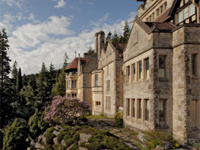
View of Cragside (Image: ©National Trust Images/John Millar)

To his contemporaries, Cragside must have seemed beyond ingenious – a place grown from an inhospitable hillside, packed with innovations.  The house became a significant marketing tool for Armstrong as visits from his prospective customers, including the King of Siam, the Shah of Persia and the Crown Prince of Afghanistan, gave him the chance to demonstrate the advanced technology they could be buying into, a true theatre of innovation.  The Prince and Princess of Wales also visited in August 1884, thus giving the royal seal of approval to such a modern approach to the traditions of the country house.

Cragside passed to the National Trust in 1977, sadly missing the best of Armstrong’s picture collection (sold in 1910), but cared for and open so we can enjoy seeing the products of two great Victorian minds.  Despite being the genesis of domestic hydroelectric power, a gas turbine was installed in 1895 to provide more power before being connected to the National Grid in 1945.  However, in early 2014, the National Trust is again installing a modern hydroelectric screw to once more generate electricity for the house providing a welcome return of innovation.

———————————————————

Article: ‘Hydro-electricity restoration work starts at Cragside‘ [BBC News]

Official site: ‘Cragside‘ [National Trust]

160+ images: ‘Cragside‘ [National Trust Images]
Merry Christmas and a Happy New Year

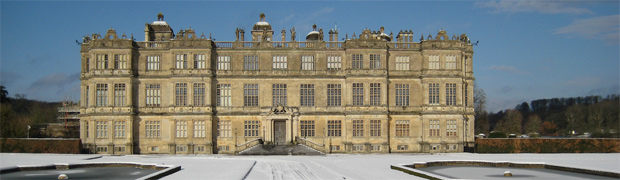
Longleat, Wiltshire (Image: Karen Weeks via flickr)
Longleat, Wiltshire in 2009 (Image: Karen Weeks via flickr)

So the National Lottery or an hitherto-unknown-and-childless uncle have again failed to give me the route to my spending a Christmas in front of a roaring fire in my own country house drawing room.  That said, I have had the pleasure of visiting other people’s houses either independently or via such wonderful organisations such as The Georgian Group. Delights of the last year have included:

Each has had a fascinating story to tell; be it the Italianate beauty of the gardens at Iford, the statesmanlike Chevening, the exciting return of the Old Masters collection to Houghton, the sensitive restoration of Heveningham Hall, or the endless architectural complexity and beauty of Apethorpe, to name just a few highlights.  Some stories stretch over centuries, others more recent, but for every one their history is constantly evolving in terms of their past, as more is discovered, and their present and future as new uses show them adapting and evolving today.

Terrace at Hengistbury Head (Image: RIBA Library Drawings Collection)

It’s this constantly changing nature, like light playing on mother-of-pearl, which makes country houses so endlessly fascinating.  Again, it’s been a pleasure to write the blog (though, as ever, work pressures have prevented greater frequency) and to have experts such as Amicia de Moubray provide articles (‘White knights – the 20th-century castle rescuers‘) – and I hope to have others in 2014.  Interest has remained strong, though slightly less than last year, which is likely due to the lack of TV series such as Country House Rescue.  One of the earliest articles of 2013, which also proved to be one of the most popular, was about a house which never came to be created: Harry Gordon Selfridge and his grand plans: Hengistbury Head. I am working on creating an index to make it easier to find older articles, as there are now hundreds.  Twitter has also proved to be a remarkably effective way of communicating both about and with houses so I would recommend it – even if you just follow @thecountryseat (over 1,900 followers and rising) and any houses of interest.

The year has presented country houses with the usual challenges and some new ones.  The threat posed by the HS2 rail link, and the plans which affected a significant number of houses, has not abated and may yet come to pass.  Country house sales this year have seen some notable examples, including the Grade-I listed Castle Goring and Halswell House (both misleadingly described in press coverage as ‘bargains’), change hands, whilst there has been relatively few of the premier league (exceptions being Kingston Lisle, The Mynde and Tyringham Hall) appearing in the front pages of Country Life, which I take to be a positive indicator.  Signs are that well-managed estates (of which there are thankfully many) are thriving and those which have diversified are finding a sustainable income.  For others, it will still be a challenge, as the English Heritage ‘At Risk’ Report highlighted, and, as has always been the case, some will change hands.  If Scotland chooses independence, this may trigger further sales – and, in theory, some interesting questions for the scope of the blog.

Thank you again for taking the time to share my passion in the UK’s country houses and the architectural history which they embody.  It’s humbling that you visit and subscribe and I hope that I can continue to provide articles and knowledge which you find interesting.  As always, I’m keen for your feedback, including which were your favourite articles (and why) and topics or houses you might like me to have a look at.

Wishing you all a very Merry Christmas and all the best for 2014; a year which I hope will involve further discoveries and delights from the great treasures that are the nation’s country houses.

Kind regards

Matthew

——————————————————-

Articles published in 2013:

A deceptive bargain: Halswell House, Somerset

Halswell House, Somerset (Image: Clive Emson Auctioneers)

When newspaper stories appear with headlines such as ‘One of Britain’s ‘finest’ mansions for sale with guide price of £250,000‘, it guarantees that many will immediately start dreaming of exchanging their current home for the life of a country squire.  The auction of Halswell House, Somerset, is the latest chapter in a blighted recent history of the house and the absurdly low guide price should be a warning. This is a house which will require equally deep reserves of money and heritage sensitivity for anyone wishing to take on this important house, a beautiful example of early English Baroque, described by Sir Nikolas Pevsner as ‘the most important house of its date in the country‘.

The Halswell family had been resident in the part of Somerset which took their name since the early 14th-century.  Though no trace of the early building can be seen in Halswell House today, the core – consisting of two rambling gabled wings around a courtyard – dates from the early 16th-century, specifically 1536, when Nicholas Halswell used some of his inheritance to build a new home.  The house and estate passed through the Halswells until 1667, when the then owner, Hugh Halswell, settled the inheritance on his daughter’s 18-year old son, who became, in due course, Sir Halswell Tynte – his daughter having married Sir John Tynte and wisely passing on the family surname as a first name.

It was Sir Halswell who was responsible for the building of the imposing great North wing, completed in 1689; a bold, three-storey addition which was placed so as to hide the older buildings from the view of visitors arriving along the main carriage drive.  As to the identity of the architect; in a letter, dated March 1683, among the Thynne papers at Longleat, a surveyor called William Taylor, states that before he can return to London he needed to visit Sir William Portman at Orchard Portman and then Sir Halswell. In his famous dictionary of architects, Sir Howard Colvin states that Taylor was almost certainly responsible for the rebuilding of Halswell. Taylor had several commissions in the south-west in the 1680s, including Chipley House, Somerset (built 1681-3, rebuilt 1840, later dem.), and in Devon; Wembury House (dem. 1803) and Escot House, which was destroyed in a fire in 1808, but was illustrated in Colen Campbell’s Vitruvius Britannicus.

Escot House, Devon as shown in Vitruvius Britannicus (vol i, plate 78) - burnt down 1808
Escot House, Devon as shown in Vitruvius Britannicus (vol i, plate 78) – burnt down 1808

The design of Escot has been attributed to Sir Robert Hooke but Colvin quotes that in 1684 Taylor was contracted to ‘contrive, designe, and draw out in paper‘ and supervise the building of the house, for which he was paid £200.  Looking at the design of Escot House, especially the engaged pillars beside the door, the recessed doorway (inspired by Wren’s St Mary-le-Bow, London), surmounted window with pediment,  it’s clear to see the similarities in Taylor’s work at the two houses.  A similar style can be seen at nearby Ston Easton Park, a grand and beautiful house built in 1739, but designed by an unknown architect who appears to have taken inspiration from Halswell.

The importance of Halswell House stems from its very early use of the architectural language of the baroque – some five to ten years before the wider movement took hold in the country.  Sir Christopher Wren had been the midwife to the use of the style but it was only once he had handed over his responsibilities as the Queen’s Surveyor in 1692 that others such as Nicholas Hawksmoor and Sir John Vanbrugh were able to develop their designs into a distinctive school of English Baroque which reached its peak with the grand palaces such as Castle Howard (built 1699-1712) and Blenheim (built 1705-24).  William Taylor was innovative in his use of the style although he was probably copying elements from French pattern books as he lacked the genius of Vanbrugh to bring it to its full expression.

Robin Hood's Hut, Halswell, Somerset (Image: Ian Sumner / Landmark Trust)
Robin Hood’s Hut, Halswell, Somerset (Image: Ian Sumner / Landmark Trust)

After Sir Halswell’s death in 1702, the house continued down the Tynte family line, with his son John’s marriage bringing Welsh wealth into the estate.  It was Sir John’s third son, Sir Charles, who looked beyond the house (completing only minor works there) and instead concentrated his energies on beautifying the parkland.  A series of new lakes, canals and ponds, avenues of trees all grew under his watch, but his best commissions were the hermit’s house on the hill, Robin Hood’s Hut (now restored by the Landmark Trust) and the Temple of Harmony, derived by Thomas Prowse from a Robert Adam design.  Extensive gardens and greenhouses ensured that the table at Halswell was as exotic as it was plentiful.

Sadly, the 19th-century was a time of neglect and disuse for Halswell as, although it was still owned by the family, it had passed to a niece and was regarded as old-fashioned.  It came back into use when Charles Theodore Halswell Kemeys-Tynte succeeded as Lord Wharton in 1916 and the house again became a home.  Any hope that this upward trend in the fortunes of the house could continue were dealt a cruel blow early on 27 October 1923 when Lord Wharton’s valet awoke to smoke seeping under the door to his room at the top of the house.  Despite the efforts of estate staff to both fight the fire and rescue the contents, by breakfast time the grand North wing was gutted, destroying ten bedrooms, the drawing room, reception hall and the dining room.  The local paper reported mournfully that ‘Practically all that remained of the front part of the building were blackened outside walls, the interior being a mass of smouldering debris‘.

The cause of the fire was eventually judged to be a newly-installed electricity supply.  Despite the estate being heavily mortgaged, the house was rebuilt at a cost of £41,534 with the work to such a standard that it was confused for being original.  During WWII, the house became a girls school and the grounds were used as a prisoner of war camp. Halswell House finally passed out of family ownership when it was sold in 1950, after which it was divided into flats (badly) and also used as a furniture store.  The house had a brief respite when it was bought by a businessman in 2004 who lived there and used it as an events venue (sometimes with unexpected results).  However, with the house and estate being repossessed Halswell is again looking for a new owner.

East and North wings, Halswell House (Image: RCHME in 'Some Somerset Country Houses' by David Dunning')
East and North wings, Halswell House (Image: RCHME in ‘Some Somerset Country Houses‘ by David Dunning’)

The auction guide price is simply that – and in this case feels more like a marketing ploy to attract the greatest interest.  It’s likely that bidding will be keen and the final price for the house alone will be multiples of the original guide price, probably nearer £1m, though ideally they will be able to start putting this fractured estate back together, reuniting the parts to create the surroundings that this grade-I listed house deserves.  Beyond the sale price, will also be the certainty that the new owner – if they are the right owner – will need to be willing and able to spend large sums to restore the house, especially the Tudor ranges, to the state it deserves. So, rather than £250,000, this house will easily require £2-4m – and possibly more. Not such a bargain after all.

That said, Halswell House is not simply a home – it’s an important milestone in the development of the English country house and a source of wonder at the beauty and composition of the exterior, married to an equally impressive interior.  Hopefully the house will sell for a price which reflects its value and ideally to someone who will appreciate it and is willing to pour money almost beyond reason into restoring it.  In return, they will be the custodians of one of the finest houses in the country and proud owners of a piece of architectural history.

———————————————————————

Full auction details: ‘HALSWELL HOUSE & THE TUDOR BUILDINGS, HALSWELL PARK‘ [Clive Emson] – auction to be held on 17 December 2013 in Saltash, Cornwall. Halswell House and its five other outbuildings lots will firstly be offered as one lot, then separately if not sold.

Official website: ‘Halswell House

Listing description: ‘Halswell House‘ [British Listed Buildings]

Further history: ‘Halswell House‘ [Wikipedia]

Further reading: ‘The bargain-basement mansion: Historic house which has been a school, a PoW camp and even the site of an ORGY goes on sale for just £250,000 after owner went bust‘ [Daily Mail]

A minor prodigy: Brereton Hall for sale

Brereton Hall, Cheshire (Image: Jackson-Stops & Staff)

Advancement in Elizabethan society depended largely on being noticed by the Queen. In an age where the monarch wielded enormous powers of patronage and with so many others jostling for her attention, your house and the hospitality you could provide were effectively the biggest advert you could make.  As a result of this, the houses of courtiers became destinations for the monarch as she made her way around the kingdom, and these homes developed both architecturally and stylistically to not only accommodate, but to also impress.  Known as Prodigy houses, they are now some of the most beautiful in England, and a fine smaller example, Brereton Hall in Cheshire, is currently for sale.

Surprisingly, the genesis of the Prodigy house actually lies far from the bucolic charm of the countryside, and instead can be found on the banks of the Thames in central London. Built in 1547-1552 (dem. 1776), the old Somerset House was the home of Lord Protector Somerset, and was the first classical building in the UK – a remarkable symmetrical façade which proclaimed the dawn of a new architectural style.  Although the core of the building was late-medieval, the decoration was resolutely classical; the gateway on the Strand was a development of the Roman triumphal arch, combining the three orders with pedestals and the pairing of windows and pediments.

The influence of Somerset House began to spread with the style adopted by those in the Lord Protector’s circle.  In the 1540s, at Lacock Abbey, Sir William Sharington, who was close to the Lord Protectors brother, added Renaissance features to his newly acquired monastic home.  So although elements of the new language began to be used elsewhere first, Longleat, built in 1572-80 by the Lord Protectors steward, Sir John Thynne, was the first of Prodigy houses; a new, larger style of country house which embraced the classical and which were explicitly designed for show.

Longleat House, Wiltshire (Image: Christ Church Association)

Few can mistake the remarkable façades of Longleat, a glittering statement of confidence, wealth and architectural learning.  Thynne was part of the Lord Protectors circle and therefore out of favour under Queen Mary’s rule after 1553, so he wisely retired to Wiltshire to concentrate on applying what he had learned of classical architecture to the new house he was building. Sadly, the early results are unknown as the house burnt to the ground in 1567, forcing Thynne to start again. A new model was created in 1568 (this time in conjunction with that genius of the age Robert Smythson), the new façades were added in 1572, and when the Queen visited in 1575, it was complete up to the second floor.  Interestingly, the third floor may have only been completed after his death in 1580, Thynne having spent a lifetime and a fortune creating one of the greatest examples of Elizabethan architecture.

Wollaton Hall, Nottinghamshire (Image: stuartmcq84 via flickr)

Smythson was to become one of the most accomplished of the new breed of specialist; the architect.  Officially his title was ‘Queen’s Master Mason’ but his influence, though the Royal Office of Works, was such that his architectural guidance was to become pre-eminent.  After the success of Longleat, Smythson’s next project was the grand extravaganza that is Wollaton Hall, Nottinghamshire, built between 1580-88.  Sir Francis Willoughby, the High Sheriff of Nottinghamshire, had entertained Her Majesty previously but now wished to create as great a statement as any member of Court.  Drawing on the traditional broad plan of a castle, with all its heraldic and chivalrous echoes, Smythson adapted it to accommodate the new classical language (though even this was inspired by the Poggio Reale in Naples, which Serlio mentions in his third book).  Although the plan of the house still followed the processional structure of royal apartments, the house radically dispensed with the central courtyard arrangement and instead created a huge central ‘keep’, but one without any pretence of defence. This was about glass, power, ornament and display.

Worksop Manor, Nottinghamshire - burnt down 1761 (Image: Nottinghamshire History)
Worksop Manor, Nottinghamshire – burnt down 1761 (Image: Nottinghamshire History)

Wollaton Hall was the last house with a documented link to Smythson but there is strong circumstantial and stylistic evidence that he was linked to two of the other great houses of the age; Worksop Manor, Nottinghamshire, and Hardwick Hall, Derbyshire, both seats of the Shrewsbury family.  Worksop Manor was another departure for Smythson; another variation of the castle plan but now much more loosely applied.  Completed by 1585, the design was a compressed and heightened version of Longleat and without clear precedent in earlier Italian work.  Hardwick Hall – famously ‘more glass than wall‘ – neatly fits into this narrative of Smythson and the nascent English Renaissance. Built between 1590-97, it is a simplified and reduced version of Worksop – and all the more elegant for it.  Built by Bess of Hardwick, it enjoys a prominent site (as with Longleat and Worksop), to better display its charms.  Where Hardwick can claim renown is as the first house to be built with a cross-hall, running from front-to-back in the centre, a derivation of Palladio‘s Villa Valmarana, and is therefore some of the earliest evidence of the use of Palladio’s teaching.

Palace of Theobalds, Hertfordshire - from an article in the Gentleman's Magazine, 1836
Palace of Theobalds, Hertfordshire – from an article in the Gentleman’s Magazine, 1836

Influential though Longleat was, a wealthy man may always wish to find his own way of expressing conformity and so it proved with another group of the Prodigy houses built by William Cecil, 1st Baron Burghley from 1571 (b.1520 – d.1598), the Queen’s Secretary of State and then Lord Treasurer.  Powerful and politically astute, Cecil became one of the most important men in the country and one very close to the Queen.  As such, her progresses often took advantage of his hospitality, leading to the creation of two of the great Prodigy houses.  The first was perhaps one of the largest and grandest non-royal residences ever built; Theobalds in Hertfordshire.  Originally a smaller house, as Burghley said, ‘[it] was begun by me with a mean measure but encreast by occasion of Her Majesty’s often coming‘, and then completely rebuilt in her honour.  It was a grandiose gesture which spread across five courtyards covering a quarter of a mile and anyone seeing it could not fail to be awed by the size and the statement it made of homage to the Queen, who visited 13 times in all, often treating it as one of her own palaces.  Sadly, the house became one of the many casualties of the Commonwealth; listed for disposal, it was largely demolished by 1650.

Burghley House, Lincolnshire (Image: xposurecreative.co.uk via flickr)

Cecil’s other house, Burghley in Lincolnshire, was more conservative and, in comparison, modest, though still on a grand scale.  Built between 1558-57, the house displayed all the typical Elizabethan swagger but in a compact form with an impressive entrance front which was one of the last to use the style of the high turreted gatehouse and towers at each end. One of the most innovative architectural feature of Burghley is the celebrated three-storey tower which dominates the inner courtyard.  Developed from the gateway at Somerset House, the Burghley tower features stacked arches, surmounted by a clock which acts as a plinth for a huge obelisk.  The house today survives as the seat of descendants of the Cecil family.

New Hall, Essex (Image: New Hall School)

Though there are many other examples, two other houses are of particular note in this era of extravagant architecture.  One that can still be seen today, though is now enjoyed more by the pupils in its current use as a school, is New Hall in Essex, where the great stretch of the main lodgings is lavishly fenestrated.  Built by Thomas Radcliffe, Earl of Sussex, around 1573, it was explicitly designed for the Queen’s use with a full suite of royal apartments: great chamber, presence chamber, privy chamber, withdrawing chamber, bed chamber and inner chamber.

Reconstruction of the South front of Holdenby Palace, Northamptonshire (Image: Holdenby Hall)

The other, now sadly lost, is the vast palace of Holdenby Hall, Northamptonshire, a house which influenced those who later also wished to build to impress.  A late starter, Sir Christopher Hatton (b.1540 – d.1591), began the construction of his new house in 1571 as a direct, though amicable, challenge to William Cecil, though with an element of flattery in that it sought to mimic Theobalds.  Expressly designed to accommodate a Queen who never actually visited, by the time of its completion in 1583, Holdenby had few equals as possibly the largest house in the country; an enormous Renaissance palace with symmetrical façades stretching 380ft on the garden front, almost all of it glass. Hatton’s ambitions sadly ran far ahead of his wealth and his attempt at establishing himself as Cecil’s successor failed, partly due to being bankrupted by the enormous expense of building Holdenby, but also by his death less than ten years after completing the house.  Holdenby became a royal palace of James I in 1607 but was sold under the Commonwealth and demolished by 1651, with a smaller house later rebuilt as a new Holdenby Hall, one clearly linked architecturally to its more grand forebear.

The plan of the early prodigy houses still owed much to the traditional pattern of the Royal progress which required that courtiers accommodate the monarch and their retinue according to the strict rules of precedence and access practised in London.  This meant a series of courtyards and state apartments, each stepped back with a clear route of progress through them.  This naturally forced compromises in the early use of classical, leading to it being external decoration applied to an essentially medieval plan.  However, change was taking hold and in the now-for-sale Brereton Hall, it was reversed with a non-courtyard layout married to a distinctly historical feature, that of the grand gatehouse entrance.

Brereton Hall, Cheshire - 1819 - from George Ormerod's 'History of the County Palatine and the City of Cheshire'
Brereton Hall, Cheshire – 1819 – from George Ormerod’s ‘History of the County Palatine and the City of Cheshire

Whilst the courtiers were engaged with their vast and expensive projects, others also wished to show their allegiance through architecture, adopting the style of those close to the Queen, but scaled to their own circumstances.  Brereton was completed in 1577 but was in one way, curiously behind the times as it was one of the last to be built with a grand gatehouse (added in 1586) – though it was more impressive than it appears today.  The design was novel in that one tower was, in fact, a staircase leading to a small room in the domed turret (similar to Barlborough Hall, designed by Smythson) but with the addition of a bridge which crossed to a banqueting room in the other turret.

Gatehouse, Brereton Hall (Image: Jackson-Stops & Staff)

The rest of the house is typical of the smaller gentry Elizabethan houses, such as Cobham Manor in Kent (completed 1597), or Easton Lodge in Essex (burnt down 1847), which rejected the local vernacular and instead adopted that of the Court.  In doing so, Brereton was a fine example, decorated with the Queen’s coat of arms both inside and out.  The Brereton line died out in 1722, with the house passing to the Holtes of Aston Hall, before being sold in 1817 to John Howard of Hyde. He unsympathetically set about altering the house, radically changing the internal layout and removing the turrets of the gatehouse, adding instead what, in 1909, Country Life magazine called ‘battlements of outrageous proportions and cumbersome mouldings‘.  The house later became a school which closed in 1992 and then passed to the headmistress’ daughter who, with her husband, carefully and sensitively restored it as a home before it was sold in the late 1990s to a technology millionaire, who then sold it in 2002 for around £2.25m.  The house is now again for sale at £6.5m; certainly expensive, but by comparison with the illustrious and much grander architectural ancestors, not prodigiously so.

—————————————————–

Property details: ‘Brereton Hall, Cheshire‘ [Jackson-Stops & Staff]

Article: ‘Country Houses as Family Homes‘ [Country Life]

Photos of the house in 1909: ‘Brereton Hall‘ [Country Life Picture Library]

Further reading: ‘Prodigy house‘ [RIBA]

England’s most ‘at risk’ country houses; English Heritage 2013 report

Though he his House of polish’t marble built
Yet shall it ruine like the Moth’s fraile cell.*

Nymans, West Sussex - gutted by fire in 1947 (Image: sjr60 via flickr)
Nymans, West Sussex – gutted by fire in 1947, now a romantic ruin (Image: sjr60 via flickr)

There is a long tradition of the romanticisation of ruins and decay, but watching once grand houses slide into dereliction is thankfully now seen as a failure; on the part of the owner, and of the official bodies charged with the preservation of our shared architectural heritage. With those local experts disgracefully being seen as expendable by councils, it’s important that English Heritage has produced the 2013 ‘Heritage at Risk Report‘ [PDF] – a sad national roll call from which the priority sites list contains a surprising selection of country houses.

To be included in the list is not to say that a house is derelict, but is more a reflection that there are concerns about the long-term future of the house and current signs of deterioration.  Owners can often find that there are significant projects which require substantial investment which may not be currently possible through their own means, though inclusion on the ‘Priority’ list does open doors to grants and other funding.

Knebworth, Hertfordshire (Image: June Buck / Country Life Picture Library)

Perhaps one of the best known to appear is Knebworth House, Hertfordshire, a Victorian fantasy that is now faced with a modern reality.  Home to the Lytton family since 1492, the house was originally a mid 16th-century courtyard house before losing three sides in 1811, leaving just the west wing which was remodelled externally in 1820 and 1843 in the Tudor-revival style, with interior alterations by Lutyens in 1907 (see Listing description for details).  Still a family home, the Lytton-Cobbolds (as they now are) have worked hard to open the grade-II* house and, famously, host vast pop concerts in the park.  Major grant-funded repairs in the late 1990s restored half the house, but now, as a priority case, a further £240,000 has been allocated for works on the roof and to restore the upper rendering and two pinnacles.

Sockburn Hall, County Durham (Image: Sockburn Hall Project)

For an estate once reputedly tormented by a dragon, the modern threats to Sockburn Hall, Darlington were much more prosaic, but which have meant years of restoration work.  The current house was built in 1834 for the younger brother of Sir William Blackett (1758-1816) in whose family it remained until sold in 1920.  A varied ownership history led to the period which left it in the current damaged state, when the house was owned by two sisters who were later convicted of keeping many dogs in terrible conditions in Sockburn Hall.  The accumulated excrement rotted the floors and a lack of maintenance led to water ingress.  New owners and a dedicated team of volunteers have rallied and started restoration, part-funded by English Heritage grants, though work clearly has some way to go before the house will be safe again.

Scraptoft Hall (Image: wikipedia)

Scraptoft Hall, Leicestershire has long been a cause for concern, faced as it is with threats from the weather, vandals and poor local planning decisions.  Originally built in the 1720s, this elegant smaller house, although still on the edge of Leicester, had earlier suffered the usual short-sighted urban development, which now encroaches on it and its condition had deteriorated significantly.  However, the setting of the house is still worth preserving, though previous proposals would have unsympathetically left it as a mere architectural bauble in the middle of a much larger development.  Sadly, in 2010, despite going against English Heritage advice, the local planning department, council, and MP, were all happy to cast this fine piece of local architectural heritage onto the scrapheap of their own inadequate vision.  A reduced scheme was approved in July 2013, which although at a more appropriate scale, still contains some regrettable choices such as separating the house from the lake and ruining the approach to the hall by lining the drive with houses (See Planning Documents: Presentation Layout). This plan will result in the house being restored as eight apartments, but neither the local council or the developer can claim any sort of credit from this outcome.

Scarisbrick Hall, Lancashire (Image: Paul Barker / Country Life Picture Library)

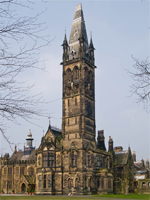
For anyone stumbling across the Gothic Revival majesty of Scarisbrick Hall, Lancashire, it might seem as thought they had found a university rather than a house – in fact, they had found one of the most remarkable buildings of the Victorian age.  On inheriting in 1833, Charles Scarisbrick embarked on a huge project to embellish his home, initially spending £5,500 between 1836-1846 on old antique carvings.   As one of the oldest Recusant families, the Scarisbricks had an affinity to the Gothic style and one of the reasons for the Hall’s grade-I listing is the creation in 1812-16 of the first new domestic ‘great hall’, to designs by Thomas Rickman and John Slater. One of the key reason for the highest listing is that the house is one of the greatest surviving examples of the work of A.W.N. Pugin, especially after the ruination of his masterpiece, Alton Towers.  Pugin was the architect who thought Gothic was the only ‘true’ architectural path for a Christian nation and, although Charles Scarisbrick initially only asked for a garden seat and a fireplace, Pugin eventually re-designed the interiors before being asked to alter the exterior, creating a more picturesque aspect.

Scarisbrick Hall, Lancashire - the bell tower (Image: Alexandre R. dos Santos via flickr)
Scarisbrick Hall, Lancashire – the bell tower (Image: Alexandre R. dos Santos via flickr)

Pugin died in 1852, and Charles Scarisbrick in 1860, after which, Charles’ sister inherited and employed Pugin’s son, Edward Welby, to continue the alterations including the spectacular tower – though without the planned clock so rendering it somewhat pointless.  The house passed out of the family in 1872, and was eventually sold for demolition in 1962 but became a school instead, a role it retains today. However, a mounting repair bill (estimated at £2.46m in 2008) has led to the house being added to the ‘at risk’ register, with particular concern about the main hall, and east and west wings.  On all counts, this is a remarkable house and warrants close monitoring and support to ensure that this magnificent example of the Gothic Revival doesn’t fall into a more parlous state.

An estate can contain many more buildings than just the main house, such as stables or follies, which form an important part of the a part of the character of an estate, but which can also become at risk. Below are examples from the same priority report:

In more positive news, although the grade-I Castle Goring, West Sussex, is included in the list, it also notes that this remarkable house has been sold and work to rectify the maintenance backlog has now started.  Congratulations to the South West and West Midlands regions which have no country houses or related buildings included in the 2013 list.

These Registers are a valuable opportunity to highlight the ongoing threats to our shared national architectural heritage, for although many of these country houses and buildings are in private ownership, we all enjoy the wider benefit of their beauty and history. If anyone demands justification as why anyone should care, why we should protect them, just ask them to imagine our country without them.

Ruins of Ravensworth Castle, County Durham (Image: Webb Aviation)
Ruins of Ravensworth Castle, County Durham which also feature on the ‘Priority’ list (Image: Webb Aviation)

—————————————————–

Full list (PDF): ‘Heritage at Risk Register – 2013‘ [English Heritage]

Previous blog post: ‘How to get depressed quickly: the English Heritage Buildings at Risk Register 2010

—————————————————–

* – Quote by Gaston Boissier, ‘Rome and Pompeii‘ (1896), as quoted in ‘The Pleasure of Ruins‘ by Rose Macaulay