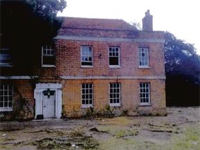
Doddington Hall pyramid proposal

Doddington Hall, Lincolnshire (Image: doddingtonhall.com)

The financial pressures of owning a country house usually mean that the priority always has to be the main building with little left over for the kinds of follies, garden buildings and ‘eye-catchers’ which were a common enhancement in previous centuries.

Over the last few decades there have only be a few notable additions to parklands including the strikingly modern garden pavilion designed by I.M. Pei for the Keswicks in Wiltshire.  However even this has a practical use but in the spirit of landscapers such as ‘Capability’ Brown, a proposal has been submitted for a new pyramid to be built as an ‘eye-catcher’ at the end of a 1km walk at Doddington Hall in Lincolnshire.  Doddington is a beautiful, symmetrical, red-brick house designed by the celebrated Elizabethan architect Robert Smythson.  It also has the rare distinction of being one of the few houses to have never been sold since it was completed in 1600.

Fingers crossed that this interesting proposal will be approved and completed to continue an important tradition of folly building in English gardens.

Full story: ‘Plans for pyramid at Doddington Hall‘ [Lincolnshire Echo]
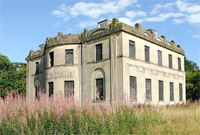
Pell Well Hall finally sold – but will buyer finish the job?

Pell Well Hall (Image from Strutt & Parker)

After abandonment, institutional use, and a serious fire, there is finally some good news for Pell Well Hall.  It’s reported that an offer has been accepted and finally the house can move to what will hopefully be the final stages of restoration.   Originally with an asking price of £750,000 the offer accepted was £550,000 – but with estimated costs of between £2m – £5m to complete the restoration.

With such a huge project and the need for significant financing, the hope is that the new purchaser will complete the work sooner rather than later.  However, after neglect and fire the original interior has been entirely lost meaning that in many senses this is a recreation rather than a strict restoration.  Perhaps leaving some evidence of this sad state would be an honest approach – and heaven forbid that the interior ends up as just some identikit footballers Surrey mansion.  This a special house and deserves a careful hand on the design and budget.

Full story: ‘New owner for historic hall as offer accepted‘ [Shropshire Star]

Beauty – but at what price?‘ [Daily Telegraph]

Caldwell House – a nearly-lost Adam classic

Caldwell House, Scotland (Image: intriguing_rly@livejournal)

Sometimes houses suffer in so many ways and yet, despite their eventual condition, it’s still possible to imagine them being restored to something approaching their former glory.  Caldwell House near Paisley in Scotland is definitely one that would require a purchaser with deep pockets and a slightly cavalier approach to budgeting – but they would be rescuing a classic house by the famous Scottish architect Robert Adam.

In 1773, Baron Mure of Caldwell commissioned Adam to design a grand home for him. For Adam it was to be the last of the ‘castle’ houses he designed, a style he’d started with at Ugbrooke House in Devon (1760s) and Mellerstain House in Berwickshire (1770).

It remained the family home of the Mures until 1909.  In the 1920s the House was sold to Glasgow Corporation and became a hospital for mentally handicapped children. The institutional changes were severe and included the removal of the main staircase to accomodate a lift shaft and the addition of numerous poor-quality outbuildings.  After the hospital closed in 1985 the usual pattern of neglect and vandalism set in, with a major fire in 1995 resulting in serious damage to the interiors and the loss of the roof.  In spite of being a Grade A listed building, it is now empty and has sadly been neglected and allowed to decay and has been on the Scottish Civic Trust’s Buildings at Risk register for some years.

As this shocking set of photos show, the house is now in a terrible condition.  However, the shell still evocative and it’s rural location would ensure privacy and so ought not to be written off yet.  Perhaps the family motto of the Mures – “Duris Non Frangar”, which means, “not to be broken by adversity” – would be an appropriate one to bear in mind when taking on this monumental restoration.

Are you restoring a country house?

Country houses are always popular subjects for TV programme and can be a great way of highlighting the good work done by so many hard-pressed owners (or even those not so hard-pressed!).  They can also provide an unrivalled opportunity to attract interest in houses in need of some care and attention. The BBC is searching for owners restoring decaying country houses for a new series.  Ideally, the families would have historic links with the property and would demonstrate the challenge of preserving their house in the context of 21st century demands.

If you think you and property fit the bill, contact Katherine Phillips at Endemol either by phone on 0333 577 7740 or email homes@endemoluk.com

Good news for Brook House?

Brook House, Essex

A new development in the long running saga of Brook House in Tiptree, Essex has opened the possibility for some good news.  As had been reported here before, the lovely red-brick house in the heart of Tiptree was subject to an application to demolish from the owner who claimed that it was beyond repair.

However, photos taken recently show that the house is actually in very good condition and pressure from heritage organisations such as SAVE Britain’s Heritage have led to a spotlight being shone on the plans. 

It’s now been reported that the application has been withdrawn.  It’s the slow, piecemeal loss of fine houses such as this over the last fifty years which has left our towns all the poorer visually. Hopefully there will now be discussions where the starting premise is that the house should be restored as an important part of Tiptree’s architectural heritage.