A Hollandaise Source: Henry Holland’s Benham Park, Berkshire

As the costs of owning a country house mounted in the early-twentieth-century and eventually overwhelmed the finances of many families, so they sought alternative uses for their houses. Whether as a care home, school, or any of other myriad uses, few houses or their estates endured the experience unscathed. For those used as offices, the particular indignity of large, modern additions obliterated the immediate setting of a house, occasionally driving it into obscurity. Few who suffered this fate have ever escaped, yet a rare and beautiful survival – Benham Park in Berkshire – has not only escaped, but been wonderfully (partly) restored and is now offered for sale.  What is most remarkable though about this house are its connections to some of the most famous names of Georgian architecture, including Lancelot ‘Capability’ Brown, a young Henry Holland, and an even younger John Soane.

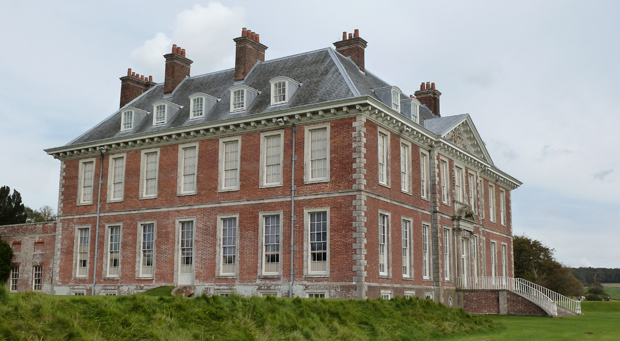
Benham Park, Berkshire (Image © Savills)

Nestled in a lush parkland, Benham Park is significant as a formative experience, in different ways, for both Holland and Soane; a house where the two would each contribute in different ways, each gaining experience which would serve them well in the future. The noted architectural historian Dorothy Stroud declared Holland ‘a designer of perception and originality’. Her tireless research underpins much of what is known about Holland and his work.

Detail of Henry Holland (1745-1806) Image © National Portrait Gallery

Henry Holland (b.1745 – d.1806) was one of the leading architects during the reign of George III. Today, his reputation has been overshadowed by his contemporaries who were more willing to engage in courting public notice, such as by exhibiting their work at the Royal Academy, which Holland never did. Chiding a friend in 1789, he stated ‘Pray no more public compliments to me. I began the world a very independent man and wish to hold it at arms length…I find myself already more the object of public notice than suits my disposition or plan of life’.

Henry Holland was the son of Henry Holland (1712-1785 – to avoid confusion, the father will be referred to as ‘the elder Holland’, any other mentions of Holland are the son) of Fulham. A successful master builder, he built many important houses in the middle years of the eighteenth-century and worked with architects such as Robert Adam, executing his alterations to Bowood in Wiltshire in 1761 and, in the same year, working at Ashridge House, Hertfordshire.  It was this latter commission which was to prove singularly important as it established a professional relationship between Holland senior and Lancelot ‘Capability’ Brown (b.1716 – d.1783), a landscape architect still revered today for his skill and imaginativeness. Brown’s particular ability was to be able to envision a whole landscape as it would be after the planting had reached maturity – to see its ‘capabilities’.

He was also noted architect, with even his rival Humphrey Repton praising the ‘comfort, convenience, taste, and propriety of design in the several mansions and other buildings which he planned’. The houses include Croome Court, Worcestershire (though the design may have been provided by Sanderson Miller), Corsham Court in Wiltshire (1761-64), Broadlands in Hampshire (1766-68), Fisherwick Park in Staffordshire (1766-74 – dem. 1814-16), Redgrave Hall in Suffolk (c.1770 – dem. 1946), Claremont House in Surrey (1771-74), and Cadland in Hampshire (1775-78 – later much enlarged – dem. c.1955).

Fisherwick Park, Staffordshire, painted by John Spyders (1786)

Although the initial connection was with the elder Holland, Brown would become central to both the professional and personal life of the younger Holland.  Although he never undertook a Grand Tour, his education was more practical, working with his father in the family business. Holland displayed aptitude and skill, taking on more responsibility but also his talent for design was becoming clear.  With his father’s connections, Holland was taken on as architectural assistant in 1771 by ‘Capability’ Brown who would, in time, hand over much of his design work to Holland, who would use these earlier designs as inspiration.  The closeness and respect between the two can be gauged by the marriage of Henry Holland to Brown’s daughter, Bridget, in 1773. Professionally, a measure of the level of joint enterprise between Colvin notes that Claremont and subsequent houses are jointly attributed to Holland.

Benham Park was an easy commission of Brown to secure, though it was likely that he was primarily thinking of his new partner when doing so. The probability that Brown would be commissioned was high as he was already working for the owner of the estate, William Craven, 6th Baron Craven (b. 1738 – d.1791), on another country house for him, Coombe Abbey, Warwickshire. Apparently under pressure from his wife, Elizabeth Berkeley, Lord Craven wrote to Brown saying ‘Lady Craven wishes to make some alterations here and to begin immediately’. Holland and Brown submitted their designs for a house in September 1773 using a similar pattern to Brown’s previous work with a neoclassical, two-storey main house with grand central portico.

Benham Park, Berkshire (Image © Savills)

The house was built between 1774-75, the final result a sympathetic marriage between an elegant yet imposing house and the Arcadian pleasures of a sculpted landscape.  Despite these fine attributes, Benham has been rather overlooked in the histories of both Brown and Holland with the latter clearly learning important lessons from one who designed with practicality in mind, but not to the exclusion of an element of drama. However, Holland was not without his own influence as Stroud notes that from the time he joined Brown’s office, the interior design evolved from a more robust Palladian character to the more restrained yet elegant style which was Holland’s hallmark. Claremont, Cadland, and Benham all display this style, indicating that although the shell of the house was more the work of Brown, the interiors were to Holland’s designs.

What’s remarkable about Holland was his almost precocious drive to build on a grand scale. Backed by his father’s capital and expertise, Holland leased in 1771, aged 26, eighty-nine acres of what is now Chelsea and Knightsbridge, including what is now Cadogan Place, and proceeded to speculatively design and build houses based around a miniature park or garden square. This high profile activity brought Holland his first major solo design for Brook’s club in Mayfair, London, a haunt of the Prince Regent and Whig aristocracy. This would lead to the Prince commissioning two major buildings from Holland; Carlton House and Brighton Pavilion. These two commissions plus Holland’s speculative building cemented his position within the highest social strata, creating future opportunities.
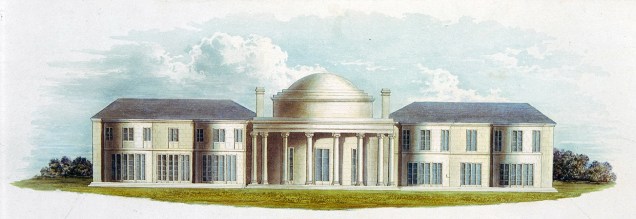
Undated print of Henry Holland's Brighton Marine Pavilion of 1786-87 (Image source Khan Academy)
Undated print of Henry Holland’s Brighton Marine Pavilion of 1786-87 (Image source Khan Academy)

Other significant commissions included the the refurbishment in 1787 of Althrop, Northamptonshire, for the 2nd Earl Spencer, including a full re-casing of the red-brick house in white mathematical tiles with stone dressings, a re-design of the gardens, and inside, a re-ordering of the accommodation including the creation of the noble triple libary, divided into sections by screens of Ionic columns. Another Whig patron was Francis, 5th Duke of Bedford, who had Holland complete some minor works to Bedford House before commissioning more extensive work, also in 1787, at his main house at Woburn Abbey. Holland was back at Broadlands in 1788 creating a new vestibule and inner hallway, the entrance marked by a new grand portico. In 1795, after a sojourn into theatres, Holland returned to grand country houses, with the rebuilding of Southill Park in Bedfordshire for Samuel Whitbread, of brewing fame. Again, as with Althorp, this was a refurbishment to the point of rebuild; the house encased, the accommodation extended and a new portico added. His last commission was again from Lord Spencer in 1801 to rebuilt his Wimbledon house, which had earlier burnt down, with a sophisticated villa in a severely plain style both inside and out. Sadly, this was demolished in 1949.
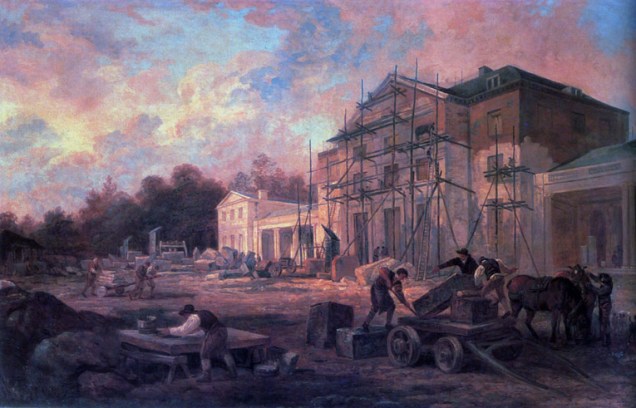
'Rebuilding of Southill' (1797) by George Garrard (Image © University of Texas)
‘Rebuilding of Southill’ (1797) by George Garrard (Image © University of Texas)

Benham Park was also important for another young, aspiring architect, Sir John Soane. As a young apprentice, Soane had joined Holland’s office in 1772 as a junior. At Benham, Soane was given the task of measuring up to create the final bills, a task he was to repeat at other locations, giving him a valuable insight into not only the process of building but also the business aspects. Although, sadly, almost all Holland’s papers and drawings were posthumously destroyed by his nephew, one of Holland’s account books is preserved in the Soane collection. Soane seems to have retained it as a valuable record and tool when setting up his independent practice. Benham therefore provided practical, aesthetic and business training to the young architect who no doubt admired Holland’s neo-classical approach before evolving his own distinctive response and style, which was to establish him as one of the leading architects of his age.

Benham Park in 1904 (detail) - note the large servants wing to the left, now demolished (Image source Stockcross History via Wikipedia)
Benham Park in 1904 (detail) – note the large servants wing to the left, now demolished (Image source Stockcross History via Wikipedia)

Benham survived largely unaltered into the twentieth-century until 1914 when the pediment was removed from the portico and replaced by a balustrade. This was echoed at the roof level where the pitch was lowered and obscured  by a pierced stone balustrade. The servants quarters were removed at the same time due to their poor condition. The house and estate remained with the Sutton baronets until 1982 when it as bought and converted into offices in 1983, with additional office blocks built next to the house. These were thankfully demolished as part of the latest restoration of the house and estate.
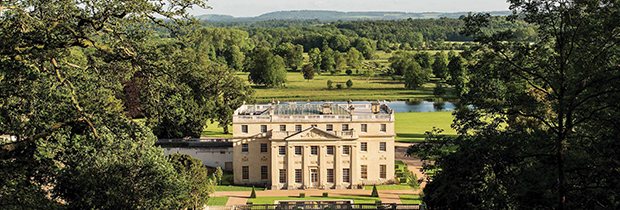
Benham Park - looking out over the lake (Image © Savills)
Benham Park – looking out over the lake (Image © Savills)

Benham Park, (Grade II*), is now offered for sale with 130 glorious acres for £26m. Inevitably for a house of such grandeur situated so close to London, there are approved plans for the house to become a ‘wellness’ centre with a huge (though thoughtfully designed) extension to the side and rear.  For me, as ever, this is a house which would be best served by being returned to it’s original purpose, that of a family home. For a new owner, they could revel in the knowledge that the house and landscape had been conceived by one of the great Georgian partnerships of Brown and Holland.  Standing under the portico today, much as where they and the young John Soane must have once stood, the latter on the cusp of his era-defining career, looking out at Brown’s landscape, they can appreciate this rare combination of architectural genius – truly a prize worth such a princely sum.


Estate agent particulars: ‘Benham Park, Berkshire‘ [Savills]

Brochure (PDF): ‘Benham Park, Berkshire‘ [Savills]

Listing description: ‘Benham Park‘ [Historic England]


Please note: Savills very kindly provided the images and brochure but had no input into the text.

A Sleeping Beauty: Ombersley Court, Worcestershire

The temptation when Country Life magazine arrives each week is to flick through the properties and make tabloid-esque comparisons about how a detached Regency villa in Dorset with space for a family, chickens, and an excitable spaniel, could be had for the price of a tatty flat in London. Yet sometimes these comparisons seem almost too unreal when faced with the exemplary beauty of a country house like Ombersley Court, Worcestershire, which, along with 39 beautifully wooded acres, has just been put up for sale for just £3.5m; the price of a 3-bed terrace house in Chelsea.

Ombersley Court, Worcestershire (© Savills)

Tucked away in a quiet corner of Worcestershire lies a house which, either through deliberate privacy or convenient obscurity, is little known to the world. Yet Grade-I listed Ombersley Court is one of the finest houses in Worcestershire, arguably even in the wider region, due not only to the sublime architecture and surrounding estate, but also the fine collection of paintings and artwork. The estate has long been the seat of the Sandys family who acquired the manor in the late sixteenth-century. The current house was originally built for the 1st Lord Sandys (b.1695 – d.1770) between 1723-26, replacing earlier monastic buildings on the site.  The house was designed by Francis Smith of Warwick (b.1672 – d.1738), one of the leading regional architects and, working with his brother William (b.1661- d.1724), ‘one of the most successful master builders in English architectural history’ (Colvin).

‘Smith of Warwick’, as Francis was more commonly known, was a clients ideal contractor due to his famous honesty and reliability, able to deliver buildings on time and on budget. His reputation spread amongst the Midlands gentry and aristocracy with almost all his work within a fifty-mile radius of Warwick.  Such was his standing that even the fractious Duchess of Marlborough (who had famously fallen out with Vanbrugh over Blenheim), demanded that for her house in Wimbledon, Surrey, ‘that Mr Smith of Warwickshire the Builder may be employed to make Contracts and to Measure the Work and to doe everything in his Way that is necessary to Compleat the Work as far as the Distance he is at will give him Leave to do’ (1732-33).

Smith’s solid reliability also manifested itself in his repetition of his well-developed plans and designs for houses, creating a distinctive style which is quite recognisable as his own. Broadly, this would be a three storey house with the centre section either projected or recessed, consistent fenestration, and relatively sparse external decoration, usually only decorative stone dressings such as keystones, quoins or balustraded parapets. This consistency was perhaps a double-edged sword, with the Hon. Daines Barrington stated in a letter in 1784, that although ‘all of them (are) convenient and handsome […] there is a great sameness in the plans, which proves he had little invention’.

Yet, this is to overlook that Smith was, at heart, a successful commercial builder whose understanding and appreciation for architectural ornament and variety was inevitably tempered by his determination to deliver the commission on time and on budget. As the architectural historian Sir Howard Colvin highlights, the core design is that of a standard seventeenth-century house such as Belton House, Lincolnshire, but with stylistic updates as fashions evolved.  ‘Smith’ houses such as Umberslade, Alfreton, and Wingerworth all share this readily accessible style, one which married domestic practicality with exterior grandeur.

Perhaps Smith’s greatest achievement was the tragically now-ruinous Sutton Scarsdale, Derbyshire; a house with a facade so stately as to rival Chatsworth. Built for the 4th Earl of Scarsdale in 1724, Sutton Scarsdale was one of the finest houses in the country. Although the form is familiar, the masterful control of a palisade of pilasters and columns topped with Corinthian capitals, gives it a gravitas, whilst the detailing such as the scrolled window surrounds to the projecting wings hint at Renaissance motifs; Fausto Rughesi (Santa Maria in Vallicella, 1605/06) filtered through William Talman (design for Thoresby House, 1685, – shown in Vitruvius Britannicus, C1, Pl.91) and James Gibbs (to whose designs Smith was building Ditchley Park, Oxfordshire, 1722).

derbyshire-Sutton_Scarsdale_Hall_circa_1900

One regret with Ombersley Court is that although the form and plan of the house and much of the superb unaltered early-Georgian internal decoration is still Smith, the exterior is now not his. The original design featured a hipped roof, and what looks to be pilasters, giving it the recognisable ‘Smith’ characteristics.  This was lost when the existing brick was refaced with ashlar in 1809 by the architect John Webb for Mary Sandys, the Marchioness of Downshire. In fairness though, this was a lucky escape as John Nash prepared a much more ambitious scheme in 1808, which proposed adding a two-storey pavilion to each side, linked by a seven-bay screen of giant Ionic columns, though this seems to have been rejected on cost.

Ombersley Court - proposed alteration by John Nash, 1808
Ombersley Court – proposed alteration by John Nash, 1808

One of the glories of the house are the interiors and especially the plasterwork and carving. With a desire for privacy which was rarely breached, few had seen the exceptional decorative work, except through the lens of a Country Life profile by Arthur Oswald in 1953. This extolled the virtues of many aspects including The Chippendale Room which featured bamboo framed silk wall pieces, remarking that ‘it is uncommon to find a Regency example as complete as this or as charming’. The rest of the house struck a careful tone of stately refinement; enough decoration to proclaim wealth and taste, but never excessive.

Ombersley Court - Hallway (© Savills)
Ombersley Court – Hallway (© Savills)
Ombersley Court - Drawing Room (© Savills)
Ombersley Court – Drawing Room (© Savills)
Ombersley Court - Morning Room (© Savills)
Ombersley Court – Morning Room (© Savills)

With the death of Lord Sandys in 2013 the house passed to Lady Sandys but following her recent death, concerns were raised and rebutted via letters in Country Life that this wonderful house would be forced (for complicated reasons) to become a care home; a fate which would have despoiled this jewel of a house. Instead, for the first time since it was built in 1724, it has been placed on the market. This is a house created by one of the finest craftsmen of the early-Georgian period, with connections to a wider, distinct Midlands architectural tradition which epitomises all that one would hope to see in a country seat. As an important house which deserves respect, one hopes that the new owner will appreciate this remarkable situation and that perhaps the best approach would simply be to buy the house and contents and perhaps another couple hundred acres to truly secure an Arcadian ideal, one which would be hard to better anywhere in the country.


Sales particulars: Omblersley Court, Worcestershire [Savills] – £3.5m with 39 acres

Listing description: Ombersley Court, Worcestershire [British Listed Buildings]

Guided missel: the rise of the country house guide book

‘Dear Picture Editor for the 2017 National Trust Handbook

National Trust Guide Book 2017

Yours is a challenging job. Faced with selecting one cover image to represent the National Trust for an entire year and with the myriad opportunities presented by having over two hundred country houses (unfortunately now minus Clandon), hundred of thousands of acres of countryside, and 775 miles of coastline, such a welter of natural and man-made beauty makes your task both enviable and daunting.

It’s therefore somewhat odd that the 2017 image is a close-up of a couple and their slightly disdainful-looking dog getting caught in a wave on a beach. The lady in the couple looks distinctly unhappy, the chap is possibly saying a swear word. Perhaps the oddest thing about it is that the bloke is wearing a bowler hat. For a walk on a beach. Of course, you would know that the bowler was created in August 1849 by the famous London hat-maker, James Lock, for the Coke family at Holkham Hall to help protect their gamekeepers from branches; both those attached to trees and those wielded by poachers. Holkham Hall, awkwardly, is not one of the many country houses (minus Clandon) under NT care so this image is, on many levels, a bit silly.

For next year, may I personally suggest a country house. Though I fear that they, as a class, appear to somewhat out of favour in the upper echelons of the NT, hopefully by appearing on the cover of the handbook, it may remind them that they are custodians of one of the finest groups of country houses one could dream to care for in perpetuity (minus Clandon).’

Guide books have long been a source of fascination for those who visit country houses. Topographical guides have been written for hundred of years to help those of us fascinated by country houses to determine which we might be able to gain entry to and revel in, whether in splendour or shabbiness.

Country house tourism is not a modern phenomenon.  Whether pilgrim or royalty, the idea of visiting houses was an ingrained part of the tapestry of life in the Middle Ages for providing hospitality.  One key difference can be seen in the preferences of Henry VIII who largely visited his own houses compared to Elizabeth I who frequently visited those of her favoured courtiers. Thus the concept of the country house (or palace) being built as much for display and prestige as the more mundane practicalities of large scale domestic occupation became a core characteristic of aristocratic life.

An Historical Account of Corsham House in Wiltshire, the seat of Paul Cobb Methuen [1806]
An Historical Account of Corsham House in Wiltshire, the seat of Paul Cobb Methuen by John Brittan [1806]
In the Georgian era, the burgeoning wealth of the expanded upper classes afforded increased leisure opportunities for travel and cultural pursuits. Their desire to assimilate themselves into the attitudes of the existing aristocracy fuelled a natural curiosity about their lives and tastes.  With frequent wars on the Continent often thwarting the traditional Grand Tour destinations, travellers now looked more domestically to visit their extended families and their friends. Even without the wars, it’s likely that the opportunities for women to travel were more restricted and to visit other ‘good’ families in their homes would have been an acceptable way for them to broaden their knowledge and tastes, thus cross-pollinating ideas, styles and fashions.

However, a family’s immediate social circle might contain only a limited number of contemporaries with whom they would be comfortable lodging.  Therefore, when visiting an area, either as a family guest or staying in accommodation, for example during the Season in Bath, day trip visits to other country houses was a favoured activity.  Despite the expectation that an owner would, as part of their duty to better society, open their house, the key question was how to find them and to determine whether they would even be amenable to visitors, no matter how genteel. Much as today, in fact, and hence the birth of the country house guidebook.

Opening Times in 'An Historical Account of Corsham House in Wiltshire, the seat of Paul Cobb Methuen' by John Brittan [1806]
Opening Times in ‘An Historical Account of Corsham House in Wiltshire, the seat of Paul Cobb Methuen’ by John Brittan [1806]
By the latter part of the eighteenth-century, an infrequent stream of visitors had become something of a torrent, if not a flood. Houses near large conurbations were particularly susceptible as Horace Walpole found at his charming neo-Gothic villa at Strawberry Hill, near Twickenham, described as ‘the prettiest bauble you ever saw’.  Writing to his friend Sir Horace Mann in July 1783, Walpole complained that ‘I am tormented all day and every day by people that come to see my house, and have no enjoyment of it in summer.’  Areas with a higher density of fine houses, which were within a day or two ride of a city or existing tourist destinations, such in as Norfolk, Derbyshire or Wiltshire, were soon part of an unofficial British Grand Tour. This was a natural progression for a society structured around the idea of circuits; domestically through suites of rooms and socially through visiting friend’s houses and at functions and balls.

Shirburn Castle, Oxfordshire (J. Skelton, 1825)

As the idea of country house visiting grew, so did the need to manage the number of visitors and their conduct whilst in the houses. Some simply refused access – a galling experience for those who might have travelled long distances such John Byng, who despite being just a civil servant, toured widely.  On being refused access to Shirburn Castle, Oxfordshire, he splenetically cried ‘Let people proclaim that their great houses are not to be view’d, and then travellers will not ride out of their way with false hopes.’ Owners increasingly favoured knowing when visitors may appear and so started having set days of admission. By 1760, Chatsworth was specifically open on two days per week. In 1774, Walpole, though ‘very ready to oblige any curious persons with the sight of his house and collection’ started personally issuing tickets and rules for good conduct.

The internal tours of country houses were usually conducted by the housekeeper who would provide rich accounts of the history of the building and family and details about the works of art – and sometimes the information was even true.  Unfortunately many myths about a family’s history and unwarranted artistic attributions for paintings are likely to have been started by the imagination of the unwitting guide. As the hobby of visiting grew in popularity so too did demand for more accurate accounts; giving birth to the new concept of the guidebook. The earliest from the 1730s-40s were more for reference at home rather than from a carriage and usually focused on individual houses, giving a history,  a catalogue of art works and sometimes a plan for the route to take through the house. These quickly spawned more democratic versions from competing booksellers, sometimes for the same property such as Benton Seeley’s ‘A Description of the House and Gardens…at Stow‘ (first published 1744, totalling twenty-two subsequent editions)

'Plan of the Library Story' from 'The Peak Guide; containing the topographical, statistical, and general history of Buxton, Chatsworth, Edensor, Castlteon [sic], Bakewell, Haddon, Matlock, and Cromford' by Stephen Glover of Derby [1830]
‘Plan of the Library Story’ from ‘The Peak Guide; containing the topographical, statistical, and general history of Buxton, Chatsworth, Edensor, Castlteon [sic], Bakewell, Haddon, Matlock, and Cromford’ by Stephen Glover of Derby [1830]
The guidebooks were both guide and tutor, ushering the visitor through an agreed route around a house but also providing sometimes detailed entries on each individual art work with the expectation that the visitor would view and gain a deeper understanding. This can be seen in ‘The Peak Guide‘ by Stephen Glover [1830] where the entry for the most significant house in the county, Chatsworth, runs to a generous thirty-seven pages. Starting with a description of the immediate vicinity, the bulk of the text runs to great detail on the Cavendish family, the architectural history (including the architects, painters, plasterers, even the plumber’), and the expected walking tour of the house.  A typical entry reads

The second Drawing-room is 36ft by 30ft hung with Gobelins’ tapestry, representing the Death of Ananias and Sapphira, Peter and John healing the cripple, and Paul and Barnabas at Lystra. In an oval compartment in the ceiling is painted the discovery of Mars and Venus. In this room are the following portraits, viz. William, first Earl of Devonshire, in his state robes, ascribed to Mytems; and declared by Mr. Walpole to be one of the finest single figures he had ever seen. Two fine whole-length portraits, said to be the Earls of Pembroke, with pointed beards, whiskers, vandyke sleeves and slashed hose; James, Duke of Ormond, and an Earl of Devonshire, in the costume of the seventeenth century

The level of detail created almost the sensation of a virtual tour, allowing those who could afford a copy of the book, or at least get access to one, the chance to imagine inhabiting the palaces and houses which may be socially or physically out of reach.

Guidebooks have evolved continuously as the requirements of owners and visitors have demanded. Early National Trust books were written by noted historians such as John Cornforth and maintained the seventeenth-century principle of guidance and education. However more recent editions have dispensed with much of the in-depth information in lieu of more pictures of daffodils or scones (and let’s not even get started on the paucity of information about the houses on the National Trust website *sigh*). Happily, other private owners have created lavish books very much in the form of those earlier versions – Woburn Abbey, Bedfordshire, and Boughton, Northamptonshire, are notable examples.

Whatever their role, the guidebooks are an essential component to the experience of the country house. Without them, the rooms would simply be an anonymous store of gilded treasures, without context or understanding. The books remain the key which unlocks the secrets of the houses; the owners and their motivations, their collections and tastes.

Handbook reviews

Hudson's Historic Houses & Gardens, Museums & Heritage Sites 2017
Hudson’s Historic Houses & Gardens, Museums & Heritage Sites 2017

Hudson’s Historic Houses & Gardens, Museums and Heritage Sites 2017

Content (design/layout): Having now been published for 30 years, the Hudson’s guide is a unique oracle for identifying ‘historic houses & gardens, museums and heritage sites’ for your visiting pleasure. In slightly-larger-than-A4 format, this is a book to be enjoyed as much at home, with full-page entries for leading houses, enhanced by full-colour photos. Bonus features include interviews and number of interestingly varied articles (including location filming / James Paine / The Clive Collection / Indian influences on the Royal Pavilion) and thematic guides such as dog friendly sites, events venues, and which properties have guided tours. If there is any criticism it’s that some of the smaller entries for houses read as though it were copied from their usual leaflet and sounds a little off-key.  However, given the comparatively almost lavish space, most sites have an informative, rather than purely functional, write-up with history and details on the art and architectural features.

Comprehensiveness: Unrivalled – the guide is invaluable when in an unfamiliar area and need to plan days out. It includes private properties, National Trust, HHA, plus other heritage sites.

Convenience: The larger-than-A4 format and number of pages means this is not one for the pocket and would be a bit hefty to carry all day. That said, the design means that planning your itinerary is both practical and a pleasure.

Verdict: Even if you get other member handbooks for free, for those wanting more detail or looking to visit a broader range of heritage sites, the Hudson’s guide is unequalled and definitely worth the modest investment. (Available on Amazon or all good bookshops)

*Transparency notice: Hudson’s did send me free copy to review but had no editorial input to any part of this blog post and I’d buy a copy anyway.

National Trust Members Handbook 2017

Content (design/layout):  As the product of many years of refinement, the guide is an excellent way to plan your visits. Set out with listings by county, each property or location has a brief write-up though some properties eclectically get more space and further details. All the useful information is in there including opening times and facilities. Bonus content includes a clever themed index highlighting which properties tick boxes for ‘Adventure playground, boat hire, bicycle hire, camping and caravanning, gardens, ghosts, and industrial heritage’. Note that neither ‘art’ nor ‘architecture’ make the cut as categories. Ghosts though, do.

Comprehensiveness: Unsurprisingly, it only covers National Trust properties.

Convenience: About the dimensions of a paperback novel so easy to leave in the glove box of the car or add to a rucksack.

Verdict: A benchmark for member organisation guides – one that marries convenience to practical information to help plan visits. Just wish it felt able to give equal billing to the houses and their contents as much to the playgrounds and cafes.

Historic Houses Association Friend’s Handbook / English Heritage

Unfortunately I’m not a member (there are limits to funds and time, you see) so I haven’t seen a copy of the latest version – but if said organisations would like to send me this year’s edition, I’ll add details to this page.

Other suggestions

If anyone can suggest other guides (either members or general) then please do comment below.

Find out more

Reflections on the loss of Clandon Park, Surrey

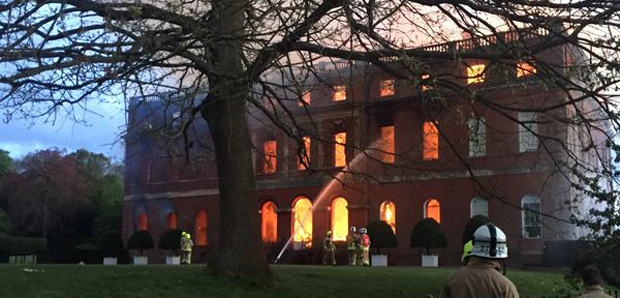
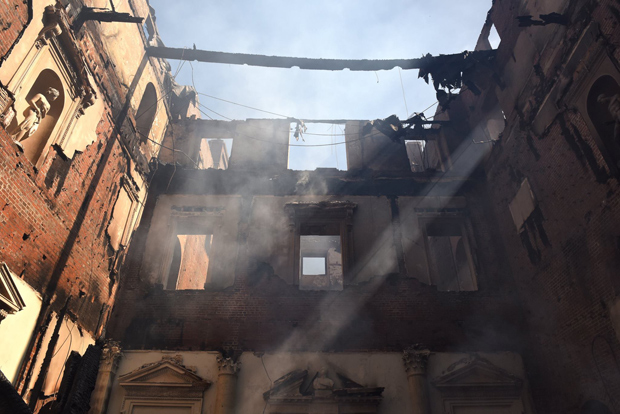
Loss is mainly regret that we will never see something, or that we have known it and will never see it again.  Where the loss is of something of beauty, which embodied ideas, history, culture, it takes on many facets. Fire is a destructive, cruel enemy, consuming all in its path; caring not for the value – either great or small – simply taking whatever it can as fuel for its avaricious need to grow. On 29 April 2015, as the fire at Clandon Park took hold we hoped for the best – yet sadly, less than twelve hours later, all that remained was a gaunt, blackened shell. The loss was not just the building and its beautiful interiors and contents, but also what it represented to UK architectural history.

Clandon Park, Surrey (Image: Matthew Beckett)

News breaks now on social media, the first photos and reports of huge plumes of smoke spreading much as the flames did; slowly at first, rapidly growing. Quickly it became clear that the fire had reached the roof and that the rooms on the ground floor of the south side had already gone – the Green Drawing, Palladio, Hunting, Prince Regent.  Each a small gem in themselves, their contents the result of decades of collecting and curation. As the floors above collapsed, it became clear that this was a very serious situation and thoughts immediately are to hope that, first, everyone is safe, but, secondly, how far would the fire go? Sadly, it soon became clear that the entire house was to be consumed in the inferno.

Clandon Park on fire, 29 April 2015 (Image: © Andrew Blondell / BBC Surrey)

Why was Clandon Park important? It wasn’t just the history and collections.  Most importantly, the design of the house was a key transitional link between two defining periods of British architectural history; the Anglo-Baroque and the Palladian. The house, both interior and exterior, was designed by a Venetian architect, Giacomo Leoni, and built between 1723-29.  Both the architect and the dates are key to understanding why the house was so significant.

Clandon Park on fire - two-thirds of the house was now on fire (Image: © Oliver Dixon)
Clandon Park on fire – two-thirds of the house was now on fire (Image: © Oliver Dixon)

Giacomo Leoni (b.1686 – d.1746) played a key role in bringing the ideas of Palladio to the UK through the publication of that architects’ ‘I Quattro Libri dell’Architettura (which he called ‘The Architecture of A. Palladio, in Four Books’). Although not an entirely accurate recreation (Leoni wasn’t above adding his own improvements) the instalments (published between 1715-20) were a huge success, casting the ideas of the Palladian ideal deep into the aspirational hearts of the British aristocracy.  Leoni’s edition remained the primary source of the nascent Georgian Palladianism until (prompted by Lord Burlington) Issac Ware produced a more accurate translation in 1738.

Clandon Park on fire - the flames reached the north side (Image: © Alex Greenwood)
Clandon Park on fire – the flames reached the north side (Image: © Alex Greenwood)

For all his intellectual influence, Leoni’s physical output was relatively meagre for a 45-year career – his earliest designs were for an unexecuted rebuilding of Wrest Park in August 1715 for the 1st Duke of Kent. His first completed work was in London in 1721, Queensberry House, 7 Burlington Gardens, for John Bligh, Lord Clifton, which featured an antique temple front, a reduced version of which appears on the south front of Clandon Park. Leoni’s output was mainly country houses; he designed eleven but only nine were completed (the two unfinished houses being Carshalton Park and Thorndon Hall) of which four have been lost already (Moulsham Hall – dem. 1809, Bold Hall – dem. 1901, Burton (or Bodecton) Park – fire 1826, and Lathom House – dem. 1929/1955).

Comparison of Leoni's 7 Burlington Gardens and south front of Clandon Park (Image: 7BG: Wikipedia / Clandon: Matthew Beckett)
Comparison of Leoni’s 7 Burlington Gardens and south front of Clandon Park (Image: 7BG: Wikipedia / Clandon: Matthew Beckett)

This left just four completed house which survived into the 21st-century; Lyme Park (c.1725-35), Alkrington Hall (1735-36), Wortley Hall (1743)- and Clandon Park (1723-29).

The brilliance of Leoni’s design for Clandon had survived almost unchanged as it had remained in the Onslow family until being handed to the National Trust in 1956. Where Clandon excelled was that the exterior was early-Anglo-Palladian; chaste, restrained decoration, subtle temple motif, but this was married with one of the greatest of the Anglo-Baroque rooms, the Marble Hall (the plasterwork of which Sir Simon Jenkins thought better than the similar room at Houghton Hall), and other rooms rich in beauty. This contrast between the quiet exterior and the exuberant interior is what made Clandon so important as the link between two of the most significant trends in British architectural history.

Marble Hall, Clandon Park (Image: Matthew Beckett)

So, what next? The incredible staff and volunteers of the National Trust swiftly put into place the plans they never hoped to have to use and clearly, the efforts are being directed to the care of the salvaged contents and an examination of what can be recovered from the debris.   Investigations will be undertaken and conclusions reached as to the cause but looking to the future the options are the same as ever; rebuild, re-use, or ruin.

Marble Hall, after the fire (Image: © John Millar / NT Picture Library)

As a nation, we have fetishised ruins for centuries with castles, abbeys, fortifications and now factories celebrated for their managed decay. We have enough derelict country houses (far too many, truth be told), so to consign another to that sad, lonely fate would miss the chance to grasp a recoverable beauty and miss the opportunity to demonstrate and inspire through an educational process around the reconstruction.

The Landmark Trust’s inspired recent work at Astley Castle, Warwickshire, to create a modern living space in a shell created by a fire in 1978, shows that ruins can be re-used intelligently and with great aesthetic success.  However, Astley Castle was a smaller house and also without the spectacular interiors which once graced Clandon Park.

Uppark, Sussex (Image: © Matthew Beckett)

So the remaining option is rebuilding and restoration.  As has been shown at Uppark, Sussex, which also suffered a serious (though not quite as devastating) fire in August 1989, it is possible to restore the house back to as it was before.  This is not pastiche as it’s not conjectural – we have extensive, detailed records of the interiors and, combined with salvaged fabric, it is possible to recreate what was there.  As Sir Simon Jenkins argued in the Sunday Times (03/05/2015), it would be unthinkable not the reinstate the great Marble Hall – because we can.

Modern care and conservation means that the rate of losses of country houses has dropped from the hundreds each year in the 1950s to barely a handful and these are almost always due to fire. All those we have – that which survived this far – are fragile and it’s an uncomfortable truth to understand that they will not last forever.  As the painter Salvator Rosa once wrote:

All our works is fallen and sicken
Nothing is eternal
The Colossei die, the Baths
The worlds are dust, their pomp a nothing…

Rather than despair, we should celebrate and enjoy the architectural heritage which is still available to us and care for it for future generations. The original Clandon Park is lost; that patina of age, the individual details which only it knew are no more. Although the contents have been largely lost, resurrection is the most appropriate option as the main shell of the house has survived – the sterling work of the fire service has saved at least one half of Leoni’s vision. Modern craftsmen with ancient crafts, honed at Uppark, Hampton Court, and Windsor Castle, can recreate the beauty of the interior.  It won’t be the original but from our shock at the loss can come awe at the artistic skills that can recreate such wonders as the Marble Hall.

———————————————————————————

Gallery of images of the aftermath: ‘Clandon Park fire 2015‘ [National Trust Picture Library]

Statement: ‘Fire breaks out at Clandon Park, Surrey‘ [National Trust]

40 years on from the ‘Destruction of the Country House’ exhibition

Many was the time I stood in that exhibition watching the tears stream down the visitors’ faces as they battled to come to terms with all that had gone.’ – Sir Roy Strong [Diaries, 1974]

'Destruction of the Country House' exhibition, 1975 - V&A
‘Destruction of the Country House’ exhibition, 1975 – V&A

In October 1974, one of the most influential exhibitions ever staged by a UK museum opened at the Victoria & Albert Museum.  The ‘Destruction of the Country House‘ laid bare the scale and depth of the losses the UK had suffered, showing how four centuries of architectural tradition and achievement in country houses had been severely damaged by the depredations of the 20th-Century. It was conceived as a dramatic display to waken the nation to the threat faced by country houses and the danger faced by all aspects of heritage.  This was in an age with weak legal protection and which seemed to be growing ever more apathetic, or even hostile, to the idea of preserving what represented the cultural character of the UK.  The exhibition was a huge success, not only in terms of the impact on the public, but also in being the catalyst for a long-term shift in how we seek to save and manage our heritage.  From 13-21 September, a new exhibition at the V&A, ‘Country House – Past, Present & Future‘, seeks to revisit this ground-breaking event and look at the future of the country house.

Thorington Hall, Suffolk - demolished 1949 (Image: Lost Heritage / Tiger Aspect Productions)
Thorington Hall, Suffolk – demolished 1949 (Image: Lost Heritage / Tiger Aspect Productions)

By the 1970s, relatively few people would have been aware of the parlous state of a significant number of country houses and how many had been lost in the demolition binges of the 1930s and the 1950s.  However, that there was a crisis was recognised not only by the owners of the houses, but also by the government which in 1948 had created a committee to look at ‘Houses of Outstanding Historic or Architectural Interest’ and tasked it:

To consider and report what arrangements might be made by the Government for the preservation, maintenance and use of houses of outstanding historic or architectural interest which might otherwise not be preserved, including, where desirable, the preservation of a house and its contents as a unity.

The committee’s conclusions, which became known as the Gowers Report, were published in 1950 and the tone could be determined from the first paragraph which stated that ‘What our terms of reference require us to consider is not whether houses…should be preserved, but how this is to be done‘. The report made a number of recommendations including the creation of the Grade listing system we are so familiar with today, combined with tax concessions to which owners would be entitled, and also financial assistance for which they may be eligible. The aim to create a legal framework where restrictions on the rights of the private owner were compensated by financial incentives to ensure the preservation of these houses.

Trentham Hall, Staffordshire - in its heyday and during demolition in 1912 after being polluted by nearby industry  (Images: Lost Heritage)
Trentham Hall, Staffordshire – in its heyday and during demolition in 1912 after being polluted by nearby industry  (Images: Lost Heritage)

Yet, by the early 1970s it was clear that the crisis had not been solved, as demonstrated by the title of a report published in 1972: ‘Country Houses of Britain – can they survive?‘. Written by noted architectural historian John Cornforth, he sought to explore why the issues surrounding the sustainability of the country house had not yet been resolved, but also to cast the debate in a new era of soaring inflation, economic malaise, and with threatened punitive taxes on the asset rich (though cash poor).

In was at this time that Sir Roy Strong had conversations with Christopher Gibbs but the core of the idea came from John Harris, now noted architectural historian, but also a keen fisherman who, in his youth in the 1950s, had surveyed many an abandoned parkland and empty country house whilst fishing the ornamental lakes (adventures later recounted in his book No Voice from the Hall: Early Memories of a Country House Snooper). Combined with Marcus Binney, then at Country Life, they conceived and created this most remarkable exhibition, quite unlike any before or since.

Hall of Lost Houses, from the 1974 Destruction of the Country House exhibition at the V&A
Hall of Lost Houses, from the 1974 ‘Destruction of the Country House’ exhibition at the V&A

Designed by Robin Wade, the layout took visitors through a short display showing the glories of the country house, but then, as they turned a physical and symbolic corner, were faced with an almost full-height portico tumbling to the ground.  On the pillars and walls were photos of some of the hundreds already lost, whilst in the background, John Harris sombrely intoned a roll-call of their names.

Original poster advertising the Destruction of the Country House exhibition - 1974 (Image: Victoria & Albert Museum)
Original poster advertising the Destruction of the Country House exhibition – 1974 (Image: Victoria & Albert Museum)

The exhibition captured the public imagination, with queues forming to see it at the weekends and the catalogue becoming a best-seller.  Yet, it wasn’t just the public who were captivated by it; in the last week, the Queen, Princess Margaret, Lord Mountbatten, and various government ministers all visited too.  1975 was designated the European Architectural Heritage Year and so focused minds on how to help ensure the survival of the nation’s heritage. This resulted in further legislation which strengthened the legal protection afforded to buildings.   The exhibition also led Marcus Binney to form SAVE Britain’s Heritage, a campaigning charity which took a far more pro-active approach than had traditionally been the case, achieving many notable successes, as it continues to do so today.

Politically, the exhibition could not have opened at a more awkward time – just two days before a general election which brought in a Labour government whose proposed ‘wealth tax’ would have made private ownership of most of these houses unsustainable, probably leading to further wholesale demolition.  Yet, the exhibition also has been identified as ‘…a pivotal moment in the history of country house preservation and heritage politics more generally.’ (Ruth Adams). In truth, a shift had started, as shown by the strong reaction to the proposals by John Baring to demolish The Grange in Hampshire in 1972 which prompted angry exchanges of letters via The Times. However, after the exhibition, no longer were country houses an elite interest for just the owners or art historians, but now the public started to identify with them as part of their national heritage, as something which embodied characteristics and history which they wished to be saved. That broad public sense of attachment to heritage has grown and become almost a natural part of the national psyche (apart from, it seems, in the minds of developers and their occasionally pocket planning committees).

For me personally, the lost country houses were the subject which were the catalyst for my own passion for country houses, leading to the creation of the Lost Heritage website in 2005. The aim is to create the most comprehensive list of all notable lost English country houses – and as far as I’m aware, is the only current ongoing research into the topic. Having seen the ruin of Guy’s Cliffe House about ten years ago, I then started trying to find out more, with two of the most important sources being the superb Catalogue of the exhibition and Giles Worsley‘s later book, the beautiful and elegiac ‘England’s Lost Houses‘.  These contained a gazetteer of known losses – the version in the Catalogue compiled by John Harris and Peter Reid, with Giles’ list building on theirs to take the total to 1,169.  John had estimated that as many as 2,000 had been lost since 1800 and after nearly a decade, sadly my Lost Heritage research has a total of 1,925 (as at Sept 2014), largely proving him correct.

The ‘Destruction of the Country House’ was as much a platform as an exhibition. Although aimed at the public, it was also a touchstone for a wide variety of heritage interests to coalesce and focus their energies and arguments. This helped to create a society which increasingly understood and appreciated heritage but also one which felt there was some collective responsibility towards its defence.  One can only hope that, as a nation, we can continue to recognise the importance of the country house, as well as heritage more broadly, to ensure that those in the future can continue to appreciate their beauty and the rich cultural history they represent.


Events – 2014


Further reading

An academic assessment of the impact of the exhibition: ‘The V&A, The Destruction of the Country House and the Creation of ‘English Heritage‘ – Ruth Adams [Museums & Society]