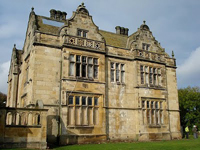
Townhead House, Lancashire (Image: SAVE Britain's Heritage)
Townhead House is a rare thing indeed – a house which has not been altered since before the last people to use it left in 1939 but also is not in a dire state of dereliction. Its unoccupied status was a cause for concern and although parts of the house required attention, overall the house was in remarkable condition.
Built in 1729 for Henry Wiglesworth using parts of a 17th-century building, the architect is unknown but achieved an elegant if somewhat austere house using large blocks of coursed limestone. Inside, the main rooms with their fine Georgian panelling and particularly the staircase indicated the architect was influenced by other such as Wren, Jones and Gibbs. This can be seen with the use of certain architectural elements before they became widely known through pattern books such as Batty Langleys.
The grade-II listed house was used just a shooting lodge between the 1890s and 1930s. Now finally, a local man, semi-retired businessman Robert Staples, has bought the house and has promised to sensitively restore it to use as his home:
“The works will ensure that the integrity and longevity of Townhead is not compromised and that the building has a continued and long future.”
All this bodes well for this important part of the local architectural heritage. Also encouraging is Mr Staples’ professed desire to return the house to being the centre of a ‘gentleman’s estate’ – a welcome reversal of the pattern of the last 50 years when small estates were increasingly broken up and lost.
Sockburn Hall, County Durham (Image: Sockburn Hall Project)
A project to restore the long-neglected Sockburn Hall has received a boost with a grant for £37,000 from English Heritage. This is in addition to the £38,000 it was also awarded last year as part of a long-term project to make the house watertight, eliminate the dry rot and then restore the interiors.
The grade-II* listed Sockburn Hall was originally built in 1834 in a neo-Jacobean style for the Blackett family on the site of a lost Jacobean house built for the Conyers family which had vanished by 1823. The house became notorious in 2000 when the sisters who lived there were prosecuted for keeping animals in squalid conditions in the various rooms of the house. Listed on the English Heritage ‘Buildings at Risk’ Register it had long been a cause for concern as water penetration and vegetation growth threatened the structure of the house.
The family have taken on the house as a restoration project to avoid selling it and risking it being developed and have created a small group of volunteers who are valiantly clearing the grounds and restoring features whilst specialist firms are working on the house. The grant in 2009 enabled emergency repair work to be undertaken on the roofs and guttering to remove the temporary tin sheeting and to ensure good drainage to help stop water ingress into the building. This project will take years but hopefully, one day, the family will be able to move back into this house and make it a home again.
You can follow the progress of the work either on their website or via the Sockburn Hall Facebook group where you can also volunteer to help out.
The fascinating first series of ‘Country House Rescue’ showed all to clearly that ownership of a country house is no passport to an easy life of luxury. In fact, it demonstrated that being the ‘lord of the manor’ brings with it many responsibilities which can take a significant toll both physically but most importantly financially.
On Thursday 4 March at 20:00 on Channel 4 the next series of ‘Country House Rescue‘ starts in Wales with the owner of Plas Teg; a grade-I listed Jacobean house which has remained remarkably unchanged since it was built in 1610. However, for the owner who gave up her glamorous life in Notting Hill when she moved to this 20,000sq ft house, it has proved to be a constant struggle to maintain this important house. Hopefully Ruth can provide some of her usual robust advice to help get Plas Teg on the path to a more secure future.
Following earlier concerns, sources have confirmed that the grade-I listed former ‘showplace of Wales’, Gwrych Castle, is once again for sale.
After many years as a deteriorating ruin, it’s outlook improved when the castle was finally sold for £860,000 in 2007 to City Services Ltd (trading as Clayton Homes – a separate company to Clayton Hotels which is still trading). They soon announced ambitious plans to convert it into a luxury 5-star hotel using the original layout as the starting point. Initial work on site has included the removal of over 1,900 tons of asbestos and debris from within the shell and the vegetation stripped from the exterior. The site was ready for restoration to start and Donald Insall architects were working on the designs for restoration.
Unfortunately 2007 was the height of the property market and the subsequent fall hit many companies including Clayton Homes which went into administration on 12 August 2009. Deloitte (Leeds) were appointed as administrators and have been quietly marketing the assets including Gwrych Castle. This was highlighted by the story of the businessman who was viewing the castle as a possible site for his ‘psychic school’ when he conveniently saw a ghost at a window. Kevin Horkin has apparently submitted a bid for around £850,000 – which may secure him the site but to complete the project to the required standard will require at least another £6m-12m depending on his ambitions. This is a significant level of investment if he is to restore this wonderful house to the appropriate standard. Hopefully Cadw, the Welsh equivalent to English Heritage, will keep a very close eye on the project and ensure that any plans are at least to the same standard as those approved for Clayton Homes.
Many people have taken a keen interest in Gwyrch Castle and had hoped that the sale would lead to this once grand house again taking a key role in the local area and also to save this important part of their architectural heritage. It would be tragedy if the work already done to create a secure and viable foundation for restoration was allowed to deteriorate again – the house must be sold to a sympathetic owner who has both the vision and funds to complete this project in a way which befits this beautiful house.
When Gwrych Castle was finally sold in June 2006 after twenty years of neglect, dereliction, fires and theft, there was much praise and relief locally that the once-beautiful “showplace of Wales” was to be rescued. Bought by Yorkshire-based Clayton Hotels for £860,000, they estimated that once planning permission had been secured, the restoration would take between 2-3 years and cost an estimated £6m – however three years later, the major part of the restoration work has yet to start.
Built between 1819-1825 for Lloyd Hesketh Bamford-Hesketh, grade-I listed Gwrych was one of the largest ‘castlellated mansions’ in Europe, part of a ‘gothick’ revival which included some of Britain’s most picturesque country houses such as Eastnor Castle, East Cowes Castle, Lea Castle, and Castel Coch and many more. Following its sale by the 13th Earl of Dundonald in 1946 it was opened to the public in various forms and under various owners until 1989. The failure of the redevelopment plans led to the castle being left unprotected against the ravages of the weather, travellers, and vandals, leaving the castle a mere shell, the fine interiors rotting in piles in the collapsed ground floor.
The plans unveiled by Clayton Hotels in 2007 showed that the castle would be fully restored and largely based on the original layout. Mark Baker of the Gwrych Castle Preservation Trust, who had campaigned since he was 11 to save the castle, welcomed the plans and for many it seemed that the end was in sight. In February 2009, Wales Online (‘Welsh ruin to be transformed with techniques fit for royal home‘) trumpeted how the design work for the restoration was starting under the care of Donald Insall, one of the best conservation architects in the UK. However, in May 2009, a story on BBC News (‘Slow economy delays hotel plans‘) explained that the slow economy had delayed plans and also the cost for the project had risen to between £12-14m.
Now a recent story (‘Clitheroe man haunted by ghostly image in castle window‘) about a ghost in a window included some interesting quotes which raise some questions about the status of the project – or perhaps just the intended future clients.
A Lancashire businessman who combines being an optician with “psychic management” claimed to have taken a picture of a girl standing at a window where there is no floor. Kevin Horkin claimed he was visiting the site as “I buy property and was looking at the castle with the view buying it.” and the story ends by saying that “Kevin has put a bid in for the castle which he hopes to turn into a luxury psychic retreat.”. Despite the obvious convenience of a psychic who wants to open a hotel taking one of the clearest ever pictures of a ghost, it does raise questions about why he is saying the hotel is for sale? The Clayton Hotels website is one page with an email link and with the dramatic rise in restoration costs and the difficulties of the property markets, is the castle being quietly marketed ‘off the record’? Perhaps the quotes are misconstrued, or perhaps Clayton will refurbish the house but lease it Mr Horkin, but either way, Clayton Hotels should perhaps clarify exactly what is happening to this iconic part of Wales’ architectural heritage especially as so many people have spent so long campaigning for its rescue.



 The Country Seat