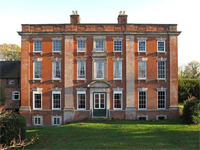
A rural power house; literally – Fairfield House, Somerset

Fairfield House, Somerset (Image: Anthony Kersting)

To describe a country seat as a ‘power house’ was usually to allude to its status economically, politically, certainly as a local employer, usually even in matters of style. Yet, these houses also indirectly, and sometimes very directly, played an important part in the provision of the electricity which has grown to power our everyday lives.  Power stations play an obvious central role and their expansion has often been controversial.  In earlier decades, a local power house was sometimes sacrificed to the demands of industry and the needs for power stations, but now, for some, particularly Fairfield House in Somerset, they have proven to be a windfall.

Country estates have a long history of being the beneficiaries of the need for power. In medieval times, the natural resources of an estate, such as a fast-flowing river or extensive woodland would be harnessed or harvested to drive local industry.  The most productive land could prove especially valuable if it could support the entire production cycle such as for bread, with corn grown on the estate, being ground in the windmill or mill on the river, before being sold in the market in a town owned by the local lord, who, at each stage would profit.  As the Industrial Revolution flourished, so the need for power grew, leading landowners to fully exploit the natural resources which lay beneath their land as well, with coal becoming a leading creator of Victorian fortunes.

Methley Hall, Yorkshire - demolished 1963 (Image: Lost Heritage)

Yet, the almost insatiable need for power, and the coal which generated it, has also consumed some of our country houses, including one of the grandest, and threatens some even today.  One of the greatest threats from mining is subsidence caused by extensive mine workings which simply followed the coal seam – wherever it may lead.  Given the choice between a loss of income or the loss of the family seat, it was rarely the house which won.  It was, of course, the northern counties which were worst affected; Methley Hall, seat of the Earls of Mexborough, was eventually ruined by the coal workings which surrounded it (an issue even when Country Life visited in 1907) and demolished in 1963.  Kippax Park, once the second longest country house in the country, stood in the way of an open-cast coal mine which eventually consumed it in the late 1950s.  In County Durham, Coxhoe Hall, was eventually bought by the local coal board who proceeded to demolished it in 1956 to avoid having to fix the structural issues they had created.
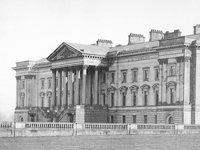
Hamilton Palace, Lanarkshire, Scotland - demolished 1919 (Image: Wikipedia) - more info from Virtual Reconstruction website

This is, inevitably, just a small selection of some of the many losses but easily the most spectacular casualty of coal mining would be Hamilton Palace in Lanarkshire. Built for the Dukes of Hamilton, the Palace was the epitome of aristocratic wealth, creating both a home and a collection which would rival the best in Europe.  Built on the incredible wealth generated by the Lanarkshire coalfields they owned, the 10th Duke, Alexander, enclosed the existing house in a grand Classical embrace. The one-room deep extension of the house, in 1819, accommodated not only the many works of art he had acquired on his Grand Tour but also many of the treasures inherited from the fabulous collection of William Beckford which came via the Duke’s wife, who was Beckford’s youngest daughter.  Yet those same coalfields eventually fatally undermined the house, and faced with such a substantial problem, and not lacking other houses to move to, the decision was taken in 1919 to demolish the Palace – the most serious loss to Scottish country house architecture in the last 200 years.

Others houses were even more directly affected by the need for power stations which, ironically, shared similar requirements with the aristocracy for their homes; a level site with good access to roads (and later rail), a ready water supply and space to expand.  In the dark days of the mid-twentieth century, for an impoverished owner, the offer to be bought out by the local power company must have been very attractive – and perhaps may have helped their guilt by feeling that it was contributing to national infrastructure; though often the house had already gone.

Drakelow Hall, Derbyshire (Image: Lost Heritage)

One house which certainly matched these criteria was Drakelow Hall, Staffordshire, seat of 28 generations of the Gresley family and which, declared Country Life in 1902, “…is one of those seats of ancient eminence which win the regard of all Englishmen.“. Situated above the River Trent, the house was perhaps best known for the Painted Dining Room by Paul Sandby which was completed in 1793.  Sadly, declining family fortunes led to its sale in 1933, followed by ill-fated ventures such as a country club and motor racing circuit before the house was demolished in 1938, though, fortunately, a section of the Dining Room was saved by the V&A.  In 1948, the huge Drakelow Power Station rose on the site, attracted by the sizable 707-acre estate and its proximity to the river, and railways, road and, most importantly, the East Midlands coalfields. Hams Hall in Warwickshire similarly vanished under the same demands. One house which was rescued was Barlaston Hall in Staffordshire, a wonderful small villa by Sir Robert Taylor, which was bought for £1 by SAVE Britain’s Heritage to prove that it was possible to restore it.  The house is now again a home as a result of their valiant efforts. However, even today, subsidence from old coal workings threatens other houses such as at Wentworth Woodhouse, where the owner, Clifford Newbold, has lodged a claim for £100m in compensation to fund the stabilisation and restoration of this magnificent house.

The requirements for nuclear power stations were different in that they were obviously less dependent on proximity to the raw fuel but they did require vast quantities of water for cooling so were often sited on the coast – which thankfully also meant fewer houses would be affected. Of those, the small manor house at Calder Hall had already gone by the time the decision was taken to built the UK’s first nuclear reactor on the site in 1947. So although the opportunities for landowners are now primarily around wind turbines, a report in the Sunday Times (13 Nov 2011) highlights the windfalls from owning the land adjacent to a nuclear power station scheduled for expansion.

Main entrance - Fairfield House, Somerset (Image: Anthony Kersting)

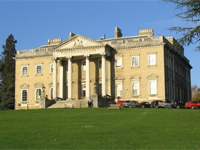
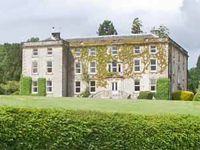
Lady Elizabeth Gass, Lord Lieutenant of Somerset, and current owner of the 6,000-acre family estate, recently accepted a £50m offer from EDF to purchase 230-acres of farmland which will become the proposed Hinckley C power station.  The Fairfield House estate (a prime candidate for the Handed On blog of lesser-known seats) has descended through the Palmer-Acland-Wood-Fuller families for 800 years and has never been sold. The current part-Elizabethan house was begun in about 1580, but with later changes in 1633 to change it from a medieval courtyard layout to the more familiar E-plan which we see today.  Excitingly, traces of the old house are still embedded in the fabric today, with a cell for those awaiting the justice of the local magistrate and, once revealed behind some 19th-century plasterwork in the attics, the original finely-carved late-medieval roof timbers of a first floor hall.

The future of this wonderful estate is now secure and stands as a testament to how changing patterns of land use which once threatened and toppled grand houses can also enrich a country estate.  That it is going to support a rare survivor of familial descent is an added bonus and I hope Lady Gass feels rightly proud of her success.

————————————————————————————-

More details: ‘£50m deal as Somerset wind turbine land goes to nuclear plant‘ [This is Somerset]

Listing description: ‘Fairfield House, Somerset‘ [British Listed Buildings]

————————————————————————————-

An apology: you may have noticed that I haven’t been able to publish as frequently as I’d like but just to reassure you that this is definitely not due to any slackening of interest on my part but simply due to my day job requiring a greater commitment at the moment.  This hopefully will be temporary and as we go into the Spring I can pick up the pace again – but in the meantime, please do take time to re-read some of the old posts you may not have seen, and hopefully discover something new amongst the archives.

Thanks for your patience.

Matthew

For sale: a Soanian springboard – Burnham Westgate Hall, Norfolk

Burnham Westgate Hall, Norfolk (Image: Savills)

For any architect starting out, the early commissions are perhaps the most important; establishing them both in terms of not only their designs but also how they operate in the execution.  In architectural terms, the early buildings of some architects are sometimes less prized, and therefore protected, than their later works which benefit from the full measure of their developed skill and experience.  In that light, Burnham Westgate Hall deserves to be cherished as not only a fine house but also the first substantial country house project of Sir John Soane.  It provided the springboard for one of our finest architects and is important for the promise shown but also for securing one of the most important prizes in the Georgian era: patronage.

For someone who ended up a knight of the realm, with fame and a noble client list, Sir John Soane (b.1753 – d.1837) had a very ordinary start in life as the son of a bricklayer from Goring-on-Thames, near Reading.  Patronage and connections were to define Soane’s personal and professional life, providing opportunities to establish himself in a way that his competitors, often connected from birth, already enjoyed.  Almost nothing is known of his early life but his obvious talent must have been spotted as he entered the office of George Dance the Younger in 1768, though only starting as errand boy, via an introduction by James Peacock, an employee of Dance who knew Soane’s older brother.

Claremont, Surrey (Image: Claremont Fan Court School)

His talent and work ethic propelled Soane to join the Royal Academy Schools in 1772, where he quickly won the silver medal for a measured drawing of the facade of Inigo Jones’ Banqueting House.  What was particularly clear during Soane’s time at the Royal Academy was his ambition and an industriousness that was to serve him well in later periods, combined with an attention to detail which proved to be a blessing in his professional life.  In 1776, he won the Academy gold medal, which made him eligible to compete for the highly coveted King’s travelling scholarship which, for someone of Soane’s limited financial means, would be his only chance to see Italy first-hand.  Soane had heard that George III thought him a suitable candidate and so he rashly gave up his position with Henry Holland (where Soane was known to have assisted on three country house commissions: Claremont in Surrey, Benham Park in Berkshire, and Cadland in Hampshire (dem. 1953)) only to find out that Sir Joshua Reynolds had intervened to demand the winner of the scholarship be by vote from the Academicians. This delayed his departure by a year but it was put to good use completing smaller tasks for Henry Holland such as estimating bills and measuring work which exposed him to clients such as Thomas Pitt, 1st Baron Camelford; a man of noted taste and an amateur architect who was to prove particularly important in Soane’s career.  Though delayed, in 1777 Soane set off on the single most important trip of his life to Italy; one which was to establish him professionally and socially.

Arch of TItus, Rome - drawing by Sir John Soane
Arch of TItus, Rome – drawing by Sir John Soane

The Grand Tour had become an institution amongst the younger aristocrats as a way of experiencing the glories of classical art and architecture in their native environments.  It was also a fine opportunity for the wealthy to indulge their passion for art collecting but, for novice architects, days were largely spent measuring and recording the wonders of Roman architecture.  On a more practical level, Soane would have seen and experienced during his time with Dance and Holland how useful family and professional networks were in securing commissions.  In Italy, Soane worked assiduously to develop his own connections; travelling with his friend Robert Furze Brettingham (nephew of the famous architect Matthew Brettingham the Elder who had designed the original Burnham Westgate Hall, then called Polstede Hall) and visiting the English Coffee House; a central meeting point for the English nobility abroad, whom Soane courted as clients.

Soane's proposed design for Downhill, Northern Ireland (Image: Sir John Soane's Museum) - click to see full sketchbook page
Soane’s proposed design for Downhill, Northern Ireland (Image: Sir John Soane’s Museum) – click to see full sketchbook page

Patronage could also be a double-edged sword, with the ambitions of the client giving what could turn out to be false hope to an architect.  Of all those Soane met in Italy, Frederick Hervey, Bishop of Derry, later the 4th Earl of Bristol, was a prime example of the capricious client – though despite the Earl’s failure to deliver, he did introduce Soane, once again, to Thomas Pitt, Lord Camelford, and cousin of William Pitt the younger, and who became a lifelong friend, supporter, mentor and patron.  Soane had fallen under the influence of the Earl, a charming, witty aristocrat who had a growing reputation for being a difficult client.  How much Soane knew of this is unclear but after travelling through Naples and Sicily for many weeks together discussing architecture, Soane believed he would be given a handsome commission to improve Downhill (now a ruin), the Earl’s rather bleak seat, set in the coastal hills of County Derry, Northern Ireland. However, after persuading Soane to cut short his travels by a year and luring him over to Ireland in 1780, after six fruitless and frustrating weeks with the disagreeable Earl not committing to any of Soane’s designs, he left Ireland in despair, seriously out of pocket, and with the hopes of his first significant commission of his architectural career in tatters.

Rustic dairy at Hammels Park, Hertfordshire (Image: Sotheran's)
Rustic dairy at Hammels Park, Hertfordshire (Image: Sotheran’s)

Back in London, Soane’s wealthy and well-connected friends, particularly those he had made in Italy, and especially Pitt, sought to ease his plight by asking for his designs for smaller estate buildings or their own houses, such as for his friend John Stuart at Allanbank, Berwickshire.  Again, although the smaller projects were built, the larger plans failed to materialise – the only one of significance being some limited  alterations to Petersham Lodge, one of Lord Camelford’s homes.  After this, Soane took on a few smaller commissions from other clients which allowed him to develop his skills as an architect, not just in designing but the delivery of the projects, including the elegant dairy in the fashionable rustique, Rousseau-esque style at Hammels Park, Hertfordshire for the Hon. Philip Yorke, later 3rd Earl of Hardwick – another of his Italy contacts.

Proposed design for Allanbank, Berwickshire by Sir John Soane (Image: Sir John Soane Museum)

However, it was his main supporter, Lord Camelford, who provided the largest commission in 1783, the one which elevated Soane from dreamer of grand plans but only executor of small estate buildings.  Camelford’s wife had inherited Burnham Westgate Hall and now her husband wished to create a seat of suitable standing near to that other fulcrum of political influence in north Norfolk, Holkham Hall, home of the Earl of Leicester.  Burnham Westgate is curious in that it is one of the early examples of Soane’s practice of reusing his designs.  Compare Burham Westgate Hall today with the unexecuted design illustrated right which Soane completed for John Stuart at Allenbank – the overall form of the house is similar, differing only in the striking chimneys and the size of the flanking wings.  Soane seemed to do this less as he grew as an architect but it can be seen in his bow-fronted design for Saxlingham Rectory and enlarged version seen on the south front of Tendring Hall (dem. 1955), and even more directly between Shotesham Hall in Norfolk and Piercefield near Chepstow.

Burnham Westgate Hall has perhaps been a little overlooked in the literature, perhaps suffering from being overshadowed by Soane’s next project: his first solo, entirely new-build house; Letton Hall, which was started in the following year in 1784.  However, the innovation of Letton could only be created on a sound architectural foundation which Soane had spent years building; the smaller commissions of temples, kennels and interiors, before Burnham Westgate gave him the opportunity to demonstrate that he was capable of working on a project of that size.  Bar the limited and hotly contested public works, private country houses were some of the most significant commissions available to any architect and Burnham Westgate was Soane’s calling card; his proof of his ability, imagination and practical ability to deliver a fine house suitable for those in upper society.  That it is a close variation on a earlier design can be forgiven considering the nascent stage of his career; this sale offers a new owner the chance to own the project which gave Sir John Soane the springboard which helped establish this most brilliant of architects.

————————————————————————————–

Property details: ‘Burnham Westgate Hall‘ – £7m, 38-acres [Savills]

Detailed listing description: ‘Burnham Westgate Hall‘ [British Listed Buildings]

Further information:

————————————————————————————–

A Salvin for sale: Mamhead House, Devon

Mamhead House, Devon (Image: Strutt & Parker)

One of the pleasures of running your own blog about country houses is that you get to play favourites.  I’m often asked which is my favourite but this is a difficult one to answer; is it the one I want to live in (currently Bragborough Hall, Northamptonshire), the one I most want to visit (Mereworth Castle, Kent), or one that I think is just stunning (Bruern Abbey, Oxfordshire)?  However, there are some which just hold a special affection – and that, for me, has to be Mamhead House in Devon, partly for its beauty and also for no better reason than it having been local to where I grew up.

Mamhead’s main claim to fame is that it was the project which established one of the best Victorian architects; Anthony Salvin (b.1799 – d.1881).  Described as a pioneer of Gothic Revival architecture, Salvin could be seen as the secular equivalent to the religiously driven Pugin. Both sought to restore Gothic as the traditional form of design most suited to the nation, but whereas Pugin saw this as a devotional mission to return Britain to how it might have been had the Reformation never occurred, Salvin saw Gothic as the form which was best suited to our landscape and aesthetics.  Salvin’s historically rigorous approach saw him create some of the most interesting country houses of the Victorian era – and Mamhead is a rare example which has now been restored to its former glory.

According to Mark Girouard, Salvin’s reputation appropriately rests on his country houses, dismissing his churches as ‘seldom interesting‘, and that it’s ‘hard to regret‘ that his designs for larger buildings such as the new Houses of Parliament and the Carlton Club were never built.  However, in the sphere of the country house; his success rested on his ability to combine three elements; “the domestic or castellated architecture of the Middle Ages and the Tudors; the design techniques of the Picturesque; and the needs of the Victorian upper classes“*.

The first Mamhead House, Devon shown c.1826, demolished c.1828

Salvin specialised in the restoration and modernisation of ancient buildings, building on a precocious interest in medieval architecture which saw him elected to the Society of Antiquaries in 1824, aged just 24.  His obvious scholarly talent marked him as someone to watch but it’s still unclear exactly how he secured his first commission at Mamhead – especially as he replaced a more experienced architect whose plans he then had to adapt.  The owner, a merchant called Robert Newman, had commissioned Charles Fowler, who had designed a classical house to replace the existing house (altered by Robert Adam for the Earl of Lisburne in 1774), which Newman appears to have decided not to proceed with, possibly seeing the winds of fashion shift towards the Gothic.  He may also have been influenced having seen Kitley (now a hotel), also in south Devon, which had been remodelled by George Stanley Repton between 1820-25, in one of the first attempts at authentic Elizabethan.  This change of heart gave Salvin his opportunity.

Moreby Hall, Yorkshire (Image: Country House Picture Library)

For Pevsner, Mamhead was the house which established Salvin as the chief Victorian architect for large country houses in the Tudor style. Salvin was constrained in that he was working from the existing symmetrical plan and denied the chance to introduce the projection and recession of elements so traditional with Gothic.  However, this plan does have tradition in that it has the feel of an Elizabethan E-plan house; though one where the main door has been moved to the corner rather than the expected middle. These minor quibbles were to be later offset by the masterly later additions.  Mamhead’s cost of £20,000 was financed from income, so although work started in 1827-8, the final interiors (strangely being the entrance hall) weren’t finished until seven years later.  During this time Salvin’s knowledge and experience grew – not least through his second commission for a new country house; Moreby Hall in Yorkshire, built between 1828-32. Here he enjoyed a freedom to create and developed his own arrangement of a central, two-storey hall off which came the main rooms and which also allowed warm air to circulate – not only visually impressive but also practical.

Conservatory - Mamhead House, Devon (Image: Devon Life)

It was perhaps the later additions of stables and the conservatory at Mamhead where Salvin clearly demonstrated the flair which marked the original thinking of a great architect.  Rather than continue strictly in the same style, the stables were now to be housed in a mock, red sandstone castle, modelled on Belsay Castle in Northumberland, slightly above and behind the house, with the conservatory in a more correct Gothic design.  The conservatory is a beautifully elegant single-storey extending from the north-west of the main house featuring four Perpendicular windows leading to a two-storey pavilion leading to the garden.  The skyline features many pinnacles with an interior decorated with carved scrolls and verses, shields, and carved panels – all in stark contrast to the rather severe fortifications which Salvin chose for the stables at the other end of the house.

Harlaxton Manor, Lincolnshire (Image: stemurphy4 / flickr)

Mamhead is fascinating as it not only shows early brilliance in an architect’s career but unusually also is a house which shows all the styles in which he worked – both the Gothic and the fortified.  Salvin’s skill with the Gothic form and vocabulary perhaps found its greatest expression in his third country house commission: Harlaxton Manor in Lincolnshire; a fantastical composition which took full advantage of its location and the wealth of the owner.

Harlaxton must be seen to be believed and even when one has seen it, it is not always easy to believe it.” said Mark Girouard – and who can disagree?  Harlaxton takes the elements of Gothic and Elizabethan but then injects the visual flair to give it a skyline to rival Kirby Hall, Burghley or the lost Richmond Palace. The house is almost theatrical but coherent enough that the look isn’t overwhelmed by any element.  Inside, the most spectacular feature is the famous Cedar Staircase which seeks to match the outside with an unexpected Baroque interior.  The design demonstrates how quickly Salvin’s skills had developed, with the work at Harlaxton starting just three years after Mamhead.

Peckforton Castle, Cheshire (Image: the pepper tree / flickr)

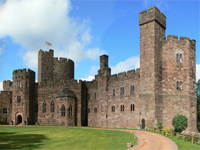
By contrast, Peckforton Castle would be recognisable to a medieval knight as a useful fortification.  Rising prominently above the relatively flat Cheshire countryside, the imposing red sandstone castle is very much in the tradition of BurgesCastell Coch for the Marquess of Bute, and the later Castle Drogo by Lutyens.  However, a significant difference is the much greater degree of historical accuracy, perhaps appropriate considering it was visually challenging the truly medieval Beeston Castle on a neighbouring hilltop, but also to reflect the benevolent feudalism of the owner, John Tollemache who spent huge sums on buildings and homes for his workers.  However, the widespread public discontent at that time, with the risks of mobs and rioting, meant that it is also possible that Tollemache chose a castle with the intention that it be defensible.  So successful was Salvin’s design that even a critic (fellow architect George Gilbert Scott) called it a “…a perfect model of a Medieval fortress…“.  I think Salvin enjoyed the challenge of this design; a rare chance to build an uncompromising castle in a way which hadn’t been necessary for 500 years, fully taking advantage of his encyclopaedic knowledge of fortifications.  Today, despite being badly damaged in a recent arson attack, the castle is still a fascinating example of his work.

Apart from ecclesiastical work and alterations to existing houses such as Warwick, Alnwick and Dunster castles, he also designed a number of notable country houses including, in addition to those already mentioned: Cowesby Hall, Scotney Castle, Parham Park, Skutterskelfe Hall (one of Salvin’s rare Classical designs), Crossrigg Hall, Keele Hall, and Thoresby Hall, which still survive today.  Sadly, Flixton Hall, Campsea Ash High House, Congham High House, Stoke Holy Cross Hall and Hodnet Hall have all either been completely demolished or, in the case of the latter, significantly reduced.

Salvin was one of those rare Victorian architects whose work started strongly and just got better.  To have the opportunity to purchase the first major work at Mamhead is a rare privilege and one that I hope the new owner will recognise and appreciate.

Sales details: ‘Mamhead House‘ – £8m, 164-acres [Strutt & Parker]

Lovely article with many photos in ‘Devon Life’: ‘Mamhead House

More details:

———————————————————————————-

* source: foreward to ‘Anthony Salvin: Pioneer of Gothic Revival Architecture‘ by Dr Jill Allibone which I can highly recommend, and which was very helpful for this posting.

The Lost Rooms: the sale of architectural salvages to America

Having just spent two weeks touring the west coast of the United States, one great pleasure has been visiting the various art museums to see some of the wonderful paintings which the immensely wealthy collectors of the late 19th- and early 20th-centuries acquired at a time when many of our country houses were in crisis. Sadly, in so many cases, the sales were a precursor to the complete loss of the house, with over 1,400 houses demolished since 1900.  However, it is still possible to see a fragment of these grand homes as the demolitions fuelled an impressive transatlantic trade in architectural salvage which included entire rooms. The whereabouts of many of these are now unknown – but they do sometimes reappear in surprising places…

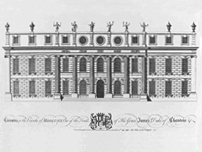
Cannons, Middlesex (Image: Vitruvius Brittanicus / wikipedia) - engraving from Vitruvius Brittanicus, vol. 4, by J. Badeslade & J. Rocque (London, 1739)

This post and the entire subject of country house architectural salvage owes an immense debt to the historian John Harris who has been chronicling these losses since he first started exploring country houses in the grim era following World War II. Of course, the trade had been going for many years: Nonsuch Palace, in Surrey, was deliberately sold for its materials in 1682, Cannons, in Middlesex, the seat of the Duke of Chandos was stripped and sold in 1747 after his death, and the once impressive Wanstead House, Essex, was similarly dismembered and sold to pay the debts of the spendthrift husband of the heiress in 1824. The plundering of rooms as part of the spoils of war by a conquering army has also happened throughout history with perhaps the most famous room taken also one of the greatest mysteries; no-one has seen the famed Amber Room from the Catherine Palace, just outside St Petersburg, since the German army meticulously removed it in 1941.

The country house room salvage trade takes off when, just as Europe is facing an agricultural slump which disproportionately affected landowners, the immensely wealthy industrial titans in the US were flexing their wallets to acquire collections which would become their legacies.  In the UK, as the situation worsened, so the familiar pattern of contents sales started with pictures and other artworks being discreetly sold.  Often many of these works were acquired by US collectors such as Frick, Mellon, Carnegie, Kress, amongst others, often on the enthusiastic encouragement of dealers such as Joseph Duveen.  However, to display the art required the right setting, and so an industry grew up to satisfy a voracious demand for authentic rooms – even if the rooms weren’t identical by the time they arrived.  Later, museums were also looking for rooms in which to provide context for their collections of furniture and art.

The Lawrence Room, Boston Museum of Fine Arts - de-accessioned 1930 (Image: 'Moving Rooms' - John Harris)

John Harris identifies the first stirrings of the transatlantic trade with the sale in 1876 of a supposedly ‘Jacobethan’ room to a Mrs Timothy Lawrence, which was incorporated into the Boston Museum of Fine Arts.  Harris next highlights the reference, in November 1897, in the sales/stock records of the famous Duveen family of art and antiques dealers of a ‘large Louis 14 Style Brown & Gold Room‘ ‘delivered free New York‘ for Mrs William C. Whitney which cost $10,000.  By the early 1900s, adverts were appearing in Country Life magazine and the Connoisseur listing entire rooms or just the parts; chimneypieces being a popular offering.  Building on the still lingering Victorian fashion for anything Elizabethan and Jacobean, dealers competed to offer the most choice rooms from the houses being demolished at the time.  One of the largest dealers, Robersons, were boasting in 1906 of having ‘100 Old Marble Mantelpieces in Stock‘, whilst Druce & Co had 5,000 feet of old panelling.  Books such Charles Latham’s ‘In English Homes‘ fuelled the fascination with these periods – perhaps even spurring on the demolition of some houses by creating a demand for the materials, and making it easier for the owners to decide to demolish.  As the architect John Swarbrick, founder of the Ancient Monuments Society, argued in 1928, ‘history adds commercial value to buildings’.

This desire for ancient association led some dealers to be somewhat generous in their attributions of the architects or owners involved.  The dealers Robersons were particularly apt at indulging in this type of misattribution, often assigning provenance with little or no research.  Another firm, Gill & Reigate, were being quietly accused of fabricating rooms as early as 1926.

Advert for the Staircase from Cassiobury House with Edwards & Co (Image: 'Moving Rooms' - John Harris)
Advert for the Staircase from Cassiobury (Image: 'Moving Rooms' - John Harris)

However, the finest pieces were often were those with a clear provenance, usually from a celebrated dispersal or demolition auction such as that of Cassiobury House near Watford or Hamilton Palace in Lanarkshire.  The urban growth of Watford has spoiled the estate at Cassiobury and so it was gutted in 1922, leading to the sale and dispersal, via French & Co, of one of the finest sets of Grinling Gibbons carvings in the country, including the impressive staircase.  Hamilton Palace, seats of the Dukes of Hamilton, was one of the most impressive houses in the country – and one of the greatest losses.  Built on coal wealth, it was also its literal undermining with subsidence (but also it’s vast size) leading to its demolition following huge sales in 1919 which not only released huge quantities of art and antiques but also of material.

Although there were many buyers, the most voracious – and possibly indiscriminate – was William Randolph Hearst; publishing magnate and heir to a mining fortune which reputedly gave him an annual income of $15m.  Although disliked by dealers for his lack of taste (something Joseph Duveen was particularly sensitive to), the value of his spending meant that they beat a path to his door despite his sometimes difficult behaviour.  In one case, having bought the staircase from Hamilton Palace via French & Co, he returned it to them no less than three times – but as he had spent $8m with them they were willing to be indulgent.  A network of agents throughout Europe sent him a daily stack of catalogues and flyers which he would eagerly read before dispatching orders for purchases.  These would then be shipped to his five-storey warehouse which occupied a whole New York block and was dedicated to his acquisitions and employed a staff of 30.  European purchases were mainly installed at San Simeon in California, but 50 English medieval salvages were installed at St Donat’s Castle in Wales which he bought without seeing and in which he only spent one night. In New York, he occupied five floors of a mansion block, creating a vast home which housed yet more salvage and art.  Almost inevitably, Hearst’s spending caused financial difficulties leading to a badly timed sale of many items in 1941 through the Gimbel Brothers department store in New York – though much remains even today in that warehouse which is still owned by the Hearst Corporation, who sadly refuse access to researchers (and if anyone knows someone who can get me in there I would happily make the trip to New York!). The scale of Hearst’s acquisitiveness is astounding and I’ll probably revisit it later in a separate post.

Inlaid Chamber, Sizergh Castle, Northumberland (Image: NTPL/Andreas von Einsiedel)

Sadly, like a tide coming in, which swept so many items and rooms into houses and museums in the States, so it also retreated and they also were removed, sometimes to vanish, their present whereabouts unknown.  Museums began quietly de-accessioning some rooms when they discovered that they perhaps weren’t as authentic and accurate as they had been led to believe.  Sometimes it was a positive thing; that sense of place being the greater concern leading to restitutions such as the Inlaid Chamber from Sizergh Castle (now National Trust) which was removed to the V&A Museum in 1891 and returned in 1999. One rare success for a Hearst purchase was that of the Dining Room from Gwydir Castle in Wales which was returned – having never been unpacked – in 1996 (the story is wonderfully told in ‘Castles in the Air‘ written by the then owner).

Perhaps it’s a little harsh to call the rooms lost if they have only been moved but to take a room from its original context is to lose something of the intrinsic value of it as part of an architectural whole. That said, it could also be argued that they were being rescued as, when the houses were demolished, fittings which couldn’t be sold were sometimes burnt – John Harris recalls seeing a beautiful staircase from Burwell Park in Lincolnshire being put on a bonfire in 1957.  Yet, so much of what was bought is still out there – particularly the items acquired by Hearst.  Which leads me to my own personal discovery in a bar in San Francisco; if you are ever in the Fisherman’s Wharf area of San Francisco, do visit ‘Jack’s Bar‘ in The Cannery where you will be standing in the former Long Gallery of Albyns, an elegant Jacobean house built c.1587.  It was demolished in 1954 but which had been gutted earlier with the gallery bought by Hearst but sold in the mid-1960s and given a new life – though not an elegant one.

Long Gallery, Albyns - now Jack's Bar, San Francisco (Image: Matthew Beckett)

So these rooms, once the centrepieces of some of our finest country houses, have been extracted and shipped around the world but particularly to America where, although they were initially often fully appreciated, now they may languish, unremarked and more worryingly unknown, vulnerable to just being dumped as though simple room decoration.  So, if you know of a Hearst room installed in a house or museum (and I’d be particularly grateful to my many American readers) then please do post a comment or email me and we’ll try and make sure that these wonderful expressions of the craftsman’s art are not forgotten and lost forever.

—————————————————————————————–

If you would like to see some of the rooms and items then below is a small list of museums where these items are being exhibited (thanks to Andrew for help with the research):

New YorkMetropolitan Museum of Art

PhiladelphiaPhiladelphia Museum of Art

BostonMuseum of Fine Arts

MinneapolisInstitute of Arts

  • Tudor Room‘ – unconfirmed, possibly Higham Manor House, Suffolk

Louisville – J.B. Speed Art Museum

Amherst, Massachusetts – Mead Art Museum, Amherst College

Washington DC – Freer Gallery of Art

—————————————————————————————–

Find out more – some recommended further reading

Inspired by Park Place? Other country houses for sale to restore

The recent restoration and sale of Park Place was certainly on an epic scale – £42m to buy, a further £100m to complete – but thankfully not all projects need be so expensive (though they’ll never be cheap).  The story of the country house has, for many, featured a cycle of ascendency, enlargement, and enjoyment, followed by neglect but – hopefully – rescue. As the annual SAVE Britain’s Heritage ‘Building’s at Risk’ Register sadly makes all too clear there are any number of country houses which have reached quite a serious state of disrepair, even dereliction. Yet even for these there may be someone who is willing to step up and rescue part of the nation’s architectural heritage. Houses in need of a saviour are often for sale, their forlorn state in Country Life magazine a stark contrast to their better loved brethren.

The UK generally has a much more positive attitude towards restoration than many other countries.  The Victorians would often be tempted to restore an ancient seat due to the contemporary popularity of the romantic notions of ‘Ye Olde England’.  Living in an Elizabethan or Jacobean house gave the owner associations with older family lines (not necessarily their own) and was a short-cut to perceived greater respectability.  Today, those who take on a restoration of one of our beautiful older houses are rightly lauded over those who simply buy a super-sized Barrett home.  Yet, restoration requires sensitivity and a willingness to submit an individual’s grand designs to work within the boundaries of the listed building regulations and the character of the house.

Marske Hall, Yorkshire (Image: Carter Jonas)

One house with hidden character and which will require careful planning is Maerske Hall, Yorkshire.  Originally built by the Hutton family in 1597, they were still in residence in 1730 when the house was rebuilt and extended in a Classical style. The grade-II* house was mainly used for shooting parties by the family in the 19th-century saving it from alteration but in the 20th it was threatened with requisition by the Army in WWII.  Luckily the family were able to arrange for pupils from Scarborough College to take up residence instead which saved it from the worst damage.  After the war, it again came near to destruction, as it was sold in 1947 to local builders George Shaw and his son George William who intended to demolish it for the materials.  However, they baulked at taking down such a lovely house and so sympathetically converted it into 10 apartments.  Still divided but now empty it is for sale at £2.5m with 19-acres of beautiful, mature gardens, and presents a fascinating opportunity to recreate a single family home. For more on the history, there’s a brochure: ‘Marske Hall‘ PDF [Carter Jonas].

Walton Hall, Derbyshire (Image: Knight Frank)

For those wanting a more straight-forward restoration, Walton Hall, Derbyshire perhaps offers a more appealing option.  This fine and elegant grade-II* house, prominently sited above Walton on Trent, was built between 1724 -1729 to designs by the architect Richard Jackson. The most striking feature are the full-height pilasters, giving dignity to a slowly deteriorating house which has become such a concern as to be listed on the English Heritage ‘At Risk’ register.  Inside, the most impressive feature is the grand staircase, reputedly copied from a building in The Hague.  The house is basically habitable but requires significant sensitive restoration, hence the price; £1.5m for the house plus just 7.5-acres.  That said, once restored this will be a quintessential Georgian  house to be enjoyed for generations.

Felix Hall, Essex (Image: Savills)

For those who prefer a real challenge then the next two houses could be ideal.  The first is Felix Hall, situated just outside Kelvedon, Essex – the picture (right) immediately showing the scale of the challenge.  At its core, this house is firmly in the tradition of the Palladian villa with a compact footprint but featuring wonderful architectural flourishes such a fine portico (added in 1825) and, to the rear, four engaged columns and a pediment.  Originally built between 1760-2, it was purchased by the Weston family of Rivenhall Place in 1793 and was significantly extended with flanking wings in the early 19th-century, possibly on the occasion of Charles Callis Weston’s  ennoblement as Lord Weston of Rivenhall in 1833.  However, as with many larger houses, a reduction in  size was thought prudent and so in 1939 the two wings were removed, leaving just a 7-bay central section.  Sadly, during the course of renovations it caught fire, completely gutting the fine interiors leaving the gaunt shell with the proud Ionic columns we can see today.  The remains were bought in 1953 and the basement rooms restored as an occasional country retreat but this is a house crying out for a full restoration (for which there is planning permission).  However, the estate buildings such as the nearby stables have been separately converted and there is only a small amount of land – it would be lovely if the new owner could also purchase the buildings and gardens and if they could also acquire the field in front, they could create a superb small parkland in which to truly display the house.

Piercefield House, Monmouthshire (Image: darkcell / flickr)

Another shell available is the one I would be heading for: Piercefield, near Chepstow, Wales.  Designed by the peerless Sir John Soane in 1785 for George Smith, the actual completion of the house was delayed until 1793.  Of particular interest  here is that the design is not entirely unique – Soane appears to have used very similar plans for Shotesham Park in Norfolk which was also built in 1785, although that house was brick with stone dressings, whilst Piercefield is faced entirely with stone. The house was sold 1794 as Mr Smith had run into some financial difficulties and it was bought by Sir Mark Wood who employed Joseph Bonomi to add a saloon and a winding staircase – though not the two pavilions as has been suggested.  The house was sold in 1926 by the Clay family, who had bought it in 1861, to Chepstow Racecourse who abandoned it, leaving it become increasingly derelict, apparently helped by American troops stationed nearby in WWII who used the house for target practice.  After 90 years of neglect, the house still has the power to impress with its refined façade and elegant temple pavilions.  Although on the market for over six years the price has remained at a rather ambitious £2m (although it does include 129 grade-I listed acres of parkland). However, recent comments by the director of the race course have indicated that they might entertain offers of around £1m; though, of course, the restoration bill would be many times that – but what a prize at the end!

Ruperra Castle, Wales (Image: Jeffrey Ross - Estate Agent)

Even further down the scale of dereliction is another important house, also in Wales, which has been stubbornly mis-priced.  Ruperra Castle near Newport is one of the few ‘mock’ castles designed for pleasure and not as defensive installations – a subject examined in more detail in an earlier blog post related to Ruperra: ‘Developer shows sense; Ruperra Castle for sale‘ (Sept 2010).  Few of these style of houses were built and Ruperra’s importance derives from it being one of the earliest of the country houses of this type, having been built in 1626.  Sadly, many of the other examples have been lost (most recently, fire gutting the interior of Lulworth Castle in 1929) so for someone Ruperra offers the opportunity to not only restore an architectural gem but also to be able to enjoy the same stunning views which attracted Thomas Morgan to build there in the first place.  Unfortunately, although the owner has now switched agents, the price is still ambitious at £1.5m – especially considering the immense challenges and costs of restoration and the location.  Hopefully, as with Piercefield, the owner ought to be willing to entertain realistic offers and allow the house to be saved before it is lost forever.

Perhaps the last is stretching it to call it a restoration opportunity as Bellamour Hall, Staffordshire now exists only as two walls and a few piles of stones!

Restoration is never a cheap or easy approach but the satisfaction and pride in knowing that the work has saved another part of our architectural heritage must be immense.  For too long our country houses have been under threat from neglect, vandalism and poor maintenance and the selection above (and there are more) show that the degrees of restoration and commitment required can vary dramatically.  That said, I can only hope someone is out there with the wealth and sensitivity to take on these houses and bring them back to life.