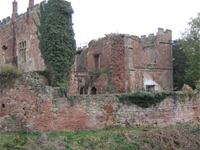
Astley Castle rises from the ashes

Astley Castle, Warwickshire

The devastating fire which tore through Astley Castle not only ended it’s use as a hotel but also seemed to mark the end as a building.  However, a remarkable project by the Landmark Trust is seeking to once again restore life to this battered shell.

Although never a proper ‘castle’, Astley was designed as a fortified manor house (see also the beautiful Compton Wynyates nearby). This original house was built largely by the Grey family but it was slighted following the execution of Lady Jane in 1554.  The house was rebuilt in 1600 by a new owner, Edward Chamberlain, and it eventually became part of the Newdigate family’s Arbury Hall estate, with a new ‘Gothick’ stable block added in the 18th-century – but with little done to the house itself.  The grade-II* listed castle was leased out as home for most of in the 20th-century until the 1960s when it became a hotel until the fire destroyed it, leaving it as a deteriorating ruin for the next 30 years.

The Landmark Trust has been attempting to find a solution to this situation since the 1990s, originally looking at plans for a full restoration, but which unfortunately proved too costly.  The continued decline of the building fabric gave fresh impetus to their efforts as it was realised that without urgent work the house as a structure would be lost forever.  In 2005, the Trust held a competition to find a design for accommodation to be created within the shell as sensitively as possible, which could then be used as a holiday let.  The winning design from the architects Witherford Watson Mann will create a modern two-storey structure in the oldest part of the castle, with the first-floor living spaces enjoyed spectacular views across the parkland.  A £500,000 £1.47m grant from the Heritage Lottery Fund, plus earlier fund-raising, has taken the Trust to within just £134,000 of the total project cost of £2.3m, and great progress has been made on the scheme. What’s particularly impressive about this project is that it has enabled a full architectural survey of the house, which has revealed many fascinating features as the rubble has been cleared and the later Victorian additions are removed.

The Landmark Trust has a strong record of taking on derelict listed buildings, converting them, and finding a long-term sustainable use for them – usually as unusual holiday accomodation.  Although it’s not been possible to fully restore Astley Castle as a home it is encouraging to see it being consolidated and enhanced with a sensitive modern addition which will provide the opportunity for others to experience this amazing part of our architectural heritage which was so nearly lost.

More details: ‘Astley Castle‘ [The Landmark Trust]

If I won the lottery…Fillongley Hall

Fillongley Hall, Warwickshire (Image: Weddington Castle website)

Considering the difficulties faced by country house owners with death duties and a changed society, it’s always remarkable when a house is passed down through the generations; particularly so when it’s the same family for nearly 200 years.  Fillongley Hall designed by George Woolcott and was built in 1824-25 for the uncle of the 1st Lord Norton, extended in 1840-1, and now for sale again by the 8th Lord Norton after an unsuccessful attempt to sell in 2005.

The grade-II listed house is considered to be one of the best examples of smaller scale Greek Revival architecture which demonstrated the good taste of the Grand tourist with it’s fine interiors and classical exterior with recessed Corinthian columns on the main entrance front.    Bearing some resemblance to the now-demolished Thirkleby Park in Yorkshire, the house is a compact essay in elegant classicism with a restraint all too often lacking in modern country house architecture.  The house was inherited by Lord Norton in 1993 since when he and his wife have lovingly maintained and updated the house.  More images of the interior and exterior can be seen either on this fascinating local history website or on the Savills website.

When Fillongley Hall was put up for sale in 2005 the guide price was £5m but this included 400-acres as opposed to the 114 plus the house which are available now for £4.5m.  [The house subsequently sold in 2006]

This is a beautiful house and deserves and owner who understands the house and is sympathetic to its status as one of the best houses of its type in the region.

Property details: ‘Fillongley Hall‘ [Savills]

Ury House restoration project still in doubt a year on

Ury House, Scotland (Image: Geograph)

When the developers FM Developments went into administration in 2009, it put in jeopardy a huge development scheme which was to fund the restoration of the historic Ury House.  The size of Ury House meant that any scheme was going to have to be ambitious to provide sufficient funding and this one involved the building of 230 homes and the creation of a Jack Nicklaus-designed golf course.  The developers had been praised for consulting with local residents and had the full support of the council for bringing jobs and no small measure of glamour to Stonehaven. Now, a year after the collapse, it’s still not clear if the scheme will proceed at all, leaving the spectacular ruins of Ury House at further risk of decline.

The first house had burnt down in 1645, and the second house was subsequently completely rebuilt as the Ury House we see today in 1855 for Alexander Baird in a fine Elizabethan style by the architect John Baird.  Baird was one of the most successful of the architects working at this time even if he rarely followed fashion.  His work at Ury was a continuation of the style of Wilkins and Burns they had developed 40 years earlier but was of a high quality which is still visible even today in the shell of the house. As a first stage of the work of the restoration, extensive scaffolding had been erected around the house in January 2009.

The proposals for redevelopment of the 1,500-acre estate included the conversion of the house into nine townhouses.  Unlike in many other cases of ‘enabling development’ where the setting of the house is compromised through the encroachment of the housing, the plan put forward placed the residential estate well to the east of the house, thus protecting it.  With the bankruptcy of FM Developments these plans have  been thrown into doubt and local planning officers are now working on the assumption that the development will not go ahead – despite local councillors being determined to resurrect the scheme.  Unfortunately the danger is now that another, less sympathetic, developer will take on the project but may try to cram more houses in or extend the area of the estate taken for housing. This would be a real shame. Although the ideal but unlikely outcome would be the restoration of the house as a single family home, this project had developed as a good example of enabling development practiced in the right way, with sensitive restoration of the main house, protection of the setting of the house, and productive use of the estate.

More details: ‘Future of Ury mansion site in doubt‘ [The Press and Journal]

Future of Ury mansion site in doubt

Confirmed: Gwrych Castle is for sale again

Gwrych Castle, Wales (Image: geograph.co.uk)

Following earlier concerns, sources have confirmed that the grade-I listed former ‘showplace of Wales’, Gwrych Castle, is once again for sale.

After many years as a deteriorating ruin, it’s outlook improved when the castle was finally sold for £860,000 in 2007 to City Services Ltd (trading as Clayton Homes – a separate company to Clayton Hotels which is still trading). They soon announced ambitious plans to convert it into a luxury 5-star hotel using the original layout as the starting point.  Initial work on site has included the removal of over 1,900 tons of asbestos and debris from within the shell and the vegetation stripped from the exterior. The site was ready for restoration to start and Donald Insall architects were working on the designs for restoration.

Unfortunately 2007 was the height of the property market and the subsequent fall hit many companies including Clayton Homes which went into administration on 12 August 2009.  Deloitte (Leeds) were appointed as administrators and have been quietly marketing the assets including Gwrych Castle.  This was highlighted by the story of the businessman who was viewing the castle as a possible site for his ‘psychic school’ when he conveniently saw a ghost at a window.   Kevin Horkin has apparently submitted a bid for around £850,000 – which may secure him the site but to complete the project to the required standard will require at least another £6m-12m depending on his ambitions.  This is a significant level of investment if he is to restore this wonderful house to the appropriate standard.  Hopefully Cadw, the Welsh equivalent to English Heritage, will keep a very close eye on the project and ensure that any plans are at least to the same standard as those approved for Clayton Homes.

Many people have taken a keen interest in Gwyrch Castle and had hoped that the sale would lead to this once grand house again taking a key role in the local area and also to save this important part of their architectural heritage.  It would be tragedy if the work already done to create a secure and viable foundation for restoration was allowed to deteriorate again – the house must be sold to a sympathetic owner who has both the vision and funds to complete this project in a way which befits this beautiful house.

More details:

Is Gwrych Castle for sale again?

Gwrych Castle, Wales (Image: geograph.co.uk)

When Gwrych Castle was finally sold in June 2006 after twenty years of neglect, dereliction, fires and theft, there was much praise and relief locally that the once-beautiful “showplace of Wales” was to be rescued.  Bought by Yorkshire-based Clayton Hotels for £860,000, they estimated that once planning permission had been secured, the restoration would take between 2-3 years and cost an estimated £6m – however three years later, the major part of the restoration work has yet to start.

Built between 1819-1825 for Lloyd Hesketh Bamford-Hesketh, grade-I listed Gwrych was one of the largest ‘castlellated mansions’ in Europe, part of a ‘gothick’ revival which included some of Britain’s most picturesque country houses such as Eastnor Castle, East Cowes Castle, Lea Castle, and Castel Coch and many more. Following its sale by the 13th Earl of Dundonald in 1946 it was opened to the public in various forms and under various owners until 1989.  The failure of the redevelopment plans led to the castle being left unprotected against the ravages of the weather, travellers, and vandals, leaving the castle a mere shell, the fine interiors rotting in piles in the collapsed ground floor.

The plans unveiled by Clayton Hotels in 2007 showed that the castle would be fully restored and largely based on the original layout. Mark Baker of the Gwrych Castle Preservation Trust, who had campaigned since he was 11 to save the castle, welcomed the plans and for many it seemed that the end was in sight.  In February 2009, Wales Online (‘Welsh ruin to be transformed with techniques fit for royal home‘) trumpeted how the design work for the restoration was starting under the care of Donald Insall, one of the best conservation architects in the UK.  However, in May 2009, a story on BBC News (‘Slow economy delays hotel plans‘) explained that the slow economy had delayed plans and also the cost for the project had risen to between £12-14m.

Now a recent story (‘Clitheroe man haunted by ghostly image in castle window‘) about a ghost in a window included some interesting quotes which raise some questions about the status of the project – or perhaps just the intended future clients.

A Lancashire businessman who combines being an optician with “psychic management” claimed to have taken a picture of a girl standing at a window where there is no floor.  Kevin Horkin claimed he was visiting the site as “I buy property and was looking at the castle with the view buying it.” and the story ends by saying that “Kevin has put a bid in for the castle which he hopes to turn into a luxury psychic retreat.”.  Despite the obvious convenience of a psychic who wants to open a hotel taking one of the clearest ever pictures of a ghost, it does raise questions about why he is saying the hotel is for sale? The Clayton Hotels website is one page with an email link and with the dramatic rise in restoration costs and the difficulties of the property markets, is the castle being quietly marketed ‘off the record’? Perhaps the quotes are misconstrued, or perhaps Clayton will refurbish the house but lease it Mr Horkin, but either way, Clayton Hotels should perhaps clarify exactly what is happening to this iconic part of Wales’ architectural heritage especially as so many people have spent so long campaigning for its rescue.

More information about the house: ‘Gwrych Castle Trust