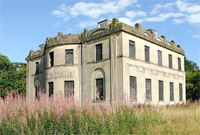
After abandonment, institutional use, and a serious fire, there is finally some good news for Pell Well Hall. It’s reported that an offer has been accepted and finally the house can move to what will hopefully be the final stages of restoration. Originally with an asking price of £750,000 the offer accepted was £550,000 – but with estimated costs of between £2m – £5m to complete the restoration.
With such a huge project and the need for significant financing, the hope is that the new purchaser will complete the work sooner rather than later. However, after neglect and fire the original interior has been entirely lost meaning that in many senses this is a recreation rather than a strict restoration. Perhaps leaving some evidence of this sad state would be an honest approach – and heaven forbid that the interior ends up as just some identikit footballers Surrey mansion. This a special house and deserves a careful hand on the design and budget.
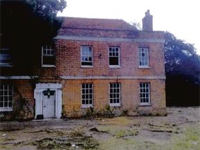
A new development in the long running saga of Brook House in Tiptree, Essex has opened the possibility for some good news. As had been reported here before, the lovely red-brick house in the heart of Tiptree was subject to an application to demolish from the owner who claimed that it was beyond repair.
However, photos taken recently show that the house is actually in very good condition and pressure from heritage organisations such as SAVE Britain’s Heritage have led to a spotlight being shone on the plans.
It’s now been reported that the application has been withdrawn. It’s the slow, piecemeal loss of fine houses such as this over the last fifty years which has left our towns all the poorer visually. Hopefully there will now be discussions where the starting premise is that the house should be restored as an important part of Tiptree’s architectural heritage.
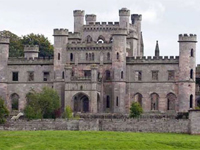
Empty since 1942, Lowther Castle was used during WWII as a weapons research lab and the grounds as a practice ground for tanks who did their best to destroy the ornaments, fountains, paths and gardens. The house was not lived in again and in 1957 was unroofed and abandoned as a shell, leaving it as an ornament in the gardens of the 3,000-acre estate. The castle deteriorated over the passing decades until it was overgrown and the central tower was in danger of collapse and was featured in the 2008 Buildings at Risk register. However, this decay is about to be arrested and ambitious plans are afoot to partially restore the tower and invest in the gardens and park.
An application has been lodged to restore the gardens including the kilometre-long central avenue and create an indoor garden within the shell of the house once this has been stabilised. The work is expected to cost up to £9m but will attract 160,000 vistors a year to the attraction, generating £10m for the local economy.
Although the loss of the castle as a house is lamentable it’s encouraging to see that the shell and estate still have such value which will hopefully secure the future for this elegant building for future generations. Who knows, one day it may be possible for the Lowthers to restore the castle and move back in?
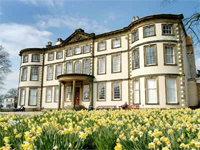
Sewerby Hall, Yorkshire (Image: East Riding Council)
Sewerby Hall has secured £50,000 to develop further it’s plans for a £2.6m restoration of the house.
The grade-I listed Sewerby Hall was inherited by John Graeme in 1714 who promptly rebuilt the house which is the core of the current building. The Graeme family owned Sewerby unti 1934 and in intervening 200 years made many alterations to create the elegant house which survives today.
The Council are proposing to redevelop the outbuildings such as the former laundry block to provide the necessary visitor facilities. The house will also be restored but encouragingly the Council have said that they “will work closely with planning and architectural colleagues, English Heritage, the Heritage Lottery Fund and other specialist advisors to take the project forward to the next stage” – which sounds encouragingly sensitive in contrast to the plans of other councils (see earlier post on Forty Hall in Middlesex). Of course, the proof of how sensitive they will be will only become apparent when the plan is published but hopefully this project will not only protect but enhance this important house.
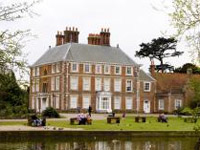
Enfield Council’s proposed renovation plan for Forty Hall in Enfield has been given the go-ahead by the council planners. However, the plan seems to verge on invasive and to contravene best practice guidelines from organisations such as the Society for the Protection of Ancient Buildings which recommend preserving as much historic material as possible to show how a building has developed. The changes are part of plan funded with nearly £2m in grants from the Heritage Lottery Fund.
The Grade-I listed house was originally built in 1629 for Sir Nicholas Rainton, a City Alderman, President of St Bartholomew’s Hospital and Lord Mayor of London. The house passed through various owners until bought in 1895 by Major Henry Bowles who made many changes including a new staircase with stained glass incorporating his family’s coat of arms.
However, rather than respect it as an important example of one of the many smaller mansions built on the edges of the then city but now subsumed into the suburbs, the council seem determined to make their own extensive changes. An illuminating quote was given when the HLF grant was announced: “This gives us a unique chance to re-model the Hall completely to make sure that every aspect of it is planned and coordinated to make it the top visitor attraction that it should be.” [enfield.gov.uk]. Among the changes the council have proposed are:
installation of a lift shaft,
removal of the entrance porch,
construction of a glazed roof to the central courtyard, and
replacement of the main staircase.
It’s the latter that seems to be the most worrying change as the staircase was an important part of the history of the house. The Victorian Society has raised their objection to this loss. Interestingly, the press release inspired news story doesn’t mention whether English Heritage or the Society for the Protection of Ancient Buildings have given their approval.
Also of concern is the intention to redocorate the interior which will be carried out “by detailed investigation of historic finishes” – which doesn’t say that they will follow the evidence of the past.
All in all this seems to be a council who have approved their own plans to make many insensitive and substantial changes to a Grade-I listed building in an attempt to create a ‘theme-park’ pastiche of an old house. Perhaps a more considered approach would not only preserve more of the historic fabric the council seem so willing to rip out but would also offer cost savings.
The plans still require approval from the Secretary of State, John Denham, before they can be implemented so there is hope yet that this apparently inappropriate scheme might yet be modified so that whilst still meeting the council’s aim of increasing access and improving facilites it’s much more sensitive to this elegant house.
 The Country Seat