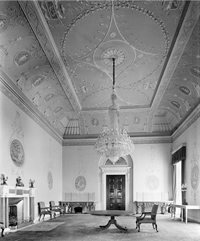
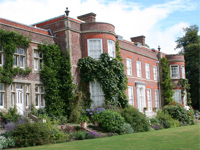
For the polo enthusiast; for sale – Cowdray Park House, Sussex

Cowdray Park House, West Sussex (Image: Knight Frank)

Despite a house having been in the family for over a hundred years, sometimes it can seem the most rational choice to sell.  For the current Lord Cowdray, the idea that he might saddle his heir with what he considers a burden has led to his decision to put the impressive Cowdray Park House up for sale.

If you mention Cowdray often the first house which springs to mind are the atmospheric ruins which are all that are left of one of the grandest Tudor houses in the country.  The fire in September 1793 destroyed not only a large part of the house but also many priceless and historically important artefacts including William the Conqueror’s sword and also the roll-call of those present at the Battle of Hastings.   Just two weeks after the fire the 8th Viscount Montague drowned whilst swimming in the Rhine, forcing the title to a distant descendent of the the 2nd Viscount, who died childless, extinguishing the Viscountancy.

The tragedies continued – the 8th Viscount’s sister inherited but both her sons died whilst swimming off Bognor in 1815.  The three daughters who then inherited in 1840 eventually decided to sell and it was bought by the 6th Earl of Egmont for £300,000.  The current Cowdray Park House dates from 1878 when the 7th Earl, who had inherited the estate in 1874, massively enlarged the Keeper’s Lodge to create the house we see today.  A large rambling, but very picturesque creation, it obviously has taken its cues from houses such a Knole and Penhurst with their varied rooflines and many courtyards.  The grounds had been previously landscaped by Lancelot ‘Capability’ Brown between 1768 and 1774 with the ornamental gardens laid out in the early 18th-century.

The house was bought in 1908 by Sir Weetman Pearson who was created Viscount Cowdray in 1917.  Sir Weetman was a brilliant engineer who not only built the Blackwall Tunnel under the Thames but also had extensive oil interests in Mexico.  The house then passed through the Pearson family with few changes until the 3rd Viscount, in pursuit of his passion for polo, created one of the premier polo grounds in the country within the 16,500-acre estate.

Yet being a titled aristocrat living in a 16-bedroomed, 44,000 sq ft house in the middle of a fine estate proved to not be what the current Viscount hoped for after he inherited in 1995.  In May 2009 it was announced that he and his wife and son were to move out of the main house and into a smaller house on the estate, Fernhurst, where they had lived before inheriting.  The 2009 plan involved finding someone to take a long lease and create a hotel and spa in the house but the wider economic circumstances have forced this plan to be abandoned.    Unwilling to continue managing such a large house, with all the attendant issues with staffing and maintenance, the Viscount has decided to sell, putting it on the market, with 110-acres, for £25m, whilst retaining the rest of the estate including the world-famous polo grounds.  Renting the house out, he says, would just be delaying the decision.

Speaking to the Sunday Times in 2009 when he announced his plans, Viscount Cowdray admitted that “I’m not the sort of person who feels hugely attached to things, and it’s a big house.” and later speaking to the Observer that same year he said “I have worried whether I will be leaving Perry a wonderful asset or a noose around his neck. I fear it is likely to be the latter,”.

Whilst the arguments put by the Viscount seem rational it does seem a shame to divorce the house from the estate.  The Cowdray estate has long adapted to changing circumstances but to dismember it seems to be a short-term solution which his son may, with hindsight, regret when he comes to take over, as it leaves one of the most significant estates in Sussex without a principal house.

*Update* Remarkably, Cowdray Park House is unlisted so any buyer has the opportunity to make any changes they wish – and I’m willing to bet they won’t be good.  Knight Frank are touting this as a benefit but perhaps representations ought to be made to Chichester District Council to nominate it for listing using this form.

More details: ‘Cowdray Park House on sale for £25m‘ [Chichester Observer]

Property details: ‘Cowdray Park House, West Sussex‘ [Knight Frank]

The Cowdray Estate

The ‘artocracy’ expands: West Acre High House, Norfolk

West Acre High House, Norfolk (Image: Strutt & Parker)

In any age, once someone is successful they often seek the traditional status symbols – with a country house being high on the list.  For footballers it seems that the modern, bling-laden mansions are the favoured style but for an increasing number of modern artists it’s the historic houses which are finding favour.  The news that Anthony Gormley has bought West Acre High House in Norfolk adds him to a distinguished roll-call of artists who are forming what has been glibly named, the ‘artocracy’.

Artists moving to the country to help their work has a long history including  Peter Paul Rubens buying the Castle of Steen Manor House in the Netherlands in 1635 which led to some of his finest landscape paintings. West Acre High House was regarded as one of the prize estates when it came up for sale in 2008 for £9.5m with 1,000-acres.  Yet, it languished on the market despite the nearby 1,600-acre Kelling estate being sold which was listed at the same time.

West Acre High House was built in 1756 by Edward Spelman (d. 1767), a writer and translator and known eccentric, who had inherited the estate from the Barkhams.  The design raised eyebrows, particularly for that part of the world, with its novel piano nobile arrangement which was also being used around that time in the construction of Holkham Hall and Houghton Hall.  A visitor in that year, Caroline Girle, reported:

“I paid a droll visit to see an odd house, of a still odder Mr Spelman, a most strange bachelor of vaste fortune but indeed I’ll not fall in love with him.  We were introduced to him in the library where he seemed deep in study (for they say he’s really clever) sitting in a Jockey Cap in stiff white Dog’s Gloves. On seeing Mr Spelman one no longer wonders at the oddity of the edifice he has just finished.”

The house is also unusual in that the south front is 7 bays with the central 5 deeply recessed, but the north front is 13 bays due to the flanking wings being built level with the main block.  The wings were built by Anthony Hamond (b.1742 – d. 1822), a nephew of Richard Hamond who had bought the estate from Spelman in 1761.  The next major change was put in effect by Anthony’s second son, another Anthony, who, in c.1829, employed the well-known country house architect, W.J. Donthorn, who refaced the whole house in pale oatmeal Holkham brick, crenellated it and created the spectacular internal double-flight staircase.  The staircase leads to a picture gallery modelled on the one in Buckingham Palace and is formed of five perfect cubes of 18ft.

The house was bought by Henry Birkbeck in 1897 who might have inherited it having  married Anthony Hamond’s daughter in 1849 but, for reasons unknown, purchased it instead.  It remained in the Birkbeck family until the sale to Gormley, who has bought the house plus 100-acres for just £3m having had the price reduced by wanting less land and after factoring in the £1.5m cost of restoration.

Toddington Manor, Gloucestershire (Image: Images of England/Heritage Gateway)

The restoration costs may well turn out to be much higher – as Damien Hirst, another of the ‘artocrats’, has found out.  He has admitted recently that he has been affected by the recent economic turmoil and in addition to closing down his studios, he has paused the vast, £10m restoration programme he is undertaking at his equally vast country house, Toddington Manor in Gloucestershire, which he bought in 2005 for £3m.  Built in 1819-35 for Charles Hanbury-Tracy, later 1st Baron Sudeley, using his own very accomplished designs. He drew his inspiration from the Perpendicular architecture of Oxford and Pugin‘s work, to create an important Gothic-revival building at a cost of £150,000 (equivalent to £15m in today terms).  The design clearly influenced Sir Charles Barry in his design for Highclere Castle in Berkshire (built between 1838-78) and the Houses of Parliament (started in 1840) – but perhaps Barry was playing to the audience with the latter as Hanbury-Tracy was also on the committee which chose the design for the new Parliament.  After being empty for 20 years until Hirst bought it, the house was a cause for serious concern with outbreaks of dry-rot and a pressing need to replace the acres of roof.  After being saved from becoming a hotel, Hirst bought the grade-I listed house as both a home but also to eventually become a gallery for his work.

Another artist seeking the country life is Anish Kapoor who was apparently interested in taking the lease on Ashdown House in Berkshire – though it eventually went to Pete Townshend of The Who.  One of our prettiest country houses, and now owned by the National Trust, leasing it would have given him the status without the huge restoration costs.

One of the most encouraging aspects of both Gormley and Hirst’s purchases has been the willingness and ability to finance the necessary huge restoration projects.  For Hirst, this has involved covering the whole of Toddington Manor in some ‘Christo’-esque scaffolding with the expectation that the restoration will be a lifetime’s work.  Any restoration has an element of being a labour of love but, in exchange, their houses will give them status, but most importantly, a home – these are houses to be lived in, albeit on a much grander scale than most.

Property listing: ‘West Acre High House‘ [Strutt & Parker] – marked as ‘Sold’ so may not be on the website for long.

Detailed architectural listing: ‘West Acre High House‘ [British Listed Buildings]

More images: ‘Toddington Manor‘ [aerial-cam photography]

A salute to determination: Goldsborough Hall, Yorkshire

Goldsborough Hall, Yorkshire (Image: Goldsborough Hall)

Love is a strange emotion which by chance can leave a person very attached to something.  For Clare and Mark Oglesby the object of their affections is the elegant Goldsborough Hall in Yorkshire, which, after five years hard work and a substantial budget has been rescued from dereliction and possible development.

Goldsborough Hall was built between 1601-1625 for Sir Richard Hutton, a London judge who used his wealth to establish himself in Yorkshire and was High Sheriff in 1623.  The internal plan of the house is interesting as it features a lateral corridor on all three floors and originally included fashionable features Sir Richard probably learnt of from his London friends such as a long gallery which useful for exercise in the inclement weather. Slightly unusually it was on the first floor (though not uniquely as Beaudesert, Condover Hall, and Treowen House also have this) when they were normally on the upper floors as, high up, their excess of glass gave visitors the most impressive view of the house – see, most famously, ‘Hardwick Hall, more glass than wall’.

The house was then rebuilt in the mid 18th-century for Richard Byerley before being bought by the Earls of Harewood, the Lascelles family, who employed the famous architect John Carr of York to remodel the interior in 1764-5, whilst he was also working on their main house, Harewood.  Goldsborough features numerous mementos of the family with their crest embedded in rainwater heads and in stained glass.  The house remained in the Lascelles family until 1965 when it was sold to pay death duties.  It then became a school, a private home, a hotel and then nursing home before being put up for sale in 2003 when the Oglesby’s first saw it but had their offer rejected.  At that time the house was still in good condition but this had changed dramatically when the estate agent contacted them again in 2005 to say it was between them and a developer. They successfully bid but now, just two years later, water was running down the 17th-century oak staircase and the panelling in the library, and the house lacked heating or working plumbing.  Undaunted, over the last five years they have spent around £2m on the restoration which has now rescued this wonderful house from ruin and is back to being a family home which pays it way by hosting weddings.

Rise Hall, Yorkshire (Image: Pastscape)

Another house which needed work and has now been restored explicitly as a wedding venue and family home is Rise Hall, also in Yorkshire.  Set in a beautiful small park laid in the 1770s, the grade-II* listed seat of the Bethell family was rebuilt between 1815-25, though the architect is disputed with some claiming it’s by Robert Abraham (whose eldest daughter was conveniently married to the owner, Baron Westbury) but more likely, as given by Howard Colvin, it was by Watson & Pritchard who also designed a Doric lodge for the house in 1818.  The slightly austere, 9-bay ashlar Georgian facade is dramatically enlivened by a full-height, tetra-style Ionic portico.  Inside the house features a top-lit staircase hall and some neoclassical decoration with an Adam-style dining room.  The house remained in the Bethell family until 1946 when they moved into the former rectory, now Rise Park, and let the house to the Canonesses Regular of St. Augustine, who ran a Catholic boarding school there until 1998.

The house was then bought as a second home by Sarah Beeny, star of many property restoration TV shows.  She and her husband used the house for many years but realised that the 97-room house was simply too large to function as just a weekend retreat and it also needed to pay for its own restoration. Beeny seems to take a rather hard-headed approach – unsurprisingly given her background – but is committed to achieving the right result. The location ruled out use as a hotel so they decided that they would convert it into a wedding venue in just eight months as part of a TV show called ‘Beeny’s Folly‘ which will be broadcast in Autumn 2010 on Channel 4.  This will be a chance for the wider public to get a real insight into just how much work is required to restore and maintain a stately home.  Who knows, it might even inspire someone with deep pockets and hopefully a sympathetic attitude, to find and fall in love with a one of our other country houses at risk and bring it back to life as a home.

Full story on Goldsborough Hall: ‘We’ve moved from our 4-bed detached to an 80-room stately home‘ [Daily Express]

Official website: ‘Goldsborough Hall

Detailed architectural description: ‘Rise Hall, Yorkshire

More buildings at risk: ‘Live and Let Die – 2010 Buildings at Risk Register‘ [SAVE Britain’s Heritage]

Conran collects another Georgian gem: Wardour Castle, Wiltshire

Wardour Castle, Wiltshire (Image: Strutt & Parker)

The recent financial crisis has forced many properties onto the market and easily one of the grandest was the main apartment of Wardour Castle in Wiltshire which has now been bought by the fashion designer Jasper Conran.

The Apartment (as it’s imaginatively known) includes the wonderful central staircase, described by Pevsner as ‘the most glorious Georgian interior of Wiltshire’, plus the other major state rooms which were restored with the assistance of John Pawson, the high priest of Minimalism.  This particular property has featured twice in this blog, once for suggested conversion back to being a single family home, but also later with the news that the property was one of the grandest repossessions in the country.

Ven House, Somerset (Image: Mike Searle/wikipedia)

What is interesting about Conran’s purchase is that he appears to be collecting fine Georgian houses in the same way one might collect furniture or paintings.  In 2007 he bought the incredibly elegant Ven House in Somerset for just less than the £8.5m asking price. At the time the house had languished on the market for two years before Conran took it on.  Although more famous as a fashion designer, Conran has a good track record with property restoration having bought Walpole House in Chiswick, London for £7.25m which was sold following refurbishment for £12.5m in 2008 or Flemings Hall in Suffolk which he sold for £2m in 2006. Ven required comparatively little work and has remained his country home, opening it up for use by local organisations for charity fund-raisers.

It seems fashion designers have a taste for Georgian as Jasper’s father Terence Conran lives in Barton Court, an elegant red-brick villa-style house in west Berkshire which he bought in the 1970s and has carefully restored.  On a much larger scale, the American fashion designer Leon Max famously bought the magnificent Easton Neston in Northamptonshire for £15m in 2005.  The grade-I listed house, designed by Nicholas Hawksmoor and built between 1695-1710, was the home of the Hesketh-Fermor family for nearly 500-years before the current Lord Hesketh decided to sell up. Leon Max purchased the house with the intention of converting a fire-damaged wing into a base for his fashion company.

Perhaps the natural grace and light of the best of the Georgian homes appeals just as much to the aesthetic eye of the designer as it does to most of us, confirming their broad appeal.  Happily for Wardour Castle it seems that has caught the eye of someone who has a good track record of looking after the wonderful homes he has bought.  Perhaps he might be open to suggestions for others that need some attention: Melton Constable Hall perhaps?

Full story: ‘Conran captures the repossessed castle: Fashion designer Jasper snaps up £7m ‘Billy Elliot’ house – for just £2.75m‘ [Daily Mail]

What may come? Ireland’s country house property crash

Bellamont Forest, Ireland (Image: Knight Frank)

One side effect of the exceptionally buoyant Irish property market which made areas of Dublin as expensive as central London was a similar rise in value of their country houses.  Now with the drastic drop in property values, Irish country houses have proven to be far from immune and offer a useful indicator of what might happen in a similar situation on this side of the Irish sea.

The country house market in Ireland truly rode the boom when property became a sure-fire route to riches in the republic.  Houses which had been neglected for many years were suddenly ‘discovered’, bought and lavishly refurbished as private houses for the newly wealthy.  This is actually unsurprising as a key aspiration for anyone acquiring riches over the last 400 years has been to establish themselves in a rural domain.  Owning land was the route to power since time immemorial with greater acreage giving greater influence.  Despite the breaking of that link in the UK between 1870 and 1920 (and most decisively with the passing of the Lords Reform Bill of 1911) the idea of the country estate as the acme of achievement had become embedded as the ultimate status symbol.  Therefore any boom in the economy has usually led to a rush to the country.

Ireland’s situation was slightly different in that, unlike in the UK with it’s stricter planning laws, the purchase of a country house was also viewed with residential development potential in mind. For those projects which completed this meant that the house was simply a means to an end leaving fine houses stranded in the middle of a new suburb (many of which are now half-empty) thus ruining a perfectly good house. This also meant that some houses were bought with over-inflated ‘development value’ built into the price.

So now the crash has hit, what has happened to the houses?  For those owners who were simply in the family home and managed to sell a few acres for development they have ‘won’ as they still have their house and estate but also gained money to sustain the estate and complete much needed restoration and improvements.  For others who didn’t capitalise there must be a certain disappointment as they’ve gone from lying in bed thinking about how the house is now worth ten times what it was a few years ago, back to lying awake wondering how to pay the bills again.

Worse though are those who paid hyped prices and now are stuck either with a home they may have paid for but which is now worth much less than they paid for it – country houses prices can race ahead of the trend in a bull market but can easily do the same when it falls.  On a positive note, for those owners who can afford to, they are likely to stay longer than otherwise they might, providing stable ownership and perhaps a commitment to invest in the estate to sustain what value they can.  For those who bought on finance or who now lack the funds to meet the running costs they may now be forced to sell at a loss.  Declines of 30-50% aren’t unheard of, even for the very best properties.  The Lyons Demesne, one of the finest estates in Ireland and former home of Tony Ryan, founder of Ryanair, is currently for sale with 600-acres at €50m, down from its former valuation of €80m.  Even on the less stratospheric level, Bellamont Forest, the first Palladian house in Ireland (and ridiculously beautiful) was initially marketed at €10m but is now offered at €7.5m.

So what could happen over here?  UK country houses prices, certainly for the best properties, have risen dramatically over the last 10-20 years.  However, that rise has been on the back of a broader boom in the economy which, despite some aspects turning out to be smoke and mirrors, did actually generate real money. In addition, the commodity value of UK farmland which has risen from £2,000 per acre to around £7,000 per acre has also provided a stronger capital base for the estates.  The natural British caution does have its advantages.

The dangers are where owners are left with over-priced houses unable to meets the cost of maintenance and there is the risk that basic tasks are put off leaving the houses at risk from any number of ailments such as water ingress due to blocked gutters.  Unfortunately government austerity means that at a time when local councils need to be most vigilant they are going to be less likely to fund the necessary heritage conservation staff.

Country houses are never immune from the challenges of the wider economy but they can also be insulated if the owner has the resources to weather the storm.  Luckily for the UK, many owners are in a strong position but there is always the danger that the over-excited may get carried away and over-pay leading to problems if the property market weakens. The situation in Ireland should be watched as a useful case study in the dangers of an over-heated market.

Full story: Crash-landed gentry [ft.com]

In need of resuscitation: Firbeck Hall, Yorkshire

Firbeck Hall, Yorkshire (Image: Paul Eggleston/English Heritage)

Some houses languish for years slowly deteriorating, much to the annoyance of interested locals who care about their architectural heritage.  For some houses, the obstacle in the way can sometimes be a difficult owner, for others it’s just the sheer scale of the job. Certainly falling into the latter category is Firbeck Hall near Rotherham in South Yorkshire; once palatial home, then a country club, a hospital, and now a cause for serious concern.

Firbeck Hall was originally built in 1594 for William West, a wealthy lawyer who was also connected between 1580 to 1594 to Gilbert Talbot, 7th Earl of Shrewsbury.  After his death in 1598 it passed through various branches of the family via inheritance until bought by Henry Gally in the late 18th-century.  It was his son, Henry Gally-Knight, who, in 1820, substantially remodelled and extended Firbeck in the Elizabethan style we see today. Sold in the mid-19th-century it passed through the Ecclesiastical Commissioners who sold it to Mrs Miles of Bristol who left it to the Jebb family who remained there until 1909 when it was put up for sale.  The early 20th-century was a particularly hard time for country house owners with falling rental and agricultural income affecting all landowners but particularly those caring for the architectural extravagances of previous owners.

Firbeck Hall was badly damaged by fire in 1924 but it’s fortunes improved when it was eventually sold in 1934 to businessman Cyril Nicholson who invested £80,000 (approx £4m – 2008 values) who created the premier country club in the nation, visited by royalty and celebrities.  World War II put an end to the gilded lifestyle and it became a hospital in 1943, a role it was to fulfil until c.1990 when it eventually closed.

Firbeck Hall, Yorkshire (Image: Rookinella @ Pretty Vacant)

Since then the house has deteriorated significantly – despite it’s grade-II listing it has suffered from lead theft from the roofs, neglect, and a series of failed plans to rescue what is still one of the largest houses in the area with over 200 rooms.  It’s this last fact which is the root cause of the difficulties with any plans for conversion and restoration requiring significant financial resources which banks are unwilling to provide in these tough economic times.  Too large for private solutions, the house is also probably too large for our stretched national heritage organisations to take on (such as English Heritage did with Apethorpe Hall, Northamptonshire) – especially as the institutional use has degraded the interior.

The house was bought by a local construction firm in 1996 but little seemed to happen apart from further thefts and vandalism and with little reaction initially from Rotherham Council and active interest from a local conservation group, the ‘Friends of Firbeck Hall‘. However, a major theft in 2005 prompted a complete change of heart from the owner who forged links with a new conservation officer leading to new plans for conversion, active security and some remedial restoration works.  Although progress was slow, at least it was progress – until July 2009 when a fire broke out during works on the roof causing serious damage.  More bad news followed when the construction firm went into liquidation in May 2010 – joining the ranks of developers with grand plans who have been beaten by the scale of the task, as seen at Gwrych Castle in Wales.

There does seem to be a gap in the provision of solutions for larger houses where private initiatives are insufficient.  A more active local conservation department may have slowed the decay in the early stages but the longer houses of this size continue to be unused the greater the cost of restoration, reducing the chances that they can be saved.  Hopefully there is some hope for Firbeck Hall as the house was sold again in July 2010 – but as yet there’s no news as to future plans, or more importantly, how they will be financed.

Campaign group: ‘Friends of Firbeck Hall

Detailed architectural description: ‘Firbeck Hall, Yorkshire‘ [Heritage Gateway]

A justifiable replacement? Parkwood House, Surrey

Parkwood House, Surrey (Image: Peter Lind & Co)

There is a long tradition of replacing country houses going back hundreds of years ever since the first non-fortified mansions were built in the early Tudor period. Since 1974 when the V&A exhibition ‘The Destruction of the Country House’ did so much to highlight the hundreds which had already been lost across the UK and particularly in England the presumption has rightly been against the demolition of country houses – a position which this blog very firmly supports.  Yet to stop the replacement entirely could be seen as preventing the improvement of existing estates and seems to presume that no modern architect could match the skill of those who went before.  The case of Parkwood House in Surrey could be a useful case study in showing that replacement can be ‘creative destruction’.

Since 1800, of the nearly 1,800 English country houses which have been lost, over 150 have been replaced by a new house.  In the austere times of the post-WWII era, the new house was often smaller and easier to manage.  However, before 1930, houses which were demolished were often replaced by much larger houses to reflect the newly established status of the modern captains of industry and finance or to mark an inheritance.

Fonthill Splendens, Wiltshire (Image: RIBA)

This process of renewal could strike again and again – I think the record is held by the Fonthill estate in Wiltshire which has had seven principal houses of varying sizes including the infamous Fonthill Abbey which replaced the superb Fonthill Splendens. James Wyatt’s Fonthill Abbey is widely regarded as one of the most interesting (if ultimately unsuccessful) houses ever built in the UK – yet its creation led to the destruction of the old house.  Do we deny country house architects the ability to develop and improve just to preserve every older country house regardless of its merits?  Is it worse to stagnate estates with unsuitable (or unsightly) houses or must new houses only be built where a house has already been lost or on greenfield sites?

Parkwood House in Surrey is unlisted – and probably rightly so.  Built in the late nineteenth-century, it is, in the words of the architects of the new house “…an unremarkable and diluted essay in the ‘Old English’ or ‘Arts and Crafts’ style of the time” – but of course they would say that.  However, looking at it architecturally, there does seem little to recommend it – a rambling house, pebble-dashed, with an unexciting entrance front with an only slightly more interesting garden front.  The house is not connected with any noted architect, nor any particularly notable family (the only one of interest is the Australian 1st Baron Ballieu who was living there in the 1950s). The house then became the Rank Hovis conference and training centre with all that damage that entails during institutional conversion.

Proposed Parkwood House, Surrey (Image: Candy & Candy)

Planning permission was originally submitted in September 2007 and approved in November 2007 – a remarkably quick approval which might indicate that the planners had few qualms about the loss of the house.  In fact it might be said that Parkwood is simply a big house a countryside setting – and ‘big’ does not automatically mean it is of merit.  However, if the new house designed by the eminent Robert Adam Architects was not of such a high quality would the presumption fall on the side of retaining the old house?  The new house is an elegant essay in the use of the Palladian vocabulary to create a design which obviously provides the space and comfort that someone who would live in such a house would demand but is also architecturally interesting.  This is no mere cobbling together of a few weak ideas – this is a house which would rightly enter the list of good country houses in Surrey.  Robert Adam Architects are one of the leading practices in the country working in the Classical style and have completed other similar projects such as this house in Surrey which also replaced an earlier country house or this house in Sussex.

So if we can be confident that the new house would be high quality replacement is it justified to demolish the existing house?  In this case, as the earlier property is so unremarkable it would seem that the 91-acre estate would be better served through the keeping alive of the tradition of country house replacement – but this can only be justified where the original house is unlisted and of a poor design and the new house would be of the highest quality.  Demanding the destruction of one house to provide another has a long tradition but is a very risky path and any such application must be open closely scrutinised to ensure that we are not simply throwing away architecturally interesting houses just to build hideous ‘McMansions‘ where bigger is automatically assumed to be better.

Credit: thanks to Andrew for flagging this up.

More details and images: ‘Parkwood Estate, Surrey‘ [Candy & Candy]

More work by Robert Adam Architects: Residential portfolio

Cash in the attic: Chatsworth House sale

Chatsworth House, Derbyshire (Image: Rob Rendell/Wikipedia)

Usually during times of economic hardship all areas of life suffer as disposable income is held rather than spent.  However, paradoxically the art market is currently on something of a high which has produced record prices at recent auctions.  For the country house owner faced with ever higher bills there has rarely been a better time to re-evaluate collections and contents and see if they too can raise some much needed funds or, as in the case of Chatsworth House in Derbyshire, to make space.

The Dukes of Devonshire have always enjoyed a privileged position as one of the UK’s premier aristocratic families.  Their fortune was set with the four advantageous marriages of Bess of Hardwick (b. 1527 – d. 1608) following the early deaths of her rich husbands. OF particular note was her second husband, the 6th Duke of Devonshire, who in 1811 had inherited not only the title but eight major houses and estates including Chatsworth, Hardwick Hall (now National Trust), Devonshire House in London (demolished 1924), Chiswick House (now English Heritage), Lismore Castle (still owned by the Devonshires) and Bolton Abbey (owned by Devonshire family trust), Burlington House (now the Royal Academy of Arts), and Londesborough Hall in Yorkshire (demolished in 1819), totalling some 200,000 acres.  Chatsworth was considered her principal seat and has been for the Devonshire family ever since.  This meant that when earlier economically austere times led to the selling of other family properties such as Chiswick House and Devonshire House in London the contents of these houses were largely packed up and brought back to Chatsworth.

The current, 12th, Duke has now decided to follow the recently well-trodden path of the asset-rich aristocracy and clear out some of the accumulated contents of the storage areas and raise some welcome capital which will be ploughed back into the running of the estate.  The 20,000 items include a rare William Kent mantelpiece which is expected to go for around £300,000.  Recently up to £100m of art has been sold including an earlier sale by the Duke of Devonshire for £10m of a bronze statue, Ugolino Imprisoned with his Sons and Grandsons (around 1549), by Leonardo’s nephew Pierino da Vincia, a record-breaking Turner watercolour, Modern Rome—Campo Vaccino, from the Earl of Rosebury which made £29.7m, a 1.3-metre long, 81kg wine cooler from the Marquis of Lothian, a variety of works including a Rubens from Earl Spencer, and other sales by the Earl of Wemyss and March, the Earl of Jersey, and Lord Northbrook.

Whilst the current situation continues with rising costs not being met by investment income or from the revenue from opening up houses and estates it’s likely that we will continue to see a steady trickle of art flowing from the galleries of our stately homes into the private collections of the billionaires currently willing to pay record-breaking prices for the finest works.  Although this is in some respects regrettable, as long as the money is spent on the restoration and maintenance of our wonderful country houses then there is little cause for concern.  However, once the attics are empty or all the ‘non-core’ pictures have been sold then we may need to be worried as to what will be sold next. The worst outcome would be to have houses without estates or that we have a fine collection of stately homes in which visitor’s footsteps merely echo around empty state rooms.

More about the Chatsworth sale: ‘Chatsworth’s ‘lost’ treasures up for sale‘ [BBC News]

More about recent art sales: ‘Who is behind the great stately home art sell-off‘ [The Art Newspaper]

Bargains from difficult circumstances: country house reposessions

Sheriff Hutton Hall, Yorkshire (Image: Savills)

An article in the Sunday Times Home section (11 June 2010) includes two houses featured on this blog; one recently and one back in November 2009.  The story this week exposes that both are for sale as some of the grandest repossessions in the country with lenders forcing the sale.

Each of these houses when bought was probably the realisation of an aspiration many have to own a grand country house.  Yet, what goes up can come down and each owner has now been forced out of their dream.  The first house, Sheriff Hutton Hall in Yorkshire is a grade-I listed gem surrounded by 170-acres and indeed featured on this blog entitled ‘If I won the lottery…‘.  Originally built in the early 1600s as a hunting lodge before being remodelled in a lighter brick in 1732.  The outbuildings were constructed using quantities of stone and panelling from nearby Sheriff Hutton Castle, it also features richly decorated ceilings with plasterwork by John Burridge and Francis Gunby, who is also thought to have worked on the Dining Room at Temple Newsam in Leeds.

Sheriff Hutton Hall was sold in 1998 and became the northern branch of the East 15 acting school.  Today however, despite strenuous efforts by the owner, a secondary lender has called in their loan forcing the sale.  Originally for sale, through Savills, at offers over £5m (nearer £6m was apparently hoped for) the price has now dropped to £4.5m.

Sale details: ‘Sheriff Hutton Hall‘ [Savills]

Detailed architectural description: ‘Sheriff Hutton Hall‘ [British Listed Buildings]

Wardour Castle, Wiltshire (Image: Strutt & Parker)

The second property, Apartment One in Wardour Castle, Wiltshire, was only launched in Country Life magazine a few weeks ago and was featured here with the idea that it might be used as a starting point for the conversion of the house back to a single home (‘Conversion reversion: Wardour Castle‘).  Yet it now appears that it was the original project to convert this Georgian gem that has caused the current vendor’s difficulties.  The house, designed by James Paine, was built in the 1770s for the eighth Baron Arundell and was (and in some ways still is) the grandest and largest house of it’s era in Wiltshire.

After use as a school for thirty years until 1990 it had an uncertain future.  Nigel Tuersley then bought the grade-I listed house for £1m in 1992 and decided to convert the house into ten large apartments with Nigel retaining the largest in the centre of the house for himself.  However with property boom turning to bust the bank was unwilling to continue funding the project.  This first manifested itself when the same apartment, all 23,000 sq ft of it, was put on the market for £7m in 2008 – possibly a bit ambitious even at the time.  With the contents now removed (not that you can really tell as the interior was designed by the famous Minimalist architect John Pawson) the apartment now waits for someone with a more reasonable £2.75m through Strutt & Parker.

The house is another in a small but sadly growing list of ‘posh repossessions’ (those valued at over £1m) which show that dreams, however big, can still be brought down and that perhaps the hardest part of reaching the top is staying there.

Sale details: ‘Apartment One – Wardour Castle‘ [Strutt & Parker]


Credit: original story in the Sunday Times Home section – 11 July 2010.  Story only available online to subscribers.

How to get depressed quickly: the English Heritage Buildings at Risk Register 2010

Winstanley Hall, Lancashire (Image: English Heritage)

This blog has highlighted several country houses which are at risk but the true scale of the issue is unfortunately much larger, as the publication of the 2010 English Heritage Buildings at Risk Register shows.

Country houses all too easily can move from being secure, watertight buildings to having minor problems to becoming seriously at risk due to their size and the high standards required to repair them necessarily making even simple tasks much more expensive.  For the owners this can mean that the burden of looking after their ancestral family home becomes a daily challenge which, rather than facing, can be easier to ignore – especially if they are able to simply shut the door to a wing and forget the damp and leaks.

One of the greatest enemies of the country house is obscurity – particularly when combined with negligent or incapable owners. For some the house is merely an obstacle to redevelopment and so it is in their interest to forgo maintenance and hope that the house quickly and quietly deteriorates to the point where they can apply for permission to demolish.  Unfortunately under-resourced councils are rarely able to regularly survey all the listed buildings in the area meaning that houses can slip through the cracks.  The current economic climate means that it is even more unlikely that councils will be able to fully fund the heritage teams to ensure that they are able to ensure owners meet their obligations.

Melton Constable Hall, Norfolk (Image: English Heritage)

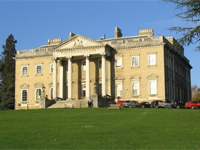
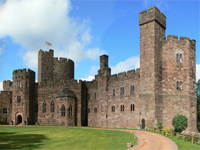
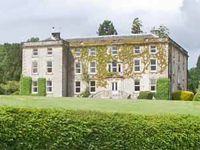
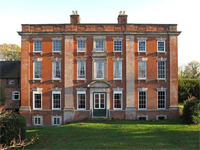
Although English Heritage have had some limited successes (e.g. Sockburn Hall, County Durham) there are still far too many houses at risk – I counted nearly 100 in a couple of searches.  It should be noted that houses are included even where works are planned or under way such as at Clarendon House, Wiltshire which was recently sold (with estate) for a reputed £30m and where restoration is expected to be completed by the end of 2010).  However, other examples include:

Others on the list include:

The head of English Heritage, Simon Thurley, said at the launch:

“Neglect is a slow, insidious process whose costly damage takes time to become clearly visible. Cuts in both private and public spending are currently inevitable but armed with our Heritage at Risk Register, English Heritage is well-equipped to guard against the loss of the nation’s greatest treasures and to suggest effective and economical strategies to protect our national heritage.”

One can only hope that this proves to be the case and that EH are able to fully fulfil their role particularly in relation to country houses and ensure that these beautiful buildings aren’t allowed to quietly slip into dereliction, depriving future generations of wonder of these grand houses.

More details: English Heritage Buildings at Risk 2010 or you can search the 2010 Register