A house and it’s garden to be reunited? Leonardslee, Sussex

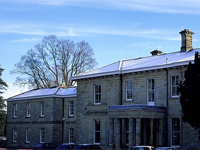
Leonardslee House, Sussex (Image: tom@picasaweb)

Often the course of the country estate over the last 100 years has been for the land to be gradually sold off, starting with the outlying areas, and moving closer until just the house and it’s immediate gardens remain intact.  At Leonardslee in Sussex the process was eventually taken one step further with the house being sold off.  This, however, may about to be reversed.

Sir Edmund Loder bought the manor house and 225-acre gardens from his inlaws in 1889 and soon opened them to the public.  Over the next five generations, the Loder family added to the planting and landscaping to create what is now one of the only 163 grade-I listed gardens in the country.  Despite the family still owning the gardens the grade-II listed Italianate manor house, built in 1853 and featuring a 900 sq ft central hall decorated with Ionic columns, was sold off separately in the 1980s and became offices.  The gardens grew in reputation so it was something of a shock when in April 2008 it was announced that they were being put up for sale by Robin Loder for £5m through the estate agency Savills.  Cleverly, the company who owned the house also announced they were open to offers at around £3.25m for the house.

The Times is now reporting that after nearly two years on the market, the gardens have been sold to a private businessman and are likely to close to the public.  They are also reporting that the house may also be under offer at £2.75m to the same businessman giving him a perfect  opportunity to once again recreate a stunning small estate which, with the addition of the house, could be worth in the region of £10m.  Though a sad day for the many garden-lovers who have made many a pilgrimage to wander among the wallabies, it’s an encouraging reversal of the trend for houses to lose the control of the landscape which so often perfectly frames them.

Full story: ‘Leonardslee Gardens to close to the public after being sold‘ [The Times]

The greatest country house you’ve never heard of: Wentworth Woodhouse

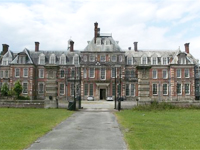
Wentworth Woodhouse, Yorkshire (Image: geograph.co.uk)

Although Britain is a relatively small island it still has the capacity to hide some spectacular buildings which, unless opened to the public, can remain a secret.  One such house, featured this week in Country Life magazine (February 17) is Wentworth Woodhouse in Yorkshire, thought to be the largest private residence in Europe and for Marcus Binney “unquestionably the finest Georgian house in England”.

Built over a 25 year period from 1724 for Thomas Watson-Wentworth, Marquess of Rockingham, it is twice as wide as Buckingham Palace and boasts over a 1,000 windows, 365 rooms and five miles of underground passageways.  The stable block appears to be a large country house but is merely the lodging for up to 100 horses. Inside the main house, the Earls FitzWilliam enjoyed a priceless art collection which included works by Titian, Van Dyck, Guido, and Raphael.

Yet this was a house to be blighted by the bitter class-war hatred of the post-war Labour government and questions of inheritance. In April 1946, heavy machinery moved into Wentworth Park to pointlessly mine low-grade coal right up to the back door of the house on the express instruction of Manny Shinwell, the minister of fuel and power.  A old-school left-winger, Shinwell was given options to save the parkland and gardens but was determined to press on despite representations from the local miners who had been very well treated by successive generations of FitzWilliams.

Once mining finished the FitzWilliams leased the house as a training college and retreated to 40-rooms but even then lived mostly elsewhere. Questions about the legitimacy of the inheritance led the last Earl to order a vast bonfire in 1972 of 16 tons of family papers, some dating back to medieval times, which burnt for three weeks.

Yet, despite its size the house escaped the fate of so many large houses in England and merely languished in obscurity.  Sold with just 30-acres in 1988 by the daughter of the last Earl it was bought by Wensley Haydon-Baillie who promised investment but in 1998 it was repossessed. It was then sold for the unbelievably low price of £1.5m (equivalent to just £7 per sq ft) to the architect Clifford Newbold whose careful restoration work has been praised and beautifully photographed in this weeks Country Life.

—————————————————————————–

*Update* May 2011 – I have written a more extensive write-up on the architectural history of the house in response to the episode of ‘The Country House Revealed

—————————————————————————–

More information: ‘Wentworth Woodhouse’ (Wikipedia)

Welsh ‘Versailles’ still awaiting saviour: Kinmel Hall for sale

Kinmel Hall, Conwy (Image: Hannells)

When Kinmel Hall was bought in March 2006 by an investment company it was almost immediately advertised on their website as a ‘a unique development opportunity’ with plans for use as either hotel, spa, offices, conference venue or apartments.  Yet, nearly four years later, this impressive mansion is still languishing without a clear future.

The Kinmel estate was bought in 1786 using the vast wealth generated for the Hughes family in the eighteenth century through their half-ownership of the copper mine in Parys mountain which generated up to £150,000 a year at it’s peak (equivalent today to about £200m measured against average earnings).  The Hughes family lived in the house already there until it was rebuilt in 1842-3 in a Palladian style designed by the famous Georgian architect Thomas Hopper for the 1st Lord Dinorben.  When this house burnt down shortly afterwards in 1848 their huge income meant that an even larger house could be built to replace it.  Designed by William Nesfield in a monumental chateau-style and built between 1871-76 it was for an age of lavish house parties and featured 52 bedrooms and accomodation for 60 live-in staff.  The Hughes family lived there until 1929 when it became a health spa, then a hospital during WWII and then a school from 1945 until a large fire forced them out in 1975.  Restored in the 1980s, it was sold several times before being purchased by Derbyshire Investments who still own it today.

The original descendants of the Hughes’ still own the 5,000-acre Kinmel estate – all that remains of their original holding of 85,000 acres they once owned across the area.  The grade-I listed Hall and the 18 acres of walled gardens would make a magical location for what ever final purpose is decided – but the important task is to determine that future.  I suppose it’s too much to hope that it will again be a family home but any sensitive use which preserves this historic house as part of Wales’ architectural heritage is to be encouraged.

More details: ‘Kinmel Hall, North Wales‘ [Derbyshire Investments]

Proposal for Trentham Hall to be rebuilt as a hotel

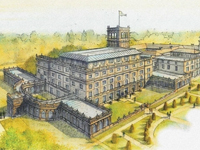
Trentham Hall proposal, Staffordshire (Image: Property Week)

One of the greatest losses in the many country houses demolished in the 20th-century was that of Trentham Hall, the Staffordshire seat of the Dukes of Sutherland.  Originally a large Georgian house, it was rebuilt and greatly extended for the second Duke in the 1830s by the famous architect Sir Charles Barry, who was also responsible for the rebuilding of the Houses of Parliament.  The house became a celebrated venue for entertaining and was filled with fine works of art and sculpture.

Unfortunately the relentless expansion of the nearby Potteries areas of Staffordshire led to increasing amounts of pollution entering the rivers which fed the lakes and gardens designed by Capability Brown. By 1898 the smell was so bad that the house was effectively abandoned by 1907.  The Duke tried to donate the house and estate to the local council  in 1905 but was rejected so in 1912 the house was demolished.

The gardens were eventually opened to the public with the remaining outbuildings sitting rather forlornly around the blank space which marked out the site of the now lost house.  The gardens had been maintained and delighted generations of locals who would walk through the extensive terraces which led down to the now clean lake.  Now the 750-acre Trentham Gardens are part of a £100m project to bring back the glory of the earlier eras, with the centrepiece being the £35m recreation of the house as a 150-room luxury hotel following Barry’s original designs.

Despite the economic turmoil, the developers, who originally planned for completion by 2011, are still hopeful that they will be able to proceed with the project.   Although the hotel will not bring back the history and unique architecture of the house, the idea of recreating a lost country house is one to be encouraged.  Although many houses were demolished, the parkland and gardens were often simply abandoned and are still visible today.  Perhaps other estates might be encouraged to look at whether a new house might be the most appropriate use of the estate – after all, this was the purpose of their creation.

Full story: ‘Trentham rebuilt‘ [Property Week]

Lowther Castle to be partially restored

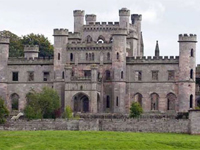
Lowther Castle, Cumbria (Image: dailymail.co.uk)

Empty since 1942, Lowther Castle was used during WWII as a weapons research lab and the grounds as a practice ground for tanks who did their best to destroy the ornaments, fountains, paths and gardens.  The house was not lived in again and in 1957 was unroofed and abandoned as a shell, leaving it as an ornament in the gardens of the 3,000-acre estate.  The castle deteriorated over the passing decades until it was overgrown and the central tower was in danger of collapse and was featured in the 2008 Buildings at Risk register. However, this decay is about to be arrested and ambitious plans are afoot to partially restore the tower and invest in the gardens and park.

An application has been lodged to restore the gardens including the kilometre-long central avenue and create an indoor garden within the shell of the house once this has been stabilised.  The work is expected to cost up to £9m but will attract 160,000 vistors a year to the attraction, generating £10m for the local economy.

Although the loss of the castle as a house is lamentable it’s encouraging to see that the shell and estate still have such value which will hopefully secure the future for this elegant building for future generations.  Who knows, one day it may be possible for the Lowthers to restore the castle and move back in?

Full story: ‘Move to restore Lowther Castle could see gardens open in 2010‘ [The Cumberland News]