A Hollandaise Source: Henry Holland’s Benham Park, Berkshire

As the costs of owning a country house mounted in the early-twentieth-century and eventually overwhelmed the finances of many families, so they sought alternative uses for their houses. Whether as a care home, school, or any of other myriad uses, few houses or their estates endured the experience unscathed. For those used as offices, the particular indignity of large, modern additions obliterated the immediate setting of a house, occasionally driving it into obscurity. Few who suffered this fate have ever escaped, yet a rare and beautiful survival – Benham Park in Berkshire – has not only escaped, but been wonderfully (partly) restored and is now offered for sale.  What is most remarkable though about this house are its connections to some of the most famous names of Georgian architecture, including Lancelot ‘Capability’ Brown, a young Henry Holland, and an even younger John Soane.

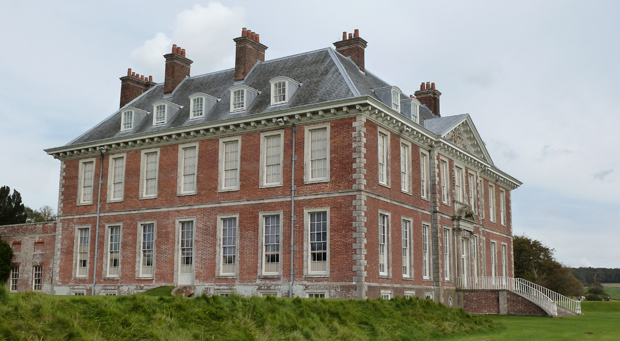
Benham Park, Berkshire (Image © Savills)

Nestled in a lush parkland, Benham Park is significant as a formative experience, in different ways, for both Holland and Soane; a house where the two would each contribute in different ways, each gaining experience which would serve them well in the future. The noted architectural historian Dorothy Stroud declared Holland ‘a designer of perception and originality’. Her tireless research underpins much of what is known about Holland and his work.

Detail of Henry Holland (1745-1806) Image © National Portrait Gallery

Henry Holland (b.1745 – d.1806) was one of the leading architects during the reign of George III. Today, his reputation has been overshadowed by his contemporaries who were more willing to engage in courting public notice, such as by exhibiting their work at the Royal Academy, which Holland never did. Chiding a friend in 1789, he stated ‘Pray no more public compliments to me. I began the world a very independent man and wish to hold it at arms length…I find myself already more the object of public notice than suits my disposition or plan of life’.

Henry Holland was the son of Henry Holland (1712-1785 – to avoid confusion, the father will be referred to as ‘the elder Holland’, any other mentions of Holland are the son) of Fulham. A successful master builder, he built many important houses in the middle years of the eighteenth-century and worked with architects such as Robert Adam, executing his alterations to Bowood in Wiltshire in 1761 and, in the same year, working at Ashridge House, Hertfordshire.  It was this latter commission which was to prove singularly important as it established a professional relationship between Holland senior and Lancelot ‘Capability’ Brown (b.1716 – d.1783), a landscape architect still revered today for his skill and imaginativeness. Brown’s particular ability was to be able to envision a whole landscape as it would be after the planting had reached maturity – to see its ‘capabilities’.

He was also noted architect, with even his rival Humphrey Repton praising the ‘comfort, convenience, taste, and propriety of design in the several mansions and other buildings which he planned’. The houses include Croome Court, Worcestershire (though the design may have been provided by Sanderson Miller), Corsham Court in Wiltshire (1761-64), Broadlands in Hampshire (1766-68), Fisherwick Park in Staffordshire (1766-74 – dem. 1814-16), Redgrave Hall in Suffolk (c.1770 – dem. 1946), Claremont House in Surrey (1771-74), and Cadland in Hampshire (1775-78 – later much enlarged – dem. c.1955).

Fisherwick Park, Staffordshire, painted by John Spyders (1786)

Although the initial connection was with the elder Holland, Brown would become central to both the professional and personal life of the younger Holland.  Although he never undertook a Grand Tour, his education was more practical, working with his father in the family business. Holland displayed aptitude and skill, taking on more responsibility but also his talent for design was becoming clear.  With his father’s connections, Holland was taken on as architectural assistant in 1771 by ‘Capability’ Brown who would, in time, hand over much of his design work to Holland, who would use these earlier designs as inspiration.  The closeness and respect between the two can be gauged by the marriage of Henry Holland to Brown’s daughter, Bridget, in 1773. Professionally, a measure of the level of joint enterprise between Colvin notes that Claremont and subsequent houses are jointly attributed to Holland.

Benham Park was an easy commission of Brown to secure, though it was likely that he was primarily thinking of his new partner when doing so. The probability that Brown would be commissioned was high as he was already working for the owner of the estate, William Craven, 6th Baron Craven (b. 1738 – d.1791), on another country house for him, Coombe Abbey, Warwickshire. Apparently under pressure from his wife, Elizabeth Berkeley, Lord Craven wrote to Brown saying ‘Lady Craven wishes to make some alterations here and to begin immediately’. Holland and Brown submitted their designs for a house in September 1773 using a similar pattern to Brown’s previous work with a neoclassical, two-storey main house with grand central portico.

Benham Park, Berkshire (Image © Savills)

The house was built between 1774-75, the final result a sympathetic marriage between an elegant yet imposing house and the Arcadian pleasures of a sculpted landscape.  Despite these fine attributes, Benham has been rather overlooked in the histories of both Brown and Holland with the latter clearly learning important lessons from one who designed with practicality in mind, but not to the exclusion of an element of drama. However, Holland was not without his own influence as Stroud notes that from the time he joined Brown’s office, the interior design evolved from a more robust Palladian character to the more restrained yet elegant style which was Holland’s hallmark. Claremont, Cadland, and Benham all display this style, indicating that although the shell of the house was more the work of Brown, the interiors were to Holland’s designs.

What’s remarkable about Holland was his almost precocious drive to build on a grand scale. Backed by his father’s capital and expertise, Holland leased in 1771, aged 26, eighty-nine acres of what is now Chelsea and Knightsbridge, including what is now Cadogan Place, and proceeded to speculatively design and build houses based around a miniature park or garden square. This high profile activity brought Holland his first major solo design for Brook’s club in Mayfair, London, a haunt of the Prince Regent and Whig aristocracy. This would lead to the Prince commissioning two major buildings from Holland; Carlton House and Brighton Pavilion. These two commissions plus Holland’s speculative building cemented his position within the highest social strata, creating future opportunities.
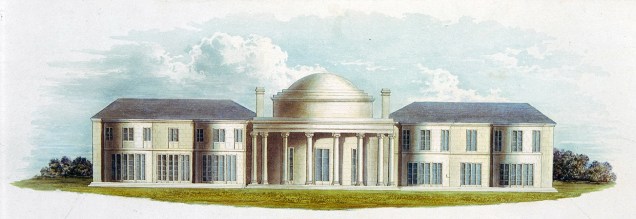
Undated print of Henry Holland's Brighton Marine Pavilion of 1786-87 (Image source Khan Academy)
Undated print of Henry Holland’s Brighton Marine Pavilion of 1786-87 (Image source Khan Academy)

Other significant commissions included the the refurbishment in 1787 of Althrop, Northamptonshire, for the 2nd Earl Spencer, including a full re-casing of the red-brick house in white mathematical tiles with stone dressings, a re-design of the gardens, and inside, a re-ordering of the accommodation including the creation of the noble triple libary, divided into sections by screens of Ionic columns. Another Whig patron was Francis, 5th Duke of Bedford, who had Holland complete some minor works to Bedford House before commissioning more extensive work, also in 1787, at his main house at Woburn Abbey. Holland was back at Broadlands in 1788 creating a new vestibule and inner hallway, the entrance marked by a new grand portico. In 1795, after a sojourn into theatres, Holland returned to grand country houses, with the rebuilding of Southill Park in Bedfordshire for Samuel Whitbread, of brewing fame. Again, as with Althorp, this was a refurbishment to the point of rebuild; the house encased, the accommodation extended and a new portico added. His last commission was again from Lord Spencer in 1801 to rebuilt his Wimbledon house, which had earlier burnt down, with a sophisticated villa in a severely plain style both inside and out. Sadly, this was demolished in 1949.
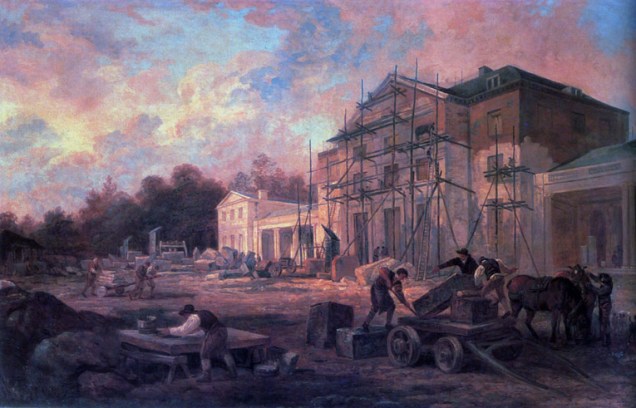
'Rebuilding of Southill' (1797) by George Garrard (Image © University of Texas)
‘Rebuilding of Southill’ (1797) by George Garrard (Image © University of Texas)

Benham Park was also important for another young, aspiring architect, Sir John Soane. As a young apprentice, Soane had joined Holland’s office in 1772 as a junior. At Benham, Soane was given the task of measuring up to create the final bills, a task he was to repeat at other locations, giving him a valuable insight into not only the process of building but also the business aspects. Although, sadly, almost all Holland’s papers and drawings were posthumously destroyed by his nephew, one of Holland’s account books is preserved in the Soane collection. Soane seems to have retained it as a valuable record and tool when setting up his independent practice. Benham therefore provided practical, aesthetic and business training to the young architect who no doubt admired Holland’s neo-classical approach before evolving his own distinctive response and style, which was to establish him as one of the leading architects of his age.

Benham Park in 1904 (detail) - note the large servants wing to the left, now demolished (Image source Stockcross History via Wikipedia)
Benham Park in 1904 (detail) – note the large servants wing to the left, now demolished (Image source Stockcross History via Wikipedia)

Benham survived largely unaltered into the twentieth-century until 1914 when the pediment was removed from the portico and replaced by a balustrade. This was echoed at the roof level where the pitch was lowered and obscured  by a pierced stone balustrade. The servants quarters were removed at the same time due to their poor condition. The house and estate remained with the Sutton baronets until 1982 when it as bought and converted into offices in 1983, with additional office blocks built next to the house. These were thankfully demolished as part of the latest restoration of the house and estate.
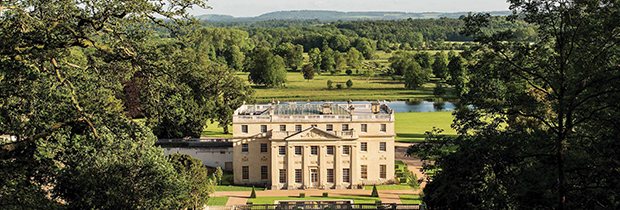
Benham Park - looking out over the lake (Image © Savills)
Benham Park – looking out over the lake (Image © Savills)

Benham Park, (Grade II*), is now offered for sale with 130 glorious acres for £26m. Inevitably for a house of such grandeur situated so close to London, there are approved plans for the house to become a ‘wellness’ centre with a huge (though thoughtfully designed) extension to the side and rear.  For me, as ever, this is a house which would be best served by being returned to it’s original purpose, that of a family home. For a new owner, they could revel in the knowledge that the house and landscape had been conceived by one of the great Georgian partnerships of Brown and Holland.  Standing under the portico today, much as where they and the young John Soane must have once stood, the latter on the cusp of his era-defining career, looking out at Brown’s landscape, they can appreciate this rare combination of architectural genius – truly a prize worth such a princely sum.


Estate agent particulars: ‘Benham Park, Berkshire‘ [Savills]

Brochure (PDF): ‘Benham Park, Berkshire‘ [Savills]

Listing description: ‘Benham Park‘ [Historic England]


Please note: Savills very kindly provided the images and brochure but had no input into the text.

A Sleeping Beauty: Ombersley Court, Worcestershire

The temptation when Country Life magazine arrives each week is to flick through the properties and make tabloid-esque comparisons about how a detached Regency villa in Dorset with space for a family, chickens, and an excitable spaniel, could be had for the price of a tatty flat in London. Yet sometimes these comparisons seem almost too unreal when faced with the exemplary beauty of a country house like Ombersley Court, Worcestershire, which, along with 39 beautifully wooded acres, has just been put up for sale for just £3.5m; the price of a 3-bed terrace house in Chelsea.

Ombersley Court, Worcestershire (© Savills)

Tucked away in a quiet corner of Worcestershire lies a house which, either through deliberate privacy or convenient obscurity, is little known to the world. Yet Grade-I listed Ombersley Court is one of the finest houses in Worcestershire, arguably even in the wider region, due not only to the sublime architecture and surrounding estate, but also the fine collection of paintings and artwork. The estate has long been the seat of the Sandys family who acquired the manor in the late sixteenth-century. The current house was originally built for the 1st Lord Sandys (b.1695 – d.1770) between 1723-26, replacing earlier monastic buildings on the site.  The house was designed by Francis Smith of Warwick (b.1672 – d.1738), one of the leading regional architects and, working with his brother William (b.1661- d.1724), ‘one of the most successful master builders in English architectural history’ (Colvin).

‘Smith of Warwick’, as Francis was more commonly known, was a clients ideal contractor due to his famous honesty and reliability, able to deliver buildings on time and on budget. His reputation spread amongst the Midlands gentry and aristocracy with almost all his work within a fifty-mile radius of Warwick.  Such was his standing that even the fractious Duchess of Marlborough (who had famously fallen out with Vanbrugh over Blenheim), demanded that for her house in Wimbledon, Surrey, ‘that Mr Smith of Warwickshire the Builder may be employed to make Contracts and to Measure the Work and to doe everything in his Way that is necessary to Compleat the Work as far as the Distance he is at will give him Leave to do’ (1732-33).

Smith’s solid reliability also manifested itself in his repetition of his well-developed plans and designs for houses, creating a distinctive style which is quite recognisable as his own. Broadly, this would be a three storey house with the centre section either projected or recessed, consistent fenestration, and relatively sparse external decoration, usually only decorative stone dressings such as keystones, quoins or balustraded parapets. This consistency was perhaps a double-edged sword, with the Hon. Daines Barrington stated in a letter in 1784, that although ‘all of them (are) convenient and handsome […] there is a great sameness in the plans, which proves he had little invention’.

Yet, this is to overlook that Smith was, at heart, a successful commercial builder whose understanding and appreciation for architectural ornament and variety was inevitably tempered by his determination to deliver the commission on time and on budget. As the architectural historian Sir Howard Colvin highlights, the core design is that of a standard seventeenth-century house such as Belton House, Lincolnshire, but with stylistic updates as fashions evolved.  ‘Smith’ houses such as Umberslade, Alfreton, and Wingerworth all share this readily accessible style, one which married domestic practicality with exterior grandeur.

Perhaps Smith’s greatest achievement was the tragically now-ruinous Sutton Scarsdale, Derbyshire; a house with a facade so stately as to rival Chatsworth. Built for the 4th Earl of Scarsdale in 1724, Sutton Scarsdale was one of the finest houses in the country. Although the form is familiar, the masterful control of a palisade of pilasters and columns topped with Corinthian capitals, gives it a gravitas, whilst the detailing such as the scrolled window surrounds to the projecting wings hint at Renaissance motifs; Fausto Rughesi (Santa Maria in Vallicella, 1605/06) filtered through William Talman (design for Thoresby House, 1685, – shown in Vitruvius Britannicus, C1, Pl.91) and James Gibbs (to whose designs Smith was building Ditchley Park, Oxfordshire, 1722).

derbyshire-Sutton_Scarsdale_Hall_circa_1900

One regret with Ombersley Court is that although the form and plan of the house and much of the superb unaltered early-Georgian internal decoration is still Smith, the exterior is now not his. The original design featured a hipped roof, and what looks to be pilasters, giving it the recognisable ‘Smith’ characteristics.  This was lost when the existing brick was refaced with ashlar in 1809 by the architect John Webb for Mary Sandys, the Marchioness of Downshire. In fairness though, this was a lucky escape as John Nash prepared a much more ambitious scheme in 1808, which proposed adding a two-storey pavilion to each side, linked by a seven-bay screen of giant Ionic columns, though this seems to have been rejected on cost.

Ombersley Court - proposed alteration by John Nash, 1808
Ombersley Court – proposed alteration by John Nash, 1808

One of the glories of the house are the interiors and especially the plasterwork and carving. With a desire for privacy which was rarely breached, few had seen the exceptional decorative work, except through the lens of a Country Life profile by Arthur Oswald in 1953. This extolled the virtues of many aspects including The Chippendale Room which featured bamboo framed silk wall pieces, remarking that ‘it is uncommon to find a Regency example as complete as this or as charming’. The rest of the house struck a careful tone of stately refinement; enough decoration to proclaim wealth and taste, but never excessive.

Ombersley Court - Hallway (© Savills)
Ombersley Court – Hallway (© Savills)
Ombersley Court - Drawing Room (© Savills)
Ombersley Court – Drawing Room (© Savills)
Ombersley Court - Morning Room (© Savills)
Ombersley Court – Morning Room (© Savills)

With the death of Lord Sandys in 2013 the house passed to Lady Sandys but following her recent death, concerns were raised and rebutted via letters in Country Life that this wonderful house would be forced (for complicated reasons) to become a care home; a fate which would have despoiled this jewel of a house. Instead, for the first time since it was built in 1724, it has been placed on the market. This is a house created by one of the finest craftsmen of the early-Georgian period, with connections to a wider, distinct Midlands architectural tradition which epitomises all that one would hope to see in a country seat. As an important house which deserves respect, one hopes that the new owner will appreciate this remarkable situation and that perhaps the best approach would simply be to buy the house and contents and perhaps another couple hundred acres to truly secure an Arcadian ideal, one which would be hard to better anywhere in the country.


Sales particulars: Omblersley Court, Worcestershire [Savills] – £3.5m with 39 acres

Listing description: Ombersley Court, Worcestershire [British Listed Buildings]

An Indian takeaway: Sezincote, Gloucestershire

We long for an ‘Indian Summer’, whilst sitting in a bungalow drinking tea, eating curry followed by a sorbet and later having a toddy and going to bed in our khaki pyjamas. There are many words, phrases, foods and customs Britain has adopted from our interactions with India, but strangely, despite its strong and vibrant architectural history, the tide of architectural style has been largely one way; Western traditions flowing east, with only scant examples of the ebb bringing Indian influences back. Except, that is, in one small corner of Gloucestershire where the remarkable Sezincote stands as a unique monument to the influence of India – but also leaving the question as to why the Indian (also known as Hindoo or Mughal) style failed to find wider acceptance.

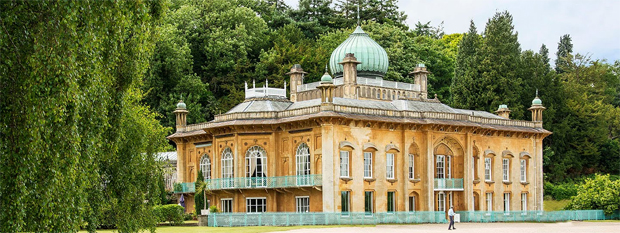
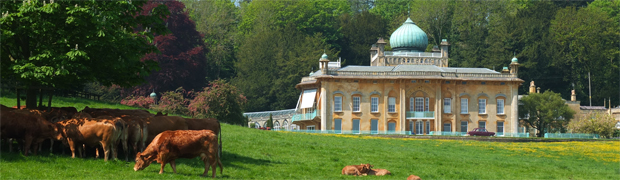
Sezincote House, Gloucestershire - entrance front
Sezincote House, Gloucestershire – East Front

UK country houses have always been a magnet for other influences, the interiors vying with each other to embody ‘fashion’ and be seen to reflect the culture and stature of the owners.  With the advent of travel, particularly what would become recognised as the Grand Tour, architectural styles from across Europe including Roccoco, Classical, Baroque and Palladianism would also find a ready home, being easily adaptable to the English physical and intellectual climate.  Further afield, imperial trade in the late 17th-century carried home Chinese, Persian and Indian influences and evidence of both can be widely found in porcelain, furnishing, fashion and art. Daniel Defoe noted Queen Mary’s ‘love of fine East India calicos‘ which led to an increased popularity for imported textiles, much to the chagrin of domestic mill workers.

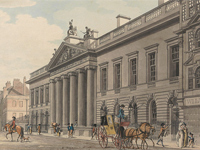
"East India House" by Thomas Malton the Younger (1748-1804), (Wikipedia / Courtesy of the Paul Mellon Collection, Yale Center for British Art, Yale University, New Haven, Connecticut.
“East India House” by Thomas Malton the Younger (1748-1804), (Wikipedia / Courtesy of the Paul Mellon Collection, Yale Center for British Art, Yale University, New Haven, Connecticut.

Behind this trade was a British firm which grew to wield power never equalled and with an ability generate wealth in a way few have; the East India Company (EIC).  On the strength of resurgent national confidence following the defeat of the Spanish Armada in 1588, merchants gained permission from Queen Elizabeth I to sail to explore the opportunities of the Indian Ocean, with the first ships sailing in 1591. After three abortive attempts, they succeeded in 1600 and the Queen granted the newly formed EIC a 15-year monopoly on trading with the East Indies. After besting their Dutch, French and Portuguese competition both militarily, diplomatically and eventually financially, by the mid-1700s, control of trade in India was under the control of the EIC.

This control was exercised through the EIC’s own staff and enforced by its private army creating a pseudo-state-like entity which offered the chance for rank, prestige and to create a fortune. Back in Britain, many looked at the usual prospects of joining the clergy, law or military service as a dim comparison against the possibilities of India.  As the financial opportunities of India became apparent, so the attractiveness of a position there increased amongst the aristocracy who came, saw, and administered, with the intention of taking their new fortunes home to establish themselves or boost their status in society.

Yet, from an architectural viewpoint, for all the interaction and extended immersion in the rich Indian culture, the complex and beautiful architecture was largely ignored as an appropriate style for country houses back in Britain. This was in stark contrast to the European styles which came back to Britain, like burrs on the coat-tails of the aristocratic Grand Tourists. This makes the domed, florid Sezincote, nestled deep in the Gloucestershire countryside all the more exceptional.

Originally a small 15th-century manor house, it was bought by the Earls of Guildford in 1692 and survived largely unchanged until bought by Colonel John Cockerell in 1775 – but he was not the author of the final version of the house. Sir John was a friend and had been part of the military staff of Warren Hastings, the former Governor-General of Bengal, who was building his own house at nearby Daylesford, and Cockerell probably had the help of his friend, or at least his agent, William Walford, in selecting the estate. In 1797, Cockerell wrote to Walford saying ‘I have many conceits and fancies in regard to Seasoncote [his spelling] for a residence…‘. In reality, the plans were a conventional Georgian remodelling with Sir John looking for someone to complete ‘the plain sort of work I shall mostly want‘. Building work was well under way by 1798 but at the end of the year came to a rather unexpected stop with the death of Sir John.

The half-finished house was inherited equally by his brothers, Charles and Samuel, and his sister. Charles had also made a fortune in India through a combination of official positions and private trading and, having bought out his sibling’s shares in the house for a total of £38,000, decided to embark on a much more radical vision. Seemingly unconstrained in his imagination, Charles decided (in collaboration with Thomas Daniell and his nephew William, the famous painters Indian topographical pictures), to clothe his Georgian house in full Indian robes.

Indian fireplace, Daylesford House, Gloucestershire (Image from 'Country Houses of Gloucestershire' by Nicholas Kingsley (1992, Phillimore & Co)
Indian fireplace, Daylesford House, Gloucestershire (Image from ‘Country Houses of Gloucestershire’ by Nicholas Kingsley (1992, Phillimore & Co)

The architect for this grand plan was S.P. Cockerell, his brother, whom Colvin described as ‘original and inventive‘ and this commission would certainly give free reign to both those attributes. Interestingly, this was not Cockerell’s first experience of designing with Indian motifs as he had been employed in 1789-93 to remodel the nearby unfinished Daylesford House, the newly acquired seat of the controversial former Governer-General of Bengal, Warren Hastings. Facing numerous charges of embezzlement, cruelty and abuse of power from 1788-95 (of which he was later cleared), perhaps unsurprisingly the exterior does not laud his Indian experiences, except for a hint in the west front which features a curved bay topped with a copper dome with a ball and spike decoration. Inside, although Hastings owned an exquisite set of gilt ivory Indian furniture, the decoration was restrained though it featured a remarkable fireplace, carved by Sir Thomas Banks in 1792, which depicts an Indian sacrificial scene and Indian female figures on either side.

Daylesford House, Gloucestershire (Image © altitudepix.co.uk)

At Sezincote, Cockerell had a much less restrained brief and so was able to fully embrace the Indian architectural language but whilst still firmly rooting it in the ideal of the Picturesque – that ability to surprise. The design though is not just collection of Indian forms and details; this is a house built at a time of great interest in this new culture and with a client both well versed in the country and its buildings and with a genuine respect for them. Drawing on both Muslim and Hindu motifs, it reflected such impressive buildings as Humayun’s mausoleum of Emperor Akbar’s mother in Delhi (especially the roof shape of the small turrets), and Sezincote’s entrance front bears some echoes of Akbar’s own mausoleum with the double-height arch.

East Front, Sezincote (Image © Cotswold Journeys)

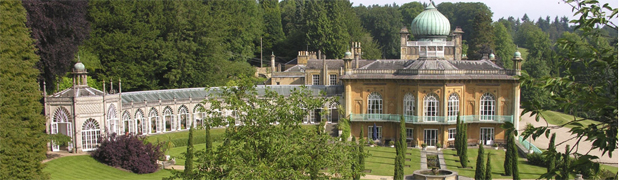
The south facade is the most playful and graceful; a delicate blend of Anglo-Indian to create something unique in British architecture.  Dominated by a canted bay, the windows are shaped into peacock fantails such as seen in the Jaipur palaces, the chajja or wide over-hanging eaves create shade, with the corners punctuated by chattris, or small minarets, the green balcony railings imitating Indian jali work. The main dome is striking in both its shape and dominance whilst still being proportional to the overall design. The main house then joins the grand curved sweep of the Orangery (possibly to follow the landscape, possibly shaped like a scimitar), with its continuation of the peacock windows, terminating in an elegant pavilion.  It should be noted that the interior was pure Greek Revival, again emphasising the application of Indian design being in the Picturesque tradition of decoration, rather than slavish copying.

Orangery and Pavilion, Sezincote (Image © Sezincote Estate)

Fashion being what it is, news of the building of this extraordinary house travelled far, even reaching the Prince Regent.  The earlier popularity of William Hodges ‘Select Views in India’ (1783) and the six volumes of Daniell brothers ‘Oriental Scenery‘ watercolours (completed 1808), this helped created the brief flourishing of the Anglo-Indian style.  The Prince Regent, ever one for fashion, visited the still unfinished Sezincote in 1807 (probably at the suggestion of Humphrey Repton who was working there) and was so duly taken with this fantasy (supported by one of Repton’s famous Red Books), he resolved to indulge as well and so his new pleasure retreat in Brighton externally adopted the same, creating the iconic Brighton Pavilion.

Hindoo Temple, Melchet Park, Wiltshire c.1800 (Image © British Library)

However, the Anglo-Indian fashion failed to gain widespread popularity beyond the ephemeral (and hidden) interior decorations and fabrics. Architecturally, there were a few examples. In the City of London, George Dance the Younger created one of the early Indian-Gothic designs in 1788 with his entrance to the south front of the Guildhall. Dance also added unspecified Indian elements to Stratton Park, Hampshire (built 1803-06, dem. 1963) for Francis Baring (who made a fortune with the EIC) and at Coleorton Hall, Leicestershire (built 1804-08). It made appearances in various architectural pattern books (e.g. Robert Lugar and Edmund Aikin), leading to some quite isolated ancillary buildings appearing to be influenced by it; a Hindoo temple at Melchet Park, Hampshire, (c.1800) and further afield such as in Ireland with the Copper Lodge, Portlaw, (probably built 1820s, dismantled 1970s), and the Dromona Gate, Co. Waterford, built in 1861.  Back in England, perhaps the most impressive was the dramatic conservatory at Enville Hall, Staffordshire, built in 1854, which mixed Gothic and Indian, and which was sadly blown up for demolition practice during WWII.

Conservatory, Enville Hall, Staffordshire (Image © Historic England)

So, despite the inventive opportunities, the widespread cultural exposure and even an element of Royal patronage, why did the Anglo-Indian style not become more popular for country houses?

Probably the most influential element was timing – but also a number of other more negative factors. Fashion is part inspiration, but also heavily dependent on there being a space in popular taste for it to expand into. Although Britain had been involved in India since 1600, achieving the dominant position had been a struggle with a heavy price paid by all participants; financially, militarily but also directly in the mortality rates of the colonial staff sent to this still largely unknown place.

Often, those who were sent to make their fortunes in India were second or third sons, who may have been in the shadow of their elder brother who stood to inherit.  Although the position of Viceroy was considered a significant honour, it was sometimes coveted for the financial advantages it offered to the incumbent: the substantial salary, the state-funded lavish lifestyle and the chance to rent out your own home back in the UK. Also, unless they made their own significant fortune, their time in India was perhaps considered an exotic distraction, possibly combined with ‘moral’ difficulties, considering the stories of the taking of local ‘wives’ and the adoption of local dress and customs, as reflected in the pejorative phrase of ‘going native‘. The ongoing military operations, the accusations of mismanagement, and the reports of massacres by both sides can only have added to the sense that Indian culture and British involvement was not one to be celebrated.

From an architectural perspective, just at the time that the EIC had established its dominance in the mid-18th century, the popularity of Chinoiserie was in ascendance, boosted by Thomas Chippendale’s ‘The gentleman and cabinet-maker’s director‘ (1754) and the architect William Chambers’ influential book ‘Designs of Chinese Buildings, Furniture, Dresses, Machines and Utensils‘ (PDF, 15mb) in 1757.  As mentioned before, this fashion culminated in the Prince Regent’s Oriental extravagance, the Brighton Pavilion, completed in 1823, inspired by Sezincote.  However, the unpopularity of the Prince may well have meant that what he favoured, was unfashionable. As fashion was swept along by Gothic Revival and Neo-Classicism, the Anglo-Indian style was politically difficult, architecturally challenging, and increasingly unattractive.

'Designs of Chinese buildings, furniture, dresses, machines, and utensils' - William Chambers (1757) (© Warburg Library)
‘Designs of Chinese buildings, furniture, dresses, machines, and utensils’ – William Chambers (1757) (Image © Warburg Library)

This makes Sezincote all the more remarkable; the determined vision of Charles Cockerell, an educated man who revelled in his experience in the beauty of India, realised with great care and skill. It is also a reminder that architecture is often a product of fashion and both are closely linked with wider society. Today though, thanks to the loving restoration of the Kleinwort family, who bought the estate in 1944, both the house and gardens have been restored back to their former glory; a vision of India, unique in the UK.


For a more in-depth history:

To see Indian influences in the UK:

  • Sezincote, Gloucestershire – gardens often open, house used for events.
  • Powis Castle, Wales – former home of a Viceroy with extensive collection of artifacts.
  • Elvedon Hall, Suffolk – if you can get in on a rare visit, Elevedon was once owned by the Maharaja Dulap Singh and has some impressive Indian rooms added in the 1890s.

Why the long gap between posts?

I last posted in May 2015 on the devastating fire at Clandon Park. In June, I then moved house with the expectation that after a couple of months I’d be unpacked and able to start again. Unfortunately, as with any house, the renovations took far longer than expected (and it’s only a small 1930s semi!) and I’ve had to be very hands-on. More significantly, my father, who had been ill for a while, deteriorated in January and sadly passed away. This blog, in part, exists because he fully supported my interests and enabled me to start collecting books to indulge my passion for country houses, so, for this and many other reasons, I will always be grateful to him.

Reflections on the loss of Clandon Park, Surrey

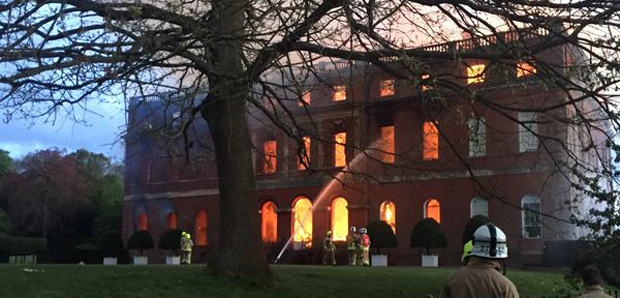
Loss is mainly regret that we will never see something, or that we have known it and will never see it again.  Where the loss is of something of beauty, which embodied ideas, history, culture, it takes on many facets. Fire is a destructive, cruel enemy, consuming all in its path; caring not for the value – either great or small – simply taking whatever it can as fuel for its avaricious need to grow. On 29 April 2015, as the fire at Clandon Park took hold we hoped for the best – yet sadly, less than twelve hours later, all that remained was a gaunt, blackened shell. The loss was not just the building and its beautiful interiors and contents, but also what it represented to UK architectural history.

Clandon Park, Surrey (Image: Matthew Beckett)

News breaks now on social media, the first photos and reports of huge plumes of smoke spreading much as the flames did; slowly at first, rapidly growing. Quickly it became clear that the fire had reached the roof and that the rooms on the ground floor of the south side had already gone – the Green Drawing, Palladio, Hunting, Prince Regent.  Each a small gem in themselves, their contents the result of decades of collecting and curation. As the floors above collapsed, it became clear that this was a very serious situation and thoughts immediately are to hope that, first, everyone is safe, but, secondly, how far would the fire go? Sadly, it soon became clear that the entire house was to be consumed in the inferno.

Clandon Park on fire, 29 April 2015 (Image: © Andrew Blondell / BBC Surrey)

Why was Clandon Park important? It wasn’t just the history and collections.  Most importantly, the design of the house was a key transitional link between two defining periods of British architectural history; the Anglo-Baroque and the Palladian. The house, both interior and exterior, was designed by a Venetian architect, Giacomo Leoni, and built between 1723-29.  Both the architect and the dates are key to understanding why the house was so significant.

Clandon Park on fire - two-thirds of the house was now on fire (Image: © Oliver Dixon)
Clandon Park on fire – two-thirds of the house was now on fire (Image: © Oliver Dixon)

Giacomo Leoni (b.1686 – d.1746) played a key role in bringing the ideas of Palladio to the UK through the publication of that architects’ ‘I Quattro Libri dell’Architettura (which he called ‘The Architecture of A. Palladio, in Four Books’). Although not an entirely accurate recreation (Leoni wasn’t above adding his own improvements) the instalments (published between 1715-20) were a huge success, casting the ideas of the Palladian ideal deep into the aspirational hearts of the British aristocracy.  Leoni’s edition remained the primary source of the nascent Georgian Palladianism until (prompted by Lord Burlington) Issac Ware produced a more accurate translation in 1738.

Clandon Park on fire - the flames reached the north side (Image: © Alex Greenwood)
Clandon Park on fire – the flames reached the north side (Image: © Alex Greenwood)

For all his intellectual influence, Leoni’s physical output was relatively meagre for a 45-year career – his earliest designs were for an unexecuted rebuilding of Wrest Park in August 1715 for the 1st Duke of Kent. His first completed work was in London in 1721, Queensberry House, 7 Burlington Gardens, for John Bligh, Lord Clifton, which featured an antique temple front, a reduced version of which appears on the south front of Clandon Park. Leoni’s output was mainly country houses; he designed eleven but only nine were completed (the two unfinished houses being Carshalton Park and Thorndon Hall) of which four have been lost already (Moulsham Hall – dem. 1809, Bold Hall – dem. 1901, Burton (or Bodecton) Park – fire 1826, and Lathom House – dem. 1929/1955).

Comparison of Leoni's 7 Burlington Gardens and south front of Clandon Park (Image: 7BG: Wikipedia / Clandon: Matthew Beckett)
Comparison of Leoni’s 7 Burlington Gardens and south front of Clandon Park (Image: 7BG: Wikipedia / Clandon: Matthew Beckett)

This left just four completed house which survived into the 21st-century; Lyme Park (c.1725-35), Alkrington Hall (1735-36), Wortley Hall (1743)- and Clandon Park (1723-29).

The brilliance of Leoni’s design for Clandon had survived almost unchanged as it had remained in the Onslow family until being handed to the National Trust in 1956. Where Clandon excelled was that the exterior was early-Anglo-Palladian; chaste, restrained decoration, subtle temple motif, but this was married with one of the greatest of the Anglo-Baroque rooms, the Marble Hall (the plasterwork of which Sir Simon Jenkins thought better than the similar room at Houghton Hall), and other rooms rich in beauty. This contrast between the quiet exterior and the exuberant interior is what made Clandon so important as the link between two of the most significant trends in British architectural history.

Marble Hall, Clandon Park (Image: Matthew Beckett)

So, what next? The incredible staff and volunteers of the National Trust swiftly put into place the plans they never hoped to have to use and clearly, the efforts are being directed to the care of the salvaged contents and an examination of what can be recovered from the debris.   Investigations will be undertaken and conclusions reached as to the cause but looking to the future the options are the same as ever; rebuild, re-use, or ruin.

Marble Hall, after the fire (Image: © John Millar / NT Picture Library)

As a nation, we have fetishised ruins for centuries with castles, abbeys, fortifications and now factories celebrated for their managed decay. We have enough derelict country houses (far too many, truth be told), so to consign another to that sad, lonely fate would miss the chance to grasp a recoverable beauty and miss the opportunity to demonstrate and inspire through an educational process around the reconstruction.

The Landmark Trust’s inspired recent work at Astley Castle, Warwickshire, to create a modern living space in a shell created by a fire in 1978, shows that ruins can be re-used intelligently and with great aesthetic success.  However, Astley Castle was a smaller house and also without the spectacular interiors which once graced Clandon Park.

Uppark, Sussex (Image: © Matthew Beckett)

So the remaining option is rebuilding and restoration.  As has been shown at Uppark, Sussex, which also suffered a serious (though not quite as devastating) fire in August 1989, it is possible to restore the house back to as it was before.  This is not pastiche as it’s not conjectural – we have extensive, detailed records of the interiors and, combined with salvaged fabric, it is possible to recreate what was there.  As Sir Simon Jenkins argued in the Sunday Times (03/05/2015), it would be unthinkable not the reinstate the great Marble Hall – because we can.

Modern care and conservation means that the rate of losses of country houses has dropped from the hundreds each year in the 1950s to barely a handful and these are almost always due to fire. All those we have – that which survived this far – are fragile and it’s an uncomfortable truth to understand that they will not last forever.  As the painter Salvator Rosa once wrote:

All our works is fallen and sicken
Nothing is eternal
The Colossei die, the Baths
The worlds are dust, their pomp a nothing…

Rather than despair, we should celebrate and enjoy the architectural heritage which is still available to us and care for it for future generations. The original Clandon Park is lost; that patina of age, the individual details which only it knew are no more. Although the contents have been largely lost, resurrection is the most appropriate option as the main shell of the house has survived – the sterling work of the fire service has saved at least one half of Leoni’s vision. Modern craftsmen with ancient crafts, honed at Uppark, Hampton Court, and Windsor Castle, can recreate the beauty of the interior.  It won’t be the original but from our shock at the loss can come awe at the artistic skills that can recreate such wonders as the Marble Hall.

———————————————————————————

Gallery of images of the aftermath: ‘Clandon Park fire 2015‘ [National Trust Picture Library]

Statement: ‘Fire breaks out at Clandon Park, Surrey‘ [National Trust]

Purchasing the picturesque: Hampton Court and Lasborough Park for sale

Hampton Court, Herefordshire - £12m, 935-acres (Image: Knight Frank)
Hampton Court, Herefordshire – £12m, 935-acres (Image: Knight Frank)

What is beauty? Though it is often in the eye of the beholder, some have attempted to define just what it is. In architecture, this can be seen in the development of the Picturesque ideal which sought to combine natural and man-made elements to compose a vision which would delight the eye and uplift the soul. Hampton Court in Herefordshire, and another house launched this week, Lasborough Park in Gloucestershire, can both be considered part of the Picturesque movement, even though the former took shape before the theory of the sublime and beautiful was brought to life and the latter was built just before the revival took hold.

'Landscape with Narcissus and Echo' - Claude Lorrain, 1644 (Image: National Gallery)
‘Landscape with Narcissus and Echo’ – Claude Lorrain, 1644 (Image: National Gallery)

The origin of the Picturesque movement can, in part, be found in the philosophical writings of a much under-rated figure of the 17th-century, Anthony Ashley Cooper, the third Earl of Shaftesbury.  To him, nature ought to be imperfect and that, in turn, we ought to celebrate the untamed trees and serpentine rivers, those dark glades and tumbling crags. Unsurprisingly, the Earl found that the early Italian landscape paintings by Nicolas Poussin, Gaspard DughetClaude Lorrain and Salvator Rosa, reflected best this vision of a wilder natural world.  Landscapes had been unfashionable when Lord Shaftesbury first arrived in Italy in 1686, but by the turn of the century, they were in high demand amongst the grand tourists who carried these canvases back to the UK and into the popular taste of the nation.  These views married with Vanbrugh‘s early call in 1705 for a more natural approach to landscaping at Blenheim Palace, but found its true champion in William Kent in the 1730s, especially in his work at Rousham, Claremont and Stowe. The ideas were then developed further in 1757 in Edmund Burke’s ‘The Origin of our Ideas about the Sublime and the Beautiful‘ which, in its musing on aesthetics, distinguished between the latter, which was all about smooth lines and bold colours, whereas the former is about an awesome beauty on an almost fearful scale.

The death of Lancelot ‘Capability’ Brown in 1783 created a vacuum which led to the revival of the debate as to the most tasteful approach to landscaping.  The arguments were largely between Humphry Repton (who defended Brown’s ‘contrived natural’ approach of smooth curved borders and sweeping lawns which ran right up to the house) versus Sir Uvedale Price, 1st Baronet (b.1747 – d.1829), author of the ‘Essay on the Picturesque, As Compared with the Sublime and The Beautiful’ (1794), who, along with Richard Payne Knight, sought to create a more ‘robustly natural’ approach, where blasted tree stumps and ruins were also important.  This mirrored the first wave of the Picturesque to some extent, but this later flourish created a new passion to rediscover the beauty of the same painters whom Lord Shaftesbury had admired decades earlier.  Although neither Price or Knight worked on any gardens other than their own, their ideas were to have a dramatic impact on the settings of country houses, which were now considered as part of the overall composition rather than separate from it; formal gardens were swept away and snaking carriage drives now swept visitors through glades and past vistas before their arrival.

Detail from 'The Southeast Prospect of Hampton Court, Herefordshire' by Leonard Knyff, c1699 (Image: Wikimedia)
Detail from ‘The Southeast Prospect of Hampton Court, Herefordshire’ by Leonard Knyff, c1699 (Image: Wikimedia)

The grand formalism of the gardens of Hampton Court c1699 (above) contrasted with the asymmetrical grouping of the house. ‘The Southeast Prospect of Hampton Court, Herefordshire‘ by Leonard Knyff, shows how the grounds were a vision of control; of formal avenues and canals (see also the companion North prospect view). The house was, at this time, owned by the Coningsby family, having been bought by Sir Humphrey Coningsby in 1510 from a fellow courtier. His son became the first Earl of Coningsby and it remained in their family for 300 years.  Sir Richard Arkwright (1732-1792), who famously made his fortune from bringing the industrial revolution to the cotton industry, bought the house and 6,220-acres in 1810 for £226,325 (approx. £6.2m). His son, also Richard (1755-1843), made another fortune, before inheriting from his father in 1792, and invested in significant country houses, one for each of his five sons. However, the most significant changes came under his (fourth) son, John, who decided that ‘…of all the situations I know, there is none which suits my taste so well as Hampton Court‘ (funny that). After John’s marriage, the requirements of a growing family persuaded his father that the house needed to be enlarged.

The man chosen to design the work was Charles Hanbury-Tracy, a gentleman architect who had built his own home, Toddington Manor, between 1819-40, in his favoured ‘gothic collegiate’ style at a cost of £150,000 .  Though the style was sympathetic to Hampton Court, the relationship between architect and client became difficult. Another architect, John Atkinson, had pleaded with Hanbury-Tracy not to ‘make Hampton Court a cell to the Abbey of Toddington‘ but his determined views were at odds with Arkwright’s wife, who fell out with Hanbury-Tracy over the nursery arrangements, which led to nearly a decade of alterations and disagreements, especially as the costs mounted to eventually total over £30,000. John certainly preferred working with Joseph Paxton, who created the new conservatory, which was added in 1845-46. That said, the end result is one which successfully married old and new, creating a successful interpretation of domestic gothic and the picturesque.

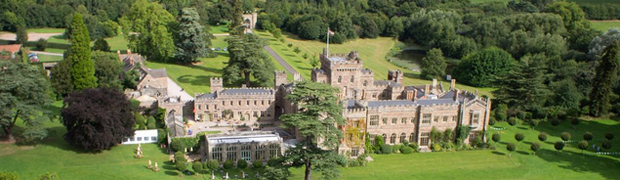
Lasborough Park, Gloucestershire - £12m, 55-acres (Image: Savills)
Lasborough Park, Gloucestershire – £12m, 55-acres (Image: Savills)

The Picturesque was a constant presence throughout the 18th-century but enjoyed a revival of interest in the 1790s and Lasborough Park represented the style just at the cusp of this.  Built in 1794 for Edmund Estcourt, his architect was James Wyatt, who enjoyed a rare skill in being able to master a number of different architectural styles – something which led later to his being unjustifiably underrated.  At Lasborough, Wyatt provided a continuation of the theme which John Martin Robinson in his book on the architect called a ‘toy-fort model‘; that is, a symmetrical house with battlements and corner turrets.  Wyatt had been using this pattern when working on various schemes for remodelling the interiors of Slane Castle since 1773 but it was only over ten years later that he was able to remodel the exterior, taking an irregular L-shape and bringing symmetry by adding matching towers.

Slane Castle, Co. Meath (Image: Slane Castle)

Wyatt’s design developed the tradition of the castellated residence; houses which had been either adapted from an older fortification or made to look like they might have done. Six decades before Wyatts’ work at Slane Castle, earlier versions, such as Howth Castle, Co. Dublin, which was altered significantly in 1738, are evidence that the style was already favoured and also incorporated an effort to create symmetry with the original keep on the left, mirrored in a new tower on the right.

The Picturesque style was popular in Ireland but initially as an import of the Protestant aristocracy and was viewed by some as an attempt to import a ‘little England’, a form of architectural and landscape colonialism. However, Ireland was particularly suited to the forms of the Picturesque which often worked in harmony with its natural beauty to form a unified creation which led the eye of the visitor from the grounds near the house, towards the middle distance, and then out to the wider landscape – much as a painter would structure their picture.

Hampton Court from south west (Image: Knight Frank)

Hampton Court is one of the most important and impressive country houses to come to the market this year.  As part of our heritage, it embodies architectural developments which brought the country house from fortification to domestication, with a landscape which started with formal terraces but finished with flowing lawns.  The genesis of the more structured medieval revival form of Lasborough Park can be seen in the core of Hampton Court and in each of the subsequent alterations.  Both houses are valuable pieces of the nation’s architectural record and deserve owners who will appreciate them and hopefully both will remain as single family homes, enjoyed as they have for generations, for their Picturesque beauty.

——————————————————————-

For a more in-depth history of the Arkwrights and their time at Hampton Court, I recommend: ‘Champagne & Shambles – The Arkwrights and the Country House in Crisis‘ by Catherine Beale [Amazon]

Sales details:

Articles: