The estate office: country houses as corporate headquarters – and Barrington Hall, for sale

Barrington Hall, Hertfordshire (Image: Hamptons)

In many ways, a country house was often the headquarters of a business relating to both the estate and the affairs of the family who lived there.  This role was to be mirrored in the latter half of the 20th-century as firms sought to adopt the prestige of stately homes and set up their offices in the many country houses which were then available. What grander statement could a company make to clients and investors than to invite them to visit their stately offices?  Yet times changed, and over the years companies found it harder to justify such lavish accommodation, leading to a steady trickle of houses being sold – and the latest is Barrington Hall, Hertfordshire.

Shalford Park, Surrey (Image: (c) Allianz Insurance Plc via Shalford Village)
Shalford Park, Surrey (Image: (c) Allianz Insurance Plc via Shalford Village) – click for an excellent history of the house

The Second World War ushered in the modern era of offices in country houses.  With little by way of aerial bombing, few firms saw the need to move out of London and other cities in World War I, however, this danger had dramatically increased by 1939.  Faced with the significant logistical challenges in moving their vital paper-based records and operations, the late 1930s saw a number of companies actively scouting out possible alternatives, with country houses an ideal choice due to their size and seclusion.  This new lease of life enabled some houses to escape the demolisher’s pickaxe, such as at Shalford Park in Surrey.  A solid, well-proportioned Georgian house, the result of a rebuild of an older house in 1797, had been sold to Guildford Borough Council in 1938, but primarily to protect the land from development, with the intention that the house be demolished.  However, a lease was granted to the Cornhill Insurance Company (later part of Allianz Inc) who moved there in 1939, creating dormitories on the upper floors.  Cornhill were to remain at Shalford Park until 1955, but unfortunately the condition of the building had significantly deteriorated, and combined with it being in the ideal location for a new local water treatment works, meant that the house was demolished.

Wrest Park, Bedfordshire (Image: English Heritage)

One house which fared only slightly better from this type of arrangement was the beautiful Wrest Park, Bedfordshire.  A fanciful French château, it was built in the 1830s to the accomplished designs of the owner, Thomas de Grey, 2nd Earl de Grey, and features some of the finest, and earliest, Rococo Revival interiors in the country – of particular note is the spectacular staircase.  The house was sold in 1939 for £25,000 by John G. Murray to the Sun Insurance Company (later Sun Alliance) who bought it in anticipation of war. They promptly moved there from London once war had been declared, having made plans to ‘…alter the stable block and erect huts in the grounds for sleeping quarters, together with washing facilities and air-raid shelters … the stable block was the first area to receive our attention. The whole of the East Wing and the upper storey of the West Wing were to be converted for sleeping accommodation with toilet and washing facilities. The middle connecting section was also to be similarly altered, but it was later decided to make part of the upper storey into a communal long room.‘. Such scenes were undoubtedly repeated in many a country house – though such a use was preferable to the treatment meted out at the hands of enlisted men or children.
Cranbury Park, Hampshire (Image: Angus Kirk via flickr)

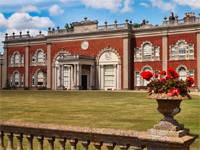
Other houses had the good fortune to secure relatively benign tenants for the duration of the war. The imposing Stratton Park, Hampshire, was built between 1803-06 by George Dance the Younger for Sir Francis Baring, Lord Northbrook, a founder of Barings Bank. Although it had been sold following the death of his descendent, Francis Baring, 2nd Earl of Northbrook in 1929, the house was bought back by Barings Bank in 1939 as their base for the duration of the conflict (though sadly it was demolished in 1960 by a later Baring who had bought it after the war).  The choice of house was possibly influenced by the fact that the Bank of England had decamped to the nearby beautiful Cranbury Park, also in Hampshire – and, coincidentally, also designed by George Dance the Younger, but built in 1780.  This little known house, still lived in today by the Chamberlayne family who commissioned it, has particularly impressive interiors; the hall and ballroom were described by Pevsner as an ‘unforgettable experience‘. Compared to the horrors of the bombing in London, what a strange pleasure it must have been to be stationed in such an environment.

Banqueting House, Wrest Park, Bedfordshire (Image: English Heritage)

The extensive alterations to even such an important house as Wrest Park indicated the level of damage such intensive use could bring to buildings which had not been designed for such a purpose.  The post-war era held many threats to country houses and use as offices saved many from the wave of destruction which led to the demolition of so many in the 1950s.  In 1949, Wrest Park was sold to the Ministry of Works, who leased it to the National Institute of Agricultural Engineering, later called Silsoe Research Institute which inflicted even more stress on the house and estate.  Although Simon Jenkins included it in his book ‘England’s Thousand Best Houses‘, he wrote that ‘The [Institute’s] outbuildings spoil the approach avenue and its abuse of the interior is dreadful.  The best of the reception rooms, the library, is packed with modern bookcases and computer equipment. Other rooms are cheaply kitted out for lectures and seminars.  It is like a Soviet academy of sciences camped in a St Petersburg palace.’. Thankfully the Institute closed in 2006 and the ground-floor rooms of the house (sadly, office space remains), along with the superb gardens and Thomas Archer‘s sublime Baroque banqueting house have been expertly restored by English Heritage.

Hursley House, Hampshire (Image: Sarah Graham via Panoramio/Geolocation)

The pressure to create more space is often the cause of the most damaging changes to a country house.  Simon Jenkins’ criticism of the additional buildings at Wrest Park can similarly be levelled at the extensive construction which has taken place at Hursley House, Hampshire, home of IBM UK.  The house itself was originally built between 1721-24, with ‘gentleman architect’ Sir Thomas Hewett acting as architectural consultant for Sir William Heathcote, and with further major reconstruction in 1902-03 to create the imposing Queen Anne house which appears in various marketing materials.  What the images don’t show is the huge campus (of fairly ugly buildings) which has sprung up so close to the house since IBM took over the site in 1958. A more intelligent approach to the siting of extra accommodation can be seen at the Computer Associates site at Ditton Park, Berkshire, where the new office buildings have been placed a sensitive distance from the main house.  If their priorities changed, the house could be sold and could resume a comfortably independent existence even if the offices remained in use.  Such a change might once have been expected at Donington Hall, Leicestershire, which served as the headquarters for the airline BMI for many years until the recent merger made it redundant.  Sadly, it’s actually unlikely that anyone would chose to live there as there would be no peace and quiet as the parkland has long been converted into the Donington Park race circuit, just half a mile south of the house.
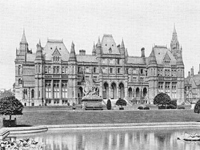
Barrington Hall, Hertfordshire (Image: from "A New Display of the Beauties of England" (London : 1776-1777))
Barrington Hall, Hertfordshire (Image: from “A New Display of the Beauties of England” London,  1776-1777) – click to see full size image

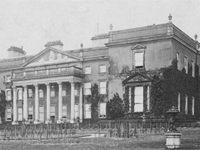
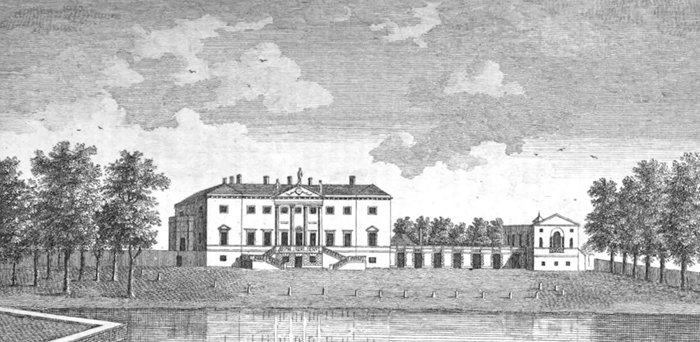
Sadly, it is uncommon for a house, once it has been used as offices, to escape such a fate being made permanent.  The alterations and additions can render the house a soulless shell with the grounds ruined beyond the possibility of economic rescue.  However, some have survived this role remarkably intact and, if the possibility presents itself, offer a remarkable opportunity to rescue a house and bring it back to the glory of being a single family home.  One such example is Barrington Hall, Hertfordshire, which has had something of a chequered history.  The original house (above) was built between c1735-40 for John Barrington to designs by John Sanderson (b.? – d.1774), a man who Colvin wrote was described as a competent ‘second-generation Palladian’, who worked on an impressive roster of houses including Hagley Hall, where he proved to be an accomplished designer of rococo decoration, Kelham Hall (burnt down 1857), Kirtlington Park, Pusey House, Langley Park, Copped Hall, and Kimberley Hall.

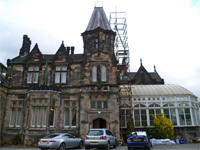
Barrington Hall, Hertfordshire (Image: Hamptons)

Barrington Hall remained unfinished (despite the engraving above) and was uninhabited for 128 years due to, what the estate agents refer to as, ‘bizarre and unfortunate events‘ (anyone with more details please do post a comment!). The house was eventually restored in 1867 by George Lowndes, a distant relative of John Barrington, who employed the Lincolnshire architect Edward Browning to remodel it in a Jacobean style. The changes created an attractive house with a varied and interesting form, featuring a series of handsome architectural details such as the ‘Dutch’ gables, quoins and a miniature ogee turret.  The house was bought by the Gosling family in 1903 who had merged ‘Goslings Bank‘ to create Barclays & Co in 1896. It was then sold in 1977 to the British Livestock Board who converted it to offices and then subsequently sold in 1980 to CPL Aromas LTD, a family perfumery firm who seem to have had some challenging times following an ill-fated public listing in 1994, which they reversed in 1999.  Having remained at Barrington Hall it now seems that the company has reviewed its requirements and decided that a stately home is a luxury no longer required.

Although originally offered several months ago for £5m (with 32.85-acres), it seems possible that a serious, but lower, offer could be successful.  It would probably take at least £2m to restore this fascinating house, creating the rich and lively interiors which it needs to match the exterior and bring it back to life, but whoever did so would have the pleasure and pride of having rescued an interesting country house from the drudgery of corporate service.

—————————————————————————–

Sales website: ‘Barrington Hall‘ [Hamptons] – which, by the way, is a pretty weak effort.  Nice photos but quite lacking in details.

Listing description: ‘Barrington Hall‘ [British Listed Buildings]

Know any more? If you’re aware of any other country houses of a similar size to Hursley House, Ditton Park, or Donington Park, please post a link (ideally) to a Google Map aerial view in the comments below.

N.B.: an earlier article on this blog (‘Converting country houses from commercial to residential: a sound investment?‘) looked at a few other examples including Gaddesden Place, Hertfordshire, now the headquarters for Xara software, and Benham Valance, Berkshire.

A silver lining to an industrial cloud; the Mersey mansions of the Victorian elite

To join the landed gentry you previously needed to have no connection with the vulgar business of actually making money. Even if you had bought a significant house and estate, to be truly accepted (and not be cast off into social Siberia) a gentleman would have to sell all his business interests and retire to live off the proceeds.  Yet, times changed and as it became acceptable to mix business and pleasure, so the requirements of the new gentry altered as they became unwilling to be too far from their sources of wealth, particularly around the great Victorian cities.  Smaller country houses and weekend villas with reduced estates sprang up to meet this new demand, with Liverpool being a prime example of these forces.  Later, as the cities grew, fortunes waned and housing pressures increased, many of these houses were lost; yet, occasionally, a rare survivor appears such as Calderstones Park Mansion House in Liverpool.

Harewood House, Yorkshire (Image: Lee Elvin via flickr)

The Georgian era truly challenged the mystique of inherited wealth and royal patronage being the primary route to social elevation (though both helped).  Money talks, and the vast wealth being created, and the men making it, could not be ignored.  No family exemplified this more than the Lascelles family of Yorkshire. Although the family had been in the county for many years, their purchase of the Harewood estate in 1739 for £63,827 (for an estate of 6000-8000 acres) was with wealth generated only relatively recently.  Henry Lascelles (b. 1690 – d. 1753) had made his fortune largely between 1715 and 1730 as a plantation owner, victualling contractor and Collector of Customs in Barbados. It was his son, Edwin, who, having inherited his father’s vast fortune, set about, between 1759-71, building the grand house we see at Harewood today, to designs by John Carr of York who had already built the stables.  The vast expense of paying Carr, plus Robert Adam for the interiors, Angelica Kauffman and Biagio Rebecca for internal decorative painting, Thomas Chippendale for the superb furniture, and ‘Capability’ Brown for the beautiful grounds hardly made any serious dent in the family fortune.  On Edwin’s death in 1795, he reportedly had an income of £50,000 per year, of which half came from the West Indies business interests.  It was this mercantile wealth which established one of the great houses of the 18th-century, elevated the family to the peerage and enabled them to become a local political force, all in the space of just 60 years – something not possible on the limited and sometimes uncertain income of an estate alone.

Picture gallery, Dawpool, Cheshire (Image: H Bedford Lemere, Bedford Lemere & Co / copyright: English Heritage/NMR)

The 19th-century only saw this trend accelerate with the great wealth of the cities now a serious challenge to the old inherited wealth of the land. This was especially true since, following political reform, land holdings were not always necessary to secure power and influence.  Now the owners could indulge their preferences, as not all of them, having been born, brought up, educated, worked and having made their fortunes in the cities, would feel a natural attachment to the countryside, beyond the social cachet it brought.  Rising land values from the mid-19th-century also would have been a factor which might have put off the hard-headed businessman – better value to invest in the most luxurious house possible.  Yet, the allure of the country seat was still strong as a recognised symbol of success so around each major Victorian city could be found these mini ‘pleasure’ estates; with Liverpool being a classic example.

Hafodunos Hall, Wales in 1954 (Image: RCAHMW) - burnt out in 2004

For some, their fortunes financed the Victorian version of the Lascelles, with the acquisition of large estates and the building of the great houses away from the dirt and noise of the cities, such as at Hafodunos Hall (sadly burnt out by morons in 2004) by George Gilbert Scott for H.R. Sandbach (son of a Liverpool West India merchant). Yet for some of these gentleman there was no shame in being near to the industrial heart which pumped their fortunes – but that didn’t mean they had to compromise on luxury or convenience. Soon, many large houses with small estates populated the edges of the city.  Writing in 1873, the journalist Patricius Walker said:

Crowds of comfortable and luxurious villas besprinkle the country for miles round Liverpool, inhabited by ship-owners, ship-insurers, corn merchants, cotton brokers, emigrant agents, etc, etc, men with “on foot on sea, and one on shore,” yet to one thing constant ever – namely, money-making – and therein duly successful.

These captains of industry and commerce were also able to take advantage of the newly developed railways; becoming early commuters, able to spend the day at the office yet still escape at the end, back to their slice of bucolic charm.

The merchant palaces of Liverpool were, broadly, either those which were built as villas with substantial gardens near the large pleasure parks such as Sefton, or, taking advantage of the rail links, based outside the city in areas such as a the Wirral, just across the Mersey.

Holmestead, Cheshire (Image: openlyJane via skyscrapercity)

One particularly fine example of ‘rural urban’ villa was Holmestead on Mossley Hill, set in its own extensive grounds just to the east of the elegant and very desirable Sefton Park.  What is remarkable is that many of the larger houses still survive, albeit in an altered form; some becoming flats or care-homes.  The house was originally built in the 1840s in a Gothic style and effectively doubled in size in 1869-70 by the then owner, Michael Belcher, a local cotton broker. Urban ‘society’ of the newly wealthy mirrored the practices of those in the countryside as shown by William Imrie, owner of the house at the turn of the 19th-century and formerly of the famous White Star line, and also a patron of the Arts-and-Crafts movement.  He held regular concerts in his music room – a grand space, decorated with William Morris’ ‘Acanthus‘ pattern wallpaper, with the imposing ‘The Tree of Forgiveness‘ by Edward Burne-Jones on one wall, and Spencer Stanhope’s ‘Why Seek Ye the Living Amongst the Dead‘ on another. Remarkably, the house has survived and is still a single family home.

Dawpool, Cheshire - dem. 1927 (Image: H Bedford Lemere, Bedford Lemere & Co / copyright: English Heritage/NMR)

One of the grandest houses of them all was also connected to the White Star Line.  Dawpool was the pet project of Thomas Henry Ismay, the man who built a company large enough to launch the Titantic. Although was not conceived as the centre of a landed estate, it was certainly designed to showcase the power of his empire.  Designed by the leading architect, Richard Norman Shaw, the house, started in 1882, was a monument to Ismay’s wealth and meant to last – the local red sandstone was finely shaped and even the screws being finest brass.  The house took four years to build at a cost of over £50,000 – equivalent to over £3.5m today, a colossal sum compared to the average £80 per year the skilled ship-worker took home. Yet, the house was to survive less than half a century. After Ismay’s death in 1899, the widowed Mrs Ismay said that the house had given her husband pleasure every day – but without that driving force, it languished before being sold, becoming an orthopaedic hospital in WWI, before being sold again, and then demolished in 1927 [more history and photos available on Lost Heritage: Dawpool].

Calderstones House, Liverpool (Image: Liverpool Confidential)

Although some have been demolished and most of the houses have lost their extensive grounds, one rare survivor, Calderstones House, gives a rare insight into the once-gilded edges of Liverpool.  The now grade-II listed house was built in 1823 for Joseph Need Walker, a lead shot manufacturer, who built an elegant late-Georgian design (architect unknown) with a Doric portico which looked out over carefully tended gardens and parkland.  In 1875, the house and grounds were sold for £52,000 to Charles MacIver, a shipping magnate who had spent 35 years with the Cunard Line. The house and grounds were sold in 1902 to the Liverpool Corporation for £42,000 and became one of the city’s finest parks (John Lennon apparently used to hang about there) with the house used as offices for their Parks departments with a public tea-room and, to the rear, a stage for concerts.

Faced with severe budget cuts, Liverpool Council are now exploring what options are available, with a sale the preferred outcome.  Sadly, it is extremely unlikely to become a home again; to carve out sufficient space and access from a public space would be extremely controversial, with security a further worry.  The two most likely options are that it is taken on as a public facility with commercial aspects such as concerts and refreshments, or that it will languish, becoming progressively more dilapidated.  Sadly, local government generally has often shown a rather careless attitude to heritage assets in their care -though in recent years they have improved markedly from the 1950s and 60s when some (Derbyshire being particularly notorious) would simply demolish the historic buildings, especially country houses.

The current period of austerity is forcing councils to re-examine their assets and objectively analyse the most cost-effective way of operating – a process open to the risk of losing elements of what makes an area locally distinctive.  This is especially true when ‘heritage’ and ‘arts’ are seen (falsely) as relatively ‘high-brow’ interests – this creates a challenge for everyone to be aware of what their councils own, and to monitor whether there are any signs of them seeking to cut corners and creating conditions which threaten the heritage assets.  They hold these in trust for the local area and, if necessary, councils need to be forcefully reminded of their obligations to this generation and the ones which follow to care for the built environment which contributes so much to local identity.

Articles:

Further reading: Merchant Palaces: Liverpool and Wirral Mansions Photographed by Bedford Lemere (Photographers of Liverpool) (disclosure: this is an Amazon associates link – the price you pay is the same but I’m experimenting to see if I can help offset costs with Amazon affiliate links).

A stay in the country: country houses as hotels – and a bad plan

Stoke Park, Buckinghamshire (Image: Stoke Park Country Club and Resort)

Although country houses were built primarily as homes, an integral and important function was their use for entertaining.  However, one dramatic change has been the nature of the guests and how they paid for their visits – and the birth of the refined country house holiday now regarded as the best the hospitality industry can offer.  That said, running such a hotel is no guaranteed path to the wealth suggested by the lifestyle; with huge initial costs, large ongoing expenses and the elusive need for profitability leading to the recent troubles for the Von Essen hotel chain which had dominated this niche, including running the finest country house hotel – Cliveden, before collapsing under their own ambition.  The chase for profitability has also led to some shocking schemes for building further accommodation which can be seen in the recent proposals for Wyreside Hall in Lancashire.

Country houses have long been used as accommodation for travellers, be they friends of the owning family or, more spectacularly in medieval and Renaissance periods, for the monarch.  Often considered a great honour (supposedly there are more beds in which Queen Elizabeth I has apparently slept than nights she was alive), the occasion of a royal visit – or the possibility of one – would cause local aristocrats, or those aspiring, to refurbish suites of rooms such as at Burghley, Hatfield House, and Kirby Hall (even though Elizabeth I never came to the latter).  Sometimes, the ruinous expense of hosting the royal retinue would sometimes leave the owner with a title but also debts they’d be paying off for decades.

Eaton Hall, Cheshire (by Alfred Waterhouse - dem. 1961) (Image: Lost Heritage)

The heights of country house entertaining were reached by the Victorians and Edwardians who popularised, amongst the aristocracy, the vast weekend house party.  This led to houses being built or extended to create, in effect, large hotels.  The key difference was the guests were pre-selected from a narrow social strata and were expected to ‘pay’ for the hospitality with reciprocal entertainment or with business or political favours.  The greater the social elevation of the guests, so the number of staff required increased, leading to some houses, particularly at the cream of society, such as Eaton Hall and Clumber House, being greatly extended.  Eaton Hall eventually numbered around 150 bedrooms ranging from those for the honoured guests down to the  lowliest servants who would share dormitories.  Sadly, it was these sizeable extensions and aggrandisements which were largely the reason for their demolition in the 20th-century in their hundreds as austerity hit home and these huge palaces became unaffordable.

Sandringham, Norfolk (Image: Sandringham Estate)

Edward VII, when Prince of Wales, was the longest serving Regent and developed a highly cultivated habit of ‘weekending’ at country houses, especially his own at Sandringham, Norfolk.  His preferences have been said to have laid the foundations for not only the practice of weekend visits but also for indulging with grand breakfasts followed by country activities such as shooting, followed by convivial dinners.  Such was his reputation that some owners would fear a visit for the expense involved with one family, the Gurneys of Northrepps Hall in Norfolk, allegedly burning down a wing to forestall such a visit. By contrast, in 1902, when Edward VII visited Burton in Staffordshire an entire wing was built and named after him in his honour at Rangemore Hall.

Country house visiting had been a common activity for the travelling aristocrat in the Georgian era (a topic explored in a previous article ‘How tourism split a house from the estate‘).  Often calling on those they knew, they would also call on the notable houses in an area (an acceptable enough practice to be included by Jane Austen in ‘Pride and Prejudice‘) – and the owners of these ‘show houses’ were happy to parade their good taste.  By the beginning of the 18th-century, Blenheim, Castle Howard, Chatsworth, Wilton and Burghley had become the ‘must-see’ houses for the country house tourist – later joined by Houghton, Holkham, Eaton Hall and Kedleston.  Sadly, visitors weren’t always there for the educational opportunities of seeing some of the finest art in the world – as Horace Walpole lamented regarding the visitors to his father’s Houghton Hall, where he was a guide, the worst were the seers:

 …they come, ask what such a room is called, in which Sir Robert lay, write it down, admire a lobster or a cabbage in a market-piece, dispute whether the last room was green or purple, and then back to the inn for fear the fish should be overdressed.

Tregenna Hotel, Cornwall (Image: lindad4a via flickr)

It’s the last line which is of particular interest – even the well-to-do Georgian guest would be staying in a nearby coaching inn unless they had family nearby.  By the Victorian era, the nature and number of the guests had changed, but still the houses were private residences – until 1878 when the first country house became a hotel; Tregenna Castle near St Ives, Cornwall.  The catalyst was the extension of the railway, and the purchasers of a initial lease on Tregenna, before buying the freehold in 1895, was the Great Western Railway who could not only provide the destination, but the means to get there.

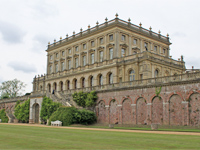
Cliveden, Buckinghamshire (Image: sjm_1974 via flickr)
Cliveden, Buckinghamshire (Image: SJM_1974 via flickr)

The growth of a paying middle class in the Victorian and Edwardian eras created demand – but most importantly, both eras were about aspiration.  The middle class may not have had the wealth to run a country house (and in the 1930s and 1950s, many owners didn’t either) but they certainly wanted to experience it.  The glut of country houses which became available in the first half of the 20th-century presented many opportunities for the hospitality industry to cater for these new markets.  For the upper classes, although many had been forced to sell up or move out, they still wanted to continue the lifestyle – though not necessarily alongside the nouveau riche. This created another market for the exclusive country club with clear social stratification driving the finest hotels to become bywords for extravagant elegance – something still clear today (though entry is more socially open) when one looks at hotels such as Cliveden or Stoke Park.

Gravetye Manor, Sussex (Image: Patrick Baty)

Though initially slow to take-off, the first half of the 20th-century saw a number of houses become hotels; in 1929, Theobalds Park, Hertfordshire and North Bovey Manor, Devon (another for the Great Western Railway), Welcombe Manor, Warwickshire in 1931, Otterburn Tower, Northumberland and Studley Priory, Oxfordshire, both in 1947 and Greywalls in Scotland in 1948, to name but a few.  Gravetye Manor was sold to Peter Herbert in 1957, when he paid £57,000 and charged £2 per night.  One author reported that the 1995 Egon Ronay guide listed 220 country house hotels, and the Historic Houses Association estimated that a quarter of the country houses sold between 1972-1990 were converted into hotels.  Though some have inevitably failed, the trend continues with one of the most recent being Coworth Park, built in 1776, opening in September 2010.

This potential re-use of the houses has not always been benign.  The nature of hotels is that the bedrooms generate the income so the more you have the better for them – though usually not for the architectural cohesion of the house. In hotel terms, many houses would not be economic which has led to the building of large, and not necessarily sensitive, additions.  Considering the original intentions of country house owners were to demonstrate their wealth and taste and to build a house to last, rarely are the modern extensions designed with anything approaching the same care and expense so there is an inevitable mismatch.  Many a country house hotel is scarred with poor quality and visually flawed wings which are almost designed to detract from the main house – but then buildings designed by accountants never win prizes for beauty.

Wyreside Hall, Lancashire (Image: Lancaster Guardian)

Although there is evidence of a greater sensitivity in recent years where new wings are tucked away from the main house and linked by corridors, it seems that there are still some owners who see the house as merely an ornament to put on the front cover of the brochure whilst they ruin the setting.  It was hoped that the worst schemes were behind us but sometimes one is proposed which is so bad that it would be laughable if it didn’t threaten a fine (though currently not in the best condition) house – Wyreside Hall in Lancashire (hat-tip to Matthew Steeples for flagging this one up).

The house was originally built in the 17th-century but was remodelled in 1790 by the then owner, John Fenton Crawthorne, MP, to a design by the gifted architect, Robert Adam.  Though the full scheme wasn’t implemented, the exterior benefited from a graceful symmetry with the drawing room, dining room and library also completed to his plans (though apparently no evidence of their decoration now remains).  The now Grade-II house remained in the Garrett family until 1936 after which it became a school and then home for a local motorsport legend.  The scheme that has now been proposed learns none of the lessons of sensitive hotel development (or any work involving heritage) over the last 50 years.

Proposed development, Wyreside Hall, Lancashire (Image: Wyre Council planning proposal, via Matthew Steeples)

Yes, it really is that ugly.  The design effectively doubles the size of the house and, as can be seen from the plan (scroll to page 44 – no direct link, sorry), the associated access roads, parking and ‘landscaping’ ruin the immediate setting of the house.  The usual arguments have been made about this bringing jobs to the area but if we must sacrifice the very heritage which gives an area a distinct identity, which attracts tourists or the wealthy (who usually also spend money locally) then it’s a poor bargain.  Wyre Council should throw out this and any subsequent plan which displays equally limited thinking and such an arrogant disregard for the architectural heritage of the area.  As we’ve seen, country house hotels can work – but not when they are at the expense of the original building.

———————————————————————————

Matthew Steeples’ original blog post is available here: ‘Adam would turn in his grave

Listed buildings description: ‘Wyreside Hall, Lancashire‘ [British Listed Buildings]

Planning application documents: ‘Ref 11/00840/LBC – Wyreside Hall‘ [Wyre Council]

———————————————————————————

This is the last post for 2011 – 43 posts in total, now over 350 subscribers to the blog, nearly 210,000 pages served up; and 850 followers of @thecountryseat on Twitter, so all-in-all, a fairly impressive level of interest; thank you! Matthew

The most expensive UK country house: Park Place, Oxfordshire

A new record price for a UK country house has just been achieved with the sale of Park Place, near Henley-on-Thames, in Oxfordshire.  One of three most notable estates on that stretch of the Thames, it was also the most expensive country house ever sold in its unrestored state in 2007.  Now, after five years and many millions of pounds, the house again has set the record having been sold to an unknown Russian billionaire for £140m.

'A view of Park Place, Henley' - artist unknown - c.1742-3 (Image: Royal Collection) - click to see full image

Park Place is, at its core, a more modest Georgian house built in 1719 for Lord Archibald Hamilton, son of the Duke of Hamilton.  The proximity to London and the beautiful setting has long attracted the wealthy to the area as a convenient escape from the city, with several riverside estates featuring a series of impressive houses.  Starting at Marlow, the first house is Bisham Abbey (now the national sports centre), then the now lost Temple House (dem. 1910), Harleyford Manor (beautiful small villa restored in 1989), Whittington House [pdf] (rebuilt by Reginald Blomfield c1897, now HQ of SAS Ltd), Danesfield House (now a hotel), Medmenham Abbey (now two houses), Culham Court (sold for £38m in 2006), Greenlands (now Henley Management College), Fawley Court (sold for £13m in 2008, possibly for conversion back to a private house), and then finally, just past Henley, lies Park Place.  Of particular interest are the architectural similarities between Fawley Court (built 1684 – reputedly to a design by Sir Christopher Wren), the original Park Place (built c1718), Culham Court (built 1771), and Reginal Blomfield’s 1897 rebuilding of Whittington House, all of which are on based on a red-brick 5- or 7-bay, two storey villa with bulls-eye window inserted into a projecting pediment.

Park Place, Henley - c1810 (Image: Thames Pilot) - click for the full image

Sadly, Park Place is no longer part of this architectural brethren having undergone a series of substantial changes.  The house was sold by Lord Hamilton in 1738 to Prince Frederick, then Prince of Wales and eldest son of King George II, who split his time between there and Cliveden. After Frederick’s death, the house was then bought by General Henry Seymour Conway in 1752 and it was he who made the first significant changes both to the house (including a library by Sanderson Miller in 1757) and, perhaps more importantly to the grounds, which are now grade-II*. His works, to designs by Thomas Pitt, 1st Baron Camelford, included the installation of an ancient stone henge given as a gift from the people of Jersey where he was Governor, the lightning-damaged steeple from St Bride’s Church as an obelisk, four more obelisks as gateposts, an underground cavern, and a bridge, using stones from Reading Abbey, which was subsequently admired by Horace Walpole.  There was also an artificial classical ruin designed by James ‘Athenian’ Stuart.

Park Place, Oxfordshire - c.1900 (Image: henleyonthames.org)

The house was sold to John Noble in 1871 but was largely gutted by fire a year later, giving Noble the opportunity to indulge something of an architectural whim.  The pattern and style of the Victorian country house was much admired around Europe and our expertise was exported widely around the continent – but it rarely flowed back (a topic already covered in an earlier post ‘The rise and fall of French taste on UK country houses‘).  Park Place is one of the few houses in the country build using the French Renaissance style, creating an impressive château in the heart of England.

The design of the rebuilt house is widely attributed to Thomas Cundy [III], the son and grandson of two previous Thomas’ who had also been country house architects. Although the latter two are given sizeable entries in Howard Colvin’s ‘Biographical Dictionary of British Architects‘, the grandson is given only a paragraph as part of his father’s, leaving us somewhat in the dark as to what, bar some London churches, he may have been involved with. However, considering his father had good form with the chateau style having built Grosvenor Gardens in London, so Thomas III would have been schooled in the style before his father’s death in 1867.

The house remained with the Noble family until 1947 when it and the 670-acre estate was parcelled up into 22 lots and sold off.  The main house was bought by Middlesex County Council who converted it into a special school, which it remained until 1988 when it closed. The house was then bought by John Latsis, the Greek shipping tycoon, but it seems unlikely that he lived there as it remained unrestored, with the vestiges of the school – gymnasium, classrooms, a woodwork studio etc – all still in situ, along with various outbuildings, as can be seen from these images of the house.

Those who had a chance to look around the house when it was for sale in 2006 all noted that beneath the shabby institutional veneer, the potential of the house was clear; glimpses of fine tiles, the original stone fireplaces, stained glass, and grand spaces with impressive views.  The house was then sold to a consortium who intended to create a superior country club – until Wokingham council said ‘no’.  Put on the market for £45m, it was finally sold for £42m to Mike Spink, a property developer who specialised in high-end houses in central London. With this experience, Spink transformed this once dilapidated house into a palace fit for a billionaire with all the requisite features such as a helipad, swimming pool, panic room etc.  Somewhat disappointingly, the house now only comes with 200-acres, with the remaining 300 with which it was sold retained by Spink for as yet unspecified ‘development’ – a phrase which will no doubt spark local concerns.

Even when it was first sold, those in the property business were predicting that Park Place would sell for possibly up to £100m, and the rising ‘super prime’ market has proven even those estimates conservative.  Sadly, this record is not for a spectacular historic house at the centre of a large estate but instead one where the location (location, location!) has elevated the price to such a stratospheric level. Nevertheless, many country houses were built as retreats for wealthy industrialists and financiers and this house is proof that the lure of the trophy country estate is as strong as ever – which can only be a good thing for those seeking to prove their desirability in modern times.

———————————————————————–

Story about the original sale: ‘Sold for £42m… still in need of renovation‘ [Daily Telegraph]

Latest sale: ‘Park Place: Britain’s most expensive home sold for record £140m‘ [Daily Telegraph]

Country House Rescue: spectacular spats – Hill Place, Hampshire

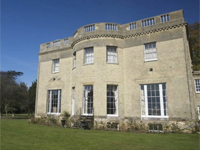
Hill Place, Hampshire (Image: Historic Houses Association)

The challenges of inheritance have been a recurring theme throughout Country House Rescue.  The obvious challenges are perhaps more tangible; taking on the new house, contents, gardens and the related discoveries – for good or ill.  Yet part of the nature of inheritance is often the bequeathing of disappointment to others who expected to benefit or who disagree with the choices of the new owners.  Country House Rescue this week (17 April) visits Hill Place in Hampshire where Ruth Watson’s skills seem to be in demand to placate some disgruntled aunts rather than to simply identify business opportunities.

Hill Place is an elegant, grade-II listed Georgian villa, built in 1791 on the back of wealth made in India.  The architect is unknown but there is a beautiful simplicity to it, with each side five bays wide with a canted three-bay projection on the entrance front and a graceful three-bay bow front to the south.  The style is in the fine traditions of Sir John Soane and there are even suggestions that it may have been by the man himself.   At some stage, a mansard roof was added and then later removed, leaving an unfortunate flat roof with the stub end of the staircase still rising to a small access extension.  Overall, this is a particularly neat example of the smaller country villa which was to prove so popular at that time.  However, what is of particular interest that the current owner, Will Dobson, inherited the house due to his grandparent’s commitment to the tradition of primogeniture – that of the eldest male inheriting, which, in Will’s case, meant the bypassing of his grandparent’s four daughters, which is the cause of the strife in the programme.

The rules of inheritance in the UK have ensured that ownership of country houses, estates and contents can be passed down as a unified possession.  This has ensured a multi-generational continuity which has benefited the country by embedding a very long-term perspective to plans and that a culture of paternalism was fostered; the spirit of noblesse oblige. Ironically, in France, the Napoleonic code demands equal shares for all potential inheritors, forcing the break-up and sale of large estates, preventing the same depth of connection between the nobility and society.  Yet, for this culture to be preserved it is important that the estate is kept together – especially as it usually has to fulfil its traditional role of funding the main house.

Knighton Gorges, Isle of Wight (Image: wikipedia)

Yet inheritance has caused incredible friction for hundreds of years between those favoured by those who inherit and those who do not, leading to extreme outcomes and court cases.  One example of the former was Knighton Gorges, a manor house on the Isle of Wight, where, in 1821, the owner George Maurice Bisset had the entire ancient house demolished to ensure that his heir (his daughter or nephew – accounts vary) wouldn’t be able to cross his threshold even after his death, their having angered him through an unauthorised marriage.  In Kent, Lynsted Park was originally a huge Elizabethan E-plan house built for Sir John Roper, later Lord Teynham, in 1599, but an inheritance dispute between two Roper brothers in the 1800s led to the one living there demolishing all but the entrance porch (later Georgian additions created the current house) as he thought he would lose the case and have to give the house to his brother.

Gopsall Hall, Leicestershire (Image: Lost Heritage)

Perhaps the most famous litigation from inheritance was that surrounding William ‘the Rich’ Jennens which reputedly took nearly 120 years before the cases finished being heard and was also thought to be the inspiration for Jarndyce v Jarndyce in Charles Dickens’ Bleak House – though recent scholarly opinion now discounts that. The Jennens family had created a huge family fortune as ‘ironmasters’ in Birmingham but due to a lack of heirs and, more importantly, a will, when William died intestate in 1798, his fortune (including houses such as Gopsall Hall, Leicestershire and Acton Place, Suffolk) was passed to three distant – though very aristocratic – relatives.  This was the catalyst for a small cottage industry of claimants who all thought themselves related and therefore due a share of the inheritance.  This was partly due to a popular fad at the time for novels to feature an unexpected inheritance – though, in real life, it was usually just the lawyers who became richer.

So, inheritance can often be a mixed blessing, laden with expectations and complications.  A recent survey by Country Life magazine (6 April 2011) found that 61% of current owners were concerned that estates stay in the family – with only 25% not bothered if their heir were to sell (it would be interesting to see if there was a correlation between whether those in the latter group were also those whose family had owned for the least time).  For some, it’s particularly important to ensure that the family name is preserved. In the same Country Life article, David Fursdon, whose family have been on the Fursdon estate in Devon since 1289, highlights that after 750 years in single ownership the pressure is on to ensure that a male heir is produced to provide that continuity (though with three sons he should be OK).

Holker Hall, Cumbria (Image: andrew_j_w / flickr)

Primogeniture, or full inheritance by the eldest son, has been the rule for hundreds of years.  It was expected that all other children either had to marry or make their own fortune or living with the second son often going into the Army and the third to the clergy.  The strict rules may now be relaxing with parents choosing the child most inclined and best equipped to take on the inheritance – the Country Life article highlights how Holker Hall in Cumbria will be inherited by the middle child, Lucy Cavendish, who has moved back to the estate to learn the ropes before her parents ‘retire’ and move out in a few years time.

The challenge for families such as the Dobson’s is ensuring that the one who inherits feels they have complete ownership and is able to take decisions for the good of the house and estate without sniping from other quarters.  It is no light responsibility to be the owner of a country house and the Dobson’s should be thanked for taking on such a lovely home when others might have simply sold up and enjoyed the spoils.  Here’s hoping they can truly make a success of the house as a business to ensure that they can also pass it on to future generations.

Country House Rescue: ‘Hill Place‘ [Channel 4]

Country House Rescue: see complete previous episodes

Official website: ‘Hill Place