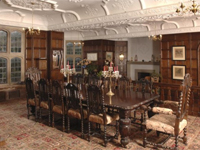
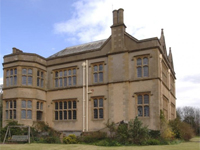
A Hollandaise Source: Henry Holland’s Benham Park, Berkshire

As the costs of owning a country house mounted in the early-twentieth-century and eventually overwhelmed the finances of many families, so they sought alternative uses for their houses. Whether as a care home, school, or any of other myriad uses, few houses or their estates endured the experience unscathed. For those used as offices, the particular indignity of large, modern additions obliterated the immediate setting of a house, occasionally driving it into obscurity. Few who suffered this fate have ever escaped, yet a rare and beautiful survival – Benham Park in Berkshire – has not only escaped, but been wonderfully (partly) restored and is now offered for sale.  What is most remarkable though about this house are its connections to some of the most famous names of Georgian architecture, including Lancelot ‘Capability’ Brown, a young Henry Holland, and an even younger John Soane.

Benham Park, Berkshire (Image © Savills)

Nestled in a lush parkland, Benham Park is significant as a formative experience, in different ways, for both Holland and Soane; a house where the two would each contribute in different ways, each gaining experience which would serve them well in the future. The noted architectural historian Dorothy Stroud declared Holland ‘a designer of perception and originality’. Her tireless research underpins much of what is known about Holland and his work.

Detail of Henry Holland (1745-1806) Image © National Portrait Gallery

Henry Holland (b.1745 – d.1806) was one of the leading architects during the reign of George III. Today, his reputation has been overshadowed by his contemporaries who were more willing to engage in courting public notice, such as by exhibiting their work at the Royal Academy, which Holland never did. Chiding a friend in 1789, he stated ‘Pray no more public compliments to me. I began the world a very independent man and wish to hold it at arms length…I find myself already more the object of public notice than suits my disposition or plan of life’.

Henry Holland was the son of Henry Holland (1712-1785 – to avoid confusion, the father will be referred to as ‘the elder Holland’, any other mentions of Holland are the son) of Fulham. A successful master builder, he built many important houses in the middle years of the eighteenth-century and worked with architects such as Robert Adam, executing his alterations to Bowood in Wiltshire in 1761 and, in the same year, working at Ashridge House, Hertfordshire.  It was this latter commission which was to prove singularly important as it established a professional relationship between Holland senior and Lancelot ‘Capability’ Brown (b.1716 – d.1783), a landscape architect still revered today for his skill and imaginativeness. Brown’s particular ability was to be able to envision a whole landscape as it would be after the planting had reached maturity – to see its ‘capabilities’.

He was also noted architect, with even his rival Humphrey Repton praising the ‘comfort, convenience, taste, and propriety of design in the several mansions and other buildings which he planned’. The houses include Croome Court, Worcestershire (though the design may have been provided by Sanderson Miller), Corsham Court in Wiltshire (1761-64), Broadlands in Hampshire (1766-68), Fisherwick Park in Staffordshire (1766-74 – dem. 1814-16), Redgrave Hall in Suffolk (c.1770 – dem. 1946), Claremont House in Surrey (1771-74), and Cadland in Hampshire (1775-78 – later much enlarged – dem. c.1955).

Fisherwick Park, Staffordshire, painted by John Spyders (1786)

Although the initial connection was with the elder Holland, Brown would become central to both the professional and personal life of the younger Holland.  Although he never undertook a Grand Tour, his education was more practical, working with his father in the family business. Holland displayed aptitude and skill, taking on more responsibility but also his talent for design was becoming clear.  With his father’s connections, Holland was taken on as architectural assistant in 1771 by ‘Capability’ Brown who would, in time, hand over much of his design work to Holland, who would use these earlier designs as inspiration.  The closeness and respect between the two can be gauged by the marriage of Henry Holland to Brown’s daughter, Bridget, in 1773. Professionally, a measure of the level of joint enterprise between Colvin notes that Claremont and subsequent houses are jointly attributed to Holland.

Benham Park was an easy commission of Brown to secure, though it was likely that he was primarily thinking of his new partner when doing so. The probability that Brown would be commissioned was high as he was already working for the owner of the estate, William Craven, 6th Baron Craven (b. 1738 – d.1791), on another country house for him, Coombe Abbey, Warwickshire. Apparently under pressure from his wife, Elizabeth Berkeley, Lord Craven wrote to Brown saying ‘Lady Craven wishes to make some alterations here and to begin immediately’. Holland and Brown submitted their designs for a house in September 1773 using a similar pattern to Brown’s previous work with a neoclassical, two-storey main house with grand central portico.

Benham Park, Berkshire (Image © Savills)

The house was built between 1774-75, the final result a sympathetic marriage between an elegant yet imposing house and the Arcadian pleasures of a sculpted landscape.  Despite these fine attributes, Benham has been rather overlooked in the histories of both Brown and Holland with the latter clearly learning important lessons from one who designed with practicality in mind, but not to the exclusion of an element of drama. However, Holland was not without his own influence as Stroud notes that from the time he joined Brown’s office, the interior design evolved from a more robust Palladian character to the more restrained yet elegant style which was Holland’s hallmark. Claremont, Cadland, and Benham all display this style, indicating that although the shell of the house was more the work of Brown, the interiors were to Holland’s designs.

What’s remarkable about Holland was his almost precocious drive to build on a grand scale. Backed by his father’s capital and expertise, Holland leased in 1771, aged 26, eighty-nine acres of what is now Chelsea and Knightsbridge, including what is now Cadogan Place, and proceeded to speculatively design and build houses based around a miniature park or garden square. This high profile activity brought Holland his first major solo design for Brook’s club in Mayfair, London, a haunt of the Prince Regent and Whig aristocracy. This would lead to the Prince commissioning two major buildings from Holland; Carlton House and Brighton Pavilion. These two commissions plus Holland’s speculative building cemented his position within the highest social strata, creating future opportunities.
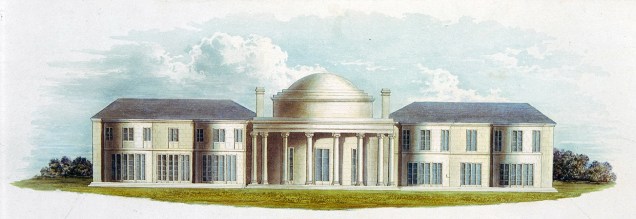
Undated print of Henry Holland's Brighton Marine Pavilion of 1786-87 (Image source Khan Academy)
Undated print of Henry Holland’s Brighton Marine Pavilion of 1786-87 (Image source Khan Academy)

Other significant commissions included the the refurbishment in 1787 of Althrop, Northamptonshire, for the 2nd Earl Spencer, including a full re-casing of the red-brick house in white mathematical tiles with stone dressings, a re-design of the gardens, and inside, a re-ordering of the accommodation including the creation of the noble triple libary, divided into sections by screens of Ionic columns. Another Whig patron was Francis, 5th Duke of Bedford, who had Holland complete some minor works to Bedford House before commissioning more extensive work, also in 1787, at his main house at Woburn Abbey. Holland was back at Broadlands in 1788 creating a new vestibule and inner hallway, the entrance marked by a new grand portico. In 1795, after a sojourn into theatres, Holland returned to grand country houses, with the rebuilding of Southill Park in Bedfordshire for Samuel Whitbread, of brewing fame. Again, as with Althorp, this was a refurbishment to the point of rebuild; the house encased, the accommodation extended and a new portico added. His last commission was again from Lord Spencer in 1801 to rebuilt his Wimbledon house, which had earlier burnt down, with a sophisticated villa in a severely plain style both inside and out. Sadly, this was demolished in 1949.
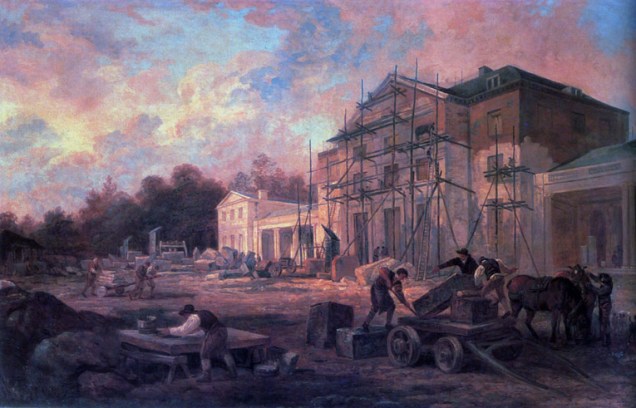
'Rebuilding of Southill' (1797) by George Garrard (Image © University of Texas)
‘Rebuilding of Southill’ (1797) by George Garrard (Image © University of Texas)

Benham Park was also important for another young, aspiring architect, Sir John Soane. As a young apprentice, Soane had joined Holland’s office in 1772 as a junior. At Benham, Soane was given the task of measuring up to create the final bills, a task he was to repeat at other locations, giving him a valuable insight into not only the process of building but also the business aspects. Although, sadly, almost all Holland’s papers and drawings were posthumously destroyed by his nephew, one of Holland’s account books is preserved in the Soane collection. Soane seems to have retained it as a valuable record and tool when setting up his independent practice. Benham therefore provided practical, aesthetic and business training to the young architect who no doubt admired Holland’s neo-classical approach before evolving his own distinctive response and style, which was to establish him as one of the leading architects of his age.

Benham Park in 1904 (detail) - note the large servants wing to the left, now demolished (Image source Stockcross History via Wikipedia)
Benham Park in 1904 (detail) – note the large servants wing to the left, now demolished (Image source Stockcross History via Wikipedia)

Benham survived largely unaltered into the twentieth-century until 1914 when the pediment was removed from the portico and replaced by a balustrade. This was echoed at the roof level where the pitch was lowered and obscured  by a pierced stone balustrade. The servants quarters were removed at the same time due to their poor condition. The house and estate remained with the Sutton baronets until 1982 when it as bought and converted into offices in 1983, with additional office blocks built next to the house. These were thankfully demolished as part of the latest restoration of the house and estate.
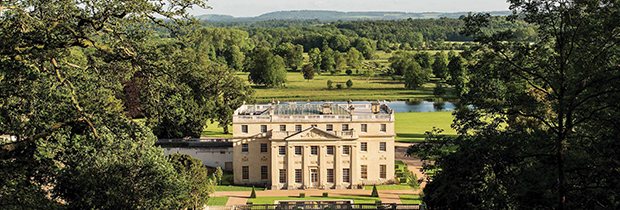
Benham Park - looking out over the lake (Image © Savills)
Benham Park – looking out over the lake (Image © Savills)

Benham Park, (Grade II*), is now offered for sale with 130 glorious acres for £26m. Inevitably for a house of such grandeur situated so close to London, there are approved plans for the house to become a ‘wellness’ centre with a huge (though thoughtfully designed) extension to the side and rear.  For me, as ever, this is a house which would be best served by being returned to it’s original purpose, that of a family home. For a new owner, they could revel in the knowledge that the house and landscape had been conceived by one of the great Georgian partnerships of Brown and Holland.  Standing under the portico today, much as where they and the young John Soane must have once stood, the latter on the cusp of his era-defining career, looking out at Brown’s landscape, they can appreciate this rare combination of architectural genius – truly a prize worth such a princely sum.


Estate agent particulars: ‘Benham Park, Berkshire‘ [Savills]

Brochure (PDF): ‘Benham Park, Berkshire‘ [Savills]

Listing description: ‘Benham Park‘ [Historic England]


Please note: Savills very kindly provided the images and brochure but had no input into the text.
Bylaugh Hall: the hidden history to a remarkable restoration opportunity

Bylaugh Hall, Norfolk (Image: Chesterton Humberts)

Many country houses we can visit today are innately interesting; the design, the contents, the occupants, all tell a tale.  Sometimes though there are houses with a much richer past which not only have an immediate story to tell but also a much more complex history, one fascinating for anyone with an interest in how these houses came to be created. One such house which was recently launched – and amusingly described on Rightmove as a ‘60 bedroom detached house for sale‘ – is the remarkable Bylaugh Hall in Norfolk, an engineering marvel and architectural delight, which had a forced birth through litigation, which wasn’t wanted by the first owner, and where credit for the design hasn’t truly been given to the right architect.

Bylaugh is remarkable in many ways; some obvious, others less so.  Even its genesis came from beyond the grave as the controversial inherited wish of the last owner, Sir John Lombe Bt (b. c1731 – d.1817), a man whose fortune came from the family’s silk throwing mill in Derbyshire.  The Lombe’s were established Norfolk gentry whose original estate was at Great Melton, centred around Melton Hall (built in 1611 by the Anguish family) but now a ruin having been first tenanted and then, by the end of the 19th-century, abandoned.

Allegedly won by Sir John in a skewed card game, the Lloyds had owned the Bylaugh estate for a number of years, and even if the story is false, it was legitimately Sir John’s by c1796.  The Lombe’s were unusual in that their wealth largely came from industry, and one which was located outside of the county, but they quickly used their fortune to create the fourth largest estate in Norfolk, at over 13,000-acres by 1883.

Whatever house was already at Bylaugh was insufficient for Sir John so he resolved to build an entirely new one.  However, the house he had in mind was not the house which was built.  Sir John must have had a fair idea that he would not survive to see his grand plan to fruition but he certainly wasn’t going to let mere death cheat him of his ambition.  Having placed £20,000 in trust for the express purpose of building the house – though without approving a design – he died in 1817 (unmarried and childless), leaving his estate and his firm directions to his brother Edward. Here, the family history becomes a little complicated as Edward was his half brother, the product of an affair with a Norwich doctor’s wife.  Edward adopted the Lombe surname but was reluctant to take on the grand role envisioned by his late brother – which is perhaps why Sir John’s will was so prescriptive, and which led to a quite extraordinary court case.

Edward Lombe disputed with the executors of the estate the instruction to build the new house.  However, Sir John had been quite clear, including this fascinating clause in his will:

And whereas it is my wish and intention that a mansion house and suitable offices fit for the residence of the owner of my estate shall be erected on some convenient spot in the parish of Bylaugh in the county of Norfolk either in my lifetime or after my death and that if I shall not erect the same in my lifetime then that my said trustees shall forthwith after my death erect the same according to such plan as I shall in my lifetime approve of or if I shall die before such plan shall be prepared and completed then according to such plan as the trustees or trustee for the time being under this my will with the consent of the person for the time being beneficially entitled to the immediate freehold of my said manors &c under this my will shall think proper to adopt adhering as closely as possible situation and other incidental circumstances being considered to the plan of the house now the residence of Robert Marsham esquire at Stratton Strawless in the said county of Norfolk. (source)

Yet Edward resisted, delaying the start of the build for years by arguing with the executors, Mr Mitchell and Mr Stoughton, and stating that even if they built the house he wouldn’t live in it.  Finally, in 1828, he went to the Court of Chancery and demanded that the money, now having grown to £43,000, be placed with it and a judgement made as to whether he could overturn the provisions of his brother’s will. The case was still undecided in 1839, by which time the fund had grown to over £63,500, when Edward again pressed his case, with a decision finally being made in 1841 – against him.  The Vice-Chancellor said:

It appears to me to be impossible to read this passage in the will without seeing that there is in the plainest language an express trust for the erection of the mansion house which the trustees are forthwith after his death to commence and to proceed with the erecting of. I cannot conceive any words more plain.

Stratton Strawless Hall, Norfolk - pre 1960 (Image: 'The Country Houses of Norfolk' by David Clarke)
Stratton Strawless Hall, Norfolk – pre 1960 (Image: ‘The Country Houses of Norfolk’ by David Clarke)

Which rather settled that. In the meantime, the executors had not been idle in their duties – but they weren’t as obedient as they might strictly have been.  Sir John had clearly stated that the house was to follow ‘as closely as possible‘ Sir Robert Masham’s house at Stratton Strawless; a three-storey (now two), strictly classical, almost Palladian house with a Tuscan-columned porch.  However, the executors ignored this provision and with possibly an eye to emphasising the esteemed family line and to help the new house blend in with the other seats in the area, they chose to create a historical ‘Jacobethan’-style house – but even that is not the one we see today.

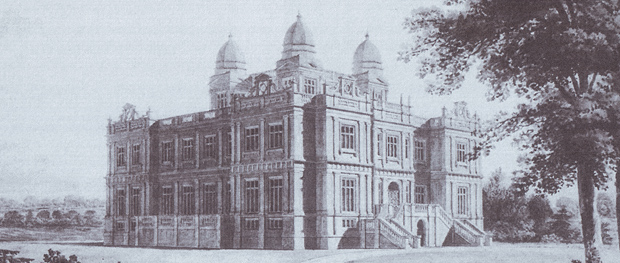
Interestingly, although the current Bylaugh is rightly described as being designed by Charles Barry the younger and his partner, Robert Robinson Banks, few are aware that in 1822 the trustees had originally asked another noted architect, William Wilkins (b.1778 – d.1839), to draw up a plan, and his design showed a remarkable stylistic similarity to the one actually built 27 years later.

Unexecuted design for Bylaugh Hall by William Wilkins, 1822 (Image: Public Record Office MPA. 66.1 / 'William Wilkins, 1778-1839' - R.W. Liscombe)
Unexecuted design for Bylaugh Hall by William Wilkins, 1822 (Image: Public Record Office MPA. 66.1 / ‘William Wilkins, 1778-1839’ – R.W. Liscombe)

Although a noted proponent of the Greek Revival, Wilkins, like many an architect, was well-educated in other styles and could turn his hand if asked. Clearly inspired by the style of ‘Prodigy‘ houses such as Burghley and Longleat, he also drew on elements of buildings he had seen and studied – for example, the polygonal domes capping the raised central hall are copied from the Porta Honoris at Gonville and Caius College, Cambridge, on which Wilkins had written a scholarly article for the esteemed ‘Vetusta Monumenta‘ in 1809. Although each façade was similar, the entrance front was enlivened by a projecting centre bay above the door which was on the piano nobile, reached by an elegant split stair.

The plan of the house was also modern, rejecting a rambling layout, and firmly following the Palladian 3×3 grid on the ground floor.  Centred around a double-return staircase, this was an innovative layout for an early Victorian design – though one Wilkins the classicist would have been entirely comfortable with.  Essentially, he had designed a Palladian villa, dressed in the architectural garb of the ‘Jacobethan’ style.

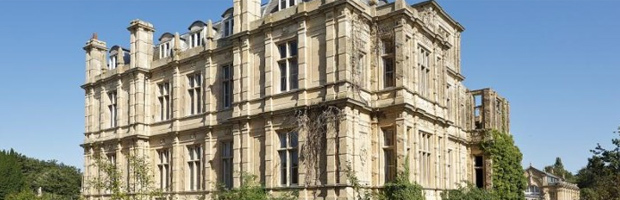
Bylaugh Hall today (Image: Chesterton Humberts)

Bylaugh Hall, as attributed to Barry and Banks in 1849, was perhaps better described as an updated version of Wilkins earlier plan – the core 3×3 layout remained, as did the external style, though some of the details such as the raised central hall and domes were removed, and the central staircase replaced by a saloon.  The construction did display some innovation, being one of the earliest steel-framed buildings and was considered a success with one rather giddy local newspaper exclaiming ‘Neither Holkham nor Houghton, those Norfolk wonders, can compare with it for either appearance or comfort‘.  Such wild exaggeration aside, this was a house at the forefront of domestic convenience and was commended in The Builder for having no corridors in the main block, which maximised the space.  It was completed in 1852 at a cost of £29,389, and by 1869 it was reported that £38,000 had been spent on the project, which would have included further works on estate buildings and landscaping (see photos of the house and grounds c1917).  An interesting aside is that during the delay in starting the money had grown to quite a considerable sum, more than enough for all the works.  Edward Lombe applied for the remainder but the Court demanded it be spent on bricks and mortar and so a 4-mile perimeter wall was constructed to satisfy this.

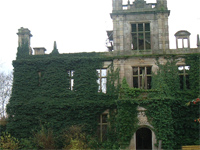
Ruined shell of Bylaugh Hall before restoration (Image: The Burrell Partnership)

It seems that no descendent ever loved the house.  By 1878, the then owner, Edward Henry Evans-Lombe, was renting the handsomely Classical Thickthorn Hall, before buying Marlingford Hall, whilst selling off outlying parts of the estate.  In 1917, Bylaugh Hall and the 8,150-acre estate were put up for auction in 140 lots but Edward sold it whole for £120,000, and the hall and 736-acre park were subsequently sold to the Marsh family.  Used by the RAF in WWII, it was sold in 1948 to a new owner who unsuccessfully planned to turn it into a nursing home.  At that nadir of country houses generally, a familiar pattern started; parts of the house were demolished and in June 1950 a 350-lot demolition sale was held which stripped the interiors of the house, creating a gaunt and sad shell.  So it remained until, in 1999, the house and a lodge was sold to a local sculptor who dreamt of fully restoring the house but with insufficient funds he was forced to restore just the Orangery (article by the engineers with lots of photos), intending it to be a wedding venue.  Other parts of the main house were parcelled up as investments and rebuilt but the plan faltered and then failed, leaving the partially restored house we see today.

So Bylaugh Hall is a house paid for by a man who never got to see it, with a design chosen by two men who ignored the last wishes of the patron, with credit for that design going to two men who relied heavily on another architect now obscured, for a beneficiary who really didn’t want it in the first place. A brilliant story richly illustrating the fascinating complexities of our country houses.

So what should happen to this superb house? Interestingly, the 557-acre Pavilion farm which surrounds the east and south of the house, and includes one of the original lodges, is also for sale, providing the opportunity for the right person to combine them both.  It would require real vision – the restoration work at Bylaugh Hall may be sound but the aesthetics are dire.  Given the budget, much of the existing restoration should be stripped right back and the interiors given the lavish attention they demand.  This is a house which cries out for sumptuous plasterwork and panelling, for grand rooms with fine wallpaper and filled with artworks and quality furniture. With the funds and the vision to take advantage of this rare opportunity, a restored Bylaugh Hall, combined with the farm and more land later, could once again create one of the finest estates in Norfolk.

—————————————————————————–

Property details

1917 auction catalogue:

Listing description: ‘Bylaugh Hall‘ [British Listed Buildings]

A country house at risk of demolition: Winstanley Hall – and how you can help save it

Winstanley Hall, Lancashire (Image: Paul Barker / SAVE Britain's Heritage)
Winstanley Hall, Lancashire (Image: Paul Barker / SAVE Britain’s Heritage)

That the headline above is even possible today is shocking; that it almost came with the acquiescence of English Heritage is even worse.  The wealth of Britain allowed the creation of thousands of wonderful country houses; stores of learning, art, literature, music and much more.  Yet hundreds have been lost, the contents scattered, the fixtures and fittings sold for a fraction of their worth and the history and visual value of these beautiful buildings lost to the demolisher’s pickaxe.  Many a country house has been restored from a serious state of dereliction, so for demolition to even be proposed is to be deplored. Winstanley Hall, near Wigan, has long been a cause for concern but a new campaign, run by SAVE Britain’s Heritage, hopes to quickly raise the funds needed to rescue this fascinating house.

The Country Seat blog is an off-shoot of my earlier interest and research into the lost country houses of England.  Initially sparked by the ruins of Guys Cliffe House in Warwickshire, I have been building on the remarkable work of Peter Reid, John Harris and Marcus Binney who produced an initial list of nearly 1,200 houses which had been lost since 1800.  This list formed the backbone of the ground-breaking 1974 exhibition at the Victoria & Albert Museum in London which dramatically brought home the shock that so much of our architectural heritage had been lost already and the then legal constraints were insufficient to stop it continuing. My list now totals over 1,800 houses which have been lost since 1800 – every county has been affected and each has their own sad roll-call of losses.

Hall of Lost Houses, from the 1974 Destruction of the Country House exhibition at the V&A
Uppark House, Sussex - on fire, 30 August 1989 (Image: National Trust)
Result of a bad workman and his tools: Uppark House, Sussex – on fire, 30 August 1989 (Image: National Trust)

Houses can be lost for a number of reasons but two of the main causes are fire and finances. Country houses are unfortunately particularly susceptible to fire; the wooden construction, the flammable contents, the open fires and the restoration work which often brings careless workmen with their blowtorches.  Beyond mitigating the risk, preventing these devastating blazes has always been a challenge.  Yet, diminishing or insufficient finances are equally pernicious but harder to combat as the decay can quietly take place over generations, with the realisation of the seriousness only coming too late.

Many houses were traditionally supported by their estates but the agricultural crisis of the 1880s led to a reduction in income which was largely staved off through the sale of contents, until, in the early 20th century, this was no longer sufficient and the houses themselves were demolished – at a stroke removing the running costs and raising funds through the sale of the materials.  This continued through that century, spiking in the 1920-30s and again in the 1950s, reaching a nadir in 1955 when a significant house was being demolished every five days.  This fascinating video below shows rare footage of a country house in Kent, Pickhurst Manor, as it was destroyed in the 1930s:

The impact of the ‘The Destruction of the Country House‘ exhibition cannot be over-stated in heritage terms. It can be said to have jump-started the heritage movement, creating the current mass interest in country houses which can still be seen today in the popularity of the National Trust and the many individual owners who open their houses to the public. It also led to the formation of SAVE Britain’s Heritage, which has since then been one of the countries most effective campaigning charities; saving not just country houses, but working to find viable uses for a broad range of historic buildings including factories, churches, offices, and, most recently, terraced housing threatened by the wasteful and pointless Pathfinder Scheme. In the interests of transparency: I am involved with SAVE as a member of the Committee which is consulted about current cases, but this post was not written at their request and the views expressed are my own.

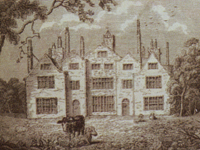
Winstanley Hall, Lancashire - print
Winstanley Hall, Lancashire – print showing the original Elizabethan house

Which brings us to the Grade-II* Winstanley Hall. One of only three surviving Tudor buildings in that borough, the house was built shortly after James Bankes, a London goldsmith, bought the estate in 1595.  The core of the Elizabethan house, with its two projecting wings, can still be seen on the garden front of the house, thought the original gables were replaced by parapets during alterations designed by Lewis Wyatt in 1818-19.  It was Wyatt who created the new entrance tower to the west with its Ionic portico and his work can still be seen inside with some surviving plasterwork and the fine cantilevered staircase.  What makes Winstanley particularly interesting is that it contains layers of work but with each grafted onto the last making the house quite ‘readable’.  A new wing to the south-west was added in 1780, with further changes, marked by keystones, in 1843 and 1889.

The stable court is especially fascinating architecturally as it contains a range of different styles, chosen at the whim of the owner; Meyrick Bankes II.  This delightfully eccentric but still functional range of buildings reflect his life as a well travelled, well educated man and includes Norman, Tudor, and Baroque motifs (and even his own likeness) in the masonry which creates a varied design which adds to the charm of the setting.  The visual interest of the courtyard, combined with the house, really does set Winstanley apart as many houses have lost one or the other of these core elements which make up an estate.

The house started declining in the 1930s and was last occupied in the early 1980s, with the parkland being open-cast mined during the post-war period and later the M6 being built along the edge of the parkland.  However, the parkland has now been restored and the road, which is some distance to the west of the house, is hidden in a cutting and by banks of trees, resulting in the Winstanley estate forming a precious rural space on the edge of Wigan, still approached from the east along a long, secluded drive which dips in between romantically landscaped woodland.

When the family sold up, the house and 10-acres were bought by a local developer who submitted a scheme which proposed enabling development, even though, as Green Belt land, it was unlikely to succeed.  With the failure of this scheme, the house remained unused, sliding further into dereliction to the point where another scheme was suggested which would have involved the conversion of the buildings in the courtyard but would have resulted in the demolition of the main house – and it’s this shocking scheme which English Heritage almost approved in 2011 (though EH, to be fair, also cannot be praised highly enough for their saving of Danson House and Apethorpe Hall – which is still for sale, by the way).

Proposed restoration of Winstanley Hall (Image: Huw Thomas / SAVE Britain's Heritage)
Proposed restoration of Winstanley Hall (Image: Huw Thomas / SAVE Britain’s Heritage)

SAVE stepped in and prevented the demolition and has been working with leading consultants to draw up plans for emergency repairs but also to find a long-term, sustainable solution which not only preserves the house through re-use but also brings the other buildings in the complex to life.  The leading country house conversion architect Kit Martin along with the Morton Partnership, a leading firm of heritage surveyors, have been working with Roger Tempest of Broughton Hall (who has a track record of creating business space in estate buildings), in conjunction with the Landmark Trust, and the Heritage Trust for the North West, who have been consulted about creating heritage training skills opportunities.  The overall aim is to create a community which is not just residential but also hosts businesses and events, with public access via an exhibition space and café.

How you can help: English Heritage have agreed a major grant of £217,000 for the emergency works but SAVE urgently needs to raise a £50,000 contribution.  Any donation, large or small, will help rescue this wonderful house and estate and help prevent the loss of yet more of our heritage.  Since 1974 no house of this size or quality has been lost, so, if you can, please do help.

Ways to donate:

  • Online via the SAVE website
  • Phone: donate £3 or £5 by texting RESTORE3 (for £3) or RESTORE5 (for £5) to 70500. (This will cost £3 or £5 plus your standard message rate and 100% of your donation will go to SAVE Britain’s Heritage.)
  • Cheque: made payable to ‘SAVE Britain’s Heritage’ and sent to SAVE Britain’s Heritage, 70 Cowcross Street, London, EC1M 6EJ.

Thank you!

——————————————————————————

Full SAVE campaign brochure: ‘Help us Save Winstanley Hall‘ [PDF – SAVE Britain’s Heritage]

Photos of the house in better days ‘Winstanley Hall: gallery‘ [SAVE Britain’s Heritage]

A very unofficial tour: ‘Winstanley Hall‘ [YouTube]

A view of the interior: ‘Winstanley Hall‘ [WiganWorld]

Aerial view of the house and outbuildings: ‘Winstanley Hall‘ [Bing]

Listing description: ‘Winstanley Hall

Country House Rescue – Season 4: Chapel Cleeve Manor, Somerset

Chapel Cleeve Manor, Somerset (Image: Webbers)

Many have bought things on a whim; it’s quite something for that thing to be a huge country house which once played host to royalty and celebrity.  When plans don’t work out and problems mount, it can be understandable for a family with generations of emotional attachment to a house to doggedly carry on, but the owner of Chapel Cleeve Manor in Somerset, who features in this weeks ‘Country House Rescue‘ (Thursday 21 June, 20:00, Channel 4), displays a rare level of stoicism.

Chapel Cleeve would be a fascinating house even if it wasn’t on television, but sadly its decline is all to familiar.  The origins of the house lie as a medieval inn for pilgrims visiting the now lost St Mary’s Chapel and travelling to the Cistercian abbey at Cleeve, which owned much of the land in the area until it was surrendered to the Crown in 1536.  The estates then passed to the Earls of Sussex in 1538 who held it until 1602, after which it passed through a number of owners, including Lord Foley of Kidderminster in the early 1700s.

When the new house was built, the remains of the inn, dating from 1423, were then incorporated as part of the north-west wing of the house as it is today.  The house, built between 1818-1823, was designed by Richard Carver (b. c1792 – d.1862) whom Colvin believes to be the ‘R. Carver’, a pupil of Sir Jeffry Wyatville who submitted work for display in The Royal Academy in 1811 and 1812, before establishing his practice in Somerset and eventually rising to be County Surveyor.  Best known for his many churches, Colvin is critical saying “…though occasionally showing some originality in plan (e.g. Theale, and the octagonal Blackford), are poorly detailed, and were despised by serious Gothic Revivalists.” He was damned by the Ecclesiologist in 1844 as having “…proved himself entirely ignorant of the principles of Ecclesiastical Architecture.” He may have been grateful that his Tudor Gothic design for Chapel Cleeve Manor was outside their remit and so escaped their ire.

Dining Room - Chapel Cleeve Manor, Somerset (Image: Webbers)
Dining Room – Chapel Cleeve Manor, Somerset (Image: Webbers)

Just under a century after Carver finished, the house was enjoying what was to prove to be its heyday.   Bought by the Lysaght family, wealthy from their corrugated-steel business, the original five bay house, featuring a central octagonal entrance hall with a top-lit staircase, was extended between 1913-14 with a sympathetic addition which increased the size of the house to over 27,000 sq ft, with salons, a ballroom and a 100-ft long gallery. Of particular note are the high-quality interior plasterwork ceilings which were created by one of the leading Arts-and-Crafts sculptors; George Percy Bankart. Staffed by 50 servants, the house played host to the young Princesses Elizabeth and Margaret, and with Fred Perry staying for tennis parties.

The death in 1951 of G.S. Lysaght triggering punitive death duties which forced the sale of the house and, worse, the sale of parts of the grounds as building plots.  The dense woodland which had thus far shielded the manor was now largely obliterated with housing claustrophobically creeping up on three sides. Perhaps the expectation was that the house would not survive and further housing could be built, but the house then enjoyed a resurgence when it became a hotel in the 1960s and 70s, becoming the place to be in the area. However, when that business closed, the rot, both metaphorically and physically, set in, so that when it was bought by the current owner for 14 years of Chapel Cleeve, Jeannie Wilkins, in 1998 ‘there was not one habitable room‘.

Chapel Cleeve Manor, Somerset (Image: Webbers)

Having spent £360,000 purchasing the property with her partner and with the help of two skilled friends, they started the mammoth task of restoring the house.  Correctly starting with the roof, it took two years to complete the task of making it watertight, with the restoration of the Edwardian wing taking many of the subsequent years.  The restoration was to a high standard, with care being taken to reinstate the many various mouldings and panelling, with the overall intention being to create six flats in the house, five of which could then be let – but, as with all the best laid plans, it went awry.

The inevitable challenges of finding an agreeable path through the stringent planning rules governing this Grade-II* listed house caused delays, and, sadly, Ms Wilkins relationship ended, following which she bought out her ex-partner, leaving her in sole charge of a vast partially-restored mansion with its 150-ft façade and spectacular views over the nearby hills.  With an income of just £5,000 per year from renting out a cottage in the grounds she faces a huge backlog of repairs (only 18 rooms are habitable out of 45 in total) and the costs of restoring it, which she estimates at around £500,000 (so, at least £750,000 – as anyone who has watched Grand Designs will know!).

Chapel Cleeve was offered for sale in early 2010 at £1.695m (and featured in a post at the time: ‘The start of the rush? Country houses for sale in the Sunday Times Home section‘), but it is still available. The combination of the restoration challenges, general economic climate and the severely compromised situation of the house – reduced to just 7-acres surrounded by a drab housing estate – have driven Ms Wilkins to call for the help of Simon Davis and ‘Country House Rescue’ to inject some new ideas – which he does, though none are the financial miracle she may have been hoping for.

In many ways, Ms Wilkins’ commitment to the house has to be admired – her dedication has almost certainly saved it from joining the sad, long list of lost houses.  However, it might be argued that her unwillingness to drop the asking price (especially considering the cost of the works outstanding) is also again putting the house at risk. A house of this size would ideally have much larger grounds to provide seclusion and planners ought to insist on a minimum 500-metre ‘green-belt’ around each house which would help protect their long-term viability. Undoubtedly Jeannie Wilkins deserves a just reward for the incredible work she has put in, but a quick sale at a reasonable price would certainly not only be best for her, but also for the long-term future of the house.

——————————————————————————

Sales details: ‘Chapel Cleeve Manor‘ [Fine & Country]

Official website: ‘Chapel Cleeve Manor

Listing description: ‘Chapel Cleeve Manor‘ [British Listed Buildings]

News articles:

Country House Rescue – Series 4 [Channel 4]

A poor prognosis: Great Barr Hall, Staffordshire

Great Barr Hall, Staffordshire (Image: English Heritage)

Many of the houses featured in this blog are shown as a celebration of the brilliance of our architects and craftsmen in creating one of the finest bodies of buildings of their type in the world.  Yet, in abundance is, perhaps inevitably, failure; where an interesting house becomes a victim of circumstance, policy, incompetence or, sometimes, all of the above.  Great Barr Hall, once outside Birmingham, now encircled by advancing urbanisation, is a sad example of where a house can languish and deteriorate whilst deliberate vandalism and institutional lethargy condemn it to its fate – and unless something is done soon, Great Barr Hall will join the already far-too-long list of the lost country houses of England.

Great Barr Hall c1800 (Image: artist known / sourced from Bill Dargue)

Despite its current sorry state, Great Barr Hall was once a sizable house – though precisely how large is unclear.  An early print in 1798 Stebbing Shaw’s ‘History and Antiquities of Staffordshire‘ shows a 11-bay castellated house with four corner turrets but the present house is 9-bays.  For comparison, it’s interesting to note the stylistic similarities with Syon House in west London, a seat of the Dukes of Northumberland, though it is also 9-bays wide and has an imposing porte cochere.

What is known is in the 1760s, Sir Joseph Scott, then head of a family line which had been in the area for 600 years, built a new house in a ‘gothick’ style.  The original architect is unknown but Stebbing Shaw describes how ‘The present possessor [Joseph Scott], about the year 1767, began to exercise his well known taste and ingenuity upon the old fabric, giving it the pleasing monastic appearance it now exhibits – and has since much improved it by the addition of a spacious dining room at the east end, and other rooms and conveniences‘. If Scott was his own architect, perhaps he was, in part, inspired by the remodelling of Syon House by Robert Adam which started in that same year.

Sir Joseph Scott’s original extensive works led to some financial difficulties and so, from 1785, he moved to the Continent and rented the house out.  The lease was taken by Samual Galton junior, a controversial Birmingham Quaker, banker,  gun manufacturer, and intellectual who hosted meetings of the Lunar Society at Great Barr Hall leading to it becoming a noted crossroads for industrial ideas, a crucible for the Midlands industrial growth and the wider Industrial Revolution.

Where Great Barr becomes particularly interesting from our point of view is with the arrival of the young architect John Nash and his business collaborator and famous landscaper, Humphrey Repton. Nash was there to provide the buildings which Repton needed to complete his  gardening visions. This worked well for both men; Nash was to pay Repton 2.5% for any work the latter passed his way so Nash charged his clients the then rather high fee of 7%, giving him a 4.5% fee. There is no record of Nash ever putting any work towards Repton – but Nash benefited with work on over one hundred estates. There seems to be some uncertainty as to exactly when Nash started working there but John Summerson gives the date as 1800 for the construction of a gothic archway to the adjacent chapel, but other works such as the gate lodges, an icehouse and a new steeple for the chapel started in 1797 and were probably also by Nash and Repton.

Corsham House, Wiltshire - copper engraved print published in The Beauties of England and Wales, 1813 (Image: Ancestry Images)

About this time, the house was also updated to create the appearance we can just make out today – but it hasn’t been confirmed that Nash was the architect.  However, there are tantalising clues that it could well be by him. Nash had been developing his particular style of Picturesque gothic during his time in Wales and had been applying it with varying degrees of success since then during alterations at Kentchurch Court, Herefordshire, (1795) and at Corsham House, Wiltshire (1797 – a disaster due to poor workmanship with Nash’s work later demolished).  Yet, some of the architectural fingerprints of each of these can be seen in Great Barr.  Externally, one such feature is the crenellations applied to both the roof and the tops of the projecting towers, another is the hooded Elizabethan-style windows. Another interesting piece of the jigsaw is a house which Nash was working on in 1800 in Buckinghamshire,  Chalfont Park, which bears not only a superficial stylistic similarity but also one of form – a long rectangular main body with a projecting 3-bay centre.  However, Chalfont Park was also altered by Anthony Salvin in 1840 so it’s not possible to tell how much of the gothic detailing is Nash’s.

The Scott’s return in 1797 prompted the works of Repton and Nash before further work in 1830 and 1848 which included moving the entrance from the west side to the north.  In 1863, a chapel was built to a design thought to be by Sir George Gilbert Scott, though it was never consecrated and so became a billiard room.

The replacement windows (Image: Simon Cornwell) - click to see 'before and after'

The house remained with the Scotts until the house became a hospital for the mentally ill in 1918 following the death of Lady Bateman-Scott in 1909.  As is usual, the institutional nature of hospital use was not kind to the house.  Beyond the extensive network of buildings which marched across Repton’s parkland (and the south eastern corner of the estate being carved up by the M6 motorway), the house itself had a modern two-storey extension added in 1925 and in 1955 the clock tower, stables and much of the east wing were demolished.  In the 1960s, some sensitive architectural ‘genius’ removed the two splendid first-floor oriel windows which flanked the main entrance and inserted a pair of non-matching government-issue casement windows.

The current plight of Great Barr Hall can largely be laid at the door of Bovis Homes and John Prescott, formerly the Deputy Prime Minister, and the one who eventually signed off on the architectural blight that now affects the house.  Considering that the hospital buildings were in two distinct campuses, one to the north west and another to the north east, if there had to be development, replacing the buildings to the NW would have placed them furthest from the house, with the advantage of creating a more complete parkland around the house, with the possibility of re-instating, to some extent, the earlier Picturesque drive.  To hope that someone of Prescott’s aesthetic insensibilities would see such a solution was always forlorn but one might hope that someone on the local council or in English Heritage might have proposed a more sensitive outcome.  Sadly it was not to be and now a large development of 445 executive-style homes has been built, the closest being scarcely a hundred metres from the back of the house.  Worse, following the sale of the house to a building preservation trust, little progress has been made, with questions now being asked about the trust’s failure to restore it as promised earlier.  It was again put up for sale in May 2011 by the Trust at the unrealistic price of £2.2m with the option to buy a further 100-acres of parkland – with the threat of even more development.

Despite some architectural uncertainties, what is clear is that those charged with its care in the recent decades have failed.  Perhaps this is a broader failure of policy, that without an explicit mandate to determine that the architectural heritage must be managed, maintained and preserved as far as is possible, it will fall to all-to-fallible councillors to look beyond their own short-term interests; sadly, an unlikely prospect.  The NHS generally has a poor record of managing historical assets once it has no further use for them e.g Sandhill Park, and Stallington Hall are just two examples and don’t forget that Soane’s Moggerhanger survived despite the NHS, not because of it. A strong national policy should provide a clear strategy for preservation of heritage assets taken over by the state rather than just relying on existing listed buildings legislation.  In Great Barr Hall’s sad circumstance, one can only hope that someone will be able to extract the money owed as part of the enabling development, which can then be devoted to restoring this interesting and significant house so that it once again can be something for the local residents to be proud of, rather than the monument to NHS, central government and local council incompetence which it is today.

————————————————————————

Still for sale? (thanks to Andrew for spotting this): Great Barr Hall might still be for sale – there is a page with details but it’s not listed on the agent’s website: ‘Great Barr Hall‘. Now listed for £3m but with 150-acres but with another 100-acres of parkland by separate negotiation.   Considering the Building Preservation Trust paid just £900,000 for the entire site this seems a little odd – perhaps someone will enlighten us.

————————————————————————

Listing description: ‘Great Barr Hall‘ [British Listed Buildings]

‘At Risk’ Register entry: ‘Great Barr Hall‘ [English Heritage]

Recent history of house and some proposals for rescue

News stories: