A suburban survival at risk: Braunstone Hall, Leicestershire

Braunstone Hall, Leicestershire (Image: East Midlands Oral History Archive))
Braunstone Hall, Leicestershire (Image: East Midlands Oral History Archive)

Two of the most important aspects of campaigning to save country houses are vigilance and visibility – and yet sometimes even this doesn’t always seem to bring about restoration any quicker when faced with a slow-moving owner. Braunstone Hall, a Georgian gem still with significant grounds but now swallowed up in the sprawl of Leicester, has been empty for over ten years but despite a vigorous campaign both in the media and online it still remains very much at risk.

Braunstone Hall, now grade-II listed, was built in 1776 (date on rainwater head) for the Winstanley family by the architect William Oldham (b. 1737 – d. 1814) who also designed an early Leicester racecourse grandstand (1770), Master’s House at Alderman Newton’s School (1789) and the New House of Correction (1803) – all though now demolished.  The red-brick house is two and a half storeys tall by five bays wide with a cornice and hipped roof.  The relatively simple front is enlivened with stone bands marking the ground and first floors with an impressive tripartite doorway with fluted columns, a small pediment and an elegant fanlight with arched glazing bars.  One further very distinctive feature is the giant blind recessed arch in the central bay – an architectural device which seems quite popular in Leicestershire with examples in Burbage, Belgrave House (also 1776), and the beautiful rectory at Church Langton (by William Henderson – 1760).  The interior is largely complete with some impressive detailing.

The Winstanley family bought the estate from the Hastings family in 1650 and remained there until forced out in the 1920’s by the pressure to build houses following the First World War.  Estates on the edge of existing towns and cities were eagerly eyed-up by local councils.  For some families, already facing financial hardships following the war this was a perfect opportunity to sell the family seat and relocate.  Others, including the Winstanleys in the shape of Major Richard Norman Winstanley, fought the prospect of compulsory purchase arguing that this was still a family home and the building work would undermine the value of his recently modernised house.  However, he was unsuccessful and so the house, gardens, parkland and further 949-acres were compulsorily purchased in 1925 for £116,500 (equivalent to £5.2m – 2008).  Most of the land was built over except for the house and 168-acres surrounding it which became a public park.  The house remained in council ownership and was first a secondary school, opening in 1932, before becoming a primary school a year later until it closed in 1996.

Since then the Leicester City Council has failed to either find a viable long-term use or adequately protect Braunstone Hall with the house falling victim to repeated acts of vandalism and arson.  The latter is the most worrying as the incidents have not only included fires outside the building but also now inside.  Over the last few years the Council have been making very slow progress towards finding a solution but, as always, they are claiming poverty when it comes to heritage projects.  A very active campaigning group has been set up on Facebook with the members regularly corresponding with councillors and reporting any damage or deterioration at the hall – effectively a dedicated ‘Neighbourhood Watch’ for the house.

The Council put the house up for sale on a 125-year lease in 2007 and had recently been negotiating to sell the house to a local businessman for conversion to a hotel, conference centre and wedding venue. However this has been delayed by changes to what’s being offered in relation to the land for enabling development.  Each delay increases the risk that the local yobs will finally succeed in their mindless vandalism and burn down this elegant and important part of Leicester’s heritage.  If this happens the blame can be laid firmly at the feet of Leicester City Council and their apathy and indecisiveness over the last 14 years.

Join the Facebook campaign group: ‘Restore Braunstone Hall

Detailed history of the house: ‘Braunstone Hall‘ [Leicester City Council]

Detailed description of the house: ‘Braunstone Hall‘ [English Heritage]

A country seat of learning: Wispers, Sussex

Wispers, Sussex
Wispers, Sussex (Image: Daily Mail)

There has been a long tradition of country houses being converted to schools.  Indeed, the practice has saved many hundreds from being demolished all together, denying us today the pleasure of houses such as Stowe and Bryanston.  In recent years fewer houses have passed into institutional use with a preference for modern school buildings.  However, despite some difficulties in the last couple of years for private schools, the recent sale of Wispers in Sussex has shown that there is still the appetite for the country house based school.

Grade-II listed Wispers was built in 1874-76 by Richard Norman Shaw for stockbroker Alexander Scrimgeour and was sold in 1928 to the Bedford estate for Dame Mary Russell (the wife of the 11th Duke of Bedford) as a weekend retreat to which she added the huge eastern wing in the 1930s.  Dame Mary was known as ‘The Flying Duchess’ due to her interest, later in life, in aviation which led to her regularly flying her Tiger Moth – including from the Bedford’s main home, Woburn Abbey, to Wispers.  To help accommodate her new mode of transport, at the same time as the new wing was being added to the house, she had an airplane hanger built as well.  Dame Mary’s love of flying did eventually lead to her death when, at the age of 71 in 1937, her plane disappeared over the North Sea as she flew from Woburn to Cambridge.

Following her death, the house was sold in 1939 and became a school known as St Cuthman’s before West Sussex council bought it as a special needs facility.  After this closed in 2003, the house was sold and a planning application lodged to convert the main house into 7 flats with other buildings on the estate being either converted or demolished.  However, this plan was never implemented and after lying empty for 6 years was sold for £3m (against an original asking price of £4.5m) with 20 of the original 35 acres in April 2010 to Durand Primary, near Brixton, South London. The school was able to use the profits from its successful leisure and student accommodation business to provide Wispers as a weekly boarding environment for secondary age pupils.

Educational use has saved many country houses from being demolished or converted – though sometimes the alterations required or the heavy wear and tear on these buildings could be quite damaging.  When English Heritage took on Apethorpe Hall in Northamptonshire they discovered light switches and other fittings had been poorly installed, usually by simply hacking through the plasterwork.  However, on balance, these minor issues are the lesser of two evils compared to possible complete loss.  It’s not known precisely how many country houses have been used for educational purposes at some point in their lives (and many took on this role temporarily in WWII, most famously Blenheim Palace and Castle Howard) but it certainly shows the versatility of our country houses.  Use as a school can also help preserve a house so that one day it might possibly be converted back to being a home.

More details: ‘Inner-city school buys mansion to keep pupils safe from knife crime‘ [Daily Mail]

If I won the lottery…Fillongley Hall

Fillongley Hall, Warwickshire (Image: Weddington Castle website)

Considering the difficulties faced by country house owners with death duties and a changed society, it’s always remarkable when a house is passed down through the generations; particularly so when it’s the same family for nearly 200 years.  Fillongley Hall designed by George Woolcott and was built in 1824-25 for the uncle of the 1st Lord Norton, extended in 1840-1, and now for sale again by the 8th Lord Norton after an unsuccessful attempt to sell in 2005.

The grade-II listed house is considered to be one of the best examples of smaller scale Greek Revival architecture which demonstrated the good taste of the Grand tourist with it’s fine interiors and classical exterior with recessed Corinthian columns on the main entrance front.    Bearing some resemblance to the now-demolished Thirkleby Park in Yorkshire, the house is a compact essay in elegant classicism with a restraint all too often lacking in modern country house architecture.  The house was inherited by Lord Norton in 1993 since when he and his wife have lovingly maintained and updated the house.  More images of the interior and exterior can be seen either on this fascinating local history website or on the Savills website.

When Fillongley Hall was put up for sale in 2005 the guide price was £5m but this included 400-acres as opposed to the 114 plus the house which are available now for £4.5m.  [The house subsequently sold in 2006]

This is a beautiful house and deserves and owner who understands the house and is sympathetic to its status as one of the best houses of its type in the region.

Property details: ‘Fillongley Hall‘ [Savills]

Kiddington Hall sold – but as a home or an investment?

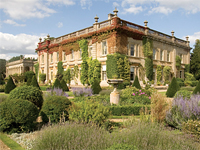
Kiddington Manor, Oxfordshire (Image: Country Life)

After many viewings and some speculation, the Sunday Times is reporting that Kiddington Hall has finally been sold for £15m to Jemima Goldsmith, the wealthy socialite.  The grade-II listed house, originally built in 1673 but largely rebuilt to designs by Sir Charles Barry, comes with 466-acres of gardens and parkland designed by ‘Capability’ Brown.  The Sunday Times quotes a ‘property source’ as saying “It was a romance. She just fell in love with it.”.

The sale was ordered by the court to fund the divorce settlement of the owner, Erik Maurice Robson, who needed to raise £8m to provide for his ex-wife (for a detailed estimation of the likely proceeds see the comments on a previous post: ‘The economics of selling a country house‘).  The estate, described as a ‘jewel in the heart of Oxfordshire’, was one of the most important estates to be launched onto the market last year as rarely do prime estates with a manageable house, fine gardens and a productive estate, come up for sale in the prime Home Counties and this was reflected in the original asking price of £42m for the entire 2,000-acres and house.

However, considering Jemima’s previous successful forays into property development, is Kiddington Hall to be a family home or will she take the advice of some who say that if she spends a couple of million on refurbishment the property could be worth £20m?  It will certainly be one to watch as if it is relaunched in a year or two, it will provide a useful barometer as to the recovery of prime country property.

The sale of the main house will also mean that the sale of the remainder of the estate, encompassing 1,600-acres plus several farms and houses can proceed.  These sales were contingent on the main sale as without the sale of the main house the rest of the estate could not be sold.  The Sunday Times is reporting that Alec Reed, founder of the Reed recruitment agency, is the purchaser.

More details: ‘Jemima Goldsmith jumps on £15m stately home‘ [The Sunday Times]

Ury House restoration project still in doubt a year on

Ury House, Scotland (Image: Geograph)

When the developers FM Developments went into administration in 2009, it put in jeopardy a huge development scheme which was to fund the restoration of the historic Ury House.  The size of Ury House meant that any scheme was going to have to be ambitious to provide sufficient funding and this one involved the building of 230 homes and the creation of a Jack Nicklaus-designed golf course.  The developers had been praised for consulting with local residents and had the full support of the council for bringing jobs and no small measure of glamour to Stonehaven. Now, a year after the collapse, it’s still not clear if the scheme will proceed at all, leaving the spectacular ruins of Ury House at further risk of decline.

The first house had burnt down in 1645, and the second house was subsequently completely rebuilt as the Ury House we see today in 1855 for Alexander Baird in a fine Elizabethan style by the architect John Baird.  Baird was one of the most successful of the architects working at this time even if he rarely followed fashion.  His work at Ury was a continuation of the style of Wilkins and Burns they had developed 40 years earlier but was of a high quality which is still visible even today in the shell of the house. As a first stage of the work of the restoration, extensive scaffolding had been erected around the house in January 2009.

The proposals for redevelopment of the 1,500-acre estate included the conversion of the house into nine townhouses.  Unlike in many other cases of ‘enabling development’ where the setting of the house is compromised through the encroachment of the housing, the plan put forward placed the residential estate well to the east of the house, thus protecting it.  With the bankruptcy of FM Developments these plans have  been thrown into doubt and local planning officers are now working on the assumption that the development will not go ahead – despite local councillors being determined to resurrect the scheme.  Unfortunately the danger is now that another, less sympathetic, developer will take on the project but may try to cram more houses in or extend the area of the estate taken for housing. This would be a real shame. Although the ideal but unlikely outcome would be the restoration of the house as a single family home, this project had developed as a good example of enabling development practiced in the right way, with sensitive restoration of the main house, protection of the setting of the house, and productive use of the estate.

More details: ‘Future of Ury mansion site in doubt‘ [The Press and Journal]

Future of Ury mansion site in doubt