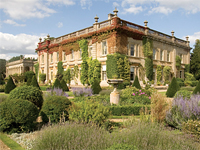
Rempstone Hall, Leicestershire (Image: Country Life)
In the early part of the 20th-century one option for a country house to avoid demolition was to be converted to institutional use. In this way, many houses became schools, hospitals or offices, but also some became religious institutions – for example, in the 1940s and 50s, Gloucestershire lost seven houses but twenty-two were converted to institutional use. Now with property prices rising but membership of convents falling, houses used for holy purposes are now being sold – and could once again be homes. Rempstone Hall in Leicestershire, currently the Holy Cross Convent, is on the market for £2.5m, as the nuns move to a purpose-built home nearby.
Rempstone Hall is a classically beautiful Georgian red-brick house, originally built in 1792 for William Gregory Williams, a major local landowner. Various families passed though the house usually keeping it as a secondary house to much grander seats elsewhere. By the beginning of the 20th-century it was unoccupied as probably, as with many other houses, at risk of demolition as the houses became surplus to requirements and a drain on finances already under pressure. Rempstone Hall was saved in 1909 when P.W. Carr moved in and made significant additions including a new north wing and a fine stable block before selling it in 1920 to the Derbyshire family from whom the Convent bought it in 1979 for just £110,000.
During their time at Rempstone, the nuns have removed the exterior stucco to expose the warm red-bricks giving the house a bold appearance, the two red blocks framing an elegant loggia which faces the gently sloping lawn. At 21,000sqft this is undeniably a large house with 20 bedrooms, a large entrance hall with possibly Jacobean staircase, a sizable chapel and many other rooms. One downside of institutional use is the rather functional decor and Rempstone is no exception, with lino, acres of red carpet and various partitions which the new owner would need to remove; total renovation costs are estimated to be in the region of £500,000.
This fine and beautiful house, well-located in the Midlands, with 60-acres and several estate buildings, cries out for someone with taste to restore this house back to being a family home – which is helpfully the outcome favoured by the local planners.
Kiddington Manor, Oxfordshire (Image: Country Life)
An article regarding the sale of Kiddington Hall in the Financial Times has highlighted that the asking price of a country house when put on the market is not the amount which will end up in the buyer’s pocket.
When grade-II listed Kiddington Hall was launched on the market in September 2009, the price tag of £42m reflected its status as one of the most important houses to be offered since the sale of Easton Neston in 2004. The main house was built in 1673 and sits in the centre of it’s 2,000-acre estate in Oxfordshire, with parkland designed by ‘Capability’ Brown. The house was remodelled in the 1850s by Sir Charles Barry in his trademark Italianate style which included the creation of a large courtyard and extensives terraces in the gardens.
The beautifully elegant house is being sold by Erik Maurice Robson, whose father bought the house for £115,000 in 1950. The sale was court ordered to fund his £8m divorce settlement, and valued his freehold interest in the house and estate at just £16m. This article states that this value is what remains after “excluding furniture, capital gains tax and sale costs”. Mr Robson has now asked the court to reduce the value of the settlement as, due to a fall in property values, his interest is now worth only £13.18m. This seems a remarkably small amount to be able to realise from such a high asking price and perhaps emphasises that a country house is not the pot of gold many imagine it to be.
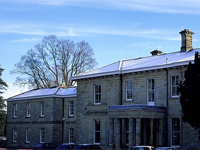
Townhead House, Lancashire (Image: SAVE Britain's Heritage)
Townhead House is a rare thing indeed – a house which has not been altered since before the last people to use it left in 1939 but also is not in a dire state of dereliction. Its unoccupied status was a cause for concern and although parts of the house required attention, overall the house was in remarkable condition.
Built in 1729 for Henry Wiglesworth using parts of a 17th-century building, the architect is unknown but achieved an elegant if somewhat austere house using large blocks of coursed limestone. Inside, the main rooms with their fine Georgian panelling and particularly the staircase indicated the architect was influenced by other such as Wren, Jones and Gibbs. This can be seen with the use of certain architectural elements before they became widely known through pattern books such as Batty Langleys.
The grade-II listed house was used just a shooting lodge between the 1890s and 1930s. Now finally, a local man, semi-retired businessman Robert Staples, has bought the house and has promised to sensitively restore it to use as his home:
“The works will ensure that the integrity and longevity of Townhead is not compromised and that the building has a continued and long future.”
All this bodes well for this important part of the local architectural heritage. Also encouraging is Mr Staples’ professed desire to return the house to being the centre of a ‘gentleman’s estate’ – a welcome reversal of the pattern of the last 50 years when small estates were increasingly broken up and lost.
Often the course of the country estate over the last 100 years has been for the land to be gradually sold off, starting with the outlying areas, and moving closer until just the house and it’s immediate gardens remain intact. At Leonardslee in Sussex the process was eventually taken one step further with the house being sold off. This, however, may about to be reversed.
Sir Edmund Loder bought the manor house and 225-acre gardens from his inlaws in 1889 and soon opened them to the public. Over the next five generations, the Loder family added to the planting and landscaping to create what is now one of the only 163 grade-I listed gardens in the country. Despite the family still owning the gardens the grade-II listed Italianate manor house, built in 1853 and featuring a 900 sq ft central hall decorated with Ionic columns, was sold off separately in the 1980s and became offices. The gardens grew in reputation so it was something of a shock when in April 2008 it was announced that they were being put up for sale by Robin Loder for £5m through the estate agency Savills. Cleverly, the company who owned the house also announced they were open to offers at around £3.25m for the house.
The Times is now reporting that after nearly two years on the market, the gardens have been sold to a private businessman and are likely to close to the public. They are also reporting that the house may also be under offer at £2.75m to the same businessman giving him a perfect opportunity to once again recreate a stunning small estate which, with the addition of the house, could be worth in the region of £10m. Though a sad day for the many garden-lovers who have made many a pilgrimage to wander among the wallabies, it’s an encouraging reversal of the trend for houses to lose the control of the landscape which so often perfectly frames them.
There is always a temptation when any country house and estate comes to the market for the land to be built over with residential developments which provide a quick and relatively easy profit – even if it does ruin forever the setting of the house. Usually the houses are snuck through under the cover of ‘enabling development’ with a promise that this will secure the long-term future of the house. Grade-II* listed Sandhill Park in Somerset is an interesting example of where this fails if the development is build in an inappropriate location and a council who apparently haven’t ensured that at least some of the profits are invested in the house.
The main house at Sandhill Park was built around 1720, for the John Perriam, the MP for Minehead and inherited in 1767 by his grandson John Lethbridge (who was knighted in 1804) and remained in the Lethbridge family until 1913. On inheriting Sandhill Park in 1815, Sir Thomas Buckler Lethbridge, the 2nd Baronet (b. 1778 – d.1849) added a grand portico to the main house and large wings to the rear. The main house was substanially rebuilt in the 19th century giving it the distinctive and elegant sandstone ashlar look it retains today. These changes were funded through debt which burdened the family for years but ensured that no further major changes were made. However, following the death in 1902 of Sir Wroth Acland Lethbridge, the 4th Baronet, the family moved out and the house was let until it was sold, along with 4,000 acres, in 1913. It was subsequently bought in 1929 by Somerset County Council for use as a hospital and was requisitioned as a military hospital during WWII. After the war, it became a psychiatric hospital until it closed in 1992 since which the house has remained unused.
The assumption appears to have been that the house could not be returned to being a family home which appears to have given the green light to the estate being built on and the conversion of the house with further building works to the rear, again turning a wonderful country house into a mere afterthought in a large development. Planning permission was initially refused for what is now known as the Lethbridge Park housing estate which has been built to the east of the main house with the nearest property being just 100-metres away. The only access for this estate is a small road to the north – the opposite direction to the town – which forces all traffic through a country lane before joining the main road back to Bishops Lydeard. It’s not possible to walk to the town so even to get a paper the residents must use their car. Surely it would have been better to site the estate away from the house and use the parkland nearest the town? The isolated residents gain no benefit from being so close to the house and the council’s decision has merely ensured more traffic on the local roads whilst compromising the setting of the main house.
This development has made it harder to sell the house as a home as the roofs of the new houses are visible from the main house. But perhaps this was part of the plan as the Knight Frank sales particulars explain that planning permission has been granted for the conversion of the main house into apartments with many more houses being built to the rear of the house. However, as the house and 145-acres are now for sale for £2.75m it appears that after completing the residential development, the owners have decided to pocket the profits, sell the ‘difficult’ part and run. This is apparently a prime example of a fine, though misused house being failed by the local council who are supposed to protect it. How did they get planning permission for such an inappropriately sited development? Why did the council not insist that the house be restored? Why are the old derelict hospital buildings still standing – surely they should have been removed as a minimum? The council seem to have decided that it’s better to have two inappropriately sited developments rather than looking after an important part of their local architectural heritage.
Update – 22 November – Sandhill Park seriously damaged by fire
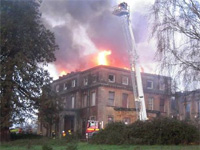
Fire at Sandhill Park - 22 Nov 2011 (Image: Lucy Robert Shaw / This is Somerset)
Sadly, as so often happens with uninhabited country houses, Sandhill Park has suffered a serious fire which has affected large parts of the house. The mysterious blaze started on the first floor (and considering there are no services to the house, this has to be suspicious) and quickly spread through the rest of the first and upper floors. The huge quantities of water the fire brigade would have had to have used have almost certainly brought down the ceilings in the rooms below and the now serious damp house will be extremely vulnerable to wet rot. If it is proved that the fire was arson, it’s a terrible indictment of the NHS for abandoning the property and the local council for approving such a ridiculous housing scheme which has made it harder to sell the house – compounded by their ineffectiveness in getting the old hospital buildings removed and the house restored in the first place.
I can only hope the owner was insured and is able to take protective measures to mitigate the fire and water damage and to somehow get ownership of this fine house into the hands of someone who can care for and restore it. Anything less would be an architectural tragedy and would reflect badly on those involved. However, if history is any guide, I suspect we will shortly see an application to demolish, claiming that it is ‘dangerous’ (usually this is not remotely true and just a developers excuse) and more bland housing will march across this once fine parkland, a poor memorial to the heritage of the town.



 The Country Seat