Confirmed: Gwrych Castle is for sale again

Gwrych Castle, Wales (Image: geograph.co.uk)

Following earlier concerns, sources have confirmed that the grade-I listed former ‘showplace of Wales’, Gwrych Castle, is once again for sale.

After many years as a deteriorating ruin, it’s outlook improved when the castle was finally sold for £860,000 in 2007 to City Services Ltd (trading as Clayton Homes – a separate company to Clayton Hotels which is still trading). They soon announced ambitious plans to convert it into a luxury 5-star hotel using the original layout as the starting point.  Initial work on site has included the removal of over 1,900 tons of asbestos and debris from within the shell and the vegetation stripped from the exterior. The site was ready for restoration to start and Donald Insall architects were working on the designs for restoration.

Unfortunately 2007 was the height of the property market and the subsequent fall hit many companies including Clayton Homes which went into administration on 12 August 2009.  Deloitte (Leeds) were appointed as administrators and have been quietly marketing the assets including Gwrych Castle.  This was highlighted by the story of the businessman who was viewing the castle as a possible site for his ‘psychic school’ when he conveniently saw a ghost at a window.   Kevin Horkin has apparently submitted a bid for around £850,000 – which may secure him the site but to complete the project to the required standard will require at least another £6m-12m depending on his ambitions.  This is a significant level of investment if he is to restore this wonderful house to the appropriate standard.  Hopefully Cadw, the Welsh equivalent to English Heritage, will keep a very close eye on the project and ensure that any plans are at least to the same standard as those approved for Clayton Homes.

Many people have taken a keen interest in Gwyrch Castle and had hoped that the sale would lead to this once grand house again taking a key role in the local area and also to save this important part of their architectural heritage.  It would be tragedy if the work already done to create a secure and viable foundation for restoration was allowed to deteriorate again – the house must be sold to a sympathetic owner who has both the vision and funds to complete this project in a way which befits this beautiful house.

More details:

Posh B&B – stately home owners diversify

Sennowe Park, Norfolk (Image: sennowepark.com)

A country house was traditionally the centrepiece of an estate usually absorbing huge amounts of money in running costs and improvements.  This model was sustainable when the estate or other source was sufficient to provide the necessary income but today often a family can inherit a large house with all the costs but not the means to fully maintain it.

In another example of the diversification that has allowed so many of our country estates to survive, aristocratic families are now offering the chance for those willing to pay from £1,000 per day to experience life as it is for those lucky enough to live in these beautiful homes. A Suffolk firm, ‘More than Good Manners‘ arranges these luxury stays with an emphasis sharing in some of the best country pursuits in houses such as Sennowe Park, the grand Edwardian family home of Thomas Cook and his descendants.

Some may complain that these are a devaluation of the grandeur of the country houses and the families who live there. However it could be argued that there is a long tradition of these houses hosting visitors for gain when years ago the monarch would be lavishly entertained in hope that honours or privileges would be bestowed on the hosts. This modern twist on the theme sees income being provided in a way which doesn’t greatly increase the wear and tear on the fabric of the house and is largely in keeping with the original purpose of the house as a centre for leisure.

Full story: ‘Take a break – with an aristocratic family‘ [Eastern Daily Press]

‘Aristocracy is dead’ says Duke of Devonshire *Updated*

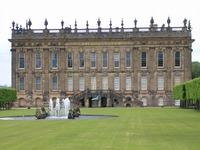
Chatsworth House, Derbyshire (Image: wikipedia)

Although the country houses are often impressive in themselves there is always heightened interest when they are associated with a grand title.  Unfortunately the 12th Duke of Devonshire, in an article in today’s Sunday Times magazine, believes that the concept of aristocracy is dead and that if the current government succeed in removing the last remaining hereditary peers he will take this as a sign from the public and would be willing to give up his own.

To me this seems very sad as his own title comes with 300 years of history and in some ways it’s not his to declaim as his heirs may be willing to keep it going.  The family seat of Chatworth in Derbyshire is synonymous with the Devonshire title following the recent films and books and to lose it is as much a commercial loss as it is one of heritage.  Perhaps he might consider just not using it and placing it in abeyance until his death and then it can be used or not as his son wishes. I can’t believe that the current legislation is a fair reflection of the will of the people who generally have a greater respect for the nations heritage and traditions than those currently in charge.

Full story: ‘Aristocracy is dead, says Chatsworth’s duke‘ [Sunday Times]


Update issued on behalf of the Duke of Devonshire  [22 Feb 2010]

“Sir

Further to reports in the press I would like to clarify my position on the use of the Devonshire title. Should hereditary peers be removed from the House of Lords I would indeed strongly consider dropping the public use of my title, as I believe that I would have to consider and respond to any future democratic mandate against hereditary peerage. However, my principle duty will continue to be to preserve and enhance Chatsworth itself for future generations and I remain immensely respectful of my Devonshire predecessors who have bequeathed us this very special place.

Yours,

Stoker Devonshire

The Duke of Devonshire, KVCO, CVE, DL

Chatsworth, Bakewell, Derbyshire”

The greatest country house you’ve never heard of: Wentworth Woodhouse

Wentworth Woodhouse, Yorkshire (Image: geograph.co.uk)

Although Britain is a relatively small island it still has the capacity to hide some spectacular buildings which, unless opened to the public, can remain a secret.  One such house, featured this week in Country Life magazine (February 17) is Wentworth Woodhouse in Yorkshire, thought to be the largest private residence in Europe and for Marcus Binney “unquestionably the finest Georgian house in England”.

Built over a 25 year period from 1724 for Thomas Watson-Wentworth, Marquess of Rockingham, it is twice as wide as Buckingham Palace and boasts over a 1,000 windows, 365 rooms and five miles of underground passageways.  The stable block appears to be a large country house but is merely the lodging for up to 100 horses. Inside the main house, the Earls FitzWilliam enjoyed a priceless art collection which included works by Titian, Van Dyck, Guido, and Raphael.

Yet this was a house to be blighted by the bitter class-war hatred of the post-war Labour government and questions of inheritance. In April 1946, heavy machinery moved into Wentworth Park to pointlessly mine low-grade coal right up to the back door of the house on the express instruction of Manny Shinwell, the minister of fuel and power.  A old-school left-winger, Shinwell was given options to save the parkland and gardens but was determined to press on despite representations from the local miners who had been very well treated by successive generations of FitzWilliams.

Once mining finished the FitzWilliams leased the house as a training college and retreated to 40-rooms but even then lived mostly elsewhere. Questions about the legitimacy of the inheritance led the last Earl to order a vast bonfire in 1972 of 16 tons of family papers, some dating back to medieval times, which burnt for three weeks.

Yet, despite its size the house escaped the fate of so many large houses in England and merely languished in obscurity.  Sold with just 30-acres in 1988 by the daughter of the last Earl it was bought by Wensley Haydon-Baillie who promised investment but in 1998 it was repossessed. It was then sold for the unbelievably low price of £1.5m (equivalent to just £7 per sq ft) to the architect Clifford Newbold whose careful restoration work has been praised and beautifully photographed in this weeks Country Life.

—————————————————————————–

*Update* May 2011 – I have written a more extensive write-up on the architectural history of the house in response to the episode of ‘The Country House Revealed

—————————————————————————–

More information: ‘Wentworth Woodhouse’ (Wikipedia)

Is Gwrych Castle for sale again?

Gwrych Castle, Wales (Image: geograph.co.uk)

When Gwrych Castle was finally sold in June 2006 after twenty years of neglect, dereliction, fires and theft, there was much praise and relief locally that the once-beautiful “showplace of Wales” was to be rescued.  Bought by Yorkshire-based Clayton Hotels for £860,000, they estimated that once planning permission had been secured, the restoration would take between 2-3 years and cost an estimated £6m – however three years later, the major part of the restoration work has yet to start.

Built between 1819-1825 for Lloyd Hesketh Bamford-Hesketh, grade-I listed Gwrych was one of the largest ‘castlellated mansions’ in Europe, part of a ‘gothick’ revival which included some of Britain’s most picturesque country houses such as Eastnor Castle, East Cowes Castle, Lea Castle, and Castel Coch and many more. Following its sale by the 13th Earl of Dundonald in 1946 it was opened to the public in various forms and under various owners until 1989.  The failure of the redevelopment plans led to the castle being left unprotected against the ravages of the weather, travellers, and vandals, leaving the castle a mere shell, the fine interiors rotting in piles in the collapsed ground floor.

The plans unveiled by Clayton Hotels in 2007 showed that the castle would be fully restored and largely based on the original layout. Mark Baker of the Gwrych Castle Preservation Trust, who had campaigned since he was 11 to save the castle, welcomed the plans and for many it seemed that the end was in sight.  In February 2009, Wales Online (‘Welsh ruin to be transformed with techniques fit for royal home‘) trumpeted how the design work for the restoration was starting under the care of Donald Insall, one of the best conservation architects in the UK.  However, in May 2009, a story on BBC News (‘Slow economy delays hotel plans‘) explained that the slow economy had delayed plans and also the cost for the project had risen to between £12-14m.

Now a recent story (‘Clitheroe man haunted by ghostly image in castle window‘) about a ghost in a window included some interesting quotes which raise some questions about the status of the project – or perhaps just the intended future clients.

A Lancashire businessman who combines being an optician with “psychic management” claimed to have taken a picture of a girl standing at a window where there is no floor.  Kevin Horkin claimed he was visiting the site as “I buy property and was looking at the castle with the view buying it.” and the story ends by saying that “Kevin has put a bid in for the castle which he hopes to turn into a luxury psychic retreat.”.  Despite the obvious convenience of a psychic who wants to open a hotel taking one of the clearest ever pictures of a ghost, it does raise questions about why he is saying the hotel is for sale? The Clayton Hotels website is one page with an email link and with the dramatic rise in restoration costs and the difficulties of the property markets, is the castle being quietly marketed ‘off the record’? Perhaps the quotes are misconstrued, or perhaps Clayton will refurbish the house but lease it Mr Horkin, but either way, Clayton Hotels should perhaps clarify exactly what is happening to this iconic part of Wales’ architectural heritage especially as so many people have spent so long campaigning for its rescue.

More information about the house: ‘Gwrych Castle Trust