Country House Rescue – Season 4: Bantry House, Ireland

Bantry House, County Cork, Ireland (Image: Bantry House)

Some houses seem to have it all, yet beneath the surface lie issues which, unless dealt with, grow and undermine all that the generations before have built.  This week’s edition of Country House Rescue (Thursday 28 June, 20:00, Channel 4) gives a remarkable insight into just such a house and demonstrates exactly the situation so many families found themselves in at the turn of the 19th-century and which led, over the next half century, to the demolition of hundreds of houses across Britain.  In a first for CHR, Simon Davis goes to Ireland, to Bantry House, County Cork, which, arguably, is one of the finest and most important houses to feature in any of the series so far.

The history of the country house in Ireland was, for too long, wrongly regarded as something of a provincial offshoot of the wider trends of England.  Yet with the period of peace between 1690-1798, rising rents, and combined with the coming of Palladianism, Ireland developed a remarkably sophisticated response to the styles of elsewhere, marrying a confident use of the architectural language with a natural and extensive mastery of plasterwork. This resulted in a large number of houses which not only were architecturally impressive, placed in some of the most beautiful settings, but also with equally elegant interiors, complemented by a well-travelled elite who filled their houses with paintings, sculpture, books and the other assorted souvenirs of the Grand Tour.

Bantry House and Bantry Bay (Image: Exos Lucius via flickr)

Nestling at the southern part of Ireland, Bantry House sits in a truly spectacular situation overlooking Bantry Bay – a position which was to play a crucial role in the elevation of the family to the aristocracy.  The fortune of the family came through judicious purchases of land by a succession of Richard Whites (each son being named after the father), so that, by the end of the 18th-century, the family had become the largest landowners in the area, generating about £9,000 per year in rental income – a sizeable fortune.

Although locally significant, the family appeared to have played little part in the social or political life of the area. Their elevation to the peerage started in December 1796 when a French invasion force, encouraged by the ‘United Irishmen‘, a group seeking to overthrow British rule, arrived in Bantry Bay.  A violent storm on the way over had split the fleet and so, whilst waiting to re-group, they lay at anchor in full view of the White family from their house.  Richard White took it upon himself to organise the local defences, gather intelligence on the ships and, wisely, placed his house at the disposal of the British general commanding the defenders.  When the rest of the invasion force failed to rendevous, the sick, tired, poorly-led advance party abandoned the invasion and sailed home. Richard White was rewarded for his loyalty and was created Baron Bantry in March 1797, in 1800 he was made a Viscount, and in 1816, Earl of Bantry. The titles became extinct with the death of the 4th Earl in 1891 who died without a male heir; the inheritance passing through the female line.

It was the 2nd Earl (b.1800) who truly enjoyed the titles (he was Viscount Berehaven until he inherited) and wealth; travelling widely in Europe between 1820-40 and assembling a superb collection of paintings, sculptures, and furniture and creating a noted collection. His finest acquisitions were certainly the sets of tapestries from the famous Gobelin, Beauvais and Aubusson workshops, which were then hung in several rooms to great effect, particularly in the drawing room.  Sadly, parts of the collection have been sold over the years, but many fine works do remain.

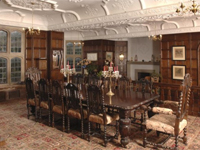
Blue Dining Room, Bantry House (Image: Malcolm Craik via flickr)

The house enjoys the slight deceit of looking as though it was built as a single phase when, in fact, it grew in three distinct phases. The original house was built in 1750 by the Hutchinson family, to create a house then called Blackrock, which was then enlarged by the first Richard White, a prosperous farmer, who bought the house in 1765 and renamed it Seafield.  It was enlarged in 1820 when the six-bay wing with bowed windows was added, providing two drawing rooms and extra bedrooms.  The house then grew again in 1845, probably to the designs of the second Earl, when it was remodelled with the addition of the two side wings. At this stage, the look of the house was unified with the grand full height red-brick pilasters topped with Corinthian capitals encircling the house with varying frequency, along with a neat balustrade around the roof.  Inside, of particular note is the vivid blue dining room which features life-sized portraits of George III and Queen Charlotte by Allan Ramsay which were given by the King in gratitude for White’s help against the French in 1797.

Main entrance, Bantry House, Ireland (Image: Smeets Paul via flickr)

As with the UK, country houses in Ireland have suffered many grievous losses. Many fell victim to broken fortunes, particularly relating to losses in agriculture, on which much of the wealth was based, especially following the Potato Famine in the mid-19th-century.  Much of Ireland, at that time, was owned by absentee British landowners who rarely visited, but for those who did live there they were determined that their houses would be as grand as those in the rest of Europe.  Great fortunes were poured into ever greater buildings – larger, more lavish, decorated in beautiful, full flourish rococo plasterwork, and filled with fine works of art.  This meant that when times became harder, the size of the houses worked against the owners, draining their diminishing coffers.  Fire has robbed Ireland of a tragic roll call of houses; including the accidental gutting of places such as Powerscourt (though now restored as a hotel), but the greatest losses were the 275 which were deliberately burnt down or blown up in the Troubles between 1920-23. Today, Ireland is littered with hundreds of these sad ruins, reminders of their former grand lives.

In this context of such great architectural achievements combined with such devastating losses, Bantry House is truly remarkable in that it is still lived in by the family who built it, surrounded by many items bought for the house.  However, running a house such as this is a constant struggle without wealth and the family have accumulated debts of nearly €1m, partially as a result of restoring and converting the wings to function as B&B accommodation.  Bantry House is, in many ways, an insight into the situation faced by many families around the turn of the 19th-century as unfavourable events left them with mounting debts, falling finances, and expensive running costs. These circumstances conspired to create a situation which all too easily ended in a grand country house contents sale before the house itself passed from a reluctant last generation.  One can only hope that Simon Davis can find the right solutions to enable the Shelswell-White family to remain in the house and pass it on to future generations.

—————————————————————————

Official website: ‘Bantry House

Official blog: ‘Bantry House

Country House Rescue – Series 4 [Channel 4]

Related information: British & Irish Stately Homes – for sale and on screen


Country House Rescue – Season 4: Chapel Cleeve Manor, Somerset

Chapel Cleeve Manor, Somerset (Image: Webbers)

Many have bought things on a whim; it’s quite something for that thing to be a huge country house which once played host to royalty and celebrity.  When plans don’t work out and problems mount, it can be understandable for a family with generations of emotional attachment to a house to doggedly carry on, but the owner of Chapel Cleeve Manor in Somerset, who features in this weeks ‘Country House Rescue‘ (Thursday 21 June, 20:00, Channel 4), displays a rare level of stoicism.

Chapel Cleeve would be a fascinating house even if it wasn’t on television, but sadly its decline is all to familiar.  The origins of the house lie as a medieval inn for pilgrims visiting the now lost St Mary’s Chapel and travelling to the Cistercian abbey at Cleeve, which owned much of the land in the area until it was surrendered to the Crown in 1536.  The estates then passed to the Earls of Sussex in 1538 who held it until 1602, after which it passed through a number of owners, including Lord Foley of Kidderminster in the early 1700s.

When the new house was built, the remains of the inn, dating from 1423, were then incorporated as part of the north-west wing of the house as it is today.  The house, built between 1818-1823, was designed by Richard Carver (b. c1792 – d.1862) whom Colvin believes to be the ‘R. Carver’, a pupil of Sir Jeffry Wyatville who submitted work for display in The Royal Academy in 1811 and 1812, before establishing his practice in Somerset and eventually rising to be County Surveyor.  Best known for his many churches, Colvin is critical saying “…though occasionally showing some originality in plan (e.g. Theale, and the octagonal Blackford), are poorly detailed, and were despised by serious Gothic Revivalists.” He was damned by the Ecclesiologist in 1844 as having “…proved himself entirely ignorant of the principles of Ecclesiastical Architecture.” He may have been grateful that his Tudor Gothic design for Chapel Cleeve Manor was outside their remit and so escaped their ire.

Dining Room - Chapel Cleeve Manor, Somerset (Image: Webbers)
Dining Room – Chapel Cleeve Manor, Somerset (Image: Webbers)

Just under a century after Carver finished, the house was enjoying what was to prove to be its heyday.   Bought by the Lysaght family, wealthy from their corrugated-steel business, the original five bay house, featuring a central octagonal entrance hall with a top-lit staircase, was extended between 1913-14 with a sympathetic addition which increased the size of the house to over 27,000 sq ft, with salons, a ballroom and a 100-ft long gallery. Of particular note are the high-quality interior plasterwork ceilings which were created by one of the leading Arts-and-Crafts sculptors; George Percy Bankart. Staffed by 50 servants, the house played host to the young Princesses Elizabeth and Margaret, and with Fred Perry staying for tennis parties.

The death in 1951 of G.S. Lysaght triggering punitive death duties which forced the sale of the house and, worse, the sale of parts of the grounds as building plots.  The dense woodland which had thus far shielded the manor was now largely obliterated with housing claustrophobically creeping up on three sides. Perhaps the expectation was that the house would not survive and further housing could be built, but the house then enjoyed a resurgence when it became a hotel in the 1960s and 70s, becoming the place to be in the area. However, when that business closed, the rot, both metaphorically and physically, set in, so that when it was bought by the current owner for 14 years of Chapel Cleeve, Jeannie Wilkins, in 1998 ‘there was not one habitable room‘.

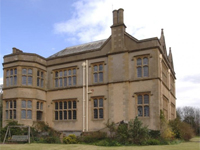
Chapel Cleeve Manor, Somerset (Image: Webbers)

Having spent £360,000 purchasing the property with her partner and with the help of two skilled friends, they started the mammoth task of restoring the house.  Correctly starting with the roof, it took two years to complete the task of making it watertight, with the restoration of the Edwardian wing taking many of the subsequent years.  The restoration was to a high standard, with care being taken to reinstate the many various mouldings and panelling, with the overall intention being to create six flats in the house, five of which could then be let – but, as with all the best laid plans, it went awry.

The inevitable challenges of finding an agreeable path through the stringent planning rules governing this Grade-II* listed house caused delays, and, sadly, Ms Wilkins relationship ended, following which she bought out her ex-partner, leaving her in sole charge of a vast partially-restored mansion with its 150-ft façade and spectacular views over the nearby hills.  With an income of just £5,000 per year from renting out a cottage in the grounds she faces a huge backlog of repairs (only 18 rooms are habitable out of 45 in total) and the costs of restoring it, which she estimates at around £500,000 (so, at least £750,000 – as anyone who has watched Grand Designs will know!).

Chapel Cleeve was offered for sale in early 2010 at £1.695m (and featured in a post at the time: ‘The start of the rush? Country houses for sale in the Sunday Times Home section‘), but it is still available. The combination of the restoration challenges, general economic climate and the severely compromised situation of the house – reduced to just 7-acres surrounded by a drab housing estate – have driven Ms Wilkins to call for the help of Simon Davis and ‘Country House Rescue’ to inject some new ideas – which he does, though none are the financial miracle she may have been hoping for.

In many ways, Ms Wilkins’ commitment to the house has to be admired – her dedication has almost certainly saved it from joining the sad, long list of lost houses.  However, it might be argued that her unwillingness to drop the asking price (especially considering the cost of the works outstanding) is also again putting the house at risk. A house of this size would ideally have much larger grounds to provide seclusion and planners ought to insist on a minimum 500-metre ‘green-belt’ around each house which would help protect their long-term viability. Undoubtedly Jeannie Wilkins deserves a just reward for the incredible work she has put in, but a quick sale at a reasonable price would certainly not only be best for her, but also for the long-term future of the house.

——————————————————————————

Sales details: ‘Chapel Cleeve Manor‘ [Fine & Country]

Official website: ‘Chapel Cleeve Manor

Listing description: ‘Chapel Cleeve Manor‘ [British Listed Buildings]

News articles:

Country House Rescue – Series 4 [Channel 4]

Country House Rescue – Season 4: Colebrooke Park, N. Ireland

Colebrooke Park, Co. Fermanagh, Northern Ireland (Image: Colebrooke Park)

Country House Rescue has proved to be one of the most interesting of programmes featuring the many varied mansions which the UK is lucky to enjoy.  Rather than the more glamorous recent series showing life at Chatsworth, or Jeremy Musson’s brilliant ‘Curious House Guest‘, Country House Rescue has shown the sometimes harsh reality of owning these homes, despite the lazy jibes in the wider media about families living in a state of supposed luxury.  The programmes have shown the hard work and sense of duty these families possess, though this is sometimes overshadowed by the friction which change can bring, and which is often what is broadcast.  Yet, with a new presenter for the new series (starting Thursday 14 June), perhaps the commitment of the owners and the sheer beauty of their houses will come more to the fore.

In the first three series, Ruth Watson has proved to be an entertaining, if no-nonsense, deliverer of some rather stark home truths to owners up and down the country. For series four, a new presenter, Simon Davis, (favourite houses: Sezincote, Blenheim, Mount Stuart, Villa Emo, Babington House) takes the helm and steers a more collaborative and involved course as he stays at the houses, with the families, to experience their day-to-day life, including the hardships; at one house he spent an extremely cold night after the family admitted they never turn on the heating as it costs £30 per hour to run. It will be interesting to see how the new messenger is received and whether a less assertive style will bring greater success – though many will undoubtedly miss Ruth’s acerbic commentary.

The houses to feature in the new series are now known: Colebrooke Park, Bantry House, Chapel Cleeve Manor, Craufurdland Castle, Great Fulford, Meldon Park (thank you Andrew); starting with Colebrooke Park in Co. Fermanagh in Northern Ireland; the first time the show has been to that part of the UK.

Colebrooke Park is a fascinating example of the varied fortunes of the country house over the last two centuries; a story marked by wealth and also decline, but also one driven by a continued commitment to a house by generations of one family. Home to the Brooke family for over 350 years, the current owner, the 3rd Viscount Brookeborough (a prominent peer, one of the 92 hereditaries sitting in the House of Lords) received what many would regard as an unenviable inheritance in 1980 when he took on the decaying and empty family seat.

Of course, as with many houses, they had had a heyday.  Once the centre of one of the five largest estates in the area, which had reached a peak of almost 28,000-acres in 1876, the house had been home to a succession of prominent politicians and soldiers including the 1st Viscount, the longest serving Prime Minister of Northern Ireland (1943-63). However, agricultural changes, taxation, and the Troubles, meant that the estate slowly shrank to just over a thousand acres, with a similarly reduced income insufficient to maintain a house of this size.

Castle Coole, Northern Ireland (Image: Stephen McKay / Geograph.ie)

The house itself is a rather austere neo-Classical design; a two-storey, nine-bay block only enlivened by a grand pedimented portico with Ionic columns.  The house was built in 1820 for Henry Brooke (b.1770 – d.1834) who was created a baronet in 1822 (second creation), as a statement of his position, but one which was to be built on a budget – though a substantial one; the house was completed for £10,381 – approx £7m today.  Sir Henry had inherited the house and estate from a rather profligate uncle and clearing the debts and establishing a comfortable fortune had taken three decades – the house was a reward and a monument to his sound management.  Despite being a cautious man, Sir Henry still succumbed to the suggestions of his architect that he compete with the nearby Castle Coole by James Wyatt (built 1790-97), increasing the dimensions of the house so that it was larger, and then later in the summer, approving the enlargement of the Library to 36ft by 18ft.

Rise Hall, Yorkshire (Image: Pastscape)

For those who regularly watch TV programmes featuring country houses, Colebrooke Park may trigger a vague sense of deja vue.  This is because the house is, bar a few details, quite similar in design to Sarah Beeny’s Rise Hall in Yorkshire (mentioned in this previous blog post).  Both houses were built around the same time but by different architects; Colebrooke in 1820 by William Farrell and Rise Hall in 1815-20 by Watson and Pritchett.  Yet it is likely that this was more co-incidence than copying as there is a clear architectural lineage for the ‘rectangular block with portico’ style of house which goes back to Colen Campbell‘s masterpiece of architectural propaganda, Vitruvius Britannicus.  Published in 1715, this collection of designs helped shift the national preference away from the more florid Baroque houses of Vanbrugh toward a simpler architectural style; one which Campbell himself exemplified with his quite radical first design for Wanstead Hall, Essex. Although Wanstead as built was significantly different in the detailing, the core architectural idea was for a rectangular central block, fronted by a bold, pedimented portico.  This was to be one of the most influential designs produced by an architect; shaping national taste, it was widely imitated for decades afterwards – see Prior Park in Bath, built in the 1730s and 40s, and Adlington Hall, Cheshire, built in the 1750s, and even today.  Of course, this design is a derivative of the rectangular, double-pile plan developed by Sir Roger Pratt at Coleshill, Berkshire (built 1650-64, burnt down 1952).

Wanstead House I by Colen Campbell - first proposed design - 1715
Wanstead House I by Colen Campbell – first proposed design – 1715

Despite the grandeur, the agricultural depression in the 1880s hit the estate and the decline began. This was only arrested by the return in 1918 after WWI of Sir Basil Brooke who instituted changes to bring the estate back. It was, though, a struggle; many rooms were left unused in the 1930s and by 1939 the timber was being felled as ‘the only way to save Colebrooke’.  Poor tax planning meant that when Lord Brookeborough died in 1973 the contents of the house had to be sold to pay the death duties, leaving a rather forlorn house for the present Lord Brookeborough when he took over in 1980.  Realising the scale of the challenge, an architect was engaged to explore what options were available; including the dreaded conversion to a golf club with the grounds becoming fairways.

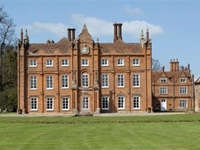
Colebrooke Park, Northern Ireland (Image: Colebrooke Park)

Luckily, a better solution was found; the house became an exclusive country sports destination, with sporting rights over 10,000-acres and the Viscount and Viscountess welcoming the guests as though friends into their home.  The house was sensitively adapted to meet both the requirements of discerning visitors and official regulations whilst preserving the architectural fabric of the house to the greatest extent.  Despite their success, the Viscount and his wife wish to pass on the house and 1,100-acre estate to their nephew in an even more robustly healthy condition; hence the invitation to Country House Rescue.   It will be fascinating to see if this series presents radically different ideas to those proposed by Ruth Watson.  Obviously one hopes that whatever happens, the solutions enable the families to remain in their homes whilst providing sufficient income to not only maintain them but invest in them to give them a stronger future.

—————————————————————

A more detailed history of Colebrooke Park [Colebrooke Park]

TV makeover for stately home‘ [Belfast Newsletter]

Country House Rescue – Series 4 [Channel 4] – Colebrooke Park (episode 1: Thursday 14 June – 20:00)

Country House Rescue – Series Listing [Wikipedia]

‘So you made the 2012 Sunday Times Rich List…’ – a selection of country houses for sale

Spring is upon us: the birds are singing, the flowers are blooming, the drizzle is almost incessant – *sigh*. One bright spot is each week’s increasingly heavy Country Life magazine; the extra weight from the greater number of property adverts which signal the launch of the late spring/early summer (hah!) country house sales push. Below is a round-up of some of the most interesting and beautiful properties currently for sale, all entirely and subjectively chosen by me.

Bletchingdon Park, Oxfordshire (Image: Knight Frank)

The most impressive house to be offered for sale this year so far has to be the beautiful Bletchingdon Park, Oxfordshire [Knight Frank]. One of the relatively few Palladian villas in the county, it can easily hold its own with the others such as Kirtlington Park (completed in 1746) and Nuneham Courtenay (built 1756).  Bletchingdon Park was slightly late to the Palladian party, being built in 1782 for Arthur Annesley, Viscount Valentia, to the designs of James Lewis (b. c1751 – d.1820).  Lewis was mostly employed as surveyor of various charitable hospitals in London and near counties but he also completed a clutch of excellent country houses including Eydon Hall, Hackthorn Hall, and Lavington Park (now Seaford College). Owned since 1993 by Dr Michael Peagram, a philanthropist and chemicals industrialist, the grade-II* house has been obviously well cared for and offers the highly desirable combination of an imposing facade, superb views, 127-acres and elegant interiors which includes a wonderful sweeping, top-lit staircase – if you have £20m.

Cockfield Hall, Suffolk (Image: Savills)

For those who prefer an alternative to the architectural austerity of Palladianism, then Suffolk offers a wealth of brick houses; statements just as bold, but in a different language. Cockfield Hall, Suffolk [£5m, 74-acres, Savills] has a grand façade, galleried great hall, a wealth of rich plasterwork ceilings, and a range of estate buildings in the same style.  Although mainly built in 1613, the windows were sashed c1770 and the overall look is largely due to later Victorian enhancements, including the upper storey, gables, the great hall and various Tudor motifs.  That said, it is undeniably attractive as the changes work well together.

Highfields Park, East Sussex (Image: Knight Frank)

There is often something just so elegant about Regency houses, particularly the smaller country villas which echoed the style and features of much larger and grander houses. Highfields Park, East Sussex,  [£5.75m, Knight Frank] is set in 191-acres, and overlooks its own lake and out to the countryside.  The house has grown as the ambitions and wealth of the owners allowed; a ballroom being added to the east and a swimming pool beyond that. Awkwardly, access to latter is through the former so just be careful not to schedule a pool party at the same time as your formal dances; though, on the upside, it will be easy to tell which guest is supposed to be at which party.

Ayton Castle, Scotland (Image: Knight Frank)

Previously offered for sale in May 2011 for £3m and now re-listed, Ayton Castle, Scotland [offers over £2.2m / Knight Frank] is a sprawling confection of Scots Baronial motifs; the design the work of two of the best architects working in Scotland at the time, now set in 159-acres.  The house was originally built in 1851 for William Mitchell-Innes who commissioned the talented James Gillespie Graham. Graham was known for his work in the Scots Baronial style which became so popular in the Victorian era, notably on the praise of Sir Walter Scott and the Queen’s remodelling of Balmoral.  Yet, Graham was a rare architect comfortable working in various styles; neo-classical at Blythswood House or semi-ecclesiastical Gothic at Cumbusnethan Priory (now tragically a ruined shell).  Ayton was later extended in 1860, with the addition of a billiard room and an enlarged drawing room by David Bryce.  Bryce, perhaps, more than any other architect, can be argued to be responsible for the legacy of Scots Baronial, if only through his prolific output of more than 230 buildings including many country houses such as Craigends (dem. 1971), Panmure House (dem. 1955), Torosay Castle and Dalmore House (burnt out 1969). Considering the tragic swathe cut through his work, it’s a shame that legacy wasn’t appreciated.

Honourable Mentions

There are, of course, many other good houses featured in Country Life but some would not be regarded as the seat of an estate – but they are still wonderful country houses; albeit ones with very large gardens and worth a mention.  A couple here are proper country seats but just haven’t made it to the list above:

Bradwell Lodge, Essex (Image: Matthew Beckett) - for sale: £2.25m through Jackson-Stops & Staff
Bradwell Lodge, Essex (Image: Matthew Beckett) – for sale: £2.25m through Jackson-Stops & Staff

Bradwell Lodge, Essex – a house of contrasts and a mixture of architecture; a Tudor core, latter additions by Robert Adam, Robert Smirke the elder, and Quinlan Terry, with decoration by Angelica Kauffman. The library/small dining room in the projecting bay on the ground floor is particularly elegant with twisted-wire screens to the bookcases. Grade-II*, 26-acres, £2.25m [Jackson-Stops & Staff]

Broadwell Manor, Gloucestershire – grade-II*, 35-acres, excess £8m [Knight Frank]

Burnham Westgate Hall, Norfolk – a fascinating early house by Sir John Soane which has previously featured on this blog (‘For sale: a Soanian springboard‘). Grade-II*, 38-acres, £6.5m (down from £7m) [Knight Frank]

Glansevern Hall, Powys – an apparently unique property in that it is the only complete house designed and build by the architect Joseph Bromfield and which also features some impressive gardens. Grade-II*, 80-acres, £4.5m [Balfours]

Rainthorpe Hall, Norfolk – grade-I, 18.7-acres, excess £2.95m [Strutt & Parker]

Roundhill Manor, Somerset – grade-II, 280-acres, £6m [Savills]

—————————————————————————

For other updates on country houses for sale do sign up for the excellent British and Irish Stately Homes blog, which is written by Andrew Triggs who frequently contributes comments on this blog.

‘On behalf of a grateful nation’: country houses given to military leaders

Nations have always found ways to reward those subjects who have rendered some greater or lesser service.  In earlier centuries, this often took the form of positions at Court which came with a salary, prestige, and unrivalled opportunities to feather one’s nest.  Titles have also always been popular, ranging from a baronetcy for those who have hosted the monarch for a weekend, to dukedoms and earldoms for the upper echelons of Court and on the battlefield – and it’s this latter category who have also enjoyed that rare gift of an entire country estate, in recognition of their services.  Such largesse is now unthinkable but the practice of rewarding military leaders in this way only fell from favour perhaps later than might be imagined.

Blenheim Palace, Oxfordshire (Image: Blenheim Palace via flickr)

The grandest and most spectacular of these gifts is Blenheim Palace in Oxfordshire – though the intrigues for both monarch, recipient, recipient’s wife, and architect make it something of a mixed blessing.  The recipient was certainly worthy of such a grand prize; John Churchill, 1st Duke of Marlborough had risen through numerous victories to elevate and secure Britain’s place in the world, defeated the ambitions of various European leaders, and created the peace which ushered in the Georgian era.  These glorious victories provoked such a feeling of patriotic pride that even his critics praised him.  So how to reward such a man for such remarkable achievements?

Great Hall and Eastern Corridor, Blenheim Palace (Image: Country Life Picture Library)

Blenheim Palace was to represent many things – explicitly a national monument to the defeat of Louis XIV’s plans for European domination at the Battle of Blindheim in 1704, the considerations of it as a house were somewhat secondary. It embodied the idea that whereas previously the glory of the nation was demonstrated through the palaces of the Monarchy, Blenheim was the first which sought to do this though a private individual.  However, Marlborough’s close ties with Queen Anne would inevitably mean the prestige would reflect onto her and the nation. Work started in 1705 and, writing in 1709, the architect of the house, Sir John Vanbrugh stated,

‘Tho’ ordered to be a Dwelling house for the Duke of Marlborough and his posterity [it was] at the same time by all the world esteemed and looked on as a publick edifice, raised for a Monument of the Queen’s glory.’

The Queen had already resolved to gift the estate at Woodstock but the agreement on paying for the construction of the house was a murkier affair.  Royal patronage could cut both ways as the Marlboroughs and Vanbrugh found out.

Vanbrugh was the ideal choice for a building of this nature.  His background in theatre design gave him an understanding of dramatic effect and his relative inexperience and lack of formal training meant his imagination was bolder than others.  The commission at Blenheim required such a mind; the resulting spectacular building was a monument to power and prestige, incorporating military forms and details to reflect the occasion, but was also one of the most complete expressions of English Baroque.  Yet despite his fabulous wealth, the Duke was determined that the state would show its gratitude by paying for the construction, though he had originally intended the budget to be no more than £40,000 (approx £5m).  Wren had estimated £90,000 – £100,000, however the final cost totalled nearly £300,000 (approx £38m) for which the Treasury eventually was liable (proving that for government projects it was ever thus!).

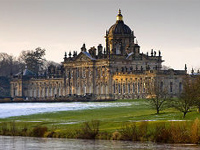
Castle Howard, Yorkshire (Image: Castle Howard)

Such overruns were to be expected where the intention had been to build something like Castle Howard – only bigger. However, the Duchess opposed such a scheme saying: ‘I never liked any building so much for the show and vanity, as for its usefulness and convenience.‘ With such an attitude, friction with Vanbrugh was inevitable. Political changes hadn’t helped; a new government and Treasurer in 1710 slowed payments to almost nothing.  In 1711, the Duchess also fell out quite acrimoniously with her childhood friend, the Queen, leading, in part, to the Duke losing his official posts and the Marlborough’s going into self-imposed exile.  The accession of George I in 1714 brought them back into favour and work progressed again, though constant conflict between the Duchess and Vanbrugh led to his resignation in November 1716, saying: “You have your end Madam, for I will never trouble you more.  Unless the Duke of Marlborough recovers so far [he had suffered a stroke in 1716], to shelter me from such intolerable Treatment.‘ Work proceeded under Vanbrugh’s right-hand man, Nicholas Hawksmoor, to the original plans, with the family taking up residence in 1719, and work largely complete by 1725. Sadly though, the Duke never got to see this, having died in 1722; his monument incomplete, his reputation assailed, and his architect grievously estranged from his masterpiece.

It seems only some of the lessons of Blenheim had been remembered by the time the next gift was proposed for an equally illustrious general, Arthur Wellesley, 1st Duke of Wellington.  Again, a superb leader who had defeated plans for European domination, Wellington – the Iron Duke – was certainly worthy of such a reward. Rather than receiving a direct gift from the monarch, it was decided that the nation would provide £600,000 (approx £38m) for the purchase of an estate and the building of a suitable house. Rather than just provide the money, in 1817, Parliamentary trustees were appointed to oversee the purchase.  The Duke knew his limitations and called upon the architect Benjamin Dean Wyatt (son of James Wyatt) who promptly, even before a site had been found, drew up plans for a ‘Waterloo Palace’ which, in his words, would have “…a very magnificent & imposing effect” without “the monstrous expense of a Fabrick extended to the dimensions of Blenheim [or] Castle Howard“.  Despite his professed aim, this would have been an enormous house; designed around three sides of a courtyard, it featured two flanking pavilions, with the main house centred on a huge domed hall, with suites of grand rooms surrounding it.  Perhaps of particular interest was the severely Neo-Classical decoration, with few of the architectural flourishes which distinguish Blenheim.  This might have reflected the notably austere Duke’s taste but even this plan was rejected.

Stratfield Saye, Hampshire (Image: Historic Houses Association)

Given the Duke’s preference to be near London, the house and estate chosen was Stratfield Saye in Hampshire, after rejecting Uppark in Sussex due to the poor land, and was bought from the Pitt family for £263,000; a significant portion of the funds available. Though this may have been a factor in the eventual rejection of the plans in 1817, another was that the Duke was in the process of spending £40,000 anonymously purchasing Apsley House in London, for the use of his almost bankrupt brother who had previously lived there with his soon-to-be-ex wife.  That house also required significant work and, faced with the need to maintain two houses, the Duke abandoned the plans for the new palace, and concentrated on updating and modernising the existing house at Stratfield Saye.  Both houses are still lived in by the Wellesley family, though Apsley is now part-owned by English Heritage and open to the public – and absolutely worth a visit if in London.

Bemersyde House, Scotland (Image: Kevin Rae / Geograph)

We may think the practice of the nation buying a country seat for a military leader was the product of the more deferential Georgian and Victorian eras when such actions by government would be less subject to widespread scrutiny, but the latest example occurred in the 1920s.   Field Marshal Douglas Haig, 1st Earl Haig, was a controversial figure as commander of British forces in WWI. Although he won, the horrendous loss of life left him with battered reputation which has only recently been revised. In the immediate aftermath of WWI, we, the victors, did feel grateful and Haig was created the 1st Earl Haig (with a subsidiary viscountcy and a subsidiary barony), given the thanks of both Houses of Parliament, plus £100,000 (though he had asked for £250,000) to enable him to live in the manner befitting a senior peer.  Haig chose Bemersyde House in the Scottish Borders, originally built in 1535 as a pele tower, to become, as it still is, the seat of the Haig family, the purchase funded by the grateful taxpayer.

Cefntilla Court, Monmouthshire (Image: Knight Frank)

It wasn’t only the ultimate leaders who could benefit from public largesse, though in the case of Cefntilla Court, Wales, the gift missed the mark by a generation.  Field Marshal FitzRoy James Henry Somerset, 1st Baron Raglan, was the Duke of Wellington’s right-hand man who was later blamed (then exonerated) for the huge losses resulting from the ill-fated Charge of the Light Brigade in the Crimean War.  Lord Raglan’s health suffered from the stress of the campaign and he died whilst on duty in June 1855.  However, such was the admiration for the man that a ‘Raglan Memorial Committee’ was formed and by 1858 was able to present Cefntilla Court, as commemorated by a plaque at the house which reads:

This house with 238 acres of land was purchased by 1623 of the friends, admirers and comrades in arms of the late Field Marshal Lord Raglan GCB and presented by them to his son and his heirs for ever in a lasting memorial of affectionate regard and respect.

Sadly, it seems that ‘for ever’ is a shorter time than they imagined as the house and estate are now for sale following a strange inheritance whereby the 5th Lord Raglan wrote his younger brother, now the 6th Lord Raglan, and the brother’s son, out of his will.  The house was instead left to another nephew, Henry van Moyland, who currently lives in Los Angeles and works as a recruitment consultant. With no deep ties to the estate, he has chosen to sell, splitting the title and estate for the first time since the gift was bestowed.  Legally, there is nothing to be done but it does seem regrettable that the whim of one Lord Raglan should lead to such an outcome, especially as it was the express intention of the donors that it should remain in the family.

That said, it is remarkable that three out of the four houses featured here are still owned by the families who were given them – a continuous link to the thanks of the nation as expressed through architecture and prestige. Though it may not happen now, or again in the future, such gifts are another part of the rich tapestry of our country house history.

——————————————————————–

Sales particulars: ‘Cefntilla Court‘ [£2m, 350-acres – Knight Frank]

More details: ‘The disinheritance of Lord Raglan’s nephew and future title holder causes split in family‘ [Wales Online]